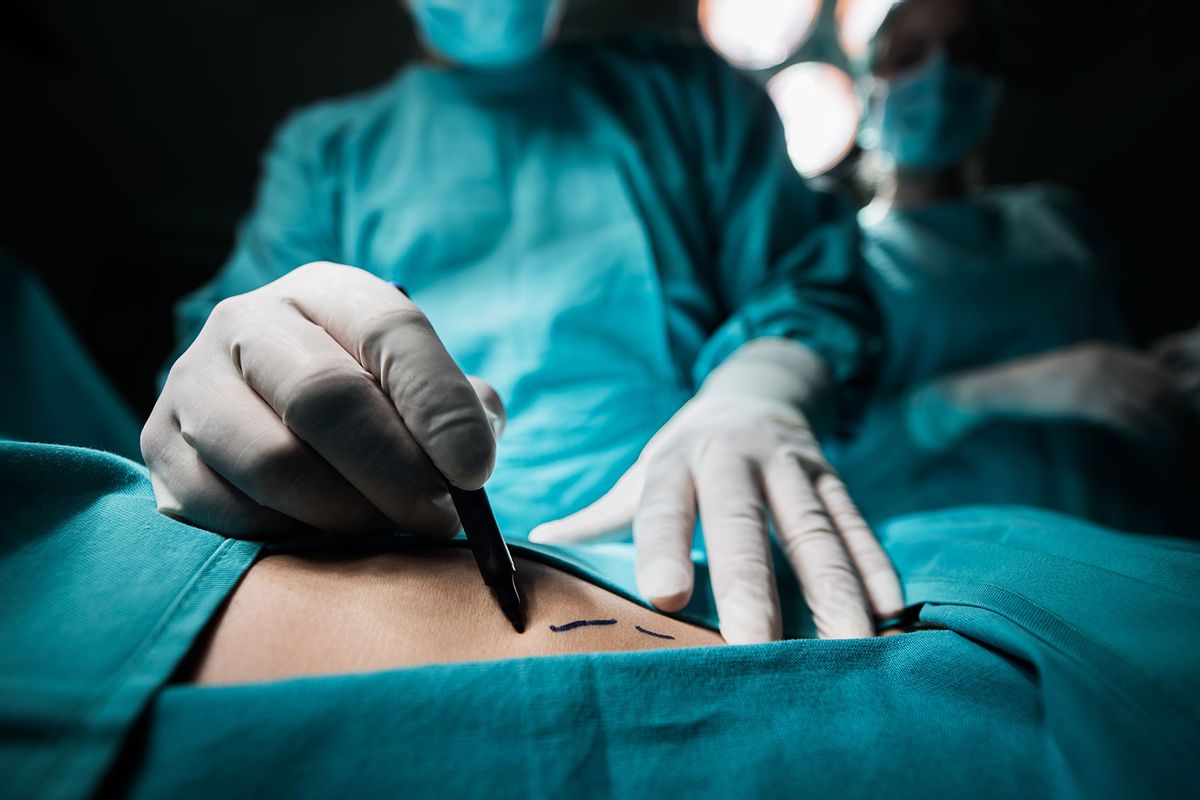
My dad used to be a god.
Every day at 5 a.m. he drove downtown to his county Pantheon. There he scrubbed up with the other gods before he took patients for swims in the River Styx. When the surgeon gods finished, he'd carry the patients' languid bodies back to the sunlight. Only able to see the sutures, they hugged the surgeons, never knowing that my dad was the one who'd been their keeper. If that ever bothered him, he never said so.
When you go under general anesthesia, the anesthesiologist suspends you between life and death.
My dad used to be an anesthesiologist — the guy who puts you to sleep. Maybe he wasn't a god, but he was the doctor who made sure you woke up. When a patient goes under general anesthesia, "slumber" is a nice way to put it. When you sleep, you can breathe without a respirator. You can detect when you need more oxygen, and react on your own. You can even wake up on your own.
Not when you go under.
When you go under general anesthesia, the anesthesiologist suspends you between life and death. This may seem a little dramatic, especially since you may only meet these doctors once before surgery, when they come to check your chart, and then again when you're in the O.R. and the last words you hear are "take long deep breaths." Perhaps if "ER" were called "OR," they'd get more P.R. Dr. John Neeld, an Atlanta anesthesiologist and president of the American Society of Anesthesiologists, likened anesthesia to the work of commercial air pilots, where "99 percent of the work is routine -- then every now and then it's terror."
When I asked my father if he ever felt terror, he said that profound apprehension was just part of the job: "With every patient, no matter how healthy or sick, you always think bad things can happen. It's because of the unknown."
Anesthesiologists are there to ensure optimum operating conditions no matter how many unknowns there are. And they must do so for both patient and surgeon. Sometimes a local or regional block will do the trick; only part of the body is anesthetized and the patient doesn't need to be unconscious. But for more serious or complicated procedures, when there's no other choice than general anesthesia. the anesthesiologist must do much to keep both you and the surgeons comfortable.
But anesthesiologists get paid their big bucks for what they do once you're under: They make sure you don't die.
At first he'll give you a sedative just to relax you. Once you're in the O.R. and surgery is about to start, the anesthesiologist will give you drugs that facilitate both amnesia and pain-relief. He also administers muscle relaxants to induce paralysis, so the surgeons can do their intricate repairs without fear of limbs moving. To get the general anesthesia started you are given an anesthetic agent -- like sodium pentothal -- intravenously. (This is what used to be known as "truth serum" but has never been proven to have that special power.) Then the anesthesiologist add inhalation agents like nitrous oxide and Forane to keep you under. And to relieve your anxiety, you're given sedatives like Versed or Valium.
But anesthesiologists get paid their big bucks for what they do once you're under: They make sure you don't die. They connect you to monitors that track your heart rate, blood pressure, oxygen saturation of the blood and carbon dioxide output. (And they know how to fix those machines if one goes kaput mid-surgery.) And they control your airway; they make sure your tongue, once relaxed, doesn't block your throat. A clear airway can be tricky to maintain during trauma cases when blood from mouth injuries or regurgitated stomach contents threaten to drip down the trachea. Then you're usually intubated -- yes, that scene they have on every episode of "ER" when they stick the plastic tube down the throat and there's always some anxiety about being "in." This is because if they accidentally stick it down your esophagus, oxygen pumped to your stomach isn't going to reach your lungs. Once successfully intubated, you're connected to a respirator.
Why do you need a machine to breathe for you, especially for a relatively simple procedure? The drugs used to keep you ignorant and numb are incredibly potent and tend to depress the respiratory system. If our body senses we aren't getting enough oxygen, we take quicker breaths. But some drugs alter that system, and the body is unable to respond to insufficient oxygen levels. And sometimes the surgery itself calls for paralysis of the diaphragm. If the procedure takes place nearby, the muscle will never relax enough on its own not to be a threat to the procedure. The anesthesiologist will use a neuromuscular blocking agent to keep the diaphragm relaxed. So, once you're under the general anesthetic, if for some reason the respirator malfunctions or the oxygen tank runs low and nobody notices, it's a problem.
Want more health and science stories in your inbox? Subscribe to Salon's weekly newsletter The Vulgar Scientist.
When it comes to oxygen intake, there's little room for error -- it only takes five minutes before your brain will die, though other organs can go a little longer without oxygen. So if you're entering hour five of a seven-hour surgery, and the surgeon is engrossed in his cutting and sewing, and the nurses are busy sucking up blood, and the anesthesiologist is distracted, it's easy to see how five minutes could slip away before someone notices that the oxygen tank has run low or the respirator has malfunctioned. Luckily, the monitoring technology is now so highly developed that these "oops" scenarios are exceedingly rare.
Dr. Keith Ruskin, a professor of anesthesiology at the Yale University School of Medicine, attributes the dramatic improvements of anesthesia safety over the last few years to the increasing sophistication of monitors. Two monitors found in every American operating room are the pulse oximeter, which measures oxygen levels in the blood, and the capnogram, which measures carbon dioxide output. During surgery, if either machine becomes incapacitated or measures a considerable drop in output, it emits piercing beeps that I've been assured are impossible to ignore. It's getting harder and harder to die accidentally on the table.
Patients may fear death, but an equally strong anxiety is waking up mid-surgery. Current research shows that only two out of every 1,000 general anesthesia patients experience any consciousness during their operation. That could just mean they retained some memory of the doctors' conversation -- not that they necessarily felt or remembered pain. And the number of general anesthesia patients who develop any psychological problems because of their experience -- such as insomnia, nightmares or anxiety -- is about two out of every 100,000. (According to Ruskin, those numbers can be misleading because they group the young and healthy. who generally have minimal complications, with the gravely ill, whose medical states preclude the anesthesiologist from using the amnesia-inducing drugs.)
Heavy sedation by itself does not guarantee amnesia; a patient may still have recall.
For most patients, general anesthesia is just an in-and-out experience. "It was like being there, then not being there," recalls Bob Jenkins, a 45-year-old engineer who had his appendix removed. "Really, it was just like being asleep." Gloria Nixon-John, 53, a Detroit-area teacher, found her general anesthesia experiences to be smooth, except for the nausea she felt afterwards. For one surgery she even asked her anesthesiologist to go lightly on the anesthetics, because she didn't want to be "out of control" completely. Now she remembers her doctors "talking and joking around." But she found the levity to be comforting. Also comforting are her memories of the music they played in the O.R., including Simon and Garfunkel's "Bridge Over Troubled Water." She says she finds herself humming the song whenever she feels "threatened," as if feeling a reassuring connection to her body's previous trial and triumph. Not all recall or awareness has to be traumatic.
The problem with awareness reports is that they often have more to do with a patient's misunderstanding than a doctor's miscalculation. Sometimes patients think they've been fully knocked out when they've only been heavily sedated. Dr. Becky Welch, an Orlando, Fla., anesthesiologist, says heavy sedation by itself does not guarantee amnesia; a patient may still have recall. But if the patient's doctor never explains the difference between heavy sedation and general anesthesia, the patient may have a memory he mistakenly thinks is from his time under general anesthesia.
With all of the potential emergencies anesthesiologists have to be prepared for, is theirs the most difficult job in the O.R.? No doctor I spoke with would go so far. But all agreed it's stressful. "But a different kind of stressful," says Ruskin. "The problem is that most of the time, everything goes fine, [but] when something goes wrong, it usually goes very wrong, very quickly."
For Welch, that terror can come when patients don't answer all their doctor's questions. "The biggest problem will arise [when patients are not] thorough in revealing their medical history." She says the use of illicit drugs can have a "devastating effect during anesthesia" and that doctors need to know beforehand so they can be prepared.
The unknown struck for Welch during a relatively routine case. Recently she cared for a woman in her 30s, perfectly healthy except for the back rods she needed to correct her scoliosis. About two-thirds of the way through the operation, "she began to bleed profusely quite suddenly to the point that it was extremely difficult to replace the blood loss." Soon she was without blood pressure or pulse, and required CPR with cardiac shock. It took a team of several nurses and other anesthesiologists to finally stabilize her. When asked what she thought about during the crisis, Welch said: "I kept thinking about her young children that may never see their mother again." They never did learn why the bleeding began. Afterwards, when she saw the patient leave the hospital, she marveled at how "someone who had been so close to death could leave ... in such wonderful condition, as if nothing but a routine surgery had taken place." Doctors try not to worry patients with worst-case scenarios, but shepherding them back from death's door is often part of their job description.
For all those who worry about not waking up again, the good news is in the numbers. In 1970, the mortality rate was one in 10,000, but now it's one in 250,000. However, for procedures done in an office (like most plastic surgery), and not a hospital operating room, the mortality rate is one in 5,000. Neeld, of the American Society of Anesthesiologists, attributes this number to increasingly invasive procedures, like liposuction, done without the benefit of an anesthesiologist present. In these cases it is usually the surgeon giving the sedation, and "no one is paying attention" enough to the patient's breathing and vital signs, or the surgeon has administered inexpert combinations of anesthetics and painkillers. Except in California and New Jersey, office surgeries go virtually unregulated. (In August, a Boyton Beach, Fla., widow settled for more than $1 million over the death of her 51 year-old husband, who died after nine hours of cosmetic surgery; the medical examiner's office determined the likely cause of his death to be a clumsy mix of anesthetics coupled with a critical shortage of oxygen.)
Often misunderstood, usually under-appreciated, the anesthesiologist doesn't always get the "thank you" hugs reserved for the surgeon. I asked my father what he thought of my deity language. His frowning response: "No anesthesiologist I worked with ever thought of themselves as a god." Then he said, "It's a myth propagated by the laity." So in my best devil's advocate voice I responded, "What about surgeons?" His diplomatic skills gleamed as he paused, contemplated, then replied: "Well ... everyone needs a certain level of confidence to do their job well."
Shares