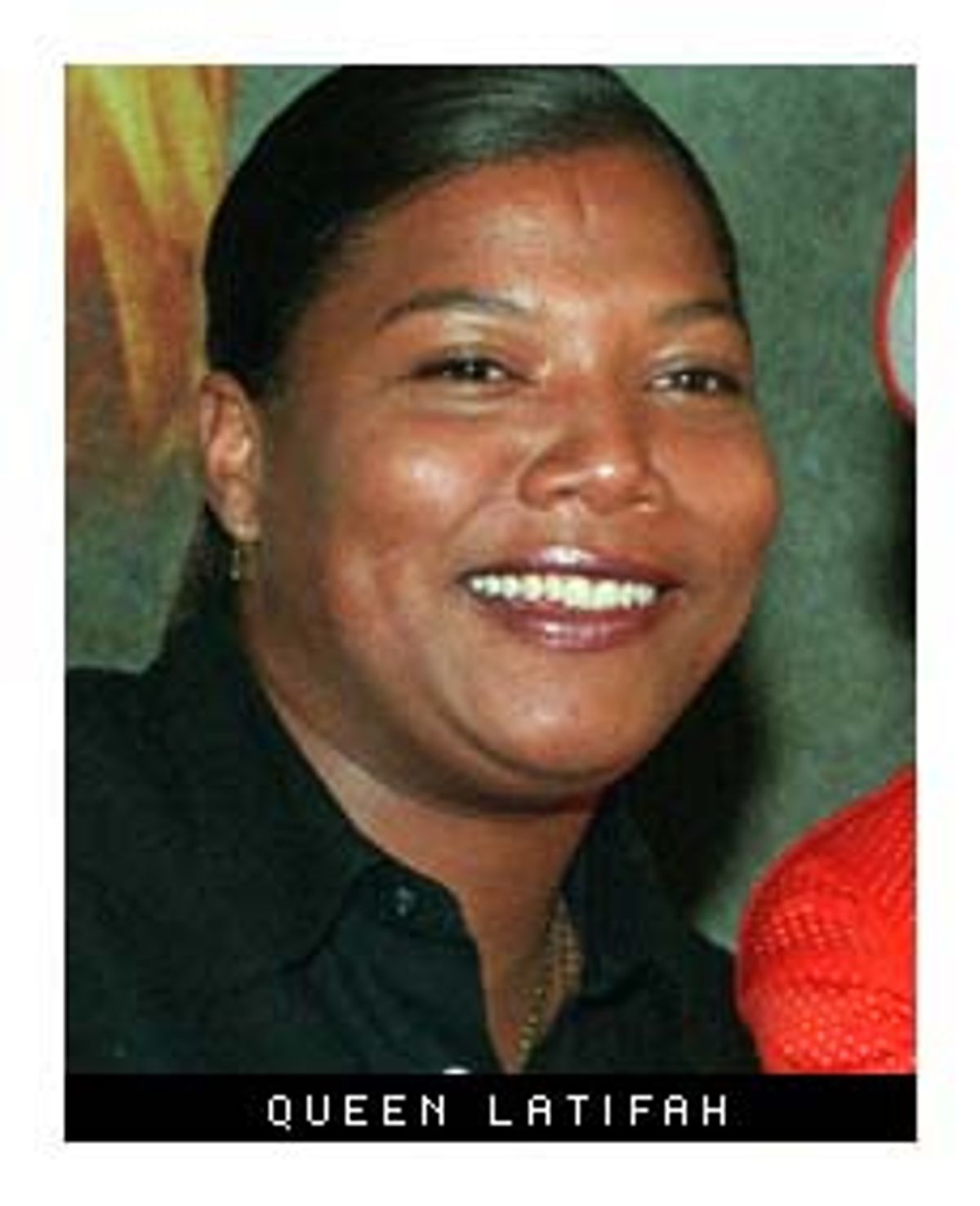
The news has not been good for TV talk shows of late. Jerry Springer has been emasculated, no longer allowed to feature fistfights on his former daily brawl-fest. Jenny Jones has lost face over the murder of Scott Amedure, a guest who confessed his gay crush on a friend and was subsequently shot by the man. Montel has just announced he suffers from multiple sclerosis. And now, there's Queen Latifah, rap artist, actress, and talk show hostess extraordinaire (at least that's what her producers at Time Telepictures, a division of Time Warner, hope.) The new talker premieres Sept. 20 but, as I said, the news isn't good.
Having worked in television over the last dozen years, I've seen my share of the bizarre and the distasteful. But never have I seen anything like what I experienced this past summer, spending one full month in pre-production for the Queen Latifah show.
I admit I went in with a bit of a chip on my shoulder. After all, who wants to be in the same scuzzy profession as Jerry Springer? After producing documentaries for such esteemed cable outlets as A&E and Court TV (well, at least they're better than "My father is a transvestite hooker!"), it was a major step down. But the money was good.
I was to run the field department for the show, supervising a team of two field producers, an associate producer and a cameraman. The upper tier of producers had lofty goals for Queen Latifah. They didn't want it to be "just" a talk show. They wanted pieces, important pieces, that set up the one-hour, single-subject episodes in a compelling, meaningful manner -- all in one minute or less.
Week 1: As a newcomer to the airwaves, Latifah was an unknown quantity, and nothing scares a publicist more than booking a big-name client on a loser show. The upshot? No one wanted to stick their neck out, so it was time to start calling in the favors from B-list actors and FOLs (Friends of Latifah): Brooke Shields, Carmen Electra, Donna D'Erico. Slim pickings.
My staff's first assignment was to produce a short intro for the episode featuring Vivica A. Fox, who played Will Smith's wife in "Independence Day." Even the powers-that-be knew better than to book a full hour with Vivica Fox talking about, well, Vivica Fox. What to do? Well, they knew she was a newlywed, so they decided to broaden the hour into a themed show titled "Surviving the First Year of Marriage." Our mission: find a bunch of couples who'd been married less than a year; find a couple that had written a "how-to" guide about making it to the first anniversary; set up a surprise walk-on with Fox's husband, Sixx Nine; and -- voila! -- a show about surviving the first year of marriage. Our piece was to set up the hour.
The treatment was approved by the supervising producer -- in a room full of other producers -- and we were off. I sent a member of my staff out to do all the interviews, and though I was pleased with the results, the supervising producer was not. He insisted on sending my producer back out, but not before telling us exactly how he wanted the questions worded. He also told me that our sound bites were to be no longer than five seconds. "Do you realize how much a person can say in five seconds? Not a whole lot," I warned him. He didn't care. Five seconds.
Then there was the matter of the pictures. We were told it was too expensive to get photos of "dead" Hollywood couples like Madonna and Sean Penn or Bruce Willis and Demi Moore, so we sent out an inner-office memo: anyone who's married and OK having their wedding photos seen on national television, fork 'em over.
We had our photos. We had our interviews. We were ready for the edit room. But unbeknown to us, it was only at that moment that the show's executive producer, Cathy Chermol, learned about this segment. And she didn't like it.
"I know you're a great producer," she said, "but one thing you have to know is we don't use tape just for the sake of using tape. There's got to be a compelling reason for it."
"But, Cathy, this segment was laid out word for word, and approved by the supervising producer, a senior producer and the producer of this episode. They all really liked it and gave me the green light."
She looked over at the supervising producer, a pisher of 30 if he was a day, and asked, "Did you approve this segment?" To which he replied, "No!"
At this point, the executive and supervising producers' attention was suddenly and irrevocably claimed by the bank of monitors on the office wall. Someone was wearing an outfit on TV, and they couldn't get over how tacky it was. As they launched into a lively analysis of the hapless woman's wardrobe choice, I asked if they wanted to finish the conversation. They ignored me. Not knowing what else to do (and not having any particular opinion on the garment in question) I slowly walked out of the office.
On Friday of my first week, I was told I'd been chosen to put together a 10-minute video highlighting Latifah's best moments from the shows that had been taped to date (again, slim pickings.) Time Telepictures was throwing a pair of parties for publicists the following week -- one on the East Coast, one on the West -- and they were going to use my video to show that Latifah is hot. Latifah is edgy. Latifah cares about her audience. The publicists would, in a perfect world, begin booking their clients on Latifah's show.
This assignment was a tall order, as the show's biggest-name guest to date was Brooke Shields. My staff and I were to cull through hours and hours of shows and try to find the best sound bites, the funniest moments, the most innocuous, star-friendly material that would convince publicists that the show was an acceptable outlet for their clients. The number-two honcho from Telepictures wanted to know every single sound bite I planned to use for the video, and she scrutinized each and every quote with the kind of intensity usually reserved for Talmudic scholars studying the words of the Rabbi Hillel.
"I don't know," she fretted about one of Brooke Shields' racier comments, "If she admits she lost her virginity to Dean Cain at Princeton, would that put off a publicist? Or would they like it that Latifah was able to get Brooke to kiss and tell? Does it make Latifah look good? Or does it make the show look sensationalist?"
I was dumbstruck by this conversation, but I played along. After all, it was a paycheck.
Week 2: Over the next four days, I spent dozens of hours in the edit room, combing through material, and talking on the phone with the Telepictures senior vice president, who was obsessively concerned about the success of the piece. After several agonizing attempts, I finally put together a short piece that worked beautifully. The morning after the New York party, I had messages on my voice mail from the senior vice president and from the executive producer. The video was a major hit. I was shocked to hear any positive feedback. Until now, the news around here had only been of the bad variety.
In the short time I'd worked there, the mantra at Queen Latifah had become: "We don't want to be another Ricki Lake. We don't want to be another Ricki Lake." Her name had become the benchmark for everything our show wanted to avoid. (Ironically, we shared office space with her staff -- though Ricki was supposedly so paranoid about producer-poaching that she'd had another entrance built in the back of the building.) In light of this, I was surprised to learn that our supervising producer had spent the last six years of his career cutting his teeth, where else, but at Ricki Lake.
Week 3: No one was happy with the shows that were being taped, so a mandatory meeting was called for the entire staff. With Time Telepictures' top executive presiding, each producer team was to pitch several show topics. I knew the meeting was important, because even Queen Latifah was there (it was one of the few times we'd seen her in the office when she wasn't taping shows.) She was accompanied by a co-executive producer I'd never seen or heard of before.
With so many people and so many ideas, it seemed the only sensible way to run the meeting would have been to have each person run down his or her list, and then go back to only the pitches that piqued the interest of Latifah or the executives. Instead, the first producer took close to one hour to get through her list. The room became stuffy, then sweaty, as almost every one of her ideas was analyzed, scrutinized, and then unceremoniously discarded. Another producer took her turn, then another. Finally, the top dog from Time Telepictures blew his stack. "All of these ideas suck!" he blurted out, red in the face. "We have only a few weeks left before we premiere, and every one of you knows that the shows we've taped have been shit. We have to get our act together. We cannot continue to produce shows the way we've been producing them. If you can't do it, you shouldn't be here!"
Now, the staff was not just angry and demoralized, but hungry! We were three and a half hours into a meeting that had begun at 11:30. Someone must have said something, because a few dozen pizzas suddenly showed up. The show's top executives, meanwhile, were nowhere to be found.
After lunch, Queen Latifah and the phantom co-executive producer returned to hold an impromptu meeting with the staff -- minus the top executives. The rest of the staff had collectively decided it was now or never, and the complaints spilled forth. One woman spoke for the bunch about how we've been pointed in one direction, turned around, pointed in another, and then another. "No one seems to know what they want this show to be!" she lamented. Another woman talked about how everyone on the staff left really solid shows to come here, because we were promised this was going to be different. "Not only isn't it different, but it's an abusive atmosphere."
Latifah listened sympathetically, but at the same time, she had a lot on the line. She said that she wouldn't put up with the tabloid show topics and the low caliber of the guests. "I believe we have the power in this room to make this show work," she said. "Some of us will make it, some of us won't be here in a month or even in a few weeks. That's just the way this business is. But I'll tell you one thing, if I don't like the kinds of stories I see coming out of here, I ain't gonna stick around. It's in my contract that I can walk, and I will walk, if these shows don't get better."
Clearly, Latifah didn't want to inflict any more wounds upon an already beaten-down staff. But she also knew she couldn't afford to sit by idly and let the show die a painful death before it even premiered. She wrapped up the meeting at 4:30 -- five hours after it had begun -- by asking everyone in the room to hold hands, form a giant circle, and bow our heads for a short prayer
"I pray to God to give us the strength and the know-how to make this show a success. I know we can do it." And it went on from there. I opened my eyes and peered over at my cameraman. We had trouble keeping a straight face. What were we all really praying for? For Latifah and the show's executives to get rich? On Friday of my third week, I went into the executive producer's office and told her I didn't think this was the right fit. She agreed. I told her I'd be equally happy to leave that same day, or the following Friday. She said to take another week. I considered it a gift.
Week 4: During my fourth and final week, there were the usual B-roll shoots, for which I sent my cameraman out to shoot video of people walking in the streets, of women getting makeovers and of taxis speeding by. The supervising producer still insisted on approving every single shot before we handed tapes over to the show's director. Morale on my staff was at an all-time low. Still, the week was fairly uneventful -- except for the several voicemail messages I received from the executive producer on Thursday. I couldn't imagine what she wanted, since I'd been off her radar screen for several weeks. Things had gotten so bad, however, that even though I only had only 24 hours left at Latifah, I spent the better part of the day worrying about what I had done wrong.
On the morning of my last day, I learned that the executive producer had been fired. Apparently she'd been trying to reach me on Thursday to let me know. That last day was probably the strangest I'd experienced since I'd been there. There was a collective sigh of relief over her departure, but this was dampened by a creeping sense of dread that her successor could end up being far worse.
Since my departure from Latifah, I've stayed in touch with several people, and they tell me things have in fact gotten worse. In order to keep the show from becoming the next Ricki Lake, Time Telepictures pulled the executive producer from its other crown jewel, "Jenny Jones," to serve as temporary EP of Queen Latifah. Heads have been rolling ever since. The new chief's open-door policy seemed inviting enough at first -- until a producer, unhappy with the direction of one of her segments, tried to share her concerns. According to Latifah lore, he told her to pack up her things immediately and had her escorted from the premises.
Now I'm told he's gone too, and the team running the show consists of the executives from Time Telepictures, the supervising pisher, and another woman -- formerly the producer of a program I've never seen called "Forgive and Forget."
Shares