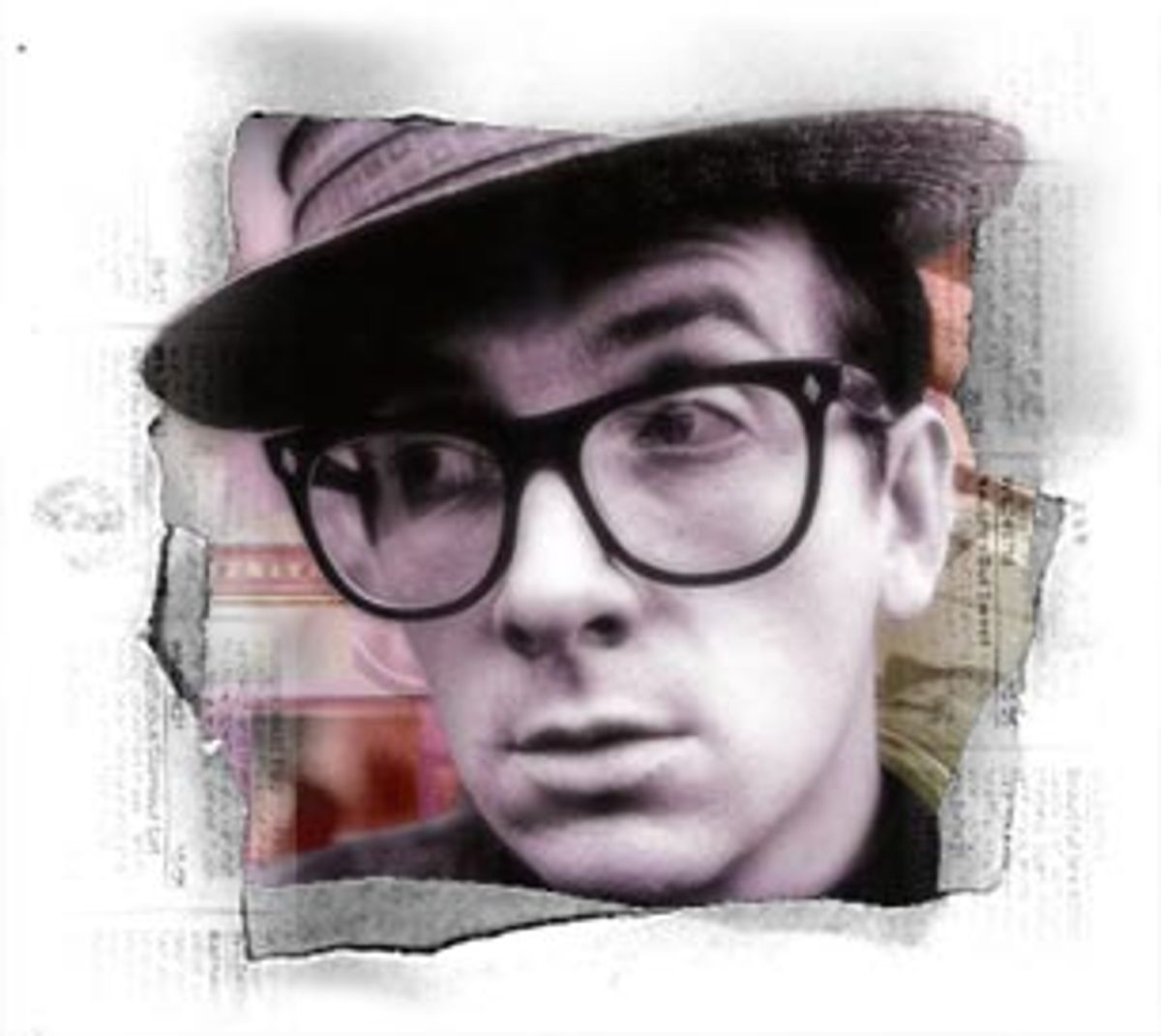
In 1982, Elvis Costello was in something like a state of shock: He was exhausted by an unremunerative fame, wired on speed and slightly disgusted with his career. He’d entranced the rock world with his tautly assembled first few releases, each produced by the shambling Nick Lowe. But for a new album he enlisted an engineer named Geoff Emerick, who’d worked on both “Dark Side of the Moon” and “Sgt. Pepper,” to help him conjure up a twisted pop extravaganza.
The record that resulted was called “Imperial Bedroom.” In it, he outfitted his arch, peevish songs with every armament the studio could muster, from soaring synths, sharp as razors, to treated vocals, dark, discomfiting and vengeful. A famous song called “Man out of Time” is this deadly work’s scariest musical concoction, a caustically inflamed track of shimmering pianos, cascading melody lines, overwhelming dynamics and unbridled vocals.
On his first few albums Costello had laid out sweeping, ever-more-paranoid romantic equations — love as civil disturbance, as propaganda, as global warfare; in “Man out of Time,” this area of lyrical inquiry climaxes in a portrait of the unfaithful lover as unmasked international spy. Costello delivers his most feeling vocal track. The singer is standing at some sort of “traitor’s gate” with a cast of social parasites (“the biggest names in industry,” “the minister of state”), all set against a tableau of bleak geographical sarcasm. (“Days of Dutch courage/ Just three French letters/ And a German sense of humor.”) The portrait, sprawling and fractured, seems to be of an adulterous father and husband whose bourgeois self-satisfaction masks an internal degradation:
He’s got a mind like a sewer and a heart like a fridge
He stands to be insulted and he pays for the privilege
Funnily enough, “Man out of Time” is a love song. “To murder my love is a crime,” wails our burgher, inexplicably and unforgettably. And over those words, Costello and Emerick craft a production coup; Costello’s voice is echoed thickly, flattened electronically. The layered, slightly awry vocal tracks precisely limn the man’s fracturing persona. “But will you still love/The man out of time?” Costello’s singing here is definitive; I can’t think of an instance of rock vocalizing so simultaneously lost and controlled. You’d think he was singing about himself.
- – - – - – - – - – - -
High Fidelity
The most salient fact about Elvis Costello, in many ways a traditional talent, was that he had the misfortune of coming of age in a most untraditional time. As the 1970s deepened, the most influential figures in white rock were throwbacks — Dylan and Neil Young were from the ’60s, and Bruce Springsteen might as well have been. Punk changed all that. Suddenly, it was a given that most of the stars from the 1960s were full of shit. The punks and new wavers adopted frequently harsh music, often deliberately unpleasant subjects and striking, virtually nihilistic attitudes, all with an irrational Jacobin vehemence.
Musically, Costello came out of a relatively genial strain of British pub rock, but by the time he got his record contract, in England at least it seemed as if a generation was aflame, and his natural, gripping sarcasm seemed a piece with it. His attitude toward rock history was encapsulated nicely in his withering choice of a stage name. While possessed of a certain brutal charisma, he looked pinched and dorky, in keeping with the perverse fashions of the time. Indeed, Costello soon became the avatar of the reed-thin, narrow-tied, short-haired new waver.
But it was a tough posture. While indubitably possessed of nearly everything one could want for significant and lucrative rock stardom — head-snapping songwriting skills, a rabidly supportive critical corner, a clue to the pop moment, ambition of a heroic size and the necessary accompanying ruthlessness besides — he was unlucky enough to be possessed of all that just as the pop audience balkanized and, with frayed nerves, stopped doing its part. For one, it suddenly refused to reward its most talented stars financially; Costello was a major figure from the start, but never sold records in any significant number. (Even Linda Ronstadt’s cover of “Alison” was never a Top 40 single.) At the same time, driven by the contempt of the punks, the audience suddenly stopped giving artists a moral pass as well. In other words, Elvis Costello became a star just when the fun was taken out of it.
- – - – - – - – - – - -
The Suit of Lights
He was born Declan Patrick MacManus, in 1955. His father, Ross, was a workaday musician, a singer in a silly dance-hall cover band called the Joe Loss Orchestra. He grew up in London but lived in Liverpool from 16 on. He developed a keen musical knowledge and an unhealthy contempt for almost everything on earth during this period, and also wrote songs. He left school and was a computer operator (not a programmer) and a wannabe folkie in his late teen years. He met Nick Lowe, then playing in Brinsley Schwartz, as early as 1972.
He spent the next few years working at boring computer jobs, getting married and trying to sell his songs. His tapes were rejected by most record companies. Finally, Lowe got him a contract with a new label called Stiff, which would become an amusing feature of the British music scene over the next few years. Besides the predictable double entrendres (“If it ain’t Stiff it ain’t worth a fuck”), the company’s name allowed its PR department to supply record stores with signs saying “We got Stiffs in stock.” Along with early work from Lowe, the Damned, Graham Parker, Ian Dury and Lene Lovitch, the label put out Costello’s first astonishing singles (“Less Than Zero,” “Alison,” “Red Shoes” and “Watching the Detectives”). His full-length debut, “My Aim Is True,” was released in England in July 1977; after (as the perhaps apocryphal story goes) he was arrested for busking outside a CBS Records convention, Columbia Records put it out in the United States some months later, beginning his 13-year association with the label.
From the start, his temperament distinguished him. The other major figure of this period, Johnny Rotten, of the Sex Pistols, hated the world with an innate zeal and used that emotion as a vehicle for an unusual and provocative social analysis. (“A rock band can tear down society.”) This, depending on whom you talk to, was either societally dangerous (and a fantastic but portentous failure) or merely part of a centuries-spanning but relatively benign subversive order (and a complete, pointless success). Elvis Costello, by contrast, didn’t hate, exactly. He was mostly irritated, and motivated by much different things. “That girl who won’t go out with me” was the most important one, though “It took me too long to get a record contract” came a close second.
On “My Aim Is True,” he introduced himself as a folk rocker cum sex killer who used a pleasant familiarity with folk, rockabilly, reggae and soul as a sardonic fagade for a somewhat narrow set of lyrical concerns. These typically leveraged themselves against his primary concerns of — as he notoriously put it — “revenge and guilt,” the shame of the latter presumably fueling the ferocity of his desire for the former. In this peculiar recipe he found an outlet for a molten psyche that did indeed seem to equal that of Rotten’s, which is saying something.
Sexual confusion, sexual frustration, sexual jealousy — these are the key themes from that first album. Consider the malevolence of the singer in “Watching the Detectives,” who is upset not that mass culture degrades humanity nor that cartoon violence deadens it, but rather that the woman on the couch next to him won’t stop watching TV. The most recurring images are slightly disturbing ones, with various species of impotence — voyeurism, submissiveness — emerging again and again.
A year later, on “This Year’s Model,” aided by a violent trio known as the Attractions and a strange encoding of the mid-’60s work of the Rolling Stones, he delivered a rock masterwork that includes all the sexual dysfunctionality of his first record and adds a dollop or two of social criticism, detailing his displeasure with, among other things, advertising, censorship, models, record companies, the corporate ladder generally, radio and poseurdom. Yet arching over it all still is his utterly distracting obsession with girls. This sometimes made for amusing moments. His attitude toward oral sex, for example — “If I’m gonna go down/You’re gonna come with me” — can be described as unhelpfully confrontational.
A year after that he produced “Armed Forces,” a rabid pop exposition that found no little joy in the world of mercenaries and a lot to be fearful of in romance. It began with a winning admission of indecision (“Oh, I just don’t know where to begin”) and ended with a hugely unlikely song, a cover of Lowe’s “(What’s So Funny ‘Bout) Peace Love and Understanding,” sung with such indigestible sarcasm that to this day many fans think he was being sentimental.
His fourth album is a remarkable, soul-inflected work perversely called “Get Happy!!” It was the last record he would release that would even come close to the top 10. He and Nick Lowe shoehorned 20 songs onto one of those old-fashioned LP records, quite an achievement at the time, even if it did sound as if it had been recorded on a Walkman. Some of the songs Costello later admitted he’d written in a cab on the way back to the studio from lunch. (Good ones — “Possession,” for example.)
In America, around this time, he released a record called “Taking Liberties,” a scintillating collection that included various non-album songs and B-sides; these tracks are now distributed across the respective albums in Rykodisc’s elegant, essential reissues of his original Columbia albums. 1981′s “Trust” has an amazing cover photograph. He has jowls and an innocent expression, and seems to want to please. The songs are gorgeous, if essentially meaningless. Dismayed that “Trust” didn’t sell, Costello embarked on an odd excursion into country. “Almost Blue” confused fans and wasn’t very good, either; today the C&W posturing seems tinny after more substantive country-inflected numbers like “Stranger in the House.” The baroque “Imperial Bedroom” followed. Then came two utterly boring efforts, “Punch the Clock” and “Goodbye Cruel World.” In the Ryko reissue of the latter, Costello’s liner notes begin, “Congratulations! You’ve just purchased our worst album.”
- – - – - – - – - – - -
Goon Squad
During this time Costello’s personal life was wound up with nonstop touring, lots of speed and this and that variation of rock-star nogoodnickness. He seems not to have forgiven the world for not making him a star until he was 23; out of a sense of principle the source of which is unclear at this late date he was by his own account an asshole to most of those he came into contact with during this time. By 1979 fans were sometimes booing his short and unpleasant performances.
In this atmosphere of pointless aggression and self-indulgence, Costello began to distinguish himself. The first chance he got, he began dating models. One was Bebe Buell, that era’s escort of choice of has-been rock stars. She had recently given birth to Steven Tyler’s child. (The kid, incidentally, grew up to be Liv Tyler.) Their very public affair was doggedly covered by the British tabloids. Costello’s wife must have enjoyed it. (They eventually divorced.) The Buell-Costello alliance lasted a few years, until Costello unceremoniously dumped her: She said he hung up on her one day and that she never heard from him again. In March 1979, Costello capped off this productive period in his extra-artistic life by getting himself into a scrap with Stephen Stills (of Crosby, Stills, Nash and Young fame) and Bonnie Bramlett (a minor singer from the ’60s) in a hotel bar in Ohio. Again motivated by an unclear principle, he did his best to offend them, finally resorting to a burst of profanity and bigotry, capped with the assertion that Ray Charles was a “blind, ignorant nigger.”
There’s no evidence that Costello was a racist — he’d been active in Rock Against Racism before it was fashionable and was too smart in any event to let it show if he was — but he was being as stupid, reckless and out of control as any of the broken-down ’60s stars his energy, brains and invective were supposed to be an antidote for. In any event, Bramlett industriously publicized the exchange and Costello tried to explain and apologize. He took his lumps in a months-long transatlantic brouhaha; to this day some serious critics hold him in contempt.
- – - – - – - – - – - -
Brilliant Mistake
Costello’s iconoclastic “Girls Girls Girls,” a greatest-hits-style retrospective that came out a decade or so ago, is a thrilling, kaleidoscopic account of his career. The enigmatic programming — song following song in dizzying, nonsensical fashion — keeps you off guard. His “Almost Blue,” a rueful romantic envoi, is followed by “Riot Act,” a blisteringly self-destructive one. “Night Rally,” a furious, unrelenting portrait of fascism, is followed by “American Without Tears,” an oblique, metaphorical dissection of capitalism. What it all meant was dizzying, impenetrable. In his typically scintillating liner notes, Costello makes vague reference to stories he wished to tell in the sequencing, but this never becomes clear as, of course, it couldn’t, or wouldn’t.
Costello understands the Faustian bargain rock ‘n’ rollers make — and seems to accept as well the even rougher demands of the even more unforgiving milieu in which his persona was hatched. But he’s never liked it. He dutifully wrote a minor hit or two (most notably “Everyday I Write the Book”), but by the mid-’80s, it was plain that he was never going to sell a lot of records. He was losing his looks, putting on weight and his hair was thinning.
What to do? The smarter stars from the ’60s rolled on, cannily playing their greatest hits for aging fans and jumping on this or that fad, like disco. To the punks the very words “Rod Stewart” were synonymous with pop degradation, but that didn’t stop Stewart from selling ever-increasing numbers of records in the 1970s and 1980s. But that wasn’t an option for Costello. The musical genre he cared the most for was classic country; unfortunately for him, it was the only genre the mass audience liked less than punk.
Crueller yet was the other avenue open to him — that of artiste. In the ’60s, with few exceptions, the greatest artists sold the most records — it was a given. By the ’80s, a wide gulf had opened up between talent and record sales. And for that matter, for all his reputation, Costello could scarcely comfort himself with the consolation that his was an unappreciated genius. “Punch the Clock” and “Goodbye Cruel World” were hardly evidence of that.
At a certain point it must have occurred to him that his moment had passed.
So in 1985 he tried to kill himself off. He jettisoned his stage name and resolved to record as Declan Patrick MacManus. He was quickly disabused of this notion by Columbia Records, which wasn’t about to let him throw away his one salable commodity. So he sighed and produced what from this perspective must be seen as the key album of his oeuvre, more than those corrosive first albums, more than the magnificent “Imperial Bedroom.”
This was 1986′s “King of America,” his haggard essay on the pointlessness of his career. (It ended up being credited to “The Costello Show,” incidentally. It was a full, uh, six months before he put out another record under the name Elvis Costello.) To make his peace with the past, his key backing ensemble, which he collected with producer T-Bone Burnett, included some former players from that other Elvis’ TCB band. The result is the most frustrating of Costello’s unquestionably great efforts: Puffed up by his sidemen’s risumis, he throws in too many tired boogie rave-ups (“Glitter Gulch,” “Loveable”); and some forced genre posturing (“Eisenhower Blues”); and an annoying, mood-breaking cover of “Don’t Let Me Be Misunderstood.”
But buried in the record as well is a suite of major songs, their intents extravagant and plain, that together are a shuddering portrait of his condition. Each is quiet and soft, and sung and enunciated with a deliberateness that suggests that their composer wants them to be understood. In “Jack of All Parades,” he lurches feelingly between his love life and the pop life. (“I was everybody’s boy/But soon that thrill just fades.”) In the quivering “I’ll Wear It Proudly,” he offers a sarcastic deal to his audience: “I’ll wear it proudly through the dives and the dancehalls/If you’ll wear it proudly through the snakepits and catcalls.” And the grand, ragged “Brilliant Mistake” is a hugely ambitious song that eviscerates, in vertiginous order, the American way of life, romance and then the singer’s personality itself:
I wish that I could push a button
And talk in the past and not the present tense …
I was a fine idea at the time
Now I’m a brilliant mistake
The last song of this suite is “Suit of Lights,” an intensely allusive affair with a musical panorama stretching from the journeyman musician to Nat King Cole to that other Elvis to Costello himself. Deep inside the song you can find a grinning crowd tarring and feathering an artist it doesn’t like. Some of us may think that there’s not enough of that these days, but to Costello it’s an important image, a symbol of the crowd’s fascistic leanings. His commentary on “Suit of Lights” on the “Girls Girls Girls” compilation is so central to understanding his career and work that they’re worth taking a close look at. I quote them in their dense entirety with his idiosyncratic punctuation and slightly odd grammar, and advise that they bear careful reading.
There are small demands of respect. They are denied in this song, which I wrote for my father, Ross. He has greater professional resolve in the face of the tiny indignities that every working person shares, but is somehow overlooked and even resented when expressed by a performer. It is assumed that the risk of humiliation is the price paid for the privilege. I don’t believe that is right and I am not talking about someone like myself, who has already been spoilt by your affection, coming to expect it to the extent that I sat down to write all of this but it’s all ‘Work.’ The same pig-faced lout or drunken bore who is very large in the dark of the crowd would be horrified if you were to simply trip him up on the way to work. Here endeth the lesson. By the way, we forgive nothing.
I interpret those words this way: People think performers have it made, that if they don’t like it they should get the hell off the stage. But musicians are working people. Show them some respect, you pig-faced louts who buy my records, and by the way I’m not making this plea on behalf of a star like myself, but rather on behalf of my sainted father, though I’m holding the grudge personally anyway.
I’m fascinated by the epigram that anchors his words: “The risk of humiliation is the price paid for the privilege.” Costello disagrees. But here he’s finessing a crucial distinction — the difference between a journeyman and an artist. The journeyman, like Costello’s father, makes no claim to art: He’s just giving the crowd what it wants, trying to make a buck as he launches into the nine millionth cover of “Louie Louie.”
But if that’s the noble proletarian work you’ve chosen, the drunken louts are the ones you need to please. If they’re talking, you’re not doing your job. Humiliation and privilege don’t enter into it.
The only people who are contemptuous of such labor are, of course, critics, who paradoxically love the son. A true artist like him — and particularly one from the punk era — has a responsibility to his audience that transcends entertainment. As he acknowledges, artists are spoiled, but that doesn’t mean the audience is not, at the same time, a scary sight. Costello has always viewed it with horror. But really, what can you do? It’s terrible to stand on a stage and try to sing a new song with a drunken lout screaming, “‘Pump It Up’!” especially if you haven’t written a song as good as “Pump It Up” in quite a while. You might say that the humiliation is the price paid for the privilege.
- – - – - – - – - – - -
Man out of Time
Which brings us back to “Man out of Time.”
For that song he drafted a line — “He stands to be insulted and he pays for the privilege” — that would find an unconscious but unnerving echo in the defensive words he wrote about his father for the “Girls Girls Girls” compilation five years later. For Costello, the man out of time is someone very much like a performer.
And suddenly the middle-class spy evaporates. In his place is a rock star — a rock star who never was a star, really — hooked on betrayal and on the run. “Man out of Time” is really about Costello and his career, practically from the first line to the last. With a nod to his namesake he describes himself wearing “dirty dead man’s shoes.” What is a star but someone who has “A tight grip on the short hairs/Of the public imagination” and who rather pathetically “listens for the footsteps that would follow him around”? The star on the run’s affairs are splashed across the tabloids. (“For his private wife and kids sometimes/Real life becomes a rumor.”) His minor celebrity and minor comforts are merely a reminder of the true stardom and riches denied him: “A tu’penny ha’penny millionaire/Looking for a fourpenny one.”
That’s the thing about Elvis Costello; he’s been there before you. After “Imperial Bedroom” he recorded “King of America” and a solid Attractions follow-up, “Blood and Chocolate,” and then slid quietly out of the artistic firmament. He moved to Warner Brothers; his albums there have been without interest, as have been his attempted collaborations with the likes of Paul McCartney, the Brodsky Quartet and Burt Bacharach. His most loyal fans will doughtily make a case for “Spike,” or “Mighty Like a Rose,” or “Brutal Youth.” That is what one’s most loyal fans are for; a disinterested listener hears that in the last dozen or so years he’s written barely a song or two that have the unforced drive, sparkle and complexity of his best work.
At the same time, Costello gave up any pretension of discriminating behavior. He did reunion tours with the Attractions and high-grossing, low-overhead outings with Nick Lowe or Steve Nieve, the Attractions keyboardist. He makes grinning appearances on TV shows and movies, and is happy to grab a paycheck at disgusting corporate rock events like the Guinness Fleadh and Woodstock. And when the Rock and Roll Hall of Fame has its annual dinners, Costello joins hacks like Billy Joel to grin and perform for the assembled industry parasites.
It’s an old story and a common one; Costello’s only novel approach was to see it coming before anyone else; when he did, he tried to vaporize his career and his future in a metaphorical auto-da-fi. No other major rocker has even considered such a thing, and you have to credit the punk era for even raising the question. Buried in all the noise, the aggression, the affected nihilism was a commitment to something like honesty. This is why ’60s artists like John Lennon and Bob Dylan retain their psychic pop force: For all their missteps, their honesty never wavered.
To be honest to an audience, you have to care for it. The bravest can be humble before it, acknowledging its hunger, its capacity for horror and its unquestioning love for the performer, which Costello, as one of rock’s greatest students of the music, must appreciate as well as anybody. In this context, what is worse than the feeling you’re letting it down?
Whatever his ambivalent attitude toward the crowd (as the picture in “Suit of Lights” makes clear), Costello must have sensed the devotion a great part of it had for him. Those of us in the punk generation were taught to hate the heroes from the ’60s who went soft and ridiculous in the ’70s — the Stewarts, the Claptons, the Jaggers. (Not to mention the Stillses and Bramletts!) Costello stood for something more than pop glee; he knew that rock’s reason for being, if the music meant anything at all, was its ability to provide an outlet for rage like his, and that he had nothing to apologize for. But he was cursed to have been part of the first great rock moment that did not change the world, and was as a consequence born to hate itself. Someone with his capacity for fury could scarcely complain, but he must also have felt the waste, of both his talent and a generation’s affection. To have murdered our love was a crime. We forgive nothing.
Three years ago, the Oscars announced the biggest change in its workings in decades. It expanded the best picture lineup to 10 films, up from five. We’ve seen two Oscarcasts since; the third one will be broadcast this Sunday on ABC.
The Academy of Motion Picture Arts & Sciences, which puts on the show, doesn’t admit it, but the tweaks are born of a concern about one thing and one thing only: TV ratings. The academy makes a mint each year off the broadcast, traditionally one of the year’s biggest shows. But the trend line for viewership has been heading downward for more than a decade. The academy’s not in the poorhouse or anything; it can still charge an ever-growing premium for advertising, of course. But the show’s not cheap, either, and those declining ratings are a very real indicator of the once fabled awards show’s fading glory.
Here’s the academy’s biggest, and growing, problem: The movies winning Oscars are movies that nobody has heard about — and, as a result, nobody is tuning in.
Five or six years ago, when movies like “Crash,” “The Departed,” “No Country for Old Men” and “Slumdog Millionaire” were winning best picture Oscars, the average box-office gross for the five best-picture nominees each year was in the $50 million to $70 million range — and “Crash ”and “No Country” were among the lowest-grossing winners (adjusted for inflation) of all time. Those were the years that drove the Academy nuts. Bad enough that a movie about a guy who killed people by sticking some sort of pneumatic hammer on their foreheads won the best picture Oscar. The next year was about a slum kid from Mumbai. The ratings tanked during these years, hitting an all-time low of 32 million in 2007.
Then came the big change. In 2009, the switch did what it was supposed to do. The average gross of the films nominated for best picture went up an extraordinary $100 million, to approximately $170 million. The ratings took a jump to 41 million. On the one end you had “Avatar” — in inflation-adjusted dollars currently the 14thhighest-grossing film of all time— but also Pixar’s “Up” and the popular family sports drama “The Blind Side.” What won? A downer of an Iraq film called “The Hurt Locker,” which made about one-fiftieth the amount “Avatar” did in ticket sales. Its $17 million made it by far the lowest-grossing best picture in the history of the Oscars.
2010 came next. There were more respectably big-ticket, high-grossing, critically acclaimed films to lavish awards on. There was “Inception,” directed by industry darling Christopher Nolan, who’d been nominated for an Oscar already and wowed everyone with “The Dark Knight.” There was “Toy Story 3,” arguably the best-reviewed Pixar movie yet, if that seemed possible. And then “True Grit,” the closest thing the Coen brothers will ever direct to a family film.
But there was a problem: The average gross of this lineup was down to $135 million and the winner was “The King’s Speech,” an agreeably middlebrow work about primogeniture and stuttering with a disappointing $138 million total box office. The Academy ignored Nolan and the Pixar folks, and the ratings were accordingly off 10 percent, making the show another of its lowest-rated ever.
Now we’re up to this year. Let’s look at the nine nominees, “The Artist,” “The Descendants,” “War Horse” and “Moneyball” among them. The average gross has plunged by more than half of last year’s, back down to $62 million. In just three years, in other words, the box office of the Academy voters’ picks has speedily regressed to more or less what it was before the big switch. In essence, the revamping has accomplished nothing.
Short of creating an affirmative-action program for blockbusters, there’s little it can do at this point. First, the Oscars has the most integrity of any awards show. The academy runs a tight ship. Corrupt outfits like the Grammys, remember, allow a secret committee to overrule its membership’s nominations to hide embarrassments and make for a more youth-friendly show. Shenanigans like that wouldn’t fly in Hollywood.
Secondly, and worse, there’s the sequel problem. Hollywood’s love of the sequel (and movies that might produce a sequel) is well known. These films have increasingly come to dominate moviegoing. The last year a quote-unquote normal movie for adults was the year’s highest-grossing film was “Saving Private Ryan,” way back in 1998. 2007 was a landmark: The top five films were all sequels, reboots, wannabe franchises, or films based on superhero comics or toys — and there were five more in the top 20.
Well, this year, Gotterdammerung hit. In 2011, for the first time, the top-10 highest-grossing films of the year are all of that ilk. It’s hard to keep track anymore. Was the latest Harry Potter a septoquel or an octoquel? I think that was the third “Transformers” movie this year, unless I’m forgetting one. I count at least three fourquels (the latest “Twilight,” “Mission: Impossible,” and “Pirates of the Caribbean” entries); what number “Fast Five” is in the “Fast & the Furious” series I haven’t the faintest. Then there were a raft of straight-up sequels (“Sherlock Holmes,” “Hangover,” “Cars”) and the new would-be superhero franchise, “Thor.” And numbers 11 through 20 included five more sequels, reboots or superhero workouts. (“Captain America,” “Planet of the Apes,” the second “Kung Fu Panda,” the fourth “X-Men” and — wait for it — the third “Alvin and the Chipmunks,” coming in at 20.)
With very rare exceptions (the “Toy Story” sequels and not any others I can think of), no one seriously claims any of these are deserving of best picture honors. Of the top-grossing films of the year that weren’t in one of these predictable categories, the highest, “The Help,” was actually nominated for best picture. So it’s not like the members of the academy aren’t trying. It’s just that there’s nothing, really, for them to nominate in the category of high-grossing films worthy of a best-picture Oscar.
There are two Hollywoods now. One makes those cacophonous entertainments, which kids flock to see in noisy multiplexes each weekend. The other makes films for adults, which we see in the calmer art theaters or in the comfort of our own homes on home video, Netflix, or on demand. They don’t make much money, so they leverage what influence they can. One of these has been their efficient hijacking of the Oscars race each year. If you don’t overspend in production and play the awards-season game well, you can do all right financially.
It’s hard to see how this situation will change any time soon. The prognosticators this year say “The Artist”— an all-but-silent film from France with a current gross of $28 million — will win best picture; if it does, it will be the second-lowest-grossing film ever to get that award. The industry will grumble; the ratings won’t go up, and will probably plummet again. The rest of Hollywood will go back to work on their respective studio’s boffo B.O. hopefuls for 2012. One of the big studio tentpoles this summer? Universal’s “Battleship” — yes, based on the venerable family game. I doubt we’ll be hearing about it when next year’s Oscar nominations are announced.
Continue Reading
Close
CNN’s coverage of Michael Jackson’s sudden illness in the minutes before his death was reported captured nicely the way the media has treated him. Nutty people were allowed to talk at length, including a guy who kept saying his concerts in London were in 2010. (They were scheduled for next month.)
Wolf Blitzer looked into the camera to tell us earnestly that the head of the concert promotion company had told them that Jackson was in “tip-top shape,” and that he’d passed a health exam “with flying colors.”
Funny how an impossibly pampered 50-year-old guy in top-top shape could just keel over dead.
We’re supposed to live in an Age of Paparazzi. Isn’t it curious how stars nonetheless manage to die right before our eyes?
They do it with our complicity.
Born not just to celebrity but to stardom, Michael Jackson never knew what it was like to live normally, or even behave normally. He was drafted into the family’s musical act, the Jackson 5, while in elementary school, and taken to Motown records. He was taught how to live a manufactured image at the feet of Berry Gordy, who was quite good at such legerdemain.
If you’re 9 years old and born to be a star, such training will definitely turbocharge the marketing of your record sales; as for the fact that almost all the money from those sales went to your teacher and not you … well, that was his second lesson.
Trust, truth … these were concepts Michael Jackson learned early on didn’t have much worth. But of course he had his family, right?
His angry father beat him and his eight siblings with some determination, reputable biographers have told us. (Untrustworthy La Toya said that she and Michael were sexually molested, too.) On tour at age 10, Michael tried to sleep as his older brothers banged groupies in the motel rooms they shared. Then all the kids watched in wonder as their father took up with another woman and had a child with her.
Love, marriage, sex … Michael Jackson learned early that those didn’t mean much either. The Jackson 5 had a three-year run, not bad for a kid act. When the family, which realized it hadn’t made any money, left the label, a vengeful Gordy exacted as a price not just a brother – Jermaine, who, married to Gordy’s daughter, stayed at Motown — but even their name. When they moved to Columbia, they couldn’t use the name the Jackson 5.
Michael was all of 14.
In five years he collected himself, extracted himself from his father’s control and recorded two albums that would change the music industry. The best was the first: 1979′s “Off the Wall,” a groovy, irresistible stunner. Blithe and implacable, sparkling and protean, it displayed a lean talent, feline in his sexuality and relaxed in his blackness. The round-faced, broad-nosed charmer looking out from the album’s cover reeked not just of charm but confidence and, for the last time, normality.
Three years later, “Thriller” would take what became an epochal step forward in terms of commerciality. Viewed now, with the benefit of hindsight, we can see Jackson’s evolving physiognomy is symptomatic of an insecurity we didn’t think to question at the time.
His celebrity’s toll on his own and his family’s life became considerable. For some unaccountable reason, after “Thriller” he still lived at home, as his family busied itself with intrigues and cockamamie plans. One imagines him sitting in his room ignoring the knocks at his door as offers of millions came in to the family from across the country and around the world to do just about anything — anything, that is, that Michael would do too.
With the exception of Janet, his youngest sister, who somehow managed to extract herself and create her own extraordinary career, virtually every member of his family managed to blemish their reputations; among other things, more than one of the boys, their father’s sons, were charged with beating up their girlfriends or wives.
The story from that point is a bleak and unrelieved one. Superficial things: Michael’s ludicrous trappings and entourages; the fetishization of the armed militias marching around in his videos; tales of his supposed bizarre doings leaked to tabloids; the grasping grandiosity of his public appearances. Jackson had a flair for exploiting the tabloid celebrity he had, but that was a skill he shared with Anna Nicole Smith and Paris Hilton, and it probably shouldn’t be listed among his unique abilities.
More serious things: mismanaged tours; declining songwriting skills; ever-more erratic album releases.
Even more serious things: an entirely transfigured physical appearance, morphing from an engaging and handsome African-American man into a misshapen Eurasian woman; his skin bleached, his face resculpted; his nose, finally, needing to be practically taped onto his face. He left his race behind and, in a sense, his family too. (The nose, which seemed to have borne the brunt of his obsession with plastic surgery, was his father’s.)
The master of crossover had seemingly crossed over for good.
And finally, a black moral hole, and a descent into a double life as a sexual predator. You’ve heard about not taking candy from a stranger; Jackson’s candy took the form of literal amusement parks. There were nights of fun and sleepovers and inappropriate touching and …
Accusations were leveled many times; most cases were settled; one case, gone to trial, ended in an acquittal in Santa Maria in 2005.
In the obituaries, writers will savor Jackson’s talents, which were unquestioned; his ambition, which was otherworldly and a thing of awe; and his heyday, which lasted really just a few years, and encompassed perhaps two and a half albums. Others will reflect on the tragedies visited upon him and those he visited on others.
I think it’s fair to classify Kurt Cobain’s death as one brought on by medical problems, specifically the roiling interaction of depression and addiction. Jackson’s death is in this sense more purely a suicide, just as Elvis Presley’s was some three decades ago. Like Presley, Jackson at some point stepped through a door, closed it, and turned the key. What went on behind the door we’ll never know.
Continue Reading
Close
Bad art is supposed to be harmless, but the 2008 film “Roman Polanski: Wanted and Desired,” about the notorious child-sex case against the fugitive director, has become an absolute menace. For months, lawyers for the filmmaker have been maneuvering to get the Los Angeles courts to dismiss Polanski’s 1978 conviction, based on supposed judicial misconduct uncovered in the documentary. On Tuesday, Los Angeles Superior Court Judge Peter Espinoza ruled that if Polanski, who fled on the eve of his sentencing, in March 1978, wanted to challenge his conviction, he could — by coming back and turning himself in.
Espinoza was stating the obvious: Fugitives don’t get to dictate the terms of their case. Polanski, who had pleaded guilty to having unlawful sex with a 13-year-old girl, was welcome to return to America, surrender, and then petition the court as he wished. Indeed, the judge even gave Polanski more than he deserved, saying that he might actually have a case. “There was substantial, it seems to me, misconduct during the pendency of this case,” he said, according to the Los Angeles Times. “Other than that, he just needs to submit to the jurisdiction of the court.”
Polanski deserves to have any potential legal folderol investigated, of course. But the fact that Espinoza had to state the obvious is testimony to the ways in which the documentary, and much of the media coverage the director has received in recent months, are bizarrely skewed. The film, which has inexplicably gotten all sorts of praise, whitewashes what Polanski did in blatant and subtle fashion — and recent coverage of the case, in the Los Angeles Times, the New York Times and elsewhere, has in turn accepted the film’s contentions at face value.
For now, the Los Angeles judge has injected a dose of reality into the debate. But “Wanted and Desired” seems to have inserted into the public consciousness the idea that Polanski, an irrepressible European, had been naughty during a colorful time, and that he has been toyed with by a monstrous legal system. Creepy and disturbing, the film does show us a few of the director’s moral warts. But it leaves the strong impression that Polanski was a wronged man, jerked around by a cartoony, publicity-hungry judge to the point where fleeing was his only viable option.
“Wanted and Desired” is directed by Marina Zenovich. Previously she had made well-received documentaries about the Sundance Film Festival and France’s charismatic Bernard Tapie, who owned a chain of health stores and sponsored a famous cycling team, which included Tour de France winner Greg LeMond. Tapie later got into trouble with the law for fixing soccer games, and after spending time in prison, became an actor.
In “Wanted and Desired,” Zenovich casts Polanski, whose face repeatedly fills the screen with a Byronic luminosity, as a tragic figure, a child survivor of the Holocaust haunted by the murder of his wife, the actress Sharon Tate, at the hands of the Manson family. His friends are uniformly supportive: “This is somebody who could not be a rapist!” one exclaims.
As for the judge, Laurence J. Rittenband, why, he’s a risible self-promoter. If Polanski is Byron, the judge is an Oliver Hardy or a Billy Gilbert, all but twiddling his tie in a series of ever-more-comical photographs. He actually kept a scrapbook about the celebrities who came through his Santa Monica courtroom. He had two girlfriends.
Now, that’s one way to portray those two men — and one that Polanski’s current lawyers would prefer. But there’s another way, too: You could show one as a child-sex predator who drugged a 13-year-old girl with quaaludes and champagne; lured her to pose for naked photographs; ignoring her protests, had sex with her; and then anally raped her.
The other could be cast as a canny jurist — possibly a brilliant one, smart enough to have gone from high school directly to Harvard Law and graduated so young he wasn’t allowed to take the bar exam — who may have gone too far in his intent to block off the legal escape hatches celebrity wrongdoers use.
The truth is somewhere in between, but it’s probably a lot closer to the second version. Yet that initial stark contrast — the tragic hero, the goofy jurist — permeates the film. Documentarians should have a wide leeway to argue their case the way they want, but there’s a point at which ethical lines are crossed. Zenovich, like many other chroniclers to the stars, seems to have been blinded by her contact with Polanski.
Here’s an example: The word “sodomy” is briefly referenced in Zenovich’s documentary, but it’s a somewhat ambiguous term, and it’s never explained. Zenovich has fun flashing bits of the victim’s grand jury testimony on the screen, but she never gets around to using this exchange from that testimony, which was made public in 2003 and published by the Smoking Gun:
“Then he lifted up my legs and went in through my anus.”
“What do you mean by that?
“He put his penis in my butt.”
In the girl’s grand jury testimony, which is slightly sickening to read, she also said that she had repeatedly told Polanski no, but that she was too afraid of him to resist.
It’s a drag to include a scene of anal rape of a 13-year-old in your moody documentary about such a Byronic figure, but it’s also fairly relevant.
At the same time, Zenovich doesn’t have time to tell us about the exceptional back story of Rittenband. In other words, she withholds the most damaging bit of information about Polanski from her viewers, and the most favorable bit of information about the judge.
Zenovich seems to have a tin ear when it comes to sexual politics, too. The film spends a lot of time telling us that Rittenband apparently had two girlfriends, using some goofy graphics to underscore the point. Zenovich doesn’t say the judge was married, so it’s not clear exactly why this information is relevant. But given what Polanski is accused of, the irony seems to be that the judge was a womanizer, too.
But Polanski, of course, wasn’t on trial for womanizing. He was on trial for drugging and raping a 13-year-old girl. The director’s ear, here as elsewhere, seems a bit … continental when it comes to such issues.
In “Wanted and Desired,” it’s weird how detached Zenovich stays from the victim, and how she undermines her in subtle ways. The tone is set early on, when a friend of Polanski’s tells of being woken up and informed that the director had been arrested. The moment is actually played for laughs, with interspersed shots of a worried Mia Farrow using the phone in a scene from “Rosemary’s Baby.”
A filmmaker attuned to the psychological undercurrents of the characters in her drama might have been conscious of the state of a 13-year-old girl, who had just been drugged and raped and had spent the next period of time at a police station reliving the incident; and shaken by the story of “Rosemary’s Baby” — that, too, about a horrifically abused woman.
But the scene isn’t used to illustrate the victim’s story — it’s about poor Roman. He’s the person making the desperate phone call. It’s an odd juxtaposition when you think about it. That’s when the friend, having just been told Polanski has been arrested, says, “This is somebody who could not be a rapist!” Here again, Zenovich is playing with semantics. It’s obvious the friend was saying he couldn’t imagine Polanski, say, following a woman down the street and grabbing her in an alley.
If Zenovich wasn’t tipping the scales in Polanski’s favor, she could have asked the guy, “Well, what about statutory rape, having sex with an underage girl? Could you imagine him doing that?”
We also hear people note, meaningfully, that meeting someone like Polanski could help a potential young actress’s career. Such a remark about a grown woman would be slightly offensive; about a 13-year-old it’s exceedingly so. The girl told police at the time she had repeatedly told Polanski no; on the screen Zenovich runs a line to that effect from the girl’s grand jury testimony, but immediately follows it with a quote from Polanski’s: “She was not unresponsive.” This creates a subtle he-said-she-said dynamic that, in a case in which consent isn’t a issue, represents another bit of moral prestidigitation.
It’s strange to see a female filmmaker anchor her documentary’s arguments with such atavistic attitudes. It gets worse: In the media circus of the time, some of the European press reported that the victim hadn’t been a virgin. We then get to watch as Polanski’s attorney, Douglas Dalton, stands in front of a gaggle of media, Polanski nodding by his side, to say, “The facts indicate that before the alleged acts in this case the girl had engaged in sexual activity. We want to know about it, we want to know who was involved, when, we want to know why these other people were not prosecuted. It’s something we want to fully develop.”
A more feminist-minded director might have used her interviews with Dalton to explore some of the Neanderthal ways he was prepared to wage the case, had the director gone to trial. But, of course, the director didn’t go to trial. As the film shows, Polanski accepted a plea bargain and pleaded guilty to the formal felony charge of unlawful sexual intercourse with a minor; he and his lawyer knew he could face prison time. Polanski also stood in front of the judge and admitted what he did and that he’d known what he was doing.
In the wake of that, Rittenband was trying to figure out how to make sure Polanski was punished; he was apparently concerned that the director would act contrite, get a short prison term and then assemble a pack of legal wolves to get him out of trouble. And the film makes a decent case that Rittenband ultimately went off the rails.
But even this isn’t exactly a revelation; Rittenband got in trouble for his actions at the time, and was ultimately removed from the case. But by that time the director had already fled, which lost him whatever legal high ground he might have obtained.
Flash forward 30 years, and Polanski has to try to make that very old issue seem new. His lawyers are also basing their case for dismissal on two other, lesser issues. Rittenband, who Polanski has said was playing with him like a mouse, was actually nice enough to the director after the guilty plea to let him go to Europe to make a movie, an option the L.A. courts system, one suspects, affords few other accused child rapists, then or now. While there, he had the misfortune to be photographed carousing at an Oktoberfest in Munich. One of the district attorneys in the documentary says he called the judge’s attention to the photo and suggested that Polanski was making a fool out of him.
(This photo, which Zenovich attacks with the zeal of a Kennedy assassination conspiracist examining the Zapruder film, is exhaustively analyzed, with multiple interviewees testifying in all sorts of ways that Polanski really wasn’t having fun — an assertion the victim was never allowed to make unchallenged about her photographic experience with Polanski.)
Polanski’s lawyers have tried to paint what the D.A. said as an example of an inappropriate communication, but the D.A. mentions it openly in the documentary (it’s not a “revelation”) and has said it was no big deal.
Finally, the lawyers are incensed that the L.A. court responded to a press inquiry by saying Polanski had to surrender before anything was going to happen with his case. Polanski’s lawyers say this was “ruling publicly” on a matter before the court. It could be that. It could also be called “stating the obvious” — which is what Judge Espinoza did Tuesday.
The coverage of Polanski’s legal maneuverings in the last year took its cues from Zenovich’s documentary. The charges against Polanski were often vaguely described; though the charge of sodomy was in the original case, and the Smoking Gun posted the girl’s wrenching grand jury testimony in 2003, these issues were almost never mentioned.
The New York Times finally did a detailed story on the charges last month. But the story still concentrated on supposed “troubling” and “uncomfortable” issues raised by the film. Just listen to this portentous passage: “For the elder Mr. Dalton, who urged Mr. Polanski to pursue redress after reviewing the documentary, however, the issue turned from the original crime to questions about the way authorities here handled it.”
Dalton was given a lot of time in the documentary to spin wildly for his client, so it’s hardly surprising that he managed to convince himself that he was correct after seeing it — or that, given the fairly incontrovertible facts of the case, that he would like to turn the issue just about anywhere other than “the original crime.”
Polanski has had a wrenching life, of course, but it is overplayed in “Wanted and Desired.” I think it’s true to say that there are many people who survived the Holocaust who don’t drug and rape children, for example. More apposite and logical questions, in turn, aren’t explored. For example: Polanski was photographing the girl for a photo spread for a European edition of Vogue. Someone could have asked him, or his lawyer — just for the record — if he had drugged and raped any other of his photo subjects.
The girl in the case is now in her 40s; she has said the case is behind her and that she has forgiven Polanski. (The documentary waits until the end to note that this came only after she settled a civil case against the director.) But the issue here isn’t Polanski being left alone; he’s the one trying to get his case dismissed.
The movie tries to drum up sympathy for Polanski by playing up the media firestorm he was at the center of; but that’s Polanski’s fault, too. (Before they rape children, celebrities should consider how the media attention sure to result will have adverse consequences for their victims, as well as themselves.) Celebrities complain about “the dishonesty of the media,” as Polanski does repeatedly in the film, only when the dishonesty doesn’t suit them. If the coverage helps you — a portrayal as devoted husband, say — then it’s fine, true or not. But when it doesn’t, they scream.
But that’s just the Polanski team’s legal strategy: keeping as many balls in the air as possible to make it seem as if the director has something to negotiate with, which he hasn’t. Around the time of the documentary’s release, they actually cut a deal to settle the case — but balked at the prospect of cameras in the court. This too was an irony, considering that Roman Polanski got himself into trouble with a camera so many years ago. Thirty years later, the director was still trying to call the shots.
Continue Reading
Close
More than 25 years on, it’s a little hard to explain “The Last Waltz.” Rock ‘n’ roll, pop and hip-hop permeate our lives. The music blasts from commercials; you can hear the Ramones in the bar of an expensive restaurant; Joni Mitchell songs anchor an episode of “Ally McBeal.” More than that, you can see rock — and see it well — on a slew of cable channels; fans can find exquisitely filmed concert footage (and fake concert footage) of virtually any artist they’re interested in. More than that, the rock video industry, unaccountably, has found itself frequently setting the standard for film technology and construction.
In that context, it seems like no big news that you can see some rock stars in “The Last Waltz,” recently released in theaters and just out on DVD. Its technical claim to fame is based on the fact that it was shot in 35mm. The group the film is about — a band called just the Band — were once somewhat famous but dropped out of sight around the time the movie was filmed, in 1976, and haven’t been heard much of since. And the music they made — today you’d call it Americana, or alternative country — is as unfashionable a genre as you can imagine, the success of the yuppie coffee-table CD that is the “O Brother, Where Art Thou?” soundtrack notwithstanding.
The film “Woodstock,” which came out about eight years before “The Last Waltz,” contains head-snapping performances by Jimi Hendrix, the Who, Sly and the Family Stone, Santana and many others; it’s a searchingly filmed and edited documentary of a larger-than-life event and remains a larger-than-life touchstone of an era of social upheaval and a landmark in documentary filmmaking. That film aside, however, “The Last Waltz,” as the pristine DVD version attests, is the single best movie about rock ‘n’ roll and only rock ‘n’ roll ever made.
At the time “The Last Waltz” was created, the rock film was still a rarity, despite the magisterial “Woodstock” and the shockingly fun mid-1960s Beatles outings. You could see the occasional 16mm concert films — “Pink Floyd Live at Pompeii,” “Ladies and Gentlemen the Rolling Stones,” “Ziggy Stardust” and so forth — but only in theaters, and only in the cities that might have an offbeat movie house that would play such stuff. Rock appeared on TV only rarely (on cool shows like “The Midnight Special”).
So, in 1976, when it was filmed, and 1978, when it was released, “The Last Waltz” had some striking features. The film chronicled a concert in which appeared not only the Band and Neil Young and Joni Mitchell and Eric Clapton but also Bob Dylan and Van Morrison and Muddy Waters, many of these at something near their psychic best. The occasion of the show was the announced retirement from the road of the Band. Even back then, the group was a somewhat mysterious ensemble, Canadian save for an Arkansan drummer but uncompromisingly dedicated to the investigation of American music. After nearly a decade of tangential obscurity, the members found themselves Dylan’s electric backup band in the mid-’60s. Later they would hole away with him to make rock’s most famous bootleg, “The Basement Tapes,” and release influential records on their own, most notably “Music From Big Pink” in 1968. At their peak, they revealed a Crazy Horse-style force and Stones-like libidinousness, both leavened by a predilection for drolly fatalist Americana populated with R. Crumb-like characters and romantic losers.
The group planned its farewell at Bill Graham’s Winterland auditorium in San Francisco. The band’s leader, Robbie Robertson, knew Martin Scorsese, who was then in Los Angeles finishing up his wan tribute to the American movie musical, “New York, New York.” He was so late on that film, and so over budget, that he had to undertake preparations for “The Last Waltz” secretly. Once he took on the project, he decided to do what apparently had never been done for a serious rock movie — film it in 35mm, under controlled conditions. That meant turning Winterland from a concert venue into a film studio, with an appropriate set; stationary and moving cameras; storyboarded songs; and an intense communications network to capture what was needed to be captured — all of this for a complex show with an array of special guests, and in an era when “authenticity” was a rock byword and many musicians and concert production people were less than cooperative when it came to sacrificing spontaneity to decent filmmaking conditions.
Scorsese brought in Boris Leven, who had been production designer on “West Side Story” and “The Sound of Music,” to create a set; for cinematographers he had Vilmos Szigmond and Laszlo Kovacs, cameramen of choice for the “Easy Riders, Raging Bulls” generation. When Winterland’s floor proved shaky, the production sawed through it and anchored the cameras in the building’s foundation. Behind the stage, Scorsese built a rolling track for a moving camera. The San Francisco Opera lent the production pieces of a set from a recent production to create a lush and attractive backdrop.
After logistical problems that must have been nightmarish, given the egos involved, the concept came off. One of the things we learn on the commentaries on the DVD is that the group sent emissaries to the invited guests to find out what songs they were going to perform, to allow the Band to rehearse and prepare the proper arrangements, which could then be used by Scorsese for storyboarding purposes — the solos, the change in vocalists and so forth. Promoter Bill Graham served the 5,000 attendees a Thanksgiving dinner; then, tables were cleared to make room for ballroom dancers. The show began with performances by the Band (“Up on Cripple Creek,” “It Makes No Difference,” “The Night They Drove Old Dixie Down, ” Stage Fright,” etc., etc.) alternating with tunes by the guests: Mitchell (“Coyote”), Young (“Helpless”), Muddy Waters (“Mannish Boy”), Neil Diamond (“Dry Your Eyes”), Clapton (“Further on up the Road”), Dr. John (“Such a Night”), Morrison (“Caravan”) and finally Dylan (“Forever Young,” “Baby Let Me Follow You Down”). There are two striking songs filmed later, on sound stages: “Evangeline,” featuring Emmylou Harris, and “The Weight,” with the Staple Singers. Then the show ends with an all-star ensemble singing “I Shall Be Released.”
All of Scorsese’s preparations combined to imbue “The Last Waltz” with a production sheen that, while never rendering the performance antiseptic or polished, gives it, paradoxically, a momentousness. Previous rock movies, virtually without exception, had been made cheaply and on the fly. This show, by contrast, was lit for high-quality filmmaking and was being shot by several of the most brilliant cameramen in the world; the performers’ faces glow, become alive. Scorsese’s extravagant plans — a network of moving cameras and refocusing lenses — combine to capture, seemingly, every nod and wink that passes between the artists. You can see the members of the Band, familiar with each other after 16 years on the road, each playing his part confidently and independently; but when others came on, you can see the members’ antennae become alert; shrugs, glances, nods and smiles drive the concert forward. Scorsese humanizes the performance in a way that is without parallel in rock films.
There are a couple of guests who aren’t that interesting, but most are spellbinding: Neil Young, spaced out of his mind on something, smolders; Joni Mitchell is a transfixing, alien-like presence; Dr. John fills the screen with wiseass geniality; even Ronnie Hawkins, the rockabilly lifer who gave the Band its start, mugs winningly. Dylan looks extraordinary with a beard, long, curly hair and a flamboyant pimp hat, and Morrison wears a spangled jacket over a purple shirt stretched tight over his barrel chest.
The Band themselves are revealed through their songs at the concert and through interviews with Scorsese that serve as a thematic intro to each song. In Helm’s eyes, during the interviews, you can see a humble Texas kid, shy and wary; onstage he becomes randy and cheerful, reaching over to shake each guest’s hand as they leave the stage. Garth Hudson, older than the others and more musically schooled, is the gruff professor. Danko, the goofy bass player, spends his time onstage rollicking, but offstage is simply unable to answer when Scorsese asks him what he will do next. And Richard Manuel, the keyboardist, has a maniacal charm; when Scorsese asks the band about women on the road, Manuel grins wildly and cracks, “That’s probably why we were on the road so long.”
Finally, there is Robbie Robertson, the band’s leader. Robertson wrote most of the group’s songs, letting Helm’s mournful drawl and Danko’s keening tenor animate them. There are a lot of ways in which the film is a love letter to Robertson, and a lot of other ways in which he is a politician; of the band members, he’s the most controlled, the most guarded; and of all of them, he remains the most unrevealed. His songs — piercing, funny, sui generis bits of cockeyed Americana — remain unplumbed. We never learn — we never get a hint — of where those themes came from. That shadow is the film’s biggest flaw.
That said, Robertson remains a smoldering, leonine, sexy presence. He’s featured in the vast majority of the film’s scenes, strange for someone who doesn’t sing. (Robertson has a rasp of a singing voice; it’s said the other members of the Band snicker at how Robertson is seen contributing backup vocals on so many of the songs in the film.) But you see him, again and again, framed with his fellows, lost in his guitar or gazing with pride or wonder at the songs played out around him, and in the end it’s hard to gainsay the film’s focus; you can feel him draw the camera to him. Indeed, Robertson stands on the stage with Danko and Morrison and Dylan and Young and Clapton and holds his own as a songwriter, musician and sheer physical presence — no small thing.
He remains a mystery on the DVD. There’s an audio track in which he and Scorsese talk over the film. Scorsese is at his rapid-fire best, discoursing on Italian directors and frankly discussing the problems he had during the production; Robertson, by contrast, offers nothing but the highest praise for everyone involved.
The second audio track is a treasure. On it, a mass of people — musicians like Dr. John, Helm, Hudson and Hawkins; critics like Greil Marcus and Time’s Jay Cocks; and various film production people — gleefully dish on the movie as it plays in front of them. Marcus, who wrote a book on the “Basement Tapes,” patiently explains some of the themes of each of Robertson’s songs as they come up; Cocks is at his best nailing the personas of some of the players, as when he calls Morrison a “half-homicidal elf.” Even this supplementary material is searchingly edited, as when a halting Hudson rhapsodizes about the saxophone — and we watch as he then steps up to the stage on-screen for a gorgeous alto sax solo.
In these scenes and a dozen others the heart of the movie beats, as well as in the rumbling Muddy Waters, the New Orleans shuffle of Dr. John, the hyperintellectuality of Mitchell, the molten Dylan, the earthy evanescence of Hawkins; yes, even in the chuckleheaded Neil Diamond. It’s partly about that olio of sound, either unshakably American or unshakably informed by American music — from Chicago blues to Appalachian gospel, from Celtic soul to Tin Pan Alley — in all its unfettered and sometimes grimy glory, played by a group of malcontents and miscreants: Canadians, British guitar gods, Irishmen, chumps from Brooklyn.
The poignancy of “The Last Waltz” is this: That while all of the major stars present were still producing impressive work, it was, in fact, the twilight of their genius. (Only Neil Young, with “Rust Never Sleeps,” would go on to record a reverberating album.) The era these acts represent is now a bygone one, however much some would like to think an act like Dylan or Young has relevance today. Still, it’s worth noting that that era did exist — not the ’60s era, precisely, because everyone knows about that — but a slightly faded and braver one. “The Last Waltz” is our best insight to a moment when the giants of the previous decade raged against time, in the shadow of an age that changed them all inalterably.
Continue Reading
Close
Walk through the great museums or churches of Rome or Paris and marvel at a curious thing. You don’t have to be a cultural nostalgist to admit that, if nothing else, the artists of the past seemed technical masters of their media in a way that almost nothing today approaches. The degree of precision in sculpture and painting — the breathtaking emotions and the almost hallucinatory details — seem to have no counterpart in the present age.
In the mechanical or structural sense, the modern era has its areas of precision. But these are most often hidden with a patina of sparseness or repetition, as in our great skyscrapers. There are technicians, sometimes acclaimed, at work in film (Steven Spielberg, Ridley Scott) but they are emotionally crude and too often manipulative. Indeed, the modern age has come to make us view technical brilliance in the arts a bit suspiciously. Why? Are our artists today just not detail-minded? Do they lack the patience, the imagination, to work on such a precise level? Is detail on that level just not part of contemporary culture?
On the other hand, it’s possible that the people in previous eras looked at Michelangelo’s frescoes in the Sistine Chapel, or gazed on a Bernini statue, and simply took it for granted.
Perhaps today we take things for granted as well? What if the true cultural brilliance of our time existed right under our noses?
It might be something that was well liked and even respected, but might not be recognized for its mastery.
It might be something that we’d not even suspect of such artistry, precision and meticulous attention to detail. It might be a TV show. It might even be a sitcom.
It might be … “Seinfeld.”
- – - – - – - – - – - -
I didn’t watch “Seinfeld” for most of its run. I sneered at broadcast television. Friends met every Thursday to hoot over it, but I never deigned to join them.
It wasn’t until its last year on the air, sometime in 1999, that I happened to catch a scene — a rerun, as it turned out — that brought me up short.
George Costanza (Jason Alexander), Jerry Seinfeld’s schlub friend, is sitting in a car with a woman, outside her apartment, late at night. The dynamic was appreciable in an instant: A tubby bald guy with a nice looking woman, the date winding down.
You could see the emotional accounting of the moment trip through the woman’s mind, and you could see her all-but-perceptibly shrug when, in the end, the bottom line appeared, and it favored the schlub.
Sitting next to her was George, enduring the calculations; he was at an age, 30-ish, by which such moments were familiar. Indeed, he could recite the thoughts going through his date’s mind: He’s a schlub but he’s obviously willing to please; I don’t have to get up that early in the a.m.; it’s been months since I’ve been laid; I don’t have to go out with him again; my friend downstairs is out of town so there’s no chance of her busting me with him; it may be just that I had two glasses of wine but he’s not that bad looking …
The shrug. “Would you like to come up for a cup of coffee?” she asked.
This seconds-long moment was already an exquisitely brutal and compressed masterpiece of conception and acting. And here we, the viewers, sighed with amused sympathetic relief for the schlub (this is how guys like George get lucky, after all; it’s not pretty, but it works for them) when George broke into our reverie.
“Coffee?” he scowled. “No! It keeps me up all night!”
The woman looked at him with a burst of disbelief, and then the quick realization that she’d lucked out — been given an inadvertent reprieve by someone who was a bigger loser than she’d appreciated. “OK,” she said, and got out of the car.
George remained in his seat, stunned at what he’d just said and marveling savagely at the urges that moved him.
That scene was my introduction to the show, and I quickly saw how a significant part of it was created along those lines: tableaux of human fecklessness imagined and presented with an adamantine clarity no less intoxicating than the smooth stone of “Apollo and Daphne,” the riotous imagery on the dominant wall of the Sistine Chapel.
There are great movies released every year, great rock albums, great TV shows. “The Simpsons” is as dense as — even denser than — “Seinfeld,” but its deliberate cartooniness and shotgun approach to humor, however devilish, limit its timelessness. “Will & Grace” and “Frasier” are both scintillatingly written and mischievously themed, but both have a too-small worldview. Only “Seinfeld” combined extraordinary writing with incredible acting and lucid direction.
“Seinfeld” was not really about how evil humanity is, though it’s about that to some extent. The show is really about the joy of charting, in exquisite, unrelenting, almost celebratory detail, the infinitely variegated human interactions that, closely watched, will ultimately tell the story of the disintegration of our species.
- – - – - – - – - – - – - – -
The show, for those who are unfamiliar with it, features a guy named Jerry, who makes a decent living as a stand-up comic. (I’m using the present tense because it’s still viewable on a daily basis in many markets.) We never see him practice, and his interest in his work seems deliberately casual. He has some unspoken code of his art — he looks down at certain other comedians — but he’s not too edgy himself.
He doesn’t run with a fast showbiz crowd; rather, the great part of his existence is spent in the company of a loser friend of his from high school, an ex-girlfriend and an unconventional mooch across the hall.
The friend is George Costanza, who can’t keep a job and is devoid of talents or ambition in an almost systematic way — which is to say, he determinedly devotes more time and effort to avoiding work than he does actually working. He is so amoral as sometimes to seem almost a monster, ready to lie, cheat or steal to give himself a slight edge up in a world he firmly believes dealt him the worst of hands.
The ex is Elaine Benes (Julia Louis-Dreyfus), a not-unattractive woman whose laudable penchant for confrontation is taken to almost sociopath levels and who in this way functions as the closest thing the show has to a traditional male figure.
And the mooch is Kramer (Michael Richards), a gangling elf across the way who doesn’t work but seems blessed with a cosmic guardian angel, though he, like the others, is most often taunted by fate than rewarded by it. (And in the “Seinfeld” worldview, fate is nothing more than the world the characters make for themselves.)
The show’s lore has it that Costanza is a stand-in for the show’s executive producer, Larry David, a stand-up comic like Seinfeld who is generally given credit for providing the show’s mordant worldview. (David left before the last season but came back to write the final episode.) George may be the show’s most precise realization — born a white male in the most fabulously wealthy country in the history of the world, George uses nothing of what nature gave him in a resentful, infantilizing war against reality. To him, life is a very long line to get some necessity, and he views virtually everyone around him with the suspicion and hostility of a Soviet housewife waiting all day for a loaf of bread.
George is capable of eating an iclair he finds in a garbage can; pushing children and the elderly out of the way if he thinks he’s in danger; smiling when he learns his dreaded fiancie has died, taking advantage of — even physically combating — the infirm or physically handicapped; and lying and then sticking to the lie even though everyone in his immediate vicinity knows he’s prevaricating. He’s selfish and self-pitying, cheap and reflexively untruthful, and lives in a world of such flattened ambition that even his fantasies are pathetic. “I always wanted,” he says elegantly, in an early episode, “to pretend I was an architect.”
(The gaunt, acerbic David has since gone on to star in his own odd sitcom, “Curb Your Enthusiasm.” While invariably amusing, the show strikes me as problematic, from its forced title on down. Most particularly, what makes George tolerable — even, in a slightly twisted way, noble — is that we all know that in the brutal calculus of the modern urban environment, he is a loser; life isn’t fair, and there are a lot of nice fat bald guys out there who aren’t getting a break.
(“Seinfeld’s” uncompromising take on him, of course, is that George has a largely unattractive personality in addition to his genetic complaints; this gives his character its almost unwatchable pathos. David, by contrast, plays himself in his new show — it’s about the wacky situations the co-creator of “Seinfeld” gets into in the celebrity-driven world of Los Angeles. David jousts against many of the same dragons George did, but the difference is that, in “Curb Your Enthusiasm,” David is an unthinkably wealthy guy, who spends his time hobnobbing with actors and studio execs. Too much of the humor is merely illustrative of the fact that rich and famous guys can get away with a lot.)
Anyway, “Seinfeld” watches the four cast members go about their lives, debating the tiniest of life’s details: The first lines between Jerry and George in the show’s very first episode are a fabulously reductionist sample of Jerry’s stand-up humor, as he takes aim at a new dress shirt George is wearing: “To me, that button is in the worst possible spot. The second button literally makes or breaks the shirt. Look at it, it’s too high, it’s in no man’s land. You look like you live with your mother.”
What followed was eight seasons of this stuff. Jerry and George pitch a sitcom about nothing to NBC. Elaine plots to rid herself of her reputation as the office skank. Jerry and George plot to help Jerry break up with a girlfriend and date her roommate. Some episodes are now legendary for the existential punch — the four spend an entire episode waiting for a table at a Chinese restaurant, or looking for a car in a parking garage. In perhaps the slyest of these, George tells the merciless parents of his late fiancie that he has a house in the Hamptons and then finds himself driving the implacable pair out there to see it, even though both he and they know that it doesn’t exist.
As in the set piece with George and his date, over and over again we saw modern man agonistes, swept up by banal urges about the most minor of comforts as they solidly trump once-stronger and more atavistic ones. Jerry, relentlessly chary of germs, tosses clothing items that touch bathroom fixtures and could never again kiss a woman whose toothbrush he saw fall into the toilet.
Nothing was too small-minded for Seinfeld and David to tackle, from discussions of the most minute of human behaviors to … well, to other minute behaviors. Constipation and masturbation, evasion and prevarication; the pettiest envies and the most banal euphemisms. George tries to give Elaine a sweater he got cheap because it had a spot on it; Jerry forgets the name of the woman he’s dating; another he drugs, not to rape her but to play with her toys — her real toys, not metaphorical ones.
The emotional relations between friends and lovers are a bottomless abyss of ontological inquiry. What defines a male friend (going to the airport? helping them move? being a “come with” guy who goes to the laundromat?) and what doesn’t (calling him to say thank-you for hockey tickets and washing your underwear together, among other things).
In a remarkable scene early on, Jerry and Elaine, determined to sleep together again, rationalize it in a hysterical discussion about “this” (i.e., their friendship) and “that” (i.e., sex). Foreplay is reduced to a ballet of sophistry.
In the late 20th century, Seinfeld and David argue, man is unmanned and woman unwomanned by these new urges. Once rampant and fecund, we are now epicene and unwanted, not only solitary but increasingly genetically forced into solitariness.
We don’t make war, we shove for position; we don’t mate, we bump around in the dark. And in place of the big pictures and magnificent vistas seen by those who built our society, we are obsessed with the small and the trivial, even the microscopic. We are at once appalled by procreation and strangely drawn to the act that produces it.
You don’t have to agree or disagree with this thesis to enjoy the show; but you must marvel at the Herculean ingenuity that created the set pieces that follow the characters’ moral prestidigitation.
- – - – - – - – - – - – - – -
After a while it’s hard not to see virtually everything the show did leveraged against this worldview: The characters seem to operate almost as characters in a hellish, upside-down version of a miracle play, the saints replaced by sinners, their deeds endlessly examined.
We see them doing everything they can to do anything but break out of their characters. But in “Seinfeld” we knew that the group never would succeed. For one, it was obvious that the sensibilities behind the show were much too rigorous to allow any “Friends”-like shenanigans: Elaine would not get back together with Jerry; George would never marry; Kramer would never see a brilliant idea come to fruition; and Jerry, well, Jerry would continue to hang out with his friends, eat cereal, and identify an infinite number of character flaws that would rule out one vivacious, shapely, attractive woman after another.
And time and time again, their own behavior came back to bite them on the ass. In perhaps the show’s most slicing scene, Seinfeld meets the perfect mate — Janeane Garofalo, the perfect girl, who’s exactly like him — only to discover how quickly observational humor wears thin. A woman, breaking up with George, says, “It’s not you, it’s me.” This is a line George has heard before, coming out of his own mouth. He bursts into a rage — an unattractive rage, not a mock sitcom rage — and tells her: “That’s my line. Don’t tell me it’s not me; it is me. It’s me!” She concedes the point; it’s another small Pyrrhic victory for Costanza, in a life full of them.
You can look at Seinfeld, of course, as the Ur-sitcom — a bunch of people sitting around and doing, famously, nothing. This setup was a joke from the start, and course parodied in a later story line that saw Jerry and George attempt to get a sitcom on NBC, one that would be about nothing. And the idea of “nothing” would be a sly recurring motif as the show went on.
“Nothing” is also a nice way of describing star Seinfeld’s innocuous brand of comedy. And “nothing,” too, is that vast wasteland of most broadcast TV, which was assertively supposed to be about something but most often amounted to nothing.
But even joking about how “Seinfeld” is about nothing, few actually spent time examining what the show was really about. What that something was was obvious but nonetheless disturbing. Could the show have been made — or could two characters in an actual sitcom have gotten away with designing a new show — about what “Seinfeld” is really about? Something that bleak, that uncompromising? And, once proposed, could its creators have been allowed to drive home that thesis with the densest underpinning in the history of the medium, something almost play-like in its attention to details, thematic denseness and near poetic devotion to the theme?
Could they have said, that is, We’d like to do a situation comedy about man’s inhumanity to man? The petty desires, the arrant cruelties? The lack of perspective, the meaningless hostility? The lack of commitment, of sympathy; the confusion, the hostility, the isolation; the impossibility of love; the futility of even attempting to break out of the molds we’d stuffed ourselves into?
The creators quit at the top of their game and departed with one of the most widely misunderstood works of art of our time, the final episode of “Seinfeld.”
In that now infamous episode, you will remember, the group scores a free trip to Paris on an NBC jet. A bumbling Kramer nearly causes a plane crash — a nice feint at those rumors that the show would kill off the characters. The foursome is forced down at a New England town (the cradle of spiritual individualism) and watch amusedly, as they would in New York, as a fat guy is robbed.
But they’re caught in a local Good Samaritan law, and put on trial, at which local prosecutors call in a good chunk of the supporting players of the show’s eight-year run to act as character assassins; Teri Hatcher testifies that Seinfeld just wanted to know whether her breasts were real; a virgin testifies about the group’s masturbation contest; a woman in a wheelchair tells how George gave her a cut-rate wheelchair; a woman relates how Seinfeld stole a loaf of bread out of her hand; a Pakistani immigrant tells how he was deported after Jerry carelessly didn’t give him his mail with his immigration papers in it.
And on and on. The four are convicted with dispatch and sent off to a cell together.
Jerry looks at George: “That button, it’s in the worse possible spot … ”
The group had come full circle, adding a new level of existential desperation to their predicament. They’d been in the same vicious circle already but didn’t recognize it; in an insular, uncaring world, they’d acted alone in it, as if they didn’t need or want to relate to others, and then in the end found themselves in a spot where they got their wish — and then continued on as if nothing had happened.
A downer! cried the critics. Well, duh. Scriptwriter David’s semiotic coup in this episode was to try, in a last parting burst, to get the audience to consider the implications of a show about nothing that dominated the most powerful medium of its time. Finally, almost in desperation, he criminalized the act. Sometimes, he was insisting, nothing is something.
Continue Reading
Close