India

Coup d'itat: Pakistan gets a new sheriff

The overthrow of Pakistan's publicly elected government may bode poorly for democracy, but who's crying?

  • more
    • All Share Services

Coup d'itat: Pakistan gets a new sheriff

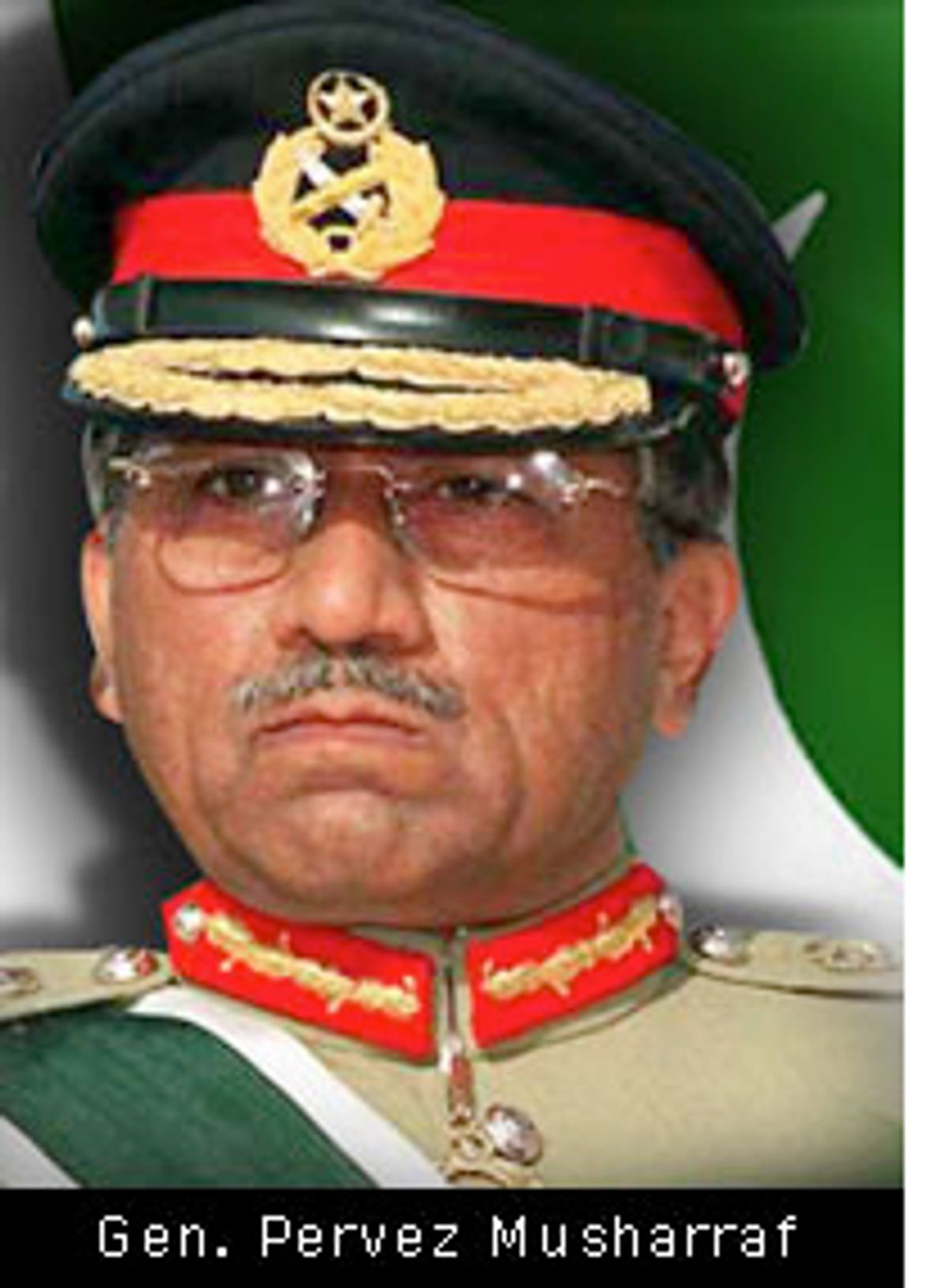
Gen. Pervez Musharraf’s successful military coup in Pakistan Tuesday surprised few of those who have been following the deteriorating situation in the South Asian country recently.

The takeover came after Prime Minister Nawaz Sharif tried to fire Musharraf on Tuesday afternoon and replace him with a former head of military intelligence. Instead, Musharraf ordered his troops to arrest Sharif, close down the Islamabad airport and secure the national media.

Appearing on state television, Musharraf stated: “Despite all my advice, they tried to interfere with the armed forces, the last remaining viable institution in which all of you take so much pride and look up to at all times for stability, unity and integrity of our beloved country.”

For the past 10 years, the country has been ineptly ruled by an alternating team of prime ministers — Sharif and Benazir Bhutto, the latter awaiting trial on corruption charges. During this time, Pakistan’s economy has declined drastically.

The downward spiral went out of control last year, after Sharif ordered nuclear weapons testing in what was widely interpreted as a challenge to neighboring India. Serious border disputes between the two countries have flared up anew in recent months, leading to the imposition of sanctions against Pakistan by Western governments. The International Monetary Fund and World Bank have temporarily stalled loans that had been keeping Pakistan’s sinking economy afloat.

Sharif initially supported a move by Pakistani infiltrators (now widely believed to have been Pakistani soldiers) into the disputed Kargil region of Kashmir last year, then ordered them back to Pakistan under pressure from the White House. The retreat outraged Pakistani military leaders and provided the context for Tuesday’s coup.

A number of experts discussed the coup in Pakistan and its implications for regional stability with Salon News.

Howard B. Schaffer is director of studies at the Institute for the Study of Diplomacy at Georgetown University and former U.S. ambassador to Bangladesh.

The overthrow of Sharif by the military did not come as a surprise.

There [was] an awareness on the part of the army that Sharif had failed in many primary areas of governance and had become unpopular, setting the stage for it to intervene without serious concern about adverse public reaction. Its hand was forced by Sharif himself, who sought to dismiss the army chief — a move which he had been successful at a year earlier when he dismissed Musharraf’s predecessor — which led to this army reaction. The most serious failure has been on the economic front.

Another failure has been on the law-and-order front. There’s been increasing sectarian violence between extreme shia and sunni groups. There have been allegations, which I fully credit, of considerable corruption. There has been tension between the majority state [the Punjab province and home of Sharif] and the four smaller provinces. This is a laundry list of failures.

There has been very little hope that there could be substantial change in any of these areas. Sharif has been unwilling to crack down on those of his supporters who have had their hand in the cookie jar. He’s been unwilling to take politically risky measures to improve the revenue situation. He failed at Kargil and he created a foreign policy situation where Pakistan has very few friends in the world.

We don’t know much about Musharraf except that he’s a professional military officer … He is considered a secular person — I’m sure he’s a faithful Muslim — but he is not seen [as some other generals have been] to be inclined to an Islamic view of things. Allegations that he may lead Pakistan to take a more Islamic-oriented policy, especially vis-a-vis the Afghanistan situation, seem ironic when you consider that the guy whom Sharif proposed to replace him [Gen. Khawaja Ziauddin, head of the military intelligence] has been seen to have strong Islamic ties.

It’s a blow to U.S. foreign policy. The attitude of the U.S. government toward the Pakistani regime is going to depend on what kind of polity emerges in the next day or so. The Pakistani generals are still consulting among themselves to decide what to do next. The [option] favored by Washington would keep the present parliament in place but remove Sharif and a few figures associated with him. And then create a new, duly elected government comprising parliament but excluding these figures. The second approach, most favored by Pakistani elites, would create a substitute government of technocrats — senior officials and retired figures — and have them serve as a caretaker government to clean up the messier elements in the three months leading up to elections. This follows the pattern used earlier in the decade.

Robert Hathaway is director of the Asia program at the Woodrow Wilson International Center for Scholars.

The real triggering event was Sharif’s decision in July to withdraw the Pakistani troops who had infiltrated Indian territory in Kashmir. What happened was Sharif saw Pakistan was taking a military beating in Kashmir, and an economic beating at home and in the international community. But the roots of the problem go back further than this summer.

The last military dictator of Pakistan was killed in 1988 in an as-yet-unexplained plane crash. Since then, Pakistan has had a succession of weak administrations, none of which finished out their constitutional lives.

The Pakistani military had become increasingly disillusioned … By any measure, the economy is going down the tubes. The social indicators are terrible. Whether you talk about literacy, infant mortality, people who live without electricity or health care, it’s staggering.

What Pakistan has had since 1988 is poor leaders. Sharif was prime minister twice, [Benazir] Bhutto twice. But neither demonstrated any real ability to govern or meet the needs of the people. Both surrounded themselves with corrupt officials.

I don’t want to overemphasis it, but another factor is the role that Islamic radicals have played or might play in the takeover. To many Islamic radicals, Kashmir was a holy war, and the pullout by Sharif was not only a betrayal of the nation, but a betrayal of a solemn religious obligation to help their Muslim brothers.

There are things the U.S. can do, has already done, and should do in the future. First, we need to recognize that our influence is limited … We should send a message that we have no intention of conducting business as usual with Pakistan. This means that we will vote in the World Bank against loans to Pakistan. It means we will use the United Nations and other international forums to highlight what has transpired. It means that we will not give them diplomatic support in the disputes with India or other countries. Not so long as the military is in power.

Marshall Bouton is executive vice president of the Asia Society.

A lot of attention has been paid to differences that emerged between the military and Sharif. There was growing tension between the military and the prime minister. The prime minister was looking to contain the influence of the military. He dismissed the previous military authority for remarks that were taken as a suggestion that the military should have more power. There was growing concern among the military about the stability of the government and economy in the country. Ultimately the army considers itself the guardian of the country’s stability and integrity.

The political institutions in Pakistan did not acquire the roots in the national body politic that would help them over time. There was always this tension and between the government and the military. You had a relationship of distrust that in turn undermined the development of a political elite.

Success of military coups in the history of Pakistan varies widely. There is a widespread expectation that this new regime will lay out some kind of phased plan that will go from something short of martial law to technocratic, non-elected civilian government to full democratic control.

It will be difficult because the political institutions and the elite are not strong enough to sustain such a plan, so there’s no one whom the military can look to, to carry out this plan.

The United States has to send a three-layered message to the new military leaders:

1. We don’t approve of extra-constitutional changes of government, period.

2. We expect them to lay out a plan for return to civilian authority and eventually some legitimate democratic process.

3. This is a message best sent privately: We would be strongly opposed to any steps that would raise tensions with India. We expect the new government to not do anything to raise tensions and actually to find a way to reduce them.

They must recognize — if their purpose is to safeguard the integrity of Pakistan — that the path to that does not run through conflict with India.

Stephen Solarz is a senior advisor on South Asia at the Center for Strategic and International Studies.

Considerable thought had been given to this [coup] for some time.

From the inception of Pakistan, the military assumed the dominant role in the affairs of the nation because the nation’s founder died not long after Pakistan became independent. In India, [Jawaharlal] Nehru served as prime minister for close to 20 years, and he was very committed to the principle of parliamentary democracy, and civilian supremacy played a critical role in institutionalizing these principles.

There was no comparably legitimizing figure in Pakistan.

Civilian lack of reaction to the coup has largely to do with the fact that the economy is in a shambles, and the regime was inept at dealing with the problems of the country. It was mired in corruption, as were previous administrations. Also, the decision of Sharif to pull troops out of Kargil was seen as humiliating.

It doesn’t have any profound implications for nuclear proliferation because Pakistan already had nuclear weapons under the control of the military and still has nuclear weapons under the control of the military. It does have profound implications for the future of democracy in Pakistan, for Pakistani relations with the United States, and for relations with India.

Andrew Koch is a reporter at Jane’s Defence Weekly and an expert in South Asian nuclear proliferation.

The coup came as a surprise to Sharif. He clearly thought he could get rid of Musharraf. But when he tried to fire him, it was the straw that broke the camel’s back. Sharif was immensely unpopular. There have been signs for weeks that something might happen. The United States warned the Pakistani military recently not to do something like this, and Sharif expected the United States to save him. But in the end what could we do?

It’s too early to say what’s going to happen to the long-term government. Everybody’s in a wait-and-see mode to see what the army’s going to do. It doesn’t really affect their nuclear stockpile — it was already under the control of the military and now remains that way.

Musharraf might be a bit [hawkish] compared to past Pakistani generals, but typically it’s the political leadership that’s been causing the biggest problems. They tend to go for the demagogue rhetoric in Pakistan to whip up political support. Both Sharif and Bhutto have been guilty of lambasting India as a huge threat and said that their opposition hasn’t been doing anything to safeguard against that threat. A lot more so than the military. People are saying that Musharraf is hawkish because he was the guy behind the Kargil [Kashmir] attack this summer. But I would caution that he is not whipping up, nor has he ever to my knowledge, Pakistani concerns vis-a-vis India like the political leadership has.

In terms of security in the region, if Pakistan could return to democracy in a solid form, that would be an immense help in stabilizing relations. But that’s predicated on the economy. [The economy in Pakistan] is a disaster. It was in very bad shape before the nuclear tests, but sanctions really hurt them. The country has suffered through many years of very poor governance. Bhutto was incredibly corrupt, and now she’s under indictment. Sharif is by many accounts just as corrupt. The level of his corruption hasn’t come fully into light because he jailed journalists and successfully ousted judges and put them under his control. With him out, it will be revealed how corrupt his regime was. These two leaders have traded off — one had led and then the other and back and forth for at least 10 disastrous years. Pakistan went on a more precipitous slide after the nuclear tests with the international sanctions and the temporary withholding of World Bank and IMF loans.

Alicia Montgomery is an associate editor in Salon's Washington bureau.

Daryl Lindsey is associate editor of Salon News and an Arthur Burns fellow. He currently lives in Berlin and writes for Salon and Die Welt.

The forgotten hunger strike

Hundreds along the India-Bangladesh border are fasting to death in protest -- and no one's paying attention

  • more
    • All Share Services

The forgotten hunger strikeA boy collects scraps near a vehicle spare parts store in Dholaikhal, Dhaka February 29, 2012 (Credit: Reuters/Andrew Biraj)
This article originally appeared on GlobalPost.

DHAKA, Bangladesh — By the eighth day of the hunger strike, Mijanur Rahaman had lost 15 pounds of bodyweight, and his blood pressure had plummeted.

Global Post

“I’m feeling very weak,” he said, stating the obvious.

Rahaman and a hundred others like him — including women and children — are 10 days into what they say is a fast-unto-death, a desperate call for release from a permanent state of limbo for the residents of the India-Bangladesh enclaves.

Officially known as “adverse possessions” — and colloquially known as “chitmahals,” or paper palaces — are a collection of Indian and Bangladeshi villages home to 51,000 people, where for generations, citizens have been stuck on the wrong side of the border.

The residents of the 102 enclaves inside Bangladesh are technically citizens of India. Those in the 71 enclaves inside India are technically citizens of Bangladesh. In reality, they are stateless and virtually prisoners in their homes, cut off from public services such as electricity, schools, and hospitals.

They are unable to leave their villages without illegally trespassing on foreign soil. Residents of the Bangladesh-India enclaves are able to get electricity only by bribing local officials. For access to schools, jobs and hospitals, they must pretend to be someone else.

“If we take someone to the hospital, they now ask for national ID cards,” complained Mokul Hossain, a resident of Dashiar Chara enclave. “If we can’t show them then they leave us to suffer outside the hospital. Our only choice then is to take them to a witch doctor.”

As desperate as a hunger strike is, this one hasn’t received the press that others have in the past. Like the plight of the stateless enclave residents themselves, this extreme act of protest has largely gone unnoticed abroad.

The situation enclave residents find themselves in would be similar to that of Liberty Island — which belongs to the New York state but is located inside New Jersey — if the Statue of Liberty was housing 50,000 people who had been trapped there for more than six decades.

Without citizenship, enclave residents feel that they will never have the chance to improve their lot. They have been fighting for their rights since 1947.

The ongoing struggle of the enclave residents highlights the dysfunctional relationship between India and Bangladesh, and their many unresolved border issues. Relations between the neighbors have almost always been contentious, souring immediately after a brief honeymoon period when India helped Bangladesh gain independence from Pakistan in 1971.

Enclave residents have grown increasingly bereft as numerous accords to resolve border disputes have been inked, but few get implemented.

The latest was a pact signed last September to simply swap ownership of the enclaves, but ratification of the land-swap deal juddered to a halt in the Indian parliament.

“We want exchange of the lands,” said Moniruzzaman Monir, a resident of Dashiar Chara, an Indian enclave inside Bangladesh. “All opportunities are closed to us until then.”

A grand Indian tradition

Delhi and Dhaka theoretically settled a host of disputes last September, from finally agreeing on a demarcation of the land border to pledging to stop extrajudicial killings of Bangladeshi citizens by Indian border forces.

But little has changed on the ground. This has driven people like Rahaman, who daily live the consequences of these political differences, to extreme steps such as the indefinite hunger strike.

The fast-unto-death is a grand Indian tradition. During India’s struggle for independence, Mahatma Gandhi frequently employed the tactic to extract concessions from British colonial rulers, prompting an aggravated Winston Churchill to send a telegram inquiring “why Gandhi hadn’t died yet.”

Most recently, septuagenarian anti-corruption crusader Anna Hazare’s hunger strike in April 2011 led to nationwide protests in his support, ending with the government agreeing to form a committee to appoint an anti-corruption ombudsman.

With little other leverage, impoverished enclave dwellers resorted to the hunger strike, hoping that this drastic measure will finally get their suffering heard.

At least five have been admitted to hospitals since the strike began on March 18. But in stark contrast to the Hazare media storm, their action has received minimal coverage and has failed to elicit a peep from the officials whose attention they are seeking.

Rahaman, who lives inside the Indian side of the border, is understandably bitter.

“There is no human in the government. They are all stupid,” he said.

Attracting the bulk of the ire of those instigating for a resolution is chief minister of the Indian state of West Bengal, Mamata Banerjee.

West Bengal, where all the Bangladeshi enclaves are located, is suspected to oppose the land exchange because of worry over how the subsequent change in electorate might impact local elections.

Banerjee has a history of scuppering landmark deals between Dhaka and Delhi. Last September the Indian Prime Minister Manmohan Singh landed in Bangladesh ready to sign a crucial water-sharing treaty, only to pull out due to Banerjee’s last minute opposition.

India considers itself to be a kind of big brother figure to the younger nation, but most Bangladeshis view the South Asian giant as the neighborhood bully.

Similarly many Indians distrust Bangladeshis, viewing them mostly as a source of unwanted large-scale illegal immigration.

The trouble the two countries have in reconciling border issues and executing the land swap raises questions about their ability to tackle more complex disputes over trade and natural resources, and bodes poorly for the future of regional cooperation in South Asia.

A worst-case scenario

The Bangladesh-India enclaves are by no means unique. Enclaves can be found on almost every continent.

In November 2011 a New York Times blog compared the Bangladesh-India setup to the enclave complex of Baarle, a town split between the Netherlands and Belgium on the Dutch side of the border.

Baarle is “a money-spinning tourist attraction,” where houses on the border move their main entrance to face whichever country has the cheaper taxes because taxes are paid to the country where the front door is located.

Baarle, the blogger opined, was a best-case scenario. The Bangladesh-India complex, on the other hand, was the worst.

On March 26, people in Indian enclaves inside Bangladesh hoisted the Bangladeshi flag in celebration of the nation’s day of independence. It was their way of asserting their claim of citizenship of the country they have spent their entire lives in.

Meanwhile, Rahaman and his neighbors continued their fast, determined to call attention to their cause.

Continue Reading Close

Letter from Mumbai

Could this long-winded carpet merchant really mistake me for a wealthy customer, ready to whip out my credit card?

  • more
    • All Share Services

Letter from Mumbai (Credit: Patrick Smith)

Flying from Europe to India, we pass overhead Odessa, Ukraine. Odessa, they say, is home to the most beautiful women in the world. Then across the Black Sea to Azerbaijan and the gorgeous barren landscapes of Georgia. Next comes the ink-dark Caspian, and then the long desolate outback of northwestern Iran. (The controllers down in Tehran are courteous and professional, their English impeccable — easier to understand than most Scottish controllers.)

From there it’s directly overhead the apocalypse of Karachi, followed by a turn southbound, out across the Arabian Sea toward Mumbai.

It’s true about the smell. At around 10,000 feet the airplane begins filling with the rank bouquet of India: a soupy waft that tastes of putrefaction and exhaust fumes. As if, somewhere below, the world’s largest garbage dump has been set on fire. It’s a smell that burrows into your clothes and your hair and right through the concrete bunker walls of your five-star hotel.

Twenty-four hours downtime.

The concierge hooks me up with young driver named Faiyaz — a most conscientious and law-abiding wheelman with a silver Toyota and remarkably handsome teeth. A hundred U.S. dollars for the day it will cost, gas and sporadic commentary included.

It’s monsoon season, and we set out under a nervous, curdled sky. The air has a smell of rotten expectation, like a sink full of dirty dishes.

Maximum City, as Suketu Mehta dubbed it. And I never thought I’d see a metropolis with traffic worse than, say, Cairo or Bangkok. But at least the chaos of Cairo stays more or less in motion. Mumbai’s traffic never has the chance to become chaotic. Every road, highway, back street and boulevard exists in a permanent state of gridlock. And all of it four-wheeled and motorized. One misses the cows and three-wheel auto-rickshaws that jostle for space in other Indian cities. If nothing else they make for a more exotic view — a form of entertainment when you’re cemented into a non-moving column for 45 minutes.

The 10-mile drive to downtown takes almost two hours. Averaged out, that’s a little faster than walking. It’s a long, if morbidly engrossing trip through the city’s most frenetic northern suburbs.

Mumbai isn’t unlike most big cities, I reckon — provided you took that city, layered it under several inches of solid and semi-solid waste, then ran it through a blender. That’s a cheap and nasty description, but looking upon Mumbai is, for me, a pained gaze through layer upon layer of chaos — a noisy, smelly, kaleidoscopic battle between machinery, concrete, garbage and flesh. From the car I catch sight of a tiny kitten, skinnier than a sparrow, moving nervously along the roadside gutter with a rat hanging limply from its fangs. The miniature, mud-spattered feline is boxed in by an endless stream of vehicles, and is simultaneously being bullied by an impetuous gang of hooded crows. A half-dozen of the lead-colored birds are jabbing at the kitten with their deadly black noses.

How does this battle conclude? Who knows. Faiyaz hits the gas and we’re gone, onward to the next little nightmare.

Looking skyward, the air above, I notice, is no less a conglomeration of noise and form, swollen with sooty rain and noisily aflutter with creatures. It’s the crows who dominate, their ranks swollen by a surplus of streetside carrion. There are pigeons too; hawks; the occasional green parrot; and a huge, day-flying bat with a wingspan as wide as a seagull’s.

Finally reaching downtown, Faiyaz navigates down a leafy street to the Mani Bhavan Gandhi Sangrahalaya, longtime residence of the country’s most beloved and well-known historical figure. I take in the history of the great scrawny Mahatma as presented through photographs, artifacts (yes, a spinning wheel) and an oddly engaging series of dollhouse-style dioramas.

It’s a self-guided tour, but I’m shadowed at each turn by a family of four, chattering away in Arabic. They are, I realize with some discouragement, decked out in the ubiquitous regalia of the upwardly mobile Arab: The man is about 35, stocky and fit, with a pair of expensive sunglasses retracted atop his head. He is wearing dark navy Levi’s, a leather belt and a Ferrari polo shirt. His young son, around 8 or 9, is wearing both a Ferrari polo and a Ferrari ball cap. Three paces behind trundles the man’s wife, heavyset, covered top-to-bottom in a Gulf-style abaya. A miniature daughter in a purple skirt and a plastic princess crown clutches the woman’s hand, chirping along in tow.

Next is Chhatrapati Shivaji Terminus, formerly Victoria Terminus, the prickly, Gothic Revival wedding cake of a railway station and UNESCO World Heritage Site. The station has a prominent cameo in 2008′s “Slumdog Millionaire.”

And on Nov. 26 that same year, you might recall, two men spent the better part of an hour inside Shivaji firing AK-47s and hurling grenades at commuters, killing 58 of them.

Eight of the attackers’ colleagues had meanwhile scattered elsewhere around South Mumbai and were having a similar night out, shooting and blowing things up at the Oberoi Trident Hotel, the Cama Hospital (for women and children), the Leopold Cafe, a Jewish community center, and, most infamously, at the British Empire’s most luxurious home-away-from-home, the Taj Mahal Palace Hotel. All together, 167 people were murdered in the attacks, and nine of the 10 terrorists were shot by police.

Today the reopened Taj, like many big-city hotels, is at least nominally protected by airport-style metal detectors and X-ray belts. I’m not sure what good this does. Inside, there’s no trace of the 60-hour siege that caused $40 million in damages. It’s all rich wood and rich upholstery and rich-looking men bent in hushed, important-sounding conversations. (I’d hardly turn down a night’s stay in the place, but as a tourist destination I prefer the actual Taj Mahal, several hundred miles to the north, in the pandemonium sprawl of Agra.)

Across the street from the Taj sits the Gateway of India, a 90-foot basalt archway and promenade poised at the harbor’s edge. It was here that the Mumbai gunmen had boated ashore from Pakistan, and where, after so much time in the car, I’m eager to go for a stroll.

The problem is parking.

Fiayaz suggests that we use a complimentary space offered by a carpet emporium — a place called All Asian Imports. The catch being that I’ll initially have to go into the store and pretend to be shopping, at least for a minute or two. Then I’ll be free to take my walk along the waterfront. Faiyaz will wait in the car.

This seems a reasonable, if entirely facetious plan, but as I’m pushing through the heavy glass doors I can’t help feeling conspicuous and a bit embarrassed. This just ain’t my kind of place. I’ve bought rugs in foreign countries before — the gouged-up floors of my apartment are concealed by curio-quality kilims from Morocco and Egypt — but the emporium’s nearly conjoined proximity with one of the world’s most exclusive hotels, not to mention its showroom chandelier, ample air conditioning and smartly dressed salespeople, say one thing clearly: There is nothing in here that I can afford.

I’m thinking, fast in, fast out, until I’m grabbed hostage by a salesman with brightly polished shoes and a furry black monobrow. I might be an obvious impostor, in my New Balance sneakers and a sweat-stained T-shirt, but for the next half-hour I am given a theatrical dissertation in the finer points of oriental carpet appraisal. I can’t get a word in edgewise. All escape is blocked.

Of all the things that might possibly happen in this store, my taking out a credit card and purchasing a carpet is beyond the realm of possibility. I’m afraid to let him know that, however. It would be impolite, even a touch hostile, not to feign interest.

So I nod and crinkle my forehead as Monobrow speaks. Nod and crinkle, nod and crinkle, nod and crinkle — the globally recognized expression of “yes, fascinating, tell me more,” as I slowly suffocate from the sheer boredom of it all.

Carpets are everywhere, stacked like logs. Monobrow snaps his finger and an assistant pulls a cylinder from the rack, unfurling it with a crackle. He shows me cotton-on-cotton, silk-on-cotton, then quizzes me on the differences. He rolls out a factory-made Chinese synthetic, laying it next to a sumptuous $5,000 Kashmiri example (something-on-something, with alkaline, or maybe it was non-alkaline, dyes). Can I spot the differences?

Maybe. Sort of.

Next example. Then another and another and another. Soon there are several inches of rugs on the floor, slabbed atop each other like sheets of multicolored plywood. Somebody, it strikes me, has to roll them all back up again. Do I look like a wealthy customer, I’m wondering, skeptically. Or is he on to our parking scam and screwing with me, just to keep me from my promenade stroll?

At one point I bend down like a baseball catcher and pinch the fringy corners of several of the offerings, running the material briefly through my fingers in what I imagine to be the gesture a serious carpet-buyer might make.

Did I give myself away?

“Thread count,” Monobrow booms, as if an entire audience had gathered in the room, “is how a fool judges a carpet!” Is that what I was doing in my crouch, counting threads-per-centimeter?

Ditto, I’m informed, about the intricacy of the pattern (which would have been my second guess). No, a rug’s real value comes from the qualities of three and only three things: “Material, dyes and workmanship.”

He pauses after each of these words, as if it were a quiz and I might fill in the blanks instead of just staring at him.

I cast a glance sideways, through tinted windows and out to the Gateway, where I’m supposed to be enjoying the rest of my afternoon. The weather, I notice, is looking more ominous than ever.

And it dawns on me that the experience of travel, like the experience of life in general, is made up of too many scenes exactly like this one. That is, long stretches of boredom and squandered time, from which one yearns to escape, only to find his egress obstructed by an instrument of commercial tedium. Like those papyrus store “convenience stops” on the way to Giza or that place near Siem Reap with the rows and rows of Buddhas. In this case it’s a long-winded lecture from a carpet merchant.

My means of escape, though, turns out to be simple enough.

“This one is extremely nice,” I say to Monobrow, pointing to whichever rug he happened to have unfurled below me at the moment. “But before we talk about price, my wife will need to see it.”

“Your wife? Of course. Where is she?”

“Across the street, at the Gateway. Let me go and find her and bring her over.”

Suddenly I’m hit by an old, old memory. The first time I ever bought a carpet in a foreign country — or maybe in any country. It was in Kusadasi, Turkey, near the ruins of Ephesus, in 1992. Kirsten, maybe, still has that little rug somewhere. This was before they lopped off all those zeroes from the Turkish lire, and I remember on my credit card statement how the numbers went right off the end of the page.

Monobrow is suspicious, I can tell, as he ought to be. But my excuse is wonderfully bulletproof. “As you wish,” he says.

“She will love the alkaline, non-alkaline cotton-silk non-Chinese dyes of this carpet.”

And with that I’m finally out of there.

As the door closes behind me I feel dirty, guilty, all eyes upon me, like a man slinking out of a whorehouse. I had no business being in there. I’m a kid from Revere, Mass., who went to community college. I don’t spend thousands of dollars on deluxe imported carpets, and I don’t feel comfortable in high-end boutiques that smell like jasmine and where the salesmen sip tea out of fancy china.

Again the alienation and failure of travel — the disappointment of finding yourself somewhere different, but not where you hoped to be.

The Gateway looks a lot like the Arc de Triomphe and its cousins in Washington Square and Brussels and everywhere else. Except that it’s grander and prettier, with its 16th-century Gujarat styling — at once European and Eastern, Victorian and Mughal.

There’s the crack of thunder. The sky looks like the bottom of a car, all rusted and scabbed and preparing to wreak havoc on everything beneath it. When the downpour comes the filthy gutters will turn to a brown, clotted stew.

I take my stroll, along past the Taj and to the back side of the Gateway, dark waves lapping at the seawall, occasional raindrops hitting me in the shoulder. I imagine the Mumbai attackers sloshing ashore here, clambering onto the street in their Adidas sneakers and cargo pants, weapons concealed in their satchels and backpacks. All the way from Pakistan they sailed. Travel of another kind.

For additional photos, see the author’s Mumbai set here.

- – - – - – - – - – - -

Join the ASK THE PILOT mailing list.  Keep abreast of upcoming changes, the newest articles and other info.  To sign up, send a message to patricksmith@askthepilot.com with the word SUBSCRIBE in the title.

Continue Reading Close

How to write about poor people

Katherine Boo on India's crushing poverty and corruption, laid out in her acclaimed "Behind the Beautiful Forevers"

  • more
    • All Share Services

How to write about poor peopleKatherine Boo (Credit: Unnati Tripathi)

To say Katherine Boo writes humanely about poverty is an impossibly limited description. She writes about people — oft-ignored people with whom she’s spent years, accruing thousands of documents and hours of footage. And somehow all of this research turns into an exquisite, seamless narrative, a feat made all the more difficult by the fact that the subjects of her first book, “Behind the Beautiful Forevers,” the inhabitants of a Mumbai slum, speak languages she doesn’t know.

And yet even beyond the particularity of their stories, it’s clear the teenage garbage collectors and would-be power brokers and brides all live within a hopelessly broken and corrupt system that crushes their aspirations daily, an unmistakable conclusion of the book. “I don’t really believe in the representative poor person as a construct,” Boo told me this week. “But even if every individual is anomalous in every class and every country, I hope there’s another way to read the book, looking at the way in which money that’s intended for schools and child laborers and girls gets diverted, or the realities of police brutality.”

It’s not as if the deprivation and violence of the community’s daily life is entirely invisible to either the Indian government or outsiders. It’s that webs of corruption are wrapped so thickly around anti-poverty efforts as to make them a joke to the intended beneficiaries. A nun who worked with Mother Teresa turns out children on the street and sells impoverished people the expired food donated by hotels to nourish them. Foreign journalists visit the Annawadi slum to see whether government-funded women’s self-help groups are empowering women, and one of the craftier characters, Asha, gathers “random female neighbors to smile demurely while the officials went on about how their collective had lifted them from poverty.” Asha announces that her daughter, who fears the marriage that her mother will arrange, won’t be “‘dependent on any man.’ The foreign women always got emotional when she said this.” Boo doesn’t judge her: “For the poor of a country where corruption thieved a great deal of opportunity, corruption was one of the genuine opportunities that remained.”

Boo says now, “When we talk about accountability and implementation, even when I say those words, they’re just such eye-glazers. But that’s really what it’s about. It’s not that everybody in power wants to have a world in which somebody who is slowly dying on the road gets passed by. It’s that there’s so little work done to make (sure what) happens in Delhi or in Washington actually gets to the people it’s intended to. Whether it’s when I was reported on group homes for the developmentally disabled” — the work that won her a Pulitzer — “it was the same thing. The money just ended up circulating among the already privileged.”

But Boo is a reporter and a storyteller, and she doesn’t have a policy prescription, per se. She does believe that “statistics about the poor sometimes have a tenuous relationship to lived experience,” as she writes at the end of the book, adding, “I just believe that better arguments, maybe even better policies, get formulated when we know more about ordinary lives.”

Boo’s husband is Indian, and he’s the one who first suggested she turn her curiosity about poverty in booming India into a reporting project. She resisted, she writes in the book, out of fear for her ailing health and concern that she lacked the context or skills to write about India’s poor. One night at home in Washington, D.C., “tripping over an unabridged dictionary, I found myself on the floor with a punctured lung and three broken ribs … Having proved myself ill-suited to safe cohabitation with an unabridged dictionary, I had little to lose by pursuing my interests in another quarter — a place beyond my so-called expertise, where the risk of failure would be great but the interactions somewhat more meaningful.”

So she spent three years in Annawadi, interviewing and reinterviewing children and men and women with the help of a team of interpreters and a Flipcam. Of the interpreters, she says, “I had a bunch of false starts. People weren’t used to working in the style that I work, patient watching and listening. The days would feel pointless to other people, like, ‘Why are we sitting here all day watching this kid sort garbage,’ somebody might say. The conditions are bad.” (One of the main geographical features of Annawadi is a giant sewage lake.)

She considered the first few months a write-off, except for the conversations she managed to witness. “The best material I got in the beginning was listening to people and tape recording and just collecting how people were to each other because that was their natural way, because they were still awkward with me and the whole translating thing,” Boo says. “If I’d tried to do straight interviews at that point, it would have been so strange. I would have been sitting in a hut, asking someone questions with a hundred people outside the door trying to find out who I am and what I’m doing.” Eventually, they got used to the sight of the delicate blond woman and stopped paying her much attention.

It’s hard not to wonder anyway how much her presence might have put some people on notice or led the main players to see their lives differently. “There was a night when I was in the police station and they were beating the shit out a mentally disabled man,” Boo replies. “And on the phone they were calling his brother in Hyderabad so he could hear his screams so he could help to secure his release financially. My presence didn’t put them on their best behavior.” But she knows she couldn’t help but change some things, even if it was just asking questions. Questions that, for example, could lead to realization that there’s something wrong when the police don’t investigate the murder of a child and document a demonstrably false cause of death.

“I could barely get out of bed at some points in the reporting,” Boo admits. A friend who had worked as an investigative reporter and is now a novelist told her to pull up her socks and keep at it — otherwise, almost no one would ever know about these wrongs. But Boo is also careful, almost to a fault, to not make the story about her. “I didn’t want it to be like, ‘When I met Abdul …’” I want the readers to see it through his point of view, that he’s risen in an incredibly competitive group of [garbage] scavengers. I don’t want to be on every page instructing the reader what to think.”

There’s a risk to that as well, of course, the possible presumptuousness of inhabiting another person’s head when they’re not your novelistic creation. But Boo pulls it off, maybe because she’s that good, or because she realizes that even the very poor “are neither mythic nor pathetic,” nor very different from herself in ways that count. “When I’ve had hardships in my own life, it doesn’t make me a better or nobler person,” she says. “Suffering doesn’t necessarily make people good in my experience.”

When, during the years of reporting, she would tell better-off Indians what she was working on, “Many people felt like, Oh, we know. I was like, do you really know? Because sometimes saying you know is a way of not knowing.” But now that the book is out, Boo has managed to get rapturous reviews from Indian critics who might be understandably skeptical of another Westerner explaining their country’s ills to them.

“She has captured the spirit of colloquial Hindustani and Marathi without using an idiosyncratic idiom, and deftly negotiated distinctions of caste, class and religion,” wrote one reviewer, Girish Shahane. “I am used to hearing false notes in depictions of Mumbai life; when they occur repeatedly, they undermine the authorial voice. The 250 plus pages of Behind the Beautiful Forevers contain no false notes.” One Indian interviewer, Anjali Puri, wrote, “All manner of ‘India specialists’ — journalists, sociologists, poverty-theorists, middle-class anti-corruption crusaders — may find themselves feeling inadequate by the time they have reached the end of” Boo’s book.

The most interested parties in India — the people featured in the book — saw Boo herself visit a few weeks ago to hand out advance copies (in English, for now) and show the videos that will be part of the enhanced e-book. “It was emotional,” Boo says of her return. “This is a very draining experience for many of them, particularly for people asked to relive some of the worst memories of their lives and to help me get it right.” (She fact-checked the book herself, another reliving for her characters.)

And they’ll have to live with what’s revealed in the book, particularly because Boo makes a policy of using real names and emphasizing that this is not “tall tales from the under city,” as she puts it. “One of the things that always troubled me is that you get to the end of a long piece and it would say, names and details have been changed. What details? Would you do that for rich people?”

Continue Reading Close
Irin Carmon

Irin Carmon is a staff writer for Salon. Follow her on Twitter at @irincarmon or email her at icarmon@salon.com.

“Behind the Beautiful Forevers”: Real-life Indian epic

A legendary journalist's first book tells of lives, loves and quarrels in a Mumbai shantytown

  • more
    • All Share Services

Katherine Boo

There are cult filmmakers and cult novelists, but Katherine Boo may be the world’s only cult journalist. Although a recipient of the Pulitzer Prize and a MacArthur Fellowship, she’s not a marquee name in her profession. Yet those discerning readers who have latched onto her work — particularly her articles for the New Yorker — are obsessed with it. (The TV and movie producer J.J. Abrams, of all people, once interrupted an interview to rhapsodize for 10 minutes about Boo. “Do you know her?” he asked reverently.) And now, at last, Boo has published her first book.

“Behind the Beautiful Forevers” is the result of intensive, immersive observation over the course of four years in the life of a Mumbai shantytown called Annawadi. Boo’s technique is as exhaustive as it is self-effacing. She conducts countless hours of interviews with her key “characters,” interviews that, to judge by the results, can be as searching as therapy sessions. She backs these up with documentary research and shoe leather reporting. To establish what actually happened during a crucial event — the self-immolation of a one-legged woman following a dispute with one of the book’s central families — she interviewed 168 people, many of them more than once. She never mentions herself.

It’s tempting to compare the resulting narrative, seamless and intimate, to a novel, but since the reading public appears to be allergic to fiction about people like the Annawadians — poor, foreign and dark-skinned — that would hardly do it justice. This is a scrupulously true story, and therefore comes to us with an added luster of authenticity. But unlike most reporting on the poor, foreign and dark-skinned, “Behind the Beautiful Forevers” mightily resists the urge to treat any of the half-dozen principle characters as examples of their class. The whole point of the book, as Boo states in an interview with her editor included as an afterword, “is to portray these individuals in their complexity — allow them not to be Representative Poor Persons.”

Who are they? Most of them are members of two families, each led by an indefatigable but flawed matriarch saddled with a weak spouse. The Husains are Muslims, migrants from northern India, who have built some modest security for themselves in the trash-picking trade, largely through the sharp eyes and diligence of the oldest son, Abdul. The other clan is Hindu and led by the formidable Asha, a ruthless fixer who aims to make herself the “slumlord” of Annawadi via her connection to the Hindu nationalist political party, Shiv Sena (a sort of Hindu Tea Party). Supporting characters include the bright and curious Sunil, a boy of indeterminate age, who sells his scavengings to Abdul.

Abdul is the quintessential head-down striver, while his brother Mirchi — in whose education the family has sunk a lot of its resources — dreams of “wearing a starched uniform and reporting to work at a luxury hotel” like the ones attached to the nearby international airport. For her part, Asha has raised a beautiful daughter, Manju, who promises to be the first female college graduate from Annawadi, though she’s too tender-hearted for her mother’s tastes and dreads being married off, as planned, to a boy from Asha’s home village. Still, Manju’s lucky compared to her spirited best friend, Meena, whose Dalit (untouchable) family beats her every time she presumes to question their orders or plans for her.

The Husains’ fate takes a turn for the worse when they decide to spend some of their new disposable income on a tile floor for their shack. (The “Beautiful Forevers” of the book’s title refers to a repeating ad for similar tiles, posted on the wall that screens off the slum from the airport road.) Their neighbor — the one-legged, man-crazy and quarrelsome Fatima — virulently objects to the noise, and the ensuing dispute ends with Fatima setting herself on fire after promising to “put you in a trap.” In the hospital, she accuses the Husains: first of burning her, and then of compelling her to burn herself. The case plunges the family into the nightmare world of Indian law enforcement and jurisprudence.

The charge is ridiculous, but this system, which for several years consumes much of the family’s time and nearly all of its money, is less a method of controlling crime and enacting justice than a vast bribe factory for the officials within it. Corruption and cronyism run and shape the world of Annawadi, from the thugs who extort protection money from rag pickers like Sunil to the nun who takes expired food donated to her orphanage and resells it to street merchants. In one of the book’s most eloquent ironies, Manju has to give up teaching the makeshift English classes she’s been offering to the local children because she’s too busy helping her mother administer an entirely fictional network of kindergartens funded by a Western nonprofit.

Boo mostly refrains from generalizing commentary; that’s part of what allows “Behind the Beautiful Forevers” to hug its subjects as closely as their monsoon-drenched hand-me-downs. But when she does choose to pull back a bit, it’s to comment on how magical thinking and conspiracy theory flourish in a world this arbitrary and unjust, a place that so glaringly lacks “a link between effort and result.” A string of deaths in Annawadi are attributed to a curse prosecuted by Fatima’s ghost, and above all, “powerless individuals blamed other powerless individuals for what they lacked … Poor people didn’t unite; they competed ferociously with one another for spoils.”

You can see why some of the people Boo writes about give up, but what’s more striking are the ones who don’t. Abdul in particular makes for an arresting figure, a man struggling to work out the pattern of a virtuous life in an immoral world. Little Sunil cases the city outside Annawadi with an eye to unexploited opportunities. Manju joins a civil defense network so she can study the manners of its middle-class members. By the time “Behind the Beautiful Forevers” winds to a close, it seems almost unbearable not to know whether any of them will succeed. We can’t. What happens next can’t be told because it’s still happening, right now.

Continue Reading Close
Laura Miller

Laura Miller is a senior writer for Salon. She is the author of "The Magician's Book: A Skeptic's Adventures in Narnia" and has a Web site, magiciansbook.com.

Salman Rushdie, back on trial

Threats and protests keep Rushdie from the Jaipur Literary Festival -- just the latest assault on Indian freedoms

  • more
    • All Share Services

Salman Rushdie, back on trialOfficials announce the news of calling off Indian born British author Salman Rushdie's video conference at the Jaipur Literature Festival, in Jaipur, in the western Indian state of Rajasthan, Tuesday, Jan. 24, 2012. (Credit: AP/Manish Swarup)

The Jaipur Literature Festival is a remarkable thing. It calls itself “the greatest literary show on earth.” In many ways, it is. Over 70,000 people show up. It’s organized by writers, not event managers. It’s free. Great crocodiles of school children in winter blazers crowd its sessions. Turbaned men with splendidly curled mustaches ladle out steaming hot chai into clay cups for the attendees. Parrots squawk in the trees. Chipmunks chase each other up and down the branches while Nobel laureates and Booker winners hold forth on the lawns. Indian grandmothers and blonde European expats trample over each other, fiercely fighting for seats. (The grandmothers tend to win.) It is a literature festival. But it’s more of a boisterous Indian mela – a fairground where anyone can come.

“We wanted it to be a place where you could meet Salman Rushdie, not just read him. Before Jaipur, you might only have been able to see him at some British Council event,” said William Dalrymple, the festival’s genial host. That was just about a month ago.

This week, the festival became a place where you could neither see nor read Rushdie. You were not allowed to even see his image on a video screen. And four writers had to leave town for the “crime” of reading from Rushdie’s novel “The Satanic Verses,” which is still banned in India.

Salman Rushdie would have been the biggest literary celebrity at Jaipur this year. But in his absence, he hovered over the festival like Banquo’s ghost. It was hard to find a session that didn’t mention the man. Even the posters lining the entrance seemed reminders of the guest who did not come to dinner. One quoted Lyndon B. Johnson: “A book is the best weapon against intolerance and ignorance.”

In the end, a government and a festival that provided VIP security for Oprah Winfrey was unable to even show a video link interview with Salman Rushdie. The teeming crowds on the front lawns were told that hordes of angry Muslims were marching upon the festival. Some were even inside the grounds. “We feel personally disgraced that after three weeks of struggle we had to give in to those who wish to suppress free speech,” the organizers said in a statement.

The next day the leading English language newspaper in my hometown of Kolkata carried a front-page image of a darkened television screen with the words “Sorry, no transmission because of weak spine” written across it. In a television interview broadcast later, Rushdie did not mince words. “It’s about time we understood, that if this is allowed to go on, that India will cease to be a free country, and that is something, which I think most Indians will greatly regret.” Of course, more people tuned into that interview across the country because of the protesters who shut down its broadcast in Jaipur.

The Rushdie affair unfolded, as he described it, as “a black farce.” It was as if two festivals happened at Jaipur.  On one hand there was a Jaipur Literature Festival with almost 300 writers, talking about everything from atheism to the young Stalin, from Shakespeare to Africa. It included the likes of Richard Dawkins, Michael Ondaatje, Jamaica Kincaid and Tom Stoppard. Rushdie might have called it the Festival of Gup (talk and debate). The other festival was the Festival of Chup (silence). It featured the chimera of Mumbai mafia hit men, silenced writers, an aborted video link and about two dozen protesters performing namaaz inside Diggi Palace, the festival venue.

Now it seems that the paid assassins who were allegedly on their way to kill Rushdie, had he come, were fabricated. It’s not even clear if reading from the “Satanic Verses” is really a criminal offense. (Some lawyers claimed that the book is banned under the Customs Act, which only prohibits its import into the country, not its reading.) Dalrymple says he was told that an 1867 statute made reading from a banned book a criminal offense. The festival could have been shut down. “The police turned up within an hour of the reading. Authors were going to be arrested. We thought we were going to spend the night in jail,” he said. Since then at least half a dozen complaints have been filed against the festival in different cities across India, complaints which could entangle everyone in cases for months to come.

Literary critic Nilanjana Roy quickly circulated a petition asking Prime Minister Manmohan Singh to consider revoking the 1988 ban on the novel, pointing out that the book has never incited violence anywhere. But given that the ruling Congress and the opposition Bharatiya Janata Party (BJP), were pretty much on the same side of the issue, it’s unlikely the prime minister is going to pay much attention. Even though his minister for human resources development, Kapil Sibal, was at the Jaipur festival reading from his own book of poems.

“Cherished freedoms must not be lost,” the minister recited from one of his poems, without any visible trace of irony.

In the aftermath of the Rushdie affair, some of those “cherished freedoms” seem to be endangered, if not lost. An editorial by Praveen Swami in The Hindu called what happened in Jaipur “a milestone that marked the slow motion disintegration of India’s secular state.” Rushdie might have become its cause celebre, but he is by no means the first victim, as Salil Tripathi points out in Index of Censorship. Nonagenarian painter M. F. Husain died in exile last year because his paintings offended the Hindu right wing.  A disabled gay painter was assaulted in Delhi this month because his work dealt with homosexual themes. Mumbai University withdrew Rohinton Mistry’s novel “Such a Long Journey” from its syllabus because some Marathi speakers thought their community wasn’t shown in a good light. Films about any remotely sensitive subject are routinely threatened with bans.

“But even if you can ban a film, can you ban the director?” asked Javed Akhtar, an eminent poet and Bollywood scriptwriter. Pakr Farooq, one of the protesters standing on the lawn, could not understand the difference.

“He has written the book,” he said stubbornly. “We cannot prosecute the book. He is the person liable. We do not even want to see his face. Directly or indirectly by video link.”

Farooq was staring at the giant screen as he spoke, his eyes fixed on it, as if waiting for Rushdie to materialize like a djinn.

Farooq’s “victory” could embolden many others like him, of all religious stripes, who know they can hold the state  hostage with just the threat of violence. And the state, whether it’s pusillanimous or pandering, is only too happy to succumb. “Free speech liberals literally don’t count in our democracy,” wrote my colleague Lakshmi Chaudhry on Firstpost. “There are simply not enough of us to matter to politicians on Election Day. There is no ‘liberal vote’ to be courted or appeased.”

“This is a wake up call for a class that wants to keep its hands clean all the time. They don’t understand India is a contested country. You have to roll up your sleeves and jump into the gutter,” journalist and editor Tarun Tejpal told the crowd.

He was met with resounding applause. I looked at Pakr Farooq and his friends. Their faces were impassive. They stood there with Jaipur Literature Festival day passes around their necks. It was a free festival. Everyone could attend, even those who threatened to shut it down. Every protester had his pass. On the way out, each one would turn it in to a khaki-clad security men, his day’s work done. But for now they stood there holding their ground in a sea of people who had turned up to listen to Salman Rushdie, thousands of people upset, angry and frustrated with them.

Impolitic as it was, I had to feel a sneaking sense of admiration.

I don’t know if I could have done the same if the situation had been reversed.

This essay is based on reporting conducted for Firstpost.com, an online site for news, views and analysis on India.

Continue Reading Close

Sandip Roy is an editor with New America Media and host of its radio show "UpFront" on KALW (91.7 FM) in San Francisco.

Page 1 of 44 in India