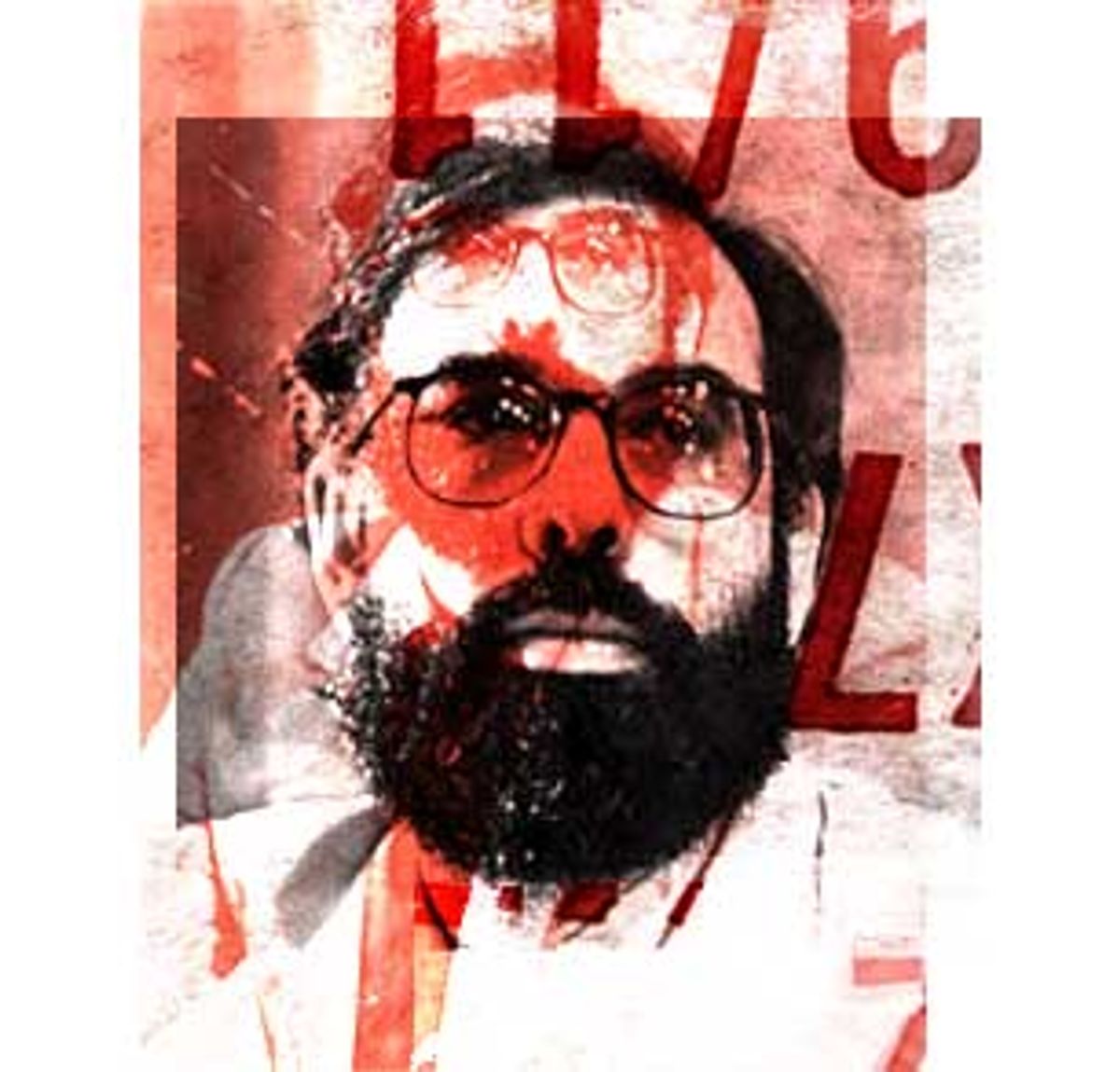
Marlon Brando

Francis Ford Coppola

At his best, his formidable creative energy has shaken up American movies and reinvigorated cinema both as art and popular culture.

The best glimpse you can get of Francis Ford Coppola comes in
“Hearts of Darkness: A Filmmaker’s Apocalypse,” a 1991 documentary about
“Apocalypse Now” that draws on his wife Eleanor Coppola’s film and audio
recordings during the shooting of the movie (in 1976 and ’77) and her
marvelous 1979 book, “Notes.” Whether you view him as a tortured poet, an
ostentatious showman, a martyr or an ogre, it’s impossible not to get caught
up in his drive to overcome disasters — natural, political and theatrical
– and to push his movie to the finish line.

No matter how desperate his
statements, no matter how eccentric his MO, he’s vastly more engaging than
the average precocious millionaire (he was, at the time, in his late 30s).
He’s going all out for art, and persuading hundreds of people to take the
plunge with him. The project seems insane because he isn’t trying to
fulfill his inspiration — he’s trying to locate it and execute it at the same time. Yet even when his ambition grows to megalomania and his film
begins to fall apart, his zeal and riskiness are as elating as they are
dismaying. He’s in the gambling tradition of American entrepreneurs — there
isn’t a single corporate-like censor in his consciousness (or apparently in
his corporation, Zoetrope).

The excitement comes from watching him go out on a limb; the
heartbreak comes from seeing him saw it off behind him. You feel you’re
seeing, in extremis, the same creative force that generated the “Godfather”
films and helped shake American movies out of their 1960s doldrums.

Of course, despite his youth (now he’s all of 60),
the “Godfather” films had given Coppola the stature of a patriarch. What fans
knew about his life only reinforced that image. Growing up in Queens and on
Long Island, he suffered through polio at age 9 (an episode he alluded to in
his script to “The Conversation”) and grew into a high school misfit, living
in the shadow of his confident, intellectual brother August. But once Francis
started directing college theater and film he became a charismatic figure.
With his mushrooming influence in Hollywood he was soon able to employ his father, Carmine — an ace flutist and frustrated composer — to write scores for his
movies. And he directed his younger sister, Talia Shire, in her
indelible performance as Connie Corleone in the “Godfather” films. Coppola
was also the father of three children, Gio, Roman and Sofia; he infected
them, too, with the movie bug. (All went on to work in movies, Sofia as a
full-fledged director; Gio was killed in a speedboat accident in 1986.)

“Hearts of Darkness” lets you sample the dumbfounding emotional
arsenal that this premature sage must employ to get his way. You get to
witness the child-wizard flirtatiousness that continues to draw creative
people to Coppola. He has a knack for making himself larger rather than
smaller by revealing his insecurities. Sometimes, the audio track drips with flop-sweat. In “Hearts of Darkness,” he says that he knows he’s making a bad movie, that
people don’t believe him because of what he’s pulled off before. (By 1976,
he’d made three classics in a row: “The Godfather” in 1972 and “The
Conversation” and “The Godfather Part II,” both in 1974.)

His frankness has a heroic quality. He’s totally disarming when he pinpoints the biggest fear of any audacious moviemaker — that his work won’t live up to the subject
matter, that it will be merely “pretentious.” He facetiously compares
“Apocalypse Now” to the disaster films of Irwin Allen (“The Towering Inferno,” “The Poseidon Adventure,” etc.). Are these contradictory ejaculations the mark of a driven artist, a self-conscious impresario or a man trying out alternatives? Of course, he is all three —
that’s why at the time of “Apocalypse” he seemed indestructible.

A series of nonstop catastrophes wreaked havoc on the backbreaking
shoot in the Philippines. A ruinous typhoon deluged locations and wiped out
sets. The Philippines armed services were unreliable. Crucial helicopters
were often called away to fight Communist insurgents, and fresh pilots had to
be coached from scratch every day. Coppola fired one star (Harvey Keitel),
shot around the heart attack of another (Martin Sheen) and wrote (and shot)
around the forbidding obesity of a third (Marlon Brando). He encouraged his actors to be their characters: In the documentary, Sam Bottoms talks of
playing a stoned soldier while on an array of drugs himself; Frederic Forrest
– who’s terrific — reveals just how surprised he was when Coppola sprang a
tiger on him. The 14-year-old Laurence Fishburne is an electrifying presence
off-screen as well as on. There’s a glimpse of Dennis Hopper as a
decade-older, strung-out Easy Rider, with melancholy in his eyes and gray in
his beard — perfect for the role of a freelance photographer too long away
from home. Through it all, Coppola says that the film’s meanings will come
into focus partly from the experiences he has making it.

After two years of post-production, the nearly finished film
screened at Cannes in 1979 and ended up sharing the Golden Palm with “The Tin
Drum.” Coppola gave a frighteningly perfervid press conference in which he
said, “My film is not a movie; it’s not about Vietnam. It is Vietnam.”
There must have been something both lunatic and exhilarating about Coppola at
that press conference, getting carried away with his own metaphor: “We had
access to too much money, too much equipment, and little by little, we went
insane.”

Of course, “Apocalypse Now” isn’t Vietnam; it is only a movie (as
Sheen’s wife told him in the hospital). Its reflection of the filmmaker’s
despair doesn’t deepen its view of the grief in Southeast Asia. John Milius’
original script and Coppola’s nonstop rewrites couldn’t support the
director’s flood of notions; the production was designed at every stage as
the sort of spectacle that overwhelms audiences rather than prods their
understanding — a movie that blows minds, not a movie that expands them. It
wasn’t even an actors’ showcase. Only the most stylized performance — Robert
Duvall’s bravura, “Patton”-esque caricature of Lt. Col. Kilgore — had a chance
to stand up to the physical grandiosity, and understandably won the most acclaim.

Yet the movie has become a contemporary benchmark. How many
reviews of the current “Three Kings” tried to explain that film’s combination
of realism and absurdity by evoking “Apocalypse Now”? The lasting message of
“Apocalypse” lies not in the thin, awkward retread of Joseph Conrad’s “Heart
of Darkness,” with Brando’s Kurtz repeating (like his namesake in Conrad)
“The horror! The horror!” No, the message lies in its druggy yet precise,
blazing downer style, which says more about our post-Vietnam attitudes toward
war than it does about war itself.

When I talk to moviemakers about Coppola, “Apocalypse Now” comes
up as often as the first two “Godfather” films or “The Conversation.” They
admire its formidable craftsmanship — the hallucinogenic merging of sound
and image so that you can’t tell electronic buzz from animal chatter, or
jungle sounds from the whoosh of helicopters. Or the way palms burn abruptly
with napalm, not with a dramatic burst but as naturally as sunflowers opening
up to daylight, while the Doors’ dirge “The End” plays out against the
flames. Coppola has selected “Apocalypse Now” to spearhead his latest cutting-edge venture, American Zoetrope DVD Lab (the wide-screen, Dolby-digital transfer of “Apocalypse” hits stores Nov. 23). And “Apocalypse Now” was picked as the first subject of the Bloomsbury Movie Guide series (Karl French did the study). Reading it back-to-back with Michael Schumacher’s dogged new biography, “From the Heart: The Life and
Films of Francis Ford Coppola,” I found the “Apocalypse Now” guide more
engaging and illuminating.

Maybe that’s because, particularly when viewed in conjunction
with “Hearts of Darkness,” “Apocalypse Now” becomes a movie epic that’s
really the epic about moviemaking, illustrating all the skills contemporary
filmmakers need when pursuing an original vision on a mammoth scale. Seen
that way it assumes a mad grandeur. There’s Coppola’s ability to talk a
great movie: When he says that he considers the river journey a trip into
past history, the concept is strong though the proof is weak. There’s his
seductive visual sense — you can see why Eleanor Coppola, in her lucid,
too-little-read “Apocalypse” diary, “Notes,” compares watery landscapes lined
with fish traps to “Paul Klee drawings on blue-gray papers.” There’s his
consciousness of publicity and damage control, especially when he tries to
maintain stability after Sheen’s heart attack. And there’s his astounding capacity for leadership, not just when he’s dynamic and eloquent, but when he’s bewildered.

The makers of “Hearts of Darkness,” Fax Bahr and George
Hickenlooper, placed Coppola in the tradition of Orson Welles, who scored a
sensation with his radio adaptation of Conrad’s “Heart of Darkness,” and tried
unsuccessfully to helm a movie version before moving on to “Citizen Kane.”
They frame the film with Welles’ Conrad broadcast, and it’s a savvy stroke:
It passes Welles’ mantle of ravaged Hollywood genius on to Coppola. But it was RKO
Studios, not Welles, that put the kibosh on his “Heart of Darkness,” and Welles
never had the chance after “Citizen Kane” to mount his projects with
Coppola’s spectacular pyrotechnics. And if Coppola hocked his own assets to
keep “Apocalypse Now” in production (as Welles poured his own money into his
later films), Coppola’s distributor, United Artists, limited his liability by
acting as guarantor for his most publicized loans.

The similarities between Coppola and Welles are illuminating, particularly their
ability to galvanize troops and their experimentation with every element of
film. But so are the contrasts. Welles’ “Othello” won the Golden Palm at Cannes, but hardly anyone went to see it. “Apocalypse Now” not only co-won the Golden Palm, but also grossed more than $150 million worldwide. Welles made a living in his later years as the spokesman for Paul Masson wine. Coppola has made a fortune manufacturing his own wine. Coppola’s myriad extra-movie interests — from
publishing San Francisco’s City magazine in 1976 to publishing Zoetrope
All Story magazine today; from restoring the Blancaneaux Lodge in Belize to
reunifying the Niebaum and Inglenook wine estates in Napa and expanding his
Niebaum-Coppola wine and food company — have augmented rather than diluted
his status in the movie game. He’s on the board at MGM, and is said to have
his eye on the driver’s seat at United Artists, now an MGM subsidiary.

During the chaos of the Philippines, Eleanor Coppola realized that
her husband might have finally found what he wanted: a community of artists.
That longing for connection with other artists and old traditions fueled
Coppola’s art from the beginning. Some careers split naturally before and
after landmark movies — Robert Altman with “Nashville,” David Lean with “Lawrence of
Arabia.” “Apocalypse Now” has been the dividing line between the untrammeled
accomplishments of early-to-mid -’70s Coppola and his rockiness in the ’80s and the ’90s. But even in his early career he teetered between attempts to
carve out an empire of art and efforts to intensify his own artistic acts.

In 1997, before the 25th anniversary celebration of “The
Godfather,” Coppola told me, “I think the style of getting together with
other people, in this case young people — a lot of it came out of my
experience in college. I was a theater major at Hofstra, a school that has a
wonderful theater and theater tradition. We were near New York so we were still
close to the professional theater geographically, and that was the time, when
I was 17 or 18, that I sort of came into my own. And on campus the theater
was in that style of student organization where we students sort of had the
power. Like many people of my age I was influenced by the films of Orson
Welles and Stanley Kubrick, and the wave of great foreign films. So I had one
foot in international film and one foot in an entrepreneurial sort of
theatrical tradition.” After Coppola graduated from UCLA film school, “It was
natural for me,” he said, “to try to be close to friends and people I admired, such as Carroll Ballard and John Milius and George Lucas, and with them try to launch something independent and something American that was really related to cinema. It was like doing in a second installment what I had liked doing in college.”

As far back as college and film school, Coppola was willing to mix the image of an artist with that of a go-getter. Peter Bart, the journalist-turned-Paramount executive (now editor of Variety) who approached him to make “The Godfather,” told me that he remembered Coppola in film school as “already a great rewrite man; I’d written a story for the
New York Times about him as an up-and-comer. I wasn’t sheltered — I had
been a writer for both the Wall Street Journal and the New York Times, I
had covered the Supreme Court and the Watts riots. Yet what was astonishing
me then was that so many young filmmakers were really impressive. It was 15
years later that I realized that there was this amazing incursion of talent
into the industry — Hal Ashby, Martin Scorsese, Lucas — that hasn’t happened
since. And Coppola was perhaps the brightest.”

He was also readier than any of his peers to pay his dues, whether that meant patching together a shoestring nudie film (“Tonight for Sure,” 1961) or doing odd jobs and a quickie horror flick for Roger Corman (“Dementia 13,” 1963, when he married Eleanor), or signing up as a screenwriter-for-hire for Ray Stark’s company, Seven Arts. Coppola’s first
“personal” movie, the 1966 youth comedy “You’re a Big Boy Now” (developed on
his own dime), is the work of an exuberant young showoff. What’s most
entertaining is the quicksilver location shooting and editing. Along with the
Lovin’ Spoonful music on the soundtrack, the film turned New York into what the
city’s PR campaigns called “a summer festival.”

Coppola confessed to me that he made his next film, “Finian’s
Rainbow” (1968), because “musical comedy was something that I had been raised
in with my family and I thought, frankly, that my father would be impressed
if I were suddenly directing a Hollywood musical comedy — because he had
wanted to break into that Hollywood area.” Coppola portrays
“Finian’s Rainbow” as a “move against my main direction of doing original
films — a left turn” meant to pay off a psychic debt to his dad. But what
makes the film affecting is Coppola’s yearning to connect with Broadway and
Hollywood’s musical-comedy legacy. Enough bubbles of spontaneous lyricism
erupt to keep the creaking fantasy afloat — especially in the opening-credits scenes of Fred Astaire and Petula Clark, as an Irish rover and his daughter, traveling through magical landscapes on their way to “Rainbow Valley, Missitucky” (Carroll Ballard shot this footage). And on this film Coppola befriended a former acquaintance, USC film school legend George Lucas, who was observing the production on a scholarship from Warner Bros.

Brainstorming with Lucas about making unconventional movies
outside Hollywood rekindled Coppola’s dreams of spearheading revolutionary
theatrical enclaves. “I wanted to be with friends in a ‘La Boheme’-style
fraternity,” Coppola confirmed. “It’s true, the stimulation you receive
from hearing what so-and-so is writing, what they’re doing; the admiration I
had for these other filmmakers was self-empowering, and stimulating for my
own work. And that has been true more generally. You ask why there are
movements in movie history — why all of a sudden there are great Japanese
films, or great Italian films, or great Australian films, or whatever. And
it’s usually because there are a number of people that cross-pollinated each
other.” When I mentioned Bart’s feeling of being stunned that all these
“brilliant” filmmakers seemed to be swarming around him, Coppola replied, “I
don’t know how brilliant we were, but we were very enthusiastic about movies
and the chance to make them.”

The idea of escaping from Hollywood chores and bringing a
generation with him fueled his determination to make his next film, the
offbeat road movie “The Rain People” (1969). He plowed his own money into
mobile equipment and began shooting flashback scenes at Hofstra before he
landed financing for the movie. Working from his original script about a
pregnant Long Island housewife (Shirley Knight) who leaves her husband and
hits the highway, Coppola surrounded himself with key collaborators,
including Lucas, editor Barry Malkin (billed as Blackie Malkin), “sound
montage” expert Walter Murch and actors like Robert Duvall and the
top-credited James Caan, playing a brain-damaged college football player.

The film is simultaneously a mood piece and a period piece — it evokes an era
when personal disintegration echoed the fraying of society at large. So three
decades later, even its arty self-importance seems expressive. More
significant, with Murch wedding aural poetry to the moody cinematography of
Bill Butler, the film showed one of the first creative trademarks of the independent company whose name would end the credit roll: American Zoetrope.

Shortly after finishing up “The Rain People,” Coppola led his exodus
of tyros from Hollywood to San Francisco and established American Zoetrope
as a studio where a hundred visions could bloom. “He infused everybody with
this great indomitable spirit,” John Milius told me. “He was the rebel envoy.
He hired four or five people from my class in USC, and he was our leader.”
(Milius went on to direct such films as “Dillinger,” “The Wind and the Lion”
and “Conan the Barbarian.”)

Yet Coppola nearly lost his dream with the first American Zoetrope
production, Lucas’ Orwellian fable “THX 1138″ (1971). After viewing the
rough cut, Warner Bros.-Seven Arts, which had sunk development money into
Zoetrope’s slate, decided to oversee the final editing of the film, reject
Zoetrope’s future projects and demand repayment of their seed money.
“Warner Bros. did not in any way make us a loan,” Coppola told me, still
seething decades later. “They never even said it was a loan.” It was Lucas,
the director of problem child “THX 1138,” who pointed the way out of
dire straits and urged him to direct a big bestseller for Paramount. “It’s
true, George is very practical,” Coppola said. “He really wanted me to do
‘The Godfather.’”

The making of “The Godfather” is now cemented in movie history as
a renegade movie victory on the scale of “Citizen Kane.” Coppola used all his
theatrical and Machiavellian powers, starting with a mock epileptic fit, to
secure casting choices like Brando and Al Pacino, maintain a stately pace and
an intricate lighting scheme and preserve the Italian-opera flavor of
Nino Rota’s score. The saga has been retold many times — including once by
me (in the March 24, 1997, New Yorker). And yet what I think has gone unstressed is how Coppola worked by magnetizing others. Although “The Godfather” was a Paramount picture, not a Zoetrope film,
Coppola made a host of creative choices with his once and future Zoetrope
cohorts.

“At least a year before ‘The Godfather,’” casting guru (and producer) Fred Roos recalled, “we would schmooze about various actors and exchange opinions on who was interesting coming up. I knew Talia; she may have talked to him about me. Then he called me on ‘The Godfather’ and asked if I wanted to work on this.” One of Roos’ personal coups was finding John Cazale in New York and realizing that he’d be the perfect Fredo. (Cazale
would also appear in “The Godfather Part II” and “The Conversation”; he died
in 1978.)

The late Mario Puzo told me two years ago that when he visited Coppola in San Francisco at the time “The Godfather” was being made, he was impressed with the Coppola group’s “high schoolish team spirit.” One of the most important members of that group was Murch, who was officially functioning as
the sound effects supervisor on “The Godfather” but was always involved in
Zoetrope projects as a top-flight film mind. (He had co-written
“THX 1138.”)

“From my perspective,” Murch told me, “Francis would never have
made the ‘The Godfather’ had the crisis not happened between him and Warner
Bros. When the studio said that the $300,000 they had fronted Zoetrope was a
loan, Francis was deeply in the hole and had no prospects for getting out
until Peter Bart made the call for ‘The Godfather.’ On one level, he needed the
money; there was also something about the material that deeply resonated in
him. He was even ambivalent about that until he really got into it.
Obviously, he was able to tie it into his life as a member of an Italian
family and also as someone who’d experienced the movie business as Big
Business. The fusion of the two was what was new about the film. It gave us
IBM or AT&T with a human face. Rather than seeing a corporation as thousands
of faceless people, Francis got it down to five faces, each a psychological
type, the father and four brothers.

“Aside from the fact that the role of the
Godfather was a comeback for Brando, who’d been exiled to the outhouse for
sins against the studios, it was a stroke of genius to cast four New York
actors [Pacino, Caan, Cazale and Duvall as the adopted son, Tom Hagen], who
had all become actors because Brando had inspired them,” Murch continued. “Each one was trying to impress dad with some aspect of dad that he had honed himself. So there
were all these harmonic resonances of Francis and the material, and Marlon
and the material, and the actors — the sons of the acting mafia of which Marlon Brando is the Godfather.”

“Francis fell in love with the actor who played Fredo,” Puzo
said, “and changing Fredo’s character was Francis’ doing.” Coppola put
Puzo on his side early on — a wise move, since Puzo was both his font of
Mafia lore and an astute storyteller in his own right. “On ‘The Godfather
Part II,’” Puzo said, “when Francis wanted Michael to murder Fredo, I told
him not to do it. But Francis was adamant. Then I said, All right, but you
can’t let Michael do it until their mother dies, and it turned out to be the
right decision — it even added tension to the funeral scene.”
To Puzo, “Francis had to do all the fighting, and I’ve always felt that’s where all
the credit should go.”

But Puzo took his own proprietary pride in their shared decisions: “I know Diane Keaton hated that role [as Michael Corleone's wife], and yet she never realized that we picked her because she had a sunny face with all those grim mugs; she represented innocence in the midst of all that corruption, even though it might not have called on all her talent.
People never talk about Keaton’s role, but she’s the reflection of the real
world opposite the Mafia world — that was my intention, anyway.”

The greatness of “The Godfather” emerged both from its “harmonic
resonances” and from its dissonances. Coppola didn’t just go to war with Paramount
during the making of the movie; he also engaged in tooth-and-claw combat with
his celebrated cinematographer, Gordon Willis. Even though they and production
designer Dean Tavoularis had agreed on the film’s tableaux style, achieving
it became an agony for Coppola and Willis. It’s a measure of Coppola’s
confidence and clarity at this creative peak that he rehired Willis to do
“The Godfather Part II.”

Under pressure to repeat the success of the first film, Coppola
achieved an unprecedented American urban epic. What the two films said
together was that for the immigrant groups that have become this country’s
backbone, the American Dream was always limited by the burdens of poverty,
unsettled Old World scores and insular cultures. As in the old countries,
immigrants were prey to powerful economic and political forces; but here
these forces took more various, insidious forms. Many post-Vietnam movies
told us that America was evil, but “The Godfather Part II” told us that in
America the evil sleeps with the good. The same Senate committee that exposes
the Corleones includes a politician in the family’s pocket — one of many
who have paved the Corleones’ road to criminal ascendancy.

In between the “Godfather” films came the precious gem “The Conversation,” which once
again displayed Coppola at his pinnacle — synthesizing influences,
reconciling conflicts and shrewdly delegating responsibility until he created
a masterpiece. It was fellow filmmaker Irvin Kershner (“The Empire
Strikes Back”) who nudged Coppola to check out the world of electronic
eavesdropping. Under the influence of Antonioni’s “Blow Up” (and Kurosawa’s
“Rashomon”), that hint grew into a tour de force of suggestive filmmaking
about a hermetic, guilt-wracked bugging master named Harry Caul (Gene
Hackman) who believes he hears intimations of murder on surveillance tapes.
Once more, Coppola found himself and his production designer (Tavoularis again) at loggerheads with a renowned cinematographer (Haskell Wexler) during filming; this time, he fired Wexler and continued with Bill Butler, the veteran of “The Rain People.” More important, he entrusted the working out of the intricate audio clues (and ultimately the clinching of the plot) to Murch, who for the first time was also made supervising editor. When the film premiered, the technological tricks and sleek corporate backdrop
evoked Watergate. Thanks to Murch’s uncanny instincts and Hackman’s uniquely
clammy, subtle performance, the movie captures a more elusive and universal fear — losing the power to respond, emotionally and morally, to the evidence of one’s senses.

The influence of Coppola’s first two “Godfather” movies and
“Apocalypse Now” has been epochal, from their catch phrases (“I’ll make him
an offer he can’t refuse,” “I love the smell of napalm in the morning”) and
divergent techniques to their expressions of contemporary confusion. But “The
Conversation” has had its own lingering aftereffects — most notably last
year, when screenwriter David Marconi, who worked as a gofer on Coppola’s
“The Outsiders,” penned the sizzling high-tech thriller “Enemy of the State,”
in which Gene Hackman co-starred (with Will Smith) as a grizzled, more ornery
version of Harry Caul. With each passing decade, “The Conversation” seems
more prophetic in its demonstration that the more technology advances, the
more it leaves us feeling existentially stripped.

In the seven years between the releases of “The Godfather” and “Apocalypse Now,” Coppola produced “American Graffiti,” launched Carroll
Ballard’s feature career with the Zoetrope production of “The Black
Stallion” and saw Lucas and many of the younger producer-director’s friends
veer off into their own company, Lucasfilm. When he didn’t know how
successful “Apocalypse Now” would be, he streamlined Zoetrope into a company
mostly meant to service only himself; when “Apocalypse Now” became a hit, he
tried to expand it again with the purchase of an actual physical plant (the
creaking Hollywood General Studios) in Los Angeles. “I saw him a lot then,
during the Hollywood thing,” Milius told me in 1997. “It was his last great
act of rebellion. There were grand ideas, like doing ‘One Hundred Years of
Solitude’ or ‘The Killer Angels.’ He was going to get Werner Herzog $20
million to do ‘The Conquest of Mexico.’”

But the ambitious studio plans didn’t survive the fiasco of Coppola’s
exercise in nouveau back-lot style, “One From the Heart” (1982). Milius
insists, “Like I say about the American Indian, or the mob in Vegas — I
think he gave in too easy. But I think he just got worn out after ‘Apocalypse
Now,’ and it changed him forever.”

The ’80s and ’90s saw the emergence of several new and barely
recognizable Coppolas: the nostalgist of “The Outsiders” (1983), “Peggy
Sue Got Married” (1986) and “Tucker” (1988); the overactive visual virtuoso
of “Rumblefish” (1983), “The Cotton Club” (1984) and “Bram Stoker’s
Dracula” (1992); the kiddie filmmaker of “Life Without Zoe” (his segment of the 1989 trilogy “New York Stories”) and “Jack” (1996). When he consented to extend his greatest triumph with “The Godfather Part III” in 1990, the result was a fascinating misfire (and a suitable subject for a running joke on the part of TV’s “Godfather”-loving mobsters
in “The Sopranos”: “What happened with ‘III’?”).

Yet every so often, passages in
a Coppola film will show signs of his old warmth and fullness, as in the
marvelous funereal rituals and the “Old Guard” camaraderie of James Caan and
James Earl Jones in “Gardens of Stone” (1987), set in Arlington National
Cemetery during Vietnam. And, in general, there’s no sign that Coppola has
merely become cynical or hackneyed or malicious. I was not a fan of “John
Grisham’s The Rainmaker”
(a minority position when it premiered in 1997), but
the problem was that Coppola, as the writer-director, had given himself over
to Grisham too completely; he showed flair with the extensive supporting cast
of slickers and slimeballs (particularly Danny De Vito’s self-described
“para-lawyer”), yet was paralyzed into sentimentality by Grisham’s bright-eyed
legal-beagle hero (Matt Damon).

I interviewed Coppola about “The Godfather” when he was working
on “The Rainmaker.” He mentioned that a tool from his theater background
that he used consistently in movies was a notebook like the one Elia Kazan
put together while directing “A Streetcar Named Desire,” in which he
“provided the core to every scene. When I did ‘The Godfather,’ I took a lot
of time and annotated the novel very carefully, trying to extract absolutely
everything that I thought pertained, and put it in the form of a big
loose-leaf book. I made a synopsis of each section and described the time,
the period, the era, and outlined the pitfalls. And then I actually directed
from that book. I find when I do a novel, I don’t really use the script, I
use the book; when I did ‘Apocalypse Now,’ I used ‘Heart of Darkness.’ I find
that novels usually have so much rich material it’s better to look through it
and base the film on that.”

Although Coppola has always declared his desire to make original
movies, the fact remains that most of his major work has derived from
fiction; even Harry Caul’s character in “The Conversation” was rooted in
Hermann Hesse’s “Steppenwolf.” Viewed in that light, the fluctuations in his
directing career are rooted in the varying quality of his sources, from Puzo
to Grisham. Just like his magazine Zoetrope All Story, which “purchases both first
serial rights and film options on the short stories and one-act plays
published here-in,” Coppola’s ongoing effort to gain control of studios and
production companies, with UA as a possible next goal, may derive from an
ambition to acquire massive and diverse amounts of material the way Old
Hollywood did.

Coppola is only 60. He may also want to reestablish the communal
dream he banked so much on achieving and never fully abandoned. Were he able
to assemble a millennial team as strong-minded and challenging as his old
one, who knows what wonders he could still pull off. “Geronimo, Sitting Bull
– a lot of those great Indians went off the reservation in one great spark
of rebellion,” Milius told me two years ago. “Francis may have that kind of
gesture and vision left in him; and if he ever really wants to do it he can
count on my sword, too.”

Michael Sragow's column about moviemakers appears every Thursday in Salon. For more columns by Sragow, visit his archive.

DVDs you should have seen — but didn’t: Beat the winter blahs!

Crap movies got you down? Stay home with Guillermo del Toro, Robert Mitchum, David Cronenberg and much more

Clockwise, top left: "Metropolis,""The Films of Rita Hayworth," "Cronos," "Inspector Bellamy"

If you’re new to this sporadic franchise, some guidelines to help you write letters of complaint:

1) Yes, the title is obnoxious. In many cases it may also be wildly inaccurate. No, I do not think that “Modern Times” or “The Night of the Hunter” are especially obscure releases.

2) Yes, lots of better known and more contemporary films have come out recently on DVD. Hey, have you heard about “The Social Network”? Yeah, it’s pretty good. For that matter, plenty of terrific films we’ve covered extensively here, from Gaspar Noé’s nutty and gorgeous “Enter the Void” to Jean-Pierre Jeunet’s deliriously slapstick “Micmacs” to the mesmerizing documentary “The Tillman Story” (an Oscar omission, if you ask me) have made it to home video in the last few weeks.

3) My purpose here, as I see it, is to provide some suggestions that might help you push your personal reset button, right in the middle of one of the coldest, dreariest winter in North American memory and — let’s face facts — a pretty darn dismal season for moviegoing. I mean, if you’re still red hot with “Green Hornet” fever, then more power to you and you don’t need my help. Otherwise, onward.

Hollywood Heavyweight Box Sets: Elia Kazan and Rita Hayworth

Nearly six decades after Elia Kazan’s fateful testimony before the House Un-American Activities Committee, and seven years after his death, Hollywood has finally made peace with one of its greatest filmmakers. I don’t have the time or space to rehearse the Kazan controversy one more time, nor the inclination to argue that he should be damned or beatified. But the monumental “Elia Kazan Collection,” curated by Martin Scorsese for 20th Century Fox, makes a powerful argument for Kazan’s artistic and social importance. This exhaustive survey includes 15 of Kazan’s films, from acknowledged masterpieces like “A Streetcar Named Desire,” “On the Waterfront,” “East of Eden” and “A Face in the Crowd” to more obscure and arguably lesser pictures like “Boomerang,” “Pinky,” “Viva Zapata!” and “Wild River.” Also here is Scorsese’s moving 2010 documentary “A Letter to Elia,” in which Scorsese credits Kazan as his first filmmaking inspiration and principal avatar.

I won’t claim that Columbia’s five-disc set “The Films of Rita Hayworth” carries quite the same heft, but if you’re not familiar with the Latina sex bomb (née Margarita Cansino) who ruled the screen in the 1940s, this is a great opportunity to get up close and personal with one of old Hollywood’s hottest starlets. The best of these films is probably Charles Vidor’s 1946 noir “Gilda,” with Hayworth opposite a seething, demented Glenn Ford. There’s also the Technicolor musical “Cover Girl” (with Gene Kelly and songs by Ira Gershwin and Jerome Kern), William Dieterle’s bizarre 1953 production of “Salome” (with Stewart Granger and Charles Laughton) and the South Pacific erotic drama “Miss Sadie Thompson,” in which Hayworth’s ample talents were originally presented in 3-D.

Silent Masterpieces: Chaplin’s “Modern Times” and Fritz Lang’s “Metropolis”

I can offer no better endorsement of Charlie Chaplin’s 1936 “Modern Times” — the great filmmaker and comedian’s last screen appearance as the Little Tramp — than to tell you I recently showed it to a couple of 6-year-olds, who loved every minute. Of course Chaplin’s thrilling stunt work and technological gags made them giggle uncontrollably, but they were also totally caught up by the film’s heart-rending vision of poverty, violence and resilience in Depression America. (I didn’t really try to explain the role that Communism and cocaine play in the plot — and yes, this was very much the film that got Chaplin branded as a seditious Red sympathizer.) Even if you think “City Lights” or “The Circus” or something else is a purer distillation of Chaplin’s art, “Modern Times” is an irreplaceable work of genius that speaks clearly across 75 years. That’s more true than ever in Criterion’s beautiful new digital transfer, which comes packaged with loads of extras, including deleted scenes and a hilarious 1916 Chaplin two-reeler called “The Rink.” (DVD and Blu-ray.)

From a film-history point of view, nothing released in 2010 could possibly be as important as the recent restoration of “Metropolis,” the sci-fi masterpiece by Fritz Lang that paved the way for dozens of dystopian-future movies to come. Incorporating 25 minutes of footage discovered in a Buenos Aires archive and a new recording of Gottfried Huppertz’s original score, this “Complete Metropolis” has superior pacing and improved dramatic tension, and presumably comes very close to the original 1927 release. An absolute must for genre fans, this new DVD/Blu-ray from Kino should bring Lang’s hypnotic and nightmarish vision, and his groundbreaking use of special effects, to a new generation of fans.

Unknown Masters of World Cinema: Helma Sanders-Brahms and Masahiro Kobayashi

If you’re undaunted by relative obscurity and emotional intensity — indeed if you crave them — here are a couple of unjustly neglected directors to pursue. While such New German Cinema figures of the ’70s as Wim Wenders, Werner Herzog and R.W. Fassbinder went on to worldwide fame, Helma Sanders-Brahms remains a sort of historical asterisk, stereotyped as the movement’s angry feminist. (Her Wikipedia page is a stub, at least in English.) Yet the best films in Facets Video’s new Sanders-Brahms box set, including “Under the Pavement Lies the Strand” from 1974, “Germany, Pale Mother” from 1980 and “The Future of Emily” from 1985, are ferocious dramas that crackle with electricity, and seem both classic and well ahead of their time. In finding explosive truths beneath the surface of women’s lives and ordinary domestic relationships, Sanders-Brahms blends Ibsen and feminist theory, and prefigures much of the independent cinema of decades to come.

If Sanders-Brahms could almost be called an emotional maximalist, Japanese director Masahiro Kobayashi goes in the other direction, setting his stringent, low-dialogue stories against the semi-rural chill of northern Japan. He got some international recognition for “Bashing” in 2005, with its memorable performance by Fusako Urabe as an aid worker held hostage in Iraq who is shunned in Japanese society after returning home. But the other films in Facets’ set “Kobayashi Four” are nearly as compelling, beginning with his 1999 debut “Bootleg Film,” a black-comic black-and-white encounter between a cop and a yakuza that announces Kobayashi as an heir to Ozu, by way of Jim Jarmusch. Also included are “Man Walking on Snow,” with a gorgeous central performance from Ken Ogata, and “The Rebirth” from 2007, with Kobayashi himself playing a grieving father who strikes up a strained acquaintance with the mother of his daughter’s killer.

The Most Cronenberg You Can Get: “Videodrome”

I’m an unrepentant fan of nearly all David Cronenberg’s work, and in fact I suspect that his post-auteur adaptations, from the unjustly maligned “M. Butterfly” to “Eastern Promises,” will only get better with repeat viewings. That said, his grotesque and visionary science-fiction films from the ’70s and ’80s are in a class by themselves, and one can definitely make a case that the prophetic and exceptionally disturbing 1983 “Videodrome,” with its conception of a consciousness-altering underground of torture media, right-wing conspiracy and bodily transformation, reaches paranoid heights unmatched in movie history. Criterion’s new high-def restoration features all manner of Cronenbergundian delights, including commentary tracks by the director, cinematographer Mark Irwin and stars James Woods and Deborah Harry, two documentaries on the film’s transformative special effects, a 2000 short film by Cronenberg and the complete footage of “Samurai Dreams,” one of the pirate broadcasts seen in “Videodrome.” (DVD and Blu-ray.)

Latin Visionaries: Alejandro Jodorowsky’s “Santa Sangre” and Guillermo del Toro’s “Cronos”

OK, arguably I’m conflating two continents and stretching a point here, but not entirely without reason. Chilean-born madman Alejandro Jodorowsky, an avant-garde cult figure whose work goes from cinema to spirituality to drugs to comic books, spent much of the ’60s and ’70s in Mexico, and it’s a pretty safe bet that his untethered hallucinatory aesthetic had an impact on the young Guillermo del Toro. With Severin Films’ new DVD/Blu-ray release of his surrealist horror film “Santa Sangre” — which tells the story, more or less, of a boy who becomes a serial killer after watching his circus-performer mother mutilated — Jodorowsky’s three major films are all on high-quality home video for the first time. (“El Topo” and “The Holy Mountain” were released on DVD in 2009, after decades of copyright problems were unwound.) It’s too bad, I think, that Jodorowsky never got to make a proposed late-’70s adaptation of Frank Herbert’s “Dune,” which would have starred Salvador Dalí and Orson Welles. What can you say, really?

As for “Cronos,” a low-budget Mexican vampire movie that blends the Hammer Films Poe adaptations of the ’60s with some seriously weird mechanical effects, it might seem tame after “Santa Sangre.” But this intriguing 1993 debut launched del Toro on a rich and strange career trajectory that keeps getting better, and its combination of old-fashioned storytelling with newfangled gizmology is immediately distinctive. Federico Luppi plays Jesús, a courtly, aging antiques dealer who happens upon a mysterious golden scarab, a device built in colonial times for which a nefarious American (the ever-enjoyable Ron Perlman) has been hunting. This Criterion restoration features new English subtitles, numerous commentaries and interviews, and “Geometria,” an unreleased del Toro short from 1987.

The French Hitchcock Bids Farewell: “Inspector Bellamy”

If you’ve got to go, go out on top, and French mystery master Claude Chabrol, who left us in September at age 80, did just that. “Inspector Bellamy,” the last of Chabrol’s 55 or so feature films (!), barely got a look in United States theaters, but it’s got all the wit, style and cold-blooded subterfuge that runs through the “French Hitchcock’s” best work, along with a fine performance from Gérard Depardieu as its eponymous protagonist, a pudgy, cynical, homebody detective whose country vacation keeps being disturbed by unwelcome late-night visitors. Now, does “Inspector Bellamy” belong on the list with, say, “La Ceremonie” or “Violette” or “The Unfaithful Wife,” among the Chabrol thrillers that transcend their genre? Probably not, but it’s a lean, economical and deceptively casual film, self-consciously modeled after the great crime novelist Georges Simenon, with a sting in its tail (as is customary with Chabrol) that you almost certainly won’t see coming.

Dark Travelers: Bergman’s “The Magician” and Charles Laughton’s “The Night of the Hunter”

Little appreciated except by completists, Ingmar Bergman’s 1958 “The Magician” deftly delivers all the Swedish master’s central concerns — life and art, men and women, language and silence, God and the supernatural — in a drily entertaining little black-comic package. It’s beautifully photographed by the underrated Gunnar Fischer (Bergman’s pre-Sven Nykvist cinematographer) and features many Bergman regulars, including Max von Sydow as Vogler, the mysterious traveling magician, and Gunnar Björnstrand as the pompous Dr. Vergérus, who hosts Vogler’s troupe in a passive-aggressive attempt to expose them as charlatans. (Ingrid Thulin, Bibi Andersson and Erland Josephson also appear.) You can explain the film’s obscurity in various ways — its droll tone, ambiguous verdict and deus-ex-machina conclusion apparently convinced ’50s critics that it didn’t measure up in philosophical heft to “Wild Strawberries” and “The Seventh Seal,” both made a year earlier. Personally, I think it holds a key to Bergman’s worldview, and belongs on any list of his best films. This Criterion DVD/Blu-ray release features archival interviews with Bergman, a visual essay by scholar Peter Cowie, and a tribute to “The Magician” from French director Olivier Assayas.

I probably don’t need to introduce “The Night of the Hunter” to film buffs, except to explain that the great English actor Charles Laughton’s only film as a director, made three years before “The Magician,” is also a fable about a seductive drifter who claims contact with supernatural authorities, but whose soul is poisoned by cynical darkness. There’s no Scandinavian angst to preacher Harry Powell, the signature role of Robert Mitchum’s career — he’s got plenty of can-do American spirit, along with “HATE” and “LOVE” tattooed on his knuckles and a version of religion “the Lord and me have worked out betwixt ourselves,” as he explains to cellmate Peter Graves. It’s a creepy, spectacular fable of innocence and experience, murder and misogyny, a classic horror film with a thread of Grand Guignol comedy that Bergman must have appreciated. The real tragedy, of course, is that “Night of the Hunter” was too much for Hollywood, and for 1950s America, although in retrospect it looks as if Laughton, Mitchum, screenwriter James Agee and cinematographer Stanley Cortez made one of that decade’s greatest American films.

Bonus British Isles TV selections: “Blue Murder” in Manchester; “Single-Handed” in the west of Ireland

Two quick hits for fans of small-screen Britcrime: Caroline Quentin is tremendous as Manchester detective Janine Lewis — a single mum solving her battered city’s most gruesome crimes — in the 2003-9 ITV series “Blue Murder,” now available in a complete box set from Acorn Media. Also just out on Acorn, from the Irish national broadcaster RTÉ, is the satisfyingly pulpy “Single-Handed: Set One,” starring Owen McDonnell as a young cop who comes home from Dublin to the windswept, treeless west coast, where he discovers that small-town law enforcement involves uncovering secrets (some of them his own family’s) that most people are happy to leave buried.

Continue Reading Close

“Smash His Camera”: The man who stalked Jackie O.

The First Widow sued him and Brando broke his jaw, but paparazzi king Ron Galella won the pop-culture war

A still from "Smash His Camera"

To say that Ron Galella provokes strong reactions is putting it too mildly. Significant chunks of Leon Gast’s highly entertaining and skillful documentary “Smash His Camera” consist of lawyers or journalists or Galella’s fellow photographers sitting around and arguing about whether the rumpled “paparazzo superstar” of the 1970s (his term) is bottom-feeding scum or a legitimate servant of the public interest or, God help us, even an artist.

Former Metropolitan Museum director Thomas Hoving, who developed a late-life avocation for appearing in documentaries to piss all over people, speaks of Galella with acid contempt, asking what we want alien archaeologists to find in 10,000 years: Galella’s shots of Jackie Onassis and Marlon Brando, or the paintings of Titian and Leonardo? Let’s answer his question with another question: Do we want them to understand our civilization as it really was, or as we wish it had been? Because Galella’s daring and demented pursuit of famous people, especially the ones who really, really didn’t want their picture taken, is a telling chronicle of our age.

Even firebrand civil-liberties lawyer Floyd Abrams, who has never hesitated to defend smut peddlers and white supremacists threatened with government censorship, refers to Galella as “the price tag on the First Amendment” — that is, as a repellent example of how far we must go to protect freedom of the press. Abrams is clearly correct that Galella’s decades-long stalking of Jackie O., in particular, crossed all possible boundaries of decency, taste, decorum and common sense, without breaking the law in any specific instance. Onassis took him to court twice and won restraining orders both times, and Galella was often reviled as a sleazebag invading the privacy of America’s beloved First Widow. (But he never had any trouble selling his pictures.)

Younger readers have likely never heard of Galella, although he played an instrumental role in creating the lightning-speed, invasive celebrity-media complex that so dominates our nation’s dubious public life. Indeed, as a painful coda to Gast’s film demonstrates, some younger people haven’t even heard of his subjects. (We witness a youthful assistant at Galella’s New York gallery show staring blankly at photos of John Belushi, Grace Kelly and Henry Kissinger, unable to identify any of them. Reading the legend on the back of a shot of Richard Burton and Elizabeth Taylor, she says, “That’s, uh, Tyler Burton.”)

Although the term “paparazzi” and the species it describes both emerged from European pop culture — and specifically from Fellini’s 1960 film “La Dolce Vita” — Galella became the most notorious and relentless American specimen. On one famous occasion, he hid in the bushes in Central Park to capture Onassis and her son, John F. Kennedy Jr., then aged about 8, as they returned from a bicycle ride. Onassis, who almost never spoke to Galella despite their years of proximity, told a Secret Service agent: “Do you see that man? Smash his camera!” (Galella got the camera into the trunk of his car before that could happen.) He concealed himself behind a coat rack in a Chinese restaurant to catch her at dinner, bought tickets to plays she was attending, and once wangled his way into the Christmas pageant at John Jr.’s private school.

A few years later, one night in the early ’70s, Marlon Brando punched out Galella on the street in lower Manhattan, knocking out five of his teeth and breaking his jaw. Brando wound up settling the ensuing lawsuit for $40,000, which very likely struck him as money well spent. Although Galella comes off in the film as a peculiar, obsessive man with little self-understanding, you can’t say he lacks a sense of humor; he showed up for Brando’s subsequent public appearances wearing a football helmet.

A wily, garrulous wisecracker who lives in a suburban New Jersey house Carmella Soprano would shun as overly vulgar — the “Italian garden” composed of artificial plants! The rabbit cemetery! — Galella is extensively interviewed in the film, discussing his various methods and subterfuges but never talking much about his motivations. He’s still working in his late 70s, chasing Brangelina around at movie premieres, along with several dozen of his progeny. We witness a telling exchange between him and Robert F. Kennedy Jr., the nephew of his most famous target, who cracks, “You’re too old now to hide in the bushes!”

If the legal issues raised by Galella and his ilk remain murky — must “public figures” abandon every expectation of privacy whenever they leave home? — so too do the philosophical and, I guess, epistemological quandaries surrounding the relationship between celebrities, the media and the public. Galella’s friends, including gossip columnist Liz Smith and former Life photo editor Peter Howe, paint him as a lovable guy who meant no one harm, and suggest that even his antagonistic relationship with Jackie Onassis was a two-way street that burnished both their images — hers as aloof and unattainable feminine perfection, his as the unsinkable shutterbug who could penetrate even the Ice Princess’ palace of privacy.

Working at film festivals, I’m often around Galella’s descendants — the British and Italian paparazzi at Cannes are an especially ferocious breed — and they’re generally hardworking, hard-partying pros who serve the valuable function of reminding people like me what the whole enterprise is really about. Even the most pseudo-intellectual of us is there, in part, to bask in the reflected glamour of the stars. If we want to dress that up in fancy adjectives, that’s great; Ron Galella and the legions who followed him just try to capture it in the raw.

With gallery shows and this movie and pictures in the Museum of Modern Art, Galella has now become respectable, or at least historical; somewhere Thomas Hoving’s shade is still spitting invective. (Hoving died last December.) Years ago Andy Warhol described Galella as his favorite photographer, and in an age when the work of art has largely become separated from craftsmanship — it can be an act, a concept or a process — the question of whether Galella is an artist answers itself. His whole career is an insidious and destructive work of art — maybe not “termite art,” in Manny Farber’s oft-misunderstood phrase, but more like earwig art.

By his own admission, when it came to Jackie Onassis, Galella was also the creepy, obsessive kind who channeled his fixations into his work. Why follow around a woman who studiously ignored him, year after year? “I’ve analyzed that,” he says. For most of those years, he wasn’t married and had no girlfriend. “So it was like Jackie was my girlfriend.”

“Smash His Camera” is now playing at Cinema Village in New York, with wider theatrical release, HBO broadcast and DVD release to follow. 

Continue Reading Close

The bitter tears of Johnny Cash

The untold story of Johnny Cash, protest singer and Native American activist, and his feud with the music industry

Johnny Cash touring Wounded Knee with the descendants of those who survived the 1890 massacre in December of 1968.

In July 1972, musician Johnny Cash sat opposite President Richard Nixon in the White House’s Blue Room. As a horde of media huddled a few feet away, the country music superstar had come to discuss prison reform with the self-anointed leader of America’s “silent majority.” “Johnny, would you be willing to play a few songs for us,” Nixon asked Cash. “I like Merle Haggard’s ‘Okie From Muskogee’ and Guy Drake’s ‘Welfare Cadillac.’” The architect of the GOP’s Southern strategy was asking for two famous expressions of white working-class resentment.

“I don’t know those songs,” replied Cash, “but I got a few of my own I can play for you.” Dressed in his trademark black suit, his jet-black hair a little longer than usual, Cash draped the strap of his Martin guitar over his right shoulder and played three songs, all of them decidedly to the left of “Okie From Muskogee.” With the nation still mired in Vietnam, Cash had far more than prison reform on his mind. Nixon listened with a frozen smile to the singer’s rendition of the explicitly antiwar “What Is Truth?” and “Man in Black” (“Each week we lose a hundred fine young men”) and to a folk protest song about the plight of Native Americans called “The Ballad of Ira Hayes.” It was a daring confrontation with a president who was popular with Cash’s fans and about to sweep to a crushing reelection victory, but a glimpse of how Cash saw himself — a foe of hypocrisy, an ally of the downtrodden. An American protest singer, in short, as much as a country music legend.

Years later, “Man in Black” is remembered as a sartorial statement, and “What Is Truth?” as a period piece, if at all. Of the three songs that Cash played for Nixon, the most enduring, and the truest to his vision, was “The Ballad of Ira Hayes.” The song was based on the tragic tale of the Pima Indian war hero who was immortalized in the Iwo Jima flag-raising photo, and in Washington’s Iwo Jima monument, but who died a lonely death brought on by the toxic mixture of alcohol and indifference and alcoholism. The song became part of an album of protest music that his record label didn’t want to promote and that radio stations didn’t want to play, but that Cash would always count among his personal favorites.

The story of Cash and “Ira Hayes” began a decade before the meeting with Nixon. On the night of May 10, 1962, Cash made a much-anticipated New York debut at Carnegie Hall. But instead of impressing the cognoscenti, Cash, who had begun struggling with drug addiction, bombed. His voice was hoarse and hard to hear, and he left the stage in what he described as a “deep depression.” Afterward, he consoled himself by heading downtown with a folksinger friend to hear some music at Greenwich Village’s Gaslight Café.

Onstage was protest balladeer Peter La Farge, performing “The Ballad of Ira Hayes.” A former rodeo cowboy, playwright, actor and Navy intelligence operative, La Farge was also the son of longtime Native activist and novelist Oliver La Farge, who had won a Pulitzer Prize for his 1930 Navajo love story, “Laughing Boy.” The younger La Farge had carved out an intriguing niche in the New York folk revival scene by devoting himself to a single issue. “Pete was doing something special and important,” recalls folksinger Pete Seeger. “His heart was so devoted to the Native American cause at a time that no one was really saying anything about it. I think he went deeper than anyone before or since.”

Cash never pretended that music could stay immune from social, but he tried his best to “not mix in politics.” Instead he talked about the things that unite us like the dignity of honest work. “If you were a baker,” he told writer Christopher Wren in 1970, “and you baked a loaf of bread and it fed somebody, then your life has been worthwhile. And if you were a weaver, and you wove some cloth and your cloth kept somebody warm, your life has been worthwhile.”

Raised in rural poverty on the margins of America, Cash empathized with outsiders like convicts, the poor and Native Americans. But his identification with Indians was especially deep — even delusional. During the depths of his early ’60s drug abuse, he convinced himself, and told others, that he was Native American himself, with both Cherokee and Mohawk blood. (He would later recant this claim.)

At the Gaslight, once he had listened to “Ira Hayes’ and La Farge’s other Indian protest tunes, including “As Long as the Grass Shall Grow” and “Custer,” Cash was hooked. “Johnny wanted more than the hillbilly jangle,” Peter La Farge would write later about meeting Cash at the Gaslight. “He was hungry for the depth and truth heard only in the folk field (at least until Johnny came along). The secret is simple, Johnny has the heart of a folksinger in the purest sense.” In fact, Cash had written an Indian folk protest ballad of his own in 1957. “I wrote ‘Old Apache Squaw,’” Cash later explained to Seeger. “Then I forgot the so-called protest song for a while. No one else seemed to speak up for the Indian with any volume or voice [until Peter La Farge].”

Cash, like many in the 1960s, could see that everything that was certain, rigid and hard was breaking apart. Social movements were blossoming. But the thunderous American choir that was singing “We Shall Overcome” and “We Shall All Be Free” drowned out the cry of the loose-knit Native movement. As Martin Luther King and other leaders steered their people toward legislative victories that would further integrate them into a society they were locked out of, the rising tide of Native youth activists wanted something different.

“In my mind, Native people could not have a civil rights movement,” American Indian Movement activist and musician John Trudell says. “The civil rights issue was between the blacks and the whites and I never viewed it as a civil rights issue for us. They’ve been trying to trick us into accepting civil rights but America has a legal responsibility to fulfill those treaty law agreements. If you’re looking at civil rights, you’re basically saying ‘all right treat us like the way you treat the rest of your citizens’. I don’t look at that as a climb up.” Rather than pursue assimilation into the American system, Native American activists wanted to maintain their slipping grip on sovereignty and the little land they still possessed.

By the early ’60s, the burgeoning National Indian Youth Council (NIYC) was attempting to stake its own claim for their equal share of justice. With the expansion of fishing treaty violations and the breach of two major land treaties that led to the loss of thousands of acres of tribal land in upstate New York for the Tuscarora and Allegany Seneca (the story behind La Farge’s “As Long as the Grass Shall Grow”), the NIYC, led by Native activists like Hank Adams, responded by adapting the sit-in protest. Rechristened as the “fish-in,” the NIYC disputed the denial of treaty rights by fishing in defiance of state law. Fish-ins were held in New York and the Pacific Northwest.

The fish-in tactic worked in helping build some public support, but it did little to stop the treaty violations. Instead, the U.S. government ramped up its efforts to crush any momentum the Native movement was building. Oftentimes their tactics were brutal and violent. “This was the time of Selma and there was a lot of unrest in the nation,” remembers Bill Frank Jr. of Washington state’s Nisqually tribe. “Congress had funded some big law enforcement programs and they got all kinds of training and riot gear-shields, helmets. And they got fancy new boats. These guys had a budget. This was a war.”

By 1964, the Native American cause had attracted the interest of another celebrity. On March 2 the NIYC gained national attention as actor Marlon Brando joined a Washington state fish-in. Already an outspoken supporter of the civil rights movement, Brando’s very public support and subsequent arrest for catching salmon “illegally” in Puyallup River helped to boost the Native movement. Brando’s involvement with the Native cause had begun when he contacted D’Arcy McNickle after reading the Flathead Indian’s book “The Surrounded,” a powerful novel depicting reservation life in 1936. Brando’s involvement in Native issues led to government surveillance that lasted decades. His FBI file, bursting with memos detailing possible means of silencing the actor, quickly grew to more than 100 pages.

Three days after Brando’s arrest in Washington, Cash, fresh off the biggest chart success of his career, the single “Ring of Fire,” and having just finished recording a very commercial album called “I Walk the Line,” began recording another, very different album. When Cash left Sun Studios for Columbia in the late 1950s, he believed his rising star would give him the creative capital to produce and record something a little outside the pop and country mainstream — albums of folk music and live prison concerts. He was alternating folky albums like “Blood Sweat and Tears,” a celebration of the working man, with commercial discs laden with radio-ready singles. “Ring of Fire,” which had reached No. 1 on the country charts and had crossed over to pop, had bought him the permission of Columbia to make an album of what he called “Indian protest songs.”

In the two years since Cash had first met La Farge and listened to “The Ballad of Ira Hayes,” Cash had educated himself about Native American issues. “John had really researched a lot of the history,” Cash’s longtime emcee Johnny Western recalled. “It started with Ira Hayes.”

As Cash explained, “I dove into primary and secondary sources, immersing myself in the tragic stories of the Cherokee and the Apache, among others, until I was almost as raw as Peter. By the time I actually recorded the album I carried a heavy load of sadness and outrage.”

But Cash felt a special kinship with Ira Hayes. Both men had served in the military as a way to escape their lives of rural poverty longing to create new opportunities. Plus, both suffered from addiction problems; Cash and his pills and Hayes with alcohol. He decided to anchor the album with “The Ballad of Ira Hayes.” And since the song had provided the spark for Cash’s vision, it just felt right that he should learn more about the song’s subject.

Cash contacted Ira Hayes’ mother and then visited her and her family at the Pima reservation in Arizona. Before Cash left the Pima Reservation, Hayes’ mother presented him with a gift, a smooth black translucent stone. The Pima call it an “Apache tear.” The legend behind the opaque volcanic black glass is rooted in the last U.S. cavalry attack on Native people, which took place on Apaches in the state of Arizona. After the slaughter, the soldiers refused to allow the Apache women to put the dead up on stilts, a sacred Apache tradition. Legend says that overcome by intense grief, Apache women shed tears for the first time ever, and the tears that fell to the earth turned black. Cash, moved by the gift, polished the stone and mounted it on a gold chain.

With the Apache tear draped around his neck, Cash cut his protest album. He recorded five of La Farge’s songs, two of his own, and one he’d co-written with Johnny Horton. All were Native American themed. “When we went back into the studio to record what became ‘Bitter Tears,’” Cash bassist Marshall Grant says, “we could see that John really had a special feeling for this record and these songs.”

Yet the album’s first single, “Ira Hayes,” went nowhere. Few radio stations would play the song. Was the length of the song, four minutes and seven seconds, the problem? Radio stations liked three-minute tracks. Or maybe disc jockeys wanted Cash to “entertain, not educate,” as one Columbia exec put it.

“I know that a lot of people into Johnny Cash weren’t into ‘Bitter Tears,’ ” explains Dick Weissman, a folksinger, ex-member of the Journeymen and friend of La Farge. “They wanted a ‘Ballad of Teenage Queen’ not ‘The Ballad of Ira Hayes.’ They wanted ‘Folsom Prison.’ They didn’t want songs about how American’s mistreated Indians.”

The stations wouldn’t play the song and Columbia Records refused to promote it. According to John Hammond, the legendary producer and Cash champion who worked at Columbia, executives at the label just didn’t think it had commercial potential. Billboard, the music industry trade magazine, wouldn’t review it, even though Cash was at the height of his fame, and had just scored another No. 1 country single with “Understand Your Man” and No. 1 country album with “I Walk the Line.”

One editor of a country music magazine demanded that Cash resign from the Country Music Association because “you and your crowd are just too intelligent to associate with plain country folks, country artists and country DJs.” Johnny Western, a DJ, singer and actor who for many years was part of Cash’s road show, recalls a conversation with “a very popular and powerful DJ.” According to Western, the DJ was “connected to many of the music associations and other influential recording industry groups. He had always been incredibly supportive of John.” Western and the DJ started discussing Cash’s new album and the “Ira Hayes” single. “He asked me why John did this record. I told him that John and all of us had a great feeling for the American Indian cause. He responded that he felt that the music, in his mind, was un-American and that he would never play the record on air and had strongly advised other DJs and radio stations to do the same. Just ignore it until John came back to his senses, is what he told me.”

“When John was attacked for ‘Ira Hayes’ and then ‘Bitter Tears,’” explains Marshall Grant, “it just ripped him apart. Hayes was forced to drink by the abuse and treatment of white people who used and abandoned him. To us, it meant Hayes was being tortured and that’s the story we told and it’s true.”

When “Bitter Tears” and its single did not get the attention he felt they deserved, Cash insisted on having the last word. He composed a letter to the entire record industry and placed it in Billboard as a full-page ad on Aug. 22, 1964.

“D.J.’s — station managers — owners, etc.,” demanded Cash, “Where are your guts?” He referred to his own supposed half Cherokee and Mohawk heritage and spoke of the record as unvarnished truth. “These lyrics take us back to the truth … you’re right! Teenage girls and Beatle record buyers don’t want to hear this sad story of Ira Hayes … This song is not of an unsung hero.” Cash slammed the record industry for its cowardice, “Regardless of the trade charts — the categorizing, classifying and restrictions of air play, this not a country song, not as it is being sold. It is a fine reason though for the gutless [Cash's emphasis] to give it a thumbs down.”

Cash demanded that the industry explain its resistance to his single. “I had to fight back when I realized that so many stations are afraid of Ira Hayes. Just one question: WHY???” And then Cash answered for them. “‘Ira Hayes’ is strong medicine … So is Rochester, Harlem, Birmingham and Vietnam.”

As Cash later explained, “I talked about them wanting to wallow in meaninglessness and their lack of vision for our music. Predictably enough, it got me off the air in more places than it got me on.” In reality, however, as Cash noted in his letter, “Ira Hayes” was already outselling many country hits. Ultimately, thanks in part to aggressive promotion by Cash, who personally promoted the song to disc jockeys he knew, “Ira Hayes” reached No. 3 on the country singles charts, and “Bitter Tears” peaked at 2 on the album charts.

Later, long after “Bitter Tears,” and after he’d won his battle with drugs, Cash would dial back his claims of Indian ancestry. But he never wavered from his support for the Native cause. He went on to perform benefit shows on reservations — including the Sioux reservation at Wounded Knee in 1968, five years before the armed standoff there between the FBI and the American Indian Movement — to help raise money for schools, hospitals and other critical resources denied by the government. In 1980, Cash told a reporter: “We went to Wounded Knee before Wounded Knee II [the 1973 standoff] to do a show to raise money to build a school on the Rosebud Indian Reservation” and do a movie for “Public Broadcasting System called ‘Trail of Tears.’” He joined with fellow musicians Kris Kristofferson, Willie Nelson and Robbie Robertson to call for the release of jailed AIM leader Leonard Peltier.

Since Cash first recorded “The Ballad of Ira Hayes” in 1964, many musicians have recorded their own versions. Kris Kristofferson is one of those musicians. He summed up the spirit behind Cash’s now nearly forgotten protest album in his eulogy for Cash, who died in 2003. Cash, he said, was a “holy terror … a dark and dangerous force of nature that also stood for mercy and justice for his fellow human beings.” Four years before his famous concert at Folsom Prison, four years before the American Indian Movement formed, and at the pinnacle of his commercial success, Cash insisted on producing an uncommercial, deeply personal protest record that was a close as he could come to truth. He would always cherish it. “I’m still particularly proud of ‘Bitter Tears,’” Cash would say near the end of his life, while talking about the topical music he recorded in the 1960s. “Apart from the Vietnam War being over, I don’t see much reason to change my position today. The old are still neglected, the poor are still poor, the young are still dying before their time, and we’re not making any moves to make things right. There’s still plenty of darkness to carry off.” 

- – - – - – - – - – - -

Antonino D’Ambrosio is the author of “A Heartbeat and a Guitar: Johnny Cash and the Making of Bitter Tears.”

Continue Reading Close

Karl Malden 1912-2009

The tough-guy character actor leaves behind a memorable career in movies and TV -- and then there's "Sekulovich"

AP Photo/Kevork Djansezian, file

In this Feb. 22, 2004 file photo, actor Karl Malden accepts the life achievement award at the 10th annual Screen Actors Guild Awards in Los Angeles.

Amid the celebrity death party of the last few days, let’s spare at least a brief thought for Karl Malden, the iconic broken-nosed character actor and American Express pitchman whose pugnacious working-class demeanor kept him going in show business for more than 50 years. Malden died Wednesday at age 97, which means he was 46 years old when Michael Jackson was born in 1958.

For someone of my generation, Malden will always be identified with Lt. Mike Stone of the long-running 1970s TV series “The Streets of San Francisco” (whose sidekick was played by Michael Douglas). For younger viewers, I guess he’ll always be the “Don’t leave home without it” guy from more than 20 years of American Express commercials. But of course Malden was an established film actor long before those gigs. He played opposite Marlon Brando several times, winning an Oscar as the likable Mitch in “A Streetcar Named Desire” and playing the sympathetic priest in “On the Waterfront.” He also played Gen. Omar Bradley in “Patton” and the prison warden in “Birdman of Alcatraz,” but my personal favorite is probably Malden’s vicious crook-turned-sheriff in the terrific revenge western “One-Eyed Jacks” (another Brando film, and the only one he ever directed).

Malden was born in Chicago as Mladen Sekulovich, the son of a Serbian father and Czech mother, and spoke no English until he went to school. This heritage is the source of his great gift to pop-culture trivia collectors, since Malden went to great lengths to include his original name in the dialogue of his films and TV shows. In “The Streets of San Francisco,” Stone frequently employed an informer called Sekulovich. In the courtroom scene of “On the Waterfront,” one of the union officials’ names read aloud is Mladen Sekulovich. Under fire in Sicily, Malden’s Gen. Bradley in “Patton” barks, “Hand me that helmet, Sekulovich.” And so on. There are a few other examples in Malden’s Wikipedia entry, but I just know somebody out there must have a definitive list.

Go in peace, Sekulovich. I don’t think they take American Express cards where you’re going. Just this once, it was OK to leave home without it.

Continue Reading Close

Force of nature

Burning across stage and screen like a human dynamo, Marlon Brando set a standard for acting that may never be reached.

To those of us who believe that Marlon Brando is the greatest American actor we have ever seen or ever will see, his death yesterday at 80 calls up a kind of bewildering doubt. “I expected him to live forever,” said the friend who called with the news. When someone whom you expected to live forever dies, it can seem easier to wonder if he ever existed than to try to imagine the world without him.

The cynical reply to that would be that Brando long ago stopped being a vital force in American acting; that (as he admitted) his movie appearances of recent years were made mostly for money; and that, with the exception of “The Freshman,” a sweet, screwball burlesque of his role in “The Godfather,” the movies themselves were a forgettable lot. They were: “A Dry White Season,” “The Island of Dr. Moreau,” “The Score.” In the last one, Brando reportedly clashed with the director, Frank Oz, who would not allow Brando to be as flamboyant as he wished in the role of a foppish gay crook. That might be a summation of the mediocrity that has stymied every original who has ever worked in American movies. For where, in the natural order of things, can you imagine Marlon Brando being impeded by a pisher like Frank Oz?

Yet there wasn’t one time Brando ventured onto the screen in the last two decades when, his infamous public protestations about the indignity of his profession aside, he didn’t show off wit and juice and a sly joy in acting. Just watch his scenes as the anti-apartheid lawyer in “A Dry White Season.” He’s playing a man who knows he will never prevail against the crooked South African courts but who takes a sort of delight in the performance opportunities that a court case gives him. The lawyer knows that just doing his job as well as he can makes everyone around him look corrupt and foolish. That was often Brando’s effect in the movies he appeared in.

Brando could even make good actors seem stodgy. He does it to that fine actress Teresa Wright in his 1950 debut “The Men.” Brando plays a paraplegic World War II veteran and Wright the wife he can barely face after the humiliation of being unable to make love to her on their wedding night. It’s a situation that Hollywood might have handled before in the discreet, conventional terms of the “well-made” social-problem picture (the specialty of the film’s producer, soon to become execrable director, Stanley Kramer), and for most of the movie it does. But Brando’s restlessness, his impolite directness, the sense of frustrated motion he implies often with just the ejaculations and guttural breaks of his speech patterns, make it impossible for us to think we’re simply watching a fine young man sitting down. In his first movie, Brando refused the easy sympathy that a young actor playing a wheelchair-bound vet could have milked. He’s sympathetic but not always likable, and his self-pity is of the raging, festering variety. Everything comes together in the movie’s most explosive moment: Brando in a bar encountering a guy blathering on to him about the great sacrifice he’s made for his country. “God bless you, mister,” Brando says. “Can I marry your daughter?” He uses the question like a knife that he turns on everybody — that man, his daughter and himself.

The change that Brando’s acting in “The Men” represented got its fullest expression in his two best collaborations with Elia Kazan, “A Streetcar Named Desire” (Brando had originated the role of Stanley Kowalski on Broadway) and “On the Waterfront.” The roles have become so familiar, so parodied (even Bullwinkle bellowed “Stelll-la!!!”), so honored (i.e., taken for granted) as a part of our cultural heritage, just as Brando’s performance in “The Godfather” would be nearly 20 years later, that you need to go back to them to remind yourself how fresh they still feel. And not just in the moments everyone remembers — “I coulda been a contender” or “We got here in the state of Louisiana what’s known as Napoleonic code” — but in the offhand moments, like Brando’s absentmindedly trying on the glove that Eva Marie Saint drops in “Waterfront.”

You can trace almost all the greatest American screen acting since then to Brando: Al Pacino, Robert De Niro, Nick Nolte, Ed Harris, Debra Winger, Jessica Lange, Sean Penn, Nicolas Cage, Robert Downey Jr., just as you can see parts of his lineage in the work of James Cagney and Barbara Stanwyck.

It’s a lineage and a legacy explored better than anywhere else in the critic Steve Vineberg’s 1991 book “Method Actors.” And yet it’s a lineage that remains largely misunderstood. Brace yourself, in the days ahead, for obits talking about Brando’s mumbling or parroting the idea that Method acting is about “becoming the character.” Vineberg’s argument was that the main aim of the Method — psychological and physical verisimilitude — coincided with the realism and naturalism that has been the primary style of American moviemaking and playwriting, and of American life. In other words, the Method fit our native casualness. It suited our actors because it allowed them to go from point A to point B with the least possible fuss. And, because it put a premium on emotion, allowed them to travel that route as deeply as possible.

Maybe it’s the fate of every great original to have his or her career and art misinterpreted or tidied away in the most trite, convenient summations. It seems that Brando’s career was more susceptible to that than most. His performance as Don Vito Corleone in “The Godfather” was heralded as a comeback even though he’d never stopped doing great work. (“Is Brando marvelous?” Pauline Kael asked in her review, and answered, “Yes, he is, but then he often is.”) Of course there were stinkers. But you can’t find an actor working in Hollywood during the decline of the studio system who doesn’t have at least as checkered a résumé. (Everyone remembers Paul Newman in “The Hustler” or “Cool Hand Luke,” but nobody talks about “The Secret War of Harry Frigg” or “What a Way to Go!”)

Brando had gone daringly far as the repressed homosexual Army major in John Huston’s underrated 1967 film of Carson McCullers’ “Reflections in a Golden Eye.” Just as he had in “The Men,” he made you uncomfortably aware of this preening, closeted man’s physicality; he made you feel the suffocation of his repressed desire. And in the only film he ever directed, the 1961 western “One-Eyed Jacks” (which he took over after Stanley Kubrick dropped out), Brando predated the sacrificial hipster rebel hero that would flower in pictures like “Easy Rider” and “Pat Garrett and Billy the Kid.” And he did it without all the sickly Christ pathos those movies wallowed in. The picture is terrific, and Brando is dangerously sexy and funny in it — especially the moment when he stands over a man he’s knocked down in a bar and seethes, in that purring, sibilant voice of his, “Get up, you big tub of guts.”

Part of the greatness of Brando’s acting was that it never lost a sense of play. One of the best moments in “The Godfather” comes when he is declining an invitation from Al Lettieri’s Sollozzo to join him in the narcotics-distribution business and Brando offhandedly brushes some lint from Lettieri’s suit. It’s the most subtle and devastating put-down you’ve ever seen, an adult putting in place a kid who has impertinently and prematurely put on his first pair of long trousers.

That playfulness is why Brando was a natural in comedy, why his performance in the wonderful “The Freshman” is one unbroken delight. Here Brando took his revenge on every second-rate nightclub comic who’d ever done a Don Corleone imitation. He took everything that had been exaggerated about the earlier performance and went even further with the exaggeration. The loveliest moment comes in a shot of Brando ice dancing with a young woman to the tune of Tony Bennett singing “I Wanna Be Around,” the perfect emblem of the light, graceful touch he shows throughout the picture.

For me, though, it’s Brando’s performance in Bernardo Bertolucci’s 1972 “Last Tango in Paris” that remains not just his greatest but the greatest performance I’ve ever seen an actor give. It’s fashionable now to put down “Last Tango” as a movie that’s no longer as “shocking” as it once was. But it was fashionable to put it down when it came out in America in the heyday of porno chic. And though I usually detest this form of argument, in the case of “Last Tango in Paris” I have to say that I have never heard one argument made against it that didn’t sound like fear of facing up to its power.

The true nakedness in “Last Tango” isn’t the nakedness of Brando and Maria Schneider’s bodies but the nakedness of their emotions. Despite the periodic landmarks — “Pandora’s Box” in the ’20s, “Last Tango” in the ’70s, Catherine Breillat’s “Romance” in the ’90s — the movies have been the most timid of the arts in exploring the erotic. Or perhaps it’s more accurate to say that movies have continued to kid themselves — and the audience — that the erotic is the only impulse at play in sex. “Last Tango” turned Freud on his head. It was not, Bertolucci was saying, that everything came down to sex, but that sex came down to everything else.

Brando brought the rage and bitterness and disappointments of middle age into sex. He showed how even the gambit of reducing sex to purely physical instinct wouldn’t keep the demons at bay. Pauline Kael’s famous review talked about how for older audiences the movie was like seeing pieces of your life; for younger audiences, it was potentially upsetting — they would not want to think that anything like that awaited them. And yet what Brando achieves in “Last Tango” is so much richer, so much more profound than the “truth-telling” that has often passed for acting and filmmaking (as in the work of John Cassavetes).

His great achievement in “Last Tango” wasn’t just the fearlessness of the performance but the way the performance is the most realized example of the Method ideal — crafted but not shellacked; rooted in exploration but not faltering; incorporating pieces of the actor’s personality but as an expression of the character he is playing. It’s a performance that matches the ravaged repose we see in the Francis Bacon portrait that accompanies the film’s opening credits. When Brando delivers a long, mournful reminiscence of being forced to milk a cow in his best shoes and then going to pick up a date with the stink of cowflop filling his truck, it’s clear he’s drawing on his Nebraska boyhood, just as the character’s résumé of jobs echoes roles Brando has played in the past. In a lesser actor, what’s being expressed in this performance — sourness, rage, the romantic’s compulsion to play the cynic in order to reduce everything to its basest motives — could have seemed ugly, self-pitying, certainly without the battered lyricism Brando gives it here.

There is so much more to remember Brando by than “Last Tango in Paris,” but there’s no diminishing the performance. When the film came out, Robert Altman said, after seeing it, he felt Bertolucci attained such a level of honesty that it left him feeling he didn’t have the right to make another movie. Brando’s performance can make you feel the same thing about acting — if an actor isn’t going to aspire to this level of instinct and craft, this willingness not to hide, then what’s the point?

Continue Reading Close

Charles Taylor is a columnist for the Newark Star-Ledger.

Page 1 of 4 in Marlon Brando