Academia
Thriving on the edge of tolerance
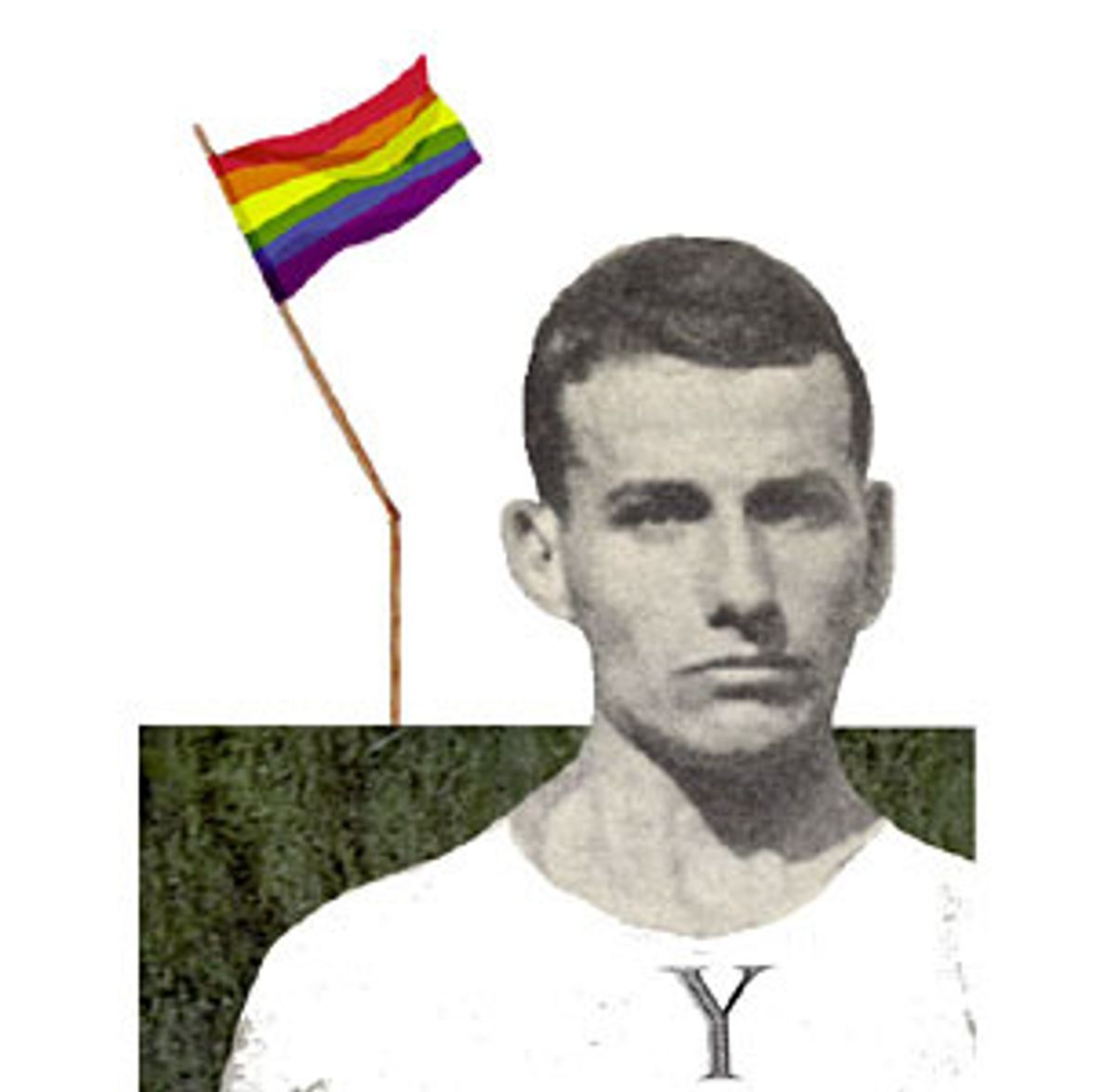
Events surrounding Yale's National Coming Out Day show that even in an enclave of gay acceptance, bigotry can survive quietly.
Last week my friend Alex woke up to find graffiti on the hallway across
from his dorm room. One line read: “Cock tastes good!” The next: “Fuck
faggots!”
My college dean sent out an e-mail that afternoon: “We consider such
conduct intolerable … These hostile and demeaning acts poison the goodwill
and trust that make possible our hard-earned feeling of community.” The
Yale Daily News ran a news story about the graffiti along with an
editorial promoting National Coming Out Day, which happened to fall on the
same day.
Although hate speech is rare here at Yale, it’s not so rare that one more
outrage will interfere with most people’s daily routines. Last semester,
during Yale’s Gay Pride Week celebrations, posters advertising “Gay Lust,”
“Gay Avarice” and the rest of the alleged homosexual Seven Deadly Sins
were placed anonymously around campus. And my classmate Katherine Kramer
still says that she feels like she’s a target. “I still get called ‘dyke’
regularly as I walk down the street,” she told me.
Hundreds of students gathered a year ago this week for a vigil in memory
of Matthew Shepard, a fellow college student 2,000 miles away whose
murder was too close for comfort. Hundreds more attend dances sponsored by
the Lesbian/Bi/Gay/Transgendered Co-Op, making these bashes among the most popular
parties on campus. Eight academic departments offer courses on sexuality.
It’s hard to imagine a majority-straight environment in America that’s
safer and more welcoming for lesbians and gays. “Yale is a fantasy world
that’s not reflective of the real world,” says one gay student. “We’re all
going to be slapped in the face when we leave this place.”
Yet for some, the fact that Yale is better than the rest of the world isn’t
enough. “Yalies are very tolerant of more mainstream, straight-looking gay
people,” Kramer says. “But there’s a substantial section of Yale [students] who
don’t accept people who look more stereotypically gay or have more radical
views.” Describing herself with a smile as a “big-ass butch dyke,” she
adds, “People are often uncomfortable around people like me.”
Although Yale is famous for being a liberal, queer-positive enclave, I
still hear “gay” used pejoratively, when it’s assumed that nobody in the
room is gay. Every so often I hear “fag,” mostly as an insult for the
presumed straight.
Last Monday, I stood in the middle of campus with other students wearing white T-shirts and blue jeans, the uniform requested for all students on National Coming Out Day to show support for gays and lesbians. There were only 15 or 20 of us. “You should be embarrassed if you think Yale is an accepting place, yet do nothing to show that you too
are ‘accepting,’” wrote Thom Cantey in a campus newspaper. If Cantey saw students not wearing the uniform, he wrote, he would know they were “obvious traitor[s] to the beliefs [they] supposedly hold.”
Maybe the kids in red plaid and black jeans were traitors — or maybe they
just hadn’t done their laundry. Or maybe they think that gays are fully
liberated and create too much commotion, or maybe they simply can’t be
bothered. In America we condemn bigotry and excuse apathy, but at their
core, are they really all that different?
I find that many straight students here, particularly straight males, take
a not-in-my-backyard view of homosexuality: Sure, be gay; but don’t sleep
in the bunk bed above me and for God’s sake don’t tell me about your lover.
The last time I saw two men holding hands on campus was about a year ago.
The last time I saw a straight couple making out in the courtyard was last
night. Gayness may be a popular slogan here, but it doesn’t mean it’s a
visible part of the landscape. Learning the appropriate, non-offensive
language is one thing. Living that language is another.
Last Monday, the National Coming Out Day festivities included a sparsely attended same-sex kiss-in. I realized very few people here would scribble profane graffiti on a dorm wall, but just as few would dare participate in a kiss-in that might expose them to the realization that homosexuality (and all the graffiti that goes with it) might be only a kiss away from real life.
My friend Jason Knight remembers coming out publicly last year, at the
vigil following Shepard’s murder. “When we came together for that vigil,”
he says, “that was me bearing witness to myself, looking in the mirror and liking what I saw. Finally I was happy for who I was.”
I await, with little patience, the day when all of us are just as happy for who he is.
Simon Rodberg is a senior at Yale University. More Simon Rodberg.
Majoring in Potterology
Are books like J.K. Rowling's popular series and Stephenie Meyer's "Twilight" fit subjects for serious scholarship?
(Credit: Shutterstock/Salon) Last week in Scotland, 60 scholars gathered over two days for the U.K.’s first scholarly conference on the Harry Potter series. The Guardian newspaper quoted John Mullan, a professor of English at University College London, questioning the wisdom of organizing such an event. Concluding that the host college, the University of St. Andrews, was primarily after “publicity,” Mullan suggested the attendees would be better off forgetting kids’ books and cultivating their gravitas. “They should be reading Milton and ‘Tristram Shandy,’” he told the Guardian. “That’s what they’re paid to do.”
Continue Reading Close
Laura Miller is a senior writer for Salon. She is the author of "The Magician's Book: A Skeptic's Adventures in Narnia" and has a Web site, magiciansbook.com. More Laura Miller.
We had all the time in the world
My sabbatical offered a quiet and calm I'd always wanted. Then I discovered what a challenge that could be
(Credit: Hofhauser via Shutterstock) One of the enviable perks of the academic life is the funded year off that comes every seven years, and my husband and I were miraculously scheduled for sabbatical at the same time. The year fell during what was technically the second year of our “empty nest,” but it was the first time we’d be without children and day jobs. Unlike our colleagues, who head to dusty provincial church archives to research the something-something in medieval Spain, we were free to go wherever. Filled with ideas for almost every medium — play, essay, screenplay, pilot, humor pieces — I dreamed of untold productivity and an endless summer at my in-laws’ lake house in New Hampshire. I would finally have the time and quiet I’d been hungering for after 19 years of teaching and raising children.
Continue Reading CloseWendy MacLeod's plays have been produced Off-Broadway at Playwrights Horizons and at The Goodman and Steppenwolf Theaters in Chicago. Her play "The House of Yes" was made into a Miramax film. Her prose has appeared in McSweeney’s Internet Tendency, The International Herald Tribune, The Washington Post, The Rumpus, The Awl, NPR’s All Things Considered and POETRY magazine. She is the James E. Michael Playwright-in-Residence at Kenyon College. Her new play "Women in Jep" will premiere in July at the Arden Theater in Philadelphia. More Wendy MacLeod.
MacArthur Foundation reveals 2011 “genius grants”
Recipients of surprise $500,000 fellowships include Chicago architect, founder of New York City children's choir
NEW YORK, NY - SEPTEMBER 18: Francisco Nunez, winner of the MacArthur Fellowship was photographed on September 18, 2011 in New York, NY. (Photo by Chris Lane/Getty Images for Home Front)(Credit: Christopher Lane) A Chicago skyscraper architect, a New York City children’s choir founder and a North Carolina scientist who studies how to prevent sports-related concussions are among the latest 22 recipients of the no-strings-attached MacArthur Foundation “genius grants.”
The $500,000 fellowships for 2011 were announced Tuesday by the Chicago-based John D. and Catherine T. MacArthur Foundation. Recipients largely don’t know they’re in contention for the annual awards, and often learn they’re winners with an out-of-the-blue phone call informing them they’ll receive the money over the next five years.
Continue Reading CloseWhen Jonathan Franzen came to town
I wanted to be the perfect host for the Great American Novelist. Instead I saw how strange literary celebrity is
Jonathan Franzen For the dinner in honor of the Great American Novelist the guest list is made up months in advance. Nobody asks whether the visiting writer wants a dinner. Nobody considers the possibility that giving a lecture on a full stomach and after a glass or two of wine might be difficult. The dinner is not about what the writer wants; it’s about what we want. And we want to meet the writer. Are we highbrow sycophants competing for the chance to say forever after that we had dinner with the Great American Novelist? Or are we faithful readers grateful to hear more from a writer we admire? When Jonathan Franzen came to Kenyon College, I was hoping we’d be the latter.
Continue Reading CloseWendy MacLeod's plays have been produced Off-Broadway at Playwrights Horizons and at The Goodman and Steppenwolf Theaters in Chicago. Her play "The House of Yes" was made into a Miramax film. Her prose has appeared in McSweeney’s Internet Tendency, The International Herald Tribune, The Washington Post, The Rumpus, The Awl, NPR’s All Things Considered and POETRY magazine. She is the James E. Michael Playwright-in-Residence at Kenyon College. Her new play "Women in Jep" will premiere in July at the Arden Theater in Philadelphia. More Wendy MacLeod.
Is it time to kill the liberal arts degree?
I was a floundering humanities graduate too, but in a brutal job market, maybe we need to rethink what we teach
Every year or two, my husband, an academic advisor at a prestigious Midwestern university, gets a call from a student’s parent. Mr. or Mrs. So-and-so’s son is a sophomore now and still insistent on majoring in film studies, anthropology, Southeast Asian comparative literature or, god forbid … English. These dalliances in the humanities were fine and good when little Johnny was a freshman, but isn’t it time now that he wake up and start thinking seriously about what, one or two or three years down the line, he’s actually going to do?
Continue Reading CloseKim Brooks is a graduate of the Iowa Writers' Workshop. Her fiction has appeared in Glimmer Train, One Story, Epoch, and other journals. She lives in Chicago and has just finished a novel. You can follow her on Twitter @KA_Brooks. More Kim Brooks.
Page 1 of 76 in Academia