Marlon Brando

The dearth of cool

Are white hipsters an endangered species? Is sellout just another word for nothing left to lose?

  • more
    • All Share Services

Topics: ,

The dearth of cool

During his opening monologue on MTV’s Video Music Awards in September, host Chris Rock surveyed the audience and asked, “Where are all the cool white guys?” Throughout the night, Rock could savor the accumulating evidence for his assertion that they were, in fact, missing in droves. Pretenders to the long tradition of cool white male stars embarrassed themselves on stage or sat in the audience looking like nervous piglets cornered by Rock’s wolfishly scathing wit. The sad display reached the pit of inanity when Limp Bizkit’s front man, Fred Durst, made lewd references to co-presenter Heather Locklear’s breasts. While Durst smirked, a bandmate and fellow would-be homey either pretended to be inebriated or really was stumbling — and neither scenario was all that entertaining.

Then Madonna took the stage, thank God, to introduce the evening’s surprise guest. She called him a talent the likes of which surfaces but a handful of times in a century. Seconds later, when Paul McCartney strutted forward, I was struck by his quiet self-assurance, his apparently secure knowledge that he was all those things the Material Girl had called him. His unimpressed aplomb contrasted neatly with all the young dudes who were so desperate to attract attention. Here at last was a cool white guy.

Ever since Marlon Brando and James Dean taught white men the devil-may-care aspect of cool, when such an attitude was the province of the young, Hollywood and rock ‘n’ roll have done the proselytizing. Everyone — or at least those of us with enough time on our hands to care — can trace their own lineage, and the list is potentially long. But there have been a handful of icons who, through artistry or artfulness, elevated cool to the point of regality — guys like Brando and Dean, Frank Sinatra, Warren Beatty and, of course, Elvis Presley and countless other musicians from a time when “cool rock star” would have been considered a tautology.

The striking thing about them all is that they achieved a kind of princely dominance by the time they were in their 20s and, importantly, they wore it well. Dean was killed in a car crash at 24; The Voice had his first number one single, “I’ll Never Smile Again,” at age 25; the presidentially coy Beatty was 24 when he found “Splendor in the Grass” with Natalie Wood; Elvis had them swooning at 20. And now? Thanks to the current demographic appeal of pre-fab teen movies and sanitized pop music, we are being haunted by the ghosts of New Edition and the Brat Pack.

Is there an entertainment industry-wide problem here? Of course not, if you take a financial viewpoint — the entertainment industry does just fine, thank you. Maybe its finely honed strategy of product positioning leaves little room for iconoclasm. The market’s tastes form a bell-curve, and cool anti-heroes have their place — off to the side of that big bulge in the middle where the innocuous cluster together, where you find the Backstreet Boys, or Garth Brooks, who only pretends to be cool by posing as a rocker. Our oft-lamented media saturation makes celebrities into commodities with the built-in obsolescence of a consumer appliance, but with shelf-lives a fraction as long as, say, a Sony Trinitron.

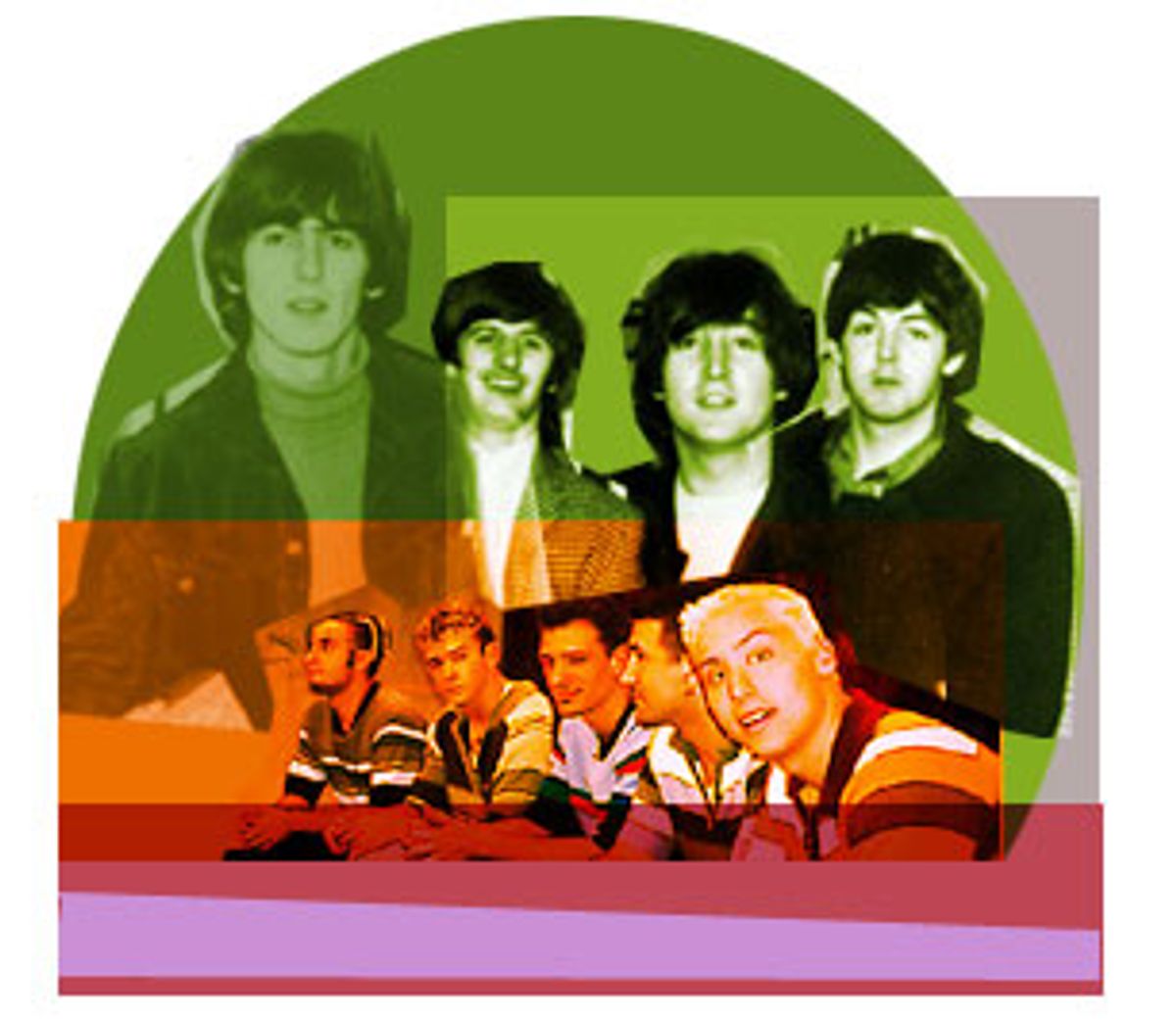
But what about aesthetics? If you use media prominence as a measuring stick (the discussion is, after all, about icons), it doesn’t matter where you look — television, movies or music — we are in short supply of young white artists who possess the kind of lasting qualities we attach to the idea of “cool.” This has happened before, especially in the cyclical music business, which has produced countless other eras of teeny-bop pop. But many earlier teen idols, the best of whom matured emotionally and artistically — Sinatra and the Beatles, for example — only got cooler as they grew up. It’s hard to envision the same kind of creative flowering for N’Sync, the boy group that has performed Christopher Cross’ “Sailing” in falsetto while suspended like circus acrobats over the audience.

Times like these serve to remind us that cool is a white man’s idea of something more purely black, like early rock music. Miles Davis oozed cool. James Brown has it in his bones. Unsurprisingly, then, plenty of hip-hop stars, male and female, exude cool. But what about Lenny Kravitz? He derived his once-cool persona from the same people he mimicked with his music — Jimi and Jimmy, among others. Kravitz’s near-simultaneous release of the song “Fly Away” as a single and in a car commercial — two videos for the price of one (and tidy revenues on the other) — was crass enough to lose him what little credibility he might have once possessed.

Older generations of stars have been similarly losing their cool, refuting the idea that the quality might endure mostly as a generational hallmark. Thanks to the endless promotion and recycling of celebrities like Mick Jagger, we see cool can be squandered through overexposure, even by legends. The Rolling Stones and just about all the other great old rockers — even Lou Reed and Bob Dylan — have also licensed songs to commercials. “Sellout,” once the antithesis of cool, is now just another word for nothing left to lose.

In the hip-hop world, of course, showy materialism can be a cool, in-your-face kind of weapon, but it can’t save white rappers like Durst or Eminem. Vanilla Ice may have died so that Kid Rock could live, but in white hands the overall effect is far more strained than self-assured. In the music biz, cool white guys seem to have gone the way of decent rock ‘n’ roll — MIA. Back in the grunge days, all of eight years ago, Kurt Cobain was a cool shooting star, too conflicted to endure. Eddie Vedder faded quickly, defensively stammering on MTV’s 1998 “Year in Rock” that he didn’t want to become a “blockage” in the music industry’s intestines. Billy Corgan lost his cool when he started hulking around like Uncle Fester. We do have Beck, but he’s a ’90s kind of hero: ironic, a techno-fetishist dressed up like a hipster. (But hey, he can dance like one, and that is cool.) Radiohead’s Thom Yorke heads up a cool white band, but Yorke so pouted his way through their recent documentary, “Meeting People Is Easy,” he became a poster boy for the perils, not the pleasures, of stardom.

It’s been a while since a young and dangerous white male actor has been seen in Hollywood, now that Leonardo DiCaprio, 25, seems to have left town. Vanity Fair may have been in a hurry to confer royal status on Matthew “Naked Bongo Man” McConaughey years ago, but he hasn’t seemed cool since he played Wooderson, the high school graduate still making the old scene in “Dazed and Confused,” in 1993. (“That’s what I like about these high school girls,” Wooderson boasts. “I keep getting older, they stay the same age.”) Nicolas Cage, who wasn’t even 20 when he played Randy in “Valley Girl,” is threatening to turn into a Stallone-clone action hero before our very eyes. Johnny Depp (24 when he arrived at “21 Jump Street”), like Cage, is well into his 30s now. Sean Penn, who was 21 in “Taps,” will be 40 next year.

What about James Van Der Beek, whose head, up close, is said to resemble a breadbox? I suppose it could be generational snobbery, but to me celebrity cool was once exhibited by young princes, whereas Van Der Beek and other so-called Generation Next stars have more in common with the annoying college kids of MTV’s “Real World.” Sure, all the young white celebs display the cockiness and style that can be purchased with megastardom. But true cool is made the old-fashioned way: It’s earned, usually with talent.

Our dearth of cool might be a factor behind another recently spotted trend — the so-called democratization of celebrity. Or it might be the subject of a sad, closing chapter in “The Lost Art of Immortality”
– a sense of living large that the creative geniuses of this century inherited from the Romantics.

A more optimistic viewpoint is that with all the cacophony (white noise?) built into the modern infotainment apparatus, it takes longer for the real stars — the cool ones — to emerge. With so many white males in the industry these days, maybe the young ones have to let their voices deepen before they can be heard above the din. Just look at Edward Norton, an Academy Award nominee who just turned 30. He’s appeared in just a half-dozen films, and he has been a cool chameleon in almost all of them. And besides, Paul Newman didn’t land his first big film role until he was 31, when he played boxer Rocky Graziano in “Somebody Up There Likes Me.” By 42, he was “Cool Hand Luke.”

Continue Reading Close

Frank Houston is a frequent contributor to Salon.

DVDs you should have seen — but didn’t: Beat the winter blahs!

Crap movies got you down? Stay home with Guillermo del Toro, Robert Mitchum, David Cronenberg and much more

  • more
    • All Share Services

Topics: , , ,

DVDs you should have seen -- but didn't: Beat the winter blahs!Clockwise, top left: "Metropolis,""The Films of Rita Hayworth," "Cronos," "Inspector Bellamy"

If you’re new to this sporadic franchise, some guidelines to help you write letters of complaint:

1) Yes, the title is obnoxious. In many cases it may also be wildly inaccurate. No, I do not think that “Modern Times” or “The Night of the Hunter” are especially obscure releases.

2) Yes, lots of better known and more contemporary films have come out recently on DVD. Hey, have you heard about “The Social Network”? Yeah, it’s pretty good. For that matter, plenty of terrific films we’ve covered extensively here, from Gaspar Noé’s nutty and gorgeous “Enter the Void” to Jean-Pierre Jeunet’s deliriously slapstick “Micmacs” to the mesmerizing documentary “The Tillman Story” (an Oscar omission, if you ask me) have made it to home video in the last few weeks.

3) My purpose here, as I see it, is to provide some suggestions that might help you push your personal reset button, right in the middle of one of the coldest, dreariest winter in North American memory and — let’s face facts — a pretty darn dismal season for moviegoing. I mean, if you’re still red hot with “Green Hornet” fever, then more power to you and you don’t need my help. Otherwise, onward.

Hollywood Heavyweight Box Sets: Elia Kazan and Rita Hayworth

Nearly six decades after Elia Kazan’s fateful testimony before the House Un-American Activities Committee, and seven years after his death, Hollywood has finally made peace with one of its greatest filmmakers. I don’t have the time or space to rehearse the Kazan controversy one more time, nor the inclination to argue that he should be damned or beatified. But the monumental “Elia Kazan Collection,” curated by Martin Scorsese for 20th Century Fox, makes a powerful argument for Kazan’s artistic and social importance. This exhaustive survey includes 15 of Kazan’s films, from acknowledged masterpieces like “A Streetcar Named Desire,” “On the Waterfront,” “East of Eden” and “A Face in the Crowd” to more obscure and arguably lesser pictures like “Boomerang,” “Pinky,” “Viva Zapata!” and “Wild River.” Also here is Scorsese’s moving 2010 documentary “A Letter to Elia,” in which Scorsese credits Kazan as his first filmmaking inspiration and principal avatar.

I won’t claim that Columbia’s five-disc set “The Films of Rita Hayworth” carries quite the same heft, but if you’re not familiar with the Latina sex bomb (née Margarita Cansino) who ruled the screen in the 1940s, this is a great opportunity to get up close and personal with one of old Hollywood’s hottest starlets. The best of these films is probably Charles Vidor’s 1946 noir “Gilda,” with Hayworth opposite a seething, demented Glenn Ford. There’s also the Technicolor musical “Cover Girl” (with Gene Kelly and songs by Ira Gershwin and Jerome Kern), William Dieterle’s bizarre 1953 production of “Salome” (with Stewart Granger and Charles Laughton) and the South Pacific erotic drama “Miss Sadie Thompson,” in which Hayworth’s ample talents were originally presented in 3-D.

Silent Masterpieces: Chaplin’s “Modern Times” and Fritz Lang’s “Metropolis”

I can offer no better endorsement of Charlie Chaplin’s 1936 “Modern Times” — the great filmmaker and comedian’s last screen appearance as the Little Tramp — than to tell you I recently showed it to a couple of 6-year-olds, who loved every minute. Of course Chaplin’s thrilling stunt work and technological gags made them giggle uncontrollably, but they were also totally caught up by the film’s heart-rending vision of poverty, violence and resilience in Depression America. (I didn’t really try to explain the role that Communism and cocaine play in the plot — and yes, this was very much the film that got Chaplin branded as a seditious Red sympathizer.) Even if you think “City Lights” or “The Circus” or something else is a purer distillation of Chaplin’s art, “Modern Times” is an irreplaceable work of genius that speaks clearly across 75 years. That’s more true than ever in Criterion’s beautiful new digital transfer, which comes packaged with loads of extras, including deleted scenes and a hilarious 1916 Chaplin two-reeler called “The Rink.” (DVD and Blu-ray.)

From a film-history point of view, nothing released in 2010 could possibly be as important as the recent restoration of “Metropolis,” the sci-fi masterpiece by Fritz Lang that paved the way for dozens of dystopian-future movies to come. Incorporating 25 minutes of footage discovered in a Buenos Aires archive and a new recording of Gottfried Huppertz’s original score, this “Complete Metropolis” has superior pacing and improved dramatic tension, and presumably comes very close to the original 1927 release. An absolute must for genre fans, this new DVD/Blu-ray from Kino should bring Lang’s hypnotic and nightmarish vision, and his groundbreaking use of special effects, to a new generation of fans.

Unknown Masters of World Cinema: Helma Sanders-Brahms and Masahiro Kobayashi

If you’re undaunted by relative obscurity and emotional intensity — indeed if you crave them — here are a couple of unjustly neglected directors to pursue. While such New German Cinema figures of the ’70s as Wim Wenders, Werner Herzog and R.W. Fassbinder went on to worldwide fame, Helma Sanders-Brahms remains a sort of historical asterisk, stereotyped as the movement’s angry feminist. (Her Wikipedia page is a stub, at least in English.) Yet the best films in Facets Video’s new Sanders-Brahms box set, including “Under the Pavement Lies the Strand” from 1974, “Germany, Pale Mother” from 1980 and “The Future of Emily” from 1985, are ferocious dramas that crackle with electricity, and seem both classic and well ahead of their time. In finding explosive truths beneath the surface of women’s lives and ordinary domestic relationships, Sanders-Brahms blends Ibsen and feminist theory, and prefigures much of the independent cinema of decades to come.

If Sanders-Brahms could almost be called an emotional maximalist, Japanese director Masahiro Kobayashi goes in the other direction, setting his stringent, low-dialogue stories against the semi-rural chill of northern Japan. He got some international recognition for “Bashing” in 2005, with its memorable performance by Fusako Urabe as an aid worker held hostage in Iraq who is shunned in Japanese society after returning home. But the other films in Facets’ set “Kobayashi Four” are nearly as compelling, beginning with his 1999 debut “Bootleg Film,” a black-comic black-and-white encounter between a cop and a yakuza that announces Kobayashi as an heir to Ozu, by way of Jim Jarmusch. Also included are “Man Walking on Snow,” with a gorgeous central performance from Ken Ogata, and “The Rebirth” from 2007, with Kobayashi himself playing a grieving father who strikes up a strained acquaintance with the mother of his daughter’s killer.

The Most Cronenberg You Can Get: “Videodrome”

I’m an unrepentant fan of nearly all David Cronenberg’s work, and in fact I suspect that his post-auteur adaptations, from the unjustly maligned “M. Butterfly” to “Eastern Promises,” will only get better with repeat viewings. That said, his grotesque and visionary science-fiction films from the ’70s and ’80s are in a class by themselves, and one can definitely make a case that the prophetic and exceptionally disturbing 1983 “Videodrome,” with its conception of a consciousness-altering underground of torture media, right-wing conspiracy and bodily transformation, reaches paranoid heights unmatched in movie history. Criterion’s new high-def restoration features all manner of Cronenbergundian delights, including commentary tracks by the director, cinematographer Mark Irwin and stars James Woods and Deborah Harry, two documentaries on the film’s transformative special effects, a 2000 short film by Cronenberg and the complete footage of “Samurai Dreams,” one of the pirate broadcasts seen in “Videodrome.” (DVD and Blu-ray.)

Latin Visionaries: Alejandro Jodorowsky’s “Santa Sangre” and Guillermo del Toro’s “Cronos”

OK, arguably I’m conflating two continents and stretching a point here, but not entirely without reason. Chilean-born madman Alejandro Jodorowsky, an avant-garde cult figure whose work goes from cinema to spirituality to drugs to comic books, spent much of the ’60s and ’70s in Mexico, and it’s a pretty safe bet that his untethered hallucinatory aesthetic had an impact on the young Guillermo del Toro. With Severin Films’ new DVD/Blu-ray release of his surrealist horror film “Santa Sangre” — which tells the story, more or less, of a boy who becomes a serial killer after watching his circus-performer mother mutilated — Jodorowsky’s three major films are all on high-quality home video for the first time. (“El Topo” and “The Holy Mountain” were released on DVD in 2009, after decades of copyright problems were unwound.) It’s too bad, I think, that Jodorowsky never got to make a proposed late-’70s adaptation of Frank Herbert’s “Dune,” which would have starred Salvador Dalí and Orson Welles. What can you say, really?

As for “Cronos,” a low-budget Mexican vampire movie that blends the Hammer Films Poe adaptations of the ’60s with some seriously weird mechanical effects, it might seem tame after “Santa Sangre.” But this intriguing 1993 debut launched del Toro on a rich and strange career trajectory that keeps getting better, and its combination of old-fashioned storytelling with newfangled gizmology is immediately distinctive. Federico Luppi plays Jesús, a courtly, aging antiques dealer who happens upon a mysterious golden scarab, a device built in colonial times for which a nefarious American (the ever-enjoyable Ron Perlman) has been hunting. This Criterion restoration features new English subtitles, numerous commentaries and interviews, and “Geometria,” an unreleased del Toro short from 1987.

The French Hitchcock Bids Farewell: “Inspector Bellamy”

If you’ve got to go, go out on top, and French mystery master Claude Chabrol, who left us in September at age 80, did just that. “Inspector Bellamy,” the last of Chabrol’s 55 or so feature films (!), barely got a look in United States theaters, but it’s got all the wit, style and cold-blooded subterfuge that runs through the “French Hitchcock’s” best work, along with a fine performance from Gérard Depardieu as its eponymous protagonist, a pudgy, cynical, homebody detective whose country vacation keeps being disturbed by unwelcome late-night visitors. Now, does “Inspector Bellamy” belong on the list with, say, “La Ceremonie” or “Violette” or “The Unfaithful Wife,” among the Chabrol thrillers that transcend their genre? Probably not, but it’s a lean, economical and deceptively casual film, self-consciously modeled after the great crime novelist Georges Simenon, with a sting in its tail (as is customary with Chabrol) that you almost certainly won’t see coming.

Dark Travelers: Bergman’s “The Magician” and Charles Laughton’s “The Night of the Hunter”

Little appreciated except by completists, Ingmar Bergman’s 1958 “The Magician” deftly delivers all the Swedish master’s central concerns — life and art, men and women, language and silence, God and the supernatural — in a drily entertaining little black-comic package. It’s beautifully photographed by the underrated Gunnar Fischer (Bergman’s pre-Sven Nykvist cinematographer) and features many Bergman regulars, including Max von Sydow as Vogler, the mysterious traveling magician, and Gunnar Björnstrand as the pompous Dr. Vergérus, who hosts Vogler’s troupe in a passive-aggressive attempt to expose them as charlatans. (Ingrid Thulin, Bibi Andersson and Erland Josephson also appear.) You can explain the film’s obscurity in various ways — its droll tone, ambiguous verdict and deus-ex-machina conclusion apparently convinced ’50s critics that it didn’t measure up in philosophical heft to “Wild Strawberries” and “The Seventh Seal,” both made a year earlier. Personally, I think it holds a key to Bergman’s worldview, and belongs on any list of his best films. This Criterion DVD/Blu-ray release features archival interviews with Bergman, a visual essay by scholar Peter Cowie, and a tribute to “The Magician” from French director Olivier Assayas.

I probably don’t need to introduce “The Night of the Hunter” to film buffs, except to explain that the great English actor Charles Laughton’s only film as a director, made three years before “The Magician,” is also a fable about a seductive drifter who claims contact with supernatural authorities, but whose soul is poisoned by cynical darkness. There’s no Scandinavian angst to preacher Harry Powell, the signature role of Robert Mitchum’s career — he’s got plenty of can-do American spirit, along with “HATE” and “LOVE” tattooed on his knuckles and a version of religion “the Lord and me have worked out betwixt ourselves,” as he explains to cellmate Peter Graves. It’s a creepy, spectacular fable of innocence and experience, murder and misogyny, a classic horror film with a thread of Grand Guignol comedy that Bergman must have appreciated. The real tragedy, of course, is that “Night of the Hunter” was too much for Hollywood, and for 1950s America, although in retrospect it looks as if Laughton, Mitchum, screenwriter James Agee and cinematographer Stanley Cortez made one of that decade’s greatest American films.

Bonus British Isles TV selections: “Blue Murder” in Manchester; “Single-Handed” in the west of Ireland

Two quick hits for fans of small-screen Britcrime: Caroline Quentin is tremendous as Manchester detective Janine Lewis — a single mum solving her battered city’s most gruesome crimes — in the 2003-9 ITV series “Blue Murder,” now available in a complete box set from Acorn Media. Also just out on Acorn, from the Irish national broadcaster RTÉ, is the satisfyingly pulpy “Single-Handed: Set One,” starring Owen McDonnell as a young cop who comes home from Dublin to the windswept, treeless west coast, where he discovers that small-town law enforcement involves uncovering secrets (some of them his own family’s) that most people are happy to leave buried.

Continue Reading Close

“Smash His Camera”: The man who stalked Jackie O.

The First Widow sued him and Brando broke his jaw, but paparazzi king Ron Galella won the pop-culture war

  • more
    • All Share Services

Topics: , , , , ,

A still from "Smash His Camera"

To say that Ron Galella provokes strong reactions is putting it too mildly. Significant chunks of Leon Gast’s highly entertaining and skillful documentary “Smash His Camera” consist of lawyers or journalists or Galella’s fellow photographers sitting around and arguing about whether the rumpled “paparazzo superstar” of the 1970s (his term) is bottom-feeding scum or a legitimate servant of the public interest or, God help us, even an artist.

Former Metropolitan Museum director Thomas Hoving, who developed a late-life avocation for appearing in documentaries to piss all over people, speaks of Galella with acid contempt, asking what we want alien archaeologists to find in 10,000 years: Galella’s shots of Jackie Onassis and Marlon Brando, or the paintings of Titian and Leonardo? Let’s answer his question with another question: Do we want them to understand our civilization as it really was, or as we wish it had been? Because Galella’s daring and demented pursuit of famous people, especially the ones who really, really didn’t want their picture taken, is a telling chronicle of our age.

Even firebrand civil-liberties lawyer Floyd Abrams, who has never hesitated to defend smut peddlers and white supremacists threatened with government censorship, refers to Galella as “the price tag on the First Amendment” — that is, as a repellent example of how far we must go to protect freedom of the press. Abrams is clearly correct that Galella’s decades-long stalking of Jackie O., in particular, crossed all possible boundaries of decency, taste, decorum and common sense, without breaking the law in any specific instance. Onassis took him to court twice and won restraining orders both times, and Galella was often reviled as a sleazebag invading the privacy of America’s beloved First Widow. (But he never had any trouble selling his pictures.)

Younger readers have likely never heard of Galella, although he played an instrumental role in creating the lightning-speed, invasive celebrity-media complex that so dominates our nation’s dubious public life. Indeed, as a painful coda to Gast’s film demonstrates, some younger people haven’t even heard of his subjects. (We witness a youthful assistant at Galella’s New York gallery show staring blankly at photos of John Belushi, Grace Kelly and Henry Kissinger, unable to identify any of them. Reading the legend on the back of a shot of Richard Burton and Elizabeth Taylor, she says, “That’s, uh, Tyler Burton.”)

Although the term “paparazzi” and the species it describes both emerged from European pop culture — and specifically from Fellini’s 1960 film “La Dolce Vita” — Galella became the most notorious and relentless American specimen. On one famous occasion, he hid in the bushes in Central Park to capture Onassis and her son, John F. Kennedy Jr., then aged about 8, as they returned from a bicycle ride. Onassis, who almost never spoke to Galella despite their years of proximity, told a Secret Service agent: “Do you see that man? Smash his camera!” (Galella got the camera into the trunk of his car before that could happen.) He concealed himself behind a coat rack in a Chinese restaurant to catch her at dinner, bought tickets to plays she was attending, and once wangled his way into the Christmas pageant at John Jr.’s private school.

A few years later, one night in the early ’70s, Marlon Brando punched out Galella on the street in lower Manhattan, knocking out five of his teeth and breaking his jaw. Brando wound up settling the ensuing lawsuit for $40,000, which very likely struck him as money well spent. Although Galella comes off in the film as a peculiar, obsessive man with little self-understanding, you can’t say he lacks a sense of humor; he showed up for Brando’s subsequent public appearances wearing a football helmet.

A wily, garrulous wisecracker who lives in a suburban New Jersey house Carmella Soprano would shun as overly vulgar — the “Italian garden” composed of artificial plants! The rabbit cemetery! — Galella is extensively interviewed in the film, discussing his various methods and subterfuges but never talking much about his motivations. He’s still working in his late 70s, chasing Brangelina around at movie premieres, along with several dozen of his progeny. We witness a telling exchange between him and Robert F. Kennedy Jr., the nephew of his most famous target, who cracks, “You’re too old now to hide in the bushes!”

If the legal issues raised by Galella and his ilk remain murky — must “public figures” abandon every expectation of privacy whenever they leave home? — so too do the philosophical and, I guess, epistemological quandaries surrounding the relationship between celebrities, the media and the public. Galella’s friends, including gossip columnist Liz Smith and former Life photo editor Peter Howe, paint him as a lovable guy who meant no one harm, and suggest that even his antagonistic relationship with Jackie Onassis was a two-way street that burnished both their images — hers as aloof and unattainable feminine perfection, his as the unsinkable shutterbug who could penetrate even the Ice Princess’ palace of privacy.

Working at film festivals, I’m often around Galella’s descendants — the British and Italian paparazzi at Cannes are an especially ferocious breed — and they’re generally hardworking, hard-partying pros who serve the valuable function of reminding people like me what the whole enterprise is really about. Even the most pseudo-intellectual of us is there, in part, to bask in the reflected glamour of the stars. If we want to dress that up in fancy adjectives, that’s great; Ron Galella and the legions who followed him just try to capture it in the raw.

With gallery shows and this movie and pictures in the Museum of Modern Art, Galella has now become respectable, or at least historical; somewhere Thomas Hoving’s shade is still spitting invective. (Hoving died last December.) Years ago Andy Warhol described Galella as his favorite photographer, and in an age when the work of art has largely become separated from craftsmanship — it can be an act, a concept or a process — the question of whether Galella is an artist answers itself. His whole career is an insidious and destructive work of art — maybe not “termite art,” in Manny Farber’s oft-misunderstood phrase, but more like earwig art.

By his own admission, when it came to Jackie Onassis, Galella was also the creepy, obsessive kind who channeled his fixations into his work. Why follow around a woman who studiously ignored him, year after year? “I’ve analyzed that,” he says. For most of those years, he wasn’t married and had no girlfriend. “So it was like Jackie was my girlfriend.”

“Smash His Camera” is now playing at Cinema Village in New York, with wider theatrical release, HBO broadcast and DVD release to follow. 

Continue Reading Close

The bitter tears of Johnny Cash

The untold story of Johnny Cash, protest singer and Native American activist, and his feud with the music industry

  • more
    • All Share Services

Topics: , , ,

The bitter tears of Johnny CashJohnny Cash touring Wounded Knee with the descendants of those who survived the 1890 massacre in December of 1968.

In July 1972, musician Johnny Cash sat opposite President Richard Nixon in the White House’s Blue Room. As a horde of media huddled a few feet away, the country music superstar had come to discuss prison reform with the self-anointed leader of America’s “silent majority.” “Johnny, would you be willing to play a few songs for us,” Nixon asked Cash. “I like Merle Haggard’s ‘Okie From Muskogee’ and Guy Drake’s ‘Welfare Cadillac.’” The architect of the GOP’s Southern strategy was asking for two famous expressions of white working-class resentment.

“I don’t know those songs,” replied Cash, “but I got a few of my own I can play for you.” Dressed in his trademark black suit, his jet-black hair a little longer than usual, Cash draped the strap of his Martin guitar over his right shoulder and played three songs, all of them decidedly to the left of “Okie From Muskogee.” With the nation still mired in Vietnam, Cash had far more than prison reform on his mind. Nixon listened with a frozen smile to the singer’s rendition of the explicitly antiwar “What Is Truth?” and “Man in Black” (“Each week we lose a hundred fine young men”) and to a folk protest song about the plight of Native Americans called “The Ballad of Ira Hayes.” It was a daring confrontation with a president who was popular with Cash’s fans and about to sweep to a crushing reelection victory, but a glimpse of how Cash saw himself — a foe of hypocrisy, an ally of the downtrodden. An American protest singer, in short, as much as a country music legend.

Years later, “Man in Black” is remembered as a sartorial statement, and “What Is Truth?” as a period piece, if at all. Of the three songs that Cash played for Nixon, the most enduring, and the truest to his vision, was “The Ballad of Ira Hayes.” The song was based on the tragic tale of the Pima Indian war hero who was immortalized in the Iwo Jima flag-raising photo, and in Washington’s Iwo Jima monument, but who died a lonely death brought on by the toxic mixture of alcohol and indifference and alcoholism. The song became part of an album of protest music that his record label didn’t want to promote and that radio stations didn’t want to play, but that Cash would always count among his personal favorites.

The story of Cash and “Ira Hayes” began a decade before the meeting with Nixon. On the night of May 10, 1962, Cash made a much-anticipated New York debut at Carnegie Hall. But instead of impressing the cognoscenti, Cash, who had begun struggling with drug addiction, bombed. His voice was hoarse and hard to hear, and he left the stage in what he described as a “deep depression.” Afterward, he consoled himself by heading downtown with a folksinger friend to hear some music at Greenwich Village’s Gaslight Café.

Onstage was protest balladeer Peter La Farge, performing “The Ballad of Ira Hayes.” A former rodeo cowboy, playwright, actor and Navy intelligence operative, La Farge was also the son of longtime Native activist and novelist Oliver La Farge, who had won a Pulitzer Prize for his 1930 Navajo love story, “Laughing Boy.” The younger La Farge had carved out an intriguing niche in the New York folk revival scene by devoting himself to a single issue. “Pete was doing something special and important,” recalls folksinger Pete Seeger. “His heart was so devoted to the Native American cause at a time that no one was really saying anything about it. I think he went deeper than anyone before or since.”

Cash never pretended that music could stay immune from social, but he tried his best to “not mix in politics.” Instead he talked about the things that unite us like the dignity of honest work. “If you were a baker,” he told writer Christopher Wren in 1970, “and you baked a loaf of bread and it fed somebody, then your life has been worthwhile. And if you were a weaver, and you wove some cloth and your cloth kept somebody warm, your life has been worthwhile.”

Raised in rural poverty on the margins of America, Cash empathized with outsiders like convicts, the poor and Native Americans. But his identification with Indians was especially deep — even delusional. During the depths of his early ’60s drug abuse, he convinced himself, and told others, that he was Native American himself, with both Cherokee and Mohawk blood. (He would later recant this claim.)

At the Gaslight, once he had listened to “Ira Hayes’ and La Farge’s other Indian protest tunes, including “As Long as the Grass Shall Grow” and “Custer,” Cash was hooked. “Johnny wanted more than the hillbilly jangle,” Peter La Farge would write later about meeting Cash at the Gaslight. “He was hungry for the depth and truth heard only in the folk field (at least until Johnny came along). The secret is simple, Johnny has the heart of a folksinger in the purest sense.” In fact, Cash had written an Indian folk protest ballad of his own in 1957. “I wrote ‘Old Apache Squaw,’” Cash later explained to Seeger. “Then I forgot the so-called protest song for a while. No one else seemed to speak up for the Indian with any volume or voice [until Peter La Farge].”

Cash, like many in the 1960s, could see that everything that was certain, rigid and hard was breaking apart. Social movements were blossoming. But the thunderous American choir that was singing “We Shall Overcome” and “We Shall All Be Free” drowned out the cry of the loose-knit Native movement. As Martin Luther King and other leaders steered their people toward legislative victories that would further integrate them into a society they were locked out of, the rising tide of Native youth activists wanted something different.

“In my mind, Native people could not have a civil rights movement,” American Indian Movement activist and musician John Trudell says. “The civil rights issue was between the blacks and the whites and I never viewed it as a civil rights issue for us. They’ve been trying to trick us into accepting civil rights but America has a legal responsibility to fulfill those treaty law agreements. If you’re looking at civil rights, you’re basically saying ‘all right treat us like the way you treat the rest of your citizens’. I don’t look at that as a climb up.” Rather than pursue assimilation into the American system, Native American activists wanted to maintain their slipping grip on sovereignty and the little land they still possessed.

By the early ’60s, the burgeoning National Indian Youth Council (NIYC) was attempting to stake its own claim for their equal share of justice. With the expansion of fishing treaty violations and the breach of two major land treaties that led to the loss of thousands of acres of tribal land in upstate New York for the Tuscarora and Allegany Seneca (the story behind La Farge’s “As Long as the Grass Shall Grow”), the NIYC, led by Native activists like Hank Adams, responded by adapting the sit-in protest. Rechristened as the “fish-in,” the NIYC disputed the denial of treaty rights by fishing in defiance of state law. Fish-ins were held in New York and the Pacific Northwest.

The fish-in tactic worked in helping build some public support, but it did little to stop the treaty violations. Instead, the U.S. government ramped up its efforts to crush any momentum the Native movement was building. Oftentimes their tactics were brutal and violent. “This was the time of Selma and there was a lot of unrest in the nation,” remembers Bill Frank Jr. of Washington state’s Nisqually tribe. “Congress had funded some big law enforcement programs and they got all kinds of training and riot gear-shields, helmets. And they got fancy new boats. These guys had a budget. This was a war.”

By 1964, the Native American cause had attracted the interest of another celebrity. On March 2 the NIYC gained national attention as actor Marlon Brando joined a Washington state fish-in. Already an outspoken supporter of the civil rights movement, Brando’s very public support and subsequent arrest for catching salmon “illegally” in Puyallup River helped to boost the Native movement. Brando’s involvement with the Native cause had begun when he contacted D’Arcy McNickle after reading the Flathead Indian’s book “The Surrounded,” a powerful novel depicting reservation life in 1936. Brando’s involvement in Native issues led to government surveillance that lasted decades. His FBI file, bursting with memos detailing possible means of silencing the actor, quickly grew to more than 100 pages.

Three days after Brando’s arrest in Washington, Cash, fresh off the biggest chart success of his career, the single “Ring of Fire,” and having just finished recording a very commercial album called “I Walk the Line,” began recording another, very different album. When Cash left Sun Studios for Columbia in the late 1950s, he believed his rising star would give him the creative capital to produce and record something a little outside the pop and country mainstream — albums of folk music and live prison concerts. He was alternating folky albums like “Blood Sweat and Tears,” a celebration of the working man, with commercial discs laden with radio-ready singles. “Ring of Fire,” which had reached No. 1 on the country charts and had crossed over to pop, had bought him the permission of Columbia to make an album of what he called “Indian protest songs.”

In the two years since Cash had first met La Farge and listened to “The Ballad of Ira Hayes,” Cash had educated himself about Native American issues. “John had really researched a lot of the history,” Cash’s longtime emcee Johnny Western recalled. “It started with Ira Hayes.”

As Cash explained, “I dove into primary and secondary sources, immersing myself in the tragic stories of the Cherokee and the Apache, among others, until I was almost as raw as Peter. By the time I actually recorded the album I carried a heavy load of sadness and outrage.”

But Cash felt a special kinship with Ira Hayes. Both men had served in the military as a way to escape their lives of rural poverty longing to create new opportunities. Plus, both suffered from addiction problems; Cash and his pills and Hayes with alcohol. He decided to anchor the album with “The Ballad of Ira Hayes.” And since the song had provided the spark for Cash’s vision, it just felt right that he should learn more about the song’s subject.

Cash contacted Ira Hayes’ mother and then visited her and her family at the Pima reservation in Arizona. Before Cash left the Pima Reservation, Hayes’ mother presented him with a gift, a smooth black translucent stone. The Pima call it an “Apache tear.” The legend behind the opaque volcanic black glass is rooted in the last U.S. cavalry attack on Native people, which took place on Apaches in the state of Arizona. After the slaughter, the soldiers refused to allow the Apache women to put the dead up on stilts, a sacred Apache tradition. Legend says that overcome by intense grief, Apache women shed tears for the first time ever, and the tears that fell to the earth turned black. Cash, moved by the gift, polished the stone and mounted it on a gold chain.

With the Apache tear draped around his neck, Cash cut his protest album. He recorded five of La Farge’s songs, two of his own, and one he’d co-written with Johnny Horton. All were Native American themed. “When we went back into the studio to record what became ‘Bitter Tears,’” Cash bassist Marshall Grant says, “we could see that John really had a special feeling for this record and these songs.”

Yet the album’s first single, “Ira Hayes,” went nowhere. Few radio stations would play the song. Was the length of the song, four minutes and seven seconds, the problem? Radio stations liked three-minute tracks. Or maybe disc jockeys wanted Cash to “entertain, not educate,” as one Columbia exec put it.

“I know that a lot of people into Johnny Cash weren’t into ‘Bitter Tears,’ ” explains Dick Weissman, a folksinger, ex-member of the Journeymen and friend of La Farge. “They wanted a ‘Ballad of Teenage Queen’ not ‘The Ballad of Ira Hayes.’ They wanted ‘Folsom Prison.’ They didn’t want songs about how American’s mistreated Indians.”

The stations wouldn’t play the song and Columbia Records refused to promote it. According to John Hammond, the legendary producer and Cash champion who worked at Columbia, executives at the label just didn’t think it had commercial potential. Billboard, the music industry trade magazine, wouldn’t review it, even though Cash was at the height of his fame, and had just scored another No. 1 country single with “Understand Your Man” and No. 1 country album with “I Walk the Line.”

One editor of a country music magazine demanded that Cash resign from the Country Music Association because “you and your crowd are just too intelligent to associate with plain country folks, country artists and country DJs.” Johnny Western, a DJ, singer and actor who for many years was part of Cash’s road show, recalls a conversation with “a very popular and powerful DJ.” According to Western, the DJ was “connected to many of the music associations and other influential recording industry groups. He had always been incredibly supportive of John.” Western and the DJ started discussing Cash’s new album and the “Ira Hayes” single. “He asked me why John did this record. I told him that John and all of us had a great feeling for the American Indian cause. He responded that he felt that the music, in his mind, was un-American and that he would never play the record on air and had strongly advised other DJs and radio stations to do the same. Just ignore it until John came back to his senses, is what he told me.”

“When John was attacked for ‘Ira Hayes’ and then ‘Bitter Tears,’” explains Marshall Grant, “it just ripped him apart. Hayes was forced to drink by the abuse and treatment of white people who used and abandoned him. To us, it meant Hayes was being tortured and that’s the story we told and it’s true.”

When “Bitter Tears” and its single did not get the attention he felt they deserved, Cash insisted on having the last word. He composed a letter to the entire record industry and placed it in Billboard as a full-page ad on Aug. 22, 1964.

“D.J.’s — station managers — owners, etc.,” demanded Cash, “Where are your guts?” He referred to his own supposed half Cherokee and Mohawk heritage and spoke of the record as unvarnished truth. “These lyrics take us back to the truth … you’re right! Teenage girls and Beatle record buyers don’t want to hear this sad story of Ira Hayes … This song is not of an unsung hero.” Cash slammed the record industry for its cowardice, “Regardless of the trade charts — the categorizing, classifying and restrictions of air play, this not a country song, not as it is being sold. It is a fine reason though for the gutless [Cash's emphasis] to give it a thumbs down.”

Cash demanded that the industry explain its resistance to his single. “I had to fight back when I realized that so many stations are afraid of Ira Hayes. Just one question: WHY???” And then Cash answered for them. “‘Ira Hayes’ is strong medicine … So is Rochester, Harlem, Birmingham and Vietnam.”

As Cash later explained, “I talked about them wanting to wallow in meaninglessness and their lack of vision for our music. Predictably enough, it got me off the air in more places than it got me on.” In reality, however, as Cash noted in his letter, “Ira Hayes” was already outselling many country hits. Ultimately, thanks in part to aggressive promotion by Cash, who personally promoted the song to disc jockeys he knew, “Ira Hayes” reached No. 3 on the country singles charts, and “Bitter Tears” peaked at 2 on the album charts.

Later, long after “Bitter Tears,” and after he’d won his battle with drugs, Cash would dial back his claims of Indian ancestry. But he never wavered from his support for the Native cause. He went on to perform benefit shows on reservations — including the Sioux reservation at Wounded Knee in 1968, five years before the armed standoff there between the FBI and the American Indian Movement — to help raise money for schools, hospitals and other critical resources denied by the government. In 1980, Cash told a reporter: “We went to Wounded Knee before Wounded Knee II [the 1973 standoff] to do a show to raise money to build a school on the Rosebud Indian Reservation” and do a movie for “Public Broadcasting System called ‘Trail of Tears.’” He joined with fellow musicians Kris Kristofferson, Willie Nelson and Robbie Robertson to call for the release of jailed AIM leader Leonard Peltier.

Since Cash first recorded “The Ballad of Ira Hayes” in 1964, many musicians have recorded their own versions. Kris Kristofferson is one of those musicians. He summed up the spirit behind Cash’s now nearly forgotten protest album in his eulogy for Cash, who died in 2003. Cash, he said, was a “holy terror … a dark and dangerous force of nature that also stood for mercy and justice for his fellow human beings.” Four years before his famous concert at Folsom Prison, four years before the American Indian Movement formed, and at the pinnacle of his commercial success, Cash insisted on producing an uncommercial, deeply personal protest record that was a close as he could come to truth. He would always cherish it. “I’m still particularly proud of ‘Bitter Tears,’” Cash would say near the end of his life, while talking about the topical music he recorded in the 1960s. “Apart from the Vietnam War being over, I don’t see much reason to change my position today. The old are still neglected, the poor are still poor, the young are still dying before their time, and we’re not making any moves to make things right. There’s still plenty of darkness to carry off.” 

- – - – - – - – - – - -

Antonino D’Ambrosio is the author of “A Heartbeat and a Guitar: Johnny Cash and the Making of Bitter Tears.”

Continue Reading Close

Karl Malden 1912-2009

The tough-guy character actor leaves behind a memorable career in movies and TV -- and then there's "Sekulovich"

  • more
    • All Share Services

Topics: , ,

Karl Malden 1912-2009

AP Photo/Kevork Djansezian, file

In this Feb. 22, 2004 file photo, actor Karl Malden accepts the life achievement award at the 10th annual Screen Actors Guild Awards in Los Angeles.

Amid the celebrity death party of the last few days, let’s spare at least a brief thought for Karl Malden, the iconic broken-nosed character actor and American Express pitchman whose pugnacious working-class demeanor kept him going in show business for more than 50 years. Malden died Wednesday at age 97, which means he was 46 years old when Michael Jackson was born in 1958.

For someone of my generation, Malden will always be identified with Lt. Mike Stone of the long-running 1970s TV series “The Streets of San Francisco” (whose sidekick was played by Michael Douglas). For younger viewers, I guess he’ll always be the “Don’t leave home without it” guy from more than 20 years of American Express commercials. But of course Malden was an established film actor long before those gigs. He played opposite Marlon Brando several times, winning an Oscar as the likable Mitch in “A Streetcar Named Desire” and playing the sympathetic priest in “On the Waterfront.” He also played Gen. Omar Bradley in “Patton” and the prison warden in “Birdman of Alcatraz,” but my personal favorite is probably Malden’s vicious crook-turned-sheriff in the terrific revenge western “One-Eyed Jacks” (another Brando film, and the only one he ever directed).

Malden was born in Chicago as Mladen Sekulovich, the son of a Serbian father and Czech mother, and spoke no English until he went to school. This heritage is the source of his great gift to pop-culture trivia collectors, since Malden went to great lengths to include his original name in the dialogue of his films and TV shows. In “The Streets of San Francisco,” Stone frequently employed an informer called Sekulovich. In the courtroom scene of “On the Waterfront,” one of the union officials’ names read aloud is Mladen Sekulovich. Under fire in Sicily, Malden’s Gen. Bradley in “Patton” barks, “Hand me that helmet, Sekulovich.” And so on. There are a few other examples in Malden’s Wikipedia entry, but I just know somebody out there must have a definitive list.

Go in peace, Sekulovich. I don’t think they take American Express cards where you’re going. Just this once, it was OK to leave home without it.

Continue Reading Close

Force of nature

Burning across stage and screen like a human dynamo, Marlon Brando set a standard for acting that may never be reached.

  • more
    • All Share Services

Topics:

Force of nature

To those of us who believe that Marlon Brando is the greatest American actor we have ever seen or ever will see, his death yesterday at 80 calls up a kind of bewildering doubt. “I expected him to live forever,” said the friend who called with the news. When someone whom you expected to live forever dies, it can seem easier to wonder if he ever existed than to try to imagine the world without him.

The cynical reply to that would be that Brando long ago stopped being a vital force in American acting; that (as he admitted) his movie appearances of recent years were made mostly for money; and that, with the exception of “The Freshman,” a sweet, screwball burlesque of his role in “The Godfather,” the movies themselves were a forgettable lot. They were: “A Dry White Season,” “The Island of Dr. Moreau,” “The Score.” In the last one, Brando reportedly clashed with the director, Frank Oz, who would not allow Brando to be as flamboyant as he wished in the role of a foppish gay crook. That might be a summation of the mediocrity that has stymied every original who has ever worked in American movies. For where, in the natural order of things, can you imagine Marlon Brando being impeded by a pisher like Frank Oz?

Yet there wasn’t one time Brando ventured onto the screen in the last two decades when, his infamous public protestations about the indignity of his profession aside, he didn’t show off wit and juice and a sly joy in acting. Just watch his scenes as the anti-apartheid lawyer in “A Dry White Season.” He’s playing a man who knows he will never prevail against the crooked South African courts but who takes a sort of delight in the performance opportunities that a court case gives him. The lawyer knows that just doing his job as well as he can makes everyone around him look corrupt and foolish. That was often Brando’s effect in the movies he appeared in.

Brando could even make good actors seem stodgy. He does it to that fine actress Teresa Wright in his 1950 debut “The Men.” Brando plays a paraplegic World War II veteran and Wright the wife he can barely face after the humiliation of being unable to make love to her on their wedding night. It’s a situation that Hollywood might have handled before in the discreet, conventional terms of the “well-made” social-problem picture (the specialty of the film’s producer, soon to become execrable director, Stanley Kramer), and for most of the movie it does. But Brando’s restlessness, his impolite directness, the sense of frustrated motion he implies often with just the ejaculations and guttural breaks of his speech patterns, make it impossible for us to think we’re simply watching a fine young man sitting down. In his first movie, Brando refused the easy sympathy that a young actor playing a wheelchair-bound vet could have milked. He’s sympathetic but not always likable, and his self-pity is of the raging, festering variety. Everything comes together in the movie’s most explosive moment: Brando in a bar encountering a guy blathering on to him about the great sacrifice he’s made for his country. “God bless you, mister,” Brando says. “Can I marry your daughter?” He uses the question like a knife that he turns on everybody — that man, his daughter and himself.

The change that Brando’s acting in “The Men” represented got its fullest expression in his two best collaborations with Elia Kazan, “A Streetcar Named Desire” (Brando had originated the role of Stanley Kowalski on Broadway) and “On the Waterfront.” The roles have become so familiar, so parodied (even Bullwinkle bellowed “Stelll-la!!!”), so honored (i.e., taken for granted) as a part of our cultural heritage, just as Brando’s performance in “The Godfather” would be nearly 20 years later, that you need to go back to them to remind yourself how fresh they still feel. And not just in the moments everyone remembers — “I coulda been a contender” or “We got here in the state of Louisiana what’s known as Napoleonic code” — but in the offhand moments, like Brando’s absentmindedly trying on the glove that Eva Marie Saint drops in “Waterfront.”

You can trace almost all the greatest American screen acting since then to Brando: Al Pacino, Robert De Niro, Nick Nolte, Ed Harris, Debra Winger, Jessica Lange, Sean Penn, Nicolas Cage, Robert Downey Jr., just as you can see parts of his lineage in the work of James Cagney and Barbara Stanwyck.

It’s a lineage and a legacy explored better than anywhere else in the critic Steve Vineberg’s 1991 book “Method Actors.” And yet it’s a lineage that remains largely misunderstood. Brace yourself, in the days ahead, for obits talking about Brando’s mumbling or parroting the idea that Method acting is about “becoming the character.” Vineberg’s argument was that the main aim of the Method — psychological and physical verisimilitude — coincided with the realism and naturalism that has been the primary style of American moviemaking and playwriting, and of American life. In other words, the Method fit our native casualness. It suited our actors because it allowed them to go from point A to point B with the least possible fuss. And, because it put a premium on emotion, allowed them to travel that route as deeply as possible.

Maybe it’s the fate of every great original to have his or her career and art misinterpreted or tidied away in the most trite, convenient summations. It seems that Brando’s career was more susceptible to that than most. His performance as Don Vito Corleone in “The Godfather” was heralded as a comeback even though he’d never stopped doing great work. (“Is Brando marvelous?” Pauline Kael asked in her review, and answered, “Yes, he is, but then he often is.”) Of course there were stinkers. But you can’t find an actor working in Hollywood during the decline of the studio system who doesn’t have at least as checkered a résumé. (Everyone remembers Paul Newman in “The Hustler” or “Cool Hand Luke,” but nobody talks about “The Secret War of Harry Frigg” or “What a Way to Go!”)

Brando had gone daringly far as the repressed homosexual Army major in John Huston’s underrated 1967 film of Carson McCullers’ “Reflections in a Golden Eye.” Just as he had in “The Men,” he made you uncomfortably aware of this preening, closeted man’s physicality; he made you feel the suffocation of his repressed desire. And in the only film he ever directed, the 1961 western “One-Eyed Jacks” (which he took over after Stanley Kubrick dropped out), Brando predated the sacrificial hipster rebel hero that would flower in pictures like “Easy Rider” and “Pat Garrett and Billy the Kid.” And he did it without all the sickly Christ pathos those movies wallowed in. The picture is terrific, and Brando is dangerously sexy and funny in it — especially the moment when he stands over a man he’s knocked down in a bar and seethes, in that purring, sibilant voice of his, “Get up, you big tub of guts.”

Part of the greatness of Brando’s acting was that it never lost a sense of play. One of the best moments in “The Godfather” comes when he is declining an invitation from Al Lettieri’s Sollozzo to join him in the narcotics-distribution business and Brando offhandedly brushes some lint from Lettieri’s suit. It’s the most subtle and devastating put-down you’ve ever seen, an adult putting in place a kid who has impertinently and prematurely put on his first pair of long trousers.

That playfulness is why Brando was a natural in comedy, why his performance in the wonderful “The Freshman” is one unbroken delight. Here Brando took his revenge on every second-rate nightclub comic who’d ever done a Don Corleone imitation. He took everything that had been exaggerated about the earlier performance and went even further with the exaggeration. The loveliest moment comes in a shot of Brando ice dancing with a young woman to the tune of Tony Bennett singing “I Wanna Be Around,” the perfect emblem of the light, graceful touch he shows throughout the picture.

For me, though, it’s Brando’s performance in Bernardo Bertolucci’s 1972 “Last Tango in Paris” that remains not just his greatest but the greatest performance I’ve ever seen an actor give. It’s fashionable now to put down “Last Tango” as a movie that’s no longer as “shocking” as it once was. But it was fashionable to put it down when it came out in America in the heyday of porno chic. And though I usually detest this form of argument, in the case of “Last Tango in Paris” I have to say that I have never heard one argument made against it that didn’t sound like fear of facing up to its power.

The true nakedness in “Last Tango” isn’t the nakedness of Brando and Maria Schneider’s bodies but the nakedness of their emotions. Despite the periodic landmarks — “Pandora’s Box” in the ’20s, “Last Tango” in the ’70s, Catherine Breillat’s “Romance” in the ’90s — the movies have been the most timid of the arts in exploring the erotic. Or perhaps it’s more accurate to say that movies have continued to kid themselves — and the audience — that the erotic is the only impulse at play in sex. “Last Tango” turned Freud on his head. It was not, Bertolucci was saying, that everything came down to sex, but that sex came down to everything else.

Brando brought the rage and bitterness and disappointments of middle age into sex. He showed how even the gambit of reducing sex to purely physical instinct wouldn’t keep the demons at bay. Pauline Kael’s famous review talked about how for older audiences the movie was like seeing pieces of your life; for younger audiences, it was potentially upsetting — they would not want to think that anything like that awaited them. And yet what Brando achieves in “Last Tango” is so much richer, so much more profound than the “truth-telling” that has often passed for acting and filmmaking (as in the work of John Cassavetes).

His great achievement in “Last Tango” wasn’t just the fearlessness of the performance but the way the performance is the most realized example of the Method ideal — crafted but not shellacked; rooted in exploration but not faltering; incorporating pieces of the actor’s personality but as an expression of the character he is playing. It’s a performance that matches the ravaged repose we see in the Francis Bacon portrait that accompanies the film’s opening credits. When Brando delivers a long, mournful reminiscence of being forced to milk a cow in his best shoes and then going to pick up a date with the stink of cowflop filling his truck, it’s clear he’s drawing on his Nebraska boyhood, just as the character’s résumé of jobs echoes roles Brando has played in the past. In a lesser actor, what’s being expressed in this performance — sourness, rage, the romantic’s compulsion to play the cynic in order to reduce everything to its basest motives — could have seemed ugly, self-pitying, certainly without the battered lyricism Brando gives it here.

There is so much more to remember Brando by than “Last Tango in Paris,” but there’s no diminishing the performance. When the film came out, Robert Altman said, after seeing it, he felt Bertolucci attained such a level of honesty that it left him feeling he didn’t have the right to make another movie. Brando’s performance can make you feel the same thing about acting — if an actor isn’t going to aspire to this level of instinct and craft, this willingness not to hide, then what’s the point?

Continue Reading Close

Charles Taylor is a columnist for the Newark Star-Ledger.

Page 1 of 4 in Marlon Brando