Academia

The luau wars

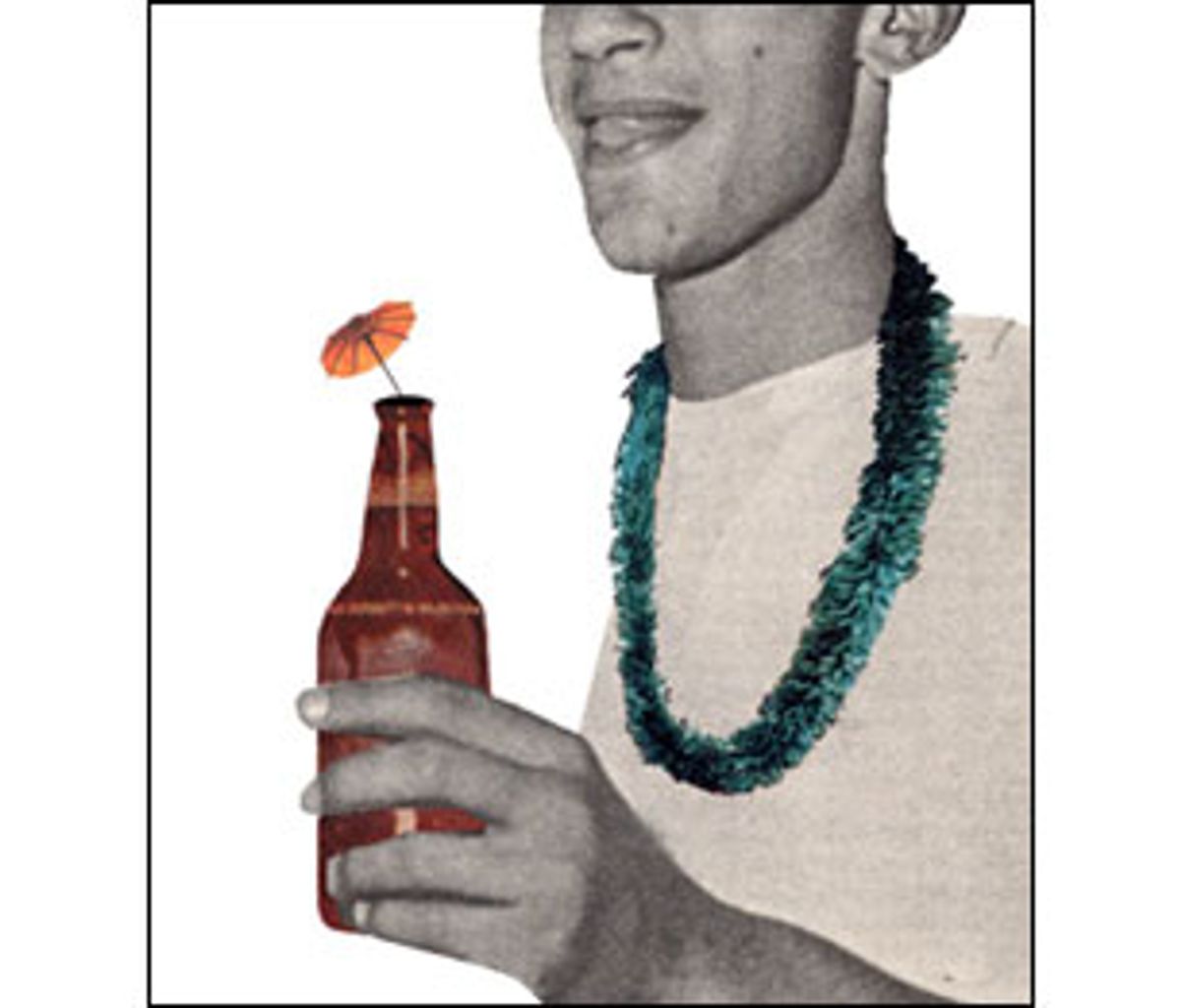
Dartmouth Greeks tried to improve their reputation with a non-offensive Hawaiian luau. The leis never even made it off the rack.

What could be more fun, reasoned some young Dartmouth
fraternity brothers, than hosting a big party and
having everyone dress up like poor black people?
We’ll play lots of rap and hip-hop music, they
decided. We’ll tell our guests to “dress ghetto.”
News of the party sent Dartmouth undergrads scurrying
for Afro wigs, toy handguns and crimping irons.

Ten months and several protests later, Dartmouth is still trying to live down the now-infamous “ghetto party” with promises of greater cultural sensitivity and more aggressive outreach programs. Fraternities and school officials offered heartfelt apologies and
promises to do better. Everyone agreed on Step 1: no more ghetto parties. From now on, only happy, non-offensive theme parties — a festive Hawaiian luau, for instance.

That’s precisely what the brothers of Alpha Chi Alpha and the
sisters of Delta Delta Delta thought they were co-hosting in August — a harmless end-of-summer bash. But hours after the e-mail invitation went out, the Dartmouth campus was again in an uproar.

Aaron -Aina Akamu, the president of the school’s Hawaii club, had e-mailed out a note of protest, saying that calling the party a “luau” was offensive to him as a native Hawaiian. A traditional Hawaiian luau, he later argued, is a ceremony with a long history and deep cultural and religious significance. Alpha Chi’s “luau,” on the other hand — with its promises of Jello shots and scorpion bowls aplenty — had nothing at all to do with Hawaii, and everything to do with a bunch of frat guys getting together to get drunk.

Ordinarily, a few complaints about an offensive frat party would have barely raised an eyebrow on campus. This was, after all, Dartmouth, the inspiration for
the film “Animal House” — a campus where stories of fraternity brothers receiving oral sex from dogs and fondling a fellow pledge dressed as a bloody, post-mastectomy woman have become an integral part of Greek lore. What’s more, these so-called luaus have been thrown at schools across the country for years.

“I thought someone was joking with us,” said Alpha Chi summer president Eric Kelley about Akamu’s e-mail. It was no joke — the presidents from both the fraternity and the sorority met with Akamu later that night and agreed to cancel the party. Two hours
after that, the presidents sent out a formal apology campuswide for “any disrespect and harm our actions caused.”

The speedy response, many claim, had little to do with
concerns over cultural sensitivity. Following Dartmouth president James Wright’s
announcement last February of plans to reform the Greek system — a plan which includes making all the houses coed — many houses on campus are doing everything in their power
to avoid anything that smells even remotely of trouble. While many fraternity and sorority
members worry about the future of Dartmouth’s Greek system, others at Dartmouth are seizing this opportunity to reform what many describe as a racially hostile environment.

Dartmouth’s recent history suggests the fraternity and sorority members have plenty to worry about. In November, the ghetto-party incident drew more than 400 protesters to the university commons. In December, a fraternity-hosted “Miami” party — which invited guests to dress as Cubans — angered members of the Latino fraternity, Lambda Upsilon Lambda. On Columbus Day, Native Americans protesting the holiday were heckled by rowdy, drunk onlookers. And at homecoming, a fraternity sold “Yale sucks” T-shirts that depicted a bulldog performing oral sex on an Indian.

The Alpha Chi Alpha party, according to summer president Eric Kelley, wasn’t meant to be controversial at all. “People were going to dress up in flowered shirts, we’d get some leis, play some tropical music and have mixed drinks and appetizers,” he said.

The problem started when a social chair from the co-hosting sorority e-mailed her sisters asking for help with the event. The e-mail message included an invitation to dress
up “hawaiian style,” along with somewhat puzzling references to “pinatas” and “volleyball with those teekee lamps.” An idea to have an “american flag jello thing” was also floated in the message; that particular idea — a patriotic tribute consisting of red, white and blue jello shots in the shape of an American flag — had been initially suggested for the group’s Fourth of July barbecue. “It’s not 7/4,” the message read, “but hell, hawaii is a state!”

The message found its way to Akamu, who sent it to his friend Omar Rashid, president of Lambda Upsilon Lambda. Rashid, in turn, composed his own e-mail and sent it off to the Coed Fraternity Sorority Council, the Greek system’s governing body on campus.
Rashid’s message was much angrier, calling the party racist and bigoted, and he threatened to pull his own fraternity out of the CFSC if action was not taken against the two sponsoring houses.

That evening, tri-Delta president Alexandra Sophocles called Akamu. “We went for a really long walk and talked for about an hour and a half,” he recalls. “I could tell she was really sorry about what happened, and wanted to do something to try to make things right.”

Later that night, Sophocles and Akamu met with Alpha Chi president Kelley and the social chairs of the two houses. At 5:02 a.m., a campuswide e-mail went out apologizing for the planned party, and the two houses announced plans for a forum “about the misuse
of culture and ethnicity on campus.” Another racial incident at Dartmouth had been narrowly averted, it seemed, with all sides leaving happy.

And then the storm started.

When news of the controversy hit the campus and eventually the AP wires, hate mail poured in for Akamu and Rashid. “A lot of people were just swearing at me,” says Akamu, who
received more than 300 messages. “There were anonymous e-mails from bogus e-mail accounts saying, You better watch it, You better keep an eye out.”

Rashid received similar messages. The controversy sparked a wave of editorials and “letters
to the editor” to the Dartmouth, the campus’ daily newspaper, many ridiculing Akamu’s assertions and blasting the CFSC for giving in to Rashid’s demands.

In the end, Alpha Chi got off scot-free, while the sorority received full sanctions from the CFSC judiciary committee. Rashid blames Dartmouth’s long-standing “boys club” traditions — the college didn’t admit women until 1972 — for the uneven sentencing. “They penalized the sorority and not the fraternity,” he says, “because all the frat guys have each others’ backs.”

Largely lost in all the late-night sessions, online debates and irate editorials was the issue at the very heart of the controversy — namely, why were people
so offended by what was, in Dartmouth Review editor Steven
Menashi’s words, a “silly” and “harmless” frat party?

In fact, much of the confusion about the incident stemmed from the party announcement’s ambiguous text. What does “dress up hawaiian style” mean, exactly? Menashi insisted that “hawaiian style” didn’t mean dressing up like Hawaiians at all — no grass skirts, no coconut bras — but rather, dressing like “silly-looking American tourists with floral shirts
and straw hats.” Either way, the implication of dressing up “hawaiian style” meant wearing something a little goofy.

“It’s because these stereotypes [are] all they know about Hawaii,” says Akamu. “They actually think that’s real, so they don’t see what’s wrong with it.”

While the prospect of his home being used as a goofy theme for a fraternity costume party obviously irked Akamu, it was the “hell, hawaii is a state” comment that really struck a nerve.

For Akamu and many other native Hawaiians, the issue of Hawaiian statehood is
particularly sensitive. Supporters of Hawaiian sovereignty point to the “annexation” of the nation of Hawaii as nothing less than a hostile takeover by U.S. military and business interests, who forcibly dethroned and imprisoned the reigning monarch, Queen Liliuokalani, stole the land and installed pineapple magnate Sanford Dole as president.

Statehood in 1959 was just the final step in the takeover, they say — albeit a more palatable step at the time, since it meant the local populace would at least gain the rights of U.S. citizens. In 1993, President Clinton signed a bill apologizing for the overthrow, and native Hawaiian groups like Ka Lahui Hawai’i continue the fight to reclaim Hawaii’s status as a sovereign nation. And here was the issue of Hawaiian statehood, popping up in a jokey comment about Jello shots?

Like the Hawaiian sovereignty movement, it seems the cultural importance of the luau was news to the party planners. “We were kind of confused because we all knew the commercialized luaus some of us had been to at restaurants and resorts, and that’s
what we were basing ours on,” says fraternity president Kelley. “We had never even looked into the fact that there are two separate classes of luaus in Hawaii.”

Ty Kawika Tengan, a Dartmouth alum and former member of the Hawaii club, explained some of the differences in a recent letter to the college daily. “It is a joyous celebration of a people who are very strong and vibrant,” he wrote, “not the echoes of the past which may be conveniently appropriated as a decoration for a frat basement.”

But why can’t it be both? some wondered. Many argued that the luau had become so commercialized, such a part of American pop culture, that it is just as much Americana as Hawaiiana. That’s no excuse, responded Akamu: “I still don’t feel that it gives people the right to be ignorant about what a real luau is.”

At the end of the day, did anything good come out of the controversy? If nothing else, it did foster some unusual friendships. Akamu and sorority president Alexandra Sophocles became “very, very close, almost best friends” through the incident, says Akamu.
Sophocles agrees that the incident and the resulting fallout brought their small group — herself, Akamu, Rashid and his brother Ali and student assembly vice president Margaret Kuecker — much closer together. “By the end of the term, the five of us had no other friends,” laughs Sophocles.

And if the five did become social pariahs — even if only for a summer, and only on one small New Hampshire campus — Rashid sees the whole experience as a positive step, emblematic of good things to come. “Alexandra stood up in front of all the CFSC members and said, ‘Look, what happened was wrong,’” Rashid says, before launching into a spirited defense of, among others, Aaron Akamu, the ghetto-party protesters and James Wright, the university president with the controversial plans to clean up the Greek system
at Dartmouth.

“I guess it sounds corny, but it’s because of them that I’m happy to be a Dartmouth student,” says Rashid. “Those drunken idiots who go running around the green throwing up and pissing on themselves? They’re not Dartmouth.”

Robert Ito has written for the Village Voice, The Believer and the New York Times. He lives in Los Angeles with his wife, Hyunu, and his son, Ezekiel.

We had all the time in the world

My sabbatical offered a quiet and calm I'd always wanted. Then I discovered what a challenge that could be

(Credit: Hofhauser via Shutterstock)

One of the enviable perks of the academic life is the funded year off that comes every seven years, and my husband and I were miraculously scheduled for sabbatical at the same time. The year fell during what was technically the second year of our “empty nest,” but it was the first time we’d be without children and day jobs. Unlike our colleagues, who head to dusty provincial church archives to research the something-something in medieval Spain, we were free to go wherever. Filled with ideas for almost every medium — play, essay, screenplay, pilot, humor pieces — I dreamed of untold productivity and an endless summer at my in-laws’ lake house in New Hampshire. I would finally have the time and quiet I’d been hungering for after 19 years of teaching and raising children.

Staying on in a summer community is like being in a department store after closing, or the zoo after dark. I wanted the place to empty out. I wanted to turn at the flashing light without waiting for the endless line of cars piling in from Boston. And yet the weekend after Labor Day, when I showed up at the flea market ready to bag the bargains that await the locals, I discovered there was no flea market after Labor Day. In high summer I bitterly complained about the busy, noisy beach where it was impossible to read undisturbed. But when I took a late September swim, it was eerie to find myself alone there. I felt like a ghost, condemned to wander the places where I was happiest.

The lake was quiet now, and we recognized the few year-round sails we saw in the distance. Taking our canoe down the Saco River, where in summer there are flotillas of canoes and beer rafts, we were now the only ones there. Arriving at Crescent Beach in Maine, where the parking lot is usually full of camp buses hugging the shade, we counted only 10 cars. By November, we were the only ones left on the lake, kayaking with hot tea in our thermoses, floating among the feathers left behind by the migrating Canadian geese. It was hard to shake the feeling that there was someplace we were supposed to be.

Without the academic calendar organizing our lives, there was a sense of unreality about where we were and what season we were in. Our life had the logic of dreams: “It was the New Hampshire house, but it wasn’t the New Hampshire house.” Brown leaves fell on the front porch, giving it an abandoned, haunted house feel – an effect heightened by our black cat, who sat on the porch railing watching the chipmunks. The weather further confounded us with a late October snowstorm (the headline in the local paper read “SNOWLIAGE!”). Watching the snow melt and the dirt roads growing muddy, it felt more like spring than autumn.

While new second homes are outfitted with every appliance, in this Cheever-y summerhouse it was considered a virtue to do without — to do without showers, dishwashers and dug wells. The water from the cistern had a bitter taste, and a washcloth left in the sink overnight would mysteriously turn blue. Whether it was the dubious water or the Dr. Bronner’s biodegradable soap, my hair was never entirely clean. Our clothing smelled like wood smoke and the cuffs of our jeans were perpetually muddy. When we went to town we were like Peruvian miners returning to daylight, blinking hard at civilization. The previously magical path to the lake became woodsy and damp and a late day swim now seemed medically ill advised. The milky sunset was moving earlier and earlier, but when we complained about the shortening days and the dark mornings, a year-rounder friend replied briskly: “What difference does it make if you don’t have to get up for work?”

The travails of a year off and the exigencies of an 18th-century summerhouse are a privileged set of problems to explore. But a sabbatical demands a kind of self-directed work that’s very different from an articulated class schedule and a proscribed roster of tutorials and department meetings. It requires a daily discipline, especially in the face of a beautiful New England fall. I careened from feeling stupid for staying indoors while the lakes and mountains beckoned, to feeling irritated that I hadn’t committed to a hard and fast writing schedule. Normally I worked on projects for someone; this year I was simply writing. There was no guarantee that anything I wrote would be produced or published and I was forced to confront the daily uncertainties of the freelancer.

I became obsessed with other writers’ schedules. I read an interview with Haruki Murakami in the New York Times Magazine in which I learned that he lived a “monkishly regimented life.” He ran or swam long distances, went to bed at 9 p.m. and woke up “without an alarm” at 4 a.m. to sit down to five to six hours of “concentrated writing.” It was implied that “concentrated writing” did not include answering emails or reading reviews and I remembered how Jonathan Franzen had famously put glue in his Internet port in order to avoid temptation.

As a professor one is perpetually needed, putting out logistical fires for the students on a daily basis, expected to respond immediately to their angsty, hormonal emails. Now when my BlackBerry blinked, it was only an email advertising a geographically irrelevant college lecture or the arrival of the new Athleta catalog. While we all fantasize about uninterrupted days, in practice there was something about the open calendar that inspired existential dread. Now when I had no students, and my two sons were both away at school, I missed the various human obstacles that used to stand between me and my writing. In the Nick Hornby book “About a Boy,” the wealthy, unemployed protagonist divides his days into 30-minute “units” to keep himself sane. How many times have you heard about the lottery winner whose life falls apart once he gives up his day job?

Writing full-time, my wardrobe was reduced to pajamas, jeans and the same red plaid flannel shirt. I’d put sneakers on to take a walk and then return to the same shearling-lined Merrell clogs. Once I discovered how little clothing I needed when I wasn’t teaching, the siren song of the nearby outlets was stilled.

In late October we moved into a winterized house that we’d planned to rent out, but our young tenants were blind-sided by medical bills, caught without health insurance after a complicated ectopic pregnancy, and moved out unexpectedly. Unsure how soon we’d be able find another renter, we decided to move into the unfurnished house ourselves.

When the snow finally flew, our world was enveloped in silence, compounded by the extra insulation of a new house. The only sounds I heard were the wood furnace kicking in or the occasional flying squirrel in the walls. This sepulchral quality was the aural equivalent of our empty nest, and the newfound quiet made it remarkably easy to concentrate. My husband painted in the heated basement while I worked long hours in the living room by the wood stove. When I looked out the window at a snowcapped Mount Washington, my heart swooned like a teenage girl spotting her crush at a party.

I often remind my playwriting students to ask the Passover question: What makes this day different from all other days? Talking to our children on the phone I struggled to answer that question myself. A writing routine requires, well, routine. When life is uneventful — when you don’t get dressed, go to work or see other people — there are suddenly many hours in the day for writing.

As the pages stacked up, I began to see how this sabbatical thing worked, and the twinges of guilt and embarrassment I’d felt about a year off went away.  Teaching not only takes up the time that might otherwise go to writing, but the short-term ego gratification can supplant the need to write. Posterity can come to seem less important than the student in your office insisting that your class is “awesome.”

I subscribed to a website called I Done This that emailed me at 6 every evening asking me to account for my day. Replying with the list of tasks I’d accomplished opened up the larger question of what counted.  Did grocery shopping count? Laundry? Taking a walk?

I also wanted to use the year to check off a private bucket list that included reading Dickens, learning Spanish and returning to figure skating.  Middle-aged fear had supplanted my pre-pubescent skills so I took lessons at the local ice rink to recoup what I’d lost. Children were now being taught to skate by pushing milk crates around the ice so I skated among the jangling, periodic clatter of the falling stacks. I knew that Murakami or Franzen would never take time away from their writing to learn how to do a Lutz but I also knew that being a student, being bad at something, is the best way to remind yourself how to be a teacher, both because it’s humbling and because it reminds you that teaching involves breaking something down into manageable steps. How do you go from the security of skating on two feet to lifting one foot up and crossing it over the other while moving? Like writing, like everything, it’s harder than it looks.

A sabbatical too is harder than it looks. A sabbatical reminds you that humans are like working dogs. We like tasks; we like to be where we’re supposed to be at a certain time. A sabbatical also makes you confront the fact that you are replaceable. (A tone-deaf junior colleague emailed me early on to tell me what a great job my replacement was doing.) And a sabbatical forces you to articulate your definition of time well spent. If there were nothing standing between you and your writing, what would you write? And what else would you want to do? Is happiness grounded in geography? Is life about checking off bucket lists?

By the time April rolled around we knew that back in Ohio our colleagues were in the home stretch. We became nostalgic for those hooky-playing autumn days when we were floating around in kayaks with the year off stretching ahead of us. A sabbatical wasn’t quite as sweet once everyone had the summer off. Though I’m only halfway through “Bleak House,” I can still point to a respectable stack of pages written. I’m speaking some present-tense Spanish and skating with the 13-year-old divas in the center of the rink. Come August, I will have to repeatedly answer the question “How was your sabbatical?”

This essay is the long answer. The short answer will be: “It was great.”

Continue Reading Close

Wendy MacLeod's plays have been produced Off-Broadway at Playwrights Horizons and at The Goodman and Steppenwolf Theaters in Chicago. Her play "The House of Yes" was made into a Miramax film. Her prose has appeared in McSweeney’s Internet Tendency, The International Herald Tribune, The Washington Post, The Rumpus, The Awl, NPR’s All Things Considered and POETRY magazine. She is the James E. Michael Playwright-in-Residence at Kenyon College. Her new play "Women in Jep" will premiere in July at the Arden Theater in Philadelphia.

MacArthur Foundation reveals 2011 “genius grants”

Recipients of surprise $500,000 fellowships include Chicago architect, founder of New York City children's choir

NEW YORK, NY - SEPTEMBER 18: Francisco Nunez, winner of the MacArthur Fellowship was photographed on September 18, 2011 in New York, NY. (Photo by Chris Lane/Getty Images for Home Front)(Credit: Christopher Lane)

A Chicago skyscraper architect, a New York City children’s choir founder and a North Carolina scientist who studies how to prevent sports-related concussions are among the latest 22 recipients of the no-strings-attached MacArthur Foundation “genius grants.”

The $500,000 fellowships for 2011 were announced Tuesday by the Chicago-based John D. and Catherine T. MacArthur Foundation. Recipients largely don’t know they’re in contention for the annual awards, and often learn they’re winners with an out-of-the-blue phone call informing them they’ll receive the money over the next five years.

“I was dumbfounded, I actually cried,” said Francisco J. Nunez, 46, founder of the Young People’s Chorus of New York City. Nunez finished what he called a “very strenuous” board meeting when he received a call from a phone number he didn’t recognize.

“I get this call from a gentleman,” Nunez said. “He tells me to tell whoever I’m with to leave and go into a private room. Next thing I know I have to sit down at my desk. I started shaking.”

Recipients can spend the money however they like, but many like Nunez say the honor of the fellowship makes them focus on what they would accomplish in their fields if only they had the means. And now they do. His group’s many choir programs have more than 1,000 young singers.

“I feel like I have an opportunity here and a challenge to figure out something really great,” he said. The foundation cited him for “shaping the future of choral singing for children.”

Even though they’re referred to as the “genius grants,” MacArthur Foundation President Robert Gallucci said the more attractive quality is creativity.

“We hope we’re giving these people an opportunity they wouldn’t otherwise have to pursue their area or interest and let that spirit that has driven them to be free to accomplish more in the future,” Gallucci said. “We’re aiming here at the future.”

As in previous years, a wide variety of fields are represented on the list of recipients, including both arts and sciences. This year’s list includes a former U.S. poet laureate, an elder rights lawyer, an evolutionary geneticist, a jazz percussionist, a cellist and a developmental biologist.

The foundation relies on hundreds of anonymous nominators to offer names to be put in contention for the grants. Nominations only are accepted from the list of anonymous nominators. Recipients often say they have no idea who nominated them. Names are then given to a selection committee of about a dozen anonymous members. They meet regularly to review nominations, narrow the list and then make final recommendations to the MacArthur Foundation’s Board of Directors.

Including this year’s recipients the MacArthur Foundation has awarded 850 genius grants since 1981.

Jeanne Gang, 47, was the architect of Chicago’s 82-story Aqua Tower and her firm, Studio Gang, puts a focus on green building and sustainable design. MacArthur cited Gang’s designs for challenging “the aesthetic and technical possibilities of the art form.” Gang said she will put together a plan for the grant money and methodically follow it.

“I’ve always tried to maintain a very experimental side and research side of our practice,” Gang said. “(The grant) will feed into our research, our prototyping, our creativity.”

Kevin Guskiewicz’s studies at the University of North Carolina in Chapel Hill have made strides in the diagnosis, treatment and prevention of sports-related concussions. Guskiewicz, 45, said he wants to use some of the grant money to develop rehabilitation plans for athletes and soldiers who suffer concussions. The foundation noted Guskiewicz’s combination of laboratory and on-the-field investigations to further his research.

“It’s sort of like piecing together a puzzle,” he said. “We still have several more pieces of the puzzle to put in place.”

Some MacArthur money could go to the ECO Girls project in southeastern Michigan. Tiya Miles, 41, started the project when she was on sabbatical from her job as a history professor at the University of Michigan in Ann Arbor. The environmental mentorship program connects urban girls with college students, she said.

“We’ve been getting some small grants, but I didn’t know how I was going to fund this project,” Miles said.

Miles’ scholarship focuses on the history and legacy of slavery in the U.S. and the relationships between African and Cherokee people in early America. The foundation said Miles is “reframing and reinterpreting the history of our diverse nation.” The grant money affords her the luxury of taking time to think and reflect on her future, Miles said.

“I have lots of plans that I could imagine,” she said.

——

Online:

MacArthur Foundation: http://www.macfound.org/

Continue Reading Close

When Jonathan Franzen came to town

I wanted to be the perfect host for the Great American Novelist. Instead I saw how strange literary celebrity is

Jonathan Franzen

For the dinner in honor of the Great American Novelist the guest list is made up months in advance. Nobody asks whether the visiting writer wants a dinner. Nobody considers the possibility that giving a lecture on a full stomach and after a glass or two of wine might be difficult. The dinner is not about what the writer wants; it’s about what we want. And we want to meet the writer. Are we highbrow sycophants competing for the chance to say forever after that we had dinner with the Great American Novelist? Or are we faithful readers grateful to hear more from a writer we admire? When Jonathan Franzen came to Kenyon College, I was hoping we’d be the latter.

The denizens of a small liberal arts college have a twitchy, uneasy relationship to fame. Those who once hoped to be literary stars themselves will often take a defiantly unimpressed stance. Having somehow been tapped to be Jonathan Franzen’s host, I bent over backward to invite a certain English professor to the dinner, seating him next to the guest of honor, only to learn later that he was “not a fan.” Bringing in a writer you admire is very much like bringing a new boyfriend home to meet the family. While you hope that they like him, and vice versa, you are resigned to being embarrassed.

In the weeks before Franzen’s visit, a sort of magical thinking took hold of the campus. A student told me with a “phew” that he’d just finished “The Corrections,” as if Franzen would somehow know who had and hadn’t read his books, indeed who had finished the books. I read “Freedom” over Christmas break, allowing enough time to finish the lengthy book but without reading it so far in advance of Franzen’s visit that I would forget things, the way I’d largely forgotten what happened in “The Corrections,” a book I’d loved years before. His are not disposable novels but all writers might be humbled to learn that however much a reader enjoys a novel, she soon forgets the characters’ names as if they were people she’d gone to middle school with. At the last minute, I ordered his memoir “The Discomfort Zone” and his translation of “Spring Awakening,” as if the act of ordering them offered a kind of partial credit.

I agonized over the writing of Franzen’s introduction, even though the times I’d been a visiting writer I never paid much attention to whoever introduced me. Wanting to introduce myself to Franzen before his visit, I was told to correspond through his agent. This was alienating but understandable, and I wrote to Franzen with an East Berliner’s awareness that a third person would be reading our correspondence. I labored mightily to appear neither stalker-esque nor obsequious, but he never wrote back, no doubt because he was busy doing his own writing rather than focusing on another writer’s oeuvre.

The night of Franzen’s talk, looking out the window at my car in the driveway, I suddenly noticed its distressed, muddy state and had a sudden urge to wash it. It would have taken 30 minutes to run to town for a car wash; Jonathan Franzen would likely be in my car for a minute and half. Still, I tried to reach my husband, who was planning to run to the hardware store, to see if he’d take my car in. Fortunately, he didn’t answer his cell and I tried to quickly forget this embarrassing evidence that I was not immune to the dizzying power of celebrity.

As it turned out, Franzen didn’t have the chance to be appalled by my car. It was a nice night and Franzen and I walked from the college inn to the dinner at the Parish House. Franzen’s ability to attract controversy was belied by his Clark Kent demeanor. He presented as a rumpled, mild-mannered reporter who only occasionally revealed hints of his superpowers. Adjusting to his thoughtful, deliberate processing time, and feeling outclassed intellectually, I stripped myself of my default comic rhythms and became suddenly earnest, discussing Thomas Mann and the best translations of Rilke.

I told him that, according to Wikipedia, we were born in the same month of the same year — indeed our fathers had been born in the same year. Perhaps this search for common ground informs every first meeting, but I noticed that other people that night reached across the canyon of celebrity in a similar way. A student named Caleb briefly bonded with Franzen during the book signing over the fact that he shared a name with a character from “The Corrections.” (Admiring the student’s signed copy afterward, with its gloriously rococo version of Franzen’s initials, I wondered if Franzen had practiced the signature as an aspiring novelist.)

I introduced Franzen around during drinks, emphatically calling him Jonathan before catching on to the fact that he went by “Jon.” He displayed a brief moment of self-deprecating panic when I suggested he meet the film and drama faculty. He joked about how square he must look in his Oxford shirt next to the young acting teacher’s stylish jacket. The group asked whether he truly put Krazy Glue into his Internet port to prevent himself from looking at email while he was writing. When I confessed to being weak when it came to the temptations of email, Franzen earnestly told me there was no shame in avoiding the source of addiction. I resolved to look into the Internet-blocking software a friend had recommended, called, appropriately enough, Freedom.

For all my agonizing over the guest list and the final seating arrangement, once we sat down to dinner it soon became apparent that the acoustics of the Parish House were so dreadful that you could only hear the person sitting immediately to your right or left, and even then, just barely. Because of a last minute substitution Franzen ended up beside a feisty poli-sci professor who insisted on locking horns over writer Kazuo Ishiguro. Trying to save him, I asked about his translation of “Spring Awakening,” wondering what had annoyed him about the Broadway musical. He hesitated, saying that he’d best articulated his complaints in his introduction to the play. I thought of the crisp, new script sitting unopened on my desk, and felt like a student who had vigorously studied chapters 1-10 only to discover the exam was actually on Chapters 11-20. I smiled wanly and told him I looked forward to reading it.

Franzen wasn’t a high-maintenance guest but he had asked to have 40 minutes in advance of his talk to prepare. On the way into the building I offered to show him the stage where he’d be speaking, but he demurred. I was taken aback, as theater people place an almost holy emphasis on “the space.” Expecting him to warm up or to pull out his notes, I was somewhat surprised that his preparation consisted of taking a nap in the Green Room. After I’d roused him and we huddled behind the curtain waiting for our cue, I realized that given the cacophony of the full house, Franzen wouldn’t even hear the introduction I had slaved over.

At the podium, I turned to welcome him and saw that he was crossing the stage still hanging on to his leather briefcase, which suggested either a charming geekiness or a spy headed to a drop. I scurried down the stairs and into the front row, where the pounding of my heart finally began to subside. He opened by saying that he’d been told that he wasn’t allowed to read from his novels but instead had to give a talk. I flushed with shame because I was the one who, when given the choice by his agent, had voted for a talk.

Franzen admitted upfront that this would be a recycled talk, one that he hadn’t looked at since giving it at a conference in Germany a year ago. Would the audience, which consisted largely of students, be charmed by this slacker admission? In fact, a prim article appeared later that week in the college paper, gently reminding the reader of the Tenets of Public Speaking, the first of which was: Be prepared. If you are invited to speak in front of any group — from your local Girl Scout troop to a huge convention — consider it an honor. The article seemed to fault him, not for giving the same talk again, but for not having readied it.

His was not the first recycled talk to be given at Kenyon. Many have done it, and most have confessed to it. But some have finessed it better than others; Tony Kushner framed his recycled speech with the playful description of a nightmare he’d had in which he realized he was about to give a talk he’d already given here. When Tim O’ Brien came, there was a village-wide blackout just as the audience of 700 people was gathering in Rosse Hall. O’Brien asked for a flashlight and soldiered on, thereby engendering a tremendous sense of event and solidarity. Franzen customized his opening by outing himself as a bird watcher, claiming to have just seen some special black vulture on the village’s water tower.

Then he began reading, and the tempo, unlike his own conversational rhythm, was very, very fast. His sentences were elegant and complex and they were difficult to grasp upon first hearing, even without the added velocity. I tried to telepathically urge him to slow down, but I saw that, for all his formidable intellect, for all his “awkward,” as the students called it, he was enjoying himself. He enjoyed being onstage. He enjoyed the hair-trigger laughter he got every time he critiqued one of his own sentences or acknowledged a passage that only made sense in Germany. Behind the podium, he would periodically kick up a back leg, as if he were Doris Day giddily kissing Rock Hudson.

Franzen began by impatiently dispatching the four perennial questions that writers were asked: Who are your influences? What time of day do you work and what do you write on? Do your characters take over and tell you what to do? Is your fiction autobiographical? As he settled and slowed, he went deeper into the complicated relationship between autobiography and fiction, talking about the honesty and self-exposure demanded of writers. He conflated his breakthrough as a writer with breaking out of a confining marriage, describing how he’d made the mistake of censoring himself to the point where it affected the organic outcomes of his early novels. He drove home the liberating point that fiction wasn’t meant to be nice.

During the question and answer period, the questioners had to climb out of their row in order to speak into microphones standing in the aisles. This setup attracted a certain kind of questioner, almost exclusively young men in flannel shirts given to provocation and self-promotion. The first two students asked about David Foster Wallace, which implied that the students were less impressed by Franzen’s writing than by his association with Wallace. Neither student seemed to allow for the possibility that it was painful for him to talk about his dead friend.

One question took the form of a throwdown. Franzen had agreed to return to Kenyon to give the commencement speech for his nephew’s graduation. Was Franzen up to the task of giving a graduation speech at the college where Wallace gave what’s considered the finest graduation speech ever written? (Wallace’s commencement speech was posthumously published as “This Is Water.”) There was an excruciating pause before Franzen graciously said that he’d be satisfied with being second best.

We were witnessing a sort of adolescent acting out as the students tried to tangle publicly with a writer they admired. I was sympathetic to their mixed-up impulses, remembering myself in a college drama class taught by a handsome, Oxbridge Ph.D. candidate. Instead of writing the paper I was supposed to write about Ibsen, I perversely wrote a parody of an Ibsen play, showboating my budding dramatist’s awareness of his structural mannerisms. In my head I argued that this was a valid exploration of Ibsen’s techniques but at the same time I knew it was a desperate attempt to get the attention of the teacher. Keeping me after class to ask why I hadn’t turned in the paper, my tutor had the same forbearing expression that Franzen wore now.

One student asked about obscure ’90s bands, another wanted Franzen to agree that genre novels were as good as literary novels, and another student sincerely asked why the cerulean warbler, at the heart of an environmental battle in “Freedom,” never appeared in the book. Franzen replied simply: “What would it do?” But the somewhat disastrous question and answer period climaxed with a question from a young man with a known Oprah obsession, who was excited about Franzen’s visit largely because the writer had once sat in a chair across from his idol.

The Oprah fan, a quirky campus character, was aggrieved because Franzen had refused to appear on his campus Web-show, which might be described as a cross between “Sprockets” and “La Cage Aux Folles.” It was ostensibly a talk show but, in the clips I’d seen, it was the student host who did most of the talking before cheerfully urging his guest to dance. I’d worried that Franzen, wanting to be a sport, might say yes to the interview only to have his embarrassment live on forever in cyberspace. So the invitation had never reached him. Now, having seized the microphone, the student was determined to get his interview despite the lines of students forming behind him. The mortified audience slunk down in their seats.

The students later discovered that Franzen’s talk was already circulating on YouTube; he’d given a portion of it last fall at the National Book Festival. Instead of Germany, Franzen had begun by saying that he hadn’t looked at the talk since he’d given it in Seattle. He used the same kind of comic asides, pausing after a given sentence to announce that it would be rewritten. Or he’d say “good evening” and then correct it to “good morning,” in order to bring the audience into the joke of the recycled talk. I thought of something Anna Deavere Smith had written: “Public figures are so expert at … performance that they have a greater gift than actors for making what they have said before seem as though they are saying it for the first time.” The students pointed to this clip as evidence that they’d been had, and their mortification morphed into indignation. They began to speak of Franzen as if he were a freshman friendship that they were so over.

The next morning, I found Franzen in the lobby of the Kenyon Inn, hanging out with his nephew, Eric, who had just rolled out of bed. Both the formidable writer and the literary celebrity had disappeared, leaving behind the fond, sardonic uncle. As I politely asked Eric tiresome middle-aged questions about what he was studying, Franzen mocked his nephew’s lightweight liberal arts courses. One in particular sounded bogus to Franzen, and he playfully snarled: “College architecture!” In that moment, it was Franzen who became the slightly embarrassing relative, acting up in front of a professor, and Eric shrugged at me, as if to say: “What can you do?” 

Continue Reading Close

Wendy MacLeod's plays have been produced Off-Broadway at Playwrights Horizons and at The Goodman and Steppenwolf Theaters in Chicago. Her play "The House of Yes" was made into a Miramax film. Her prose has appeared in McSweeney’s Internet Tendency, The International Herald Tribune, The Washington Post, The Rumpus, The Awl, NPR’s All Things Considered and POETRY magazine. She is the James E. Michael Playwright-in-Residence at Kenyon College. Her new play "Women in Jep" will premiere in July at the Arden Theater in Philadelphia.

Is it time to kill the liberal arts degree?

I was a floundering humanities graduate too, but in a brutal job market, maybe we need to rethink what we teach

Every year or two, my husband, an academic advisor at a prestigious Midwestern university, gets a call from a student’s parent. Mr. or Mrs. So-and-so’s son is a sophomore now and still insistent on majoring in film studies, anthropology, Southeast Asian comparative literature or, god forbid … English. These dalliances in the humanities were fine and good when little Johnny was a freshman, but isn’t it time now that he wake up and start thinking seriously about what, one or two or three years down the line, he’s actually going to do?

My husband, loyal first and foremost to his students’ intellectual development, and also an unwavering believer in the inherent value of a liberal arts education, tells me about these conversations with an air of indignation. He wonders, “Aren’t these parents aware of what they signed their kid up for when they decided to let him come get a liberal arts degree instead of going to welding school?” Also, he says, “The most aimless students are often the last ones you want to force into a career path. I do sort of hate to enable this prolonged adolescence, but I also don’t want to aid and abet the miseries of years lost to a misguided professional choice.”

Now, I love my husband. Lately, however, I find myself wincing when he recounts these stories.

“Well,” I sometimes say, “what are they going to do?”

The answer, at least according to a recent article in the New York Times, is rather bleak. Employment rates for college graduates have declined steeply in the last two years, and perhaps even more disheartening, those who find jobs are more likely to be steaming lattes or walking dogs than doing anything even peripherally related to their college curriculum. While the scale and severity of this post-graduation letdown may be an unavoidable consequence of an awful recession, I do wonder if all those lofty institutions of higher learning, with their noble-sounding mission statements and soft-focused brochure photos of campus greens, may be glossing over the serious, at-times-crippling obstacles a B.A. holder must overcome to achieve professional and financial stability. I’m not asking if a college education has inherent value, if it makes students more thoughtful, more informed, more enlightened and critical-minded human beings. These are all interesting questions that don’t pay the rent. What I’m asking is far more banal and far more pressing. What I’m asking is: Why do even the best colleges fail so often at preparing kids for the world?

When I earned my diploma from the University of Virginia in the spring of 2000, it never occurred to me before my senior year to worry too seriously about my post-graduation prospects. Indeed, most of my professors, advisors and mentors reinforced this complacency. I was smart, they told me. I’d spent four years at a rigorous institution honing my writing, research and critical-thinking skills. I’d written an impressive senior thesis, gathered recommendations from professors, completed summer internships in various journalistic endeavors. They had no doubt at all that I would land on my feet. And I did (kind of), about a decade after graduating.

In the interim, I floundered. I worked as a restaurant hostess and tutored English-as-a-second-language without a formal work visa. I mooched off friends and boyfriends and slept on couches. One dreary night in San Francisco, I went on an interview to tend bar at a strip club, but left demoralized when I realized I’d have to walk around in stilettos. I went back to school to complete the pre-medical requirements I’d shunned the first time through, then, a week into physics, I applied to nursing school, then withdrew from that program after a month when I realized nursing would be an environment where my habit of spacing out might actually kill someone. I landed a $12-an-hour job as a paralegal at an asbestos-related litigation firm. I got an MFA in fiction.

Depending on how you look at it, I either spent a long time finding myself, or wasted seven years. And while all these efforts hardly add up to a tragedy (largely because I had the luxury of supportive parents willing to supplement my income for a time), I do have to admit feeling disillusioned as I moved from one gig to another, feeling as though my undergraduate education, far from preparing me for any kind of meaningful and remunerative work, had in some ways deprepared me, nurturing my natural strengths and predilections — writing, reading, analysis — and sweeping my weaknesses in organization, pragmatic problem-solving, decision-making under the proverbial rug.

Of course, there are certainly plenty of B.A. holders out there who, wielding the magic combination of competency, credentials and luck, are able to land themselves a respectable, entry-level job that requires neither name tag nor apron. But for every person I know who parlayed a degree in English or anthropology into a career-track gig, I know two others who weren’t so lucky, who, in that awful, post-college year or two or three or four, unemployed and uninsured and uncommitted to any particular field, racked up credit card debt or got married to the wrong person or went to law school for no particular reason or made one of a dozen other time- and money-wasting mistakes.

And the common thread in all these stories seems to be how surprised these graduates were by their utter unemployability, a feeling of having been misled into complacency, issued reassurances about how the pedigree or prestige of the institution they’d attended would save them. This narrative holds true whether their course of study was humanities or social sciences. My baby sitter, for example, who earned a degree in psychology from a Big Ten university, now makes $15 an hour watching my kids.

“I was not the most serious student,” she admits. “But I do wonder, why was I allowed to decide on a major without ever sitting down with my advisor and talking about what I might do with that major after graduating? I mean, I had to write out a plan for how I’d fit all my required courses into my schedule, but no one seemed to care if I had a plan once I left there. I graduated not knowing how to use Excel, write out a business plan, do basic accounting. With room and board and tuition, my time there cost $120,000.”

I asked Sarah Isham, the director of career services of the College of Arts and Sciences at my alma mater about this discrepancy between curriculum and career planning, and she repeats the same reassurances I heard 10 years ago: “What we do is help students see how the patterns and themes of their interests, skills and values, might relate to particular arenas. We do offer a few self-assessment tests, as well as many other resources to help them do this.”

When I ask how well the current services are working — that is, how may recent graduates are finding jobs, real jobs that require a degree — she can only say that, “The College of Arts and Sciences does not collect statistics on post-graduation plans. I could not give you any idea of where these students are going or what they are doing. Regrettably, it’s not something in place at this time.”

I went on to ask her how the college’s curriculum was adapting to meet the demands of the recession and the realities of the job market, and she directed me to a dean who asked not to be identified, and who expressed, in no uncertain terms, how tired he was of articles like mine that question the rationale, rigor or usefulness of a liberal arts education. He insisted that while he had no suggestions regarding how a 22-year-old should weather a recession, the university was achieving its goal of creating citizens of the world.

When I asked him how a 22-year-old with no job, no income, no health insurance and, in some cases, six figures of college debt to pay off is supposed to be a citizen of the world, he said he had no comment, that he was the wrong person to talk to, and he directed me to another dean, who was also unable to comment.

The chilliness of this response was a bit disheartening, but not terribly surprising. When I was an undergrad, it seemed whenever I mentioned my job-search anxieties, my professors and advisors would get a glassy look in their eyes and mutter something about the career center. Their gazes would drift toward their bookshelves or a folder of ungraded papers. And at the time, I could hardly blame them. These were people who’d published dissertations on Freud, written definitive volumes on Virginia Woolf. The language of real-world career preparation was a language they simply didn’t speak.

And if they did say anything at all, it was usually a reiteration of the typical liberal arts defense, that graduating with a humanities degree, I could do anything: I could go on to earn a master’s or a law degree or become an editor or a teacher. I could go into journalism or nonprofit work, apply to medical school or the foreign service. I could write books or learn to illustrate or bind them. I could start my own business, work as a consultant, get a job editing pamphlets for an alumni association or raise money for public radio. The possibilities were literally limitless. It was a like being 6 years old again and trying to decide if I’d become an astronaut or a ballerina. The advantage to a humanities degree, one professor insisted, was its versatility. In retrospect, though, I wonder if perhaps this was part of the problem, as well; freedom can promote growth, but it can also cause paralysis. Faced with limitless possibilities, a certain number of people will just stand still.

“So let me ask you something,” my husband says, my wonderfully incisive husband who will let me get away with only so much bitterness. “If your school had forced you to declare a career plan or take an accounting class or study Web programming instead of contemporary lit, how would you have felt about it at the time, without the benefit of hindsight?”

It’s a good question, and the answer is, I probably would have transferred.

There were courses I took in college, courses in Renaissance literature and the anthropology of social progress and international relations of the Middle East and, of course, writing, that will, in all likelihood, never earn me a steady paycheck or a 401K, but which I would not trade for anything; there were lectures on Shakespeare and Twain and Joyce that I still remember, that I’ve dreamt about and that define my sensibility as a writer and a reader and a human being. Even now, knowing the lost years that followed, I still wouldn’t trade them in.

A new Harvard study suggests that it’s not an abandonment of the college curriculum that’s needed, but a re-envisioning and better preparation. The study compares the U.S. system unfavorably to its European counterparts where students begin thinking about what sort of career they’ll pursue and the sort of preparation they’ll need for it in middle school. Could that be the answer?

At the end of my interview with Sarah Isham, she asks me if I might come back to Charlottesville to participate in an alumni career panel. “We always have a lot of students interested in media and writing and the arts. It would be wonderful,” she says “to have you come and talk to them.” She asks me this, and I can’t help but laugh.

“I don’t think I’d be much of a role model,” I say. “I don’t have what you’d call a high-powered career. I mostly do freelance work. Adjunct teaching. That sort of thing.”

“Oh, that’s fine,” she insists. “Our students will love that. So many of them are terrified of sitting in a cubicle all day.”

They should be so lucky, I think. But I would never say that — not to them and not to my own students. They’ll have plenty of time later to find out just what a degree is and isn’t good for. Right now, they’re in those four extraordinary, exceptional years where ideas matter; and there’s not a thing I’d do to change that.

Continue Reading Close

Kim Brooks is a graduate of the Iowa Writers' Workshop. Her fiction has appeared in Glimmer Train, One Story, Epoch, and other journals. She lives in Chicago and has just finished a novel. You can follow her on Twitter @KA_Brooks.

Yale criticized for dropping anti-Semitism program

University: Interdisciplinary study initiative did not meet research and teaching standards

Yale University's Harkness Tower.

The Anti-Defamation League is criticizing a decision by Yale University to cancel a program dedicated to the study of anti-Semitism.

The Yale Initiative for the Interdisciplinary Study of Anti-Semitism was discontinued after a faculty review committee concluded it did not meet the university’s standards for research and teaching.

The Anti-Defamation League’s national director, Abraham Foxman, says the decision “leaves the impression that the anti-Jewish forces in the world achieved a significant victory.”

In comments reported Wednesday by The New Haven Register, Foxman says the university should have tried to rectify any problems rather than closing the program in July after five years.

Yale spokesman Tom Conroy said the university has been a leader in Judaic studies. He says the provost has told faculty he will support working groups studying anti-Semitism.

Page 1 of 75 in Academia