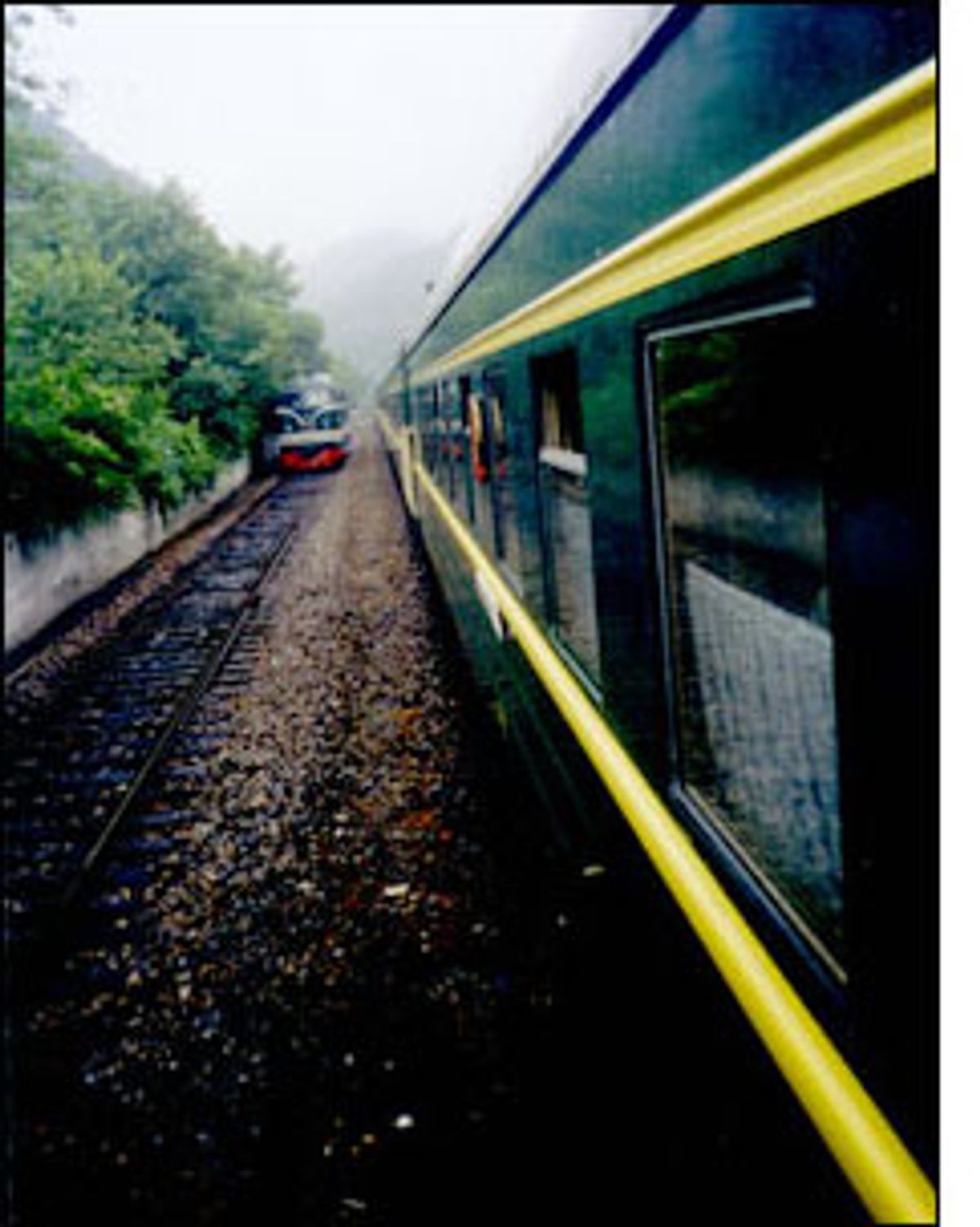
The reason most travel accounts of the Trans-Siberian train are so predictable and lifeless is that they lose their edge in the attempt to be earnest.
While in the perfumed death-grip of such optimistic sincerity, many a scribe has misled his readers with dandied visions of trans-continental reverie. Some wayward writers have committed this error by weaving the view from their train window into moony reflections about how Russian literature changed their lives. Others have tried to capture the mood of the country itself by minutely analyzing everything from their new Russian acquaintances, to whimsical encounters with the dining-car staff, to any experience involving obligatory vodka-shots.
A few rail-diarists -- the desperate -- try to validate their long hours on the train by bringing in marginally relevant trivia from the sights outside: how Tomsk is full of radioactive waste; how Taishet was once a Stalin-era forwarding camp for Siberian exiles; how Perm is home to a bicycle factory; or how Krasnoyarsk churns out refrigerators and car tires.
All of this is fine. But it falls far short of the train experience itself.
This is because a train trip across Siberia takes a very, very long time, and largely transpires in a small berth that rattles a lot, features fake-wood paneling and empties into a corridor full of antsy people who haven't bathed in days. If there is anything genuine to be communicated from this experience, it will certainly have very little to do with the novels of Boris Pasternak, the cook's opinion of Yevgeni Primakov or the dreadfully inefficient see-saw factories of Zuevka. Rather, if there is any revelation to be gleaned from spending several days on a single train, it will come from the bizarre details that lurk beneath the mundaneity of the trip itself.
This is what I'd convinced myself, at least, when my cousin Dan and I boarded the Moscow-bound train at Irkutsk.
After all, 81 hours on a train is a long time, and I didn't want 100 years of journalistic preconceptions to taint my experiences before they'd even happened.
- - - - - - - - - - - - - - - - - - - - -
In January of 1899, the first regular Trans-Siberian train service began to take passengers from European Russia to Irkutsk -- "the Paris of Siberia" -- a thriving university town that was home to all manner of exiles, from "Decembrist" nobles to Polish nationals to avowed anarchists. At the time, the completion of this railroad line was a triumph -- since it aided settlement to the region, consolidated Russia's eastern claims against China and Japan, and opened up Siberia's rich natural resources (such as timber, gold and coal). Just 10 years earlier, transportation conditions to the Russian Far East were so abysmal that it was actually faster to get from Vladivostok to Moscow by going east via the United States than it was to travel west across Russia itself.
In the early days of the railroad, the Moscow-Irkutsk run often took over a week to complete; our 1999 timetable put the journey at three and a half days. Since we'd traveled the first two legs out of Beijing and Ulan Bator in second class, Dan and I decided -- for reasons of both comfort and curiosity -- to splurge on a first class upgrade for the Moscow-bound haul.
At first blush, the environment of the first class car seemed a mild disappointment -- not because of the berths (which were clean and comfortable) or the provodnitsas (who were helpful and pleasant), but because of the company. When I'd first purchased the upgrade, I'd imagined my fellow first-class travelers as spy-novel grist: corpulent Russian mob-types with anorexic supermodel girlfriends; snooty French diplomats with snarling lapdogs; bespectacled English ethnologists with fascinating tales about the Finno-Urgic Udmurts of the Siberian plain. In reality, our first class car was mostly populated with elder-hostel tourists from places like Minneapolis and Tempe.
Over the course of the trip, of course, these folks would prove far more baffling and contradictory than a train-full of spies.
The first hint of my elderly train-mates' dual nature came just five hours into the trip, when my neighbor from two doors down, a 72-year-old man from California, suddenly rushed past me in the corridor. Since he'd always made a point of chatting me up (he'd pegged me as "that Oregon boy" after a brief discussion about college; I'd already heard his Coos Bay coastal storm story twice), I peered over to watch as, ignoring me entirely, he took a hard right into a cabin full of his bridge-playing cohorts.
"This place is just like the Bermuda Triangle!" I heard him announce.
"What do you mean, the Bermuda Triangle?" came a voice from inside the cabin.
"I mean I just saw a Russian guy wearing a shirt that said 'California.'"
"So why does that make this the Bermuda Triangle?"
"Well because that just seems kinda strange, a Russian wearing a shirt that says 'California.'"
"I think you're thinking about the 'Twilight Zone,'" a third voice pointed out. "The Bermuda Triangle is where ships and airplanes disappear. 'The Twilight Zone' is where funny things happen."
"I didn't say it was funny to see a Russian wearing a 'California' shirt; I said it was strange."
"'The Twilight Zone' isn't funny-ha-ha; it's funny-strange. The Bermuda Triangle isn't funny at all; it's where planes and ships disappear."
A fourth voice piped in with a phony John Wayne drawl: "Yeah, and this game is gonna disappear if you don't shut the door, shut your face and play your hand."
"Ha-ha! That's no joke. I swear, we have to wait 20 minutes every time you go down the hall to smell the roses."
As the door slid shut and the corridor fell silent, I stood in amazement. My septuagenarian neighbors -- who had always spoken to me with the friendly, half-interested cadence of people who've been making small-talk since the Great Depression -- were babbling at each other like a bunch of bud-smoking, low-culture-referencing Gen-X channel surfers.
Inspired, I spent the rest of the trip subtly trying to engage my elderly acquaintances with good-natured sarcasm and reflexive irony, but it simply didn't work. Regardless of what I said, they would always steer our conversation back to weather patterns, relatives who once lived near my hometown or the new-fangled wonders of Gore-Tex.
I spent my time in first class feeling like an anthropologist who can't learn the primitive tribal customs because the natives think it's more seemly to speak to him in Shakespearean English.
- - - - - - - - - - - - - - - - - - - - -
Not long into the trip, my cousin Dan and I fell into a listless First Class
routine that revolved around reading, drinking tea, staring out the cabin
window and aimlessly wandering the corridors. In time, I would take an
adventure into the Third Class car, but I never considered that option until
late in the trip.
Despite my best efforts to get caught up in the romance of the
Trans-Siberian transit, I found that feelings of reverie only sustained
themselves in very short doses. That left me with a lot of down-time. On
an 81-hour trip, down-time adds up. Thus -- aside from my geriatric
neighbors and a few books -- the closest thing I had to moment-by-moment
entertainment came when Dan would fall asleep for 15 minutes, then wake up
and tell me what he'd just dreamt.
"I was getting ready to climb Mount Everest with you and some hippie mountaineer," Dan said after falling asleep and waking up midway through our second day on the train. "I was having trouble tightening my boots, because I was wearing those pantyhose-thin 'Gold Toe' socks. I was also worried because I'd forgotten to bring warm clothes, and the road we took up to base camp looked a lot like U.S. 59 as it goes through Garnett, Kan."
"An Everest dream," I told him. "That must mean something."
"Yeah, maybe. But Everest seemed to start at the upper limit of a hallway wall, and as you and the hippie were ice-axeing your way up the glacier, your safety ropes were coiled on this short, gray industrial carpeting. I thought to myself, 'Shit, I've never used technical climbing equipment before, but Everest seems to be indoors. How hard can it be?'"
"Did you try it then?"
"I didn't get the chance; I woke up before I could try. The last thing I remember is how commercially extreme you and the hippie looked as you climbed Mt. Everest in blowing snow and fluorescent lighting."
"Nice," I said. "Very weird. You should fall asleep more often."
Dan and I occupied a berth that, while comfortable, was a far cry from the proposed first class cabins of the original train. During the Paris "Exhibition Universelle" of 1900, the Russian government promoted its recent Trans-Siberian engineering feat with an exhibit that promised libraries, music rooms, gymnasiums and marble-trimmed bathtubs in the first class cars. A century later, the closest first class came to a marble bathtub was an aluminum washbasin, and the nearest feature to a music room was a crackling cabin speaker that continuously played eclectica ranging from Stravinsky's "Firebird" to "Shadow Dancing" by the Bee-Gees.
I spent much of my cabin-time looking out at the Siberian landscape. Beyond the train tracks, coniferous taiga forests clotted the flat landscape, and small stands of birch stood out like white matchsticks on the horizon. In the open spaces, rounded piles of hay sat in vivid blue-green fields; purple-dappled meadows draped the valleys. Country people haunted bogs and pastures: men in blue overalls clutching wooden pitchforks; girls in blue dresses picking vegetables; boys in blue hats wading waist-deep in muddy ditches. Trackside cemeteries sat behind sky-blue iron fences -- their colorful garlands and bleached headstones fading back into the trees, giving the illusion that graves stretch under the taiga all the way up into the arctic.
These sights changed only slightly as the miles wore on. Sometimes, for variety, I would turn from the window and watch the landscape reflect off my cabin walls -- jumping and jittering across the plastic woodgrain like a blurry 1940s movie newsreel.
The folks from the Elderhostel tour occasionally dropped by my cabin for a chat ("Now where did you say you boys were from?"), but they were most visible and boisterous just before the station stops. In anticipation of these brief platform-breaks, our neighbors would set aside their embroideries and bridge games and crowd their way toward the corridor exit. Listening to them chatter as they shuffled by my door was like flipping through UHF television channels:
"I didn't know Cheryl Tiegs was 50."
"Well preserved, isn't she?"
"They're selling jawbreakers on the platform. Ha-ha!"
"It was a man's bathing suit that I inherited, and it was all wool."
"You fill your pelvis up with air, then your stomach, then your throat. Breathe out for five minutes, then it's gone."
"Look at me: I decided I didn't want to look like a tourist out there."
"You need to watch out for gangrene. Ha-ha!"
"I smell fish. Let's buy a fish."
"Ha-ha! He said he was gonna guy a fish!"
"I'm gonna do it! I'm gonna buy a fish and give it to her!"
"If you give me a fish, I'll give you a divorce."
"If we get a divorce, I'm gonna make you keep the fish."
"Look at him! That crazy sonuvabitch is really gonna go off and buy a fish! Ha-ha!"
At each station stop of over two minutes, the entire Elderhostel crew would dash out of the car the moment the provodnitsa let down the carriage steps, then hustle back a few moments later clutching sausages, handmade scarves, bottles of black-market vodka ("Look at what I got, ha-ha!") and fresh vegetables. By comparison, Dan and I must have seemed like complete fuddy-duddies.
- - - - - - - - - - - - - - - - - - - - -
Not wanting to feel like a total layabout, I hiked down to the dining car each evening to have dinner with my old castaway buddies Mark and James, who were enduring this leg of the trip in second class. Admittedly, the camaraderie was more of a motivating factor than the food.
"This beefsteak tastes like a beef-flavored wash-cloth," I complained over dinner our second night. Mark and James grimaced in sympathy, unenthusiastically chewing their own beefsteaks.
"That's your mistake," said a youngish Russian guy at the next table over. "You got beef. You should have gotten omul. Siberia is famous for it."
"Omul? I didn't see it on the menu."
"It's not on the menu, but this train always has it. It's a fish, a cousin to salmon. You can only find it in Lake Baikal. It cries like a baby when the fishermen catch it. You eat it salted. It's very good."
"Thanks for the tip," I said. "Your English sounds great, by the way -- very natural."
"Thanks," the Russian said. "My name's Aleksey. I studied in California; now I work for Gillette. You know: 'The Best a Man Can Get.' Today I'm taking the slow road to Novosibirsk. Are you also here for work?"
"No, just for fun."
"Fun? On this train? I think maybe you're a little crazy."
"This is a classic trip," I said. "An adventure."
Aleksey scoffed. "This isn't an adventure. You need to try something extreme -- take a ride in a MiG fighter, or parachute from a helicopter or go rock climbing in Kamchatka. That's what tourists do for fun in Russia these days. Train rides are old-fashioned."
"The Trans-Siberian is like the Russian version of going across America in a convertible," I insisted. "That's an adventure. It's not extreme, but it's still an adventure."
"It's not really an adventure. The only way to get an adventure on this train is to go to third class."
"Why? What's in third class."
Aleksey smiled at me. "Go there, and you'll find out."
The next morning, having nothing better to do, I did just that.
The first thing I remember about third class was the blast of fetid air as I walked in -- a paint-blistering concoction of feet and armpits, alcohol and urine, cigarette-butts and butt-crack. Fifty-four people had been crammed into an open bunk-room; the whole carriage looked like something out of an absurd murder mystery: men in their pajamas, pressing transistor radios to their ears; small girls singing to themselves in sweet-high voices; small boys clutching packs of cigarettes; large women with stainless steel teeth; oily-faced teens in track suits; two enormous, unshaven men passed out on the same bed.
I breathed through my mouth as I made my way down the carriage, trying to act casual. When I got to the end of the carriage, I realized that I had no real third class visitation strategy. Halfway back across the carriage, a voice called to me in English.
"Hey you!" I looked over to see a balding, round-faced man of about 40 smiling at me. He was obviously very proud of his English skills, and he spoke rather loudly. "Where you from?" he shouted.
"The United States," I said, thankful that, if nothing else, this interaction was validating my trip to third class. The man translated loudly: "Amerika!" A dozen or so people turned around to listen in.
"What you think of Beverly Hills?" the balding man asked, still smiling.
For some reason I couldn't think of an intelligent-sounding way to answer this question. "Um, it's very nice," I said. "Lots of rich people live there."
"What you think of China?"
"It's a nice place. Lots of people." Under normal circumstances, I'd have been boring these people to death, but after two days in steerage, I was something of a marquee player.
"What you think of Russia?"
"Very nice. Very interesting." There were a few nods, a few sarcastic groans.
"What means 'fuck you'?"
"That's a bad word. You shouldn't use it." The balding man translated; the peanut gallery frowned and nodded.
"What you think of Russian women?"
Experience overseas had conditioned me to answer this kind of question in a bland, positive way that neither interests potential pimps nor irritates territorial-pissers. "Russian women are very nice and pretty," I said.
For some reason, everyone thought this answer was really funny. Giggling, the balding man pointed to a girl of about 14, whose rear end was hanging out the bottom of an extremely short pair of pants. "What you think of that woman?" he yelled.
Not sure what the fuss was about, I decided to stay with my stock line. "She seems very nice and pretty."
My translated answer resulted in pandemonium. The girl's face went red, and her mother tried to wrestle her over to me. Old women screamed like teenagers, old men howled with laughter; a bottle of vodka appeared out of nowhere.
"You stay here!" the balding man shouted joyously, taking the vodka and looking around for a cup. "Maybe you kiss her later!" He immediately translated this witticism, much to the delight of the peanut gallery.
Standing there, peering around, I had no idea what was going on. I knew that I'd been in the third class carriage for about 10 minutes. I knew that this 10 minutes was already more interesting than the previous 24 hours put together.
I knew that I didn't want to stay a moment longer.
Under the inspirational moral standard set by movies like "Titanic" and "Dead Poet's Society," I should have stuck around and tried to enjoy myself or learn something. The thing is, I didn't want to seize the day or frolic in steerage. I didn't want to get drunk on vodka or learn Russian profanities or suck face with a Slavic Lolita in ass-pants. The insipid calm of first class had irreversibly jaded me: I longed for eventlessness.
Making my excuses, I fled the third class carriage. Walking into the first class corridor, I wasn't sure if I'd met Aleksey's challenge of "adventure," and I didn't care. If two listless days in first class had taught me anything, it had taught me to crave more listlessness.
Returning to my cabin, I was encouraged to find my cousin bleary-eyed from sleep.
"Did you take another nap?" I asked.
"Yeah, I guess I did."
"Did you dream?"
Dan furrowed his brow, thinking for a moment. "I dreamt of a koala bear."
"Oh yeah? What'd it do?"
"It didn't do anything. It was just sitting in a male zookeeper's arms. It was wearing a little white tuxedo glove on its forepaw, which was ever so gently grasping the zookeeper's arm-hair."
"And that was it?"
My cousin shrugged. "That was it."
- - - - - - - - - - - - - - - - - - - - -
For all practical purposes, my trip to Moscow ended not in Yaroslavl Station, but on my fourth morning on the train, when I woke up early to sit in the dining car and record the sights in my journal. "Water tower like a sentinel, trackside," I wrote gazing outside. "Collapsed sawmill next to standing trees. Piles of iron: Where do these come from? Birch trees like matchsticks."
Stopping for a moment, I flipped back several pages in my notebook. "Birch trees like white matchsticks on the horizon," an earlier entry read. I flipped back a few more pages and found another birch tree-matchstick analogy, right next to an entry that compared water towers to sentinels. Putting my pen down, I reread my journal.
In three days, I'd made eight separate references to collapsed buildings and five references to faded or broken communist murals/symbols. I'd used the word "sentinel" four separate times to describe three separate things. For the last 3,000 journal miles, the taiga had never stopped being "endless," the birch trees had consistently been "like matchsticks" and the decaying "vestiges of Soviet society" had never ceased to be ironical.
As I sat and reflected on my own redundancies, a foursome from the Elderhostel tour came in and sat at the far end of the dining car. They hadn't noticed me in my booth, and were trapped in their own quirky, wonder-filled version of the train experience.
"Did you see that train-worker lady when we were coming here?" a voice said. "She looked real classy. Good bones and dark hair, like Jackie O."
"Yeah, I saw her," came a reply. "Too bad she doesn't work in our car. They should switch those people around after a couple days."
A third voice: "Hey, whatever happened to Jackie O. Junior?"
A fourth: "What do you mean, 'Jackie O. Junior'?"
"Jackie O.'s daughter. Not the train lady; the real Jackie O. Whatever happened to her daughter?"
"Jackie O. had a daughter?"
"Of course she had a daughter. She had a daughter before she had a son, for chrissakes."
"What son?"
"Her son, you dummy. JFK Junior!"
"Wait, are you trying to ask me about Carolyn Kennedy?"
"Yeah, that's her. Carolyn Kennedy."
"So where do you come off asking me about 'Jackie O. Junior'? You're the damned dummy!"
"Never you mind that. Whatever happened to Carolyn Kennedy?"
"I don't know. Did you hear that something'd happened to her?"
"I didn't mean it that way: I meant, whatever happened to her? Where is she? What's she doing?"
Once my elderly train-mates had solved the mystery of Carolyn Kennedy and moved on to talking about the deficiencies of Russian tomato juice, I closed my notebook and put it into the bottom of my day pack.
A few days later, the mad nights of Moscow and St. Petersburg would hasten the return of my journal -- but at that moment, even with Moscow 400 miles away, I realized it was no longer of any use.
Bidding the Elderhostel crew good morning, I walked back to my cabin to see if my cousin had dreamed anything new.
Shares