Books
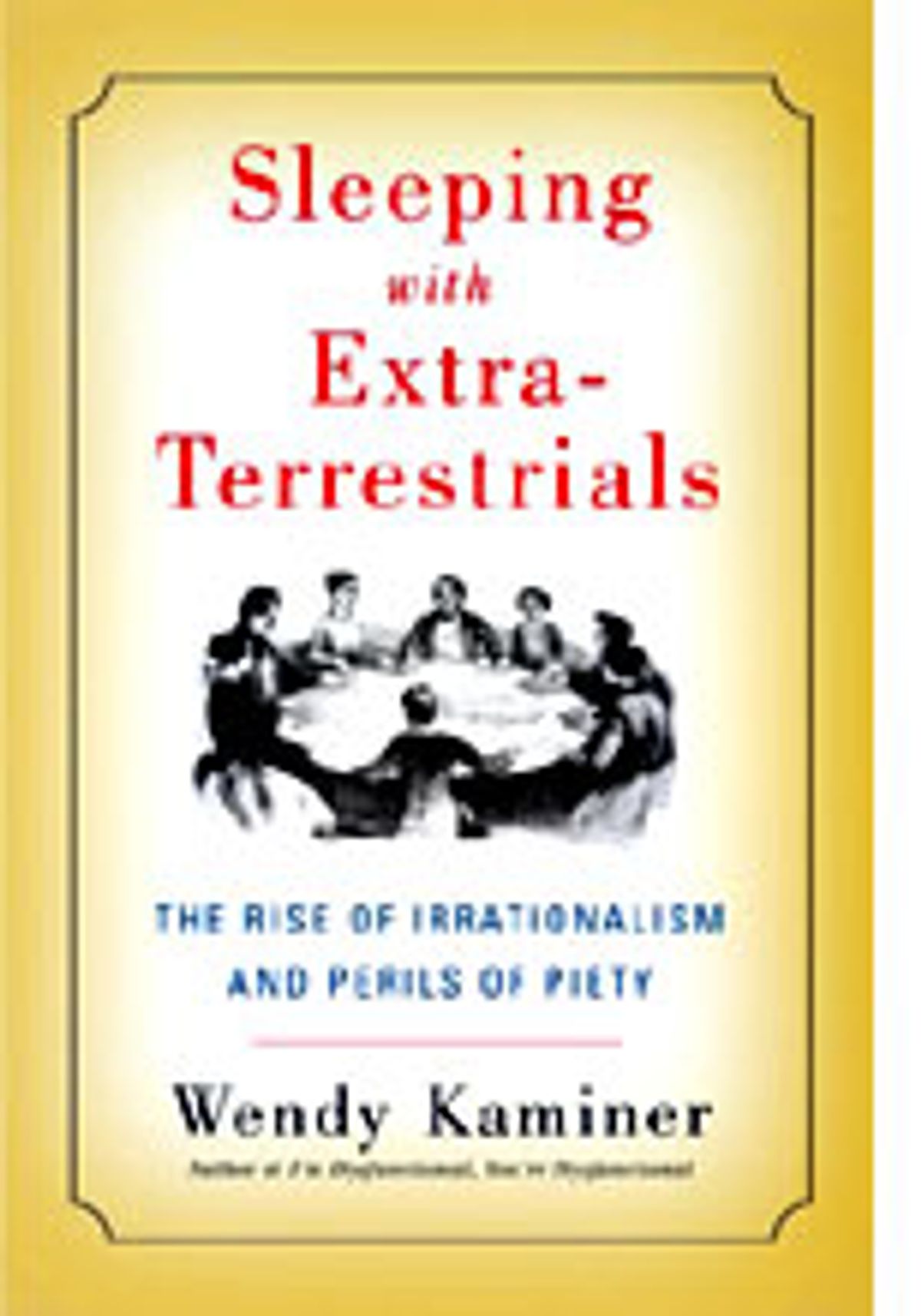
“Sleeping With Extra-Terrestrials” by Wendy Kaminer
American boobs will believe practically anything. But is this news?
Wendy Kaminer sees America returning to God, and she doesn’t like it. What she objects to (or says she objects to), though, isn’t the pre-millennial resurgence of religious faith so much as its pernicious effects on democracy. For her, the public sphere has been hopelessly contaminated with piety (much of it spurious and hypocritical), woolly-minded New Age spirituality, superstition about angels and aliens and other dangerous forms of irrationality. This promiscuous outpouring of belief, she fears, is corrupting our ability to form rational judgments — never an easy task under the best of circumstances — and compromising the Enlightenment basis of our republic.
A fellow at Radcliffe College best known for her scathing analysis of the recovery movement, “I’m Dysfunctional, You’re Dysfunctional,” Kaminer can think and write with bracing clarity. And a great deal of what she has to say in her new collection of essays, “Sleeping With Extra-Terrestrials,” badly needs saying. With virtuecrats of the right, center and even left exhorting us into the churches and synagogues and sinful politicians indulging in spectacles of prayer and penitence, it’s a positive relief to encounter a public intellectual with the courage to wonder whether all this old-time religion is really good for us. Kaminer has assumed the lonely role of skeptic in a nation of believers; she frequently ventures onto daytime TV and talk radio to be pilloried as a soulless heathen.
Actually, though, her personal attitude toward religion is complicated. She describes herself as an agnostic rather than an atheist. Sometimes she seems envious of the faithful, at other times derisive. As she struggles to define her own beliefs, she retreats into negatives and double negatives: “I’m not oblivious to the comfort that supernaturalism may provide or unimpressed by the powerful human impulse to believe; nor am I utterly secure in my disbelief.”
Kaminer observes that the ’90s revival of faith is so sectarian in character that it actually threatens true religious freedom. (In Bible Belt school districts where prayer has been introduced in defiance of the courts, Jewish children have been persecuted and harassed.) And she argues that the equation of religion with virtue has driven political debate in illogical directions on a host of issues. The immeasurably destructive war on drugs she regards as a “faith-based antivice crusade.” The 1996 welfare-reform package actually began channeling federal funds directly to houses of worship, a breach of the church-state firewall so dramatic it even troubled some religious leaders; but as Kaminer writes, these concerns were drowned out by a consensus that only churches and synagogues could “provide welfare recipients with spiritual healing, which almost everyone, left and right, assumed that they needed.”
Somewhat immodestly, Kaminer implicitly compares herself to H.L. Mencken, Mark Twain and other acerbic critics of the American tendency toward dopey credulity. And as long as she stays on the topic of religion and the idiocies it introduces into public life — fending off the communitarian left on one hand and the neo-Victorian right on the other — the thrusts and parries of her reasoning remain worthy of these forebears. But when she turns her attention to New Age spirituality, and then to popular feminism, pseudo-science, therapy and the Internet, her writing becomes increasingly shapeless and uncentered.
Too often she attacks easy and oft-punctured targets, from past-life therapists and recovered-memory experts to angel channelers and UFO abductees. But the fact that Americans believe all kinds of improbable and unprovable things isn’t exactly news. (Did Kaminer’s block just get wired for cable?) Our country was first settled by fanatics and has always incubated eccentric varieties of belief — there was never a golden age of American rationalism.
Kaminer is right, of course, that a lot of people are ready to swallow any far-fetched notion that makes the painful and lonely business of living and dying more tolerable. But in an era when the secular authorities of science and government have so often proved corrupt, almost everyone feels the need to look elsewhere, at least sometimes, for absolute verities. Kaminer’s account of the culture of credulity may be carefully argued and intellectually nuanced, but it has the unimaginative, unsympathetic tone of an indictment.
Perhaps I’m reacting to Kaminer’s bloodless style rather than to what she’s saying, and thus exposing myself as a member of the cult of “the authenticity of subjective experience,” to use her phrase. But then I don’t have any other kinds of experience to draw on. To my mind, Kaminer misses the terrifying and marvelous disconnect at work in contemporary society — the capacity of Information Age human beings to believe any number of mutually contradictory things at once. Maybe it’s because Kaminer is completely immune to the fluid, almost erotic allure of religious or magical thinking that she has no real feeling for it. But absent such fundamental sympathy, her book feels unhappily reminiscent of a civics lecture: For all the excellent points it makes, it’s earnest, self-righteous and easy to ignore.
“People Who Eat Darkness”: The disappearing blonde
A true crime story set in Tokyo illuminates the complicated truths behind media cliches
Joji Obara and Lucie Blackman (Credit: Estate of Lucie Jane Blackman) Lucie Blackman, 21, went out for the afternoon in 2000, phoning her roommate and best friend Louise to arrange a meeting later that night. Lucie never showed up, and within a few days she’d become one of those vanished blondes whose fates fuel headlines and hours of speculative media coverage. She was British, a former flight attendant, and she and Louise were living in Tokyo. They were also bar hostesses, a profession with a very specific meaning in Japan, difficult to explain to foreigners and not entirely clear to the Japanese themselves. Lucie both did and didn’t match the classic Missing Blonde profile, and for a while the mystery of what happened to her threatened to lapse into permanent obscurity.
Continue Reading Close
Laura Miller is a senior writer for Salon. She is the author of "The Magician's Book: A Skeptic's Adventures in Narnia" and has a Web site, magiciansbook.com. More Laura Miller.
Corporate criminals gone wild
The maker of the documentary film "Inside Job" has a new book excoriating Wall Street -- and President Obama
A detail from the cover of "Predator Nation" “Inside Job,” Charles Ferguson’s Oscar-winning documentary film on how government, Wall Street and academia colluded to deliver us the worst financial crisis since the Great Depression, made a powerful case that something was very very rotten at the heart of the American political/economic nexus. His follow-up book, “Predator Nation: Corporate Criminals, Political Corruption, and the Hijacking of America,” can be considered the legal brief that dots every “i” and crosses every “t” in his argument. A tightly argued, profusely footnoted and deeply enraged castigation of everyone involved, “Predator Nation” isn’t just a factually unchallengeable account of how Wall Street blew up the global economy. It’s a denunciation, a call for justice and a warning: After getting away with the crime of the century, Wall Street still isn’t satisfied.
Continue Reading Close
Andrew Leonard is a staff writer at Salon. On Twitter, @koxinga21. More Andrew Leonard.
Can you identify?
Science shows that the only way around some readers' prejudices is to trick them
(Credit: Shutterstock/Salon) The news of recent research documenting how readers identify with the main characters in stories has mostly been taken as confirmation of the value of literary role models. Lisa Libby, an assistant professor at Ohio State University and co-author of a study published in the Journal of Personality and Social Psychology, explained that subjects who read a short story in which the protagonist overcomes obstacles in order to vote were more likely to vote themselves several days later.
The suggestibility of readers isn’t news. Johann Wolfgang von Goethe’s novel of a sensitive young man destroyed by unrequited love, “The Sorrows of Young Werther,” inspired a rash of suicides by would-be Werthers in the late 1700s. Jack Kerouac has launched a thousand road trips. Still, this is part of science’s job: Running empirical tests on common knowledge — if for no other reason than because common knowledge (and common sense) is often wrong.
Continue Reading Close
Laura Miller is a senior writer for Salon. She is the author of "The Magician's Book: A Skeptic's Adventures in Narnia" and has a Web site, magiciansbook.com. More Laura Miller.
“The Aleppo Codex”: The bizarre history of a precious book
A reporter traces the shadowy fate of the definitive version of the Hebrew Bible
Matti Friedman An ancient and priceless book, a murky history of evasions and coverups, an underground of sinister and possibly violent dealers, a former spy who drops tantalizing hints and a wily 84-year-old millionaire who says stuff like, “The problem with this story is that it could damage your health”: Are these the ingredients for a cheesy, improbable historical thriller? Yet “The Aleppo Codex,” Matti Friedman’s account of his attempts to learn the history of one of the world’s most precious books, sports all of these assets, and it’s nonfiction. If reporting this story damaged Friedman’s health, it probably happened when he realized what he’d stumbled into and his reporter’s heart started beating in doubletime.
Continue Reading Close
Laura Miller is a senior writer for Salon. She is the author of "The Magician's Book: A Skeptic's Adventures in Narnia" and has a Web site, magiciansbook.com. More Laura Miller.
Augusten Burroughs: Conquer trauma by letting it go
Salon exclusive: The best-selling memoirist says past horrors haunt us because we think about them too much. Stop
Augusten Burroughs Many people continue to feel influenced and even controlled by the things that happened to them a long time ago. Sometimes, people harbor dark, traumatic memories from childhood. Or fragments of memories — incomplete scenes, uncomfortable feelings, perhaps even a sense of certainty that something specific and terrible happened to them, but little more than this.
Others experienced something traumatic in adulthood that continues to affect them day to day many years later. Maybe an assault has left a person afraid to leave their home or enter a particular neighborhood.
Continue Reading CloseAugusten Burroughs' many books include "Runnning With Scissors," "Dry," "Sellevision," "Magical Thinking" and "Possible Side Effects." His latest book is "This Is How." More Augusten Burroughs.
Page 1 of 984 in Books