Books
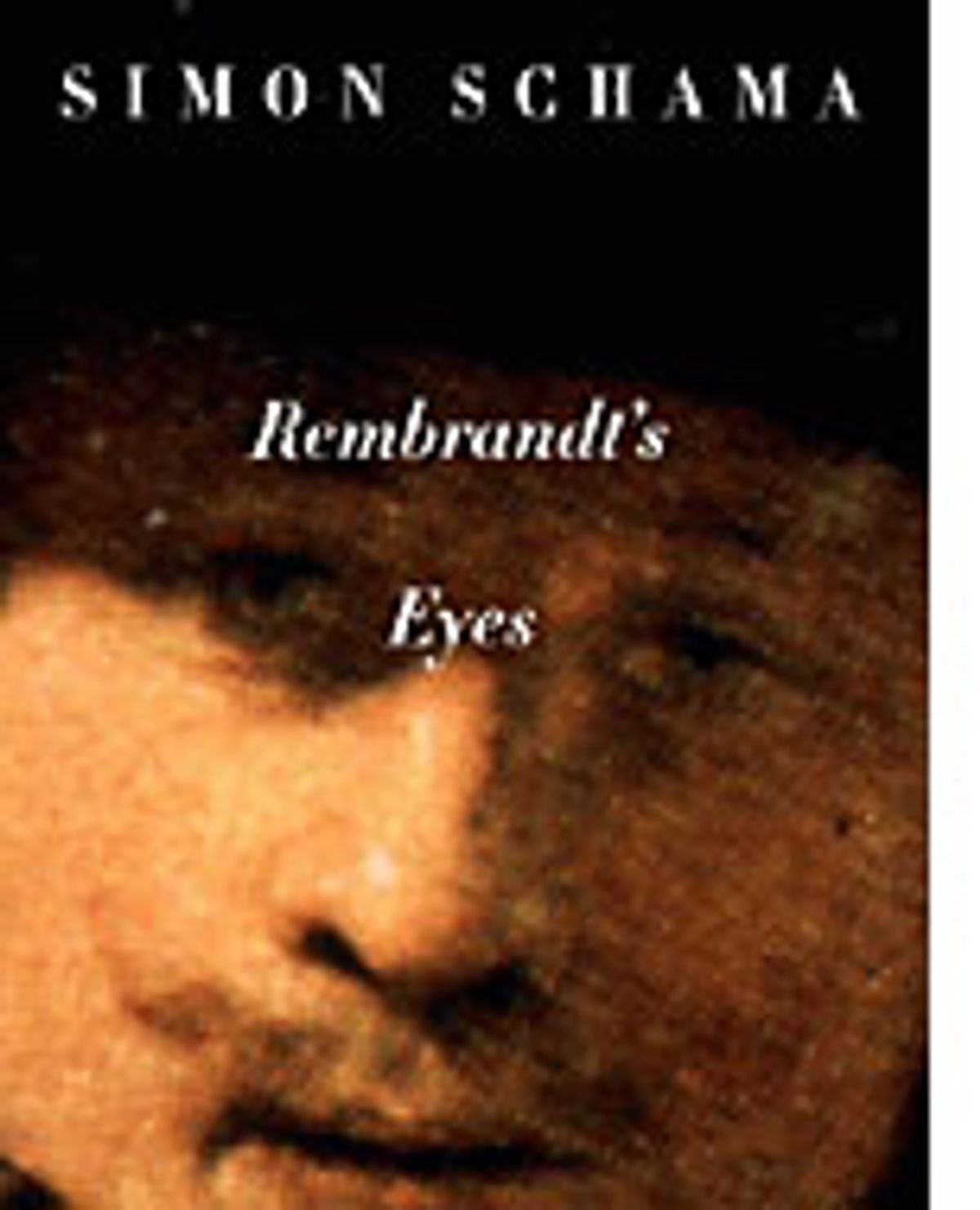
“Rembrandt's Eyes” by Simon Schama
A new biography charts the troubled painter's rivalry with the worldly, successful Peter Paul Rubens.
It’s unlikely that Simon Schama will ever produce a book anyone
accuses of being too short. The Columbia University history professor and
author of the widely praised “Landscape and Memory” and “Citizens:
A Chronicle of the French Revolution” is among the reigning champions
of the lush and massive tome. Schama doesn’t so much write books as
deliver immense objects to his readers.
His latest undertaking, an investigation of Rembrandt van Rijn’s intricate
connection to another 17th century master, Peter Paul Rubens, is close to
the heftiest volume I have ever read. This is a 728-page
book, sized to fit 359 illustrations. The pages, when not simply walls of
print, are walls of print broken only by densely painted Baroque
masterpieces, reproduced in full color. Visual overload is always just a
licked fingertip away.
Which is just the way Schama wants it; overload is his accomplice. This
is the kind of monumental undertaking most historians would gladly trade
their rustbucket Volvos for a shot at. But would their ambition be the equal
of their envy? Schama, after all, is the jet set, the Mac Daddy of historians. He gets to write gargantuan books because he delivers the goods.
He made his mainstream reputation in 1987 with “An Embarrassment of
Riches,” a you-are-there channeling of life in the Netherlands in
the 1600s. It’s another gigantic book — 698 pages — but, really, the
Netherlands? Who cares? We should, argued Schama, because in the burgher
republic of the Dutch Golden Age, we can find the seeds of our own current
lifestyle, our embrace of plenty and our neurotic misgivings about whether
all that plenty is somehow robbing us of our souls.
Rembrandt — the most important artist to emerge from this milieu — was
certainly sensitive to the tension between the desire for excess and the
penalties that excess invites. As talented as he was extravagant, Rembrandt was the perfect painter for Calvinist Amsterdam of the 1630s
and ’40s: Apparently predestined for greatness, he became, by the end of his life, an
anachronism laid low by his foibles.
This is far from the whole story Schama has to tell in “Rembrandt’s Eyes,” however. He makes the case that Rembrandt’s career was shaped by an anxiety-
They were night and day, Rubens and Rembrandt. While the older painter
was the soul of taste, a stoic and a devout Catholic, Rembrandt was a
Calvinist vulgarian. “Rubens’s most ardent admirers … [celebrated] the
Flemish painter’s commitment to discrimination,” writes Schama.
“Rembrandt, on the other hand … had no idea when to avert his gaze.”
Fittingly, Rubens died a painter-aristocrat who dabbled in
diplomacy and was universally mourned. Rembrandt went bankrupt and
expired penniless in a hovel just seven years after he had disinterred
his wife’s bones so that he could sell the grave to stave off his
creditors.
Rubens painted only four self-portraits, Rembrandt more than 40. “Unlike
Rembrandt’s restless makeovers,” Schama writes, “Rubens’s sense of himself
was constant.” The irony here is that Rubens was the more overtly flamboyant painter.
Rubens’ “Christ on the Cross” (c. 1613) gives us the Savior as a martyred Catholic muscleman. Rembrandt’s 1631 painting of the crucifixion, by contrast, depicts a scrawny hippie: “A Calvinist image of the body,” in Schama’s estimation, “pathetically slight, broken, and bleeding.” Rubens, the more practical man, had his head in the Platonic clouds. Rembrandt, the captive of his own appetites, had his eyes focused on the Aristotelian everyday, “the piebald, the scrofulous, the stained.” His most famous painting, “The Anatomy Lesson of Dr. Tulp,” depicts an autopsy.
Of course, where Simon Schama is concerned, one takes comfort in simple
dualities at one’s peril. Partly this is a function of his style, which
is both elliptical and intense. No one can match him at translating
visual detail into scholarly porn, but neither can anyone veer more
maddeningly from the straight path of historical narrative. I used to think
“Citizens” was the most willfully disorganized book ever written. I now
realize that Schama just can’t help himself. The man thinks entirely in
codas and arabesques.
But fighting to keep up with Schama is worth the struggle. Rembrandt was
among the most complex, compelling — and flabbergasting — artists who
ever lived. He is well served by an equally daring biographer, one who isn’t
afraid to take some chances in the service of his craft.
Matthew DeBord is a contributing editor at Feed. More Matthew DeBord.
“The Aleppo Codex”: The bizarre history of a precious book
A reporter traces the shadowy fate of the definitive version of the Hebrew Bible
Matti Friedman An ancient and priceless book, a murky history of evasions and coverups, an underground of sinister and possibly violent dealers, a former spy who drops tantalizing hints and a wily 84-year-old millionaire who says stuff like, “The problem with this story is that it could damage your health”: Are these the ingredients for a cheesy, improbable historical thriller? Yet “The Aleppo Codex,” Matti Friedman’s account of his attempts to learn the history of one of the world’s most precious books, sports all of these assets, and it’s nonfiction. If reporting this story damaged Friedman’s health, it probably happened when he realized what he’d stumbled into and his reporter’s heart started beating in doubletime.
Continue Reading Close
Laura Miller is a senior writer for Salon. She is the author of "The Magician's Book: A Skeptic's Adventures in Narnia" and has a Web site, magiciansbook.com. More Laura Miller.
Augusten Burroughs: Conquer trauma by letting it go
Salon exclusive: The best-selling memoirist says past horrors haunt us because we think about them too much. Stop
Augusten Burroughs Many people continue to feel influenced and even controlled by the things that happened to them a long time ago. Sometimes, people harbor dark, traumatic memories from childhood. Or fragments of memories — incomplete scenes, uncomfortable feelings, perhaps even a sense of certainty that something specific and terrible happened to them, but little more than this.
Others experienced something traumatic in adulthood that continues to affect them day to day many years later. Maybe an assault has left a person afraid to leave their home or enter a particular neighborhood.
Continue Reading CloseAugusten Burroughs' many books include "Runnning With Scissors," "Dry," "Sellevision," "Magical Thinking" and "Possible Side Effects." His latest book is "This Is How." More Augusten Burroughs.
Why did we move to Paris?
Leaving New York seemed ideal. Until the crazy landlord, topless exams, the French flu, the lack of credit cards...
Rosecrans Baldwin Paris’s neighborhoods, the arrondissements, are organized like a twist. They spiral from the river like toilet water flushing in reverse and erupting out of the bowl — a corkscrew or what have you, a flattened pig’s tail, a whorling braid notched one to 20. But if you walk from one neighborhood to the next, there is little to suggest the numbers changing. So it was confusing. Anyway, if you began in the middle of the Seine and snaked around, we lived on the Right Bank in the top of the third arrondissement, called the haut Marais, the upper Marais, on Rue Béranger, a quiet little street curling down from Place de la République.
Continue Reading CloseRosecrans Baldwin is a founding editor of The Morning News. His first novel, "You Lost Me There," was named one of NPR's Best Books of 2010. His latest book is "Paris I Love You, But You're Bringing Me Down." More Rosecrans Baldwin.
Robert Caro’s bloated LBJ biography
Robert Caro's latest LBJ tome has everyone -- even Bill Clinton! -- hyping it. They've been had
“Even the President of the United States sometimes must have to stand naked.” When Bob Dylan wrote that line in 1964, the naked emperor was Lyndon Johnson, which makes that image perhaps the most disturbing in all of Dylan’s apocalyptic work.
By stripping down Lyndon Baines Johnson to his essence, Robert Caro has himself become an American legend. Since the publication of “The Path to Power” in 1982, Caro has transformed LBJ’s life into a cautionary tale of Shakespearean dimensions. In some wonky circles, the release of a new volume is heralded like the Summer of Love release of “Sgt. Pepper’s.” Can Caro possibly top his “Revolver”?”
Continue Reading Close“Bring Up the Bodies”: Hilary Mantel’s power play
The sequel to her Booker-winning "Wolf Hall" is a thrilling exploration of what it took to run Tudor England
“Bring Up the Bodies,” Hilary Mantel’s follow-up to her Man Booker Prize-winning 2009 novel, “Wolf Hall,” is a high-wire act, a feat of novelistic derring-do. Mantel makes bold not with form — by now meaningful experimentation in that area seems exhausted — but with the very material that brings most readers to novels in the first place: our imaginative identification with fictional characters and the experiences we feel we’re sharing with them.
Continue Reading Close
Laura Miller is a senior writer for Salon. She is the author of "The Magician's Book: A Skeptic's Adventures in Narnia" and has a Web site, magiciansbook.com. More Laura Miller.
Page 1 of 984 in Books