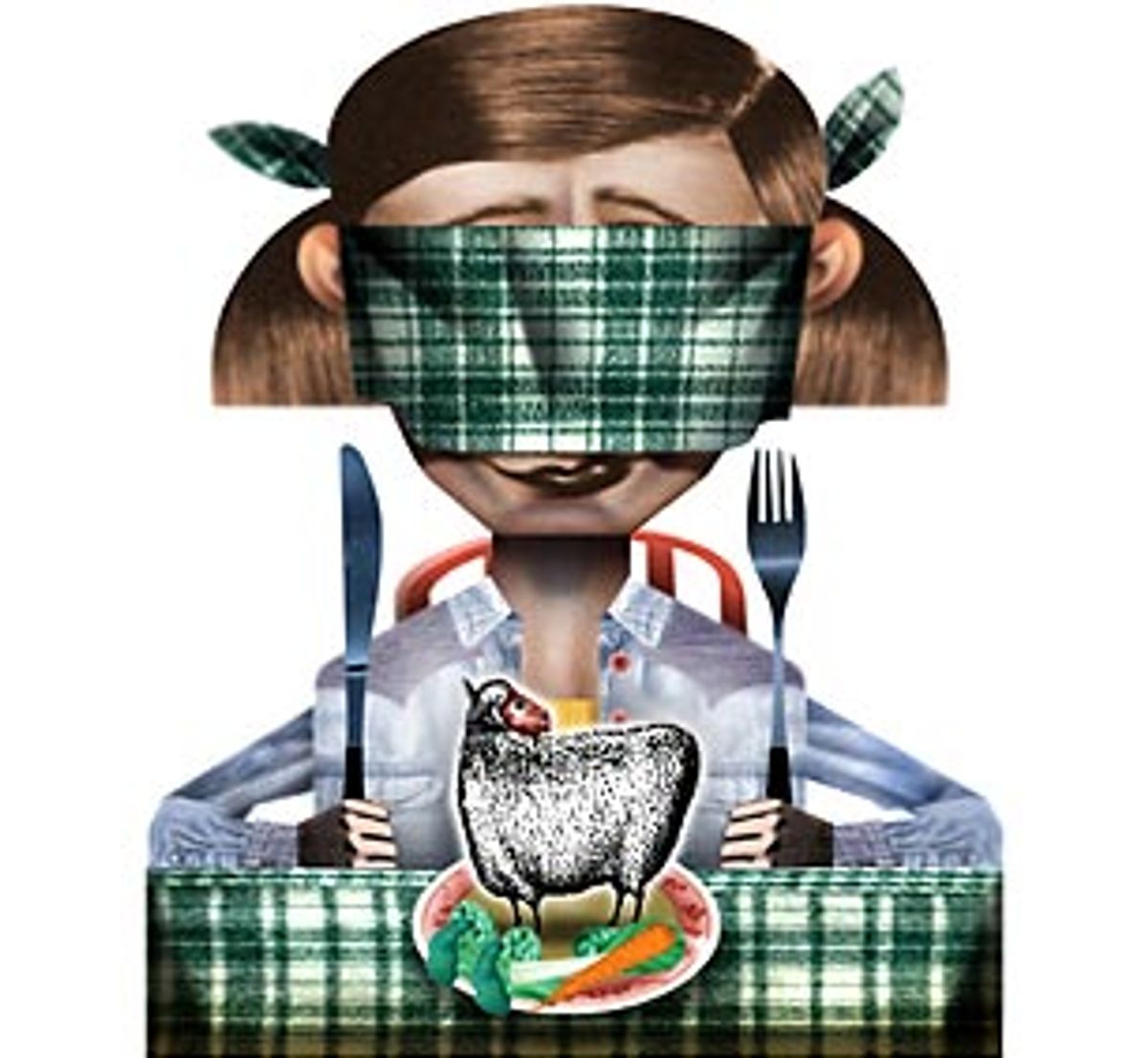
"Can we have meat for dinner?" my older daughter asked late one afternoon.
"We have fish sticks or tuna," I replied.
"There's nothing for me to eat!"
"Well, that's all we have, but we can plan to have meat another day soon."
"We could kill one of the chickens," she proposed, not skipping a beat in her negotiation. I was stopped cold.
We live on three rural acres, which we share with our 14 animals. In our current menagerie, we have four laying hens and two roosters, all used to being held and petted. This summer my two girls and I took our gold Polish rooster to the local pet show and took the blue ribbon for "prettiest bird," over bright-colored parakeets and lovebirds.
My young daughters show none of the romanticism toward farm animals that I grew up with, even though they love those idealized children's books with obsolete images of "farmers" who have a few chickens, a cow, a pig, a sheep. (These fantasy farmers look at lot like us, who are not farmers at all but hobby homesteaders.) My 6-year-old would like to eat meat a lot more often than the once or twice a week that her parents have it, preferably chicken, hamburger or her favorite, lobster.
Unlike my children, parents and grandparents, I grew up in the suburbs. My family ate meat at every meal, just as my parents and grandparents had done when they were growing up on the farm. As a child I saw no contradiction between the way we ate and the passion I felt for my pets. The disembodied act of buying meat in a supermarket felt quite ordinary -- until I started trying to make the pieces of my homestead fit together.
I've always been nutty about animals. A few years ago, at one of those workshops I normally hate -- this one for parents on moral values -- a minister asked the group to list 10 nouns that described who we each were. At the top of my list I wrote "animal lover."
As a kid I'd loved dressing up my dog and dragging her to my hideaway atop a shed. I'd stifled my allergic sneezes and sniffles rather than give up playing with cats and riding horses. As a young adult, I'd worked on my landlord until he said yes to a dog, then moved out when my housemates said no, and found another landlord who would say yes. I'd bristled at the suggestion of one of my housemates that my love for animals was actually an unsatisfied yearning for the children I hadn't had yet. Two kids later, I still bristle.
Then I moved to the country. Year by year the animals came -- two half-tailed kittens dumped across the street with an open can of cat food; peeping day-old chicks delivered to the post office; a frisky dog in need of a new home. And, after another campaign on the home front, a few woolly sheep.
"What do you do with them?" everyone asks me. I know what they mean is "You don't eat your sheep, do you?" At first, the answer was no.
From the beginning I hadn't ruled out eating lambs I raised. I had eaten meat all my life. Where was the logic in buying meat when I had healthy lambs in my backyard?
And so my little wool-producing flock grew, with new lambs each spring. In my third summer of sheep raising, with two adolescent rams mounting everything that moved, the time had come to face the question dead-on.
Roger Jackson (not his real name) became my henchman. He kills animals for a living. One Labor Day weekend I took three sheep to his small custom slaughterhouse. I made three trips, each time with one sheep stuffed into a large dog crate, bleating the whole way.
On my first trip, I found Jackson sawing a hog carcass in half. He directed me to his daughter, who showed me where to put my first 6-month-old lamb. A few months earlier the lamb had caught his horns in a pen and ripped them off. They'd grown back in lumpy.
My other sheep had names from novels (Celie, Lucy, Codi) and from public-radio newcasts (Nina, Cokie, Boutros), but I'd named this one Dinner and his twin brother Lunch. I treated the others like pets. I fed them dropped apples. I scratched Boutros' back until his eyes rolled in an ecstatic swoon. But I had barely handled Lunch and Dinner.
Unused to the halter, Dinner dug his hooves into the gravel. "Don't pull his wool or you'll bruise the meat," Jackson's daughter told me. He bucked, and I yanked him toward the pen. Once he was in, an enormous ram kept humping him. Dinner bleated continually.
"How do you want him cut up?" she asked.
"What are the choices?"
She pulled out a big piece of butcher's paper and scrawled my name and number. "Boned and rolled, steaks, chops. How do you eat?"
I didn't eat much meat. I wasn't sure I'd be able to eat this meat at all. I couldn't answer.
"Why don't we give you a variety? That way, when you come back next time, you'll know what you want."
I had arranged to sell the lamb's twin and a ewe to Jackson. The question of what to do with the ewe, Codi, had gnawed at me for months.
The previous spring she'd rejected her twin lambs. She'd butted them when they'd tried to nurse. She'd have killed them if I hadn't taken them away. I'd tried to get enough milk-replacement formula into them, but one had died the first night, in my bedroom. The other had struggled on, unable to stand. For a couple of weeks I had taken him out to the barn several times a day to force nursing. With furious tears, I'd tied Codi to a fence, held her head with one hand and tried to hook the lamb up with the other hand, mindful to keep my own baby upright in a backpack. I'd also tried rubbing him with a newborn lamb to fool its mother into adopting him, a technique I'd read about called "grafting." Nothing had worked.
I couldn't breed Codi again. I'd put up a few signs, but no one wanted a ewe who couldn't be bred. She infuriated me -- but she was like family, and she trusted me. I knew that any real farmer would "cull" her.
On the day, Codi stepped politely across the driveway in front of the slaughterhouse. It could have been a show ring. "Halter broke, hunh?" Jackson called over, smirking. It was plain that I was bringing to slaughter an animal that trusted me and was used to being handled. It also was obvious that I was feeling slightly ambivalent about the whole plan.
Jackson had told me he'd pay 15 to 50 cents per pound for an older ewe depending on how much was fat. He eyed her and pronounced that she was worth 28 cents on 130 pounds. His big fingers fumbled with a calculator. He did the multiplication twice -- $36.40.
"Can you make it $40?"
"No, that would be 31 cents a pound," he shot back. "I might lose money at that."
He pulled out two 20s. Neither of us had change. "Because you're so cute and young and vivacious, here's $40, but I don't do that all the time. I'll get it out of you next time."
I took the extra $3.60 -- not one of my prouder moments. I drove away, listening to Codi's distinctive deep bleat ringing out from the barnyard noise.
I didn't breed my ewes again. But my business with Jackson was unfinished.
Something didn't feel right about dropping off my animal, then picking him up in little packages. It was as though I had made a long journey to participate in a terrible but enlightening rite, to see and know what my forebears had seen and known, then turned tail and run.
I wanted to know how my animals were turned into meat. Jackson agreed to let me watch him work. I arrived on a Thursday afternoon when he was slaughtering hogs, many for pig roasts the following weekend.
Jackson killed two hogs before I could figure out how he did it. He herded another one from the maze of pens outside into a red steel chute. He wrapped a chain around the hog's right rear leg, then lifted the front wall of the chute enough to shove the hog into the room. He pushed a switch that hung from the ceiling. A hydraulic lift hoisted the big animal. Its free leg thrashed. He lowered her, slowly, head first, into a barrel. Then I saw: Just before her head disappeared, he stuck a knife in her throat. In and out.
I stood motionless in the only spot I could find where I wasn't in the way, behind a small pig carcass hanging next to the cooler door.
The conversion of a hog into meat was routine and quick. Jackson and his employees killed and cleaned animal after animal, with the same competent ease they might use to move pallets around a warehouse. Jackson told me that watching the first one is the hardest. It was true. After an afternoon of watching the slaughter, I knew what to expect.
Once the hog was close to dead, belly twitching only a little, he swung it into a large vat, heated by gas jets. He let it soak a few minutes, then rolled it onto the hog de-hairer. The racket was terrific. A rotor spun the hog and flicked bits of hair into the room. The ear tag flew off, too. Already, the dead animal looked like meat.
Jackson got the next hog, and an employee named Reg took over. Reg hooked each rear leg tendon and hoisted the carcass again. He slit the belly. The intestines popped out and slithered slowly toward the chest. He cut out the anus, reached into the belly slit and pulled it through, along with a mass of organs. He tossed them in a pile on the floor. Every week a rendering company hauls away barrels of the stuff.
He sawed the length of the backbone. Steam rose from the animal and the chain saw. Reg constantly hosed down the carcass, then his own hands and brown rubber apron. The air in the killing room was heavy with moisture. A customer came in for his meat, and Jackson opened the freezer door. The room filled with knee-high fog, as in a dream scene in a play.
When the carcass was done, Reg slid the two halves along a track till they were next to the little pig in front of me.
The slaughterhouse does two kinds of business: custom work, for people like me who raise their own animals; and walk-ins, who pick out animals on the lot, wait for them to be killed, and take them home to eat that night.
Three-quarters of Jackson's customers fall into the second group. And most of those are immigrants -- Puerto Ricans, Haitians, Laotians, Vietnamese, Cape Verdeans, Muslim Arabs -- all with different cultural, religious and holiday requirements for their meat.
Thursday afternoons the slaughterhouse takes walk-ins. A group of Asian women came with their young children to buy freshly killed chickens. They waited outside. One of the women, wearing a dress and pumps, stepped across the killing-room floor and pulled a $100 bill out of her purse. Reg counted out the slaughtered chickens into garbage bags. One chicken was missing. He stomped out of the room.
While he was gone, another woman, also wearing pumps, came in and washed off a baby bottle with Reg's hose. Reg came back and angrily swung the chicken into one of the blood-spattered funnels on the wall, slit its throat, and slung the head into the trough below.
The next Saturday cars and trucks pulled in and out of the lot. A woman in bib overalls wandered around the barnyard with her two children.
Her little girl hopped from pen to pen and begged for a goat. The teenager introduced himself to arriving customers, shook hands and showed animals as though he owned the place. They have been bringing animals to Jackson for 10 years. Sometimes they come just to hang out. That day they'd brought two pigs.
"We're about to go on vacation for two weeks," the woman told me. "I don't want to pay anybody to feed them, so I bring them here." The pigs would be ready when the family got back.
They called through a gate to their pig, Rosebud, a rust-colored 150 pounder. She looked up. "She's very tame," the woman said. "I was thinking of breeding her. But when we brought the trailer around, she hopped in. I told my girl, 'That's it. Good-bye, Rosebud.'"
A man came to pick up a whole pig. He does pig roasts as a side line, mostly for friends at the Air Force base where he works. He passed around Polaroids of a special pig cooker he had built, with a water tray in the bottom to keep the meat moist.
Jackson got his pig out of the cooler. Jackson reminded me, "This was the one whose hair came off easily." I knew the one -- the only black and white one. Jackson said it had come from Maine. On Sunday it went to Cape Cod, to a pig roast for the Barnstable County Deer Club baseball team.
The 39 pounds of meat I picked up from the slaughterhouse looked sterile in its white paper. I stared at it, trying to envision the animal it had been. The next evening five members of my family sat on the screened porch for our first lamb dinner in years. Five sheep crunched grass 50 feet away.
"What do you do with them?" I thought of the thorn bushes that had overrun the property before I had gotten sheep, the wool-filled comforter on my bed, the sweaters I've knitted, the manure that feeds the garden and orchard, the visual pleasure of sheep grazing. And now, this meal. We don't normally say grace, but that night we spontaneously fell quiet for a few moments.
I'd always felt that arguments like the one Dick Gregory makes in his essay "If You Had to Kill Your Own Hog" had merit: that if we human beings understood, firsthand, that eating meat meant that someone had to slit an animal's throat, hang it and chop it into pieces, we'd all become vegetarians. I was prepared for that to happen to me.
Instead, I came to believe the opposite. We have the privilege of asking the question whether humans should eat meat precisely because we are so cut off from the processes of where our food comes from. If we had grown up seeing animals slaughtered, if we depended on the animals we raised or hunted for our livelihood or survival, if we had to kill our own animals for meat, no one would ask the question.
Eating a lamb named Dinner wasn't hard at all. It's what I've been doing all my life. The hard part was taking him to the slaughterhouse and watching Jackson do his job, my job. As Jackson had told me, the first one is the hardest. I have faced what I feared. I know where my meat comes from. I can think of lots of good reasons to eat little or no meat, but sentimentality is no longer one of them.
I often think there are only two pure positions on the issue of killing animals, both worthy of respect: the canvas-shoe-wearing vegan and the butcher or hunter. Most of us fall somewhere in between. We may not all draw the line in the same place, but we must all draw it somewhere.
My little homestead demands the line to be drawn constantly. As the seasons progress, I sometimes feel astonished at how many dozens of living things I kill in a day -- ticks, mosquitoes, yellowjackets, Japanese beetles, houseflies and grain moths, but never spiders, ladybugs or butterflies.
I kill, and encourage my animals to kill, mice, rats and woodchucks but never the songbirds that visit our feeder. I hack a lettuce from its roots but would never chop down a fruit tree. I kill, or have killed on my behalf, a sheep or a chicken but never cats, dogs or people.
My attempt to root out my own sentimentality and hypocrisy raised many questions, questions that I may never fully be able to answer: If I have no problem killing a tick or a lettuce plant, should killing a cow bother me ? Or, if I would never kill a person, then should I not kill a fly?
More to the point, can I justify taking one life to feed another? Can I embrace a rationale that says I'll eat fish and birds but not mammals, or lettuce and carrots but not flesh? Can I use my not-so-distant evolution as a hunter-gatherer to define a diet that is most natural for my species? My jaw structure and digestive system look more like my dogs' than my sheep's, but with some features of each -- does that tell me what to eat?
Other carnivores and omnivores have no self-consciousness about eating what they kill; why should humans? Or because humans have reason, emotion and the capacity to organize the mass, wasteful killing of other species, do we have a different standard of responsibility?
For me, the answers lie somewhere in the balance between culture and reason, and in the mindfulness of what it means to have a life taken to nourish mine. I honor my heritage as the daughter of a long line of beef, pork and poultry farmers. I participate in a culture that socializes and celebrates with a cuisine that includes meat. I value being able to tell my hosts, "I'll eat anything." Yet I want to limit my contribution to the demand for the mass production and slaughter of animals.
I still eat meat about as often as before, not every day, and seldom when I'm doing the cooking. But whenever I do, the reverence I felt eating the lamb I raised stays with me.
Shares