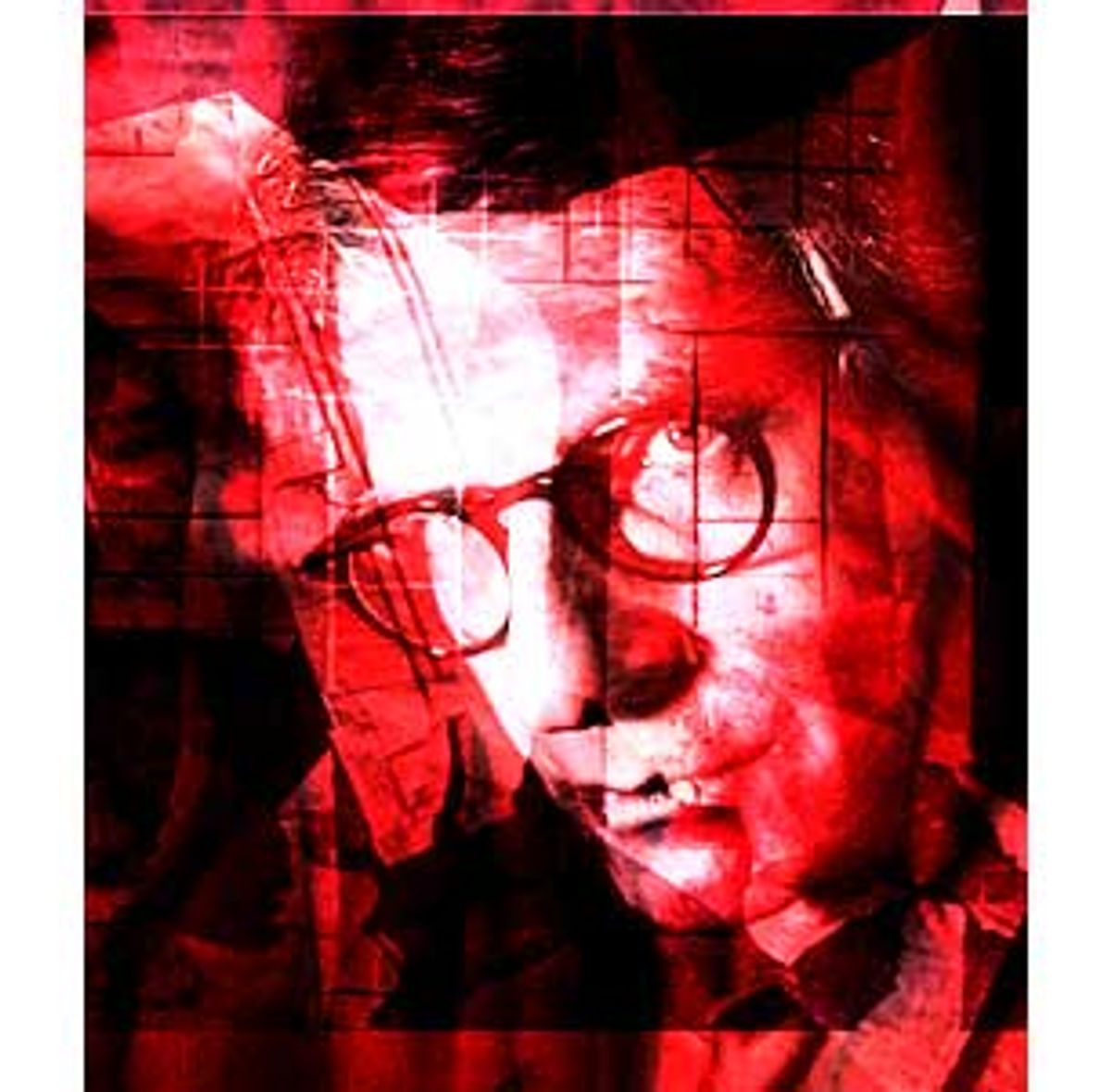
The movies of David Cronenberg inspire strong opinions. Here's the blurb they put on the video box for "Crash," released in 1996: "'... sex and car crashes ...' -- Janet Maslin, New York Times."
Yup, that's "Crash," all right. Maslin might have added "... a film ...," but basically, she captured it. And really, what else can you say about that flick, which cataloged the adventures of people who stage serious auto accidents for erotic stimulation? Well -- you could call it hypnotic; creepy; fascinating; repellent; pornographic; tedious; bizarre; very stylish; a tour de force; a complete waste of time and money. Only please, try to remember which Cronenberg movie you're describing -- when summarizing critical reaction to the 13 feature films he's made over the past 25 years, the adjectives tend to be interchangeable.
What to do with David Cronenberg? A Canadian who never went south, an exploitation horror king who revealed himself to be a genuine auteur, a B-movie Fellini who jumped to the A-list while pursuing the very same themes that once saw him reviled in the Canadian Parliament as a public menace.
The local video store doesn't know what to do with him: "Crash" sits on a shelf right beside La Toya Jackson's Playboy video. Hollywood couldn't figure him out: After Cronenberg seemed at last to be going mainstream by filming Stephen King's "The Dead Zone" in 1983, he received offers to direct "Flashdance," "Top Gun" and "Beverly Hills Cop." One can't help wondering what a different world we'd be living in if the director had accepted any of those offers. And critics can't make up their minds, either. "In Cronenberg's hands," wrote critic Stephen Schiff about the 1979 film "The Brood," "horror is no longer a disreputable bastard genre but a new avenue of expression, gleaming with possibility." "Halliwell's Film Guide" called the movie "idiotic and repellent."
Born in Toronto in 1943, with a freelance writer and a dancer for parents and a home filled with books and art, Cronenberg enjoyed an enlightened upbringing rare for that straight-laced time and place. (Since Louis St. Laurent was Canada's prime minister from 1948-57, this period is known in Canada as the Eisenhower era.) Cronenberg admits that he was not your average tyke. "When I grew up," he told interviewer Chris Rodley in the book "Cronenberg on Cronenberg," "most other kids weren't into watching praying mantises eating grasshoppers."
His early interests were fiction and science. He never saw them as incompatible. "I had a great English teacher and a great science teacher," he tells Rodley. "I went into science to begin with [at the University of Toronto] because I thought you couldn't be taught to write but you needed to be taught science."
However, Cronenberg soon found himself hanging out on the far side of the campus with the much livelier arts students, and before the year was out he had dropped science in favor of English. A friend named David Secter made a short film called "Winter Kept Us Warm," using people and campus locations familiar to Cronenberg. For the future director it was a road-to-Damascus experience. "I was stunned. Shocked. Exhilarated," Cronenberg said. "That won't happen to kids now because they've got video cameras and everybody has made 12 films by the time they've reached puberty. But then it was unprecedented. I said, 'I've got to try this!'"
Cronenberg's first effort was a 1966 short film called "Transfer," about a psychiatrist being stalked by a patient. Next came "From the Drain" -- two veterans of a mysterious war sit in a bathtub until one of them is strangled by a plant that grows out of the drain. Definite sequel potential, but it was never followed up.
Inspired by the Film Co-op of New York, Cronenberg formed the Toronto Film Co-op with Bob Fothergill, Iain Ewing and that noted independent radical, Ivan "Kindergarten Cop" Reitman. But in the late '60s, independent filmmaking was not the well-established tradition it has since become. In order to get a Canada Council grant to finance his first serious project, a 62-minute film called "Stereo," Cronenberg pretended to be writing a novel. He submitted a sample chapter, got the money and started making the film. "Stereo," released in 1969, and the 1970 follow-up "Crimes of the Future" earned Cronenberg a bit of attention in art-film circles.
But neither the artsy crowd nor the unsuspecting Canadian public was prepared when the director's first feature film slithered onscreen in 1975. "Shivers" (aka "The Parasite Murders" and "They Came From Within") is the story of a parasite, designed to help ailing human organs, that goes out of control with sickening results. It's full of the straight-from-the-subconscious imagery for which Cronenberg would later become famous. Gory flesh effects were provided by Joe Blasco, who told Cronenberg that his apprenticeship in horror make-up was the stint he put in on "The Lawrence Welk Show." "Shivers" originated from a dream Cronenberg had about a spider emerging from a woman's mouth and was made for a Montreal soft-core porn outfit called Cinepix. "Sleazy distributors," Cronenberg called them. "My kind of people."
Canadian politicians and critics were not amused -- particularly when they discovered "Shivers" was partly funded with government grant money. Robert Fulford's article in the influential magazine Saturday Night was titled "You Should Know How Bad This Film Is. After All, You Paid For It." (Decades later, British critic Alexander Walker responded to "Crash" with a review titled "A Film Beyond the Bounds of Depravity." Cronenberg hasn't lost his touch.) Fulford suggested that if movies like "Shivers" were necessary for the development of a Canadian film industry, it would be better for the country not to have one.
"Shivers" made money. Grateful taxpayers were reimbursed. A star was born.
More arty shockers followed -- "Rabid," "The Brood" and, in 1981, Cronenberg's first commercial breakthrough, "Scanners." The latter film's infamous exploding head scene briefly pushed it to the top of Variety's box office charts (a feat the filmmaker has yet to repeat, despite having since had bigger hits).
Cronenberg's first real dance with Hollywood came in 1983 with "Videodrome," the tangled tale of a sexually violent TV channel that begins to alter people physically (James Woods develops a huge vagina on his abdomen that accepts videocassettes). Universal provided some funding and distributed the picture, which meant focus groups. Or rather, one focus group, in Boston. After the screening, a lot of the response cards were retrieved from the floor. "I hated your fucking film," said one. It spoke for many.
Luckily, Cronenberg's next job was already lined up. It was by far his biggest stride toward the mainstream -- an adaptation of Stephen King's "The Dead Zone," starring Christopher Walken. For the first time Cronenberg was working from someone else's source material, and for the first time his own grotesque subconscious was not immediately evident on screen. Cronenberg became almost respectable. Fans were worried. (Despite this mainstream acceptance, "The Dead Zone," released in 1983, may contain Cronenberg's most outrageous scene ever. A gunman attempting to assassinate a presidential candidate is shot in front of a room full of reporters and falls to the floor, dying. All the reporters rush out of the room. It's Cronenberg's most bizarre vision yet.)
His next movie would demonstrate that, however briefly, his particular obsessions could dovetail with commercial filmmaking and produce a bona fide hit. After struggling with producer Dino De Laurentiis on 12 drafts of a "Total Recall" script, the two parted company and Cronenberg found himself desperate for work. He quickly snapped up "The Fly," a rethinking of the Vincent Price B-movie hit from 1958 about a scientific accident that blends a man with a house fly. Jeff Goldblum and Geena Davis co-starred as the doomed scientist and his lover (Goldblum called it his favorite role).
Notwithstanding his left-field independent splash with "Scanners," Cronenberg now had his first solid hit (even producing a legitimate catch phrase in "Be afraid. Be very afraid."). And he accomplished it without moving away from his habitual obsessions. Here were the standard Cronenberg themes and images -- mutinous flesh, morbid sexuality, the blending of machines with living organisms, the nature of mind and body, bugs. But this time there was more. There was an honest-to-God love story with an emotional core -- not just (as with James Woods and Debbie Harry in "Videodrome") the healthy respect a man pays to any woman willing to burn her own breasts with cigarettes.
Whether he'd planned it or not, Cronenberg was an A-list director now. It's a career turning point at which busloads of promising filmmakers have taken that right turn into cozy hackdom. But Cronenberg was still based in Toronto, still willfully separate from the L.A. milieu. And while people's perceptions of him may have changed, his cinematic agenda had not, a fact that would quickly become clear.
"Dead Ringers," released in 1988, based on the real-life tale of the Marcus brothers, twin gynecologists who were found together in their New York apartment, dead from barbiturate withdrawal, had actually been in the works for years, delayed by various problems. If anything, Cronenberg's new success simply meant better actors were available for casting consideration. For a while, at least. "From Al Pacino to [James] Woods to William Hurt to Jeff Goldblum to Kevin Kline," Cronenberg told Saturday Night in 1996 (apparently the magazine had forgiven him for destroying Canada's moral fiber in the '70s), "they all turned it down. Pacino couldn't even get past the word 'gynecology,' that was it for him."
Eventually the dual role in "Dead Ringers" was played -- beautifully -- by Jeremy Irons. No one knows how many women dragged boyfriends to see the latest flick starring that dreamy English actor, only to suffer through the most uncomfortable date of their lives, complete with numerous gynecological exams and a grotesque set of medical tools designed for "mutant women."
Perhaps it was the new cinematographer (Peter Suschitzky, replacing longtime collaborator Mark Irwin) or perhaps just the director's own development, but "Dead Ringers" felt like the dawn of a new, more sophisticated, far more stylish era for Cronenberg. No squishy monsters here -- just psyches unraveling in an understated, terrifying, thoroughly compelling way.
Any doubts about Cronenberg's continued dedication to maverick filmmaking were dispelled by "Naked Lunch," his 1991 attempt to translate William Burroughs' novel for the screen -- sort of. "A literal translation wouldn't work," Cronenberg insisted in a widely reported remark. "It would cost $400 million to make and be banned in every country of the world."
"All that is carried over" in the movie, "Halliwell's" says, "is the title and lack of narrative coherence." True enough, but it's a fascinating cinematic experiment, Cronenberg's most fully realized alternative universe yet.Burroughs' (as played by Peter Weller) journey into the hallucinatory dimension called Interzone may even constitute a whole new genre -- the literate creature feature.
1993's "M. Butterfly" (with Irons again) was neither a commercial nor critical success. "I saw it as the story of two people composing the opera of their lives," Cronenberg said in an article by Denis Sequin. "Sexuality is an invention, it's a creative thing ... ['M. Butterfly'] is an extreme version of this inventing, but the extreme illuminates the ordinary version of what each of us does."
Then, in 1996, "Crash," based on J.G. Ballard's story of people turned on by accidents and their physical aftermath screeched into cineplexes. Many called the movie pornographic -- even more were busy trying to figure out why. The fabled link between sex and cars had never been spun quite this way before, and the toughest part for some viewers was figuring out whether they were outraged or just puzzled. Still, where cars are concerned sex is never far from the metallic surface, particularly for a man of Cronenberg's age. As he told Susie Bright in a 1997 interview, the '50s-era kid with a car was always possessed of very practical sexual power. "I was very envious," he recalled. "I took the streetcar. You could not have sex on a streetcar -- it was not allowed."
Love it, loathe it or just go "Huh?" but the jury at Cannes probably got it right when they awarded "Crash" a prize for "audacity." (In a further sign of that nutty French brand of respect, Cronenberg was jury foreman at last spring's festival. "I just about fell over," he told Maclean's magazine.)
For those who were unaware of it, Ted Turner is not French. As the owner of Fine Line, the company with U.S. rights to "Crash," Turner held up stateside release of the film for months while loudly decrying this new attack on American morals (alas, despite Robert Fulford's best efforts it was already too late for Canada).
"At a certain point," the director said in "Cronenberg on Cronenberg," "I realized that what I liked about the classic filmmakers of the 1960s and 1970s, like Bergman and Fellini, was that you entered a world of their own creation when you went to see their films. That world was consistent from film to film."
Rent Cronenberg's most recent film, "eXistenZ," and the world you enter is immediately familiar -- weird, yet familiar. In some ways "eXistenZ" feels like a step back to the B-movie feel of earlier Cronenberg movies -- a lighter (for him) and more coherent reinterpretation of "Videodrome." But as Jennifer Jason Leigh and Jude Law disappear into the maw of an all-enveloping video game, any regular Cronenberg watcher will recognize the turf.
Cronenberg listed his own themes to Rodley as: "Disintegration, aging, death, separation, the meaning of life. All that stuff." He has spoken of a pool of imagery and metaphor that he draws from repeatedly, and in fact there's no mistaking certain Cronenbergian touches. Typical is the organic gun from "eXistenZ," constructed from the flesh and bones of an exotic meal and using teeth for bullets. Likewise the "eXistenZ" game pods, not constructed but hatched from amphibian eggs -- players do not so much switch them on as excite them by rubbing fleshy nipples. It's reminiscent of the bug typewriters in "Naked Lunch," which become orgasmic when a choice phrase is typed, which in turn is reminiscent of God knows how many other of the director's trademark visions.
That these cinematic nightmares contrast mightily with the man's placid exterior and staid domestic status (his sister, Denise, does costumes for his films and his daughter Cassandra, a second unit and assistant director, has helped Dad behind the camera on several) is not lost on Cronenberg. "The reason I'm secure is because I'm crazy," he told Rodley. "The reason I'm stable is because I'm nuts. It's palpable to me."
Aside from being one of the most articulate directors around -- "Cronenberg on Cronenberg," compiled from interview transcripts, amply demonstrates the point -- Cronenberg seems to maintain a playful sense of humor about his work. He helped promote a Canadian cable channel's week-long celebration of his movies by taping a spot in which he is seen phoning the station to complain about his disgusting films. Cronenberg also dabbles in acting, in his own movies and those of others (he's the assassin in "To Die For"), and journalism -- "eXistenZ" was inspired partly by an interview he did with Salman Rushdie for Shift magazine.
Long dogged by critics, Cronenberg rejects claims that his work exhibits misogyny and sexual disgust (although he doesn't disagree with his pal Martin Scorsese who, having read many Cronenberg interviews, told the director that he obviously doesn't understand his own films).
"You make a movie to find out what it was that made you want to make the movie," Cronenberg told Rodley.
Many would be afraid -- be very afraid -- to hear the answers.
Shares