L.A. Kauffman

A no-win situation

Nonviolent protesters get hit from both sides at the WTO conference in Seattle.

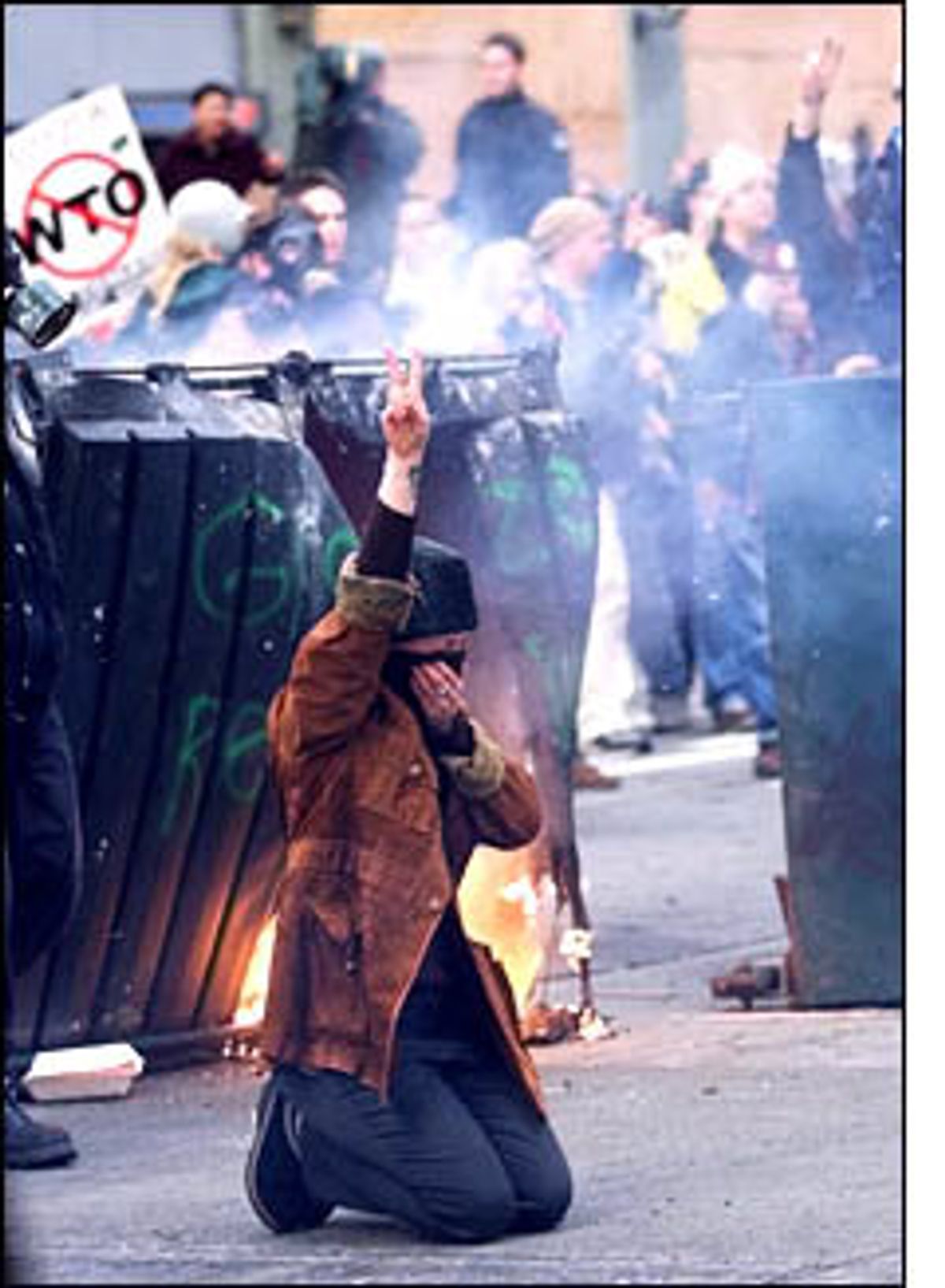
Tuesday’s World Trade Organization riot can be summed up by the story of Craig Webster, a friend I know from activist circles in New York. First he was shot with rubber bullets when police opened fire on peaceful demonstrators at the corner of Sixth Avenue and Union Street, and he has nasty welts to show for it. Then later in the day, he was slugged in the jaw by a rioter, while he and some other nonviolent activists tried to prevent the Niketown store from being looted.

Craig’s bad luck encapsulated the experience of nonviolent protesters who came to Seattle to focus world attention on WTO — they got upstaged by violent anarchists and attacked by police, who did nothing until late in the day to stop the rioting. While peaceful protesters vastly outnumbered the hooligans, there were 300 to 400 hardcore anarchists intent on clashing with police, most with scarves over their faces, some carrying hammers, crowbars and spray paint in their bags.

On Wednesday, police arrested more than 300 people, most of them non-violent demonstrators, in a change of tactics designed to clear the streets for President Clinton’s visit. Wednesday night, police used tear gas again, to disperse a crowd that began to gather downtown.

But on Tuesday, police allowed the so-called revolutionaries bent on violence to gain the upper hand. Early Tuesday morning, a few blocks away from the nonviolent blockade, small roving groups of violent protesters began tossing newspaper boxes into an intersection, dragging trash bins into the street and trying — without success at that point — to smash the windows of downtown stores.

The police pretty much let them do as they pleased. One squad of about a dozen officers in riot gear briefly marched into the crowd at the intersection of Fourth Avenue and Pike Street, but retreated almost immediately, when it became clear that the protesters wouldn’t disperse. A little after 9 a.m., I saw two cops grab a demonstrator who was tipping over a trash bin on Pike Street. But they didn’t hold him for long: 20 of the rioters rushed the police and brawled with them until they got their comrade free.

But later, I watched as thousands of people blocked the western entrance to the convention center and marveled at their defiant yet peaceful demeanor. Linked arm-in-arm in a huge perimeter around the meeting site, or sitting cross-legged in key intersections, the protesters were achieving their goal of preventing the trade body’s meeting, and in a spirit of complete nonviolence. Soon, with no provocation, they were pepper-sprayed by police.

It was no secret — not to me, and certainly not to the Seattle police — that this conference would be met with violence in the streets. Rioting had broken out at a “Reclaim the Streets” protest in Eugene, Ore., in June, and in the intervening five months, anarchist militants had been circulating apocalyptic manifestos promising more fights to come. A pre-WTO article in a Eugene ‘zine called the Black-Clad Messenger warned, “Tilting at the excesses of the system never gets down to the rotten, death-culture foundations of the system … Anarchy says it is time to face reality and destroy the global (and local) machine. Phony half-measures and pseudo-critiques and submissive demos are no advance at all. SEE YOU IN SEATTLE!”

And indeed, in Seattle, at a huge public meeting of people planning to blockade the convention center, a young woman announced that 100 gas masks had been ordered in preparation for Tuesday’s protest and were available at cost. (Tuesday, Seattle Mayor Paul Schell banned possession or use of gas masks.)

But the police took no action to contain the mayhem that was obviously on the agenda. Instead, they let the rioters run wild while assaulting peaceful protesters with pepper spray, tear gas and rubber bullets.

I was at the intersection of Sixth Avenue and Union Street when the pepper spraying began, and neither I nor three other witnesses I interviewed saw any kind of provocation from the demonstrators. I’ve been told that some in the crowd started throwing sticks at the police after the gassing started, but I didn’t see it. My eyes were burning so badly I couldn’t keep them open.

The police could have used a different method to clear the area, by simply arresting all of the blockaders. That’s what most protesters expected to happen, and they had undergone extensive training by the nonviolent Direct Action Network to prepare themselves for jail.

But mass arrests of peaceful protesters are time-consuming and expensive, and often bad for public relations. Gassing a crowd is a quick and uncomplicated way to make it disperse. Of course, it’s a controversial method, but not if the police and media make it seem like a response to rioting.

The splits on the streets in Seattle mirror divisions in direct action groups throughout the Northwest

In Seattle, some activists from Humboldt County, Calif. — mostly young, many women — engaged in what’s called a “lock-down action,” in which protesters use bicycle locks or other devices to create a human blockade. Lock-downs have been widely used by direct action movements throughout the 1990s, especially by Earth First and animal-rights groups. The devices allow protesters to hold a space — an intersection, a logging road, an opponent’s office — for much longer than they otherwise could, because it takes considerable time and effort to cut them apart.

Two years ago in Humboldt County, police developed a new way of handling lock-downs: pepper spray. In the most widely publicized incident, four Earth First activists who were blockading Rep. Frank Riggs’ office in Eureka had pepper spray applied directly to their eyes with cotton swabs.

At Tuesday’s WTO protest, 20 demonstrators from Humboldt County used lock boxes to link themselves in a circle. As supporters gathered around them, you could see thick clouds of tear gas at the next intersection down the hill, where police were dispersing a crowd. Calls went up for vinegar and rags to cover the faces of the blockaders, who calmly sat and waited.

An hour or so later, the police arrived and asked the blockaders to leave. When they refused, cops went around the circle, pepper-spraying the activists in the face. They didn’t unlock. The police sprayed again. Still the blockaders stayed firm. After two more attempts, the police finally gave up, ceding the intersection to the protesters.

Obviously it takes extraordinary endurance and dedication to take that kind of punishment, and it’s not clear that the gains exceed the costs. In Humboldt County, Earth First has been moving away from lock-downs and toward traditional Gandhi-style civil disobedience: sit-ins, human chains and the like.

But in the Eugene area, the advent of pepper spray has had a radicalizing effect. For about a year, activists have been questioning and abandoning nonviolence. I think the property-destroying tactics used on Tuesday were stupid and ineffective. It’s not just testosterone-charged yahoos who are rejecting nonviolent styles of protest, some are seasoned activists who have several years of direct-action campaigning under their belts.

Among them are two young women I’ve had contact with in the past. I met one in connection with the direct-action campaign to preserve New York’s community gardens, which I worked on for two years. I met the other at an Earth First forest encampment while doing research for a book. I didn’t see either of them on Tuesday, but I thought about a manifesto that one passed on to me last week.

It read, “Let’s not train the thousands of people who gather in Seattle to do no more than be herded by the police, hold signs and offer themselves up as sacrificial lock-down lambs. I’m not advocating a riot. The ground between violence and pacifism is wide, much larger than the ivory tower of either. Meet me there.”

Who were those masked anarchists in Seattle?

The media has blown the story, but there's a growing fringe of activists who believe property destruction isn't "violent," and are bent on convincing the rest of us.

In the week since the dramatic World Trade Organization protests, in which a massive nonviolent blockade was overshadowed by attacks on stores like Niketown, Starbucks and the Gap, the media reporting about the activism has been as confusing as some of the protests themselves.

Most reports simply labelled the rioters “anarchists,” missing the fact that many among the peaceful blockaders consider themselves anarchists, too. And news organizations have repeatedly named anarchist writer John Zerzan as the rioters’ guru, vastly overstating his influence. By far the most important influence has been the tempestuous forest activism that has taken place in the Eugene, Ore., area over the last four years.

Attempting to clear up misconceptions about the WTO rioting, one collective involved in it felt moved to issue a statement, the “N30 Black Bloc Communique,” in order “to diffuse some of the aura of mystery that surrounds the black bloc and make some of its motivations more transparent, since our masks cannot be.”

The so-called “black bloc” is advocating “direct action at the point of consumption,” damaging corporate retail outlets and hurting their sales. Despite the storm of criticism these militants have faced, they view the Tuesday riot as a ringing success. “Ten million dollars of lost revenue, plus the 2 million they’re saying there was in property damage, is a big chunk out of their holiday cheer,” exults one member of the “Eugene Brick Throwers Union Local 666,” as a loose organization of Oregon anarchists chose to identify themselves last week.

The young Brick Thrower has only contempt for the nonviolent blockaders: “A lot of these people are going to be buying burgers at McDonald’s and shopping at the Gap next week. Everybody’s going to go home and have a really nice Christmas and forget all about this.”

The masked protesters who trashed downtown Seattle last Tuesday are mostly in their late teens or early 20s, but contrary to many people’s assumptions, they are not mostly male. Young women have been some of the most outspoken and influential figures in the loose scene that gave rise to the WTO riots, and represented a good percentage of the rioters.

The prominence of young women goes back to the movement’s origins in Earth First anti-logging activism of the 1980s. About 10 years ago Earth Firsters split between so-called “deep ecologists” and activists (of whom the late Judy Bari was the most prominent) who were looking to fuse deep ecology with the agenda of the cultural and social left. At the time of the split, people talked about “the feminization of Earth First.” Since that time, women have been in the forefront of many of the local and single-issue campaigns that form the building blocks of the broad movement on display in Seattle.

Clearly, the most important influence of all has been the tumult in the Eugene area over the last four years. When federal action threatened a forest in Oregon’s Warner Creek watershed in 1995, protesters blocked the main logging road — and maintained the blockade for an astounding 343 days. “There were these two signs on the gate, white and red striped signs like candy canes with reflectors on them,” remembers a young man named Cloud, who took part in the encampment. “So we wrote, ‘Cascadia Free State’ and claimed it as our own.”

The 11-month Cascadia Free State was an unprecedented experiment in anarchist principles of self-management, a “temporary autonomous zone” where activists enacted their dreams of the good society. The experience of creating such a world for themselves, and then seeing it destroyed by Forest Service bulldozers, fostered a rare fearlessness and audacity, which continues to define the activist climate of Eugene.

When four young women who took part in the blockade were jailed in Eugene, dozens of activists stormed the jail, causing a ruckus and smashing one window before being arrested themselves. Later, someone torched a nearby Forest Service ranger station, burning it to the ground.

Over the last two years, as police have repeatedly used pepper spray against nonviolent forest activists in the Northwest, the Eugene militant scene has become a hub for people weary of traditional nonviolence and supportive of property destruction as direct action.

In Seattle, the protesters faced a choice between two types of direct action that are well outside the political mainstream: to use the activists’ own words, between “shutting it down” and “fucking shit up.”

Even the nonviolent blockaders are comfortable with some level of interfering with property rights, disrupting traffic and preventing business as usual. It was the nonviolent blockade, after all, that forced the WTO to cancel its opening ceremonies on Nov. 30, and that prevented delegates from reaching the convention center.

For the most part, the blockaders share the rioters’ belief that destroying property is not “violent.” Their objection is a strategic one. Brooke Lehman, an activist with Reclaim the Streets/NYC who helped organize the Direct Action Network (DAN) blockade, expresses the views of many. “I personally am not against property destruction. I don’t consider it a violent action,” she says. “I consider it often a stupid action but not a violent one. It’s usually not wise in a crowd situation because it endangers the public and makes things escalate.”

But in making property destruction integral to their activism, the members of the “black bloc” are returning to the original meaning of direct action, as it was defined by the early 20th century Industrial Workers of the World. The witty and defiant Wobblies, as they are commonly known, hold a special fascination for young radicals today. In the days before the WTO protest, for example, groups of activists could be found singing “Hallelujah, I’m a Bum” and other Wobbly standards.

The Wobblies’ basic approach was what they called “direct action at the point of production,” by which they meant strikes, slowdowns and workplace sabotage, rather than indirect action via traditional trade unions or the political process.

But the mask-wearing Seattle anarchists are not acolytes of Zerzan, a Eugene anarchist who has made news because of his contacts with jailed Unabomber Theodore Kaczynski. The 56-year-old writer is a leading voice on “anarcho-primitivism,” a philosophy that melds deep ecology, radical anti-capitalism and amateur anthropology to advocate the dismantling of civilization.

While primitivist ideas certainly have a following among the more bookish people in anarchist circles, their impact on activist strategies and visions has been indirect. At best, they’ve helped promote the idea that radicals must oppose the totality of contemporary human society: “Trees and animals are way more important than the human race. The human race is a greedy, destructive organism,” explains one teenage boy who identifies himself as a member of the Eugene Brick Throwers Union.

A more important intellectual influence has been “Pacifism as Pathology,” a recently reissued 1986 essay by Native American advocate Ward Churchill, and “Reflections on June 18,” a compendium of essays on last summer’s huge Reclaim the Streets action in London, which caused millions of dollars in property damage. In the week preceding the WTO protests, activists held numerous formal and informal discussions of the Churchill essay, focusing especially on its claim that pacifism is a privileged stance with little relevance to the lives of the most oppressed.

“Challenging the limitations of nonviolence is the most important thing we can do,” declared one young woman at a discussion I attended. Another — in utter seriousness — argued that kidnapping need not be viewed as a violent act.

Most nonviolent protesters are resisting the pull toward property destruction, but many confess to some attraction. “There’s a small part of me that is pretty excited to see people smashing the windows of Starbucks, to say, ‘We don’t want these things in our community anymore. We don’t want McDonald’s, we don’t want Nike, we don’t want Starbucks, and we’re taking them out,’” says Nina Narelle, a young activist who handled mobile communications for the Direct Action Network. “But I’m pushing that part of myself down.”

Continue Reading Close