Susan Lehman

Tina fires back

The most controversial editor in the history of American magazines slams her critics, defends her business acumen and says Talk will probably be her last magazine.

  • more
    • All Share Services

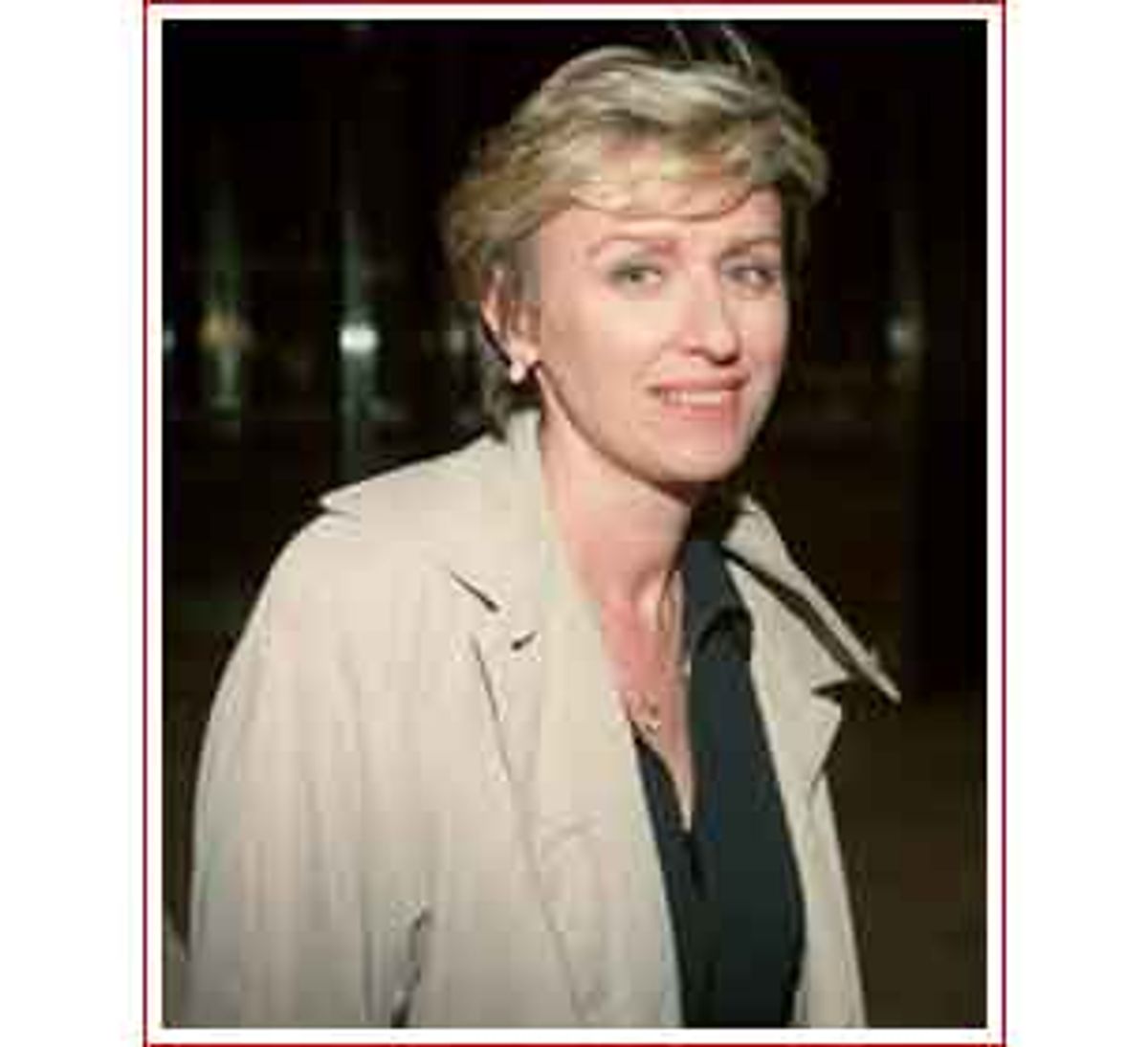
Tina fires backTina Brown, Oxford-educated former Londoner and former Editor of New Yorker magazine, leaves the Four Seasons Hotel in New York Wednesday, July 8, 1998. Brown resigned her position at the New Yorker Wednesday to lead a film, TV and publishing partnership with Miramax Films. In six years as The New Yorker's editor, Brown reshaped what some considered a dusty anachronism with punchier articles, splashy photographs, and extensive coverage of politics and popular culture. (AP Photo/Leo Sorel)(Credit: Associated Press)

Certainly Tina Brown has seen better days. Talk has been slammed
since it launched last August. Key editors have jumped ship. After
four issues, critics have called the magazine everything from a bust
to a bore. A piece in Monday’s New York Times accused Brown of
shilling for Talk’s corporate owners, Miramax Films, and its parent
company, Disney, and pointedly wondered whether Tina Brown was
actually in control of her magazine.

Preposterous, ludicrous, Brown said of the Times piece and its
question. Cool and congenial in her nearly bare, 56th-floor Manhattan office,
Brown seemed animated by the bad press and, in fact, looked sleepier
when conversation turned elsewhere. She hailed Martha Stewart,
apparently because the Living editor, too, has taken a great beating
in the press, and lived to tell the tale.

Are you having fun?

Yes, I am.

You can’t be happy with the press Talk has gotten. You’re good at
turning magazines around. What do you have in mind for Talk?

I did expect this. In June, actually, I called my staff around for
lunch and I said to them, we’ve all had a great time together for the
last eight months, but you’re about to enter a tunnel. When you come
out the other end, everyone is going to be slinging mud. I hope you
are going to be tough enough for it. I hope you can withstand it.
Some of you won’t be here at the end of it.

It’s true. It has gone down exactly as I expected. I guess with one
difference: The incredible success of the first issue and the launch
and the strength of the business side, which has remained incredibly
strong throughout and continues to build which tells me that the
criticism in time will turn around. Just as it always has in my
career. I have always operated in a sea of controversy. I have not
taken over magazines and had instant acclaim for doing what I have
done.

The first year and a half at Vanity Fair nobody liked what I was
doing. I got nothing but abuse for it. In fact, I was constantly in
the middle of articles about the closing of the magazine and the fact
that it was a major disaster.

At the New Yorker it really never ceased, the constant baying of
the dogs. So I am used to that.

I think that what I’ve learned — after being in the middle of
controversy for 20 years — is that the dogs bark and the caravan
moves on.

Of all the criticism leveled against Talk, has any rung true?

It washes over you, quite frankly. I don’t read a great deal of it
because there’s so much of it. I just check out the angle. If it’s
the same angle I’ve seen before I don’t bother to continue.

Ultimately, I know what I’m doing. We’re evolving a magazine
gradually. I never said it would come out of the box perfectly. It is
a work in progress. It’s a show that’s getting done. You retool and
you evolve, you change and you shape; you bring on elements and you
throw out elements and some elements don’t work. Something you
totally believed in doesn’t seem to work, so you do something else.
That’s what the process is. Nothing is given birth to without that.

What have you believed in that hasn’t worked?

It’s too early to talk about. It’s too early to say what has or
hasn’t worked. With a monthly, you are always operating in a
strangely dissonant universe because you are way ahead of your
critics. The critics start to stumble on things they don’t like —
you’ve already seen that that’s not quite right. You’re already
ahead. In some ways, it’s encouraging because you know what you
think, most of time. I certainly feel that I know what’s wrong …

What is wrong?

I think we were understaffed at the beginning. We really went into
a major launch with a very small and quite young staff — all of whom
have been fantastic — but we needed some more seasoned and
additional people to get things done.

Anything you’d like to say about staff defections?

There were some people who weren’t going to make the cut, quite
honestly. You have to have courage, commitment and character to do a
launch. It’s hard. If you ask anyone who’s launched — Entertainment
Weekly or any of Jann Wenner’s magazines — if you talk to Jann Wenner
about launching, it’s a war. A launch is a war. You’re in a very
competitive environment and no one is going to give you any breaks.
Why should they?

You have to get it right in the full glare of attention. It’s
very, very hard. Some people find it too hard. Out of a staff of 50,
four people have left. That’s OK. It’s fine. It was hard work. Some
people don’t like hard work. Some people are too inexperienced to
handle it. Some people are out of their depth.

Would you say that about [Talk's
second-in-command, vice president and executive editor] David Kuhn?

No, I wouldn’t say that about David. Some people left. It’s OK.
There’s no bad feeling between me and any of the people who left.

[After our conversation, Tina Brown phoned to say she'd like to
add the following to her remarks about Talk staff members who left
the magazine]

The editors who left had all worked incredibly hard under a lot of
pressure because our staff was so small. They contributed an enormous
amount to the magazine’s launch. I appreciate the efforts they made
on the ground floor and I understand if they didn’t want to sign up
for the long haul. Over the course of a year, private lives and
priorities can change and a shake-out is inevitable. I think David
Kuhn will be great at Brill’s online venture. He has the right
energy and enterprise for a start-up, as I discovered. I am glad
[managing editor] Howard Lalli got the top job in Atlanta. He deserved the promotion,
and I think the change of lifestyle will be terrific for him.

How seriously do you treat questions about Talk’s independence
from its corporate parents, Disney and Miramax? The New York Observer, for example, reported that Leonardo DiCaprio agreed to
appear on Talk’s cover days after Miramax signed on to distribute his next movie —

That was ludicrous. The Observer piece was ludicrous. The Leonardo
DiCaprio thing was a done situation before Harvey got into it by offering Leo a part.

Harvey is a major mogul who has offered a whole lot of people
parts. It’s not going to get in my way. I don’t get in his way.
Ultimately it’s a really trivial issue. It’s what I would call a New
York Observer scandal issue. To me the only shock is that it would
pass into the pages of the New York Times.

The thing that was preposterous about that chart the Times did was
that they talked about Julianne Moore as a Miramax actress. Sure
she’s made Miramax movies but, hey, at the time I published the piece
about her, she was appearing in “The End of the Affair,” which was not a
Miramax movie. She’s going to go on to do other movies. Julianne
Moore and Matt Damon and Gwyneth Paltrow have done a whole bunch of
Miramax movies; they are making movies all over town. I can’t stay
away from that talent pool and I’m not going to. I refuse to.

I’m certainly not going to be inhibited about what I do. I’m not
going to be in a position, ever, where I’ve just been to see a great
movie and it was Miramax, and I’m going to say, “You know what? I’m
not going to do the hot thing. I’d rather do the cold movie.” That’s
ridiculous.

People have beaten up [Time Magazine Managing Editor] Walter
Isaacson for putting Pokimon on the cover of Time Magazine. He did
the right thing. Pokimon is really hot. I have an 8-year-old and
I have Pokimon coming out of my ears. It’s the big thing. If Walter
Isaacson didn’t do it, he would just be handing Newsweek the issue of
the day, in terms of parents and pop culture.

My point is that [The New York Times] seems to have these
actresses and actors down as being owned by Miramax when they aren’t.
The Times mentioned “My Favorite Martian.” I was quoted as saying I
didn’t know about that movie. I thought the Times reporter meant a
new martian movie because that one was out a year and a bit ago. How
could I be plugging a movie that’s not even out? That’s just gone?

It’s a kind of feverish, kind of little trivial, sort of — it’s
very, very trivial, is all I can say. It isn’t a real issue in any
way.

You said you don’t want to be inhibited by Miramax’s
involvement in the magazine. There’s been talk — as I’m sure you know
– about Talk’s planned piece about Unabomber Ted Kaczynski. It’s been
said last-minute editorial changes were influenced by the fact that
Kaczynski’s brother has a movie deal with Disney.

That is just a fabrication. It is utterly and totally untrue. The
[Disney movie] had zero to do with anything. My problem with that
story was that I felt it was a puff piece about the Unabomber and I
thought it needed some balance. That’s all. I’d be very surprised if
the author felt in any way that [Disney's movie] was a factor because
it wasn’t.

How do you do that and have time for the 8-year-old at home?
When do you spend time with your two children?

I think every woman has that juggle. It’s very, very difficult.
It’s the endless agony and push-me pull-you of every working woman. I
feel very, very tortured about it. I do live by certain rules. I
always go home by 6 o’clock. That’s very hard to achieve. But I do.
I must be there to have dinner with my kids and be with them for
those two or three hours. I often come back, later, to the office. I
always work late at home.

I never go out on weekends. I haven’t been out on a Saturday night
in 10 years. I always stay with my children.

So much is made of your social life.

Truth to tell, I only go out once a week. Any week it has to be
twice is a hugely difficult thing for me. It can’t be more than
twice because then everything goes nuts. I do entertain myself a bit,
about once a month, I’d say.

What prompted your party for Al Gore?

Actually, Ms. Gore asked if I’d throw something together for him.
I responded and brought people together to meet him. It was a
terrific evening.

Are you a Gore supporter?

I think he’s terrific. I like him very much. He’s great. I’ve
never found him wooden.

I like Al Gore for all the reasons other people don’t. I don’t
think there’s anything wrong with being a little self-disciplined and
self-contained if you’re the future president. I rather like it as a
matter of fact.

I don’t mind the fact he’s more comfortable in a suit than in his
jeans. He’s running for president, he’s not trying to be a country
and western star.

Who, in the large cultural landscape, are the women you
particularly admire?

There are a lot of wonderful women around. I’m a big fan of Joan
Didion — her writing has always broken molds. As has Janet
Malcolm’s, another woman I admire. Anna Deavere
Smith,
I think, is very adventurous and interesting.

Martha Stewart. I admire Martha. Try looking at her clips.
Talk about trashed. She has been trashed for years. Years and years.
She has always surged ahead and been a visionary — about what she’s
done. She’s original, she’s amazing, she’s full of stamina. And she
hasn’t let it get her down. Look how she’s wound up. I think in that
sense she’s rather inspiring … I don’t think I’ll ever end up as
rich as Martha. But I think she’s pretty heroic.

Read anything great lately?

There are a lot of really great magazines right now. I think
Walter is doing a great job with Time. I think the Weekly Standard is
a very amusing magazine. The English Tattler is going through a great
renaissance right now; I get that and am very happy to see my old
magazine is doing such a great job. Business Week, I think, is a very
good magazine. Art Cooper at GQ continues to astonish.

Are you interested in the Internet?

Salon and Slate, I tend to like them. I’m surprised that Slate
doesn’t have more readers at this point. I think it’s very amusing
indeed and always has witty stuff.

I have been impressed with the voices on the Web, with the way
the individuality of the writers seem to come through so much more
strongly than on the page. It’s a much more intimate medium.

It has bolstered my desire to have intimacy on the page. I think
that a Talk piece is a very intimate piece, and if I’m looking for
something particular it’s that, that sense of up-close, fresh,
immediate connection with the reader.

Has the speed of the Internet or the way it serves narrow
interests had any effect on the way you think about editing
magazines?

The Web has increased the natural predilection I would have had
anyway to continually look for depth and quality. The Web has speed
and immediacy and quick take locked up — you’d be a fool to try to
compete with it. You can’t compete with it. The only way a magazine
can makes its mark, really, is with depth and intellectual
muscularity.

What do you make of constant reports that there’s no buzz about
Talk?

It amuses me because they are obsessively writing about the fact
that nobody writes about us. It just isn’t correct.

We set a very high bar with the first issue, and I think that’s the
reason people are saying that. The first issue really surprised me —
I was amazed by it, I thought we’d sell half of what we sold. When it
kind of went nuts, I think it set a very high bar, that’s all.

How much news has the New York Times Magazine made in the last
year? It’s a terrific magazine but no one is saying, “This issue
didn’t have any buzz.” It’s just a damned good magazine, very
well written with some very, very good articles in it. That’s true
here. This is a damned good magazine with some very, very good
articles in it.

You’re known for spending a lot of money on writers and have
been said to have lost more money than anyone else in the business.
Would Talk’s prospects be improved with more money?

That is a grotesque piece of baggage that I will probably
carry with me forever. It will be there in my obituary.

Vanity Fair made money in my editorship. I took over a magazine
that had been a disaster, that had been losing millions. I took it
from 200,000 circulation to 1.2 million. We started with 12 pages of
advertising. Take a look at my last issue. There are 250 or some such
enormous number of advertising pages. It was making between $3 and $5
million when I left. I took the magazine from disaster to
profit.

It’s much harder to take it from A to Z than to take it over now
and take that $5 million profit and turn it into $15 or $20 million.
I think it’s doing great now and I’m delighted to see that it is. But
the fact of the matter is I did leave a very, very solid financial
and commercial success. So that isn’t true, right?

At the New Yorker, I took over a magazine that was losing
documented double-digit numbers. I brought the losses down while
reinventing the brand. I re-created the magazine in terms of its new
modernization and left losing it less money than when I took it over.

I was as heartbroken as anyone that the magazine never went to
profit under me. It didn’t go to profit, because, quite honestly, I’m
not in charge of that front.

Much has been made of the bad deals Miramax and Talk have
offered writers.

That’s all rubbish, too. We deal with all the top agents. They are
all making deals with us. The writers are happy to make deals with
us. We’re publishing very good authors, across the board. None of
them are making what they feel are bad deals with us.

Talk is meant to be an American version of a European magazine
like Paris Match or Stern. What makes you think that model makes
sense for American readers?

I think a magazine that combines news and current affairs content
with glamour with good writing and a little bit of a brainier twist
is something of a European model. But I think that people here are
ready for that. American readers are always ready for something good.
It behooves us to make it good, to make it better.

Have you ever failed at anything before?

You win and lose every day, don’t you? Some days I win, some days
I lose. I certainly haven’t had unbridled success. It’s always been
incredibly hard work. I don’t feel I’ve had such a rosy path to the
top.

I once heard you tell Charlie Rose you were thinking of setting
up a film company with the New Yorker because so many of the articles
published there were optioned or made into movies. Are you sorry you
didn’t do that?

I think the New Yorker was a lost business opportunity. The moment
of opportunity may have passed now that the New Yorker is part of
Condé Nast.

What have you liked best about the New Yorker since you left?

David Remnick has done a wonderful job of sustaining the writers
who are such an incredible treasure trove, writers there that we
spent eight years building up are some of the best writers in
America. David Remnick has done a wonderful job of getting the best
out of them.

Is there anything particular that you read that really
impressed you?

The e-commerce piece was very good, the piece about the iVillage
girl was very well done, I thought. I like Jeff Toobin always. His
piece on [Kenneth] Starr was terrific. I’d like to have had that.

Are there any changes you regret having made there?

No. I didn’t make enough. If I’d stayed, I would have had to go
further. I spent too much time appeasing elements of the magazine
that, now that I’ve left, I realize were really holding it back. The
magazine has a great future, but the modernization process needs to
continue. If I had stayed I would have pushed it further. Especially
visually.

In retrospect, what was the worst Talk cover choice?

Frankly, I didn’t focus on that. If I made a mistake, this was it.
I have been consumed with the writing, the quality of the writing,
attracting the writing. I made that my focus. I guess that’s the
legacy of the New Yorker, in my brain. I probably should have spent
more time on [cover choices], and made that front burner. Now I am
focused on that.

And what are you thinking?

Coming out of a weekly, I was interested in being more spontaneous
with covers. I have realized that you can’t do that with a monthly.
You have to forgo that spontaneity, which is something that I regret.
As a journalist I would like to be able to decide a week before we go
to press who I think gives the right feeling for the cover.

With the celebrity culture being what it is, you can’t decide to
photograph a celebrity that late or kick them off the cover if a
political person is, in fact, a much more Zeitgeist person, which
sometimes happens. Sometimes it’s not a movie star person at all that
you want to put there. It could be something quite different.
Sometimes something happens to a person that makes them clearly a
great choice for a cover. In sports, or politics, or the record
industry. With a monthly, though, you have to basically decide, well,
I’m going to lock up my covers from now until next September and
forgo that spontaneity because once [the celebrities who agree to be
on the cover] have been photographed and locked in, that’s it.

What, aside from celebrity culture, interests you about the
national conversation?

Politics has become very, very interesting again. The whole churn
between the private and the public has become a searing issue. The
Internet has liberated so many energies and created so much speed.
This has impacted unfavorably, strangely, on people’s private lives
because they have no time. There are more and more demands on
people’s lives. That’s hell for the family. Questions about how we’re
living and how we’re all coping with the machinery of change is, in
fact, the most interesting thing about living today.

Do you have role models. Is there anyone in particular who has
inspired you professionally?

I’m really interested in being able to do a magazine that’s hot,
if you like that word, but also good and fair. The pressure to create
heat with unfairness and negativity is really huge; a fast way to get
“buzz” is to trash a person. I feel proud that I have been able to
create heat without doing that.

One of the things about being written about a lot yourself is
that you start to see how incredibly reductive and ludicrous most
journalism is about people. If you know people who are being written
about, it’s particularly agonizing, really.

Have you ever felt like slowing down and taking less of an
interest in the here and now, the edgy, the hot?

Let’s put it this way: I think this is my last magazine.

What’s next?

At the end of this one, I hope to have built a great asset and a
great magazine, and then I will melt into the European sunset.

Continue Reading Close

Media man

With his new Web venture, magazine veteran Kurt Andersen promises a must-go news and information site that's as witty as the Wall Street Journal.

  • more
    • All Share Services

Media man

Media writers have been buzzing about it for months, but last week Spy co-founder and editor Kurt Andersen formally announced his latest venture — Powerful Media, a Web-based entertainment/media news and information service. The site will chronicle what Andersen, in his recent novel, “Turn of the Century,” calls the “Infotainment Zone,” the colliding worlds of records, movies, music, journalism and new media.

Andersen has teamed up with former Spin editor Michael Hirschorn and the erstwhile president of Brill’s Content, Deanna Brown — with money from TheStreet.com founder James Cramer, Spy publisher Tom Phillips, Flatiron Investors, preeminent Internet venture capitalists and other investors — and is gearing up for a spring launch in new offices in Manhattan’s hip West Chelsea neighborhood.

Hand-scrawled posters in Powerful Media’s vast office space — which is currently occupied by a dozen new hires, lots of iMacs and long, unfinished-plywood work tables called, in new-media parlance, “pods”– suggest the site (which may or may not be called Insidedope.com) will include bits of music, movies, TV and other multimedia displays as well as more traditional reporting, analysis and commentary.

In a recent hiring spree, Andersen and Co. signed up editors and writers from a range of glossy magazines, daily papers and trade publications: Kyle Pope from the Wall Street Journal; Craig Marks, former Spin executive editor; Lorne Manly, a senior editor at Brill’s Content; Chris Petrikin from Variety; Suck founding editor Ana Marie Cox; and author and editor Fred Goodman.

Andersen, 45, was the editor of New York magazine from 1994 until 1996, when he was fired after Henry Kravis, a partner in New York’s parent company, reportedly had had enough of the magazine’s aggressive business coverage. He resurfaced as a New Yorker contributor. Andersen co-wrote a satiric stage review, has written television pilots for NBC and ABC and, before founding Spy, was Time’s architecture critic; next year he hosts an hour-long Public Radio show, “Studio 360,” about art and culture. Andersen is, of course, the ultimate media insider, and so is nicely poised to deliver genuine inside dope.

But who, exactly, wants this stuff? Can Andersen and Co. make money? What do they know about Web publishing? What exactly do they have in mind? In an interview in his lofty new office, Powerful Media man Kurt Andersen answers these and other questions, speaks of “Web-specific things,” calls Spy a prototypical Web publication and identifies the story of our time.

Have you had enough of magazines?

No, not at all.

When I left New York magazine, I certainly didn’t say, “Oh, I’m through with this medium.” On the other hand, I had been so spoiled by my magazine experience that my bar was very, very high, so there just weren’t many great magazines to do, and aren’t.

As of June, I was looking forward to a very happy rest of my life doing nothing but writing novels and occasionally writing magazine pieces. Things happen. Opportunities arise. This reached that point of irresistibility.

OK, so what are you doing? What will Insidedope.com, or whatever it’s called, look like?

Like nothing that exists quite yet. The closest model is TheStreet.com. We are going to sell subscriptions; like TheStreet.com, we’ll focus on one particular area and try to cover it in serious, useful and authoritative depth.

We’re hiring A-list journalists to break stories, create analysis, etc. We’ll also have various Web-specific things — database stuff and aggregate things and all those Web things. We’ll aspire to be a must-go place for information about these worlds that — for better or worse — I’m obsessed with.

Who’s going to read it?

Millions and millions, worldwide. There are several hundred thousand people who subscribe to trade magazines and newsletters about the industries we’re going to cover. And there are people in the various businesses — screenwriters and executives and editors and producers — who, for a variety of reasons, don’t subscribe to those trade magazines. We hope to get them to read this thing. Plus, we’ll have material for the millions of Americans who read Entertainment Weekly, Talk, Premiere and the rest.

Do you guys know anything about the Net? You know about magazines. Does that mean you can succeed online?

A completely reasonable thing to ask. We know enough not to try to simply redo a magazine. We know enough to abandon the habitual ways of thinking about writing journalism. There are ways to think about doing stories, presenting stories, that can be transplanted. I think we know enough to know what is the bath water and what is the baby. We’re saving the baby.

Whenever I do something — whether it’s starting a magazine, or writing a book — I wonder, Would I want this thing, will this fill a void for me personally? This will. Am I, therefore, better equipped to do it than a lot of other people? Maybe. We’ll see.

“Turn of the Century” focuses a lot on the convergence of news and entertainment, and dramatizes the lack of available sorting mechanisms — or an ideological framework — in which to make sense of a vast stream of unsorted cultural information. Does your interest in these subjects affect the way you think about the Web magazine?

One of the exciting qualities of this moment is that there is flux and volatility, a proliferating glut of information and a great confusion — in a professional sense — about what to do next. Yes, the train is leaving the station. But which train? Where’s it going?

One thing this [Web site] can do is bring real editorial coherence to the accelerating flurry of news and gossip and chatter that is a little overwhelming to people.

Buzz did not serve Talk well. Are you nervous about the buzz surrounding this project?

I don’t know that buzz served them badly. I guess there is a general fourth law of thermodynamics that says if you get this much buzz [points hands up] you get this back from it [points hands down]. All of us here have been around enough blocks to be aware of various ways you can go wrong with buzz — too much, too little press, all that stuff. You try to play it the best you can.

What, on your site, is free? What’s for sale?

We’re figuring that out.

Why all the confidentiality?

Isn’t that what you’re supposed to do in a new-media venture?

We’re still months away from starting. I don’t know what’s to be gained from showing sketches and rough drafts. Nondisclosure agreements are part of the standard operating procedures for the lawyers and venture capitalists behind this thing, so when people come in for interviews, we have them sign nondisclosure agreements.

It’s an attempt to keep all those nosy, goddamned journalists out of our hair!

What are you going to do that Brill’s Content doesn’t do?

What are we going to do that the New York Times doesn’t do?

Content had several fundamental errors in its conception. One was to focus strictly on journalism. It’s called Content, but it’s about journalism. Journalism will be part of our focus, but one very small part. We’ll also focus on music, film, television, entertainment of various kinds, broadcast and cable, streaming video, online publishing and the book industry. These
worlds have always been contiguous and interwoven, but right now — because of technology and the general blurring between all kinds of media — it is a great time to regard them as all one thing.

We’re committed to serious journalism, but we won’t have the single-minded prosecutorial take on the world that Brill’s Content has. There are miscreants in the world who deserve prosecutorial focus, but they are a minority in any given profession. I hope this venture will have a sense of glee about the worlds — not a censorious tone. When censoriousness is appropriate, fine, but that won’t be our major focus.

Also, though our lack of Web professionalism will no doubt lead us to make all kinds of dopey errors, the fact that Michael and I have been editors at magazines that people really want to read gives us a leg up in terms of understanding what it takes to make people enjoy something. Being an editor is being an editor; knowing how to present and distill and ferret out information and opinions that a heterogeneous population of people will enjoy and find useful is a complicated task. Editing New York magazine or Esquire or working at Spin is good preparation for this.

You left out Spy. Will there be remnants of Spy in this project? A similar sensibility?

I’m sure certain pieces of my sensibility and genetic code will find their way into this. The difference between this and Spy is the difference between a 31-year-old person and a 45-year-old person, though.

One of my self-serving beliefs is that much of what Spy was about in terms of sensibility and even the physical graphic look was like a Web publication before there was such a thing — it was 10 years too early for the platform. The irreverence, the obsessiveness, the skepticism, the density of information, the information-drivenness of it as a conception — I find echoes, spores of all this in the Web.

This will be much more of a journalistic enterprise than Spy was. This will be witty in the way that the Economist and the Wall Street Journal and the New York Observer are.

What is it about the media that obsesses you?

It doesn’t obsess me.

You said it did.

I know I did. But now that I’m addressing it seriously rather than ironically and self-deprecatingly, I’m being more accurate. I think the increasingly seamless and claustrophobic media culture is the important story in terms of shaping our culture. The way in which our lives — for better and for worse — are being transmogrified into a wall-to-wall entertainment media dome is interesting to me.

Politics, since Reagan and the shifts that fall under the rubric of Reaganism — I just think Washington politics is mostly irrelevant.

It’s not entertainment?

To the degree that it is entertainment, like Monica and Bill in 1998, it becomes interesting to people.

The traditional left, right, two-party system seems, each passing day, like an anachronism. It seems like the one thing in our society that is caught in some kind of time warp that hasn’t moved ahead with everything else. I find myself not caring whether George W. Bush or Bill Bradley is elected — I prefer that Bill Bradley be elected, but not very passionately. Kind of like I prefer swordfish to tuna.

Do you think independent voices, political or otherwise, can flourish in the entertainment culture dome you’ve described?

It’s tricky. Any subversive voice that is successful enough to attract an audience is so instantaneously co-opted. MTV, for instance, being the great example, but there are a dozen smaller examples.

What have you read that you find subversive, fresh?

I find McSweeney’s, Dave Eggers’ thing, good, subversive and fresh. I find Bill Bastone’s Smoking Gun a good little thing.

One of the reasons I’m helping to do this is that there has been an exponential increase in opinion but hardly any increase in reporting. Maybe it’s time now in the development of this medium to try to do the thing that isn’t cheap and easy and everybody has one of.

I know, you don’t want to give it all away. But when you do your prototype, what kind of reports, what sorts of stories will it include?

I can’t give examples of breaking stories because we don’t exist yet and we haven’t broken them yet. Stories about particular literary agents and authors, stories about particular music-management firms, that for a variety of reasons don’t get reported anywhere else, don’t get reported with a kind of cut-to-the-chase authority — “Here’s the real story.” Very rarely do you find that in the trades. In newspapers, partly because of the accreted protocols of the form, you can’t just say what’s what.

What’s an example of protocol inhibiting truth telling?

To varying degrees every story. The reporting on choosing the new editor of George — to cite a parochial example — didn’t do what it could have done. There could have been more illustrative detail about all the players and what they have in mind and what the various variables were in terms of keeping this alive. It’s a tiny example you can multiply out to a half-dozen realms covered.

We’re hiring people who have reported on these people and these companies, and who really have the chops and know the stories and, not to overstate it, can really create a new kind of journalism, a kind of journalism one gets glimpses of all the time. The Jamie Tarses story, for instance; when Jamie Tarses left ABC this summer there was great reporting on that. You see glimpses of that. As a reader, I just want more of it in one place. Together with usable data and databases that this medium can deliver.

What sort of databases?

From the most obvious commodity data, like box-office results, you can slice and dice in interesting, useful ways and provide in a very timely fashion. Embedded with another story about a film, a very simply — I don’t want to give too much away –

You haven’t given anything away.

Good. It would be nice to be able, as a screenwriter or producer, to see who is — Take a book. Wouldn’t it be useful to all kinds of people in television, movies and the book business to, say, type in the name of the book or an author you’ve heard about, and be able to find out the exact status of that book, when it’s due, how much was paid for it. That’s just one tiny little narrow example. There’s lots of data available in disparate areas; information shopping with first-rate, correct analysis, new facts, new reporting and all of the various sales data all in one place — that seems like a useful thing.

Powerful Media. What were you thinking when you chose that name?

It’s kind of a placeholder name. We are still debating and kicking around actual URL Web-site names and testing them. Insidedope.com is one of them. Powerful Media is just a name that seemed to have a little bit of a wink that would describe what we’re doing, and could be the suit-and-tie placeholder.

It suggests a bit of an ironic posture toward what you’re doing?

A little. But like so many ironic things, already the irony has disappeared. In March, when we were first thinking of this, the URL was available and I was in my Italian neighborhood in Brooklyn in my dirty T-shirt, unshaven, and yes, the name Powerful Media had a distinctly powerful, ironic cast. In that kind of old, “Name of the Game” way, it had an appealing sense of self-importance. Having been momentarily a joke about self-importance, we will become that.

Do you like the Q & A format?

I like the disintermediated quality. It’s a little rawer. I’m only interested if it’s really good. Most writing isn’t really good writing. People batting around and doing the various dances that are part of conversation is interesting.

What do you think — has journalism been cheapened by obsessive celebrity coverage?

Yeah. Celebrity stories became an addictive thing that substituted the giant marketing of show business for actual thought. Look at Esquire in the ’60s. That’s setting the bar a little high. They put out a really interesting magazine. They had pieces about famous people sometimes. But it wasn’t just, “Oh, who has a new movie? Oh, who has a new book? That’s who we’ll do.” That allows editors to abdicate some of the duties of being an editor. You don’t have to think.

As the consummate insider, do you ever long for the outside? Do you ever think, Get me out of here?

Talk to me in a year. I’m sure I’ll be entirely re-nauseated at being present in this particular fishbowl. I had almost three years sitting in a room alone. I have some stored-up appetite for the fray.

Continue Reading Close

Life's a scream

Advertising legend Jay Chiat talks about his new company, making ads work on the Web and the best commercials he's seen lately.

  • more
    • All Share Services

It’s the new, new clichi: business big shot leaves corporate post, then resurfaces in a funky warehouse full of 28-year-olds where he runs — Yes! — another new-media start-up company. Ad legend Jay Chiat, 67, who founded the Chiat/Day agency, left advertising three years ago and then, by his account, spent a lot of pleasant time on the golf course; now he’s running an Internet start-up company called Screaming Media.

Chiat, who brought us the Energizer Bunny and the Apple Computer ads that turned Super Bowl Sunday into a showcase for spectacular ads, is often called a visionary. He has a long-standing interest in technology and futuristic ideas; one of his most notorious moves was creating a virtual office — which did away with assigned desks and seating — for his Los Angeles ad team. (The experiment had decidedly mixed results.

Screaming Media is but one of many new-media companies moving into Manhattan’s suddenly hip West Chelsea neighborhood. The 30,000-square-foot office Chiat and Screaming Media took over earlier this week has lots of brightly-colored curved walls, banana-yellow phones, refrigerators full of Lactaid milk and lots and lots of “screamers” in their 20s. (“We’re not called employees here. We’re screamers,” says Chiat’s assistant. )

Chiat talked to Salon Media’s Susan Lehman about Screaming Media, new media, old media and more.

You told the New York Daily News, “The most amazing discovery was fire. The Internet was right up there.” What did you have in mind?

You will agree fire did have some impact; certainly in some of the better restaurants, it does. The Internet is going to have the same level of impact.

What sort of specific impact, do you imagine?

Fire has impacted every part of our lives — without fire, there would be no shopping, right? — that’s how the Internet will intrude on our lives, particularly our kids’ lives. It will affect their education, the way they think about movies, food, the way they shop and the way the stuff they buy is delivered, everything. Fire is not as ubiquitous as the Internet will be.

Why is this company called Screaming Media?

The Interactive Connection — its original name — sounded very generic and boring. We sat around and put up “Yahoo” at the top of the chalkboard and said, “OK, that’s the best name on the Internet. How close can we come?”

Then you have the problem of what’s not taken. This was as close as we could come. We do stream information. We couldn’t get any of the “stream”-dot-coms. Plus our name has a little more action in it.

After you left advertising, you invested in a number of new-media companies. Why did you decide to run this one?

This is the only one that asked me.

What does Screaming Media do?

We filter, syndicate and distribute content to corporate Web sites. We do it on a custom, real-time basis. We build very sophisticated filters. It makes the Web site fresher, more relevant. Anyone who has a Web site up, you’d think they’d have to use our product.

You’ve said you expect Screaming Media’s revenue to jump from $5 million this year to as much as $50 million next year. Will the increase come solely from the syndication and distribution efforts?

Yeah. Our technology is very scalable. Our software can accommodate enormous numbers of clients. It’s a marvelous opportunity. We’ll keep developing products.

How do you make money?

We have a subscriber model. You, as a Web site, will say, I want content; we’ll ask how many stories a day do you think you need to keep your Web site fresh. You’ll say, I need so many stories a day, so many a month; that translates to x amount for a subscription.

What does a subscription cost?

The rough cost for about 250 stories a month is $1,300. It’s a nice business.

How, as they say in your business, do you get “providers” to give up “content”?

We negotiate a contract with a magazine or media empire or whatever it is. We say, “We’ll distribute your content, on an exclusive basis, and for every Web site that uses it, you’ll get paid.” We distribute 20 to 25 percent of all we collect to the content providers.

Your business model isn’t based on an advertising model, though your competitors’ are. Why is that?

There are a couple reasons. One is that that’s the way we started and we thought there would be more value and less confusion if the business model was just based on delivering news that’s of value to Web sites. I think the jury is still out on whether the advertising model is going to last. It’s the case of the medium itself: As rates go down, are banner ads as effective as they were when it was more of a novelty? … I can’t say the advertising model is obsolete yet but it doesn’t make a lot of sense in the long range.

Why do you think no one has figured out a way to make traditional ads work on the Web?

It’s the same problem we originally had with television. We had the new technicians doing it first, you didn’t have the artists. That’s where we are now. We’re just beginning to get the artists. Once they get ahold of it, and grasp it and understand how to use it, it will get better.

I can’t say I’ve really surveyed it; I just haven’t seen anything that’s really provocative or exciting in terms of Web design or Web advertising. There’s some interesting off-line advertising trying to drive you to Web sites.

Why do you think so many of the dot-com ads are incomprehensible? Why would anyone think lack of clarity is a good thing when selling Web-related services?

So many of the dot-com companies are incomprehensible. The company hires an agency, the agency hasn’t the vaguest idea what the Internet is about. You look at an ad, it’s trying to establish brand recognition — it’s got 30 seconds. It’s hard to build a brand, competitively, and tell people what you do as well. Some have worked pretty well. From what I understand monster.com and hotjobs were almost out of business when they ran the Super Bowl ads.

I see that Screaming Media has reserved ad time during the Super Bowl — a showcase since you introduced the Apple ads during the 1984 Super Bowl — for spectacular ads. How will yours stand out?

I don’t know whether we’ll we use the [ad time]. If we can do something [new] we’ll use it; if not we won’t. I didn’t realize what a can of worms I was opening up. If we do this spot, its going to be the most critically viewed spot ever — it will be a nightmare. I’m a little concerned about that taking the eye off the mission of the advertising in terms of the critical fanfare. That doesn’t seem fair, does it? In a couple weeks we’ll see where we are.

As a communicator, is it a problem for you that Web metaphors — “harvesting,” “streaming,” “stickiness” — are obscure and difficult for lay users to comprehend?

Yeah. I think writers are working on that now. One of the guys here came up with this: What we do here is “commercify content.”

I said, “What do we do?”

He said, “We turn content into commerce, that’s commercifying.”

What can you say about Screaming Media’s new deal with Barnesandnoble.com, Moviefone.com and Bigstar.com?

Research we’ve done seems to indicate that people who are on the Net like the idea that they don’t have to leave what they are reading to go buy something. If they are reading a book review and want to get the book, they prefer to just click and buy it right there without having to leave the Web site.

We set up a beta site, a test site, with movie, music and book reviews. If you’re reading them and you want to buy a book or a ticket for a movie that’s reviewed on the site, you can do that without leaving our site.

If we’re right, and you can mix commerce and content in a way that doesn’t offend people, we’ll do it. We’ll attempt to contract with content providers interested in commercial opportunities and we’ll deliver text with commerce in it. Barnesandnoble.com, Moviefon.com and Bigstar.com are our partners in the test.

There’s an assumption that there is an advertising influence on everything that appears on the Web. Do you think that’s right?

No more than television. If you really think about it, when watching television, you have product placement all the time. I was watching the Channel 2 morning show with Bryant Gumbel, there’s a lot of advertising on that show. I mean it’s a nightmare. Watch any talk show, its all a P.R. play. Charlie Rose is the ultimate ad.

Getting back to your role as a visionary. Who on the Web do you think will have the most money at the end of the day? Portals, content providers, e-tailers?

I think the backbone people, the Ciscos, the people who are delivering what you need to make the Net work. I think they’ll probably make the most money. I think the portals have a potential problem because I think that as people become more savvy with the Internet, they kind of realize how many things am I really interested in and why do I need this broader portal and why don’t I just go to financial.com or golf.com or crocheting.com and get what turns me on there? So I think they have to figure out how to get into that. I think the numbers game is going to level off and attrition will set in. That’s my take.

Seen any great ads since you left the advertising business?

I like the Gap ad, the khaki one. I liked that. I kind of like the audaciousness of the gerbil ad. I don’t think I remember who did that — Outpost, right? I don’t even know what Outpost does. So its kind of like, Wow that was great, but they didn’t have the budget to make any great impact, so that one didn’t work. Advertising ought to work by telling you what it is you want to tell, you should understand what you want us to do, what you want us to think, where you want us to shop. Those ads didn’t do that. But the Gap ad did.

Continue Reading Close

“None of us are hip”

An interview with Allan Siegal, language czar of the New York Times and editor of its new style and usage guide.

  • more
    • All Share Services

The plural of “octopus” is “octopuses.” “Bra” is preferred to “brassiere.” And don’t confuse “egg roll” (the food) with “egg rolling” (the frolic).

This and other useful information is available in the new edition of the New York Times’ “Manual of Style and Usage” (Times Books). The manual — which includes entries for “hypertext,” “wannabe,” “barrio,” “biological parents,” “gay” and “Kwanzaa” — provides a nice look at the way in which language, at least in the paper of record, reflects social change.

The Times’ apparent sensitivity to identity issues, for example, is so sweeping the new manual even cautions against possible offense to voodoo practitioners. (“Voodoo,” notes the Times’ stylists, “is a religion with many followers in Africa, and the West Indies, not to mention the United States” who “are offended by disparaging uses of voodoo to mean irrational beliefs.”)

Religious awe is on the downswing, the manual suggests. While the earlier edition said He, Him, His, Thee and Thou should be capitalized when reference is made to God, Jesus, the Holy Ghost or Allah, the revised edition says lowercase will do. The perceptible increase in attention paid “East Hampton” in recent years is reflected in a fuller entry in the new volume. And what, in the last 23 years, has given rise to increased use of the terms “horsy, horsier, horsiest,” an entry included in the new but not the old volume?

Subtitled “The Official Style Guide Used by the Writers and Editors of the World’s Most Authoritative Newspaper,” the manual offers a vivid glimpse of how the paper sees itself. As the introduction suggests, readers will here find a window into the Times’ character in entries on Corrections, Dateline Integrity, Fairness and Accuracy, and Obscenity, Vulgarity and Profanity. (Times junkies will thrill to find that the paper violated its virtual ban on obscenity and vulgarity on just three occasions — during Watergate, when it published transcripts of White House conversations; again in 1991, when it published transcripts and articles generated by Clarence Thomas’ nomination to the Supreme Court; and then again last year, when the Times published the Starr Report.)

Times assistant managing editor and style czar Allan Siegal co-authored the manual with senior editor William G. Connolly. Siegal spoke with Salon Media about the Times and its new style guide.

The new manual has an entry for “Bed Bath & Beyond.” What exactly is the criterion for inclusion?

The criterion is: Are people working here likely to trip over something, a name, its spelling or punctuation? In many cases they already have.

“Spelling checker” is OK but not “spell-check.” How arbitrary are these decisions?

That decision was pretty arbitrary. It was a tone decision. We don’t like to sound staccato. We don’t like to sound like a telegram. And we don’t want to sound like technical people.

We’re writing for a middle audience that is neither very hip and very technical nor very stodgy and very hyper-traditional. We want to sound like conversation and “spell-check” sounds like techno-jargon.

Why is “flap,” as a noun used to describe fuss or controversy, trite?

Because it trips off the typewriters of too many writers, too much of the time.

The current volume contains a large entry under the word “irony.” The older editions had no entry at all. Why, after 23 years, did you decide Times writers needed the lengthy discussion of irony?

We find people using “ironic” and “irony” very loosely too much of the time. In our daily critiques of the paper, we find ourselves telling people, “That’s not an irony, it’s just a coincidence.” Irony doesn’t mean, “Hey, isn’t that interesting or strange!” So we put it in the book.

Why is “Valium” (absent from the previous volume) included in the new manual, but not “Prozac”?

Prozac probably should have been included. In fact it is very hard with well-known drugs to remember whether the name is a trademark or generic. It has nothing to do with the frequency with which Valium, or for that matter Prozac, is used within the general population. It has to do with how often people come up against it and wonder whether it’s capped or not.

What about “Land Rover,” “manhattan” (the cocktail) and “chowchow” (pickled vegetables), all of which are included in both the older and the revised manuals?

“Land Rover” is a constant problem because “Land Rover” and “Rolls-Royce” and others like them — some of these take hyphens and some of them don’t. And yeah, people gyrate crazily and guess about the hyphen.

How did “wannabe” (“the faddish slang of adults who, well, want to be teenagers”) make it into the new volume?

A lot of our writers live in Manhattan and hang out with a hip crowd and try to use hip words. Some writers are influenced by people in other media — such as advertising — and it gets real tedious real fast.

Speaking of media, the manual’s definition of media ["In discussion of news and information outlets, the word is meaningless when standing alone; politicians and publicity people have stretched it to embrace soap operas, talk shows, encyclopedias, technical journals and everything in between. And since the things in between include The Times, the discomfort of the embrace should be evident"] gives readers an idea of how the Times views itself. How did your sense of the Times inform the writing of the manual?

We think that our readers are, in many instances, better educated and, because of the work that they do, better informed, than we are. We are blessed with an extremely well-educated, accomplished, civic-minded readership. We’re also blessed with — and actively seek — a lot of school circulation and regard among teachers, because they are the people who introduce newspaper readership to the next generation of newspaper readers. On certain litmus entries, we want to be acceptable to people who care about the language in a professional, clinical kind of way.

The new volume tolerates split infinities. Was that a difficult decision?

It wasn’t a decision at all. We have long tolerated split infinitives and I don’t think our position has changed in probably several editions.

“Queer” is the only exception allowed to the Times’ no-slurs-allowed rule. Were any other exceptions considered?

No. We make exceptions, occasionally, after discussion. But there is no other exception that regularly has a place in the paper.

We put “queer” in because we think the new usage of “queer” has taken it into a different dimension and that people would be too prone to striking it out automatically or unthinkingly if we didn’t alert them that this word has another life.

What you have to realize about the way the paper comes out is that it is edited by literally hundreds of people at white heat. Stories are quite commonly still being written at 7, 8 and — God help us! — 9 at night, and they are on the street someplace a little after midnight. A lot of the time what a magazine writer would do in the way of going to a dictionary or going to a usage book, newspaper people just don’t have the luxury of doing. The manual aims to be first and foremost for the people here who edit under what I call combat conditions. It has the things they really need to know in a hurry.

Until now employees, per the Times manual, could be “dismissed” from their jobs but not “fired.” Now it’s OK to fire someone from their job. What happened?

What happened happened a long time ago. I was, in a very much more junior capacity, one of the people who helped compile the 1976 version and I argued then that “fired” had made it into the language and was no longer colloquial or slang. I lost that argument but I lived to fight another day. This time I had the votes.

“Fired” is a nice short word for headlines, so one is always tempted to overuse it. But, there is no question about it: There is nothing colloquial or slangy about “fired.” We should have accepted it a long time ago.

Was there pressure within the paper to allow words like “gay” and “Ms.”?

“Gay” and “Ms.” were admitted long, long ago. We went through an unfortunate gap between editions of the stylebook because we could never get our act together to redo it. But sometime in the ’80s “Ms.” was accepted, by memo. And “gay” probably sometime in the latter half of the ’80s also. Was there pressure in the ’80s? Sure there was, lots and lots and lots of pressure. But it hasn’t been an issue here for a long time. The stylebook is just catching up with what we’ve been doing.

On what other sorts of words and usage has pressure been exerted?

From the experience of “Ms.” and “gay” and a few other things we lived through back then, we’ve gotten awfully good at heading off pressure. Many, many times in the last 10 years, people have asked me to take a stand on “black” vs. “African-American.” I decided the republic would not fall if we did it both ways. And we did it both ways and the republic has not fallen.

Bobbing and weaving is not a bad editing technique. We’re not in the pressure business here.

When Bill Connelly and I started this project, one of the first things we did was learn from other people’s mistakes. The L.A. Times put out a stylebook that was ridiculed nationwide for what was seen as — to use a word we don’t encourage people to use — political correctness. They retreated and have since redone the stylebook. We didn’t want to be in that position.

Very early on we pulled together different panels of people from the newsroom, people who could speak for the interests and concerns of blacks, Latinos, people with physical disabilities and, believe it or not, Native Americans (in this organization, it wasn’t easy finding them, but we found a few) and Asian-Americans, of which there was no shortage.

As an editor of a stylebook sitting with these people (who would never otherwise have assembled together), you had to wonder, “What are we unleashing here, what are we inviting in terms of pressure?” In fact, the people on our panel turned out to be really level-headed folks, which is another way of saying they are Times people as much as anything else that they are. They gave us a lot of very, very good ideas, many of which are reflected in this book. But they didn’t press us to do anything that would make the language uncomfortable or awkward or artificial.

Your question was about pressure. There really hasn’t been a lot of pressure here because there has been a lot of discussion, and discussion has obviated pressure.

The Times manual, as you say in the introduction, grapples with the vocabulary of social issues. This is most evident in the lengthy entry under men and women, an entry not included in the previous volume. Given how many sub-entries refer readers to the men and women section, it seems gender identification was of special importance to the manual writers. What can you say about this?

We really feel strongly about sexual equality. It’s something that we live with every day here as we hire and make personnel decisions. We want this to be a place where a very diverse population feels welcome and feels that its prospects of advancing are as good as anyone else’s. We wanted to pay attention to the things that we knew and that our staff groups told us were and are issues.

At the same time, I have a vision of the language that is spoken in and around certain college campuses — Berkeley being one of them — where there are signs out front saying they are looking for “waitrons.” We don’t want to speak that language. We have some readers who live in places like Berkeley but we have an awful lot of readers who live quite far from places like that.

We want to find a language that accomplishes everything that needs to be accomplished in the way of reflecting sexual equality without standing on a soapbox. Why is the entry long? It took more words to say that than in some other entries.

I wasn’t speaking merely about the length, but about the apparent importance of matters connected to the way the Times treats gender issues.

Those are the issues that engage people in 1999. It’s interesting, some things have gone away — the caution against “women’s lib” and “libber” and things like that sound very ’70s to a 1990s audience. Those things have gone away. I listen — I’m a language freak –to what people say; and what people come into the office and say reflects what they hear on the outside, and you hear people say “spokespersons.”

What is the problem with that term?

It rings a bell. It’s a proclamation of a political position. We want to accomplish the same thing without proclaiming a stance.

What difference would you say rules like those in the book really make, to writers at the Times and to the rest of us?

It’s very hard to answer that kind of question without calling on my awareness of the kind of mail we get. People hold us to an incredible standard. They hold us to a much higher standard than we hold ourselves. Every editor here knows that on any given day, because of the speed with which it is produced, the paper is riddled with typographical errors, and though it is not quite riddled with grammatical errors, there are a small number. Yet pretty regularly, I get letters from people who say, “Aha! I finally caught you.” They really think that the paper is perfect and is supposed to be perfect and this one misspelled word is either the beginning of a fall from standards or, worse yet, part of a plot.

Obviously we don’t want to be judged by an unreal standard, but we want to be held to a high standard. We also know that the people we hire are of many ages, come from many places and have many backgrounds. If we did nothing about the tone of the language, we would get, in many places, a very funny-sounding newspaper.

For instance, a lot of my best friends here are business reporters and a lot of them went to B-school and spend all day hanging around people who went to B-school. If there weren’t rules, their copy would be full of the kind of jargon you would expect to hear at an alumni convention of Harvard B-school grads. I don’t think I want my newspaper to read that way.

People would still understand, wouldn’t they?

Yeah. But they would be uncomfortable. The rules are partly to make readers comfortable and to make the information move quickly off the paper and into people’s heads.

Who at the Times is subject to these rules? When are exceptions made?

Everybody is subject to them. They are more guidelines but they are not holy writ. Good writers who really know what they are doing and have a really thought-out reason for wanting to use a word differently ought to be allowed to do so.

Are there frequent battles about usage?

There are discussions. The hope is that the book prevents battles. I don’t have any examples of this kind of discussion. But, I don’t mind saying that Johnny [R.W.] Apple is the kind of writer for whom we make exceptions. He is a good writer and he thinks a lot about words. If he wants to use a particular word a particular way and he has thought about it, he ought to be allowed to do it. He’s not the only one. Janny Scott of our Arts and Ideas page is another example of someone who uses words in non-accidental ways.

There are other things in the book that reflect the experience of writers getting frustrated and asking to be rescued.

Like what?

There’s an entry called Arts Location. It’s not the most spectacular or exciting entry in the book. It says when you are writing about an arts review, you don’t have to say “the Metropolitan Museum of Art” every single time. You can say “at the Metropolitan”; if it’s clear it’s an art review, that’s OK. This resulted from an art critic being frustrated when a lead with some rhythm and some conversational quality got bogged down with what someone thought the rules required. So we made it very clear at the time that the rules didn’t require that and that seemed like a worthwhile thing to pick up and put in the book.

I see things in the paper that are just too rule-bound. Several times in this book it says its OK to talk about just “Harvard,” or just “Yale” or just “Purdue,” and you don’t have to say “Harvard College” or “Harvard University.” The reason for that is it’s just artificial; everyone knows what you’re talking about. That kind of notion grows with difficulty in the soil of this place. The purpose of this book is to get people to lighten up a little bit.

Does the lightening up suggest the Times is becoming more like other publications in which writers are given free rein — grammarians be damned — to do what’s necessary to command attention?

We’ve being trying for a long, long time to give writers free rein, but within a delimited range. The first purpose of this newspaper is to convey information. There are lots of papers whose first purpose is to show off the writer’s pyrotechnics. Once in a while, we do show off a writer’s pyrotechnics, but that is distinctly not the be-all and end-all of our style. This newspaper is read in a hurry in the morning by people on lurching trains and lurching buses and the first thing they want to know when they are reading a story about, say, taxes in Washington, is whether their taxes are going to go up or down, and not how much of a show-off the writer is about prose style. There are other parts of the paper where that may be appropriate.

What is your favorite entry in the book?

I like the entry Bill Connely wrote about the expression “the late” in which he says, “Don’t write that the late Senator opposed a bill because he was most surely alive at the time.” I like the double-take that you do before you realize that he is being subtly funny.

There is an entry I wrote that other people said was funny but I don’t find it that funny. In fact I argued repeatedly with Bill because I wanted to kill it out of the book. It’s the one of the spelling of “Punxsutawney.” ["Punxsutawney (Pa.). It is so spelled. And groundhog is so spelled. And overexposed publicity stunt is so spelled."] That’s not my favorite entry although I wrote it.

I do like the one about trying puns out on your neighbor the way a mine shaft’s air is tested on a canary. (When, as I wrote in the book, “no song ensues, start rewriting.”) I hate puns. I hate low puns. I like good New York Times puns.

Which entry were you most resistant to? Or should I say, “To which entry were you most resistant?”

My own conscience, or my own sense of how this thing had to work, led me to do some things that I’m not thrilled about doing. We get a fair amount of mail about using apostrophes in plurals in things like “60′s” and “70′s” and “80′s” and “abc’s” and “tv’s” and “p.c.’s” and it’s not wrong.

If it were outright wrong by the lights of all usage authorities and dictionaries around, we wouldn’t be doing it, but it’s not anyone’s first choice in style. The reason we do it is that we have a lot of heads that are all in caps and expressions like that are unintelligible if you drop the apostrophes.

We made our decision and we agonized over our decision and we tried several different versions of that entry. We didn’t like any of the alternatives and we don’t like this. It was the least of the evils.

You’re often called “the Times’ style czar.” How did you become style czar?

I like the language and I read a lot about it and I always have. It happened before I was aware that it was happening …

In the 1960s and ’70s, [Times usage authority Theodore M.] Bernstein kind of adopted me as the logical next generation to do this kind of work. Bernstein had an authoritarian reputation about the language, not altogether justified, but … Bernstein got pilloried a lot for rigidity. I’ve been mindful of that reputation and tried not to be that kind of czar.

On the other hand, there is no stopping people like Bill Safire from referring to me in his column as “the language czar.” Every time he does, my kids get an enormous charge out of it and the kids in their class at school kid them about it. It’s fine.

The book aside, as a language czar, which words do you find most annoyingly overused?

I don’t like writing that makes us seem like we’re trying to be hip. While most of us are not stodgy — I am at the stodgy end of the spectrum here — none of us are hip, absolutely none of us. If we were hip, we would be working someplace else.

That word “edgy” and a few others like that — these are words used by people who like the salary structure at the New York Times but would rather be taken for somebody who’s working at Details — that tone bothers the bejesus out of me. “Edgy” “big-time,” which was in the paper the other day — as in “I owe him big-time” — that’s us trying to be something we’re not. We ought to be who we are.

Continue Reading Close

What the world needs now: A feminist bikini

Ms. Magazine Lightens Up; Maxim Plays the Bloke Card; Salman's Vision Thing.

  • more
    • All Share Services

“WE’RE BACK! Wake up and Smell the Estrogen.” With this bold, if vaguely inscrutable, cover line, Gloria Steinem’s revamped 26-year-old feminist rag hit newsstands on Tuesday afternoon.

The estrogen line, says Ms. editor Marcia Ann Gillespie, “is meant to convey a sense of who we are as women — powerful and smart. Plus it’s a great goof line and I hope it makes people laugh. We want to signal, ‘We’re laughing!’”

Anxious to shed its dowdy, menopausal image, the new Ms. tries hard to keep the laughter up. Hip to the new media-saturated sensibility, the magazine offers lots of what Gillespie calls “light bites and tastes.” “Many women don’t want to read a whole article,” she says, “but they do want to be enlightened, jarred, awakened or simply amused.” The magazine’s pages are sprinkled with telling facts and observations. Examples include: “Graham crackers were invented in 1829 by clergyman Sylvester Graham, who believed that they, along with a vegetarian diet, cold baths and fresh air, could curb young men’s urge to masturbate”; and information about a financial service, sexquotes.com, that reportedly relieves the tedium involved in checking one’s stock portfolio by combining “real-time ticker information with erotic images of women.”

It’s not all fun and games inside the re-tooled pages of Ms. There are pieces about the limits of Title IX, terrorist assaults on abortion clinics and the rise of religiosity and conservative sentiment among women. In fact, there’s a little something for everyone here: a sports story about the defunct women’s basketball league, the ABL; an article about Turkish headgear; a fashion essay in which fat-girl zine creator Nomy Lamm reveals that though she once “figured nobody would want to see a fat, hairy amputee dressed up like a hussy,” she now enjoys doing same; and, for feminist cooks, an article that probes health questions surrounding the use of soy.

Ironically, the best pieces are the ones you’d be most likely to find in conventional women’s magazines, including Laurie Stone’s story (accompanied by inspirational photos) about her face lift, and a package about adultery with perspectives from the unlikely crew of Andrea Dworkin, Candace Gingrich, Betty Friedan and pornographer Candida Royalle.

Ms. suspended publication in October while Steinem rounded up financing for the relaunch. Now owned by Liberty Media for Women, a consortium of feminist investors, Ms. bills itself as “the only national publication that is truly women-owned.” Liberty investors, who paid $3 million for the magazine, include Walt Disney’s grandniece Abigail Disney, Steinem, Cisco Systems co-founder Sandy Lerner and 15-year-old Anne Kiehl Friedman and her sister Alison, an undergrad at Stanford.

The magazine has been reader-supported since its last relaunch in 1990. It will continue to publish without ads in its new incarnation. As part of its general plan to attract young readers without alienating its 200,000 core readers, Ms. promises a number of newfangled ventures, including a Web site set to launch sometime in the months ahead, and merchandising ventures. “Ms. clothing is a possibility, maybe even makeup,” says a magazine spokeswoman, who acknowledges there has been talk of possible Ms. bikinis. “We want to do things that are consumer-oriented, that are fun,” she says.

Meanwhile, over at Testosterone Central

Maxim, the wildly successful men’s magazine about sex, sports, beer and gadgets, is betting that a Brit knows what American guys really want. Mike Souter, the driving force behind Britain’s equally wildly successful babe-filled bloke’s book, FHM, will cross the pond to helm Maxim.

In a press release Wednesday, Maxim said, “Mike drove FHM from being a free magazine given away in fashion outlets through the half-million paid copies mark in just three years.” Souter has not yet arrived in the country and could not be reached for comment.

FHM is the largest-selling monthly magazine in Europe, and its imminent arrival (an American version plans to launch this summer) has men’s mags a little nervous.

Maxim also announced the appointment of James Kaminsky and Steve Perrine as co-editors. Kaminsky, a senior editor at Condé Nast Sports for Women, told Media Circus, “I have a Maxim sensibility.” From the first time he saw it, Kaminsky says, he was “always in love with this magazine — it’s accessible, easy to get into, it talks to guys the way guys talk to each other in bars. It’s not like going to a boring poli-sci class and getting lectured.” With reliable lingerie spreads and features on subjects such as a year in the life of the man who accepted a $100,000 bet he couldn’t get breast implants and keep them for a year (Kaminsky’s favorite Maxim piece), Maxim certainly isn’t that.

Perrine, who just celebrated his first anniversary as a Cosmo editor and who, prior to that, was the No. 2 editor at Men’s Health, describes Maxim as “one of the few places where you can reliably go for a good belly laugh.”

Neither Perrine nor Kaminsky has yet met Souter but both co-editors suggested that, under the new team, Maxim would continue to deliver what Perrine termed “relevant but irreverent” content. “Given Maxim’s great success, Kaminsky says, “we’re not going to throw the baby out with the bath water, but we might make the baby a little more useful around the house and a little smarter.” More service pieces are likely, he says.

Introduced to American readers in 1997, Maxim recently announced ad figures that left competitors reeling: The magazine now guarantees advertisers that 950,000 people will buy Maxim each month, significantly more than GQ and Esquire and nearly twice the number Details promises. In a move that confirmed widely held suspicion that Maxim’s rivals are copying the newcomer’s astoundingly successful formula, Condé Nast hired former Maxim editor in chief Mark Golin as the editor in chief of Details earlier this year. Maxim reportedly held Golin to his three-year contract but, a Maxim spokesperson says, he is now free to leave.

In its press release, Maxim quotes Felix Dennis, chairman of Dennis Publishing, which owns Maxim, as saying, “If this team doesn’t drive Maxim through 2 million paid copies in the U.S., I will eat my shorts, in public, at any location chosen by our hapless rivals.”

Eye-opener for Rushdie

Writer Salman Rushdie, who until recently lived under death threat from the Iranian government, has had an eye job. The droopy-lidded author told the Times of London that the surgical procedure, aimed at keeping his eyes open, was done entirely for medical reasons. “I am long past beautifying myself,” Rushdie told the Times.

Both the procedure, which received remarkably extensive coverage in the British press, and the condition that occasioned it could have been lifted from a Rushdie novel. The writer told the Times he suffered from ptosis, “which basically means falling down.” Though surgery was recommended five years ago, Rushdie said he stalled and “chickened out, ” possibly because corrective procedures for ptosis can leave patients unable to close their eyes. According to the British press, Rushdie agreed to surgery after he began to find it necessary to prop his eyelid up with his finger in order to see.

A publicist at Henry Holt, which will publish Rushdie’s new novel, “The Ground Beneath Her Feet,” on April 13, said that no one there knew much about Rushdie’s malady. Holt’s spokesperson did confirm that Rushdie had written lyrics for the book, which focuses on a rock ‘n’ roll superstar, and that the band U2 had put Rushdie’s lyrics to music. She said she had no idea whether the song would be released. American readers will have a chance to see the newly bright-eyed lyricist: Rushdie is scheduled to make several public appearances in connection with publication of the new book.

Continue Reading Close

The strange liberation of Michael Huffington

Us goes weekly, all the Remnick that's fit to print and other tales of media madness

  • more
    • All Share Services

For a good read and a terrifying insight into what made at least one recent American politician run, check out David Brock’s piece on Michael Huffington in the January Esquire, on newsstands Thursday.

“I didn’t out him,” Brock told Media Circus. “Huffington came to me and told me his story.”

Here’s a pared-down version of that story: Very, very rich Republican man spends $30 million — the most ever spent on a nonpresidential campaign — on a Senate race he doesn’t want to win. Why? Because he’s living someone else’s life.

The Texas oil scion’s political ascent begins when, in 1991, Huffington hears about a Republican training seminar for people running for office, and, since he has nothing else to do, signs on. Six months later, he announces his candidacy for Congress; $5.4 million later, the most ever spent on a congressional race, Huffington wins a seat in the House.

According to Brock’s piece, Huffington soon discovers political life is boring. He acts strangely, hugs his staff members too much and too often. But Sen. Phil Gramm, R-Texas, whose job it was to recruit Republican candidates, nonetheless tells Huffington the GOP would like him to challenge Sen. Dianne Feinstein in the 1994 election. Huffington, desperate to avoid running for reelection in the House, decides to run for the Senate, hoping to lose.

And so the man who married old Mortimer Zuckerman flame and syndicated columnist Arianna Huffington, the man whom Norman Mailer, after one of many soirees at the Huffingtons’ Washington home, said would someday be president, spent a third of his net worth, got his wish, lost the Senate seat, quit politics, left Washington, maneuvered his wife into a divorce, told Brock and Esquire magazine readers about his 50-year struggle with homosexuality, found surcease in movie production and may well live happily ever after.

Why exactly is the now-happy Huffington telling Brock all this? “He’s a public figure,” says Brock. “He figured that if he was going to live life openly, the way he chooses, sooner or later aspects of his sex life would get reported in gossip columns, etc. He decided it was in his interest to reveal his homosexuality in the context of his life story, in a dignified way.” The writer explains that Huffington didn’t say that exactly but he did say that “his 50-year struggle to accept himself might help others to understand themselves a bit sooner.”

Great details about the Huffington honeymoon and the conception of the Huffington’s two children, some words about a vital difference between Zuckerman and Huffington and a public service message too — that’s about as much as you could ask from a monthly men’s magazine.

You’re not going to believe this, but … people love to read about celebrities! Yes, they do. And no magazine — not one — is doing stories about celebrities, in-depth stories, about celebrity personal lives, relationships, fashion choices and exercise routines all together in one magazine.

That, anyway, is the thinking of Charlie Leerhsen, editor of Us Magazine. And Leerhsen knows what he’s talking about. Us’ newsstand sales have jumped 30 percent since Leerhsen, an ex-assistant editor at People and a longtime Newsweek writer, took over at Us last July. That’s more or less unprecedented for an established magazine. Jann Wenner, whose Wenner communications owns Us, isn’t exactly going to sit around counting up the cash when he could be increasing the flow: Right this very minute, Us is moving full speed ahead with plans to publish weekly next year.

“We’re going to do something for a market that’s not being satisfied,” says Leerhsen, pointing out that no one magazine covers all aspects of celebrities.

Inside Us, Leerhsen is credited with boosting sales with skillful cover selections and an increase in “service oriented pieces” — as examples of these, an Us spokesperson cites stories about celeb hairstylists and trainers. The trick with covers, Leershen says, is to find subjects that are “young, hip and fresh but not obscure or too far out ahead of the curve because people like to read about celebrities they already know a little bit about.” (Hard to believe no one else thought of this.) Jennifer Aniston, Nicolas Cage, Drew Barrymore, Demi Moore and Michelle Pfeiffer have graced recent Us covers.

Word is that part of Us’ full-steam-ahead move toward weekly publication involves lots of hiring. Leershen says he can’t comment on this, “if only because I’d get tons of résumés.” How’s a guy supposed to concentrate on working on that lifestyles-of-the-supermodels story if he’s flooded with a bunch of résumés?

Hey, what about the automotive angle on Remnick?

It’s not at all unusual for the New York Times to review a book twice, once in the daily book section and once in the Book Review on Sunday. Quite remarkable, however, is the fact that the Times managed to find not two, not three, but four occasions to cover David Remnick’s “King of the World: Muhammad Ali and the Rise of an American Hero.”

First Christopher Lehmann-Haupt weighed in with a spirited review of Remnick’s “penetrating book.” The following Sunday, in a long, reflective piece about Ali’s place in the boxing world, Budd Schulberg commended Remnick’s “racy scholarship” and “fine book.” Two weeks later, Ira Berkow revisited the Remnick beat. In a lengthy art/cultural desk piece, Berkow traced Remnick’s interest in Ali and sketched out the recently appointed New Yorker editor’s career, first as a sportswriter at the Washington Post, then as a Moscow correspondent, New Yorker writer and Pulitzer Prize-winning author of “Lenin’s Tomb.”

Then, two weeks later, as if struck by a bimonthly fit, the paper reconsidered Remnick and his book once again, this time in last Sunday’s sports section. Here Robert Lipsyte salutes Remnick’s “shrewd and lively” book that “should solve plenty of holiday gift-giving problems …”

The Style section has already found a Remnick angle. (Alex Kuczynski led a Sept. 27 piece on the changing faces of media stars with a consideration of the then-new New Yorker editor’s spruced-up image; Kuczynski noted that on a September Charlie Rose show Remnick “appeared to have treated himself to an $80 haircut, a stylish windowpane-check suit and a plump silk tie.”)

This is a good start, but much fertile Remnick ground has been left untouched. Where does the man eat breakfast? Does he prefer his eggs over easy or sunny side up? Wake up, Dining Out scribes! On what sort of hangers, in what sort of closet does Remnick hang those plump silk ties? Home Section reporters, hup! hup!

Teletubbies must die!

OK, Salon’s Joyce Millman got there first. But incessant pounding on the Teletubbies is a good thing, and so we must duly give thanks for “American Psycho” author Bret Easton Ellis’ screed in Gear Magazine’s January/February Model issue. Ellis blasts the weird li’l critters, calling them “oompa loompas on acid” and denouncing them as “an odious example of ’90s blandness.” “The soothing tones, the eerie quiet, the New Agey vibe, the immaculate surfaces, everything so controlled and antiseptic, a world where even the spontaneous seems rehearsed, the sheer humorlessness of it all,” writes Ellis, “is what makes Teletubbies so creepy and emblematic of the new mothers and fathers of my generation.” A magazine brimming with shots of half-naked models, including a pic of Kate Moss naked except for big shoes and thigh-high stockings, and full of essential reading on important questions like “Do Models Date Mortals?” and “What’s It Like to Live With a Supermodel?” is probably as good a place as any to denounce Tinky Winky, Dipsy, and their co-contaminants.

Salon salutes an editor and colleague

Salon is sorry to lose a gifted editor and great colleague. Dwight Garner, the magazine’s book editor, begins work as a senior editor at the New York Times Book Review shortly after the first of the year. Salon will miss Dwight’s insight, wit, endless good spirit and fine judgment.

Continue Reading Close

Page 1 of 2 in Susan Lehman