Salon Home
Topic

Books

Tuesday, Dec 7, 1999 5:00 PM UTC1999-12-07T17:00:00Zl, M j, Y g:i A T

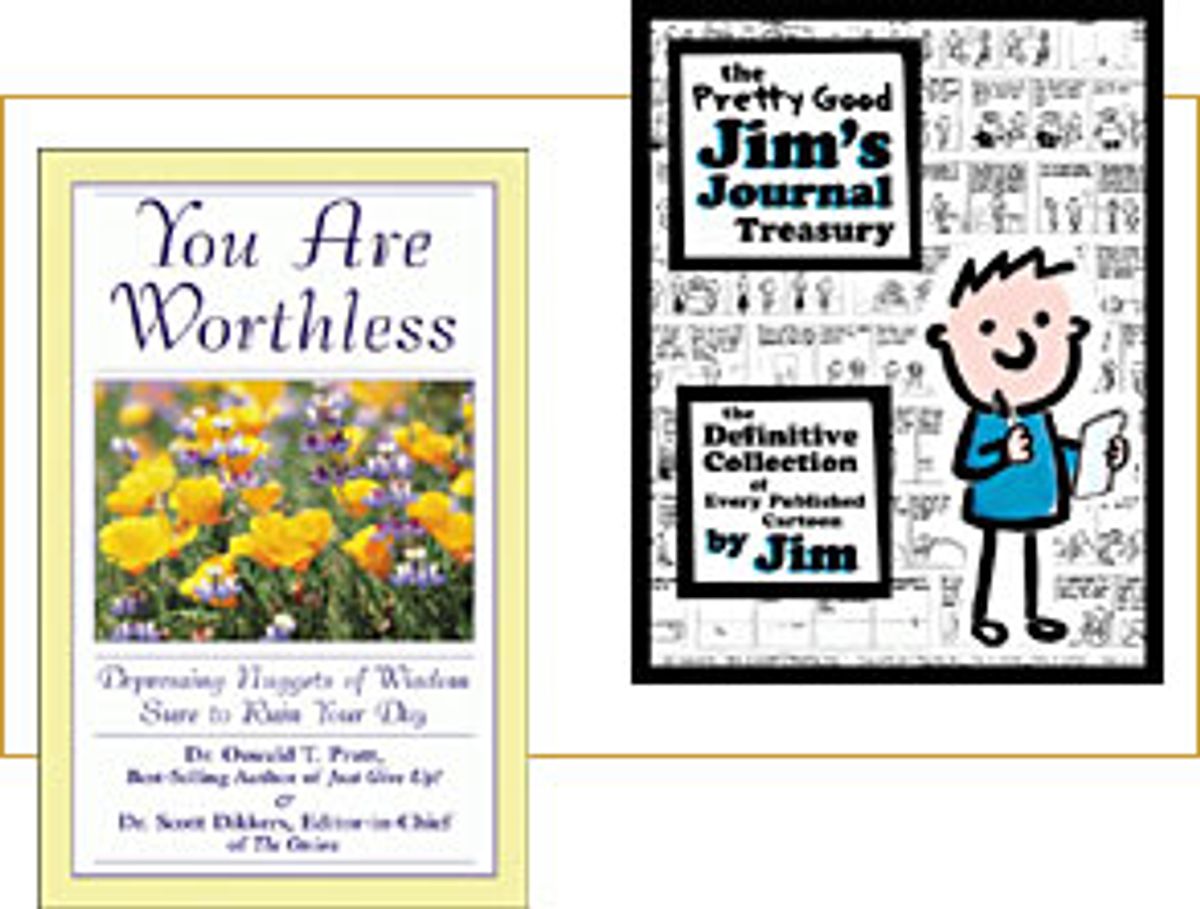
“You Are Worthless” and “The Pretty Good Jim's Journal Treasury” by Scott Dikkers

The editor of the Onion unleashes two collections of anti-humor laced with cyanide.

"You Are Worthless" and "The Pretty Good Jim's Journal Treasury" by Scott Dikkers
Topics:

As editor in chief of the Onion, Scott Dikkers turns media smugness inside out and leaves it there to bleat. The weekly anti-newspaper — whose online edition, theonion.com, has garnered the operation its deserved cult status — began humbly as a Madison, Wis., humor rag and now provides the world with its special brand of absurd government statements, nonsensical graphs, sly headlines and pathetic profiles. This year, the Onion’s bestselling collection of made-up front pages, “Our Dumb Century,” further elevated Dikkers’ satirist-about-town status. Yet it appears that he still hasn’t done enough. The oft-quoted editor recently published two more books, thus creating a discussable oeuvre in the space of six months. Now that we live in Dikkers’ world, what does he want from us?

Well, for one thing, he’d like us to quit being so goddamned cheerful. His newest creations, “You Are Worthless” and “The Pretty Good Jim’s Journal Treasury,” are not for those on the slippery end of the mood-swing seesaw. Undiluted by the Onion collective, Dikkers’ humor is strong stuff: pastel Sweet Tarts with a cyanide kick.

“You Are Worthless” is a dark little book in the vein of Jack Handey’s “Deep Thoughts,” Matt Groening’s “Life in Hell” and, within the Dikkers landscape, raw Onion lectures on stain removal and marital health. Writing as Dr. Oswald T. Pratt (“best-selling author of ‘Just Give Up!’”), a sad-sack psychiatrist who sends every patient he sees into fits of further despair, Dikkers takes everything that Hallmark holds dear — love, family, work, friendship, self-esteem, spirituality, pets — and efficiently uglifies it.

But the advice (presented in boilerplate self-help format with large type, italics and curlicues) comes in several flavors. Some of the dictums are pure elementary-school meanness: “You’re fat.” “Nobody likes you.” Others tend toward the preachy: “Our world is nothing but 95 percent poverty-stricken, bloated-stomached babies and 5 percent money-grubbing pricks. In your lifetime, you’ve only met people from the latter category.” Many more would scorch the glaze off Kathie Lee Gifford: “Mask the pain with drugs.” “Let’s sit down and actually count the genuine, true friends you have. It’s not that many, is it?” “Oh, except Jesus. He’s your friend. Why don’t you call him and see if he wants to hang out?”

Many of Dr. Pratt’s nuggets are sick in the best way — but you need to start off in a pretty good mood to chew the harsher ones without wincing. If you rush, you’ll miss out on the bizarre, the paranoid and the wonderful: “When they try to give you pills, fight them with all your strength.” “If your cat were just a little bit bigger, it would kill and eat you.” And my favorite: “Are you in love? Sucker.”

Fortunately, there is no need for such a book among the denizens of “Jim’s Journal,” the comic strip that Dikkers drew for 10 years before his editorial tenure began. This collection will introduce legions of Onion guzzlers to a delightful cartoon, which even at its peak ran in only a few dozen college newspapers. Here’s the concept: We’re reading the daily diary of a young man named Jim, whose life is pretty much unbroken by significant events. Dikkers’ bold-lined drawings are exactly as detailed as they need to be — which is to say, not very.

So what’s there? A little fuzz-haired guy with stick legs and no mouth who goes to college; works at McDonald’s, a copy shop, a grocery and a bookstore; and has a roommate (the hyper Tony), a pal (Steve, whose jokes in a deliberately jokeless strip are necessarily lame), a girlfriend or something (Ruth, twice Jim’s size, perpetual smiley face) and a cat (Mr. Peterson, who comes closest to being Jim’s soul mate). All the while, he narrates with remarks so dry they float off afterward like tumbleweeds: “When it was over we turned off the TV, sat around and didn’t say much of anything.”

Dikkers slips in a few straight essays between his protagonist’s (nominal) phases, explaining how he used anti-humor to parody a genre he’d never really liked and noting that Jim is a Taoist slacker whose observations resemble Camus’. But you need neither a higher consciousness nor irony specs to find pleasure in “Jim’s Journal.” Except for a jarring plot development near the end of the strip’s run, Jim’s serene unchangingness is hypnotic, clever, poignant, sublime and, oddly enough, funny. If there are enough Jims in the world to balance out the Dr. Pratts, I’d say we’re doing pretty well.

Emily Gordon is the assistant book editor at Newsday.  More Emily Gordon

Monday, Feb 13, 2012 1:00 AM UTC2012-02-13T01:00:00Zl, M j, Y g:i A T

“The Fault in Our Stars” and “There Is No Dog”: Not kids’ stuff

Two new young adult novels are smarter, better-written and more emotionally complex than most adult fiction

wtr_ya2

Why should you, an adult, bother with a novel intended for an audience aged 14 to 18? If you’re among the ever-growing adult readership for YA (young adult) fiction, you’re probably not even asking that question anymore. And no doubt John Green, whose most recent YA novel, “The Fault in Our Stars,” became a bestseller on Amazon even before he finished writing it (pre-orders were enabled when he settled on a title), doesn’t especially need readers with the legal right to vote. But if you were to skip “The Fault in Our Stars” — or another new novel, by YA luminary Meg Rosoff, “There Is No Dog” — because you assume that such books are less intelligent, well-written or emotionally complex than their adult counterparts, you would be most miserably mistaken.

Continue Reading
Laura Miller

Laura Miller is a senior writer for Salon. She is the author of "The Magician's Book: A Skeptic's Adventures in Narnia" and has a Web site, magiciansbook.comMore Laura Miller

Friday, Feb 10, 2012 9:45 PM UTC2012-02-10T21:45:00Zl, M j, Y g:i A T

Salman Rushdie fears nothing

The famed author opens up to Salon about new threats, his just-finished memoir and his forthcoming TV show

Writer Salman Rushdie attends an event in the Joan Fuster state library in Barcelona

Writer Salman Rushdie attends an event in the Joan Fuster state library in Barcelona, March 31, 2009.  (Credit: ©Gustau Nacarino / Reuters)

Plates and glasses are cleared away, and a hush descends on the packed private dining room of a fancy Manhattan Indian restaurant; a distinguished writer — the star of the evening’s event — is about to give a reading. The iPad in his hands bathes his familiar features in a soft, electric glow that complements the muted lights and blinking candles spaced around the room.

As Salman Rushdie intones his own elegant prose in a rich, musical British accent, a soundtrack plays softly but distinctly in the background. If the music seems particularly well-selected — if its rhythms subtly match the story’s turning points — that’s because it was commissioned expressly for the purpose.

Continue Reading

Emma Mustich is an assistant editor at Salon. Follow her on Twitter: @emustichMore Emma Mustich

Thursday, Feb 9, 2012 1:00 AM UTC2012-02-09T01:00:00Zl, M j, Y g:i A T

In defense of fact checking

A controversial writer and his fact checker battle in a new book. Too bad neither gets close to the truth

Jim Fingal and John D'Agata

Jim Fingal and John D'Agata  (Credit: Margaret Stratton)

Fact checking is a subject that many people speak of with blithe confidence despite knowing very little about it. In truth, there’s nothing like going through a 5,000-word story with an exceptionally thorough fact checker to make you aware of just how often all of us talk confidently about subjects on which we are completely, or mostly, wrong. What’s obvious, what everybody knows, what’s only common sense: Much of this stuff turns out, under scrutiny, to melt away into fable, propaganda and wishful thinking. And that includes a lot of what people assume about fact checking.

Continue Reading
Laura Miller

Laura Miller is a senior writer for Salon. She is the author of "The Magician's Book: A Skeptic's Adventures in Narnia" and has a Web site, magiciansbook.comMore Laura Miller

Tuesday, Feb 7, 2012 7:00 PM UTC2012-02-07T19:00:00Zl, M j, Y g:i A T

Salon readers: Tell us your love woes

Next week, our Valentine's Day experts will prescribe classic literature for your problems. Here's how to submit

Authors Jack Murnighan and Maura Kelly.

Authors Jack Murnighan and Maura Kelly.

Topics:,

Love woes are timeless — so why not look to literature’s most lasting works for advice on how to deal with them?

In their new book, “Much Ado About Loving,” authors Maura Kelly and Jack Murnighan do just that. Next week, in honor of Valentine’s Day, we’re bringing their expertise — and the innumerable literary examples at their fingertips — to you.

Continue Reading

  More Salon Staff

Monday, Feb 6, 2012 9:00 PM UTC2012-02-06T21:00:00Zl, M j, Y g:i A T

Charles Dickens and the Facebook generation

As Dickens turns 200, a novelist reads him for the first time, and laments that peers have become so self-obsessed

dickens200

 (Credit: Wikipedia/iStockphoto)

On Feb. 7, 1812, Portsmouth, England, received Charles John Huffam Dickens — a pomegranate-colored, squealing, slick-haired baby boy. Portsmouth is (and was) a teeming small city. In 1812 it was a major port for the British Royal Navy. Today, it has a higher population density than London.

Dickens was born at No. 13 Mile End Terrace, Landport. His mother, of course, had no anesthetic. He was named, in part, for Christopher Huffam, an oar-maker in London — now perhaps the most famous oar-maker of all time.

Continue Reading

Pauls Toutonghi is the author of the novels "Red Weather" and "Evel Knievel Days," which will be published in July by Random House/Crown.  More Pauls Toutonghi

Page 1 of 967 in Books

Other News