Salon Book Awards

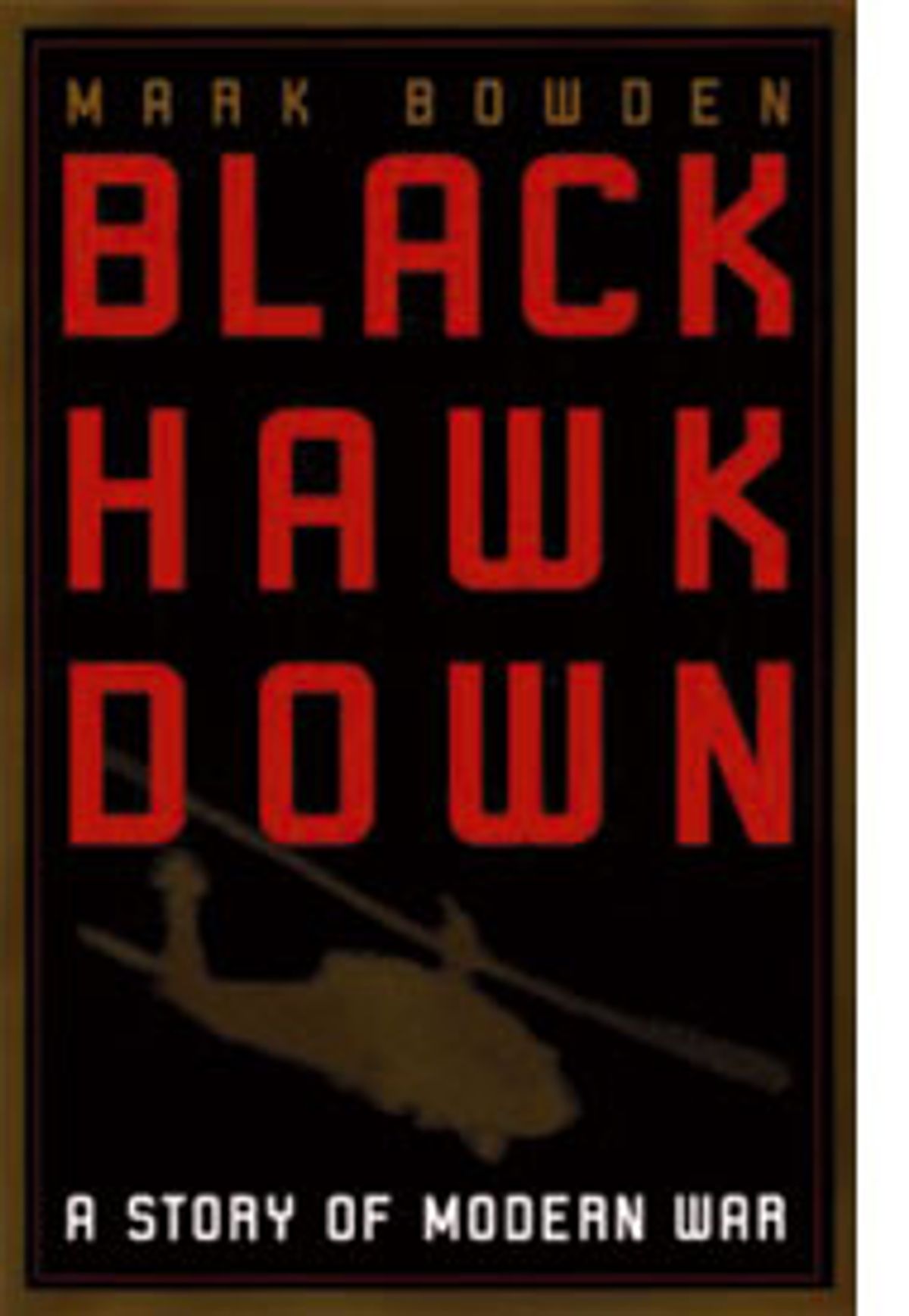
Black Hawk Down: A Story of Modern War

Black Hawk Down: A Story of Modern War

So the convoy now made a U-turn. They had just driven through a vicious ambush in front of the target house and were now turning around to drive right back through it. Men in the vehicles behind could not understand. It was insane! They seemed to be trying to get killed.

Things had deteriorated so badly that up in the C2 bird Harrell was considering just releasing the prisoners, their prize, the supposed point of this mission and of all this carnage. He instructed the Delta units on foot now closing in on the first crash site:

As soon as we get you linked up with the Uniform element throw all the precious cargo. We’re going to try and get force down to the second crash site.

The voices from various helicopters now trying to steer poor McKnight recorded the frustration of his fruitless twists and turns.

Uniform Six Four, this is Romeo Six Four. Next right. Next right! Alleyway! Alleyway!

– They just missed their turn.

– Take the next available right, Uniform.

– Be advised they are coming under heavy fire.

– Uniform Six Four, this is Romeo Six Four.

– God damn it, stop! God damn it, stop!

– Right turn! Right turn! You’re taking fire! Hurry up!

In this terrible confusion the men on the convoy saw strange things. They passed an old woman carrying two plastic grocery bags, walking along calmly through the barrage. As the convoy approached, she set both bags down gently, stuck fingers in her ears, and kept on walking. Minutes later, heading in the opposite direction, they saw the same woman. She had the bags again. She set them down, stuck fingers in her ears, and walked away as she had before.

At every intersection now Somalis just lined up, on both sides of the street, and fired at every vehicle that came across. Since they had men on both sides of the street, any rounds that missed the vehicle as it flashed past would certainly have hit the men on the other side of the road. Sergeant Eversmann, who had found some better cover for himself in the back end of his Humvee, watched with amazement. What a strategy! He felt these people must have no regard for even their own lives! They just did not care!

The city was shredding them block by block. No place was safe. The air was alive with hurtling chunks of hot metal. They heard the awful slap of bullets into flesh and heard the screams and saw the insides of men’s bodies spill out and watched the gray blank pallor rise in the faces of their friends, and the best of the men fought back despair. They were America’s elite fighters and they were going to die here, outnumbered by this determined rabble. Their future was setting with this sun on this day and in this place.

Schilling felt disbelief, and now some guilt. He had steered the convoy the wrong way for at least part of this calamity. Stunned by the confusion, he struggled to convince himself this was all really happening. Over and over he muttered, “We’re going to keep driving around until we’re all fucking dead.”

Books we love

Some of our favorite authors weigh in on the best reads of 2008.

Yesterday we revealed our favorite books of 2008. Today we’ve asked a selection of our favorite writers to chime in and tell us what books got them excited this year.

Michael Pollan, author of “In Defense of Food: An Eater’s Manifesto”

Try as I might to read about other topics, books on food seem to find their way to my bedside table, and 2008 brought a couple of exceptional ones: “Stuffed and Starved” by Raj Patel and “The End of Food” by Paul Roberts both explore the international dimensions of the food issue, and helped me to understand how decisions made about food and farming (and energy) in the U.S. affect eaters all over the world.

Sandra Tsing Loh, author of “Mother On Fire: A True Motherf%#$@ Story About Parenting!”

Although Henry Alford is a gay New York man and I’m a straight Los Angeles woman, I consider Henry a kind of soul mate, not to mention dear friend and exquisite human being. I say that because hilarious writers are rarely exquisite human beings in practice. Henry is, and his new book reflects both the hilarity and the exquisiteness. “How to Live” extracts wisdom (and some flotsam, duly noted) from an array of American elders, including a startlingly fresh and accurate analysis of my Chinese father (and our relationship) that … well, reading Henry’s account was like a wonderfully loving and in the end restorative chiropractic adjustment. For old people and anyone who has ever known an old person (and you will eventually!).

Malcolm Gladwell, author of “Outliers: The Story of Success”

My favorite book of the year was Stephen Hunter’s newest, “Night of Thunder.”  I’m a fanatical reader of thrillers and Stephen Hunter has always been one of my favorites. This book, though, is his best in years — unexpectedly funny and bitchy in addition to all the usual thrills and high jinks.

 Curtis Sittenfeld, author of “American Wife”

I absolutely loved the new novel “Ms. Hempel Chronicles” by Sarah Shun-Lien Bynum. The book is divided into eight episodic chapters — almost like short stories — following Beatrice Hempel, who’s a 20-something middle-school English and history teacher in New York. While this might not sound like inherently riveting material, Bynum is a wonderful, practically magical writer and she depicts Ms. Hempel’s life in such a hilarious, poignant, quirky way that it’s irresistible. The details are all completely perfect — the tension of watching a dorky girl do a magic act during a talent show, the mood inside the bus on a field trip, the camaraderie among teachers — and it all rings so true that I want to give this book to everyone I know who has ever taught. (Though I should add that the book, while elegantly written, also frankly discusses subjects such as, say, Ms. Hempel’s reluctance to have anal sex with her fiancé, so it’s not G-rated.) This is an unusual novel in tone, structure and focus, which I see as a virtue. I was charmed.

Kelly Link, author of “Pretty Monsters”

I grew up loving books about hobbits, horses and dogs (Walter Farley, Alfred Payson Terhune), and while I’ve stayed a faithful fan of fantasy and science fiction, somehow I seem to have drifted away from the horse genre. Reading Molly Gloss’ novel “The Hearts of Horses,” about a 19-year-old bronco buster, Martha Lessen, and a ranching community in Oregon in 1917, was one of those reading experiences that made me feel the way I did when I was a kid and reading certain books felt more urgent than remembering to breathe. I’m a huge fan of Gloss’ other books, but “The Hearts of Horses” is the one that I’d recommend to start with. It’s beautifully written, the characters are heartbreakingly real, and it fleshes out a piece of history that I know relatively little about.

And because I can never just recommend one book, I’ll also note that this was a terrific year for graphic novels. I loved the new “Scott Pilgrim” by Bryan Lee O’Malley, Matt Forsythe’s beautifully produced, weird and wordless “Ojingogo,” and Lynda Barry’s “What It Is.”  For short story collections, I can’t stop recommending Joe Hill’s “20th Century Ghosts,” and for young adults, there’s a bounty of riches: Ysabeau Wilce’s “Flora’s Dare”; Suzanne Collins’ page-turning dystopia “The Hunger Games”; the second volume of M.T. Anderson’s “Octavian Nothing”; and Margo Lanagan’s gorgeous, unsettling fairy tale, “Tender Morsels.”

Daniel Handler (aka Lemony Snicket), author of “A Series of Unfortunate Events” and “Adverbs”

Campbell McGrath’s “Seven Notebooks” has everything you want in lit — the passion and the distraction, the studied goofs and the careless formalism, the sentiment and the cynicism, the ebb and the flow and the herky-jerky dance, the anecdote and the epic and the way memory breaks your heart and throws you a lifeline, and two hard-boiled eggs. I had to read more than 300 books this year — long story — and this is the one that helped me with all the others. What do you need help with? “Seven Notebooks” will take care of that.

Rob Walker, author of “Buying In: The Secret Dialogue Between What We Buy and Who We Are”

I’m always behind on reading contemporary books that aren’t directly related to my job, and this year that was particularly true. But I ended up doing a lot of reading on airplanes over the summer, and it was on a plane that I started David Shields’ newest book, “The Thing About Life Is That One Day You’ll Be Dead.”

I started a little tentatively, because I wasn’t really in the mood to read about mortality — but when would I be? Anyway, it turned out that this is a book you can’t know you want to read until you’re reading it. And then you realize it’s exactly what you wanted and needed, whatever’s going on in your life. Or at least that’s how it worked on me. I’d planned to finish it on the trip home, but ended up doing so in my hotel room.

I was already a fan of Shields’ work; he’s as good as anybody at extracting surprising insights from topics like sports and pop culture. What impressed me most here was his handling of what I guess must be the most serious subject I can think of, with a touch that entertained without trivializing, and that delivered wisdom without resorting to sentimentality. It’s a very skilled piece of writing. I admired it, and I really enjoyed it, too. 

Meg Wolitzer, author of “The Ten Year Nap”

“Olive Kitteridge,” Elizabeth Strout’s astonishing collection of 13 linked stories, is tough and hilarious, unapologetic and beautiful. Centered around one woman’s life, this book could be described as “character-driven,” but that term might make it feel small, which it isn’t; it’s big and packed, in fact. Strout has the talent, patience and insight to let her imperfect characters tangle with one another in real, human ways over time. Back in the 1970s-’80s golden age of American fiction, people didn’t have to continually convince other people why fiction was essential, and a book like “Olive Kitteridge” would have more easily found the audience it deserves. In our era, a non-fiction-heavy, news-dominated period in which fiction is often unfairly seen as a languishing specialty item, writers like Elizabeth Strout remind us of how much we need it in our lives.

Steve Almond, author of “(Not That You Asked): Rants, Exploits, and Obsessions”

Chuck Klosterman’s debut novel, “Downtown Owl,” is shockingly good. I was expecting it to be smarty-pants and emotionally pale. But Klosterman really understands his people, he cares for them, and his cleverness is almost always in service to the story. This is going to sound like heresy to some, but the best moments of this minor masterpiece read like Kurt Vonnegut, if he’d devoted himself to the obscure longings and miseries of small-town North Dakota.

Steven Johnson, author of “The Invention of Air”

I read a galley copy of Oliver Morton’s “Eating the Sun: How Plants Power the Planet” very quickly a few months ago and was very impressed with it then. But when I went back to read it more slowly last month, I realized what a masterpiece the book was: a kind of epic poem to the power and potentiality of photosynthesis.

Oliver and I met years ago and have kept in touch loosely since then,  but this book is so great I’d be singing its praises even if we were arch rivals. “Eating the Sun” is many things. It’s a story of scientific discovery told with great clarity and narrative drive, and it’s a mind-expanding rumination on life, energy and the future of our planet. The book has descriptions of natural and semi-natural landscapes that are just exquisite. And it’s a refreshingly optimistic call-to-arms that talks about our climate crisis as something that is both immense and potentially manageable, making the most compelling case for radical innovation in solar energy that I’ve read to date. I hope there are Obama people who are reading this book right now — it should be required reading for anyone entering the White House, right up there with the Michael Pollan and the Doris Kearns Goodwin. But those of you who aren’t currently going through the screening process should pick up a copy too; it’s still early, but I think this may be my favorite book of 2008.

Lydia Millet, author of “How the Dead Dream”

I loved Joy Williams’ novel “The Changeling,” reissued after 30 years by the tiny but valiant Fairy Tale Review Press. Williams is a brilliant writer and “The Changeling” (no relation to the movie of the same name) is an explosive, strange and mythic showpiece of that brilliance. It had no business being out of print for so long. A young, drunken mother and her baby are separated in a plane crash, and thereafter the mother, Pearl, spirals into oblivion on an island of increasingly feral children — never quite sure the baby who was returned to her, and now plays among them, is her own.

Ed Park, author of “Personal Days”

A single page of Don Paterson’s collection of aphorisms, “Best Thought, Worst Thought,” contains enough philosophical conjecture, elegant bile, and cold hard truths (or facile lies) to power three regulation-length novels. The misanthropy on display here alternates with humor, or simply merges with it (“You’ve made a blog … Clever boy! Next: flushing“), making for irresistible sampling. Some of the aphorisms read like surreal microfictions (“Sex is better in dreams as the prick has an eye”), others like entries in a journal intime. Just when he has you chuckling, he’ll whip out a line that reads like a freshly translated fragment from a distant epoch (“Imagining the worst is no talisman against it”). You get the sense that Paterson both stakes his life on every sentence and wants to distance himself from it almost before the ink has dried, and these impulses give the book its perfect rhythm. As he puts it, “A style is a strategy of evasion.”

Chuck Klosterman, author of “Downtown Owl”

“Boys Will Be Boys: The Glory Days and Party Nights of the Dallas Cowboy Dynasty” by Jeff Pearlman is the sportswriting equivalent of reading Neil Strauss’ “The Dirt” — it’s totally insane, completely plausible, and “gossipy” in the best possible way. Some of the content skews unnecessarily negative (I can’t imagine anyone in the Cowboy organization not named Troy Aikman who wouldn’t hate or dispute this book), but the reporting is dogged and the stories are more entertaining than any of the fictional moments in “North Dallas Forty.” By far the fastest 416 pages I read in 2008.

Continue Reading Close

Salon Book Awards 2008

Our picks for the 10 most pleasurable fiction and nonfiction reading experiences of the year.

The conventional wisdom in publishing holds that tough economic times are good for books, because books provide more hours of entertainment per dollar, more life-enhancing education and more grist for post-materialistic soul-searching than any other form of purchasable culture.

Then again, 2008 was a year when all conventional wisdom went south, and we end it with layoffs in many of the largest publishing companies and an announcement from Houghton/Harcourt, a recently merged fusion of two venerable houses, that, for the time being, they will not be acquiring any new manuscripts. (Publishers have imposed informal buying freezes in the past, but announcing it publicly is almost unprecedented.) On the other hand, the Hachette Book Group, its coffers fattened by the “Twilight” series of teen vampire romance novels and James Patterson’s unnervingly productive thriller-industrial complex, is dishing out bonuses at a time when even hedge fund managers feel lucky to still be getting a paycheck.

There’s no doubt that escapism pays, especially when there’s plenty to escape from, but great books continue to be published and read, and many of these also provide welcome respite for jittery readers. Remember what it was like to slow down, take the phone off the hook and immerse yourself in a story, true or invented, that made the world around you disappear for hours on end? Or to give yourself the time to understand some important aspect of this world in a deeper and more comprehensive way than any newspaper or magazine can offer? Here is our annual list of 10 books — five fiction, five nonfiction — that brought us back to that experience.

In this distracted, anxious and superficial age, getting lost in a good book has begun to look like the very best way to get away from it all.


FICTION

2666 by Roberto Bolaño
An elusive German writer and the murders of hundreds of girls and women in a bleak town on the Mexican-U.S. border are the two mysteries at the core of this expansive, mesmerizing novel in five parts. The critical reputation of Bolaño, who died in 2003 at the age of 50, got a massive boost in the English-speaking world with the publication of “The Savage Detectives” last year; we were skeptics when it came to that novel, but “2666″ has made believers out of us. Bolaño pursues, with suave implacability, questions of art and evil through an immense web of stories, some humorously mundane, others as resonant and enigmatic as the great myths. On any page, you might be reminded of Borges or Melville or David Foster Wallace, but the totality is utterly original. Are the worst brutalities that humanity perpetrates redeemed or ameliorated to the slightest degree by our most sublime achievements? That’s the puzzle this novel circles as it winds through academic conferences and coroner’s reports, romantic triangles and gang killings, cafes and battlefields, with a light-footed and mournful curiosity that seems, despite the author’s abbreviated life, nothing less than infinite.

A Person of Interest by Susan Choi
In Choi’s Hitchcockian premise, an undistinguished Midwestern math professor finds himself the object of rumors and suspicion when a more celebrated colleague is killed by a mail bomber. Dr. Lee, a refugee of aristocratic descent from an unnamed Asian country, may be innocent of that crime, but he holds himself guilty of other, less actionable transgressions, and his pervasive discomfort with himself and everyone around him causes him to sink further and further into confusion and disgrace. A nuanced consideration of what it means to fit in, and of what we owe to the people around us, “A Person of Interest” eschews obvious answers. At once a tragedy of character and a tale of suspense, this novel is a seamless integration of the political and the personal, beautifully written and impeccably unsentimental.

The Likeness by Tana French
Ostensibly a detective novel, French’s follow-up to her 2007 novel, “In the Woods,” is, like that earlier book, willfully disobedient to the dictates of genre; French refuses to offer complete resolutions or strictly realistic scenarios. Cassie Maddox, the partner of the self-destructing detective who narrated “In the Woods,” is drawn into a ménage à cinq of college students living a seeming charmed existence in an Irish country house. One of the five, a girl who is Cassie’s doppelgänger and has been living under an alias Cassie once used as an undercover narcotics agent, turns up murdered in a ruined cottage. Cassie is given the unlikely task of pretending to be a woman who was pretending to be a woman whom Cassie once pretended to be. As you might expect, “The Likeness” wrestles with matters of identity and intimacy as its heroine comes to prefer this triply false life to her real one. The hypnotic prose and eerie atmosphere conspire to make this ostensible mystery novel much, much more than it appears to be.

Atmospheric Disturbances by Rivka Galchen
Perhaps it’s some subtle shift in the zeitgeist, but “The Likeness” is not the only novel of complicated identity on our list this year. In Galchen’s wryly elegant tale, Leo Liebenstein, a New York psychiatrist, suddenly decides that his beloved wife, Rema, has been replaced by a near-perfect impostor. After sparring with the “false” Rema, he embarks on a continent-spanning search for the real one, winding up in Argentina, where the notion of disappearing loved ones acquires an even more painful resonance. In his quest, Leo is assisted by one of his own patients — a delusional fellow who claims to be on the lam from a cabal that manipulates the weather — and is guided by cryptic messages apparently sent by a distinguished meteorologist. If Tana French writes of the impossibility of understanding the full truth about ourselves, Galchen marvels over the hubris in thinking that we can ever really know those we love — and suggests that authenticity is more a matter of faith than of facts.

The Northern Clemency by Philip Hensher
This sprawling, satirical novel of intersecting suburban families is set in Sheffield, England, from 1974 to the mid-’90s, and its author is firmly committed to reproducing the textures of that world, from the pretentious hors d’oeuvres served by an aspiring middle-class housewife (“mushroom vol-au-vents”) to the white formica and smoked brown glass of a neighbor’s furniture “unit.” Yet somehow the very specificity of these details makes Hensher’s suburbia seem all the more universal, an archetypal field of dreams, seething with antsy and malign children, distracted husbands and yearning, straying wives who muddle their way from the swinging ’70s through the Thatcher years. American writers tend to approach suburban life with either savage ridicule or stricken solemnity, so Hensher’s humanism, equal parts humor and sympathy and embodied in a restless third-person perspective that gives every character’s viewpoint its due, feels especially welcome. Reading it is a bit like wandering through your old neighborhood, listening in on the thoughts of the residents in each house, finally able to apprehend the hilarious, pitiful and miraculous expanse of it all.


NONFICTION

Pictures at a Revolution: Five Movies and the Birth of the New Hollywood by Mark Harris
Film critic Harris takes the five nominees for the best picture Oscar of 1967, and uses them as lenses to examine the tectonic changes that were taking place in the movie industry and American society as a whole. “Doctor Dolittle” represented the irrelevant bloat of the doomed studio system; “Guess Who’s Coming to Dinner” stood for right-thinking, middle-of-the-road liberalism; “In the Heat of the Night” showed how much (and how little) an African-American actor like Sidney Poitier could expect in the way of opportunity; “Bonnie and Clyde” embodied the birth of a hip new internationalism; and “The Graduate” spoke for youth culture and its romantic discontents. Harris retraces the very different stories behind the making of all five films, beginning around 1963, when two staffers at Esquire with no experience of Hollywood wrote a screenplay about a couple of Depression-era bank robbers for their idol, François Truffaut, and unwittingly ushered in a new approach to movie production. It seems astonishing that no one hit upon this premise earlier, but as Harris’ execution abundantly illustrates, no one could have done it better.

The Dark Side: The Inside Story of How the War on Terror Turned Into a War on American Ideals by Jane Mayer
No other book penetrates further into the black heart of the war on terror than Mayer’s masterly examination of the Bush administration’s erosion of civil liberties and human rights in the prosecution of that so-called war. Tapping published works by other journalists as well as her own reporting for the New Yorker on the administration’s efforts to justify the use of torture on detainees, Mayer makes sure that “The Dark Side” is about much more than just Abu Ghraib and Guantánamo Bay. She describes the process by which, after Sept. 11, a toxic combination of fear and arrogance infected the inner circles of the nation’s leadership — most notably Vice President Dick Cheney and his secretive advisor David Addington, the architect of the administration’s notorious torture policies — leading to what Mayer persuasively describes as “the most dramatic, sustained and radical challenge to the rule of law in American history.” Though their reign is nearly over, the moral downfall of these men remains a lasting lesson for any leader, an example of the terrible dangers inherent in power and paranoia.

The Suspicions of Mr. Whicher: A Shocking Murder and the Undoing of a Great Victorian Detective by Kate Summerscale
Part true-crime narrative, part cultural history, Summerscale’s exploration of a notorious case of child-murder in 1860 is above all an inquiry into our lasting fascination with detectives and detective stories. Her hero, Inspector Jonathan Whicher, one of the very first investigators at the newly formed Scotland Yard and a figure of fascination for such writers as Charles Dickens and Wilkie Collins, was called in to solve a killing in a country house that eerily resembles a notorious mystery of our own time: the JonBenet Ramsey murder. What Whicher found out — but was ultimately unable to prove, to his lasting despair — undermined almost everything that nice middle-class families chose to believe about their own way of life. Summerscale uses the case to crack open not only the allure of the detective as a fictional diviner of guilt and innocence, but also the curious details and ugly truths about everyday Victorian life concealed behind the most respectable facades.

Buying In: The Secret Dialogue Between What We Buy and Who We Are by Rob Walker
Much as we may decry and gripe about the phenomenon Walker calls “commercial persuasion,” marketing and advertising are omnipresent aspects of contemporary life, and Americans have a much more complex and ambivalent relationship with them than most of us are willing to admit. “Buying In” explores the bleeding edge of innovative marketing, from undercover shills touting a new line of booze in your local bar to hipsters appropriating a product like Pabst Blue Ribbon to millennial kids whose concept of art is the creation of their own brands. The implications of these examples are wide-ranging. A concept Walker calls “murketing,” in which advertisers refrain from establishing a mass-culture identity for a product and instead encourage various subcultures to project their own meanings onto it, may be the most helpful model for understanding the precedent-busting campaign of Barack Obama. Walker makes an exceptionally insightful and reflective guide to this brave new world, ever prepared to cajole his readers into thinking a little harder about cultural phenomena we take for granted and too all blithely write off as affecting everyone but ourselves.

The Suicide Index: Putting My Father’s Death in Order by Joan Wickersham
Wickersham’s father shot himself in 1991, apparently in despair over an impending business failure, but the real motivations of this Willie Lomanesque figure will never be known. Written in the form of an index, an acknowledgment of Wickersham’s inability to frame her father’s act in any conventionally linear form, this memoir is written in a cool, economical and ultimately piercing style utterly devoid of easy pathos or cliché. Anyone prone to facile dismissals of the memoir as literary high art should be silenced by the perfection of Wickersham’s prose and her ability to hold the facts and her feelings up to the light, turning them again and again to reveal yet another facet of grief, anger, love, pity and guilt.

Continue Reading Close
Laura Miller

Laura Miller is a senior writer for Salon. She is the author of "The Magician's Book: A Skeptic's Adventures in Narnia" and has a Web site, magiciansbook.com.

Their favorite things

Writers, filmmakers and other notable figures tip us off to the stuff that most excited them this year.

Yesterday we revealed our favorite fiction and nonfiction books of 2007. As part of Salon’s book week, we also asked a selection of our favorite writers, filmmakers, musicians, actors and chefs to tell us what books, music, movies (and other assorted cultural material) got them excited this year.

- – - – - – - – - – - -

Tom Bissell (author, “The Father of All Things: A Marine, His Son and the Legacy of Vietnam”)

Book: I read a number of books this year that impressed me (Joshua Ferris’ “Then We Came to the End”), frustrated me (Robert Draper’s “Dead Certain”), moved me (Dave Eggers’ “What Is the What”) and delighted me (Jack Pendarvis’ “Your Body Is Changing”), but the best book I read this year was Denis Johnson’s “Tree of Smoke.” Publishing a book about Vietnam in the same year as Denis Johnson, as I did, leaves one feeling a little like being crucified next to Jesus: in other words, nice try. Not only does it have the most impossibly beautiful and devastating first two and a half pages I’ve ever read, it creates a world that seems less imagined than opened for entry.

I would also be remiss if I did not mention my rereading of a great book I first read more than a decade ago: “Of a Fire on the Moon,” Norman Mailer’s account of the 1969 moon landing. Whether he is describing the blandly similar attractiveness of male astronauts’ wives, the inner workings of rocketry, or the first thrilling moments human beings walked on what Mailer calls “the pale graveyard of sleep,” the prose is never less than slightly crazy and totally astonishing. A month after I finished the book — which is, ridiculously, out of print — Mailer went unto the white creator. May he sleep well.

Video games: “Bioshock,” an insanely intense shooter that a) imagines an underwater city ruled by an Ayn Randian overlord and b) sets out before the gamer a series of decisions and quandaries that, for maybe the first time in video game history, felt somehow inescapably … moral. While I would hesitate to call “Bioshock” a legitimate work of art, its engrossing and intelligent story line made it the first game to absorb me without also embarrassing me for being so absorbed. Also, it’s awfully hard to dislike a game in which you smoke cigarettes and drink vodka to regenerate your attack energy.

Edwidge Danticat (author of “Brother, I’m Dying”)

Music: I’d recommend Wyclef Jean’s “Carnival Vol. II, Memoirs of an Immigrant,” his follow-up to his 1997 album “The Carnival.” The album opens intimately with Wyclef’s voice speaking over a throbbing rock-inspired beat as his daughter cries in the background. “Come on, Angie,” he says. “Let Daddy finish writing.” What Daddy ends up writing, and singing and rapping, is truly marvelous. With collaborators such as Norah Jones, Mary J. Blige, Paul Simon, Akon and Shakira (glorious once again), this is an album not to be missed.

Amy Bloom (author, “Away”)

Book: The best book I did manage to read this year — every single thing by Philip Pullman, a wonderful writer for adults and young people, heroic atheist and sensible man. What I can’t wait to read: the new book by Ha Jin ["A Free Life"] and the new book by Nathan Englander ["The Ministry of Special Cases"]. Best collections of poetry were “After” by Jane Hirshfield and Mary Jo Bang’s “Elegy.”

Music: “Back to Black” by the completely and amazingly fucked-up Amy Winehouse.

Josh Schwartz (screenwriter and television producer, “Gossip Girl” and “The O.C.”)

Book: “Harry Potter and the Deathly Hallows.” The culmination of a series that simultaneously reminds me of when I was 10, and makes me wish I still was just so I could experience it as a kid. In a time of fracturing cultural touchstones, it’s nice to have one that brought so many people together and was so imaginative, satisfying and fun. Also — “Then We Came to the End” by Joshua Ferris: A really funny, smart book from a really promising first-time author. Can’t wait to read what’s next.

Music: “Boxer” by the National. As you hit 30 it gets harder to find music that feels like it’s speaking to your experience, but this is a really emotional record full of great songs that would speak to any guy in his 20s and 30s trying to figure out growing up. And “Cease to Begin” by Band of Horses. Their first record had some truly great songs, this one is great through and through. Ben Bridwell has one of the great voices out there. A beautiful record.

Movie: “No Country for Old Men” is a return to the “Blood Simple,” “Miller’s Crossing” type of simpler but gripping storytelling. Javier Bardem’s Chigurh is as frightening as Hannibal Lecter was when he first appeared on-screen. And “High School Musical 2.” They were showing it on a plane I was on and everyone on the plane, young and old, were watching. That’s some pop cultural power.

Darcey Steinke (author, “Easter Everywhere”)

Book: “Love Is a Mix Tape” by Rob Sheffield. This book centers on Sheffield’s wife, Renee, who died young and suddenly. It also details Sheffield’s lifelong obsession with music, from the tape he made for his junior high dance to the songs that haunted and sustained him after his wife’s death. Before Sheffield wrote for Rolling Stone he was working on a Ph.D., his thesis on the poet Mina Loy. “Love Is a Mix Tape” is a weird hybrid, an elegy, both poetic and hilarious, that details one man’s faith in the restorative power of music.

Music: “White Chalk” by PJ Harvey. Driving to pick up my daughter at school I’ve been playing this album. It has a hypnotic pull; the songs are both fragile and ragged and remind me of the tunes an 1840s songstress might play as she traveled by wagon from town to town. The are spooky, partly because of the echo effects and the gothic tint to the lyrics but also because Harvey seems to be lamenting her escape from darkness. Besides Harvey, only Johnny Cash has written so well about the melancholy of maturing, that tinge of nostalgia for a darkness that has left.

TV: “My So Called Life,” starring Claire Danes and created by Winnie Holtzman, was released this year on DVD. I missed it the first time around when it ran for one year from 1994 to 1995. Recently I watched all 19 episodes with my daughter, Abbie, who was born the year the show aired and is now 12. Claire Danes’ Angela is a great role model. A spooky-smart high school girl, who questions the need for a definitive personality, thinks Anne Frank was lucky and, most endearingly, is ridiculously in love with Jordan Catalano, a dim but beautiful boy played by Jared Leto.

Alex Ross (author, The Rest Is Noise”)

Music: The year produced a sizable stack of classical CDs that I strongly recommend: the late Lorraine Hunt Lieberson’s heart-rending 1998 recital from Wigmore Hall, the Grand Valley State University New Music Ensemble’s thrilling version of Steve Reich’s “Music for 18 Musicians,” and Paavo Järvi’s punchy interpretations of Beethoven’s Third and Eighth symphonies. But my record of the year came from outside the classical field. Radiohead are filed under rock, but to me they are collectively one of the most interesting composers in contemporary music. The secret weapon on “In Rainbows” is Phil Selway, drumming intricate, tricky, spiky patterns under the surface of what seems to be a lush, almost romantic album. Was there some story about the price? I forget: “Videotape” puts me in another world.

Mary Harron (director, “American Psycho” and “The Notorious Bettie Page”)

Movie: I loved a lot of movies this year: “Control,” “I’m Not There,” “Michael Clayton,” “No Country for Old Men,” “The Savages,” “Superbad.” My greatest film experience happened on a rooftop in the desert in Jordan. I was there taking part in the Sundance Middle Eastern screenwriting lab, and every night they showed us movies under the stars. One night they showed us Yousry Nasrallah’s 1999 film “El Medina.” Set in Cairo, it showed a city that was sexy, turbulent and alive in a way New York was 30 years ago and is no longer. Watching it, I felt a new world opening up.

Malcolm Gladwell (author, “The Tipping Point” and “Blink”)

Book: This past year I got what every fan of thrillers dreams of: a new Joseph Finder ["Power Play"], a new Lee Child ["Bad Luck and Trouble"] (maybe his best yet), a new and brilliant Daniel Silva ["The Secret Servant"] and, best of all, Robert Harris’ “The Ghost” — his finest book since “Fatherland.”

Dean Wareham (musician, “Back Numbers,” and author, “Black Postcards: A Rock & Roll Romance”)

Music: “Sound of Silver” by LCD Soundsystem. This took me back to about 1981, with hints of Arthur Baker, Talking Heads, New Order and Liquid Liquid. Great songs like “Someone Great,” “North American Scum” and “New York, I Love You but You’re Bringing Me Down.”

Movie: “Margot at the Wedding.” I was a music consultant on this film, which perhaps disqualifies me from commenting. Still, I loved it. It is hard-hitting and fast-paced, intelligent, and very, very funny.

Video: Laura Miller discusses two new Vietnam books

Miranda July (author, “No One Belongs Here More Than You”; director/writer, “Me and You and Everyone We Know”)

Book: Israeli writer Etgar Keret’s book of short stories “The Nimrod Flipout.” I read this book in bed beside my boyfriend who was reading a much less interesting book and I kept shouting “Wow” and “No way” and “Oh my god” and my boyfriend would say, “What? what?” and I’d shake my head and say, “You wouldn’t get it. You just have to read it.” After I finished the book I immediately became more deadpan, more ridiculous and more in touch with my own mortality. My boyfriend was impressed with the new me and I told him, “It’s that book, ‘The Nimrod Flipout’ — it’s opened up a whole new world for me.” Now he’s reading it, just so we can stay on the same plane of reality together.

Junot Díaz (author, “The Brief Wondrous Life of Oscar Wao”)

Book: I have to break my own rules and recommend for the 1,000th time Mohsin Hamid’s “The Reluctant Fundamentalist.” Just one of those achingly assured novels that makes you happy to be a reader.

Daniela Sea (actor, “The L Word,” “Itty Bitty Titty Committee”)

Book: Jim Harrison’s “The Beast That God Forgot to Invent.” In this book of three novellas, nature seeps out from every line. It was at the same time painful and inspiring to read such open and frank truths written in the poetic language he is famous for. My heart was elated and broken apart all at once.

Music: La Monte Young’s “The Well Tuned Piano.” These records are amazing and move me so fundamentally. They are like nothing I have ever heard before … truly magical, all on a differently tuned piano.

Movie: “Away From Her,” directed by Sarah Polley. I saw this movie for the first time at the Berlinale Film Festival and was truly amazed. Sarah Polley is my hero for making this her directorial debut. Julie Christie, one of my all-time favorites, plays a woman who is dealing with Alzheimer’s. It’s one goodbye after another, as her mind’s lights slowly go out.

Christine Vachon (producer, “I’m Not There”)

TV: “Aliens in America” is the funniest show I’ve ever seen — awkward and sharp and adolescent. I love all the actors and think the teenage casting is spot-on, but the parents rock too.

Luc Sante (author, “Kill All Your Darlings” and “Low Life”)

Book: “The Long Embrace” by Judith Freeman. This creatively obsessive study of Raymond Chandler’s marriage restores literary biography to what it stopped being long ago: a genuine engagement with the subject’s soul.

Music: “Untrue” by Burial. Shards of dance-hall music stretched and twisted until it sounds like a heap of ruins, but shot through with elegiac shafts of light. I hear jungle in this, of course, as well as, weirdly, a vein of English classical music, from Purcell to Vaughn Williams.

Movie: “Out One,” by Jacques Rivette. Yes, it was shot in 1969 or so, but it wasn’t shown anywhere until recently, and not in the U.S. until this year, and it’s so much deeper and more ambitious than any current commercial release it’s not even funny. It’s a collective portrait of disillusioned revolutionaries, a treatise on the art of acting, a mystery story in which you first have to find what the mystery is, and much, much more.

Eric Roth (screenwriter, “Munich” and the forthcoming “The Curious Case of Benjamin Button”)

Book: I have been a longtime admirer of the author Denis Johnson and there was no finer experience for me than reading his “Tree Of Smoke,” which reminded me again that deception defines every human in every war, and that I could only wish I was half the writer he was. Philip Roth’s “Exit Ghost” is just that, the perfect stage direction for us all. “John Fowles, the Journals, Vol. II,” because you know before he does what his life is to become, and you watch with fascination, affection and horror, as it unfolds. A helluva good read is “Caught Stealing” by Charlie Huston, which just keeps kicking the holy shit out of you.

Movie: In the area that I have worked for far too long, the movies, of what I have seen to date I would name five: “The Assassination of Jesse James by the Coward Robert Ford,” for its stark realization of Ron Hansen’s non-narrative muse on the price of fame. David Fincher’s “Zodiac,” for the movie’s respect for the rule of law … probable cause as a forgotten linchpin of democracy. The Coen brothers for their “No Country for Old Men,” because they understand we are defined by our landscape, for good or for evil. “The Darjeeling Limited,” which made luggage as important as “Sullivan’s Travels” did. And “Knocked Up,” because Judd Apatow knows his dick from a hole in the ground.

Tom Colicchio (restaurateur and head judge, “Top Chef”)

Book: “The Many Lives of Tom Waits” by Patrick Humphries — a glimpse into the life and art of one of my favorite musicians.

Music: Iron & Wine’s “The Shepherd’s Dog” — Sam Beam’s most orchestrated album. Reflective and cool.

Movie: “American Gangster” — New York City in despair and disorder, and two actors at the top of their game.

Van Hunt (musician, “The Popular Machine”)

Book: “Mr. Untouchable.” I enjoyed the read. I could empathize with the anguish of a person who, though because of his own actions, is at the mercy of his failing relationships.

Music: Bach cello suites. This is simply the most complete musical statement that will ever be made with one instrument.

Fenton Bailey (director/producer, “Inside Deep Throat” and “The Eyes of Tammy Faye”)

Book: “The 4-Hour Workweek.” We all know that workaholic America could never embrace European-style idleness. So Timothy Ferriss does it by packaging it as a do less, get-rich, self-help regimen, kind of like eat yourself thin. A fabulous heresy that dares to declare e-mail is pointless, shopping a waste, and modern life rubbish.

Music: “Blackout” by Britney Spears. This is not a perverse choice. “Blackout” is a near-perfect concoction of Disco Noir and is a record you can actually listen to and — if so moved — write a thesis about. With a lurid self-exploitational feel that’s compellingly icky, it explores the Matrix-like layers of Hollywood narcissism. An album I bet that both the Pet Shop Boys and Madonna wish they had made.

Movie: “Julia Attacks!” is a TMZ video in which Julia Roberts chases down and gives a telling off to a paparazzi. Julia — absent from our screens for too long — is completely convincing in this role as an angry mom. The car chase is excellent and the cinematography visceral and immersive. Some moviegoers might be disappointed that this movie is less than a minute long because Julia has her costar turn off the camera before she delivers her speech about children and paparazzi, but most movies are too long anyway.

KT Tunstall (musician, “Drastic Fantastic”)

Book: “A Million Little Pieces” by James Frey. Gave me insight and deeper empathy toward drug addictions. Apparently the book — which was purportedly an autobiography — was slightly fabricated, which caused a big furor, but I don’t think that affects the power of it. It’s harrowing, but worth it!

Music: “Iodene” by Halfcousin. I played in his band a few years ago and he remains a huge source of inspiration. A brilliant mix of punk and folk. This guy definitely puts the mental into experimental.

Movie: “No Country for Old Men” by the Coen brothers. Amazing script, amazing actors, and plenty of time to digest it all with brilliant pauses. I love a bit of dark humor, and these two directors always deliver that with their excellent films. Some of the best one-liners I’ve heard since “Pulp Fiction.”

Daniel Handler (aka Lemony Snicket, author, “A Series of Unfortunate Events,” and musician)

Book: Desperate, spooky and lively, the best book of poetry I read this year was Cate Marvin’s “Fragment of the Head of a Queen.”

Music: A conflict of interest prevents me from touting “In Our Bedroom After the War” by Stars as the best album of the year, so I’ll go with the Dirty Projectors’ glorious “Rise Above,” which grabs the backing choir from Prince’s “Kiss” and makes them the Pips to David Longstreth’s passionate if tipsy Gladys, chops in some guitar from South Africa, muddles around with a little cruise ship percussion and whips the whole thing up into the sort of album Sufjan Stevens would make if he wanted to rock your ass. I listened to it five or six times before learning that it’s a cover of an entire album by Black Flag. I never listened to Black Flag in my life — back in the day there were too many Human League 12-inch singles to buy — and I love this thing to death. Hands down, the dance-around-in-your-underwear album of the year.

Movie: The best film of the year is the two-minute thing on YouTube of Doris Lessing learning she’s won the Nobel Prize. I watch it over and over. It’s an inspiration.

Bobby Flay (restaurateur and “Iron Chef” star)

Movie: “American Gangster.” I love seeing the New York of the ’70s and ’80s that I remember growing up. All the details were perfect, especially the wardrobe. And I love Denzel Washington and Russell Crowe.

Jack McBrayer (actor, “30 Rock”)

Book: “Ant Farm” by Simon Rich. This book is insanely funny. I am such a fan of Simon Rich. Plus it’s broken up into small pieces for easy, short-attention-span reading … that’s what I’m talking about.

Music: “Odessey and Oracle” by the Zombies. My brother-in-law turned me on to this one. It’s from 1968 and has stereo and mono versions of the songs. My only regret is that I wasn’t as familiar with them earlier. They are a phenomenal group.

Movie: “Knocked Up.” This Apatow fella I’ve heard so much about can do no wrong. I loved the story, and all of the performances were so hysterical. I must say, though, that Kristen Wiig could just sit there and still crack me up.

Christopher Noxon (author, “Rejuvenile: Kickball, Cartoons, Cupcakes, and the Reinvention of the American Grown-up”)

Music: My favorite CD this year was Beirut’s “The Flying Club Cup.” In a pretty great year for music, one record I can’t shake is a new one from the maddeningly young New Mexican gypsy-bandleader trumpet god Zach Condon. Shambling, sweet and waltzy, it’s a gorgeous sound. Runners-up: Feist’s “The Reminder” and Radiohead’s “In Rainbows.”

Movie: I’ve had long debates about it since, but hands-down the best time this year at the movies was seeing “Superbad” in a big suburban multiplex opening weekend. A badass combo platter of rude and sweet. I haven’t felt that kind of unhinged hilarity in a movie house in forever. Lingering worry: that a supposedly candid look at how today’s teens actually talk was really just a front for the in jokes of middle-aged Jewish comedy writers, just like “Sex and the City” was less about go-go Manhattan ladies than bitchy urban homosexuals.

Hesta Prynn (musician, Northern State, “Can I Keep This Pen?”)

Book: “No Country for Old Men” by Cormac McCarthy. I heard wonderful things about this book and knew the movie was coming out. I brought it on tour and was captivated every night. It’s a short book, but Cormac McCarthy is a very dense writer as anyone who’s read his work knows, so it took me most of Canada to read. Haven’t seen the movie yet but I will.

Music: “Baby 81″ by Black Rebel Motorcycle Club. Coolest band ever. Awesome album. Listening till my iPod explodes.

David Cronenberg (director, “Eastern Promises”)

Book: I read a Henry James novel published in 1897 called “What Maisie Knew,” about a child of divorce who bounces back and forth between her soon-remarried parents like a tennis ball. The relationship of James’ language to the psychology of his characters and then to their actions is dense and fascinating and pleasurable. It is also a very emotionally charged story, something you almost don’t notice until it flattens you. The experience of reading the book was enhanced by the fact that I was reading an edition published in 1947 that came from my father’s library. I loved it.

John Darnielle (musician, the Mountain Goats, “Get Lonely”)

Music: “Songs for a Dark Horse” by Bowerbirds. I toured with them twice this year and heard their songs every night: never got tired of any of the songs. Seriously. That’s how good the melodies are.

“The Adventures of Ghosthorse & Stillborn” by CocoRosie. “Werewolf” delivers the best wash-that-man-right-outta-my-hair jam since “I Will Survive”; most divisive band around, which ought to and does count for something.

“Phantom Limb” by Pig Destroyer. This is like the new rosetta stone for riffs. There are so many of them. And they’re so good. And the nature of the aggression is kind of tempered differently than it was on “Terrifyer.” Amazing album.

Curtis Sittenfeld (author, “The Man of My Dreams”)

Book: The best book I read this year is the novel “The Cottagers” by Marshall N. Klimasewiski. It’s about two academic-ish couples who rent a house together in the off-season on remote Vancouver Island, and then something goes horrendously wrong. A lot of the reason I loved this book is that you can really sink your teeth into it — it’s the opposite of glib or breezy. Klimasewiski calmly and persuasively goes into many characters’ heads, including the locals, and he’s great at evoking a sense of place. It’s a novel that’s suspenseful, psychologically smart, and extremely well-written.

Gary Ross (director, “Seabiscuit” and the forthcoming “The Free State of Jones”)

Book: “Supreme Discomfort: The Divided Soul of Clarence Thomas” by Kevin Merida and Michael Fletcher. This biography of Thomas should not be confused with his weak rebuttal in the form of an autobiography. Merida and Fletcher set out to answer one of the imponderable questions of our age: How did a poor black kid from “Pin Point,” Ga., raised by a single mom, helped by affirmative action, ever turn into Clarence Thomas? You might have more luck dwelling on the origins of the universe. But these authors tell a vivid and compelling story that grips you and doesn’t let you go. It’s like reading a mystery and watching a train wreck all at the same time.

“Redemption,” by Nicholas Lemann. This chronicle of Adelbert Ames, a “carpetbagger” governor of Mississippi, attempts to set the record straight about one of the most crucial and misunderstood periods of American history: Reconstruction. Almost a hundred years ago, D.W. Griffith lied to us in “Birth of a Nation” and no one has tackled the era in a popular narrative since. Lemann tells the truth: that Reconstruction ended with a genocidal pogrom visited on black people by the Ku Klux Klan, the White League, the Knights of the White Camelia and other white vigilante groups who never stopped fighting the Civil War. Some of this is hard to read, especially for Civil War junkies who would rather indulge the gentlemanly mythologies of Robert E. Lee. That’s all the more reason to pick up a copy.

Movie: “In the Shadow of the Moon.” This surprisingly moving documentary about the 12 men who went to the moon was more about the wisdom of aging and the bravery of youth than it was about the Apollo program. You see this group of men literally gain perspective on the tiny, fragile planet where they live. It was marvelous.

“Persepolis.” A complicated and nuanced portrait of a modern girl fleeing the repression of fundamentalist Iran. Beyond showing us that animation can easily be an adult medium, it paints a rich character study without ever devolving to polemics. She experiences as much turmoil in Paris after her flight as she ever did inside Iran. It’s a beautiful movie, subtly told and richly drawn in black-and-white.

TV: “Kitchen Nightmares.” The Gordon Ramsay “reality show” is one of the few in that genre that is actually “real.” Despite the amped-up drama at commercial breaks, cheesy narration and cloying music, you see people struggling to save their restaurants every week, and this “life and death” drama could never be feigned. Ramsay is a brilliant chef, compassionate mentor and tough SOB who really seems to care about the people he is helping. We never miss an episode with our kids.

“Man vs. Wild.” We were watching this show when they still pretended that the hero, Bear Grills, did all these feats of survival without assistance. Then they had “Man-vs.-wild-gate” and it was revealed that Bear had spent a night or two in a four-star hotel. I don’t really care. I’ve seen this guy start a fire with a rock in the middle of a swamp, climb inside a dead sheep to stay warm, use his wristwatch as a compass and save himself from quicksand. He deserves a night in a hotel. This is a great show.

Continue Reading Close

Eryn Loeb is a staff writer at Nextbook.

Salon Book Awards 2007

From an imaginary history of Alaskan Jews to a compelling glimpse of the CIA, we pick the 10 most pleasurable reading experiences of the year.

It’s been a tranquil year in the book industry: no big fabrication or plagiarism scandals, à la James Frey or Kaavya Viswanathan, and consequently no dramatic denunciations on “The Oprah Winfrey Show.” O.J. Simpson’s bizarre “hypothetical” confession, “If I Did It,” was finally published after the copyright had been transferred to the family of Ronald Goldman; in the end, it achieved little more than the destruction of the career of one of publishing’s premier carnival barkers, editor Judith Regan. (She’s now suing her former employer, Rupert Murdoch’s News Corp.)

But if the book world provided relatively little tabloid fodder in 2007, that doesn’t mean that graver problems aren’t afoot. The National Endowment for the Arts just released another of its depressing surveys of American reading habits, revealing that one in four of our fellow citizens had not read a single book in the preceding year. Meanwhile, the National Book Critics Circle’s Campaign to Save Book Reviews has been tirelessly documenting — and protesting — the withering away of book coverage in our magazines and newspapers.

What fragments can we shore up against this ruin? Well, there’s the single, powerful fact that in 2007, books remained the most consistently refreshing, illuminating, diverting, original and enriching sources of entertainment in our lives. This is Salon’s 11th best-books list, and it was as hard to whittle our short list of hundreds of titles down to just 10 as it has been every year for the past decade. And that’s after conflicts of interest obliged us to eliminate two terrific new books from former Salon editors — “Brothers: The Hidden History of the Kennedy Years” by Salon founder David Talbot and Scott Rosenberg’s “Dreaming in Code: Two Dozen Programmers, Three Years, 4,732 Bugs, and One Quest for Transcendent Software.”

Our criteria for this list have always been a little idiosyncratic. We leave it to other critics to try to suss out which titles will wind up on college syllabuses or cited in footnotes by future generations. To make our list, a book has to keep us up late and be the first thing we reach for when we open our eyes in the morning. These are the books we thought about on the way to work and rushed through our dinner dates to get back to at night, the books we blocked out whole weekends to read and propped up next to our bowls of breakfast cereal. However beautiful an author’s prose or important his or her subject matter, it doesn’t go on our list unless we sigh every time we close the cover and just can’t wait to open it again. We hope you’ll agree that these titles fit the bill.

Video: Laura Miller on literary marriages

“The Brief, Wondrous Life of Oscar Wao” by Junot Díaz

The title character of Díaz’ first novel is an obese Dominican-American geek living in New Jersey, with a baleful, dying mother, a devoted punkette sister and a heart full of thwarted romance. With grace and brio, Díaz conjures a world that encompasses everything from streetwise Spanglish to Dungeons and Dragons, campus politics to immigrant family saga. And guess what? It all fits perfectly, because, as it turns out, there is no better analogy for Rafael Trujillo, the fearsome real-life Dominican dictator, than Tolkien’s Sauron — no matter how far Díaz extends the metaphor, it keeps on working; “What’s more sci-fi than Santo Domingo?” Oscar asks. And what fantasy could be more heartbreaking than the yearning of an oddball “ghetto nerd” (or anyone else for that matter) for perfect love?

“Sacred Games” by Vikram Chandra”

At the beginning of Chandra’s vast, electrifying second novel, Mumbai’s most notorious gangster dies in a strange, cube-shaped bunker after a shootout with the police; the rest of the book tells us why. The man in charge of unearthing the truth is a courtly, middle-aged Sikh police detective named Sartaj Singh, who follows the trail through a dirty, maddening, glorious city that rivals Dickens’ London in ruthlessness and vitality. Mumbai may be violent and trashy, drunk on Bollywood dreams and choking on its own smog, but it’s the real hero of this story; Chandra clearly loves it to distraction even when it horrifies him. The villain is not a criminal, really, but fanaticism in all its forms, and the battle is literally between life and death, between those who understand that this world is necessarily chaotic, flawed and painful and those whose craving for order, calm and purity make them so very, very dangerous.

“Then We Came to the End” by Joshua Ferris

“We, too, thought it would never end,” say a group of ad agency employees in late-20th-century Chicago, speaking of the Internet- fueled economic boom. Joshua Ferris, a former adman himself, has written his first novel entirely in the first-person plural, capturing the way a bunch of mismatched strangers, when thrown together in an office, can learn to function as a single, organic entity. Or not. “Then We Came to the End” is a deeper, sharper, sadder version of that popular Thursday-night sitcom, filled with recognizable types — the office intellectual staying late to work on his novel, the conspiracy theorist, the woman who knows all the gossip, the guy everybody distrusts, the talented boss they all regard with slightly awestruck incomprehension. There are intrigues over Aeron chairs and paranoia once the layoffs begin, as well as intimations of tragedy throughout. Against the odds, and half the time against the will of the people involved, a single, organic entity does emerge, but what to do with it? Ferris has taken one of the unsung experiences of modern life and delicately exposed its complicated, conflicted heart.

“Tree of Smoke” by Denis Johnson

The Vietnam novel to end all Vietnam novels, Denis Johnson’s celebrated (and misunderstood) epic takes all the genre’s clichés, from the dangerously naive CIA officer to the feral tunnel rats to the cigar-chomping colonel who thinks he can win this thing, and runs them through a blender. The result recasts the war not as a tale of American hubris and Cold War skullduggery gone wrong, not even as a tragedy belonging to a specific place or time, but as a titanic clash between two fundamentally different ways of understanding the universe and how it works. That collision plays out through shattering battle scenes and sweaty afternoons in tin-shack bars, through the after-dinner philosophizing of deluded spies and the calculations of villagers just trying to make it to the next planting season. Johnson’s magnificent vision is less tragic than cosmic, the story of history repeating itself not because we don’t understand, but repeating itself whether we understand it or not.

“The Yiddish Policeman’s Union” by Michael Chabon

During World War II, the Roosevelt administration briefly considered resettling Europe’s Jewish refugees in Alaska. Michael Chabon’s soulful alternate-history novel dreams up what the world might have looked like if that scheme had played out. In a bustling, if well-bundled, Yiddish-speaking community in Sitka, a burnt-out homicide cop named Meyer Landsman investigates the death of a junkie chess-player who might have been the promised Messiah, and gets on the bad side of the district’s Hassidim-run organized crime syndicate. The novel offers lots of genre fun — snappy dialogue, action and suspense — yet it’s all seamlessly married to a searching consideration of Jewish identity. What would it mean to be a Jew in a world where the Holocaust never happened and the state of Israel didn’t exist? Are human beings the products of history, or does our essence transcend it? These are weighty questions for a book that’s so entertaining, but Chabon’s themes never overload his frame. Like the very best dancers and magicians, he makes it look easy.

“The Father of All Things” by Tom Bissell

The two books about Vietnam on our list this year prompt a question: When is a war truly over? Can a soldier ever really “get out”? Tom Bissell‘s engrossing memoir about his relationship to his father, a Vietnam veteran, offers a sobering illustration of how a war’s legacy can extend across generations. Tom Bissell wasn’t born until after his father returned from Southeast Asia, yet in his mind the collapse of South Vietnam and the crumbling of his parents’ marriage are “endlessly connected.” At the heart of “The Father of All Things” is a journey the two men took together to Vietnam, 40 years after Bissell’s father last set foot in that country. By turns hilarious, grief-stricken, perplexed and enlightening, Bissell’s account of that trip offers a new understanding of the war, one designed for all those Americans who, though too young to remember it, still live in its shadow.

“Gertrude Bell: Queen of the Desert, Shaper of Nations” by Georgina Howell

Born into Victorian wealth and propriety in 1860s Britain, Gertrude Bell abandoned convention in her 30s to become a mountain climber and explorer, crisscrossing the Arabian desert on her own in the years before World War I, excavating archaeological sites, befriending chieftains and sheiks and writing best-selling books about her adventures. Her political expertise and influence in the region were so prized by Winston Churchill that after the war she became, with T.E. Lawrence, the chief architect of modern Iraq. Unfortunately, her personal life was less successful; ill-fated love affairs and family tragedies took their toll. A woman of great physical courage, panache and intelligence (she spoke six languages, wrote and translated poetry, drew maps for the British Army and photographed ancient ruins), Bell is a dream subject for any biographer, and Howell turns her story into a ripping yarn, complete with detailed accounts of Bell’s early, life-and-death exploits while mountaineering in the Alps.

“Legacy of Ashes: A History of the CIA” by Tim Weiner

Before Sept. 11, most Americans (not to mention foreign nationals) would probably have described the Central Intelligence Agency as a puppet-master operation with eyes everywhere, skillfully manipulating world events from behind the scenes. Since the terrorist attacks of 2001, and the revelations of faulty intelligence contributing to the buildup to the Iraq war, we’ve caught a glimpse of a different but equally troubling CIA. Tim Weiner’s fascinating and masterfully reported “Legacy of Ashes” locks this new image in place. It reveals an agency chronically and often disastrously short on solid intelligence, and all too prone to embarking on half-baked covert operations with little concern for the long-term consequences (or even the short-term ones). Weiner, working from impeccable sources, documents that the CIA’s recent bumblings represent more than just a temporary difficulty adjusting to the post-Cold War world; incompetence has been a major problem since the agency’s inception. The implications of this story are scary (America is in desperate need of a decent overseas intelligence service), but the telling is never less than compulsively readable.

“The Long Embrace: Raymond Chandler and the Woman He Loved” by Judith Freeman

Raymond Chandler — the supreme master of hard-boiled prose and founder of the bruised-romantic school of noir heroes — is also the poet laureate of the seedy side of Los Angeles. Judith Freeman, a novelist fascinated by the intersection between Chandler’s detective fiction and his real life, became curious about the writer’s unusual marriage to a woman almost 20 years his senior. Material on Cissy Chandler’s life is scarce (her husband burned all her papers after her death), so Freeman decided to exercise her fiction-writer’s skills on the clues that remain: a long inventory Cissy kept of Ray’s collection of glass animals, a remark he made about his wife’s habit of doing housework in the nude, a handful of photographs and poems, etc. Most evocative are the excursions Freeman makes to houses and apartments the Chandlers rented throughout the city (the couple moved a lot), extended wanderings through a city that seems both lost and timeless. Her version of L.A. is as moodily unforgettable as Chandler’s, a fitting tribute to the “new kind of American loneliness” born there and the man who made it his muse.

“The World Without Us” by Alan Weisman

“Imaginative” is not a word customarily applied to environmental reporting, but Alan Weisman’s “The World Without Us” deserves that praise. Rather than trying to dent our apathy with dire images of melting glaciers and megahurricanes, he takes the opposite approach, describing how quickly and utterly the planet would be changed if the human race simply vanished. Within days, New York’s subway tunnels would flood, leading to the corrosion of steel supports and the eventual collapse of the streets: Lexington Avenue “becomes a river.” Suburban subdivisions fare no better, shattered by frozen pipes and devoured by mold and termites. Our cats would do just fine, but the dogs … not so much (too dependent on humanity and vulnerable to larger predators). The earth’s air and water would soon sweeten without us around to poison it, but our plastic crap, all those bottles and bags, will be sticking around until some microbe figures out how to turn them into lunch. For some reason, this doomsday scenario is more thrilling than depressing, perhaps because it beguiles us into doing what often seems beyond our power — picturing a much healthier planet — and considering a less drastic way to get there.

- – - – - – - – - – - -

What were your favorite books this year? Discuss them here.

Continue Reading Close
Laura Miller

Laura Miller is a senior writer for Salon. She is the author of "The Magician's Book: A Skeptic's Adventures in Narnia" and has a Web site, magiciansbook.com.

Best nonfiction of 2006

Forget the political treatises. This year, the nonfiction books that captivated us most told stories: Of food, of family, of secrets.

Political books — from Frank Rich’s media critique,“The Greatest Story Ever Sold,” to Lawrence Wright’s 9/11 investigation, “The Looming Tower” — stole much of the spotlight on nonfiction this year. But the books that captivated us most in 2006 told stories: of family, of food, of a double life. We promise they’ll entertain you — and surprise you, too.

“Sweet and Low: A Family Story” by Rich Cohen

Cohen’s maternal grandfather, a former short-order cook, invented the sugar packet and Sweet ‘n’ Low, the artificial sweetener that made him a millionaire. Cohen’s mother was disinherited by her own mother, and his Uncle “Marvelous” Marvin, who took over the company, got into trouble with the FBI — a little thing they call tax evasion and criminal conspiracy. Then there’s Aunt Gladys, who hasn’t stepped out of the family home in Midwood, Queens since the Nixon administration, yet still manages to pull all the strings. With this book, Cohen aims to nail down what really happened in his clan’s highly mythologized saga. His digressions on the history of, say, Brooklyn or sugar or the Walburg banking dynasty, might strike some as padding, but he describes it all with an economical, pugnacious wit that never falters. The heart of the book, though, is a long, complicated and darkly funny family feud encompassing intrigues, sabotage and widely divergent stories about what really happened and when, and of course, who it can all be blamed on.

Read an interview with the author and an excerpt | Read a review | Buy this book

“The Family that Couldn’t Sleep: A Medical Mystery” by D.T. Max

A tiny protein that works in mysterious ways is the villain at the center of this elegantly spun tale of the quest to find out what elusive agent lies behind Mad Cow disease, scrapie and the brain disorder that has caused the descendants of one16th-century Venetian doctor to die of terminal sleeplessness. The story glides effortlessly from a canalside palazzo to Scottish sheep farms to the depths of the New Guinean jungles, where the members of a cannibal tribe succumbed to a plague called “the “laughing death.” Spotlight-hogging doctors battle, backstab and misbehave but eventually the culprits — christened “prions” by one media-savvy researcher — are identified. And, man, are they scary: unkillable by most conventional antibiotic and antiviral tactics — mostly because they aren’t even alive to begin with. Max writes so lucidly you hardly notice how much you’re learning, and the book’s suspenseful narrative never flags. This is science writing at its best.

Read an interview with the author and an excerpt | Buy this book

“The Lost: A Search for Six of the Six Million” by Daniel Mendelsohn

When Daniel Mendelsohn was a boy, he would walk into family gatherings and find that the mere sight of him would move his older relatives to tears. “Oh, he looks just like Shmiel!,” they would cry, in Yiddish. All Mendelsohn knew of Shmiel was that he, the oldest brother of his grandfather, had been killed, along with this wife and four daughters, by Nazis during the war. That crumb of information was tantalizing enough to inspire long-lasting curiosity  and, as its subtitle makes plain — “The Lost” is Mendelsohn’s attempt to find out who these relatives were, and what exactly happened to them. After traveling thousands of miles, visiting the Ukraine, Israel and any place else where someone might have known someone else who knew his uncle, Mendelsohn discovers that the truth of what happened to his relatives was quite a bit more complicated — and surprising — than anyone had known. The story is gripping, but along the way “The Lost” reveals itself to be so much more than a Holocaust family memoir: it’s also a page-turning mystery, a lesson on how history is written and a work of religious scholarship. This is a book that you start and think: I have never read a book like this one before.

Read an interview with the author | Read an excerpt | Buy this book

“James Tiptree Jr.: The Double Life of Alice B. Sheldon” by Julie Phillips

Alice Sheldon had many selves. As a child in the 1920s, she went on safari through Africa with her socialite parents. She could fly planes and shoot guns. During World War II, she worked for military intelligence and after it, for the CIA. She was a clinical psychologist, and published a short story in the New Yorker. But her most daring and successful adventure in self-creation was posing for several years as a man, the innovative science fiction writer James Tiptree, Jr., who carried on many intense correspondences with such authors as Ursula K. Le Guin and Phillip K. Dick, until her real name and gender were discovered by tenacious fans. Everyone who knew “Tiptree” was flabbergasted to learn “he” was really a woman, but whether anyone really knew Sheldon — even her husband of decades, with whom she died in a suicide pact — is the question Julie Phillips pursues in this astute, sensitive and always fascinating biography. The life was remarkable, and so is the telling of it.

Read an interview with the author and an excerpt | Read a review | Buy this book

“The Omnivore’s Dilemma” by Michael Pollan

If most food writing seems like an covert form of narcissism, Pollan explodes the genre out of its navel-gazing constraints and offers a rare, expansive view of what and how we eat. Inexhaustibly inventive and imaginative, Pollan jazzes up what could have been a dreary jeremiad about the “industrial food chain” by inviting us to view the modern American diet as the triumph of a formerly obscure South American grass that has manipulated humanity into making it one of the most successful plants on earth: King Corn — it’s in nearly every processed food. He highlights an obscure scientist without whose great invention — the synthesis of nitrogen fertilizer — billions of people could not have been born (or at least, not have been fed), and he explains just how much oil goes into “making” one conventionally raised steer (about a barrel). There’s an observation to blow your mind on nearly every page of “The Omnivore’s Dilemma” — the sections on “industrial organic” farming and an entirely foraged meal are also revelatory — about this most basic of human needs.

Read an interview with the author | Read an excerpt | Buy this book

Continue Reading Close
Laura Miller

Laura Miller is a senior writer for Salon. She is the author of "The Magician's Book: A Skeptic's Adventures in Narnia" and has a Web site, magiciansbook.com.

Hillary Frey is the Books editor at Salon.

Page 1 of 4 in Salon Book Awards