Hawaii Five-O

Bill Belew, the man who dressed the King

The creator of the glorious "Burning Flame of Love" and other sartorial extravaganzas recalls what it was like to design costumes for the messiah of Memphis.

  • more
    • All Share Services

Topics:

Bill Belew, the man who dressed the King

If the songs don’t go over, we can do a medley of costumes.”
– Elvis Presley, in concert at the International Hotel, Las Vegas, August 1970

Some months ago, Rick Lenzi, a California mechanic and part-time Elvis impersonator, was invited to flex his pork chops on “Your Big Break,” a spiffed-up, non-lip sync version of the ’80s variety show, “Puttin’ On the Hits.” The program’s contestants, who mimic their favorite singers, are aided in their metamorphoses by a small staff of professional costume designers.

Upon arriving in Burbank, Calif., for taping, Lenzi learned that his transformation would be presided over by a man named Bill Belew. At first, the name had merely a familiar ring. Then it clicked. “You’re not the Bill Belew, are you?” Lenzi asked incredulously, almost reverently, when the two met.

“Yes, I am,” Belew said.

Lenzi’s jaw dropped — he knew, as any diehard Elvis maven would, that Belew wasn’t just any costume designer. He was, in fact, Elvis Presley’s costume designer and personal fashion guru for nearly a decade. “I was in awe,” Lenzi recalls.

The Belew-Presley union began in 1968, when the producers of Presley’s NBC “comeback” special, “Elvis,” who’d worked previously with Belew on a Petula Clark production, invited the designer to create some hip threads for the now-legendary program that would herald the swivel-hipped one’s second coming. When asked what “look” he envisioned for Elvis, Belew claims he knew almost immediately. “It always seemed like people assumed he wore black leather,” he says, “but he never did. He may have worn a leather jacket, but that’s about it. At that time, though, we were into denim, and I said, ‘What if I just duplicate a denim outfit in black leather?’ Elvis loved it.” And so the cowhide was procured and fashioned and fitted, then later, after the second stand-up show, pried by Belew with much difficulty from Elvis’ sweat-soaked body.

If clothes make the man, then Belew’s clothes made The Man — made him sultrier, flashier, manlier. Following the success of the NBC special, which reinvented Elvis not only musically, but physically, Belew realized what promise there was in this alliance. “He was a great person to dress,” Belew says. “He had a terrific build at that point . . . [But] at the time we started in Vegas, everything was Liberace. And I would see these outlandish things with fur and feathers and think, ‘That’s not going to be Elvis. And if that’s what he wants, he can get somebody else.’ I wanted the clothes to be easy and seductive and that was it. And I never wanted anything to compromise his masculinity.”

Of course, as Elvis’ popularity grew, so did his fans’ unconditional love. Consequently, Belew felt he had more freedom to produce increasingly intricate and outrageous designs. “I kept most of his things very simple in the early days,” Belew says. “We just watched the reaction from the fans, and that’s how we began to get more elaborate.”

In August 1970, when Elvis stormed Sin City for a triumphant stand at the International Hotel, Belew hunkered amid the capacity crowd, gauging its response to the conch-shell-studded, macrami-adorned, karate-style jumpsuit that Elvis worked expertly as though it were a second skin. Needless to note, it, and Elvis, went over big. Proclaimed a friend of Belew’s during the show, “He’s like a panther stalking that stage, exuding sexuality.”

Almost from the start there had been an unusual level of trust and familiarity between the two. To Elvis, Belew was never Bill, but Billy, and most of his designs were approved on sight, something that shocked and delighted Belew. In part, the fast fraternity stemmed from a shared sense of lineage, as both men were reared in the south — Elvis in Tupelo, Miss., and Memphis, Tenn.; Belew in Charlottesville, Va. — by doting, plump (“big-boned,” euphemizes Belew) matriarchs with a penchant for all things culinary.

In subsequent years, as Belew’s loyalty and talent continued to impress his employer, he became Elvis’ personal fashion designer (often spending upwards of $15,000 a month on custom clothing) and confidante. Elvis even bestowed upon him a coveted gold diamond-and-lightening-bolt-festooned “TCB” (Taking Care of Business in a Flash) necklace that was proffered to all the King’s men, a small inner circle often dubbed the “Memphis mafia.” Says Belew, “I thought, ‘Oh, shit, I really have come into it now!’”

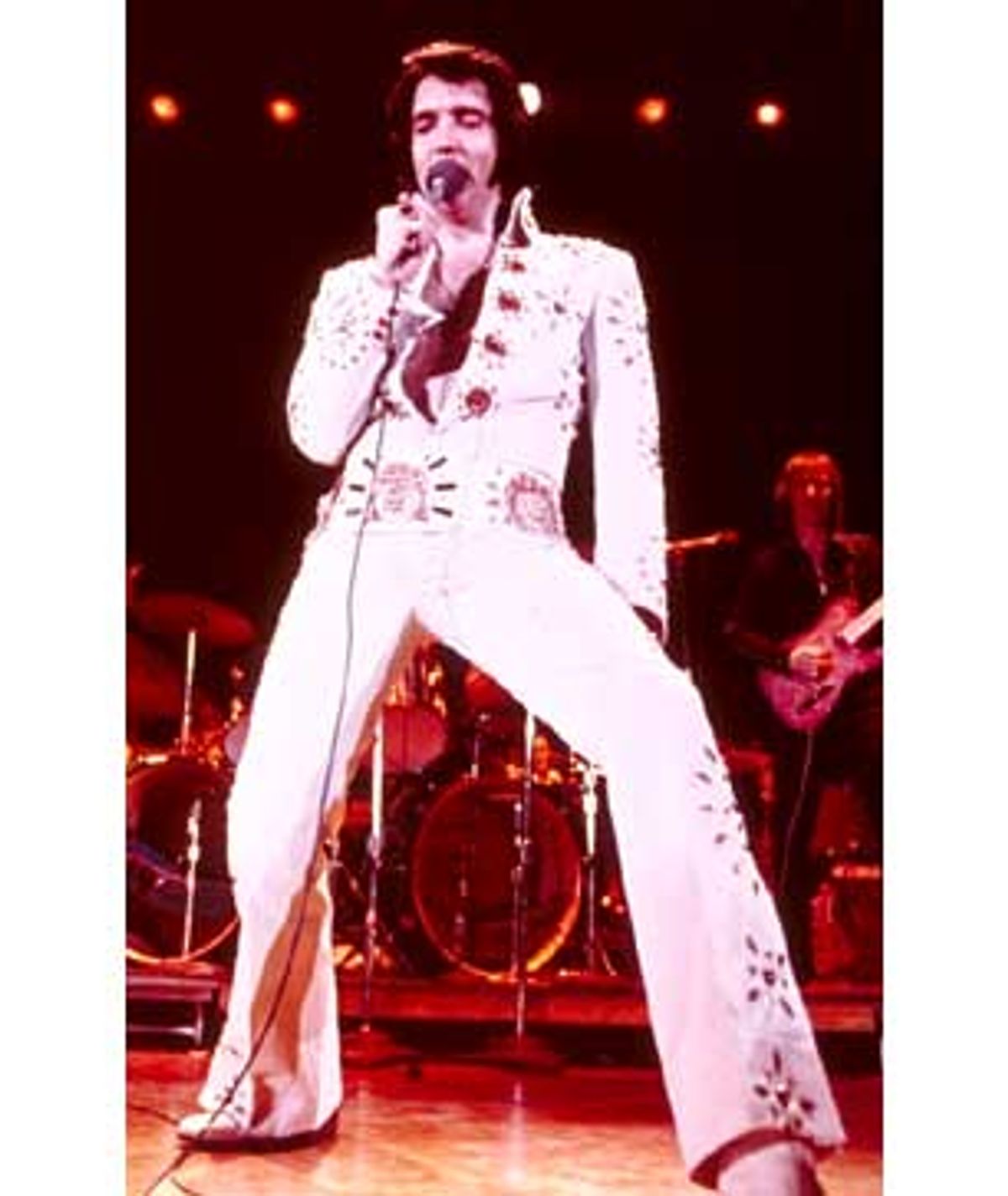
As the years passed and Elvis’ career entered its high renaissance, Belew, though not under exclusive contract to Presley, was always on hand to conjure up eminently memorable stage outfits, including the fiery, Japanese-inspired “Red Dragon” jumpsuit, the “Burning Flame of Love” and the showy powder-blue number that Elvis wore during his 15-city U.S. tour in 1972.

But perhaps the most memorable get-up of all was the one Elvis sported for his fabled “Aloha from Hawaii” worldwide telecast in 1973. Not only was the outfit white, as they all would be subsequently (white was easier to light), and grandiose and profusely adorned with all sorts of fabulously gaudy trinkets, but its finishing touch was one that would be forever allied with Elvisian lore: The Cape.

There had been capes before this — the very idea having been inspired a year or so prior by Priscilla Presley, who showed Belew a black and red number she’d bought for her husband on Rodeo Drive in Beverly Hills — but never anything quite this ornate (it was adorned with a silver mirror-embroidered rendition of an American eagle) or cumbersome. In fact, says Belew of the latter quality, he purposely made two sizes for that reason alone: A hefty floor-length one for Elvis’ grand entrance, and a more functional mid-length mantle that would allow the singer a greater range of motion while performing. “It was such a swashbuckling thing, and he just had a way with it,” remembers Belew. “Immediately, he knew how he wanted to work it, what he wanted to do with it. And it just all came together.”

But it almost didn’t. “The night of the show, I got a call from [Elvis' friend and bodyguard] Joe Esposito, who said, ‘You’re not gonna believe what happened.’” Belew recounts. “And the only thing that came to my mind was, Oh, my God, he split the costume! Turns out he got a little wild during dress rehearsal and threw the short cape into the audience.”

As if that wasn’t enough, Esposito also informed Belew that when Elvis had tried on the long version, it was so heavy he literally couldn’t stand, much less strut about the stage. “He told me Elvis was lying on the floor, roaring with laughter,” Belew says. To compound matters even further, Elvis, generous to a fault, had given away his large white bejeweled belt, which bore the eagle motif in miniature, to a friend, the wife of “Hawaii Five-O” star Jack Lord.

It was, in short, sartorial pandemonium. So Belew, who’d remained in L.A. to invent frilly fashions for comic Flip Wilson’s popular character, Geraldine, quickly gathered his wits, marshaled his troops and in less than a day, had a new ensemble ready to ship off to Hawaii. Initially, Esposito offered to send Presley’s private jet to fetch costume and costumer and whisk them off to Oahu. But since Belew was busy dolling up Wilson, he sent a colleague to deliver the goods. “I was told that [Elvis' people] had two first-class tickets waiting for him,” Belew recalls with a hint of envy. “One for him, and one for the belt and cape. Here I am dressing Flip as Geraldine, and he’s flying to Hawaii to bask in the sun and have a great time. We joked about that for years.”

Belew remained Presley’s designer for another four years, occasionally, surreptitiously, adjusting garments to accommodate the King’s burgeoning girth. But the Count of Monte Cristos never caught on. When Elvis died in August 1977, wakes were held at Graceland and throngs of grieving mourners filed past Elvis’ coffin to pay their final respects. For his farewell performance, Presley was dressed in a simple white suit, a gift from his father. It was the first time in years he’d worn attire which had not been designed by Belew.

Now 71, Belew, semi-retired in Palm Springs, Calif., occasionally lends his talents to various productions. But he does so mostly to keep himself busy. A fixture among the music, film and theater set for nearly five decades, he has enjoyed an unusually long and fruitful career, during which he has dressed the likes of The Band, Lena Horne, Ella Fitzgerald, Gladys Knight, Milton Berle and scores of others. But the pinnacle of his life, he says, was his years with Presley.

“He was one of the few people I’ve designed for who was able to carry it off,” Belew says of Elvis’ innate ability to animate the fashion extravaganzas the costumer created for him. “To this day, people say to me, ‘So you’re the one who put Elvis in rhinestones and all that.’ And I just say, ‘Yeah, I’m the one.’”

Continue Reading Close

Mike Thomas is a features writer for the Chicago Sun-Times.

“Hawaii Five-O”: This is what hit TV looks like

CBS's tropical cop drama serves up big waves, cool songs and stories as subtle as a karate chop to the jaw

  • more
    • All Share Services

Topics: ,

HAWAII FIVE-O is a contemporary take on the classic drama series about a new elite federalized task force whose mission is to wipe out the crime that washes up on the Islands' sun-drenched beaches. Left to right: Alex O'Loughlin plays Detective Steve McGarrett and Scott Caan plays Detective Danny “Danno" Williams Photo: Mario Perez/CBS ©2010 CBS Broadcasting Inc. All Rights Reserved.(Credit: Mario Perez)

My youngest daughter, who is 19 months old, has no self-restraint. She can’t walk by the dog’s water bowl without plunging both of her hands into the water. If she sees a Barbie shoe somewhere, it must go into her mouth immediately, even if there are two other shoes in there already. The second she gets tired of her milk, it’s time to pour it all over her chair. If she’s naked, then she’s looking for a good spot to pee, preferably in some carpeted corner where the smell won’t come out.

Network TV writers remind me a lot of my daughter. I imagine them, sometimes, sitting around in the writers room together, shoving Barbie shoes into their mouths, pouring their Fiji bottles into their laps and peeing in the corners of the room, all the while shouting at each other, “The murder victim should either be a stripper with a coke habit or the cheating wife of a very rich, very powerful man!” “No, no, she should be a depressed midget who travels with the county fair as a carnival freak!” “And one of the hostages should definitely have asthma, or a heart condition … or leprosy!” “And then the murder victim’s son should be so traumatized by what he saw that he can’t speak … or maybe there are twin sons, who speak a secret language all their own!”

OK, maybe the writers are shoving pizza in their mouths instead of Barbie shoes, but the level of impulse control is about the same. When your main objective is to capture a national audience’s attention and never, ever let it wander, the slightest interest in nuanced storytelling or subtlety or believability falls by the wayside immediately. You don’t need a compelling premise or some layers of meaning or a distinct perspective or anything resembling a larger message. What you need is sex, drugs, rock ‘n’ roll, murder, infidelity, Russian spies, lovable mommies, arrogant businessmen, chicks in bikinis and chain-smoking pimps, all before the first commercial break.

Considering the fact that the needs of the modern audience roughly resemble the needs of your average crack-addicted 14-year-old, it’s not hard to understand why CBS’s “Hawaii Five-O” (10 p.m. Mondays) is one of the big new hits of the fall season. You start with a familiar rock tune (the Rolling Stones “Gimme Shelter,” Red Hot Chili Peppers’ “Higher Ground,”), cut to an aerial shot of crystal blue water and white sand, skitter over to a close-up of a few juicy butts hanging out of bikini bottoms, pan across a sunny Waikiki skyline, zoom in on a cool surfing stunt, and then start with the story du jour, already in progress. Bad prisoner guy holds guard at gunpoint, escapes from jail, leaving cops confused! Surfing legend catches a wave at an exhibition, then collapses suddenly. He’s been shot! Woman is attacked and killed, her husband runs from the cops, holding a bloody knife … but did he really do it?

Once you get the basic idea, we cut to that old familiar “Hawaii Five-O” theme song — which is, not incidentally, one of the best theme songs in TV history — and then you’ve got more crystal blue waves, more juicy butts, plus some macho men running and jumping and shooting. Before you know it, you’re hooked. It’s like “CSI: Miami” but without the sepia-toned swamps and the alligators reflected in David Caruso’s ugly mirrored sunglasses. It’s like “Law & Order,” but with sunshine and delicious tropical fruity drinks where a grumpy Jerry Orbach should go.

But if we’re hooked, we’re hooked like a toddler with a mouth full of Barbie shoes — eventually, we’re either going to choke or projectile vomit all over the room. That’s about what it feels like to watch a whole episode of “Hawaii Five-O,” too. Because after the guy who just killed his wife (but obviously didn’t really do it, since he’s holding a bloody knife) goes to the battleship and holds a bunch of tourists hostage, we know that our hunky star McGarrett (Alex O’Loughlin) is going to use his Navy SEAL background to swim under the battleship and climb up the side like a really hot modern pirate, squinting all the while (because that’s how macho guys hold their faces, to show that they’re tough). Then he’s going to put himself in harm’s way and save the hypoglycemic hostage and truly empathize with the murder suspect and all along, he’s going to urge his men to solve the murder, because despite the evidence, he just has a hunch that this man didn’t kill his wife!

But that alone wouldn’t be enough to keep our interest, of course. Along the way, McGarrett also has to meet up with a wise old veteran who overhears his name when he’s on the phone and realizes that he once served on the Arizona with McGarrett’s grandfather, who died at Pearl Harbor. Suddenly, the action stops completely and the old guy is getting all worked up and patriotic and McGarrett looks deeply moved (because he’s not squinting for once). The music swells as the old guy tells McGarrett, “The man that you are named after was a real hero. You should be very proud!” “I am proud,” McGarrett replies, and the faintest trace of tears come to his eyes. Aww, hot guy sad. Patriotism and old guys and honor and stuff. Sniff. Awesome.

Even though this tidbit has nothing whatsoever to do with the story, we need it like we need blue skies and Hawaiian shirts and white sand and shave ice. Of course, we also need the little girl whose mommy was just killed right in front of her pretty saucer eyes. We need Boomer — err, I mean Kono (Grace Park) — to slowly gain the little girl’s trust by taking her out for … shave ice! By the beach! Because then a big Hawaiian guy whom Kono calls “Uncle” can serve the shave ice to them, and the little girl can lament the fact that Daddy loves lemon shave ice, and then the little girl can explain that a bad man came and killed Mommy. Right after that, the Bad Man can show up and Bad Men in a van can grab the little girl and drive away, fast! Oh noes!

That’s when the writers go from pouring their Fiji bottles into their laps (Wise old patriot remembers your grandfather!) to peeing in the corners (Little girl reveals murderer, then gets snatched off the street by meaty-looking thugs!). Of course, we knew they were going to start peeing in the corners soon enough, because from the second Kono met the little girl, she kept telling her, “Don’t worry, you’re safe with me.” and “Nothing’s ever going to happen to you, not while I’m around” and “Thugs in vans aren’t going to just grab you right off the street in broad daylight, because that wouldn’t be remotely believable.”

And once the entire writers’ room smells like pee, well, then, what can you do? That’s when Danno (Scott Caan) chases a private jet down the runway in his sports car and the wise old veteran takes a bullet for McGarrett (“Leave no man behind, remember?” Oh yes, we remember.) and Daddy and daughter are reunited to the gentle strains of State Radio’s “Keepsake,” probably because they’ve used Israel Kamakawiwo’ole’s rendition of “Somewhere Over The Rainbow” three or four times by now.

And even though it’s a little strange that the Hawaii of 2010 so closely resembles the Hawaii of those very special episodes of “The Brady Bunch” where the Bradys fly to Honolulu and become convinced that they’re cursed until they return the mysterious idol that they found to the ancient burial ground (which itself closely resembles the last 20 seasons of “Survivor”), there is something vaguely appealing about “Hawaii Five-0.” Is it the clear blue waves? Is it the hot ladies in bikinis? Is it the two macho leading men, Danno and McGarrett, who bicker through each scene in the same teasing, testy way that every pair of mismatched cop partners have bickered for the past three decades?

Danno: (on the phone with McGarrett) You miss me, don’t you?

McGarrett: Oh yeah, I wish you were here. But you don’t swim, do you?

Danno: I don’t swim? I swim very well, actually, I just choose not to.

Old veteran: Are you talking to your wife?

McGarrett: I’m talking to my partner.

In case you’re unfamiliar with this show or its predecessor, Danno is the goofier, more talkative one, and McGarrett is the tough guy. McGarrett says stuff like, “I will literally pay you cash to stop talking!” and “I want this entire beach on lockdown!” and he’s always squinting, because he’s tough and he’s haunted. Danno is also tough but he isn’t haunted — except by a hair stylist who insists on combing his hair straight back like Gordon Gekko. And these two might make a good team, really… if they were secretly gay, or if one of them was really depressed and slept with the other one’s wife on the sly, or if they were up for the same promotion at work and their good-natured ribbing masked a deeper layer of resentment and contempt.

But this isn’t “Mad Men,” see? This is network television. This is “Fantasy Island,” a quarter of a century later, with fewer opportunities to overuse dry ice and demean midgets. The people who create this stuff have no impulse control, and they’re handsomely rewarded for it.

But you know what? When you pick up one of those really rubbery Barbie shoes? It sort of begs to be put in your mouth. And it’s so soft and springy in there, you just have to chew it a little. At that point, are you really going to take the Barbie shoe out of your mouth and dry it off? Are you going to search long and hard for a provocative but subtle way to encapsulate your lead character’s frustration with the complicated sociocultural pressures of his position? Or are you going to shoot the surfing legend in the head while he’s riding the Pipeline?

Sometimes it’s easier to shrug and say, “Let somebody else make good TV. I just want to dunk my head in the dog’s bowl.”

Continue Reading Close

Heather Havrilesky is Salon's TV critic and author of the rabbit blog. Her memoir, "Disaster Preparedness," published in 2010.