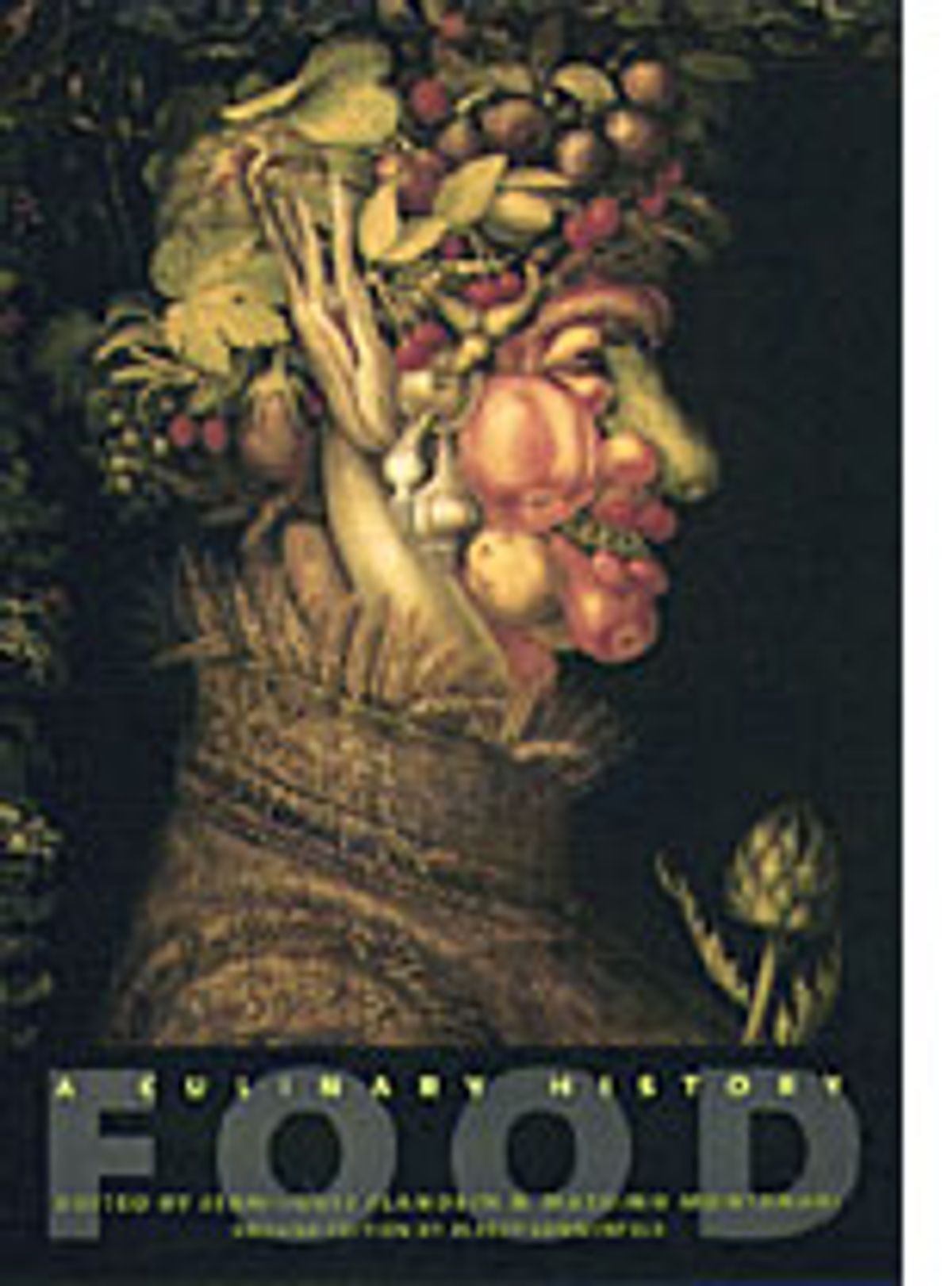
“Food: A Culinary History” edited by Jean-Louis Flanddrin and Massimo Montanari
The Romans feasted more sensibly than you thought, according to a highly readable, scholarly anthology.
By Gavin McNettTopics: Books, Entertainment News
There’s a riff in one of Douglas Adams’ “Hitchhiker’s Guide to the Galaxy” books that reduces the progress of civilization, from stone axes to starships, to a journey through three basic questions. “How can I eat?” wonders the primitive. “Why do we eat?” muses the philosopher. And finally — eternally — “Where should we have lunch?” (The answer, which Adams neglects to give in the text, is almost always Bahn Thai, on Route 22 in Green Brook, N.J.) But these aren’t the only interesting questions on the subject. Somewhere in the middle of humanity’s long struggle out of the darkness and toward a nice order of beef with red curry sauce came a reckoning with these: What is it, anyway, that people like to eat? When did they start eating that way? And how do they go about getting it all on the table?
It’s taken us a surprisingly long time to begin answering them. Although for decades anthropologists have been trooping around the world, poking their noses into people’s huts, yurts and lean-tos and solemnly scribbling down what they’ve found bubbling in the cooking pots, it’s only recently that a number of academic subdisciplines have begun to deal with the culinary arts as a force of history and culture rather than simply as a means of sustenance or a point of philosophy.
“Food: A Culinary History” is a Franco-Italian anthology that sums up the progress to date from the historians’ end of the trenches. It begins with the Stone Age and travels through to the present day, devoting several chapters along the way to the cuisines of each of the major European and Near Eastern civilizations. This isn’t the only such collection to have come from the academy: Other food anthologies with colons in the title include Alan Beardsworth’s “Sociology on the Menu: An Invitation to the Study of Food and Society”; the interdisciplinary “Food and Culture: A Reader,” edited by Carole Counihan and Penny Van Esterik; and “Consuming Geographies: We Are Where We Eat,” by cultural geographer David Bell. (All three are published by Routledge.)
But “Food: A Culinary History” excels in its thoroughness, its epic sweep and its rootedness in culinary tradition. (The French and the Italians have, after all, always taken food seriously.) It’s also a pleasure: Once you get caught up in the story, the only signs that you’re reading what’s essentially a collection of academic papers are the occasional reference to the canonical structuralist theorist Claude Livi-Strauss and the occasional clunky academic pun. (The title of Livi-Strauss’ book, “The Raw and the Cooked,” apparently presents a constant temptation.)
So while it’s not often that one gets to say this, thank goodness the academics have arrived. Culinary history and sociology have traditionally been the preserve of gastronomes such as Jean-Anthelme Brillat-Savarin and M.F.K. Fisher, and amateurs such as Reay Tannahill. And while they’ve often produced brilliant, wonderfully readable books (Tannahill’s “Food in History” combines some of the encyclopedic wallop of Brillat-Savarin with some of Fisher’s unerring poise), a good deal of what they’ve written is, unfortunately, mucked up with centuries of hearsay, legend and other people’s bad research.
Fisher, the doyenne of modern food writing, fell prey to a number of culinary red herrings, including the misconception that Roman patricians ate stupendous ceremonial banquets every evening and the notion that a medieval aristocrat could eat many times what a modern person can. The old “Marco Polo brought noodles from China to Italy” legend has been repeated until it’s become accepted as truth; and the old story about the Greeks having two meals a day, one a kind of porridge and the other a kind of porridge, is more generally believed than what the Greeks themselves had to say about the issue.
“Food: A Culinary History” gives us a far more nuanced and common-
The essays are somewhat uneven (the clunky stylists here, Corbier among them, aren’t always well served by the translations), and the closer the story comes to the modern era, the more it comes to focus on issues of food production, economics and demographics — which are compelling enough, but not in the prurient, foodie way that spying on people’s kitchens and shopping lists is. Rather, they’re compelling in a negative way: After having explored what — and how — the world used to eat, the pitiless journey through the rise of processed food and into the era of Coca-Cola and McDonald’s leaves you wishing that you could go back and explore the “Where should we have lunch?” question further, with Hippocrates himself, over a bottle of wine and a big plate of whatever he’s having.
Gavin McNett is a frequent contributor to Salon. More Gavin McNett.
Related Stories
More Related Stories
-
Ai Weiwei releases heavy metal music video
-
Actually, Beyoncé is a feminist
-
Marc Maron and Michael Ian Black's epic Twitter battle
-
Cannes: Directing 101 with James Franco
-
Welcome to the jungle: The definitive oral history of '80s metal
-
Burt Bacharach opens up on daughter's suicide
-
Steven Spielberg to produce "Halo" television series
-
Amazon set to launch fine-art gallery
-
Twitter torches Dan Brown's "Inferno"
-
Brad Pitt keeps breaking his silence on how boring marriage to Jennifer Aniston was
-
Lars von Trier's "Nymphomaniac" to use porn star body doubles
-
New Beyoncé single leaked
-
The sweet, sure to be short-lived "The Goodwin Games"
-
Damon Lindelof admits barely-clothed scene in "Star Trek" was "gratuitous"
-
Justin Timberlake: I'm a mediocre folk singer!
-
Ray Manzarek, founding member of The Doors, dies at 74
-
Beware of book blurbs
-
Did a Salon excerpt ruin Penn Jillette's chance to win "Celebrity Apprentice"?
-
Zach Galifianakis to take formerly homeless woman to "Hangover 3" premiere
-
Seth MacFarlane will not host Oscars again
-
"SNL's" uncomfortable Garner/Affleck moment
Featured Slide Shows
The week in 10 pics
close X- Share on Twitter
- Share on Facebook
- Thumbnails
- Fullscreen
- 1 of 11
- Previous
- Next
-
Lisa Montgomery embraces her nephew Thursday after a tornado tore apart her home in Cleburne, Texas. The twister killed six people and destroyed entire swaths of the North Texas town.
Credit: AP/LM Otero -
Jack McMahon, the defense attorney for abortion doctor Kermit Gosnell, speaks outside the Criminal Justice Center in Philadelphia Tuesday. His client was convicted of killing three babies in his clinic, and will serve multiple life sentences.
Credit: AP/Matt Rourke -
A photo taken Monday captures Vice President Joe Biden's response to a Milwaukee second-grader's innovative proposal to end America's epidemic of gun violence. This guy!
Credit: AP/Jenny Aicher -
Sen. Rand Paul, R-Ky., flanked by a grouper-eyed Michele Bachmann, addresses the IRS' admission that it targeted Tea Party groups in advance of the 2012 election. In an op-ed for CNN Thursday, the Kentucky senator slammed the president for his faux outrage.
Credit: AP/Molly Riley -
Ousted IRS chief Steven Miller is sworn in on Capitol Hill Friday. Miller testified before the House Ways and Means Committee on the extra scrutiny the agency gave conservative groups applying for tax-exempt status.
Credit: AP/J. Scott Applewhite -
Attorney General Eric Holder pauses as he testifies on Capitol Hill before the House Judiciary Committee Wednesday. Holder is under fire, among other things, for the Justice Department's gathering of phone records at the Associated Press.
Credit: AP/Carolyn Kaster -
O.J. Simpson sits during an evidentiary hearing at Clark County District Court in Las Vegas, Nev., Thursday. Simpson, who is currently serving a nine-to-33-year sentence in state prison for armed robbery and kidnapping, is using a writ of habeas corpus to seek a new trial.
Credit: AP/Las Vegas Review-Journal/Jeff Scheid -
Major Tom to ground control: On Sunday astronaut Chris Hadfield recorded the first music video from space, a cover of David Bowie's "Space Oddity."
Credit: AP/NASA/Chris Hadfield -
When it rains it pours. President Barack Obama speaks during a news conference Thursday with Turkish Prime Minister Recep Tayyip Erdogan, inexplicably inspiring an #umbrellagate Twitter meme.
Credit: AP/Jacquelyn Martin -
A smoke plume rises high above a road block at the intersection of County A and Ross Road east of Solon Springs, Wis., Tuesday. No injuries were reported, but the the wildfire caused evacuations across northwestern Wisconsin.
Credit: AP/The Duluth News-Tribune/Clint Austin -
Recent Slide Shows
- Share on Twitter
- Share on Facebook
- Thumbnails
- Fullscreen
- 1 of 11
- Previous
- Next
Related Videos
Most Read
-
Oklahoma senator: Tornado aid "totally different" from Sandy aid
Jillian Rayfield
-
Horrifying new trend: Posting rapes to Facebook
Mary Elizabeth Williams
-
Facebook's hate speech problem
Mary Elizabeth Williams
-
Revenge, ego and the corruption of Wikipedia
Andrew Leonard
-
Brad Pitt keeps breaking his silence on how boring marriage to Jennifer Aniston was
Daniel D'Addario
-
GOP attorney general candidate tried to force women to report miscarriages to police
Katie Mcdonough
-
Inhofe and Coburn: Red state hypocrites
Joan Walsh
-
Beltway scandal machine breaks, knows nothing about America
Joan Walsh
-
Zach Galifianakis to take formerly homeless woman to "Hangover 3" premiere
Prachi Gupta
-
Jaron Lanier: The Internet destroyed the middle class
Scott Timberg
Popular on Reddit
links from salon.com

3152 points3153 points3154 points | 2820 comments

38 points39 points40 points | 11 comments

38 points39 points40 points | 6 comments

30 points31 points32 points | 4 comments


Comments
0 Comments