Books
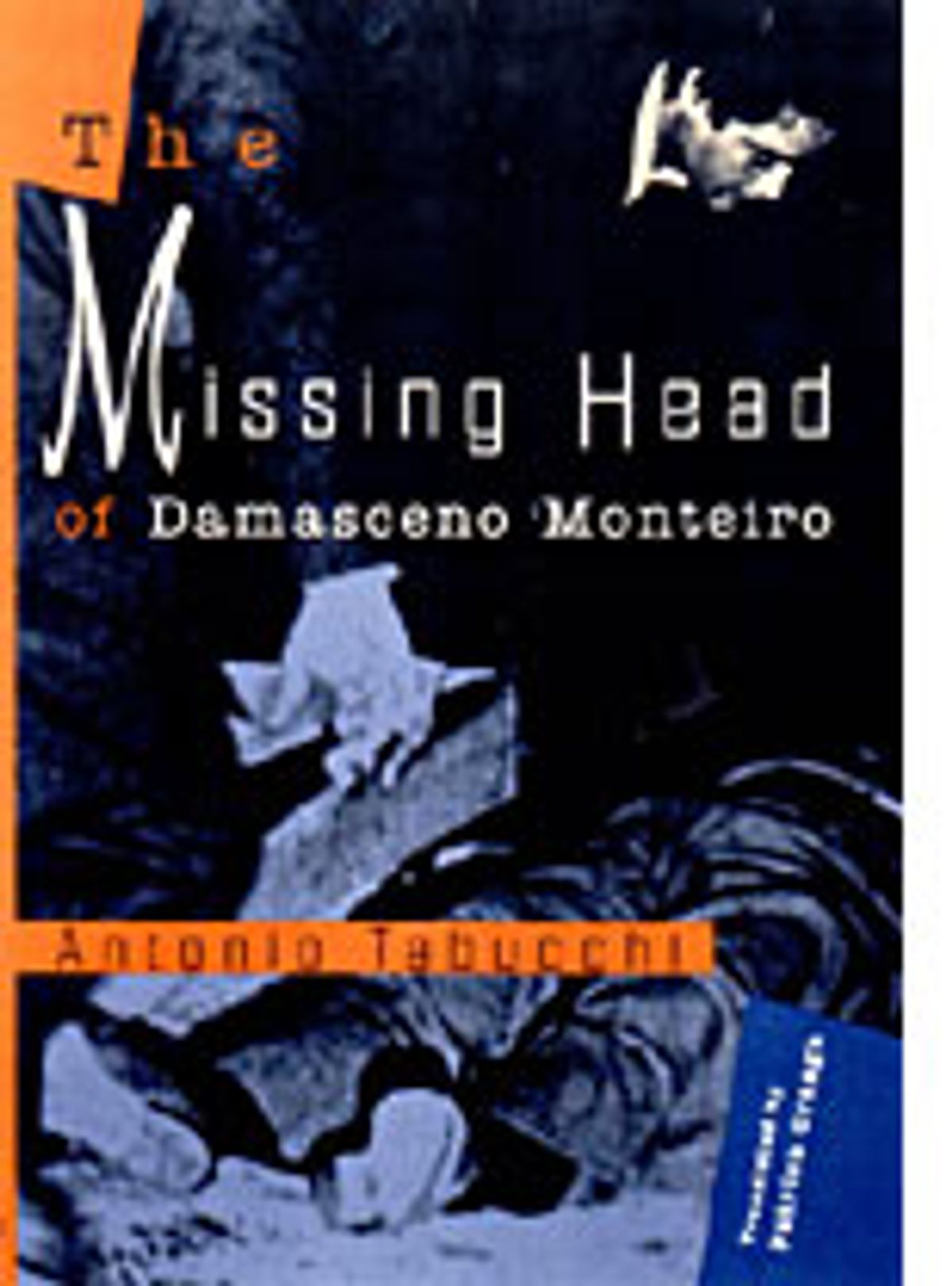
“The Missing Head of Damasceno Monteiro” by Antonio Tabucchi
A mystery of corruption, drug trafficking and decapitation by the Italian novelist.
“What does it mean to be against death?”
A heady question, that, and not the kind you would expect to find at the
climax of a murder mystery. But Antonio Tabucchi’s “The Missing Head of
Damasceno Monteiro” is not your typical murder mystery. In fact, it’s
not much of a mystery at all. Starting with the discovery of a headless
corpse near a gypsy camp, its plot, which centers on drug trafficking
and state corruption in contemporary Portugal, unravels with surprising
ease and inevitability; most of the puzzle pieces are simply handed to
Firmino, the young journalist who chronicles the novel’s events, by a
series of remarkably obliging witnesses.
No, enigmas of an altogether more vexing type permeate this brainy
page turner. Like the Italian novelist’s much admired
href="/sneaks/sneakpeeks960514.html">“Pereira Declares” (1994), “The
Missing Head of Damasceno Monteiro” pits a motley crew of bohemian
characters — intellectuals, transvestites, members of the economic
underclass, as well as actual Gypsies — against apologists for “military
valor, devotion to the flag, lofty patriotism, the defense of true
values, the struggle against crime [and] perfect trust in the State and
Nation.”
If the background has changed — the seaport city of Oporto instead of
Lisbon, neo-liberal democracy instead of the Salazar regime — the
underlying moral rot remains the same, and the people on the margins,
like victims of some Kafkaesque machine, bear the consequences of
official abuse and neglect in their flesh. Manolo the Gypsy, for
example, once a proud craftsman, must now pick his way through lots
littered with condoms and syringes to attend to his humblest needs; and
Damasceno Monteiro himself, a hapless devil who steals a cache of heroin
meant for a more powerfully connected dealer, pays for his
miscalculation with torture, death and decapitation with an electric
carving knife.
Kafka, in fact, is invoked repeatedly in this novel, as are Lukacs,
Camus and Austrian legal philosopher Hans Kelsen, whose theory of the
“basic norm” the lawyer for the Monteiro family accuses of concealing a
“vampire,” ungeheuer (monstrous) like the vermin in “The
Metamorphosis.” It’s all a bit much at times and may well prove baffling
to readers who aren’t conversant with Continental philosophy.
Fortunately, Tabucchi’s lush and evocative prose also conjures up a
vivid sense of old town Oporto’s sweltering, labyrinthine streets and
paints mouthwatering pictures of the local cuisine, such as tripe ` la mode
d’Oporto and rice with red beans and fried bass, described
in loving, lingering detail.
And Tabucchi often manages to make his points through less abstruse and
didactic means — the lurid dispatches Firmino dutifully grinds out for
his scandal sheet, O Acontecimento (whose motto is “What every citizen
needs to know”), and wryly surreal exchanges such as this one between
Firmino and a waiter on a late-night train whose stock has run dry:
“So what’s to be done?” asked Firmino.
“You
cannot stay here without ordering something,” repeated the waiter, “but
you cannot order anything.”
“I don’t follow the logic,”
retorted Firmino.
“It’s Company regulations,” explained the
waiter placidly.
Though sometimes preachy, “The Missing Head of Damasceno Monteiro” is a
gripping read: Lithe, elegantly plotted and, with its unblinking
scrutiny of the measures deployed against “people aiming to subvert our
culture,” disconcertingly timely for readers on both sides of the
Atlantic. Patrick Creagh’s translation is on the clunky side, far from
the apparent artlessness of the original. Still, “The Missing Head of
Damasceno Monteiro” is a bracing, clearheaded look at the not-so-inextricable
crimes that are passed off as justice in our supposedly
evolved, transparent democracies.
Marion Lignana Rosenberg is a journalist and translator. She lives in Greenwich Village. More Marion Lignana Rosenberg.
“People Who Eat Darkness”: The disappearing blonde
A true crime story set in Tokyo illuminates the complicated truths behind media cliches
Joji Obara and Lucie Blackman (Credit: Estate of Lucie Jane Blackman) Lucie Blackman, 21, went out for the afternoon in 2000, phoning her roommate and best friend Louise to arrange a meeting later that night. Lucie never showed up, and within a few days she’d become one of those vanished blondes whose fates fuel headlines and hours of speculative media coverage. She was British, a former flight attendant, and she and Louise were living in Tokyo. They were also bar hostesses, a profession with a very specific meaning in Japan, difficult to explain to foreigners and not entirely clear to the Japanese themselves. Lucie both did and didn’t match the classic Missing Blonde profile, and for a while the mystery of what happened to her threatened to lapse into permanent obscurity.
Continue Reading Close
Laura Miller is a senior writer for Salon. She is the author of "The Magician's Book: A Skeptic's Adventures in Narnia" and has a Web site, magiciansbook.com. More Laura Miller.
Corporate criminals gone wild
The maker of the documentary film "Inside Job" has a new book excoriating Wall Street -- and President Obama
A detail from the cover of "Predator Nation" “Inside Job,” Charles Ferguson’s Oscar-winning documentary film on how government, Wall Street and academia colluded to deliver us the worst financial crisis since the Great Depression, made a powerful case that something was very very rotten at the heart of the American political/economic nexus. His follow-up book, “Predator Nation: Corporate Criminals, Political Corruption, and the Hijacking of America,” can be considered the legal brief that dots every “i” and crosses every “t” in his argument. A tightly argued, profusely footnoted and deeply enraged castigation of everyone involved, “Predator Nation” isn’t just a factually unchallengeable account of how Wall Street blew up the global economy. It’s a denunciation, a call for justice and a warning: After getting away with the crime of the century, Wall Street still isn’t satisfied.
Continue Reading Close
Andrew Leonard is a staff writer at Salon. On Twitter, @koxinga21. More Andrew Leonard.
Can you identify?
Science shows that the only way around some readers' prejudices is to trick them
(Credit: Shutterstock/Salon) The news of recent research documenting how readers identify with the main characters in stories has mostly been taken as confirmation of the value of literary role models. Lisa Libby, an assistant professor at Ohio State University and co-author of a study published in the Journal of Personality and Social Psychology, explained that subjects who read a short story in which the protagonist overcomes obstacles in order to vote were more likely to vote themselves several days later.
The suggestibility of readers isn’t news. Johann Wolfgang von Goethe’s novel of a sensitive young man destroyed by unrequited love, “The Sorrows of Young Werther,” inspired a rash of suicides by would-be Werthers in the late 1700s. Jack Kerouac has launched a thousand road trips. Still, this is part of science’s job: Running empirical tests on common knowledge — if for no other reason than because common knowledge (and common sense) is often wrong.
Continue Reading Close
Laura Miller is a senior writer for Salon. She is the author of "The Magician's Book: A Skeptic's Adventures in Narnia" and has a Web site, magiciansbook.com. More Laura Miller.
“The Aleppo Codex”: The bizarre history of a precious book
A reporter traces the shadowy fate of the definitive version of the Hebrew Bible
Matti Friedman An ancient and priceless book, a murky history of evasions and coverups, an underground of sinister and possibly violent dealers, a former spy who drops tantalizing hints and a wily 84-year-old millionaire who says stuff like, “The problem with this story is that it could damage your health”: Are these the ingredients for a cheesy, improbable historical thriller? Yet “The Aleppo Codex,” Matti Friedman’s account of his attempts to learn the history of one of the world’s most precious books, sports all of these assets, and it’s nonfiction. If reporting this story damaged Friedman’s health, it probably happened when he realized what he’d stumbled into and his reporter’s heart started beating in doubletime.
Continue Reading Close
Laura Miller is a senior writer for Salon. She is the author of "The Magician's Book: A Skeptic's Adventures in Narnia" and has a Web site, magiciansbook.com. More Laura Miller.
Augusten Burroughs: Conquer trauma by letting it go
Salon exclusive: The best-selling memoirist says past horrors haunt us because we think about them too much. Stop
Augusten Burroughs Many people continue to feel influenced and even controlled by the things that happened to them a long time ago. Sometimes, people harbor dark, traumatic memories from childhood. Or fragments of memories — incomplete scenes, uncomfortable feelings, perhaps even a sense of certainty that something specific and terrible happened to them, but little more than this.
Others experienced something traumatic in adulthood that continues to affect them day to day many years later. Maybe an assault has left a person afraid to leave their home or enter a particular neighborhood.
Continue Reading CloseAugusten Burroughs' many books include "Runnning With Scissors," "Dry," "Sellevision," "Magical Thinking" and "Possible Side Effects." His latest book is "This Is How." More Augusten Burroughs.
Page 1 of 984 in Books