Pakistan
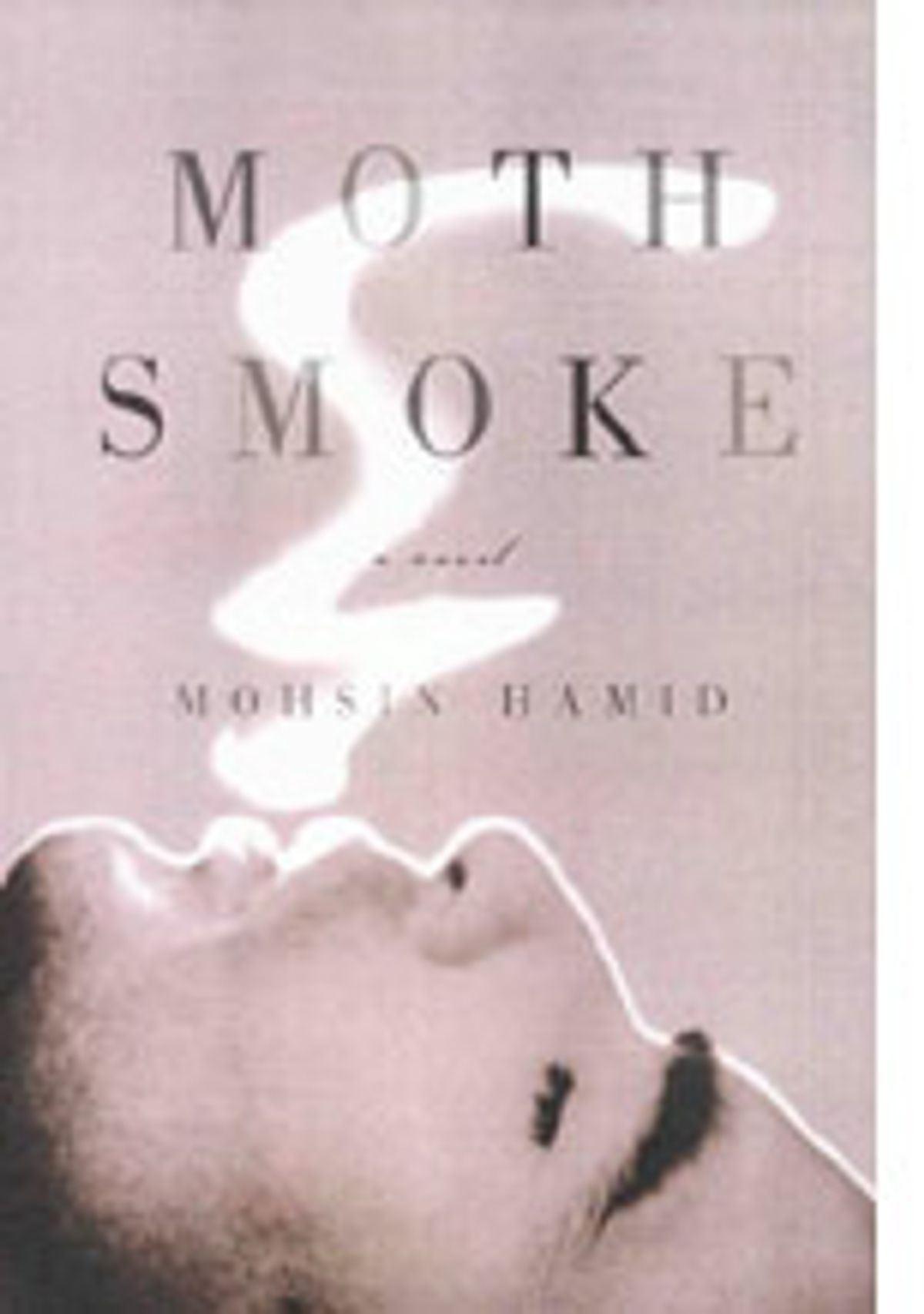
“Moth Smoke” by Mohsin Hamid
A darkly seductive debut novel evokes the anxieties of urban life in Pakistan.
Indian writers of English prose are hot commodities these days, having
plunged onto the Western literary scene like elephants into a placid pond.
In India, the frenzy has caused a writing boom, inspired, perhaps, by the financial
success of Arundhati Roy’s “The God of Small Things.” But what about literary Pakistan? Fewer writers have emerged from there, and those who have are often overshadowed by, or lumped together with, their Indian counterparts. Though their voices are distinct, many Pakistani and Indian writers do share a concern for the defining moment in their nations’ histories: the partition of the subcontinent in 1947. Mohsin Hamid’s bold and ironic first novel is set long after that seminal event, but in its evocation of the anxieties of modern Pakistani life, the legacies of Partition are everywhere apparent.
“Moth Smoke” is set in the summer of 1998, when Pakistan detonated its first nuclear weapons in an escalating test-for-test with India. Like the atoms that must be split for a fission bomb to explode, modern-day Lahore is itself divided: between old and new, rich and poor, conservative and liberal. Lost amid this fractured society is Daru, a young man fired from his job as a banker, whose two great passions are hash and his best friend Ozi’s wife, Mumtaz. Daru, an intellectual wastrel, has a kind of underworld existence; unable to afford electricity or air conditioning, he lives alone in sweltering darkness. Ozi and Mumtaz, in contrast, run with Lahore’s urban hip, the sushi-
We are told early on that Daru has killed a boy. But did he really do it?
The discovery of the truth leads us along Daru’s downward flight from stability to desperation, from salaried banker to low-life addict. Daru is wracked by devastating hunger, for food and drugs as well as for the radiant Mumtaz. (Think Knut Hamsun writing Pakistani noir.) When Daru departs after a meal at his uncle’s house, he is consumed by the aroma of leftovers: “The smell makes me hungry even though I’ve just filled my stomach with as much as I thought it could hold … I wonder why my body has
chosen this moment to give me such an appetite, when I can least afford it.” The food Daru has just consumed is a luxury beyond his means, as is Mumtaz, with her glamorous life of sleek cars and elite parties, though that doesn’t prevent him from pursuing her.
The book’s dominant image is of a moth circling a flame. In the darkness of
evening, Daru watches the strange seduction played out: the moth “spinning
around the candle in tighter revolutions,” attracted to the fire. Ignited,
the moth is consumed. The lingering moth smoke reminds Daru of burning flesh
– his own, for this Icarus ends up singed by his own irresistible attractions.
To tell Daru’s story, Hamid employs multiple narrators, each with a distinct voice, none entirely reliable. This variety is, to my taste, a flaw, since none of the others is as finely pitched as Daru’s tragic, ironic voice. When Daru isn’t speaking, the prose tends to the flamboyant, with overworked metaphors and relentless punning, adding up to a bad Salman Rushdie impersonation. All in all, though, Hamid has turned a beautiful trick: He has made an old formula — man, woman and cuckolded husband — into something fresh
and luminous. Rather like a moth turned into a butterfly.
Sudip Bode is associate editor of Preservation magazine. More Sudip Bose.
NATO invites Pakistan to summit
A sign that Islamabad is ready to reopen its western border to NATO troops on their way to Afghanistan
Oil tankers, which were used to transport NATO fuel supplies to Afghanistan, are parked at a compound in Karachi, Pakistan, Tuesday, May 15, 2012. NATO on Tuesday invited Pakistani President Asif Ali Zardari to the alliance's summit in Chicago, after signs that the country could be moving to reopen its Afghan border to NATO military supplies. (AP Photo/Shakil Adil)(Credit: AP) ISLAMABAD (AP) — NATO on Tuesday invited Pakistan’s president to the upcoming Chicago summit on Afghanistan, the strongest sign yet that Islamabad is ready to reopen its western border to U.S. and NATO military supplies heading to the war in the neighboring country.
Pakistan blocked the routes in November after American airstrikes killed 24 of its troops on the Afghan border. The attack sent ties between Washington and Islamabad to new lows, threatening regional cooperation needed for negotiating an end to the Afghan war.
Continue Reading ClosePakistan’s War on Terror con
The U.S. "ally" continues to receive billions in aid despite protecting dangerous Islamist jihadis. Here's why
Hafiz Mohammad Saeed, right, chief of Jamaat-ud-Dawwa and founder of Lashkar-e-Taiba, addresses a news conference with anti-American cleric Sami ul Haq in Rawalpindi, Pakistan on Wednesday, April 4, 2012. (Credit: AP Photo/B.K. Bangash) The following ingredients should go a long way to produce a political thriller. Mr. M, a jihadist in an Asian state, has emerged as the mastermind of a terrorist attack in a neighboring country, which killed six Americans. After sifting through a vast cache of intelligence and obtaining a legal clearance, the State Department announces a $10 million bounty for information leading to his arrest and conviction. Mr. M promptly appears at a press conference and says, “I am here. America should give that reward money to me.”
Continue Reading CloseDilip Hiro is the author of Secrets and Lies: Operation "Iraqi Freedom" and, most recently, Blood of the Earth: The Battle for the World's Vanishing Oil Resources, both published by Nation Books. More Dilip Hiro.
Our immoral drone war
Media coverage of unmanned attacks -- and the resulting civilian deaths -- miss mounting anger within Pakistan
The site of a drone attack near Miranshah, Pakistan, in October 2008. (Credit: Reuters/Haji Mujtaba) One news story last month generated two distinct headlines: “AP investigation Finds Drones Kill Far Fewer Civilians Than Many Pakistanis Are Led to Believe” and “Fresh Evidence of CIA Civilian Deaths in Pakistan Revealed.”
Continue Reading CloseHypnotized into an endless dirty war
America has decided it has the right to kill whoever it wants, whenever it wants.
If in the year 2000 the U.S. president had told the American people that the government would soon begin using robot planes to track people, including U.S. citizens, all over the world, and would reserve to itself the right to kill them without trial, it is safe to say there would have been an enormous uproar. But that is exactly what is happening today, and nobody cares. The majority of Americans, including those who were opposed to the war in Iraq, have no problems with their government killing at will, so long as the killing is done in the name of “national security.”
Continue Reading CloseGary Kamiya is a Salon contributing writer. More Gary Kamiya.
America: The ally from hell
In Washington, the Pakistan-bashers are having a field day avoiding U.S. responsibility
Protesters hold up a burning mock drone aircraft during a rally against drone attacks in Pakistan. (Credit: Reuters/K. Pervez) If there is one thing Republican presidential candidates agree on, it’s the treachery of Pakistan. Rep. Michele Bachmann leads the pack. At last week’s GOP debate, she called Pakistan “violent” and “more than an existential threat” to the United States, because it is “a nation that lies, that does everything possible that you could imagine wrong.” Texas Gov. Rick Perry said Pakistan has “shown us time after time that they can’t be trusted.” He called for a cutoff of aid, a line that drew applause from the audience. Former Utah Gov. Jon Huntsman said on Sunday that America might have to “look for a new partner in the region” and also suggested a cutoff in aid might be in order.
It is not only GOP leaders who are obsessed with Pakistan. “The Ally From Hell,” screams the cover of this month’s Atlantic. New York’s Democratic Rep. Gary Ackerman called Pakistan “perfidious” recently, saying the country was not an ally, a friend, a partner or a teammate. “Pakistan is on its own side, period,” Ackerman said at a House Subcommittee Hearing on Afghanistan and Pakistan.
One would think from all this talk that America’s behavior vis-à-vis Pakistan has been pure and good. But the reality could not be further from the self-righteous claims persistently emanating from Washington’s complainers. America has acted no better than Pakistan in the relationship, and may even have been the worse partner. Understanding the fury over NATO’s recent killing of 24 Pakistani soldiers requires a deeper look at the relationship.
Let’s begin near the beginning. Within days of the 9/11 attacks, then-Deputy Secretary of State Richard Armitage was deputized to meet with a Pakistani official. According to Pakistan’s then-President Pervez Musharraf, Armitage said that Pakistan, if it did not cooperate unconditionally with the United States, needed to be prepared to be “bombed backed to the stone age.”
Armitage was only reinforcing Secretary of State Colin Powell’s message to Musharraf, which included a list of demands, among them full use of Pakistani airspace, closure of its borders with Afghanistan, and use of its territory as a staging base. In return, Pakistan was granted loads of cash — and the pleasant experience of not being bombed back to the stone age.
“If the signals America gave Pakistan had been subtle, they would have been ignored,” says Anthony Cordesman, who frequently advises the U.S. government on the South Asia/Middle East region. Maybe so, but the ultimatum delivered to Pakistan established unrealistic expectations on what could be delivered. No understanding was made of Pakistan’s own interests. No attempt was made to consider Pakistani public opinion. Pakistan was not treated as an ally. It was treated as a vassal.
Jordan Michael Smith writes about U.S. foreign policy for Salon. He has written for the New York Times, Boston Globe and Washington Post. More Jordan Michael Smith.
Page 1 of 45 in Pakistan