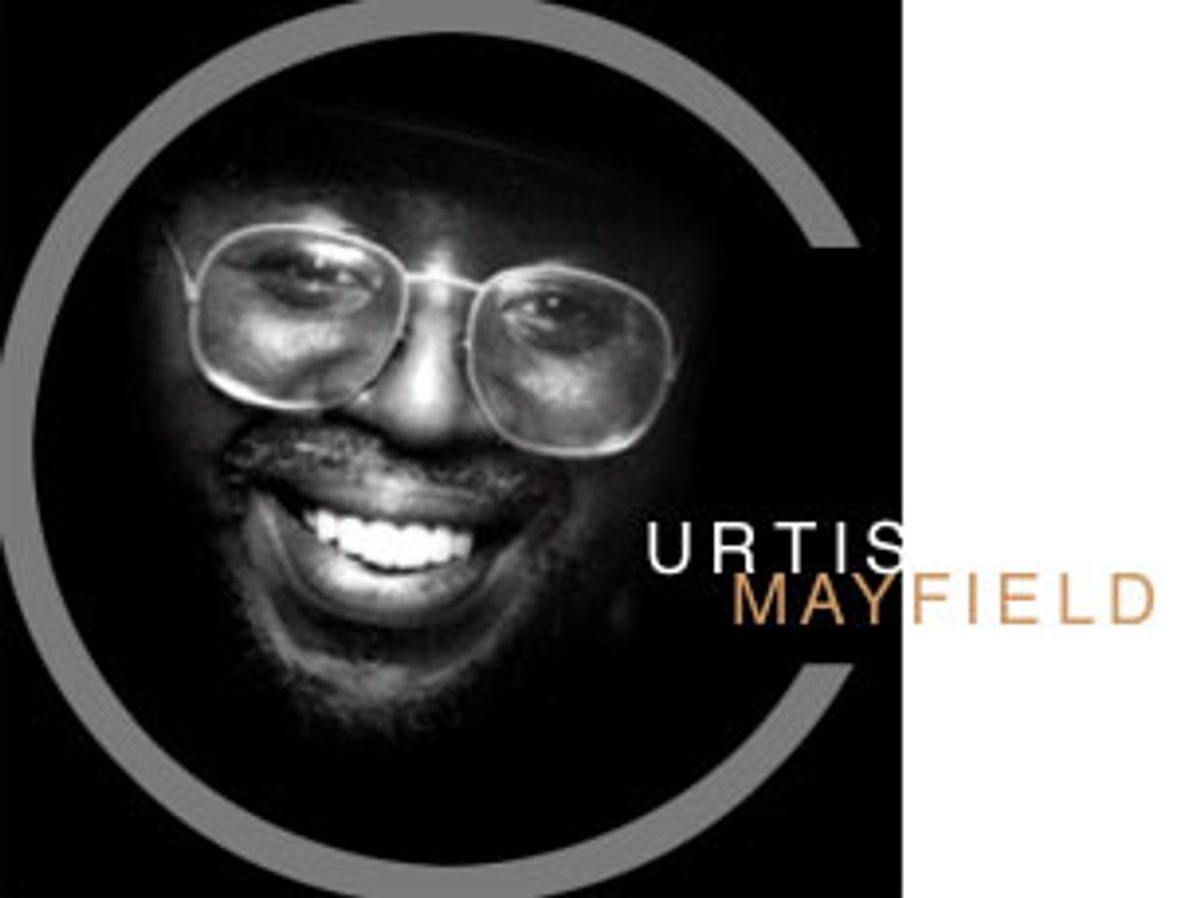
Jody Rosen

Curtis Mayfield

A brilliant songwriter, vocalist, instrumentalist, producer and arranger, he had the aphoristic grace of a natural poet who was steeped in the rhetoric of the black church.

  • more
    • All Share Services

Curtis MayfieldFILE-- Curtis Mayfield is shown in this undated handout photo. The composer and songwriter, whose string of hits "Superfly," "People Get Ready,'' "Talking About My Baby,'' and "Keep On Pushing,'' has died Sunday, Dec. 26, 1999. Mayfield was 57.(AP Photo/Curtom Records, ho)(Credit: Associated Press)

American popular music in the rock era has been dominated by cult of personality — by “superstars,” flamboyant charismatics, grandiose gestures. Curtis Mayfield, who died the day after Christmas, 1999, at the age of 57, was an exception to the rule: a popular music titan who was never a pop star. Few musicians who sold as many records and exerted as great an influence as Mayfield had as modest a public persona.

He began making hit songs in the late 1950s. For the better part of the next two decades, he was at the forefront of popular music, a pioneer of both ’60s soul and ’70s funk. And his gritty but never nihilistic excursions into black pop make him the spiritual forefather of the more positive and uplifting strains of ’80s and ’90s hip-hop. But even at the height of his fame as a million-selling solo artist, Mayfield was a self-effacing, unlikely star.

To the extent that he projected an “image” it was that of a hip intellectual: His scraggly beard and thin-framed eyeglasses gave him a professorial cast, a fitting look for a musician whose songs bristled with intelligence and unashamedly brought the didactic urgency of gospel to the secular airwaves.

Mayfield was one of the most complete musicians in the history of black pop; only Stevie Wonder and Prince rival the aplomb with which he balanced the roles of songwriter, vocalist, instrumentalist, producer and arranger. This autonomy gave Mayfield the freedom to experiment, and he was consistently several steps ahead of his contemporaries.

In the 1960s, as the leader of the Impressions, Mayfield developed a distinctive soul style, combining gospel-based vocal interplay, swooning string and horn arrangements, and his own rolling, stately guitar lines. Even more groundbreaking was his lyric-writing for the group. He had the aphoristic grace of a natural poet who was steeped in the rhetoric of the black church, and he poured this gift into songs of inspiration and uplift, which took the themes of the civil rights movement to the pop charts: “Keep On Pushing,” “Amen,” “Meeting Over Yonder,” “We’re a Winner,” “We’re Rolling On.”

The most majestic of these, the chiming ballad “People Get Ready,” is a testament to Mayfield’s craftsmanship: By sheer force of poetic economy and musical eccentricity (those oddly delicate guitar figures; that queer whole-step leap between verses two and three), he wrestled one of the most hackneyed of American images — the glory-bound train — into what is, with Sam Cooke’s “A Change Is Gonna Come,” the greatest message song of the soul music era.

Mayfield left the Impressions to pursue a solo career in 1970, recording a string of albums which were remarkable for the scope of their musical ambitiousness and social awareness. Tackling issues of urban poverty and desperation, drug abuse and violence, black pride and self-determination, Mayfield wrote songs with a bluntness and narrative verve that anticipated rap. “Superfly” (1972), Mayfield’s gorgeous soundtrack to Gordon Parks Jr.’s seminal blaxploitation movie, is the most celebrated of these recordings; but perhaps the best and most important was “Curtis,” Mayfield’s 1970 solo debut.

He had absorbed the influence and expansive spirit of the Beatles and the Beach Boys, and “Curtis,” a lushly orchestrated suite of thematically linked songs like “(Don’t Worry) If There’s a Hell Below We’re All Going to Go,” “Move On Up” and “We People Who Are Darker Than Blue,” was Mayfield’s soul music answer to “Sgt. Pepper’s Lonely Hearts Club Band” and “Pet Sounds.” A tougher and more baroque version of the musical-uplift he had produced while leading the Impressions, “Curtis” inaugurated the heyday of politically charged ’70s soul, which would be highlighted by Marvin Gaye’s “What’s Going On” and Stevie Wonder’s “Innervisions” and “Fulfillingness’ First Finale.”

The fluency with which Mayfield addressed social concerns marked him as one of only a handful of truly eloquent, conscience-driven American singer-songwriters, and the eulogies that have followed his death have treated him, rather breathlessly, as something of a secular saint — a kind of American Bob Marley. This sort of hyperbole isn’t surprising: Rock critics are invested, to the point of ridiculousness, in the myth of pop music’s political relevance, and generally find it easier to amplify that myth than to discuss a piece of music. In Mayfield’s case, this is a pity, because his music — in particular the music he recorded on that glorious sequence of early-and mid-’70s solo albums — is his great legacy.

Those records were trailblazers of what might be called black psychedelia. Take a listen, for instance, to “Superfly”: The lyrical string and horn arrangements that made the Impressions records such sweet listening are gloriously, woozily bloated into shapes amorphous and trippy; the bass is dark and wet, and Mayfield piles on layers of Latin percussion, boosted in the mix and swirling atop his multi-tracked rhythm guitar. Together it sounds unmistakably like the prototype for the funk and disco that would rule the airwaves later that decade, and which, through the alchemy of sampling, haunt the hip-hop and techno tracks of contemporary clubland.

Curtis Mayfield didn’t make it to the 21st century, but there’s every reason to believe that his weird, transcendent music will survive to see the 22nd.

Quentin Crisp

Leaving behind a handful of charmingly written books and a treasure trove of bons mots, the dignified gentleman iconoclast assures himself a fittingly singular immortality.

  • more
    • All Share Services

“England,” Quentin Crisp was fond of saying, “is a mistake.” The writer, performer and self-proclaimed “stately homo of England” was capable of speaking almost entirely in aphorisms, and his arsenal was well-stocked with impish dismissals of his native country, which he fled for Manhattan at age 72. Crisp relished the idea that he would die as he lived — unconventionally, and in self-imposed exile. He said he hoped to be dropped in “one of those black plastic bags” and put out with the trash on the streets of his adopted East Village. Crisp would have appreciated the irony that when death finally got him, on Nov. 21 at age 90, he was back in England: not even in London, where he lived for most of his first seven decades, but in gruff Manchester, the heart of England’s industrial north, and one of the least fabulous places on earth — a cosmic “mistake” if there ever was one.

The death of Quentin Crisp represents the end not just of a life but of a lifestyle — the subject he claimed as his area of expertise. He titled one of his books “How to Have a Lifestyle”; his one-man show, “An Evening with Quentin Crisp,” which was to have opened in Manchester on Nov. 22, was essentially one long lecture on that heady topic. For Crisp, “having a lifestyle” meant living a stylized life. There was artifice in his every gesture and utterance; his entire existence was a performance. He was the late 20th century embodiment of a turn-of-the-century archetype: the bohemian flbneur, the arty, outrageously dressed stroller of the boulevards who negotiates a hostile world, surviving on his guile and witticisms.

At the root of Crisp’s act was a kind of radicalism: Mocked and brutalized for his flamboyant effeminacy, he nonetheless chose to live, beginning in the London of the 1930s, “not merely as a self-confessed homosexual, but a self-evident one.” He tinted his hair lilac, wore eye shadow, pert scarves and silk blouses, and transformed himself into a walking, quipping objet d’art. It was this feat of defiant self-invention that eventually brought him celebrity. He wrote several wonderful books and at least one famous one, his 1968 memoir “The Naked Civil Servant.” But Quentin Crisp’s masterpiece was, emphatically, “Quentin Crisp.”

He was born Dennis Pratt in Sutton, a South London suburb, on Christmas Day, 1908. He described his childhood as “uneventful” and his family as “middle-class, middle-brow, middling.” He attended a prep school in Derbyshire, where his classmates tormented him for his dainty ways: He was frequently beaten up, an experience that steeled him for the even more brutal treatment he would receive as an adult at the hands of London street toughs.

Crisp was 21 when he quit the suburbs for London, embarking on an existence of “almost unprecedented obscurity” and “lack of accomplishment.” In truth, there was nothing obscure about him — his sensational appearance caused a stir wherever he went — and the doggedness with which he stayed true to himself, in the face of scorn that frequently turned violent, was no small achievement. Crisp’s “professional” life was a mess. He bounced between clerical jobs, worked as a book illustrator, tried his hand at freelance writing. His brief stint as a male prostitute was a failure: Crisp was simply too ostentatiously gay for a clientele that required discretion.

Crisp’s real calling was personal amplification, and he carried this odd job off with gusto — swanning around Soho, speaking his skewed beatitudes, refining his peculiar philosophy of lifestyle. One of its central tenets enshrined domestic slovenliness: Crisp maintained that after four years without being cleaned, a room could get no dirtier, and he prided himself on the absolute squalor of his single-room homes — the Chelsea bedsit where he lived for 40 years, and the studio near the Bowery that was for 18 years his New York home.

In 1942, Crisp began sitting as a life model for art students. “I took up posing as a profession,” he said — not quite true, of course, since posing had been more or less a full-time job for Crisp all along. But now he was being remunerated for displaying himself, and the work suited him so well that he did it for the next 35 years. It was this nude modeling work that gave Crisp’s breakthrough book its title. “The Naked Civil Servant” was an elegantly written memoir of Crisp’s struggles, filled with fizzy wit and touching ruminations on his life as a perennial outsider. In a modest way, it was a literary milestone — one of the first blunt depictions of gay life to reach a mainstream audience. The book sold decently, but it was the 1975 TV movie adaptation starring John Hurt that made Crisp a minor celebrity. Suddenly in demand, he made his stage debut in 1978, and his one-man show became a sleeper West End hit.

A touring production of “An Evening with Quentin Crisp” brought the writer to New York a year later. Crisp was instantly enchanted by the city’s pageantry and blasi, live-and-let-live attitude. He decided to emigrate, and the green card he received in 1981 made him an official New Yorker and U.S. resident alien — a term he took for the title of his New York diaries and, poignantly, embraced as a kind of metaphor for his existential plight. “Wherever I am on this earth, I am and shall always be a resident alien,” he wrote in “How to Become a Virgin” (1981). “People are never with me, they are always in my presence. I am never involved in conversation, I am always being interviewed.”

The estrangement described here was Crisp’s great theme: Beneath the wry adages and bon vivant postures, Crisp brooded on the melancholy and difficulty of living as a homosexual in a heterosexual world. He insisted that being gay was “abnormal,” “an illness,” a contention that made him an object of ire for many younger, politicized gays. But if Crisp was old-fashioned, he was no self-hater. There was as much Sun Ra as Sartre in his resident alien formulation; he clearly enjoyed being a mischievous interloper from another planet, and his vision of homosexuality was ultimately affirmative and romantic:

Homosexuals have time for everybody. This is not only an instance of the known law that all outsiders are polite to insiders because at best they secretly revere them or at worst fear that they may one day need them. Homosexuals are sincerely interested. They will sit for hours on stairs while chars complain about their rheumatism; they will stand at street corners while postmen rage against the handwriting of correspondents; they will pay extra fares to hear conductors rail against their wives. Every detail of the lives of real people, however mundane it may be, seems romantic to them. Romance is that enchantment that lends distance to things, and homosexuals are in a different world from the “dead normals” with many light years dark between. If by some chance an hour of pointless gossip makes fleeting reference to some foible, some odd superstition, some illogical preference that they find they share with the speaker, homosexuals are as amazed and delighted as an Earthman would be on learning that Martians cook by gas.

The largesse that made Crisp a confidant of chars and train conductors was his defining quality. “I have lust for small talk,” he wrote. “Nobody escapes my love.” He was often compared to Oscar Wilde, with whom he shared foppish brio and a way with words. But Crisp’s democratic spirit was a world away from the aristocratic hauteur of Wilde. In New York, Crisp was a fixture of celebrity social life, befriended by models, writers, performance artists and Sting, who paid tribute to him in a hit song, “Englishman in New York.” But Crisp was just as happy spending time with anonymous New Yorkers; his telephone number was listed in the Manhattan directory, and he vowed never to turn down an invitation. On virtually any day of the week, Crisp could be found at the Cooper Square Diner on Second Avenue, in the company of whatever new friend had come to receive a pinch of his stardust.

The message boards on Crisp’s recently unveiled Web site are a testament to his generosity to these pilgrims — they are filling up with memories of lunches, conversations on street corners and other Crispian close encounters. Meanwhile, two or three floral bouquets have materialized outside the door of Crisp’s building at 46 E. Third St., an amusing, appropriately feeble parody of that rite of media-age grief for the celebrity dead. “My fondest hope is to die at the hands of a murderer,” went one of Crisp’s favorite lines. “In America, the truly famous are always murdered.” Alas, this ambition eluded him: Crisp died of a heart attack after eating what he doubtless would winkingly have called The Last Supper. No matter: Leaving behind a small pile of charmingly written books, a treasure trove of bons mots, a filthy apartment and memories of the dignity he brought to the role of gentleman iconoclast, Crisp assured himself a fittingly singular immortality.

Continue Reading Close

Charles Aznavour

After six decades, the man who reinvented the French chanson, composed more than 600 songs and sold more than 100 million records is still a star and one of the last classic pop stylists.

  • more
    • All Share Services

“My shortcomings are my voice, my height, my gestures, my lack of
culture and education, my frankness and my lack of personality.” So wrote the
26-year-old French singer and songwriter Charles Aznavour one night in
1950, drunkenly brooding over his stalled career. Nothing, he concluded,
could be done about his unorthodox voice, whose rasp and keening “Oriental”
quality were so different from the smooth, insouciant style of that era’s
popular chansonniers. Nor was there any solution to the 5-foot-3 Aznavour’s height problem: His one attempt to rectify the situation, when he wore
elevator shoes for a New York nightclub performance, had been a tragedy of clubfooted
slapstick. His frankness: another hopeless case. “I am incorrigible … I say ‘merde’ to anybody, however important he is, when I feel like it.”

Aznavour still has the sheet of paper on which he scrawled these
thoughts, on one of the rougher nights of his decades-long climb to the summit of
French pop culture. That was the night Aznavour decided that “to get on one
must use one’s shortcomings to one’s advantage” — to embrace his
oddity, to harness his brashness and pour it into his songs. In doing so, he
transformed the French chanson, and created one of popular music’s
singular oeuvres. He drew on a riot of musical influences, reinventing the
chanson as a kind of urbane Gypsy music; he injected the vivid
“language of the street” into this most self-consciously literary of pop music
styles, animating it with a new cosmopolitanism and sophistication. Today,
after six decades as a performing artist, having appeared in more than 60 movies,
composed 600-plus songs and sold more than 100 million records, Aznavour remains
a star who belongs to France and to the world: the great torchbearer of
the French chanson tradition and one of the last classic pop song stylists.

He was born Varenagh Aznavourian, on May 22, 1924, in Paris. His
parents were Armenian immigrants who had fled to France after the Turkish
massacre, intending to go on from there to the United States. But the U.S. quota of
Armenian immigrants had been reached, and the family was denied
a visa — an accident of fate that made a Frenchman of their second child,
dubbed “Charles” by a hospital nurse who couldn’t pronounce his given name.

The Aznavourians settled in Paris, where they lived in a succession of
dim one-room apartments in the immigrant neighborhoods of the Quartier
Latin and the Marais. Though they eked out their living running a restaurant,
Aznavour’s parents were, by background and disposition, performing
artists. His father was a singer and musician, his mother an actress; the pair
had met when they were both cast in an operetta, and they continued to perform
in Armenian-language plays and musicals in Paris. It was at one of these
productions, in front of an audience of 600 Armenians, that 3-year-old
Charles made his stage debut: He wandered onstage prior to the start of
the play, and recited some Armenian poems his mother had taught him,
bringing down the sold-out house. “God be praised,” exclaimed
Aznavour’s uncle, embracing the child after his impromptu performance. “He will
be a great artiste.”

It wasn’t long before Aznavour made a mission of fulfilling his uncle’s
prophecy. At the age of 9, he heard Maurice Chevalier’s “Donnez Moi La
Main Mamz’elle Et Ne Dites Rien” — a tuneful, sunlit trifle, sung by
Chevalier with his trademark boulevardier’s wink — and announced that he had
found his calling: He wanted to be a chansonnier.

Aznavour was hired for his first professional job later that year, a
bit part in a music hall revue. Soon, Aznavour had quit school altogether and
was on the road eight months a year, touring France and Belgium in a
theatrical troupe as a singing and dancing “boy actor.” His teenage and young
adult years were like something out of a novel, a picaresque romp whose
struggles and rollicking spirit Aznavour would later capture in his wry “Mes
Emmerdes” (“My Troubles”). Bouncing on and off the road, in and out of song
and dance engagements, he fell in with a bunch of like-minded aspiring
chanteurs and songwriters, took the stage name Aznavour and became a fixture of
Paris’ Club de la Chanson. It was there that he met Pierre Roche, with whom
he formed a performing and songwriting partnership that would last nearly
a decade. The ambitious duo took their act everywhere, jumping trains
hobo-style to seek work in provincial theaters, even venturing –
riding double on a rickety bicycle — to theaters in the dangerous “forbidden zone”
of German-occupied Normandy.

Like so many great songwriters, Aznavour became aware of the scope of
his talent by accident: He needed something to do while the insatiable
Roche was off whoring, and would pick away at piano, making up melodies to go
with his unusually accomplished poetry. From the beginning, Aznavour’s songs
were different: blunt, vividly detailed, peppered with slang and,
occasionally, curse words, darker than the typical chanson. “My fundamental reason
for writing songs was based on my conviction that the French chanson,
indeed the chanson all over the world, had insipid lyrics,” he has recalled.
“I wanted to do something new, more truthful and far more to the point.”
Aznavour’s first major success, the noirish drinking song “J’ai Bu,” a
hit for singer Charles Ulmer in 1947, was a typically inspired
vignette, filled with comically correct details: “I’m drunk/And staggering I
shout loudly/That the little cops are all my friends.”

Aznavour’s songs didn’t escape the notice of France’s biggest female
star, the indomitable Edith Piaf. Like Aznavour, she was the product of a
poor, rough-and-tumble Parisian childhood; she called herself his “sister of
the pavement,” responded viscerally to his iconoclastic, street-smart
lyrics and made him a member of her entourage. It was the most important
relationship of Aznavour’s professional life. She brought him with her on tour in
France and the United States — he served both as an opening act and as a
lighting man — and encouraged him to break with Roche to pursue a solo career
singing his own material. Though they were never lovers, Aznavour lived for
years in Piaf’s house, where he endured her caprices and diva’s wrath, and spent
endless hours discussing the art of the chansonnier. “I learned from
her all you have to know in our profession,” Aznavour has said. “She lived
with her chansons.”

In America, we associate that kind of dedication with our roots music.
The grizzled bluesman, the folk troubadour, the gospel singer — these are
our archetypes of musical integrity, of music as spiritual practice. (For
us, pop singers are a different story altogether: They’re in show biz.)
The French don’t share our purist mythologies, and the chansonniers never
recognized anything odd about the idea that their top-selling popular
songs were aesthetically and philosophically sophisticated works of art. The
classic French chanson is French pop music, par excellence; but it is
also French soul music, French blues music and a form of French literature.
Though it is melodically rich, the chanson is, musically, strangely
style-less, a hodgepodge of music hall balladry, bits of American jazz,
other European idioms. The chanson prizes lyrics above all, and the
greatest of them feature meticulously crafted vernacular poetry. It’s there in
Piaf’s limpid “La Vie en Rose,” in Charles Trenet’s dream-bright watercolor “La Mer,” in Georges Brassens’ “Chanson pour l’Auvergnat,” in
Ulmer’s “Pigalle,” rumbling through Jacques Brel’s turbulent “Ne me
Quitte pas”: melancholy, urbanity, a peculiarly Gallic kind of cafe
philosophy, all expressed with delicacy and eloquence.

To this distinguished tradition Aznavour brought the zeal of a true
believer — and a renegade sensibility. “I was a visionary,” he has not
immodestly recalled, “who believed that the chanson had to change, become more
involved, stop ignoring the different social classes, be more personalized,
and more personal too.” There had always been plaintive chansons –
wistful evocations of lost love and the passage of time — but Aznavour’s songs
were a darker shade of blue. (According to Jean Cocteau, “Before Aznavour,
despair was unpopular.”) In 1950, he gave the somber “Je Hais Les Dimanches”
(“I Hate Sundays”) to Juliette Greco, an aspiring chanteuse and a
self-styled “existentialist” who kept company with Jean-Paul Sartre in the cafes
of St. Germain-des-Pres. “Je Hais Les Dimanches” was a beautifully crafted
thing, a triumph of taut French poetry utterly unlike chansons the public was
used to hearing:

I hate Sundays
And the ones who change their shirts
And wear nice suits …
The ones who sleep 20 hours
‘Cause there’s nothing to stop them …
And the ones who make love
As they’ve nothing else to do
They will envy our happiness
As I envy their happiness
To have Sundays
To believe in Sundays
To like Sundays
When I hate Sundays

“Je Hais Les Dimanches” was a huge hit, launching Greco’s career; its
success prefigured the long-sought public acceptance that would be Aznavour’s
just a few years later, when he returned to Paris from a North African tour to
find every important impresario in town clamoring to sign him for an engagement. His triumph was capped by an appearance in 1954 at the Olympia Music
Hall, an occasion that he marked with the introduction of a new song, the
anthem “Sur Ma Vie.” After years in the commercial wilderness, Aznavour had
arrived. Soon journalists were talking about the “Aznavourization” of France.

It’s not difficult to understand Aznavour’s popularity. He is a
formidable live performer, and what he lacks in classic matinee-idol looks he makes
up for in charisma, with a persona that combines the brooding intensity he
projected as the star of Francois Truffaut’s “Shoot the Piano Player” with a
brighter, vaudevillian rakishness. He is a populist: He was never as
self-consciously arty or avant-garde as some of his contemporaries (like Brel),
and his music has always been an immensely appealing synthesis of jazzy, Sinatra-esque American pop and a kind of
pan-European Gypsy music. The sheer range of his songs is impressive: His oeuvre
encompasses jaunty novelty tunes, Gypsy pastiches, stately ballads, bittersweet songs of aging and nostalgia, piquant little narratives and
character sketches.

Aznavour is proudest of this last category, especially his many “faits
de societe” songs, which dramatize social issues. “Comme Ils Disent” (its
English-language version is titled “What Makes a Man?”) is a famous
example, a sensitive portrait of a gay female impersonator that was
years ahead of its time. He continues to write such songs: about AIDS,
traffic accidents, divorce; strange slices of life about a husband
despondent over his wife’s weight problem; a song about a man in love with a
deaf-mute woman. Taken together, these chansons make up a fairly ambitious,
Balzac-like effort to capture in song the colors and contours of that 19th century thing,
“society.”

His Comedie Humaine
may be distinctly French, but Aznavour is an
international phenomenon. He taught himself English and began working
with translators, recording English-language versions of his songs (he soon did the same with
Spanish and Italian). In 1964, he sold out Carnegie Hall; he did the same three
years later in his London debut, at the Royal Albert Hall. Eventually,
Aznavour would sell millions of records in the Anglophone world, and see
everyone from Ray Charles to Liza Minelli record his songs. In 1972, he had a
No. 1 hit single in the U.K. with the gentle “She,” a song that has recently
been rerecorded by Elvis Costello for the soundtrack of the Julia
Roberts-Hugh Grant romantic comedy href="/ent/movies/review/1999/05/28/notting/index.html">“Notting
Hill.”

Aznavour’s taste isn’t impeccable. A broad purple streak runs through
his lyrics: They are always skillfully wrought, but the words to his songs
can be maudlin. One of his biggest hits, the million-selling single “La
Mamma,” is pure kitsch, depicting an Italian family’s reunion at the bedside of
a dying matriarch in crude, made-for-TV movie terms (children play in
silence around the deathbed; Georgio, the “bad son,” returns, repentant;
everyone sings “Ave Maria”). Worse yet are the arrangements of Aznavour’s
songs, which can be astonishingly vapid. He has a tendency to swathe his
songs in musical goo — tinkling elevator piano, explosions of banal
brass, queasy strings arcing over the whole mess. Aznavour, alas, has never
found the Nelson Riddle to his Sinatra.

Today, Aznavour is a fighting-fit 75 years old. He still acts in movies,
writes songs and records (his latest album is “Jazznavour,” featuring new
versions of Aznavour classics recorded with a group of talented young
American jazz musicians). He is at work writing songs for a musical comedy
based on the life of Toulouse-Lautrec, which is scheduled to be produced on
the London stage sometime next year. The singing voice that he used
to fret over — it “often gave the impression that a piece of Gruyere cheese
with its many holes was wedged in my throat” — has become a superbly agile
instrument. Aznavour can croon and burr, and burst into wonderful cantorial
ululations; he has sung a Gounod aria with Luciano Pavarotti and performed
his songs in a duo with the great cellist Mstislav Rostropovich. He packs
concert halls all over the world; in the fall of 1998, he had sold out runs
in New York and Los Angeles. He recently appeared with Sting, Elton John,
Billy Joel and other pop stars in Sting’s annual rain-forest benefit concert
at Carnegie Hall. Last year, he was chosen “Entertainer of the
Century” in
an online poll sponsored by Time magazine, edging out Sinatra, Elvis
Presley
and Bob Dylan (a professed Aznavour admirer, who has covered Aznavour’s “The
Times We’ve Known”).

It’s impossible to consider Aznavour today without asking the question,
whither the French chanson? Is Aznavour a figure in a continuing tradition,
or does he represent the end of that tradition? Aznavour himself has
suggested, as have several French critics, that the chanson might be carried
forward by talented French rappers like MC Solaar and NTM, whose songs have
Aznavourian lyrical sophistication, wit and narrative spunk. Whatever the
chanson’s fate, there can be little doubt that Aznavour embodies
certain bygone musical values — chiefly a commitment to the song itself, an
anomaly in today’s personality-obsessed musical culture. For Aznavour,
the singer is merely a medium; the song is the important thing, and
indeed, the singer has to make a grand effort to avoid dissolving
completely into the song. This song-centric ethos, Aznavour explains
in his autobiography, is behind the famous mime-like gesticulations
that are a fixture of his performance style: “The singer (according to
our ideas and principles) has to make gestures for the audience to
realize that there isn’t only the song but the singer too.” It’s a
startling idea, something completely foreign to those of us who, reared
on MTV and rock ‘n’ roll, have always operated the other way, starting
with the performer and working back through his images and
associations, his “style” and haircut and clothes and “attitude,” to
get to that thing called the song. It is the essence of Aznavour, and his best guess as to why he has enjoyed such enormous
popularity for so long. “The public and the critics … sensed my
passionate devotion to my profession. My love of the chanson towered
above my other loves.”

Continue Reading Close