Books
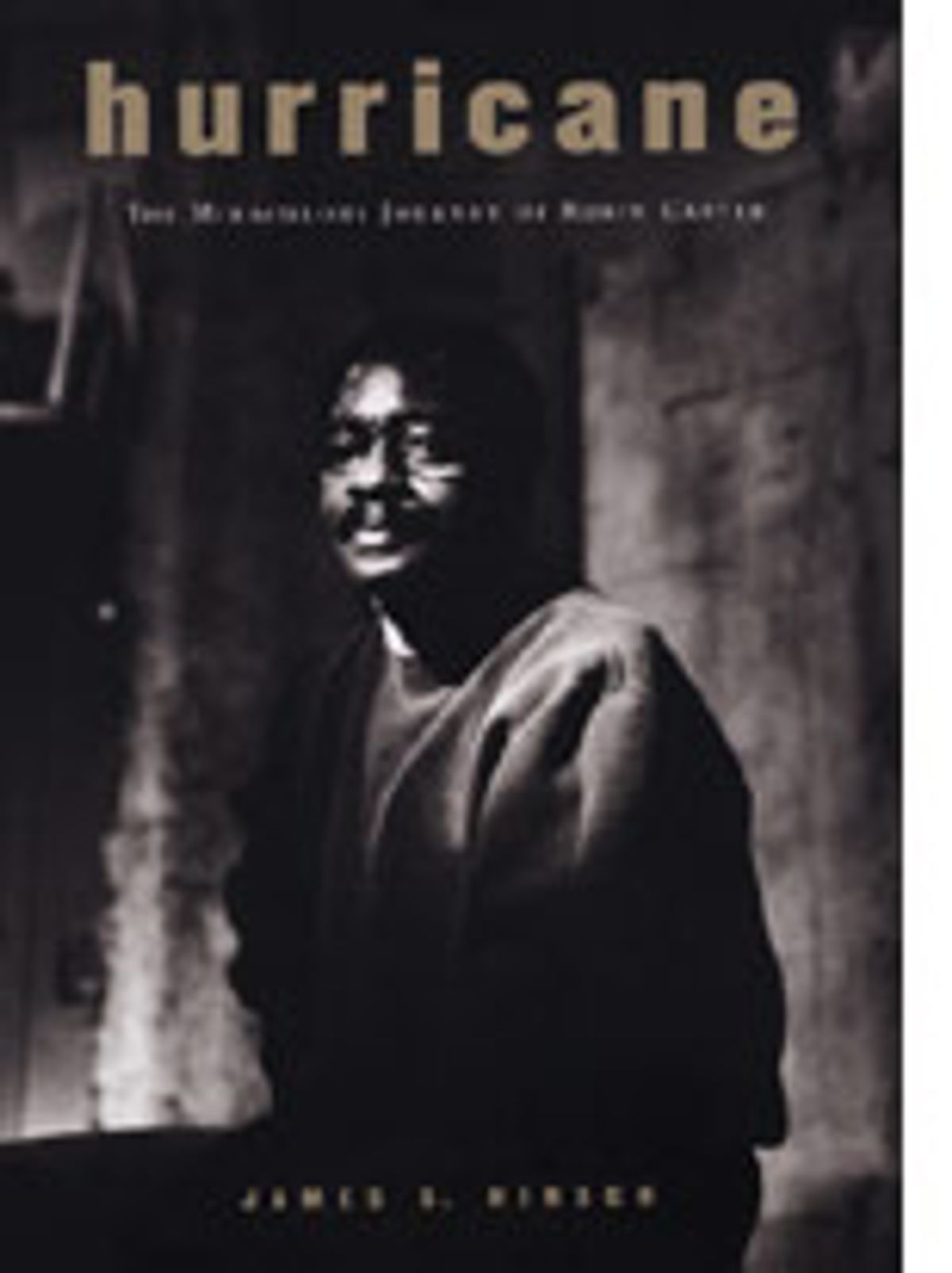
“Hurricane: The Miraculous Journey of Rubin Carter” by James S. Hirsch
A biography of the middleweight contender who was framed for murder scouts out the pieces of the life the reporters missed.
The story of Rubin “Hurricane” Carter has all the makings of a page-turning American saga. There’s violence, injustice and courtroom drama; there’s sex and celebrities; there’s damnation and, of course, redemption. Bob Dylan recognized these ingredients when he wrote his 1975 ballad “Hurricane.” The media, too, lapped up the tale: Articles and books were written, TV programs and Web sites created. This month Hurricania begins anew with the release of a movie starring Denzel Washington and James S. Hirsch’s biography, “Hurricane: The Miraculous Journey of Rubin Carter.”
As a middleweight contender in the 1960s, Carter was the anti-Joe Frazier, the Dennis Rodman of his day. Sporting a shaved head, a Fu Manchu mustache and sharkskin suits, he cruised Paterson, N.J., in his black El Dorado with his name engraved in the headlights. He swilled vodka and womanized. He became a black-power advocate and a gunrunner for Stephen Biko and was put under surveillance by the FBI. Then one summer night in 1966, the New Jersey cops arrested Carter and 19-year-old John Artis and accused them of savagely murdering three whites in a local bar. Both were convicted and sentenced to life in prison.
The case against Carter was thick with racism and thin on evidence. A catwalk of celebrities — Dyan Cannon, Ellen Burstyn, Stevie Wonder, Burt Reynolds, Johnny Cash — lent their names and money to his case, for a while. In one memorable scene in the book, a friend of Carter’s visits the “Saturday Night Live” set to try to renew Bob Dylan’s interest. But Dylan has shed his troubadour-of-
Hirsch, a former reporter for the New York Times and the Wall Street Journal, dutifully details the celebrities, the trials and appeals, Carter’s prison life and his relationships with members of a commune in Canada, including a scrappy 16-year-old named Lesra Martin who helped win Carter’s freedom. But though the book brims with facts, too often the narrative lacks momentum.
Part of the problem is Hirsch’s reverence for Carter. The biographer is unwilling or unable to offer much meaningful critical analysis of his subject. And his writing occasionally suffers from clichis about Carter’s transformation from bad guy to enlightened self-help thinker. When Carter falls for the leader of the Canadian commune, Hirsch writes: “Initially, Rubin told Lisa that his call was ‘strictly business.’ But clearly it was more than that. They had met on a higher spiritual plane while discussing human nature and the universe.” And later: “But he also realized they had developed a ‘learned helplessness,’ a dependence on Lisa to survive. That may have been fine for the others, but Carter was a solitary spirit who could never conform to a group or attach his star to another person.”
To his credit, Hirsch tries to stretch his book beyond the well-publicized criminal case. He attempts to explore the intimate life of Rubin Carter — the story that few of the celebrities, lawyers or journalists understood. Apparently one exception among the celebrities was Dylan, who met Carter in Trenton State Prison before writing “Hurricane.” “Dylan was not simply probing his innocence or guilt,” writes Hirsch. “To Carter, the folksinger was searching for something else entirely, as if he were asking, ‘Who are you, man? What are you? Are you what I see?’” Unfortunately, after reading Hirsch’s book, readers may still be asking those questions.
Maggie Jones has written for New York, Mirabella and the Philadelphia Inquirer. She lives in Los Angeles. More Maggie Jones.
“The Aleppo Codex”: The bizarre history of a precious book
A reporter traces the shadowy fate of the definitive version of the Hebrew Bible
Matti Friedman An ancient and priceless book, a murky history of evasions and coverups, an underground of sinister and possibly violent dealers, a former spy who drops tantalizing hints and a wily 84-year-old millionaire who says stuff like, “The problem with this story is that it could damage your health”: Are these the ingredients for a cheesy, improbable historical thriller? Yet “The Aleppo Codex,” Matti Friedman’s account of his attempts to learn the history of one of the world’s most precious books, sports all of these assets, and it’s nonfiction. If reporting this story damaged Friedman’s health, it probably happened when he realized what he’d stumbled into and his reporter’s heart started beating in doubletime.
Continue Reading Close
Laura Miller is a senior writer for Salon. She is the author of "The Magician's Book: A Skeptic's Adventures in Narnia" and has a Web site, magiciansbook.com. More Laura Miller.
Augusten Burroughs: Conquer trauma by letting it go
Salon exclusive: The best-selling memoirist says past horrors haunt us because we think about them too much. Stop
Augusten Burroughs Many people continue to feel influenced and even controlled by the things that happened to them a long time ago. Sometimes, people harbor dark, traumatic memories from childhood. Or fragments of memories — incomplete scenes, uncomfortable feelings, perhaps even a sense of certainty that something specific and terrible happened to them, but little more than this.
Others experienced something traumatic in adulthood that continues to affect them day to day many years later. Maybe an assault has left a person afraid to leave their home or enter a particular neighborhood.
Continue Reading CloseAugusten Burroughs' many books include "Runnning With Scissors," "Dry," "Sellevision," "Magical Thinking" and "Possible Side Effects." His latest book is "This Is How." More Augusten Burroughs.
Why did we move to Paris?
Leaving New York seemed ideal. Until the crazy landlord, topless exams, the French flu, the lack of credit cards...
Rosecrans Baldwin Paris’s neighborhoods, the arrondissements, are organized like a twist. They spiral from the river like toilet water flushing in reverse and erupting out of the bowl — a corkscrew or what have you, a flattened pig’s tail, a whorling braid notched one to 20. But if you walk from one neighborhood to the next, there is little to suggest the numbers changing. So it was confusing. Anyway, if you began in the middle of the Seine and snaked around, we lived on the Right Bank in the top of the third arrondissement, called the haut Marais, the upper Marais, on Rue Béranger, a quiet little street curling down from Place de la République.
Continue Reading CloseRosecrans Baldwin is a founding editor of The Morning News. His first novel, "You Lost Me There," was named one of NPR's Best Books of 2010. His latest book is "Paris I Love You, But You're Bringing Me Down." More Rosecrans Baldwin.
Robert Caro’s bloated LBJ biography
Robert Caro's latest LBJ tome has everyone -- even Bill Clinton! -- hyping it. They've been had
“Even the President of the United States sometimes must have to stand naked.” When Bob Dylan wrote that line in 1964, the naked emperor was Lyndon Johnson, which makes that image perhaps the most disturbing in all of Dylan’s apocalyptic work.
By stripping down Lyndon Baines Johnson to his essence, Robert Caro has himself become an American legend. Since the publication of “The Path to Power” in 1982, Caro has transformed LBJ’s life into a cautionary tale of Shakespearean dimensions. In some wonky circles, the release of a new volume is heralded like the Summer of Love release of “Sgt. Pepper’s.” Can Caro possibly top his “Revolver”?”
Continue Reading Close“Bring Up the Bodies”: Hilary Mantel’s power play
The sequel to her Booker-winning "Wolf Hall" is a thrilling exploration of what it took to run Tudor England
“Bring Up the Bodies,” Hilary Mantel’s follow-up to her Man Booker Prize-winning 2009 novel, “Wolf Hall,” is a high-wire act, a feat of novelistic derring-do. Mantel makes bold not with form — by now meaningful experimentation in that area seems exhausted — but with the very material that brings most readers to novels in the first place: our imaginative identification with fictional characters and the experiences we feel we’re sharing with them.
Continue Reading Close
Laura Miller is a senior writer for Salon. She is the author of "The Magician's Book: A Skeptic's Adventures in Narnia" and has a Web site, magiciansbook.com. More Laura Miller.
Page 1 of 984 in Books