Books
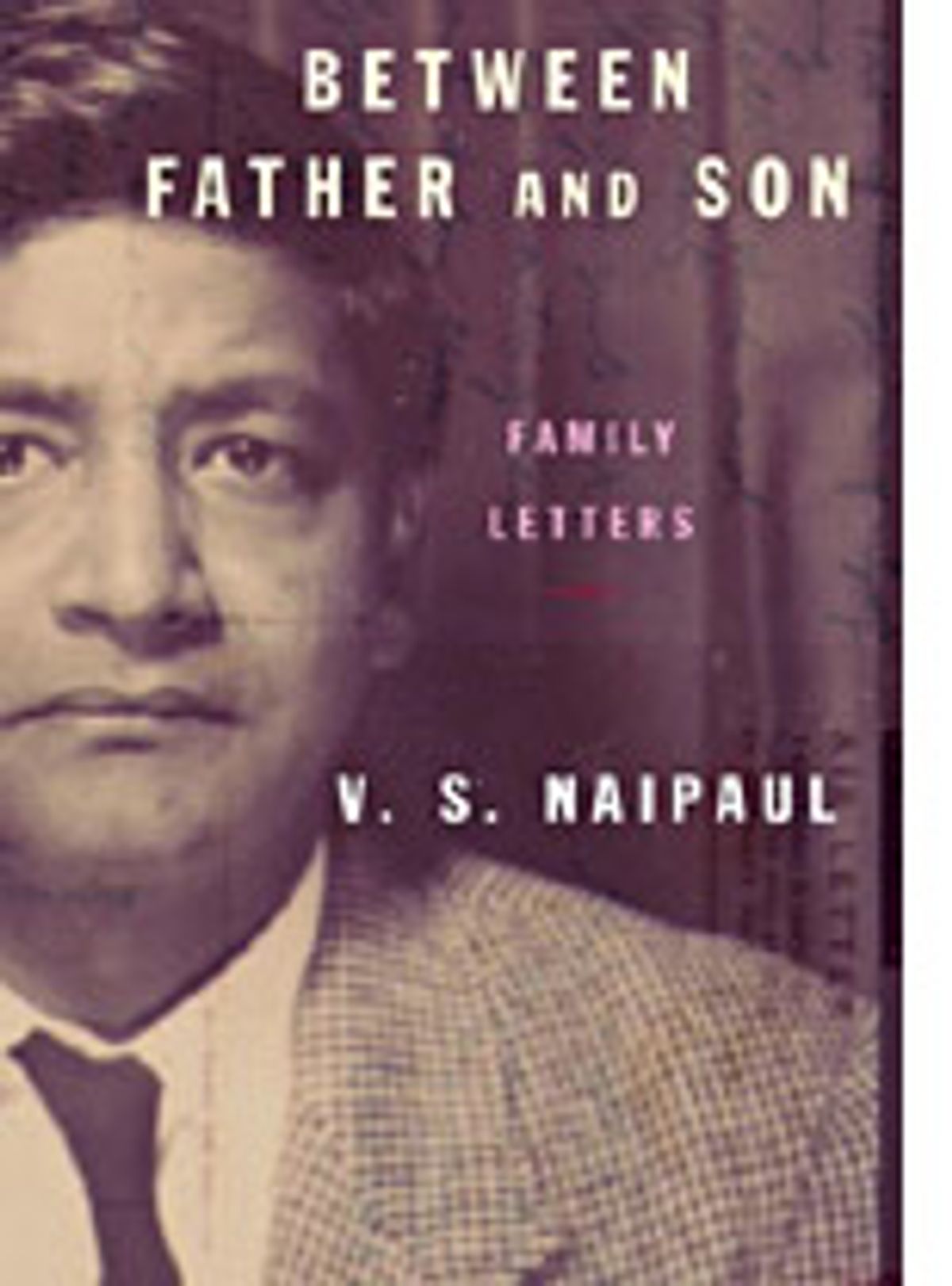
“Between Father and Son: Family Letters” by V.S. Naipaul
The correspondence of a naive and vulnerable youth whose famous bile hadn't yet started to rise.
Few writers have offended their readers as regularly as V.S. Naipaul has. From his first travel book, which disparaged the West Indies as a “dot on the map” where “nothing was created,” to his most recent, in which he dismissed Pakistan as a “criminal enterprise,” the Trinidad-born author of Indian ancestry has shown a staggering capacity for insensitivity and prejudice. Africa is filled with “bow-and-arrow people.” India is “an area of darkness.” “V.S. Nightfall,” Derek Walcott has called him; like a man who turns his back to the sun, Naipaul sees the world through his own shadow.
Traces of this imperiousness and biliousness are already evident in “Between Father and Son,” a collection of Naipaul family letters covering the period from September 1949, shortly before the 17-year-old’s departure on a government scholarship for Oxford, to the publication of his first novel, “The Mystic Masseur,” eight years later. Naipaul finds the “bright young sparks at Oxford quite insipid,” their “conversation and company tedious.” Of a new acquaintance, he writes to his sister Kamla that “I hope he isn’t homosexual. Nearly every other man one meets in this country is homosexual.” Still a teenager, Naipaul displays a remarkable cocksureness. He is, he informs his sister, “the best man on the news staff” of a student paper, and “as usual, the hardest-working.” In his second year, he produces a novel. “I am in no doubt about its being accepted,” he writes home.
|
The book is rejected, and Naipaul sinks into a long depression — a “nervous breakdown” as he later, in typically dramatic fashion, characterizes it. “A man isn’t a block of wood,” he writes morosely to his parents. “Some people, alas, feel more and think more than others, and they suffer.” This suffering Naipaul — “a jar of muddy water,” he calls himself — is not the inscrutable man of legend; he is a lonely, fragile and culturally awkward boy, unsure of his place in the world. Readers familiar with his work will turn to this book expecting the familiar cold detachment and the usual larger-than-life account of the writer’s quest for artistic purity. But “Between Father and Son” is something quite different: a portrait of the artist as a human being.
We see a naive young man struggling for social acceptability as he worries about finding his “circle of friends.” We see his fumbling, endearing advances toward women. (A Finn names her pet turtle after him; rather than sputter, Naipaul tamely throws up his hands and asks, “What could I do?”) And we see his affection for his family. Salman Rushdie, reviewing Naipaul’s masterly novel “The Enigma of Arrival” in 1987, famously observed that nowhere in that book could he find the word “love.” Yet the Naipaul here who counsels his siblings on marriage and education is warm, affectionate and caring. Toward his beloved father, Seepersad (the inspiration for his 1961 Dickensian masterpiece, “A House for Mr. Biswas”), he is all emotion, admiration and encouragement for the older man’s writerly ambitions. When, near the end of his time at Oxford, Seepersad dies, Naipaul is heartbroken. “HE WAS THE BEST MAN I KNEW,” he cables home. “EVERYTHING I OWE TO HIM. BE BRAVE MY LOVES.”
It is a sad and poignant moment — and the book is filled with such moments. Perhaps the deepest impression these letters impart is of the hardship of Naipaul’s life at Oxford. The cultural isolation, the desperate poverty, the strain of work and loneliness: Any young man might have come away with a gloomy disposition. “The world is what it is; men who are nothing, who allow themselves to become nothing, have no place in it,” says Salim, the narrator of “A Bend in the River.” To survive in the world, one sometimes needs to be a block of wood. “Between Father and Son” suggests that this is the lesson Naipaul learned at Oxford; it is a lesson he may have taken too much to heart.
Akash Kapur is a contributing editor at Transition magazine and co-host of Stop the Death Penalty, an online petition against capital punishment. More Akash Kapur.
“People Who Eat Darkness”: The disappearing blonde
A true crime story set in Tokyo illuminates the complicated truths behind media cliches
Joji Obara and Lucie Blackman (Credit: Estate of Lucie Jane Blackman) Lucie Blackman, 21, went out for the afternoon in 2000, phoning her roommate and best friend Louise to arrange a meeting later that night. Lucie never showed up, and within a few days she’d become one of those vanished blondes whose fates fuel headlines and hours of speculative media coverage. She was British, a former flight attendant, and she and Louise were living in Tokyo. They were also bar hostesses, a profession with a very specific meaning in Japan, difficult to explain to foreigners and not entirely clear to the Japanese themselves. Lucie both did and didn’t match the classic Missing Blonde profile, and for a while the mystery of what happened to her threatened to lapse into permanent obscurity.
Continue Reading Close
Laura Miller is a senior writer for Salon. She is the author of "The Magician's Book: A Skeptic's Adventures in Narnia" and has a Web site, magiciansbook.com. More Laura Miller.
Corporate criminals gone wild
The maker of the documentary film "Inside Job" has a new book excoriating Wall Street -- and President Obama
A detail from the cover of "Predator Nation" “Inside Job,” Charles Ferguson’s Oscar-winning documentary film on how government, Wall Street and academia colluded to deliver us the worst financial crisis since the Great Depression, made a powerful case that something was very very rotten at the heart of the American political/economic nexus. His follow-up book, “Predator Nation: Corporate Criminals, Political Corruption, and the Hijacking of America,” can be considered the legal brief that dots every “i” and crosses every “t” in his argument. A tightly argued, profusely footnoted and deeply enraged castigation of everyone involved, “Predator Nation” isn’t just a factually unchallengeable account of how Wall Street blew up the global economy. It’s a denunciation, a call for justice and a warning: After getting away with the crime of the century, Wall Street still isn’t satisfied.
Continue Reading Close
Andrew Leonard is a staff writer at Salon. On Twitter, @koxinga21. More Andrew Leonard.
Can you identify?
Science shows that the only way around some readers' prejudices is to trick them
(Credit: Shutterstock/Salon) The news of recent research documenting how readers identify with the main characters in stories has mostly been taken as confirmation of the value of literary role models. Lisa Libby, an assistant professor at Ohio State University and co-author of a study published in the Journal of Personality and Social Psychology, explained that subjects who read a short story in which the protagonist overcomes obstacles in order to vote were more likely to vote themselves several days later.
The suggestibility of readers isn’t news. Johann Wolfgang von Goethe’s novel of a sensitive young man destroyed by unrequited love, “The Sorrows of Young Werther,” inspired a rash of suicides by would-be Werthers in the late 1700s. Jack Kerouac has launched a thousand road trips. Still, this is part of science’s job: Running empirical tests on common knowledge — if for no other reason than because common knowledge (and common sense) is often wrong.
Continue Reading Close
Laura Miller is a senior writer for Salon. She is the author of "The Magician's Book: A Skeptic's Adventures in Narnia" and has a Web site, magiciansbook.com. More Laura Miller.
“The Aleppo Codex”: The bizarre history of a precious book
A reporter traces the shadowy fate of the definitive version of the Hebrew Bible
Matti Friedman An ancient and priceless book, a murky history of evasions and coverups, an underground of sinister and possibly violent dealers, a former spy who drops tantalizing hints and a wily 84-year-old millionaire who says stuff like, “The problem with this story is that it could damage your health”: Are these the ingredients for a cheesy, improbable historical thriller? Yet “The Aleppo Codex,” Matti Friedman’s account of his attempts to learn the history of one of the world’s most precious books, sports all of these assets, and it’s nonfiction. If reporting this story damaged Friedman’s health, it probably happened when he realized what he’d stumbled into and his reporter’s heart started beating in doubletime.
Continue Reading Close
Laura Miller is a senior writer for Salon. She is the author of "The Magician's Book: A Skeptic's Adventures in Narnia" and has a Web site, magiciansbook.com. More Laura Miller.
Augusten Burroughs: Conquer trauma by letting it go
Salon exclusive: The best-selling memoirist says past horrors haunt us because we think about them too much. Stop
Augusten Burroughs Many people continue to feel influenced and even controlled by the things that happened to them a long time ago. Sometimes, people harbor dark, traumatic memories from childhood. Or fragments of memories — incomplete scenes, uncomfortable feelings, perhaps even a sense of certainty that something specific and terrible happened to them, but little more than this.
Others experienced something traumatic in adulthood that continues to affect them day to day many years later. Maybe an assault has left a person afraid to leave their home or enter a particular neighborhood.
Continue Reading CloseAugusten Burroughs' many books include "Runnning With Scissors," "Dry," "Sellevision," "Magical Thinking" and "Possible Side Effects." His latest book is "This Is How." More Augusten Burroughs.
Page 1 of 984 in Books
