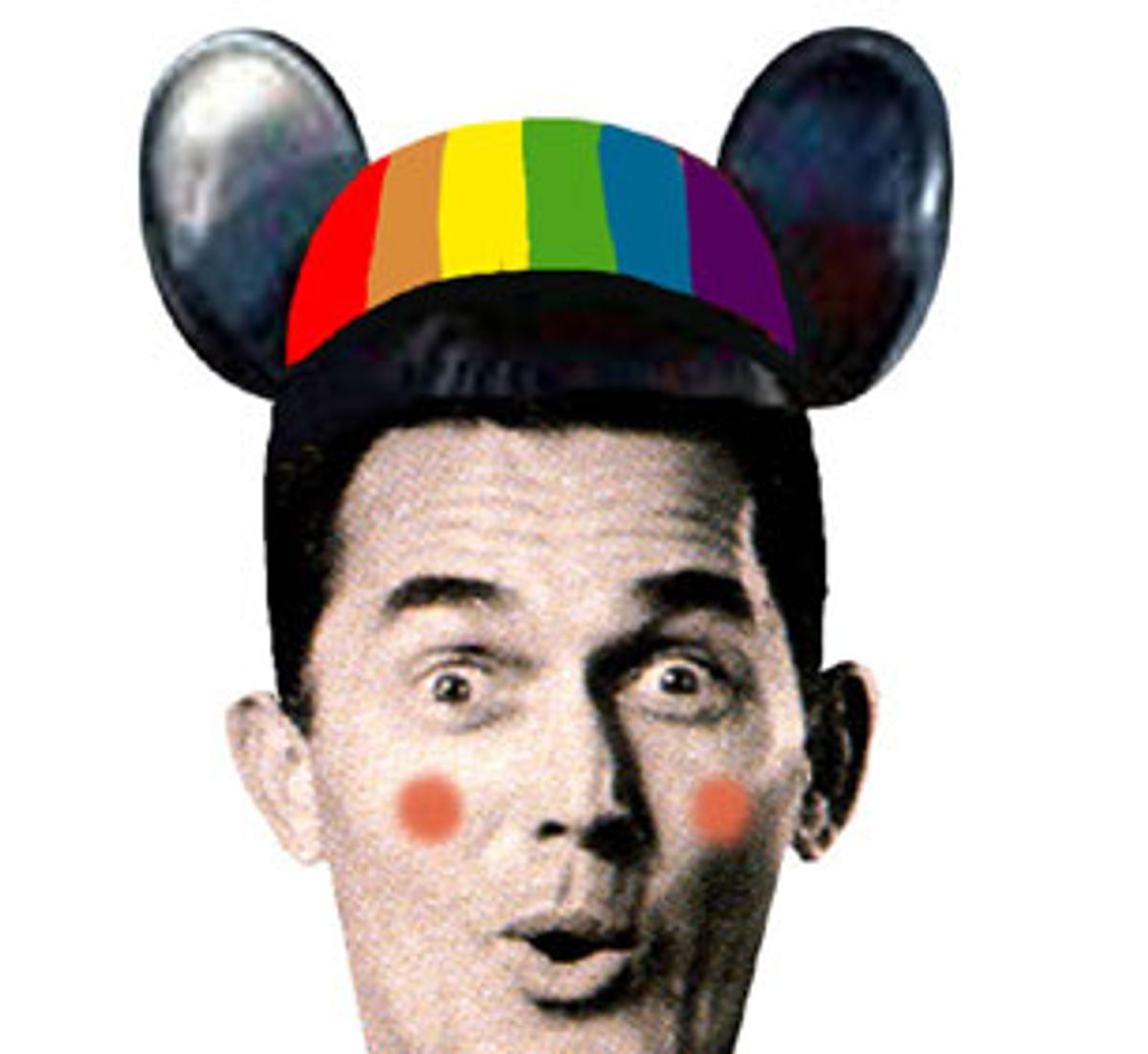
Disney

The Fabulous Kingdom

The author of a history of gays and Disney discusses the secret meanings of Mickey Mouse.

  • more
    • All Share Services

The Fabulous Kingdom

The Baptists are going to love this.

Things Disney have had a special appeal for gays and lesbians going back long before “Ellen,” argues Sean Griffin in his new book “Tinker Belles and Evil Queens: The Walt Disney Company from the Inside Out.” In this survey documenting both the accidental and deliberate embrace of gay consumers by America’s most calculating purveyor of “family values” entertainment, the film and media scholar finds enough threads to weave a pink cape for Maleficent, the villainess of “Sleeping Beauty.”

The political and religious right’s outrage over this affinity peaked in the mid-1990s when Disney decided to extend health benefits to the partners of its gay employees. Griffin, however, doesn’t paint Disney as an unambivalent ally of gays and lesbians — after all, Walt himself offered to make an educational film warning children about homosexual pedophiles. Instead, the gay author portrays a winking camaraderie that clearly serves to bolster the company’s bottom line. Salon reached Griffin at his home in South Florida, where he teaches at Florida Atlantic University in Boca Raton.

You open with a 1995 letter from 15 Florida legislators who claimed that Disney’s domestic partner benefits undermined the company’s record for representing “all that is good and pure and wholesome in our nation.” That letter proves Disney may never be let off the hook by those who imagined Walt to be a moral conscience. Was he?

Because Disney consciously chose somewhere in the early ’30s to try to be a family-friendly, kids-oriented company, it’s always, even way back in the 1930s, been an easy target for attack. When “Snow White” first opened [in 1937], various parents’ groups protested it because they thought the witch was too scary. So there’s a history of people complaining. Not that the people complaining are wrong all the time. It’s just part of what happens when you choose to market yourself with this image.

It was a good marketing decision in the ’30s. At the time, there were calls for federal censorship in films. The early Mickey Mouse cartoons show him as a ne’er-do-well, someone who’s not afraid to use violence [or to] chase Minnie around the couch. Since he was such a big star, some parents’ groups started getting on his case then. So there was a conscious decision to shift over into a more family image that would help him maintain popularity. Since Disney was a very small company — not a major studio, just a little cartoon factory — that helped gain publicity that put him on more of a par with the big studios. It helped him gain more power by deciding to fashion this image. It was economics more than anything else.

Gay and lesbian historian Allan Berube found a photograph of a gay bar in Berlin from the 1930s called “Mickey Mouse.” What’s the connection?

During this early period within at least some gay communities — there wasn’t an organized community with mass media and journals and all that stuff we have now; communities were sort of circumspect and closeted — some were using the term “Mickey Mouse” as a code word, or slang, for talking about being gay or lesbian. The idea of Mickey Mouse — the way it’s used in slang in general, as meaning offbeat, possibly a little tacky, strange — would fit for the idea of a sexual orientation that was considered not normal. But it also sort of validated it, since Mickey Mouse was such a huge star at that point — sort of awkward and offbeat, and yet fabulous at the same time.

Much of the early appeal of Disney’s films for gay and lesbian viewers seems to come from a subversive reading. Were story lines and characters actually so ambiguous that anyone could read into it whatever they wanted?

You can’t just create a whole bunch of new characters and a whole new story line out of nowhere to fit your needs. But, especially with Disney cartoons that focus so much on fantasy, where cookies or cakes or insects or animals take on human characteristics, you’re already being asked to read into things. Since the cartoons are asking that already, it might be a stretch to some heterosexual audiences, but not necessarily to gay audiences, to further say, well, why can’t you read somebody as being gay? Part of the fun for gay and lesbian audiences back then was being aware that this was not the intention, that they were doing something that the makers didn’t realize — they were sort of taking some power back. That’s not necessarily the case nowadays, where people working in the studio who are openly gay have said that they’ve been aware of the possibilities.

The 1937 Oscar-winning short “Ferdinand the Bull” depicts an effeminate bull who is content to smell the flowers rather than chase more masculine pursuits. You cheer the story line as one among many that champion “outsiders,” one of the ongoing themes that speak to gay sensibilities. I would have thought such a stereotypical portrait would produce outrage.

Because it’s animals instead of human beings, there’s a cushion there. It’s played as sort of gently comic, so he’s not looked on as some inordinate hero for standing up to things; he’s not like some gay teen trying to get through high school. While he’s content to be lazy and sit there and smell the flowers and not be out playing sports, there’s no scene of him mooning over some other bull. That might have made it OK and possibly kept most audiences from being upset.

It sounds like it’s not the audience but the animators who are being subversive. How could Walt not have caught on?

It’s hard to imagine from where we are now, but people could actually not be aware that homosexuality was going on. I don’t think Walt was not aware of that, especially living in Southern California [and] working in the film industry. But because of the sort of primacy of the heterosexual-lifestyle mandate, especially back then, when everybody’s automatically straight until somebody begins to point out they might be something else. With that basic assumption, stuff is going to go by unless somebody says, Hey, did you notice Ferdinand’s possibly a little fruity? I had that happen in a class yesterday when I showed “The Lion King” and mentioned that Skar has been read as a gay character. Pretty much the entire class was like, “What are you talking about?”

Can you draw a line between those who are on the side of the gay audience, and those who are making fun of it?

Whenever you’re dealing with animation, to a certain extent you’re dealing in caricature, so you’re just sort of asking for trouble when you’re trying to draw male or female or various ethnicities or racial groups. That fits into dealing with stereotypes of sexuality, like when the genie in “Aladdin” dresses up as the swishy tailor. How to solve that, I don’t know — how you can animate and not be dealing in stereotypes to a certain degree. This happens in terms of camp in general, not just in dealing with Disney. Gay male camp often walks hand in hand with drag culture. Whereas there’s a celebration of these female stars that they’re imitating, drag has also been critiqued and analyzed by feminist critics as being hateful towards women. Is it positive? Is it negative? Stuff like that is, I think, somewhat simplistic, almost the equivalent of “thumbs up,” “thumbs down,” which doesn’t really tell you more than yes or no instead of dealing with the complexity of these things. Are they stereotypical? Yeah, probably. But how are they being used? What are they being used for? How are they being regarded?

And?

The genie pretty much went over fine in “Aladdin.” Things seemed to be a little split among gay men over “The Lion King.” A lot of people, to a certain degree including myself, had problems with Skar as possibly a gay character, as well as the idea that the heterosexual lion is the person who has the divine right to lead the country, and as soon as Skar takes over, the ecosystem immediately falls apart — like, “These people cannot run the country!” But I know a number of gay men who really liked “The Lion King” specifically because of the story line of the son having to come to terms with the memory of his father, and being outcast, and trying to live up to his father’s expectations, which are various issues that a lot of gay men have to deal with.

Walt himself apparently fired actor Tommy Kirk in 1961 over growing awareness of his homosexuality. But by the 1970s the studio was making movies starring a loinclothed Jan-Michael Vincent, who you say was then a main pin-up poster boy among gay men.

But they’re still G-rated movies: Jan-Michael Vincent is just doing a sort of teen Tarzan. It isn’t really until the changeover at the company, when Michael Eisner and Frank Wells and Jeffrey Katzenberg start working for the studio, that you get a concerted changeover. “Down and Out in Beverly Hills” was the first film for Touchstone Pictures under this new regime, and they made certain that it would get an R rating. The introduction of homosexuality — where you can’t necessarily read it any other way — also happens with “Down and Out in Beverly Hills.” They never actually use the word “homosexual,” but the teenage son of the Beverly Hills family seems to be having trouble conforming to gender norms. He’s wearing makeup and has that sort of ’80s Boy George/Erasure type of gender-bending going on — and has something that he’s trying to tell his parents but seems too beat up inside to be able to say anything. At the end he seems to have transformed through his interaction with the bum that they adopt, and he introduces all his similarly gender-bending friends, including Alexis Arquette, who nobody knew who he/she was at that point, but who’s now pretty famous within gay culture for his drag act. It’s impossible for any audience — not just a gay audience that’s in the know, but for any audience — to watch the movie and not, in order to make sense of the story, understand the son’s character as wrestling with ideas of sexual orientation.

Your analysis gives great weight to producer and lyricist Howard Ashman — who died of AIDS complications after his work on “Beauty and the Beast” — as a direct link between Disney’s narratives and its gay audience. What empowered him to make strides that the company had not made previously?

Ashman and his songwriting partner, Alan Menken, had already had some success off-Broadway with “Little Shop of Horrors.” Ashman had always been fascinated by Disney, and so when Disney needed somebody to help refashion their animated output, Ashman seemed to quickly jump into the breach. The popularity and critical regard of “The Little Mermaid” ensured that as long as Ashman and Menken wanted to work for Disney, they were going to let them.

Ashman, beyond just writing the words to the songs, was promoted to co-producer of the films he was involved in, and even for “Beauty and the Beast” had a hand in helping fashion the script. Although it’d be nice to say they saw Ashman as a wonderful talent and wanted to foster him and said, “Here, you want to input these gay things into it, that’s great,” it was basically economics. They wanted to strengthen their animation department, Ashman was there and proved that the ideas he had were box office, and so they said, “Keep going.” And that allowed him some power to not necessarily input gay-coded messages, but to fashion stories that would appeal to him. And since he was a gay man, a number of the various messages of “The Little Mermaid,” “Beauty and the Beast” and “Aladdin” would have special resonance for a gay and lesbian audience as well.

Disney is not so much coming around to accept gay culture so much as recognizing that the demographic has dollars to spend. Should gay and lesbian communities feel used by Disney?

In a capitalistic system, unless you’re willing to foment the revolution, this is the way things work for all minority groups. In order to get representation and get noticed, you have to move up in the economic scale. I feel it’s better to have some representation and some awareness rather than nothing, even as problematic as the recognition may be. Disney is not the only one out there looking to the gay and lesbian community as a market, instead of dealing with the various social and political issues. One of the main reasons Disney decided finally to give domestic partner benefits was because almost all the other major studios were doing it, and Disney wanted to stay competitive.

Disney is still trying to maintain its image as family-oriented company. It’s never been, “OK, we’re going to stop wooing the gay and lesbian consumer,” but “How can we do this without jeopardizing the other consumers?” And so it’s always been, give a little here, then step back and wait to see if anything blows up, which is one of the reasons why they took so long with domestic-partner benefits. With the gay days and gay weekends at the theme park — which aren’t specifically organized by the Disney company — Disney has some deniability. It’s like anybody who gives us money, we’ll take the money; what they’re doing there, as long as they’re not pulling out guns and killing people, or having sex right there on the rides, they don’t necessarily care.

Given Disney’s success at target marketing, will we ever see a commercial that depicts two adult men holding hands on Main Street, USA?

No, because I think to a certain extent there still is an attempt at deniability. If there is advertising that might be aimed at gay or lesbian people, it still tends to be what I refer to as “gay window advertising,” where a gay audience can read into it, but the heterosexual audience — with that sort of natural assumption that everyone is straight until you tell me otherwise — won’t get it.

You realize, of course, that you’ve given the conservative lobby and religious right activists a whole new round of ammunition.

That was something people warned me about — like I’m letting the cat out of the bag. But what I tried to do is point out that this is not necessarily some huge victory for the gay and lesbian community. There is a measure of exploitation going on. It isn’t necessarily that Disney or any of the other companies that are giving domestic partner benefits or becoming more aware of gay and lesbian concerns are in the trenches, marching the marches, doing the sit-ins, signing the petitions. Basically it’s all down to economics. If there was not a concept that there were dollars to be made from this, none of this would be going on.

Jeff Truesdell is editor of the alternative newspaper Orlando Weekly.

Disney’s fat-shaming fail

The mouse misfires with an ambitious, awful health campaign

  • more
    • All Share Services

Disney's fat-shaming fail

You wouldn’t think the people whose theme parks feature a binge-eating bear with a honey gut would put itself in the business of fat shaming, but that’s exactly what Disney did this month. In a boneheaded stab at promoting healthy lifestyle choices, the happiest place on earth became a considerably less hospitable environment when it debuted a new interactive “Habit Heroes” exhibit at Epcot. Guess who the villains were?

A collaboration between Disney and Blue Cross and Blue Shield to help teach kids to “fight bad habits,” the Epcot attraction and tie-in app and Web page featured buff, virtuous characters Will Power and Callie Stenics squaring off against nemeses like the lazy, grotesque “Lead Bottom” and the self-explanatorily named “Glutton.” Apparently, when a company famed for its meticulous crafting of exactly what children want and one of the largest health insurers in the nation pool their talents, they come up with “Fat people are bad.”

Earlier this month, Tony Jenkins, regional market president for Blue Cross and Blue Shield, told the Orlando Sentinel that “Our challenge was to tell that story in a fun, engaging way, which is what Disney does better than anyone.” So imagine Disney’s surprise when some patrons did not take kindly to their “fun, engaging” message. As Weighty Matters blogger and assistant professor of family medicine Dr. Yoni Freedhoff told the Calgary Herald, “It’s so dumbfounding it’s unreal. I just can’t believe somebody out there thought it was a good idea to pick up where the school bullies left off and shame kids on their vacation.” On her “Dances With Fat” blog, Ragen Chastain condemned the “Disney Fat Shame Ride” and admitted she “couldn’t stop the tears” when she’d heard about it. And nutritionist and author Marion Nestle tweeted, agog, “You can’t make this up.”

It didn’t take long for the Magic Kingdom to do some hasty damage control, taking HabitHeroes.com “down for maintenance” and closing the exhibit just three weeks after it launched. The mouse is currently remaining conspicuously silent on whether it will return.

With 12.5 million children and teens now obese, the health problem in this nation is a real and growing one, one that will play in serious long-term health problems like diabetes and heart disease and short-term ones like bullying. Kids – and parents – need direction and encouragement to make healthy eating choices and develop an active lifestyle. But like Children’s Healthcare of Atlanta’s similarly in your face campaign, the Habit Heroes approach compounded the problem by making it seem like emotional, cultural, genetic and economic factors can be overcome with simple “Will Power” and a few broccoli spears. Worse, it demonized the obese, equating size with poor habits. Kind of ironic for a place that entices visitors to “Satisfy your sweet tooth at Storybook Treats” or “Wake up with treats like freshly made funnel cakes and delicious waffle sandwiches.” You want to promote good heath? Start by looking at your own sugar and animal fat-laden menus. And go on by respecting children of all shapes and sizes. Because they’re the ones who trust in the mouse to see them not as Lead Bottoms and Gluttons but as princesses and pirates. As beautiful.

Continue Reading Close
Mary Elizabeth Williams

Mary Elizabeth Williams is a staff writer for Salon and the author of "Gimme Shelter: My Three Years Searching for the American Dream." Follow her on Twitter: @embeedub.

Can “Winnie the Pooh” save Disney from Pixar?

An utterly charming new adventure with the Bear of Little Brain offers a delicious antidote to digital animation

  • more
    • All Share Services

Can

Can a Bear of Very Little Brain redeem the tarnished reputation of Walt Disney’s venerable animation studio and stake his place on the cultural landscape alongside Buzz Lightyear and Lightning McQueen? That’s a lot to ask of a tubby little cubbie whose principal concern is finding a pot of honey — sorry, hunny — but Disney’s whimsical and charming new “Winnie the Pooh” feels simultaneously like a return to the company’s more innocent past and a refreshing new direction. Specifically recalling the hand-drawn animation style of the widely beloved 1966 “Winnie the Pooh and the Honey Tree” and its sequels (anthologized in the 1977 collection “The Many Adventures of Winnie the Pooh”), and delivering only the faintest contemporary tweak to the Milne material, Stephen J. Anderson and Don Hall’s “Winnie the Pooh” will thoroughly delight both the under-10 set and their nostalgic parents. Look for this to be a surprisingly potent sleeper hit; I’m going a second time this weekend.

Sterling Holloway, who provided the classic Pooh voice in the ’60s, has been dead almost 20 years, but Jim Cummings (who also voices Tigger) has amiably filled the role in numerous lower-budget Disney productions and sounds uncannily similar. With John Cleese as narrator, Craig Ferguson as Owl and Jack Boulter as Christopher Robin, this production also has the right degree of authentic British-ness. (It’s somehow fine with me that Pooh, along with Bud Luckey’s Eeyore, sounds a bit more American.) But the real star of “Winnie the Pooh” is the imaginative animation, which features not one but two classic Disney surrealist sequences and a bit of playful postmodernism: Pooh frequently interacts with Cleese’s narrator, or wanders out of the Hundred Acre Wood into the paragraphs of the book, accidentally bringing letters and punctuation marks back with him.

Of course the Mouse has been relentlessly cashing in on A.A. Milne’s dimwit ursine hero ever since acquiring the rights from Milne’s widow in 1961, and much of that output doesn’t bear (ha!) thinking about: Piglet and Tigger got their own spinoff movies; there were Christmas and Thanksgiving and Valentine’s Day specials and a seemingly endless series of tot-oriented “Winnie the Pooh Learning” and “Winnie the Pooh Playtime” titles. Let’s not even bring up “Franken Pooh.” Well, you can forget about all that stuff; Anderson and Hall have banished the insipid primary colors, not to mention the third-rate outsourced animation, and this film has the lovingly crafted, storybook feeling that was once Disney’s specialty.

“Winnie the Pooh” feels like a turning point in the brief tenure of Walt Disney Animation Studios head John Lasseter — whose other company, Pixar, effectively destroyed Disney’s old in-house animation unit. Lasseter has said frequently that Disney Animation should have its own identity, one that draws on the company’s glorious past and doesn’t simply ape Pixar’s success, and maybe now we can see what that means. “Winnie the Pooh” doesn’t look or feel anything like a Pixar movie, and it is specifically not trying to be a “kidult” crossover success, after the fashion of almost every Pixar production. But it also feels mercifully free of the combined calculation and sloppiness that have plagued so many Disney features in recent years, and one could argue that the painstaking attention to animation and storytelling reflect Lasseter’s stewardship.

Let’s take to the way-back machine for a minute. Ever since the Walt Disney Co. began its partnership with Pixar, then an upstart digital-animation studio run out of an industrial park in Emeryville, Calif., the Mouse’s own in-house animation unit has struggled to keep up. Actually, that’s being euphemistic; what really happened was that Pixar kicked Walt Disney Feature Animation’s butt so badly that the division was ultimately dissolved and renamed. In 1995, “Toy Story,” the first Disney-Pixar release, grossed $354 million worldwide, which represented at least a tenfold return on its production costs. Walt Disney Feature Animation also had a big hit that year with “Pocahontas,” which premiered outdoors in New York’s Central Park and went on to its own $300 million-plus worldwide take. (Mind you, it also cost several times more to make than “Toy Story” did.)

Not even Lasseter, who co-founded Pixar and directed “Toy Story,” would have predicted 16 years ago that Pixar would go from one massive success to the next, becoming one of the most beloved brands in entertainment history, or that “Pocahontas” was the last big hurrah, or next-to-last, for Walt Disney Feature Animation, which had created such massive hits as “The Little Mermaid,” “Beauty and the Beast” and “The Lion King.” When Pixar released “Toy Story 2″ in 1999, another huge worldwide hit, WDFA’s big release was “Tarzan,” a wildly expensive production (not to mention an entirely forgettable film) that probably ended up in the red. Disney’s in-house studio had one more sizable hit, with “Lilo & Stitch” in 2002. But that movie earned $100 million less than Pixar’s “Monsters Inc.” had a year earlier and took in less than one-third the worldwide gross of Pixar’s huge 2003 hit, “Finding Nemo.”

At that point the writing was on the wall: Pixar engaged an enormous public with cutting-edge animation technology and appealing characters and stories, and reaped untold billions in box-office receipts, tie-in merchandise and ancillaries. Disney’s in-house animation studio, on the other hand, was an embarrassing albatross. There were straight-to-video quickies, cashing in on existing properties in the most unfortunate Disney tradition: “Mickey’s Twice Upon a Christmas” and “Mulan II” and “Tarzan II” (with “new songs by Phil Collins,” apparently meant as an inducement). The last release under the aegis of Walt Disney Feature Animation was “Chicken Little” in 2005, a work of supremely crappy-looking fake-Pixar animation that features 11 credited writers and Zach Braff in the title role. I would have been happy to completely forget that movie’s existence. (In fact I had, until now).

Lasseter has been at the helm of the reconstituted Walt Disney Animation Studios for almost five years, while continuing to run Pixar, and the results of this seemingly contradictory role are still a bit unclear. The first two Disney features made on his watch, “Meet the Robinsons” and “Bolt,” felt way too much like Pixar movies, with substandard animation and the rough edges sanded off. I’m aware there’s a critical constituency for both films, but that didn’t extend far into the public, and both were box-office flops. With the hand-drawn “Princess and the Frog” and the digital “Tangled,” Disney tried to breathe new life into its classic tradition of adapting fairy tales. Neither performed as well as expected, but they displayed more craft, integrity and audience appeal than any other Disney animated feature in years. (“Tangled” was reportedly so expensive to make that even its worldwide gross of almost $400 million might not have returned a profit; “The Princess and the Frog” failed to click with American audiences but did well overseas.)

It’s almost not worth mentioning that “The Princess and the Frog” was artistically and financially eclipsed by Pixar’s “Up,” and that “Tangled” was obliterated by the astonishing billion-dollar worldwide gross of “Toy Story 3,” the biggest animated feature in history. The same thing is likely happen again this summer; even though many Pixar-friendly critics have turned against Lasseter’s “Cars 2,” audiences don’t seem to mind. But coming as it does after those two films, “Winnie the Pooh” feels like more than a small summer surprise that will utterly charm 3-year-olds and 93-year-olds. It feels like a Walt Disney animated film, in the best possible sense of that term, and another significant step toward restoring that company’s dignity and sense of purpose.

Continue Reading Close

Pixar releases trailer for upcoming film, “Brave”

The movie, which comes to theaters next summer, is a fairy tale set in the Scottish Highlands

  • more
    • All Share Services

Pixar releases trailer for upcoming film, The heroine of Pixar's forthcoming film, "Brave."

The big box office news this past weekend was the success of Pixar’s latest release, “Cars 2,” in the face of less-than-friendly critics. In the wake of this triumph, the studio has released the trailer for its next film, “Brave,” which is due to hit theaters next June.

The movie — which takes place far from “Cars’s” Radiator Springs, in the Scottish Highlands — brings us Pixar’s first-ever female protagonist: a flame-haired princess called Merida. Entertainment Weekly has more:

It’s Pixar Animation Studio’s first fairy tale fantasy, and it marks yet another change of pace for the venerable dream factory. “What we want to get across [with the teaser] is that this story has some darker elements,” director Mark Andrews tells EW. “Not to frighten off our Pixar fans — we’ll still have all the comedy and the great characters. But we get a little bit more intense here.”

The film will use the voices of Emma Thompson, Billy Connolly, Julie Walters, Kevin McKidd, Craig Ferguson and Robbie Coltrane, and stars Kelly Macdonald as Merida.

Continue Reading Close

Emma Mustich is a Salon contributor. Follow her on Twitter: @emustich.

Today’s must-see viral videos

Watch: America gets its Susan Boyle, a Southwest pilot's anti-gay rant, a touching Ryan Dunn tribute, and more

  • more
    • All Share Services

Today's must-see viral videosLandau Eugene Murphy Jr. wows audiences on "America's Got Talent."

1. The U.S. gets its own Susan Boyle

“America’s Got Talent” contestant Landau Eugene Murphy Jr., a car washer from West Virginia, was chided by Piers Morgan for chewing gum onstage. Then he opened his mouth so the ghost of Frank Sinatra could come out singing “I’ve Got You Under My Skin.” Goosebumps!

2. A tribute to Ryan Dunn that will last a lifetime

“Jackass’” Wee-Man, (aka Jason Acuna) cuts through all the anger and flame wars surrounding his friend’s death and gives him a uniquely touching memorial.

 3. Southwest Airlines pilot loses it on the mic

I don’t know if it makes it better or worse that this guy’s homophobic tirade was supposed to be a private cockpit conversation instead of being broadcast across the entire Texas airspace. Maybe he should get a job doing standup in Nashville?

4. Culture clash

Amazing footage, just uploaded to YouTube yesterday, of a tribe in Papua New Guinea meeting a white man for the first time in 1976.

5. Trippy Disney mashup

Pogo, the foremost expert and creator of Disney remixes, has come out with his latest creation. “Bloom” focuses not on one specific film, but several different animated classics.

Continue Reading Close

Drew Grant is a staff writer for Salon. Follow her on Twitter at @videodrew.

Are we OK with Miley Cyrus in her underwear now?

Is the former Disney star old enough, at 18, to strip down without it becoming a scandal?

  • more
    • All Share Services

Are we OK with Miley Cyrus in her underwear now?Miley in her everyday outfit for "So Undercover."

Miley Cyrus … can I ever look at you without feeling like a lecherous old man? From the time you were 15 and appeared on the cover of Vanity Fair wearing only a sheet, it’s been a battle not to see you partially clothed everywhere I go.

Sometimes you’re just the victim of a bad situation, like when those hackers leaked racy photos you took in 2008 for Joe Jonas, and posted them all over the Internet. Or when this happened again in 2010 and the FBI was called in.

Other times, you’re shoving your post-Hannah Montana B-cups in my face so hard that I can almost hear you screaming, “I’m an adult now! Take me and my breasts seriously!” For example: your music videos for “Can’t Be Tamed.”  Or “Who Owns My Heart.“  Or when you pretended to kiss one of your female dancers on “Britain’s Got Talent.” And that’s not even mentioning those party shots of you involving lap dances, salvia and more half-naked, girl-on-girl kissing. Which has less to do with your sexuality, Miley, and more with the fact that you were 17 and acting like Paris Hilton on a bender.

So please forgive me for feeling weird about these new, semi-innocuous stills for your latest film “So Undercover.” If it weren’t for your dramatic history with underwear, these photos wouldn’t seem so bad. But with you Miley, the pictures carry three years of associated guilt and anxiety that the government is going to come arrest me for having child pornography on my computer.

You’re 18 now, which is the age when the sexy vs. too sexy debate usually begins to get interesting for Op-Ed writers and TV pundits. But you’ve been scandalized and scandalizing for awhile now; you’ve made your stance clear about rebelling from your Disney image, and at this point it’s barely news when you walk out of your house in only lingerie. If anything, these photos for “So Undercover” are way more conservative than the bra and short-shorts you’ve been wearing to the supermarket for the past 24 months. (The Supermarket is a hot new club in London, FYI.)

But it still feels weird. Legal, but weird.

Then again, maybe I should just be glad you’re so fond of underwear that you literally spend $3K at a time shopping for panties and bras. It will really cut down on the number of paparazzi upskirt photos we’ll have to see in the future.

Continue Reading Close

Drew Grant is a staff writer for Salon. Follow her on Twitter at @videodrew.

Page 1 of 21 in Disney