George Clooney

Price of fame

Puffy was there, and the Goo Goo Dolls, and I almost ran over Kurt Loder. But everyone was working. So, all of a sudden, we missed the lame party with the imported transvestites.

  • more
    • All Share Services

Topics: , ,

Price of fame

Dear Button,

Let me just warn you that this letter may be a scramble as my brain is deeply entrenched in Neal Stephenson’s “Cryptonomicon,”
a book that can best be described as “head-explody.” Ostensibly, it is a tale of the serious business of code breaking, primarily during the Second World War. But it is also sending feelers down into my mind and tickling the nerd center. Lots of number-play with heavy use of coincidence and primes. I’m spinning.

But that all seems boring when I have tale to tell of Al Yankovic (aka “Weird” Al, although he has since dropped the “Weird”). Have you kept abreast of VH1′s winning series “Behind the Music”? Despite being (basically) the same story again and again, it is quite good. A band gets together, usually in the ’80s. They get big. Then they get really big. Now it is the early ’90s. Parties and chicks and drugs and excess. But inevitably the bottom falls out, always around 1992. Narrator: “When we come back: In 1992 the bottom falls out of Mvtley Cr|e’s rock ‘n’ roll fantasy.” In fact, the segment of the hour-long show from 30 to 45 minutes is called the POF, or “Price of Fame,” segment. The exacted toll usually includes, but is not limited to: overdose, death, betrayal, divorce, institutionalization, wrecked cars, jail time and loss of limb. The final 15 minutes, however, mark the band’s return — Present Day.

What does this have to do with Mr. Yankovic? Well, Al’s “Behind the Music” has no POF section. He is a pleasant, fun, nice, courteous, soft-spoken guy who graciously accepted club sodas from a drunker and drunker host (me) at our Christmas Party. I just got lit and pushed club soda on him hoping he would finally get pissed and be un-nice in some way. Nope.

So then I moved to David Spade’s dad, whose name is Sam Spade. Apparently, he and the son have a rocky past but have come to understand each other in some way now. And so here is Sam at the home of Hollywood badboy Trey Parker, looking especially diminutive against the background of Trey’s colossal Steinway D. I introduce myself and make it clear that I am the guy to ask if he needs anything. Sam is grateful and puts his hand on my shoulder.

“Do you know my son?” he asks hopefully.

I met Spade the Younger at a private party in some bar on Melrose, I think, just down the street from Denzel Washington’s restaurant, Georgia, where a bunch of us had gotten logy on fried chicken. David and I have a mutual friend in Pam Brady, who at the time was writing for David’s show “Just Shoot Me” and who now writes for both that show and “South Park.” David shook my hand and told of how he had been on George Clooney’s list that fateful Christmas when “The Spirit of Christmas” began making the rounds.

This was about a month after Chris Farley had died, and I’d read the short piece David published in Rolling Stone about not going to Chris’ funeral. He simply could not resign himself to it. I mentioned the piece hesitantly, but with sufficient gravity, in order to compliment his honesty. David was receptive and gracious. We went from looking in our drinks to looking at each other. We didn’t start making out or anything, but it was clear we were at the threshold of a real conversation, which parties like these generally preclude.

With this much talent in the room, the starfuckers were out in full force, including this chick I met by the bathroom who had gone AWOL from the Army and wanted me to tie her up and do naughty things to her. She was a friend of a friend of a friend whom I vaguely remembered seeing duck into one of our limousines earlier, and now, two hours later and with no contact in between, she already has her hand pressed against the goods. Clearly an amateur, she went for the writer.

So this is just the brand of woman you expect to fling herself headlong in the middle of your nice, quiet conversation, and as I’m hanging out with David I am doubly sure it is coming.

“DAVID!!” someone screams. Here it comes. But it isn’t a slutty chick looking for star love. It’s Brad Pitt, and he’s pushing me out of the way as if I don’t exist. And he’s hairy and rude and hammered and impolite and he’s wearing a winter hat pulled up into a point so that he looks like the reservoir tip of a condom.

“Yeah, I met David before,” I tell Sam. He seems pleased.

There is another David among us, David Cross, whom I met at the premiere of the third season of “Mr. Show,”
which David does with Bob Odenkirk. Bob is also here, but he and David maintain a conspicuously antipodal separation throughout the evening. Not from any ill feelings, but because of how much time they already spend together. I’ve seen it happen with Matt and Trey.

With Bob in the kitchen, David’s at the opposite end of the house in my room, sitting on my bed with Tom and several other friends of mine, and they are improvising a pretty funny tune about being gay. I stumble in after they’ve begun, and without a point of reference, I feel I have only two options: leave, or get my camera and take pictures.

I still haven’t developed the roll — I have a few more to snap. But in thinking back on that night, I remember inviting one girl after another to sit in my desk chair and pose for a picture. I was feeling typically saucy, but I don’t remember being at all lurid about asking to take the pictures. It was pretty matter-of-fact. However (and I will have to develop the roll to be certain), I distinctly remember the uncrossing of legs and the primping of cleavage.

The Christmas party did not unwind itself completely until about 6 Sunday morning. Trey and I said good night. He wished me a Merry Christmas and said, “We showed them, huh?” which not only summed up that particular night, but the year we had in general.

Word has gotten out about us. Our reputation preceded us at the Spearmint Rhino last weekend, and Russell Crowe, whom Trey just met at the Los Angeles Film Critics Circle Award ceremony, said he heard we could party and wanted to find out firsthand. In fact, he’s coming over tonight. I’m nervous for several reasons. I’ve seen “L.A. Confidential.” This guy’s a badass. He gained 50 pounds for “The Insider,” then turned it all into muscle. He smokes like a chimney, and I’m sure you could snap an ashwood baseball bat on him as you would on a chimney. WE’RE GONNA LOSE!!!

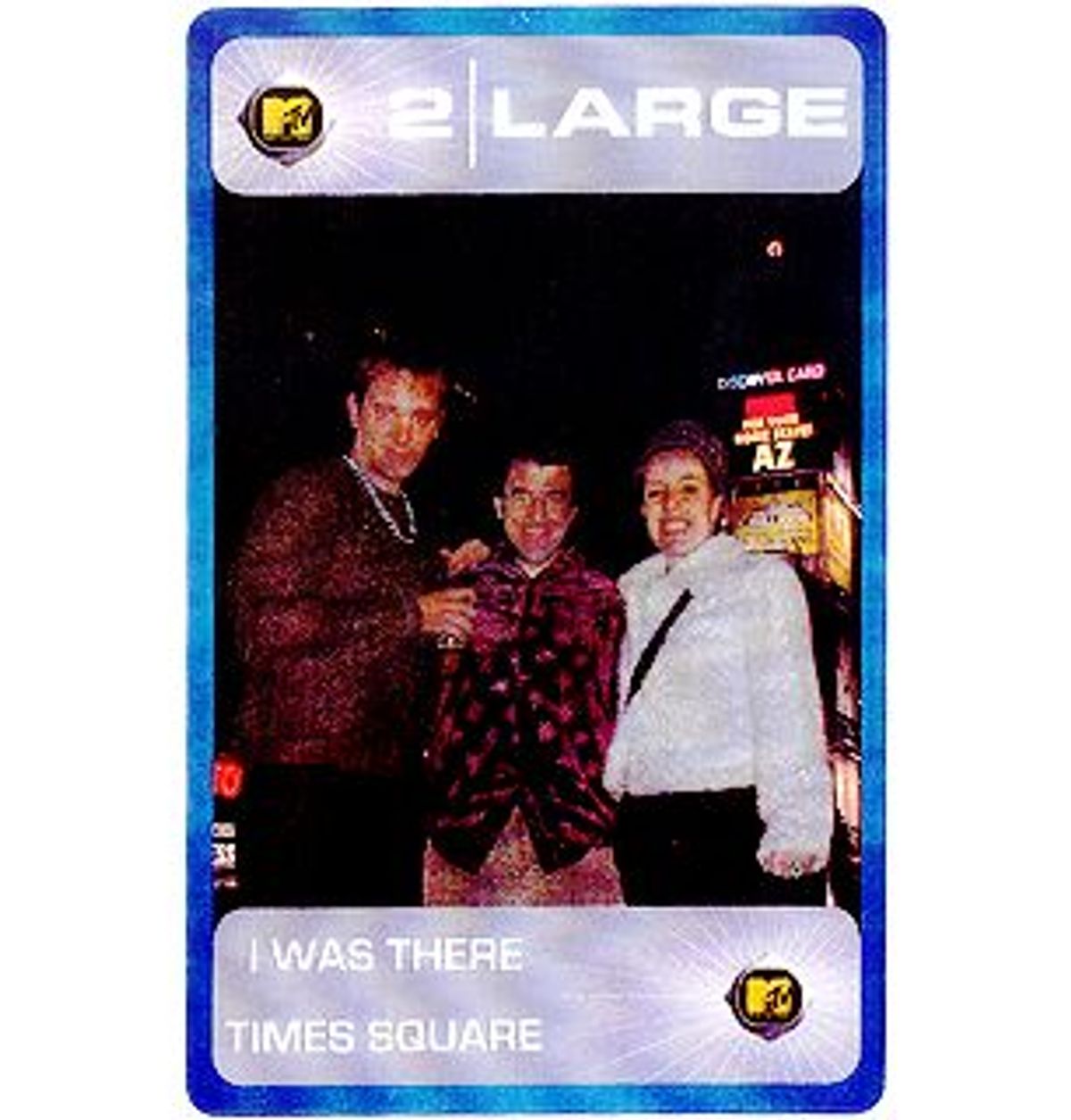
But we didn’t lose on New Year’s Eve, and that’s all that counts. Trey, Pam and I went to the MTV party in Times Square. Trey and Pam both worked with Brian Graden at Fox and now Brian heads programming for MTV. So we had the “in,” but Trey was nervous we’d end up at some lame party for production assistants while Brian rocked the house with all the celebs.

And that’s kind of what happened. After our retina scans were approved by security, we gave our names at the front desk and were assigned pink wristbands. Brian, however, was assigned a yellow wristband and got necklaced credentials. This suggested Trey, Pam and I were going to be smack in the foyer of lame mansion, high on lame hill, at the end of lame street.

Things took a turn for the worse when Brian veered off our general course and announced he had to go to work and we should go up to the party ahead of him.

I ordered a Tanqueray and tonic to ease the suffering only to find out hard liquor would not be served until 9. Great. So the three of us sipped our Coors Lights and dreamed about next New Year’s.

But then we had an idea. What if we said screw it and got really oiled RIGHT NOW! Yay. So we got things rolling along immediately. I tipped the bartender $20 and that took care of the 9 o’clock rule. In fact, by 9, we were tight.

That’s just about the time Brian rolled back around and offered to take us down to ground zero where the live show was being shot. Puffy was there, and Goo Goo Dolls, and I almost ran over Kurt Loder. But the floor was frantic. Everyone was working, and so all of a sudden the lame party with the imported transvestites seemed like home.

By 11:30 we’re gone. Wasted. But they want Trey to help give away spaces on the balcony. So he and Andrew Shue are up on the makeshift DJ stage. Trey’s announcing numbers in Cartman’s voice, slurring them horribly. It’s fantastic. Pam and I simply beam at each other. It’s fucking New Year’s 2000. Wooooo! Trey calls Pam’s number. She’s too obliterated to act. We push up the stairs, but she simply stands at one end staring at her hand. Mr. Shue comes over and puts the wristband in her hand, closing her fingers around it for her. Pam has left the building.

Finally, the big moment comes. The countdown hits 10. I am a wreck. Here we go. 3-2-1. Two million people erupt below us and the sound rockets up through the skyscrapers that pen us in. Because our balcony is back from the edge, we cannot see anyone below; we only hear them, which is eerie, but I’m not sure why yet. Confetti falls from somewhere. It blanks out the night sky, and I feel enclosed. Then it hits me. I’m standing in a great cathedral and listening to the choir, but from around the corner. I cannot see them, but hear and share in their ecstasy. And so much light is pouring up and being reflected off the confetti that it is as bright as day. So my mind finds the confetti, despite its chaotic randomness, strangely gentle. And because I feel I’m standing in a morning snowfall, my mind interprets the crazy loud chaotic and unpredictable circumstances as rather calm. Am I fucked up or WHAT?!! WOOO!!

Happy 2000, Button.

Love,

David.

Continue Reading Close

David Goodman, like Steven Spielberg before him, grew up in Haddonfield, N.J. He writes for "South Park" and is the editor of bluelawn.com.

New Yorker profile? No, thanks

It's an honor to be the subject of a long, flattering, well-written New Yorker piece. It is also the kiss of death

  • more
    • All Share Services

Topics: , , ,

New Yorker profile? No, thanks (Credit: AP/Salon)

Last year, The New Yorker ran a long, flattering profile of the director Andrew Stanton, the Pixar veteran who was engaged at the time in reshoots for the troubled “John Carter.” The article, by Tad Friend, noted some of the studio’s concerns about the initial cut of the film, which was Stanton’s debut in live action, but for the most part, its tone was highly positive, portraying Stanton as nothing less than Pixar’s resident storyteller: “Among all the top talent here,” an executive is quoted as saying, “Andrew is the one with a genius for story structure.”

Six months later, “John Carter” became one of the costliest flops in Hollywood history, and while the film may have its redeeming qualities, story structure isn’t among them. Read in retrospect, the Stanton profile now seems laden with irony, and it isn’t alone: A striking number of recent New Yorker features on movie directors and actors have been followed by embarrassing setbacks for the artists in question, usually involving the very projects that the articles are extolling.

In other words, whenever a New Yorker profile shows a director hard at work in the editing room, the studio should start to worry. Since the beginning of 2010, the magazine has published eight features on artists best known for their work in film. Two are profiles of Clint Eastwood and Jane Fonda that are basically career retrospectives. Of the remaining six, five of their subjects — Steve Carell, Guillermo del Toro, Anna Faris, John Lasseter and Andrew Stanton  — experienced significant professional reversals soon after the articles appeared. And while I’ll discuss the one exception in a moment, such a dire track record might well give pause to Armando Iannucci, the British director of “In the Loop,” who was profiled by the magazine in March.

To put it mildly, there’s something of a New Yorker feature curse going around Hollywood these days. It doesn’t always hold true — Dana Goodyear’s profile of James Cameron certainly didn’t hurt “Avatar” — but when it does, the results can be startling, especially when you set the articles alongside the films they so effusively describe. Tad Friend’s profile of Steve Carell, for instance, portrays its subject as “a brilliant piece of software, a 2.0 fix for the problem of unfunny comedy,” whose approach to collaboration is nothing less than “a painstaking set of procedures aimed at maximum creativity.” The result? “Dinner for Schmucks,” a critical and commercial nonevent that few would hold up as a model of “the golden age of improvisation.”

Other profiles read even more strangely in hindsight. Last May, the film “Bridesmaids” had everyone talking about the role of women in modern comedy, a topic that Friend addressed in a lengthy feature published the month before. “What’s at stake is not merely a tenable marketplace for ‘hard’ female comedies,” he writes, “but a fresh vantage on romance and, perhaps, a fresh way of seeing men and women.” Unfortunately, he isn’t talking about “Bridesmaids,” but about Anna Faris in “What’s Your Number?,” which came out in September and promptly sank like a stone.

I don’t mean to pick on Tad Friend, a fine and perceptive writer, because he certainly isn’t alone. I first noticed the phenomenon in an article on Tony Gilroy by D.T. Max, who glowingly describes the creative process behind the underwhelming “Duplicity.” More recently, Guillermo del Toro had the curse hit him twice, first during the writing of a profile by features editor Daniel Zalewski, which coincided with del Toro’s departure from “The Hobbit,” and shortly after the piece appeared, when Universal passed on “At the Mountains of Madness.” These articles are invariably graceful, smart,and insightful — and their subjects are all talented. Yet there’s no shaking the sense that such a feature rarely bodes well for the future.

Sports fans have talked for decades about a Sports Illustrated jinx, in which a player’s cover appearance seems to lead to a string of unusual bad luck. The reason for the jinx, if it exists, isn’t hard to understand: Athletes generally make the cover after an exceptional performance, which is right when they often regress to the mean. The New Yorker doesn’t put stars on the cover, but its features are valuable real estate, so it tends to favor subjects with a big success already behind them. There’s room in the magazine for emerging artists, but it’s in the Brooklyn of the back pages, not the Manhattan of the features section, which prefers seemingly sure things. Much as in Hollywood itself, you can’t get fired for going with last year’s star.

In finance, this is called performance chasing. It means investing in today’s interview subject based on yesterday’s hit movie, which, as an outlier, is often followed by a slump. This is how we get a look behind the scenes of “Duplicity,” not “Michael Clayton,” and it sometimes results in reportage that has a troubling tendency to ignore obvious warning signs. Anthony Lane’s feature on John Lasseter and “Cars 2,” for instance, is written in his characteristically prickly style, but for all his evident cynicism, he never raises a crucial point that many other observers had noted at the time, which was that Pixar was making a sequel to one of its weakest films. In the end, Lane’s skepticism is only skin deep, and it’s ultimately sacrificed to the needs of the narrative, in which the critic is grudgingly won over by the studio’s charms.

Occasionally, of course, the feature section does devote space to an emerging talent, as Rebecca Mead did last year with the director Lena Dunham, before the release of “Tiny Furniture.” (Iannucci can take some comfort from Dunham’s example: Their shows “Veep” and “Girls” were both renewed last week by HBO, one of the few forces around that can reliably beat the curse.) In this article, the exception mentioned above, several elements combine to push it into feature territory — social media, the New York art scene, “the cinema of unexamined privilege” — and the result is a rare instance of a profile catching an artist on the way up. Dunham jumps the queue because her story feeds into fashionable issues, a fact she lightly mocks: “There’s always an article coming out, saying ‘The new thing is funny women.’”

And this gets close to the heart of the problem. Many feature articles — including this one — strive to tie a bow on the story, to tether themselves to some larger theme, a tendency visibly pronounced at the New Yorker, thanks both to its reputation and to the relatively small number of movie features it publishes. At four or so profiles per year, an article can’t just be about Steve Carell or Tony Gilroy or Anna Faris: To justify the use of such premium space, it has to be about the future of comedy, or adult drama, or funny women, which leads to grand claims that can ultimately seem peculiar when we finally see “Dinner for Schmucks.”

“Nobody knows anything,” the writer William Goldman famously said of Hollywood, and if that’s true of filmmakers, it’s doubly true of the journalists who try to draw conclusions about so unpredictable an industry. If journalism is the first draft of history, it’s no surprise that the draft occasionally contains 10 finely reported pages on “What’s Your Number?” But that shouldn’t stop reporters from trying. We desperately need thoughtful articles that go deeper than the average star profile, like Ian Parker’s New Yorker feature from a few years back on George Clooney, which remains one of my favorite pieces ever published in the magazine. It came out the same month, naturally, as “Leatherheads.”

Continue Reading Close

Parenting advice from George Clooney’s dad

Nick Clooney explains how he raised Hollywood's socially aware icon

  • more
    • All Share Services

Topics: ,

Parenting advice from George Clooney's dadGeorge and Nick Clooney on the steps of the Sudan Embassy in Washington, D.C., on March 16. (Credit: Reuters/Kevin Lamarque)

When George Clooney was arrested on Friday while protesting outside the Sudanese embassy in Washington, he was not alone. “I’m glad to be standing here with my father,” he told reporters as he and his dad, former news anchor and television host Nick Clooney, were led away. Later, Clooney told Fox News Sunday that “I grew up in a family that believed your job was to be involved with your fellow man. You have a responsibility to participate in the human condition.” It was an example instilled in no small part by a father who he says was a “big believer in the importance of information.”

That strategy seems to have worked out pretty well for the guy. That’s why many of us currently raising our children in a culture full of forces trying to shield them from storybooks and the facts of life saw the Clooney family story as an inspiration, the epitome of bonding and parenting done right. And it made us go straight to the source and ask for some child-rearing insight from the man who gave us George Clooney — Nick Clooney himself. After genially joking about his “terrible ordeal” in jail over the weekend, and before taking his dog out for a morning walk, the veteran journalist spoke to Salon Wednesday on raising children who want to change the world.

What can we as parents do now so that someday, we might get to know what it feels like to ride in the back of a police van with our Oscar-winning, beloved humanitarian offspring?

In a lot of ways, it simply happens. Both of my children [Clooney also has a daughter, Ada] are extraordinary people, and a lot of that is just within them. Most of it is George himself. He tries to and does give credit to us for what we’ve done, but if he’d turned to be a serial killer I wouldn’t have been riding in the back of that paddy wagon with him.

How did you talk to your children when they were growing up?

We always talked about what was going on in the world. We talked about it at the breakfast table; we talked about it in the car. And we always wanted everybody in the family to know how we felt about things, especially about justice in the world. But we always tried to do it with humor and something that matched George’s and our daughter’s experiences. I hate sermonizing.

You throw out 58 homilies and you hope that one or two of them stick. And then our children would occasionally surprise us by spitting them back at us.

Based on the events of last weekend, that still happens.

We have continued to do that all throughout our lives.  When we pick up the phone now, we talk about what’s going on with us, and then we talk about what’s going on in the world.

As a newsman, what do you say to people who feel children need to be protected from the upsetting events in the world?

Perhaps we were negligent in protecting our children. We instead always opted for involvement. We always believed that was the best thing for us to do and for them to do. We believed that if someone is down on the ground, we should not be standing there and doing nothing. That has always mattered to us, and that always mattered to my grandmother and grandfather who raised me. And I hope that I’m passing it on to my children.

Continue Reading Close
Mary Elizabeth Williams

Mary Elizabeth Williams is a staff writer for Salon and the author of "Gimme Shelter: My Three Years Searching for the American Dream." Follow her on Twitter: @embeedub.

Seeing my father, through my cousin George

In "The Descendants," my cousin George Clooney channels a painful family story -- one he might not have even known

  • more
    • All Share Services

Topics: ,

Seeing my father, through my cousin George George Clooney in "The Descendants"

Every icon has a person living inside. It’s true of famous people, and true of everyday icons, too — the idealized figures against which we hold the real people we love. When iconography and reality press close enough to break the skin of one another, things can get uncanny quickly. And things got really uncanny for me when I saw “The Descendants.”

One reason for this is that my cousin is George Clooney. He’s older than I am, old enough to have fathered me if he’d really had to (he would have been a high school junior, but, hey, our family’s from Kentucky). I tell you he’s older only because I don’t want you to get the false sense that we grew up together. Rather, I grew up watching him. I was 8 and 9 and 10, for example, when George was on “The Facts of Life” (and believed, as only an 8- and 9- and 10-year-old girl might, that this was a good career move for him).

I grew up admiring my cousin George, then, in the way cousins do older cousins. Like many younger cousins, I witnessed his achievements mostly from a distance. And in that way my relationship with George Clooney is sometimes like the relationship of a lot of moviegoers with George Clooney. He is a cultural icon, after all, with his own channel on my Time Warner pay-per-view menu. Because the icon of George Clooney is so culturally pervasive, I see him on big screens and small screens more often than I see him as a member of our family, at family gatherings (where he is charming, kind, cool and venerable, as you’d expect an older cousin — and George Clooney — to be).

I have never written about my cousin because I think family should be a safe haven from exploitation. “We don’t do that,” I told someone at a family reunion a couple of years back, as she tried to take a cellphone photo of George’s ass as he leaned over some ill-placed guacamole. “It’s for the ladies at my church,” she replied.

But I’m writing this now because this essay isn’t really about George Clooney. It’s about my father, and the culture, and the weirdness of fame and art, and mostly the weirdness of remembrance. It’s about what happens when the art of one far-flung family icon makes you remember so viscerally the life of another obscure one, an icon famous nowhere but among the barns, and in the four shabby chambers of a daughter’s heart.

- – - – - – - – - – - -

I just watched “The Descendants” for the second time. I have never seen my older cousin look so vulnerable, and I think this is one part of why he reminded me of my father. George Clooney is not related to my father; George is my mother’s nephew. But my father’s name was George Matthew (he went by Matthew) and in the movie, George’s character’s name is Matthew. More important, my father, Matthew, died after a coma, and in the movie, Matthew’s wife dies after a coma. This is what triggered it: the look of the pallid skin of Matthew’s wife, the face of a coma, jaundiced and slack-jawed and tight around the eyes so that, like a skeleton — like death — it takes on the appearance of genderlessness. Elizabeth, Matthew’s wife, looked just like my father, Matthew, in his coma, down to the crusty mouth and the clawed-up hands. I hadn’t seen a coma since my father died — not one that looked so real. And that’s what really started it, the avalanche of coincidence.

My father, Matthew, was kept alive, for a while, by machines, and in the movie Matthew’s wife lives by machine until she is taken off of it; her family waits in the hospital for her to die, which is what happened with my father. My father was unfaithful, and in the movie Matthew’s wife is unfaithful. When my father died, I was a 21-year-old girl giving him shit, in part about the way he was raising my much-younger sister (which thinly disguised a bratty critique of the way he failed to raise me). In the movie, Matthew’s daughter is a 17-year-old girl giving him shit about, among other things, the way he raises her much-younger sister (which thinly disguises a bratty critique of the way he raised her).

In the movie, Matthew looks confused and quietly, desperately sad. This is a look my father wore, a lot, and one I wish I could reach through the ether to relieve. When I was 21 I thought my angry quips to my father were merely the preamble to a closer, more honest dialogue with him. I yelled only to wait for his answer. But he died before he could respond. So my unmeant words are the words that are left. They hang in the air.

In “The Descendants,” Matthew’s daughter also loses a parent in the middle of a conflict, but because her father survives, she is able to mend things with him, to admit she admires him. They work together to undo her mother’s paramour, and this conspiracy bonds them (Aristotle said it: The enemy of your enemy is your friend). The sweet, tepid ending of the movie is so good because it’s so prosaic; Matthew and his daughters watch TV, their feet sticking out of Elizabeth’s childhood quilt. This is what you do with the relics of the dead. You keep living with them until (like the fact of the death itself) they acquire the ordinariness of truth.

George Matthew became my father on Nov. 24, and in the movie another father dies on Nov. 24. In “The Descendants,” Matthew’s wife is buried at sea by Matthew and his daughters. I, too, buried my father at sea. “The Descendants” shows the ashes clouding the ocean and the leis skimming the water like fat skimming soup.

My father’s ashes in the marina, and the blooms that followed, looked the same. They circled one another like free-form, cardiac amoebas. Thus the movie reminded me of an image I’d never forget but hadn’t remembered for a long time.

- – - – - – - – - – - -

I don’t know whether George Clooney knew my father very well. Because my mother lived with her older sister, I grew up with my aunt Rosemary’s branch of the family in California. George moved to California in the early ’80s, but he moved out of my aunt’s house and onto his own life quickly. My aunt’s children were akin to my mother’s siblings, and they were the ones who knew my dad before and while my folks were married, who were my godmothers and godfathers and the attendants at my mom and dad’s wedding. My mom was sexually abused when she was a kid, though, and eventually came out about it, and coming out meant that she got exiled from my aunt’s branch of the family. When my dad died a couple of years later, it was not a surprise that I didn’t hear anything from the family I’d known as family.

But it was a surprise that, a decade or so later, it moved me so much to watch my cousin George encountering what I encountered with my father. It was a surprise that somehow, strangely, it comforted me. Probably because “The Descendants” extends the relationship between father and daughter beyond the point of crisis (which is part of what makes the movie so interesting, because so few films move relationships beyond a point of crisis without being conventional). Probably because, wishing for my dad, I lived vicariously through the characters.

It is also, though, the mere act of witnessing “The Descendants” that comforts me even as it tears me up; and I suppose this is the power of art, and of story — only connect, as E.M. Forster wrote. To see George playing a Matthew staggering under the familiar weight of mourning, under the specificity of a circumstance I have known and stumbled under — to see it, felt like my cousin was comforting me. To see my father’s hurt, and the same hurt I have felt, spread across the movie-huge space of his monochrome eyes — eyes not the same shape (the shape is my father’s) but the same near-black as mine — it was bizarre, and at the same time evocative of an eerie solidarity.

Please don’t misunderstand me. It is not a personalized solidarity. Whether or not George knew or remembered my father, Matthew, he does not know how my father, Matthew, died — we’ve never talked about it. (Why would we?) George would never know the slew of coincidences piled between my own history and “The Descendants’” script. (Why should he?) And yet, still, how weird and how wrenching to watch him live through such a thing.

Which is why the movie is so good. At its end I cried and so did a woman in a butch haircut three rows ahead of me. Which shows what I’m trying to say:  You don’t have to be George Clooney’s cousin, you don’t have to share his eye color (which might just be another coincidence; our grandmother had blue eyes, after all) to have a great movie evoke that desired effect, to move audiences not by replication of experience but by honesty of emotion, by verisimilitude, by sheer earned vulnerability, by the remembrance of life’s saddest turns and most commonplace glories.

And this, this tribute to art, and challenge to life: how strange that it was my cousin whom I did not really know, a human playing an icon playing another human, who made me feel that, of all my family, he understood my sadness and mourning and hope.

And in this way, though we all fail in the face of icons — be they famous or familiar — the truth of iconography can sometimes bring comfort closer.

Continue Reading Close

“The Descendants”: George Clooney’s Oscar-friendly Hawaii vacation

Facing mortality, adultery, teenagers and bad hair, the star should win hardware as a rumpled Hawaiian dad

  • more
    • All Share Services

Topics: , , , , ,

When I covered the premiere of Alexander Payne’s bittersweet, Hawaiian-themed comedy-drama “The Descendants” at the Toronto International Film Festival, I largely dodged my own mixed emotions about the film. Instead, I wrote about the evident fact that it may well win George Clooney the leading-role Oscar that has so far eluded him. (Although he’s twice been nominated for best actor, in “Michael Clayton” and “Up in the Air” — and was also nominated for both screenplay and direction with “Good Night, and Good Luck” — Clooney’s only Academy Award so far has come in the supporting category, for “Syriana.”) So it’s time to come clean and say that “The Descendants” bugs me quite a bit, even as it successfully navigates humor and heartbreak, and ultimately packs a considerable emotional wallop. It’s an unusual combination; if a movie can be subtle and clumsy at the same time, “The Descendants” is that movie.

Part of what’s going on in “The Descendants” is that Payne and co-writers Nat Faxon and Jim Rash (adapting a novel by Kaui Hart Hemmings, who gets to play a small supporting role) are calling on a time-honored dramatic strategy that goes back to Renaissance comedies, if not earlier: Concealing serious themes beneath a pleasant surface and a genial manner. Cinematographer Phedon Papamichael (who also shot Clooney’s “Ides of March”) delivers spectacular images of Hawaiian scenery and luxurious upper-crust life in the American tropics. Always a director who refuses to be rushed — either in making his films or in getting us through them — Payne ambles his characters from one unbelievably gorgeous location to another, pushed along by the tradewinds and by the mellowed-out rhythms of a soundtrack that’s likely to spark a mini-craze for Hawaiian slack-key guitar pop. And then there’s Clooney’s character, a bland, benign Honolulu lawyer named Matt King, who wears a Hawaiian shirt and rumpled chinos to work (yes, Aloha State readers, I know that’s normal) and seems supremely unprepared for the family crisis that has enveloped him.

Matt explains the whole situation in a series of rambling, discursive voice-over monologues that open the film: His wife, Elizabeth (Patricia Hastie, who never utters a line), is in a coma following a boating accident. Matt, who has always been the “backup parent, the understudy,” is alone with Scottie (Amara Miller), his ferociously angry 10-year-old daughter. In desperation, he summons his older daughter, the alienated teenage Alexandra (Shailene Woodley), from her boarding school on the Big Island of Hawaii. At the same time, Matt faces a huge decision about the immense land trust he manages for his extended family, 25,000 pristine acres on the island of Kauai that represents the last untouched inheritance of Hawaiian royalty. (Matt and his tribe are “haoles,” or Hawaiian-born whites, but are descended from the House of Kamehameha through a great-great-grandmother.) The time to sell out to a developer, and reap an enormous payoff that will make the whole family rich, seems to have come — but the final decision lies with Matt.

Laying out the whole story in such a patently literary, anti-dramatic fashion can only be deliberate. Matt doesn’t simply tell us the facts in this introductory narration, but also tells us what he’s feeling and thinking: “If you’re trying to get my attention, Liz, it’s working,” he tells his wife, silent in her hospital bed. “I’m ready to change.” When she gets better, he assures us (or her, or no one in particular), he’ll buy her a house in France, travel around the world, and perhaps even talk about their relationship, which we gather has been on the skids for some time. On one hand, this layer of pounding obviousness on top of Clooney’s subtle, measured tragicomic performance is completely unnecessary. On the other, I kind of get it: Payne is cashing in on Clooney’s basic likability and on the level of trust we feel for him, and using this breezy narration to make a story about mortality, loss, betrayal and adultery go down as smooth as a beachfront Mai Tai at sunset.

I’m about to describe some important but early plot developments; I wouldn’t call them spoilers, but if you feel an allergic response coming on, feel free to bail out. Before we get to that, a few more words about Clooney, who has unquestionably become a braver and more ambitious actor in middle age, and no longer seems concerned with nurturing his personal vanity or protecting his star image. Matt is an undemonstrative and uncharismatic guy with bad hair and a sub-J. Crew wardrobe, who at first seems far too modest a character to hold our attention. That’s precisely the point. Clooney gets one big emotional scene, near the end of the film, that’s likely to send viewers fishing for their hankies. But Papamichael’s camera literally backs away from Matt’s moments of crisis, and most of Clooney’s delicate, wrenching performance here lies in subtle, almost invisible things, like the way he begins to look at other people differently and hold their gaze longer, as circumstances push him toward a more grown-up relationship with his family and the world.

I think Payne is arguing that the most melodramatic elements of the story, like the boating accident and the Kauai land-trust dilemma, are just the setup for Matt’s real drama, which is internal. He has to face the truth about his marriage, first of all, and start all over again with Alex, a near-adult he barely knows who seems to view both him and Elizabeth with unmitigated disgust. (I’ve heard more than one cynical viewer observe that Payne has pulled off a neat trick: A romance between George Clooney and a teenage girl that isn’t creepy.) If there’s a second Oscar in this movie, it may well go to the 20-year-old Woodley, previously known for the TV series “The Secret Life of the American Teenager.” Alex has her own difficult emotional journey to make, as she’s thrust into the role of substitute mother to Scottie and her dad’s only emotional ally.

Matt has suspected the truth all along, and he’s about to get a heavily caffeinated double dose of it: Elizabeth isn’t getting better, and their marriage might have been over even without the head injury. Considering that this is a movie about a dying woman who lies hideously gnarled in a hospital bed and the cuckolded husband who half-suspects he deserves it, much of “The Descendants” plays as lightweight comedy. (In fact, on second viewing I see “The Descendants” as the faux-casual, American-indie alternative to Lars von Trier’s “Melancholia,” which cloaks similar emotional material in art-house grandiosity and science-fiction parable.) Matt and his family bumble episodically from one island of the Hawaiian archipelago to another, encountering Robert Forster in a bracing performance as Elizabeth’s righteously angry father, Beau Bridges as a boozy aging-hippie member of the King clan waiting for the money tap to turn on, Sid Krause providing comic relief as Alex’s stoner boyfriend, and Matthew Lillard (shticky) and Judy Greer (wonderful) as a real-estate hustler and his adorable wife.

There aren’t any huge surprises — or even too many small ones — about where “The Descendants” is going. (If you’ve ever seen a movie or a play or an episode of a TV series, you don’t even need to ask what decision Matt will make about those 25,000 unspoiled acres of paradise.) So how much you like it is largely a question of whether you enjoy getting there at Payne’s leisurely pace. There haven’t been many films set against the real-life culture of contemporary Hawaii (as opposed to touristy episodes shot on the beach), and Payne captures the slightly sleepy but fully modern atmosphere of the 50th state beautifully. Admittedly, the combination of great scenery, an interesting backdrop and two terrific acting performances easily goes far enough to make this movie a front-runner in the awards race. But I never got the feeling that I was experiencing something unexpected, or learning something new about the real world. There are quite a few better, braver and more ambitious films coming out this season, but this one has undeniable appeal and staying power. It’s a witty, well-crafted adult entertainment that hits its beats right on time and won’t insult your intelligence, with a great performance from one of Hollywood’s most beloved stars.

Continue Reading Close

Best of Toronto: Oscar candidates and indie breakouts

The Academy Award race gets underway in Toronto, and Clooney, Pitt and Knightley jump to the front of the pack

  • more
    • All Share Services

Topics: , , ,

Best of Toronto: Oscar candidates and indie breakoutsClockwise, from top left, scenes from "Think of Me," "The Descendants," "A Dangerous Method," "Moneyball"

One journalist friend of mine describes the Toronto International Film Festival as an exercise in chaos theory or, to put it another way, a gigantic real-world game of Tetris. No other festival in the world has so many simultaneous identities or fills so many niches: Toronto hosts a number of major Hollywood premieres and kick-starts the Oscar season, serves as the North American entry point for adventurous cinema from all over the world, rivals Sundance as a marketplace for American indies and is the principal showcase for Canadian film, all at the same time.

So no matter how many movies you see at Toronto — and I’ve seen plenty over the past week — you come home wishing you could have stayed longer, slept even less or sternly said no to party invitations. Among the films I didn’t see, I particularly regret Jennifer Westfeldt’s suddenly hot indie comedy “Friends With Kids,” Andrea Arnold’s reportedly abstract take on “Wuthering Heights,” Spanish director Juan Carlos Fresnadillo’s horror film “Intruders,” the ass-kicking Indonesian action film “The Raid,” Woody Harrelson’s star turn as a corrupt cop in “Rampart,” Japanese master Hirokazu Kore-Eda’s “I Wish” … the list doesn’t stop.

All that said, here are 10 movies that were much discussed at Toronto and will definitely make news in the months ahead. The first five are highly plausible or possible Oscar contenders and likely box-office winners, and the second tier consists of “specialty audience” films, as they diplomatically say in the biz. (In English, that means they’ll do well in college towns, but there’s no point booking ‘em in the shopping malls.)

MAJOR BRANDS

The Descendants This leisurely and rather quiet family tragicomedy from writer-director Alexander Payne (his first film since “Sideways” in 2004) gets by on George Clooney’s restrained and nuanced performance as a battered middle-aged dad and its unusual depiction of Hawaii as a place where people actually live, rather than a tourist destination. But it’s grown on me since I first saw it, and Payne and Clooney are both in line for multiple awards nominations. I expect to see a critical backlash on “The Descendants” in the not-too-distant future, simply because it’s an audience-friendly film that doesn’t have tremendous cinematic ambition and tells a predictable story of crisis and redemption. I don’t suspect Clooney admirers, ordinary moviegoers or Oscar voters will care too much.

A Dangerous Method Another picture that was more subdued and straightforward than many viewers expected or hoped, David Cronenberg’s drama about Carl Jung (Michael Fassbender), Sigmund Freud (Viggo Mortensen) and Sabina Spielrein (Keira Knightley), the patient-turned-therapist who came between them, remains a commercial question mark. This is a talky, elegant drama for grown-ups, largely shot in the actual European locations where Freud and Jung lived, not a twisted Cronenbergian psychodrama of orifices and nightmares. But I enjoyed its wit and vigor immensely, and suspect I’ll like it even better on second viewing. Brace yourselves, Keira-haters; Knightley is absolutely terrific as the brilliant femme fatale (and pioneering sexual masochist) who got elided from the history of psychiatry. If there’s an Oscar in this film, it’s probably hers.

Shame Arguably English artist-turned-filmmaker Steve McQueen’s Dante-esque odyssey through sex addiction, with Michael Fassbender and Carey Mulligan playing a tormented brother and sister, belongs in the art-house category. (For one thing, “Shame” will require either an NC-17 rating or none at all, which will sharply limit its theatrical potential.) But given the star power, the brilliant acting and McQueen’s audacious filmmaking, there’s at least some chance “Shame” could become this year’s “Black Swan,” albeit on a smaller commercial scale. Fassbender won the acting award at Venice for this role, and an Oscar nod is completely plausible.

Moneyball I’ll be reviewing Bennett Miller’s adaptation of Michael Lewis’ stats-obsessed baseball best-seller next week, but it’s one of the fall season’s great unknowns. Baseball movies have long been tough sells to mass audiences, and for obvious reasons don’t play well internationally (except in Latin America and Japan). Still most people who saw “Moneyball” in Toronto report that it tells an engrossing story, and that Brad Pitt’s portrayal of innovative Oakland A’s general manager Billy Beane could put him in the Oscar race — but if, and only if, enough people see the movie. Jonah Hill’s first major dramatic performance, as Beane’s assistant, might also be an awards candidate.

The Ides of March George Clooney’s cool and stylish political drama, starring the immensely hot Ryan Gosling as an idealistic media whiz facing the first major moral crisis of his young career, got mixed reviews in Toronto and arguably isn’t as distinctive as Clooney’s Oscar-nominated McCarthy-era yarn, “Good Night, and Good Luck.” But this is another case where the so-called smart people need to wait and see how ordinary viewers react. The movie’s beautiful to watch, capturing wintry Cincinnati landscapes as a sort of external corollary to its grim psychological landscape, and Gosling’s grave, measured performance — I’m tempted to call it a George Clooney performance by other means — is a memorable, artful construction. Paul Giamatti and Philip Seymour Hoffman could wind up battling each other in the supporting-actor race.

OUTSIDERS

Take Shelter Writer-director Jeff Nichols’ creepazoid psychological thriller, with Michael Shannon as a working-class Ohio man who becomes possessed by dreams and visions of apocalyptic storms, has been playing the festival circuit all year — and will finally be released just as this fall’s hurricane season winds down. I’ll be reviewing this soon, but here’s the two-second version: Holy cow! Made on a low budget and pitched halfway between a Terrence Malick or Stanley Kubrick nightmare and, say, M. Night Shyamalan, “Take Shelter” looks to me like one of the most memorable American films of the year. Shannon could be an Oscar dark horse — and certainly deserves to be — and the ubiquitous Jessica Chastain is very good as his troubled wife.

Your Sister’s Sister Seattle-based filmmaker Lynn Shelton made the festival hit “Humpday” a few years ago, which utterly failed to cross over to mainstream audiences despite tons of media chatter. Here she tries again, sticking to the improvisation-based relationship yarn but moving up in budget and in star quality. Emily Blunt and Mark Duplass play a pair of close friends with a complicated past (she was his late brother’s lover) who are clearly being drawn together, only to have the ever-terrific Rosemarie DeWitt, playing Blunt’s dogmatic vegan-lesbian sister, come between them unexpectedly. Comedy turns to darkness and then to some degree of redemption, and even in the overcrowded indie market, this satisfying and highly authentic-feeling indie could be Shelton’s breakthrough.

The Eye of the Storm Literary, dense and loaded with sharp observations, veteran Australian director Fred Schepisi’s adaptation of a novel by Nobel laureate Patrick White (a terrific writer not well known outside Australia) was my personal Toronto discovery. There’s nothing trendy or fashionable about “Eye of the Storm,” but check out the cast: Geoffrey Rush as a fading, horndog Australian actor and Judy Davis as his brittle, neurotic sister, a bankrupt Parisian divorcee with a ludicrous aristocratic title. They come home to Sydney to confront their immensely rich mother (Charlotte Rampling), who is near death and views them both with varying degrees of contempt. Add a delicious supporting cast and a hilarious portrayal of Aussie society circa 1972, and you have — well, you have something that I liked a lot, and I suspect, perhaps naively, that a grown-up, book-readin’-type audience is still out there somewhere.

Think of Me Lauren Ambrose, who played the red-haired teenage daughter on “Six Feet Under,” has been waiting for her breakout role as an adult, and if writer-director Bryan Wizemann’s downbeat single-mom drama isn’t quite that, it’s pretty close. As a struggling Las Vegas single mom named Angela, Ambrose walks the line between likable and utterly intolerable. Angela turns tricks (sometimes ineptly), works two jobs (not very well) and drags her 8-year-old daughter from one perilous situation to the next. Ambrose is on-screen for virtually every second, emanating a gorgeous, doomed charisma, and holds you in suspense the whole way. Ultimately, I suspect that “Think of Me” is too depressing to offer Ambrose her “Winter’s Bone” moment, but it’s a worthwhile recession-era drama built around a terrific performance.

The Loneliest Planet OK, I haven’t yet seen the newest film from ultra-smart indie auteur Julia Loktev, who made the strange and powerful terrorism drama “Day Night Day Night” in 2007, but I’m going to crawl out on a limb for it anyway. (It will screen at the New York Film Festival in a few weeks.) Gael García Bernal and Hani Furstenburg play a gorgeous and privileged couple who go hiking in the Caucasus, with explosive and unexpected consequences. Inspired by a Tom Bissell short story that was itself inspired by a Hemingway story, “The Loneliest Planet” will probably end up as a modest theatrical or VOD release — but everybody I know who saw it in Toronto said it was remarkable.

Bonus Pick: Take This Waltz I’ve already written a lengthy review of Sarah Polley’s potent, sexy, audience-dividing relationship flick, which stars Michelle Williams in one of her best performances. There’s still no news on an American distributor, and the Toronto scuttlebutt suggests this may not be released until 2012, to avoid competition with Williams’ presumed award-candidate role in “My Week With Marilyn.” It’s still great! But we’ll have to adjourn the debate for another occasion. 

Continue Reading Close

Page 1 of 17 in George Clooney