U.S. Economy
After Seattle, a world trade lovefest
Anti-globalization protesters meet a sympathetic President Clinton in Switzerland.
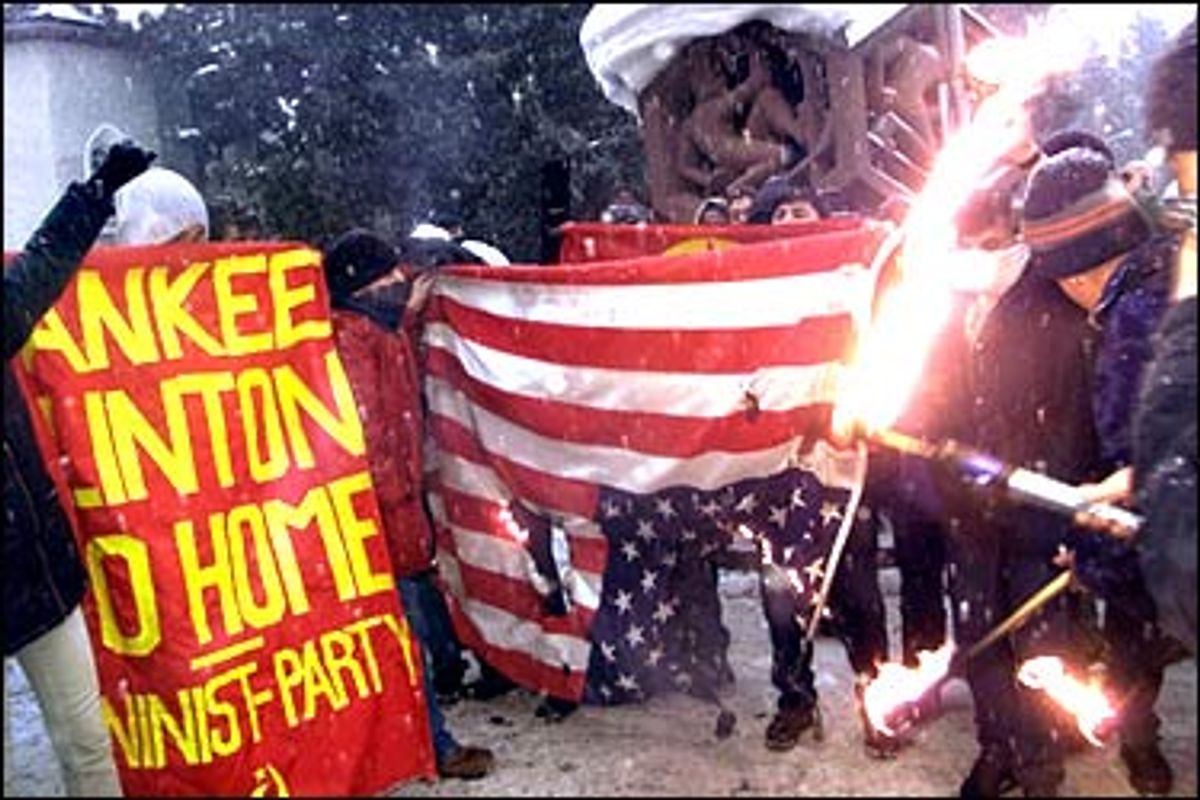
Protesters swarming the snowy Alpine village street toward the World Economic Forum on Saturday afternoon answered one question hanging in the air since Seattle. Yes, the anti-corporate, anti-globalization, anti-U.S. elements that were galvanized by the World Trade Organization demonstrations remain energized. And they are convinced they now have an international audience for their message.
Inside the conference, President Clinton indicated that he heard that message loud and clear. In a speech to the assembled CEOs, functionaries, writers and non-governmental-organization activists invited to the meeting, Clinton heralded a surprising shift in the U.S. attitude toward the expansion of global trade. “Those who heard a wake-up call in Seattle got the right message,” he said. “I do not agree with those who view with contempt these new forces seeking to be heard in the global dialogue.”
The bottom-line message of the Seattle protests was an economic critique of the globalist vision, one that raged against systems and trends that are widening the gaps between the world’s haves and have-nots. In Davos, a much smaller number of protesters, approximately 500, hammered home the same message with familiar slogans. Several protesters smashed the windows of a McDonald’s restaurant less than a mile from the conference hosting Bill Gates, Steve Case and various other symbols of corporate gigantism, an act captured by the cameras and given prominent play on CNN. But the message of Seattle was conveyed even more profoundly in Clinton’s own speech. It’s still not clear whether he’s serious about the election-year gesture of bringing environmental groups and labor unions into the evolution of international trade policy.
Clinton proclaimed, “We have got to reaffirm unambiguously that open markets and rules-based trade are the best engine we know to lift living standards, reduce environmental destruction and build shared prosperity. This is true whether you’re in Detroit, Davos, Dacca or Dakar.” He lingered after his speech for half an hour, shaking just about every hand in the place and doing that lean-in-and-listen thing.
He defended free trade but also warned, “Don’t leave the little guys out” and said, “Trade can no longer be the private province of politicians, CEOs and trade experts.” He warned business leaders that labor and environmental groups have to be seen as more than nuisances to globalization deals. He mentioned AFL-CIO President John J. Sweeney three times in his Davos speech, more than anyone else, and Sweeney could not help but be flattered.
This speech might have put Clinton at odds with leaders of developing nations who do not want rich countries telling them what labor and environmental standards to enforce. And it might have confused the debate in Washington over trade deals on China, Africa and the Caribbean basin — deals that were negotiated before Seattle prodded Clinton to start including labor and environmental groups. But Clinton’s focus was clear. He seems to be hoping these new invitees to the table will tolerate the previously negotiated deals in exchange for the promise of substantive input on future ones.
Taking the podium, Sweeney spoke of globalizations’s “tremendous potential to lift people around the world. But financial crises are growing more frequent and severe,” he added, pointing to United Nations reports on the growing disparity between the wealthy and the poor. “This means that the seeds for rejection of globalization are in every political system, in developed nations as well as developing nations.” He invoked the image of Seattle’s street protests, with their alliance of disparate groups.
Sweeney diplomatically tied the anger of protesters to that of delegates from developing nations, “who felt just as locked out as the demonstrators. If we care about equitable, sustainable development, then the impact on people — not only incomes but the environment, health, food safety, debt forgiveness and democratic participation — can no longer simply be left to chance.”
Clinton’s presence at the gathering — he is the first U.S. president to come to Davos in the event’s 30 years — did more than raise the stature of the forum. It drew protesters from Italy, France, Germany and elsewhere in Switzerland. A local environmentalist paraglided over the conventional hall trailing a banner “WEF: decide with your heart.” The confused, panicky Swiss police, many called in from Zurich, finally brought the march to a halt several hundred meters from the forum itself.
Hours before the protest, skiers and townspeople walked past bored policemen stationed with their machine guns here and there in clumps, and kidded them about their boredom. It seemed a big joke, the idea of a protest in this calm, exclusive ski village. Even when the protesters sauntered up the main street, they didn’t have much to do but throw snowballs, not exactly a textbook strategy for provoking the cops into a violent outburst that could be used on TV. But as it turned out, some snowballs were snow-covered bricks, and later one Swiss policeman was brought down by a bloody head wound.
Townspeople crowded windows along the street, fascinated by the commotion if also a little appalled by the unruliness of it all. Many of them thought there was something to the anti-globalization message.
“I think 95 percent of them are chanting and making noise, but not militant,” said retired Davos resident Peter Putscher. Any misgivings about the spray-painting of walls and other mischief did not obscure his belief in the larger message of the demonstration. “This is a follow-up to what happened in Seattle, and I think it is good that this helps make a discussion. In Switzerland, we have peace and quiet, it’s a little country. But when you go to other countries, it’s something different.”
Post-Seattle, protests of globalized trade carry an almost automatic resonance. But the protests at Davos point out the difficulties in generating a consistently articulate message and presenting it in a way that will continue to get attention. Pulling down the American flag from a conference hotel and burning it in the snowy street may be great for getting the blood flowing.
But the Davos protesters and their kindred spirits should feel at least as much of a challenge as the executives inside the meeting to come to terms with the developments in negotiations. Their success at continuing to build on the legacy of Seattle may hang in the balance.
Steve Kettmann, a regular contributor to Salon, is the author of "One Day at Fenway: A Day in the Life of Baseball in America." More Steve Kettmann.
Is America’s age of discovery over?
A small group of ambitious institutions gave us the Internet, lasers and TV. Now they're dwindling. Are we doomed?
(Credit: wavebreakmedia ltd and Christian Delbert via Shutterstock) Not so long ago, the core skill of the United States was new industry creation. And at the same time — not coincidentally — the country boasted the world’s largest and fastest-growing economy. During the 1920s, 1930s, 1940s, 1950s, and 1960s, scientific and technological breakthroughs from the United States produced a steady stream of extraordinary new industries and products. These industries stimulated consumer demand and, by providing high-paying jobs, enabled it.
That stream of basic discoveries was produced not mainly by self-funded geniuses in backyard garages but rather by a quite unusual and focused machine for discovery and innovation — a network of institutions deliberately founded, organized, and run for the purpose of fueling scientific and technological insight. Including such legendary institutions as Bell Labs, Xerox PARC, RCA Laboratories, DARPA, and others, this network consisted of public, private, nonprofit, and for-profit efforts working in combination. Programs with clear commercial potential were supported alongside efforts at “pure science,” with the two streams resonating with and feeding off each other. This discovery and innovation machine existed because of a business and political culture that supported invention independent of immediate practical applications, as being “good for the country.”
Continue Reading CloseThe folly of a Chinese trade war
American workers need China's economy to grow faster. Tariff threats from the U.S. Senate won't accomplish that VIDEO
A child poses in front of a giant red lantern on display at Beijing's Tiananmen Square on China's National Day. (Credit: Reuters/Jason Lee) Moments before China successfully launched its Tiangong “Heavenly Palace” space lab on Sept. 29 — a key step toward the goal of a manned Chinese space station in orbit by the end of the decade — China’s largest television network broadcast a 90-second long animation describing the spacecraft’s journey into orbit, with the uplifting music of “America the Beautiful” as soundtrack.
Some observers considered the juxtaposition a howling blunder; others regarded the move as a calculated insult from a rising superpower to an empire in decline. But whatever the real story, of one thing there could be no doubt: In the same year that the United States retreated from space, shutting down its Space Shuttle program, China declared that the sky would be no limit to its own ambitions.
Continue Reading Close
Andrew Leonard is a staff writer at Salon. On Twitter, @koxinga21. More Andrew Leonard.
America’s lost economic decade
The once-powerful middle class has collapsed, and the poor have it even worse. Will the U.S. ever recover?
(Credit: Jim Barber via Shutterstock) Food pantries picked over. Incomes drying up. Shelters bursting with the homeless. Job seekers spilling out the doors of employment centers. College grads moving back in with their parents. The angry and disillusioned filling the streets.
Pan your camera from one coast to the other, from city to suburb to farm and back again, and you’ll witness scenes like these. They are the legacy of the Great Recession, the Lesser Depression, or whatever you choose to call it.
Continue Reading CloseAndy Kroll is a reporter in the D.C. bureau of Mother Jones magazine and an associate editor at TomDispatch. His writing has appeared at the Nation.com, Alternet, CNN.com, CBSNews,com, and Truthout, among other places. He welcomes feedback, and can be reached at his website, http://www.andykroll.com/ More Andy Kroll.
The end of the dollar standard
The currency's grip on the world economy is rapidly slipping -- and that could mean bad things for us
(Credit: jokerpro via Shutterstock) “It’s China’s World. We Just Live in It,” Fortune announced in October 2009. The accompanying article described a prospecting trip in Africa by officials of the China National Offshore Oil Corporation. Nigeria was renewing production licenses in its oil fields, and CNOOC was aiming to elbow aside such traditional players as Exxon Mobil and Royal Dutch Shell. “The Beijing-based company wants to secure no less than one-sixth of the African nation’s production,” the article asserted. “And CNOOC, apparently, isn’t screwing around.” China’s sudden appearance distressed the existing licensees but delighted the Nigerians. “We love this kind of competition,” a spokesman for the government said.
Continue Reading CloseWhy Bernanke’s worried about Europe’s debt
How the EU crisis could lead to another giant Wall Street bailout
(Credit: AP Photo/Evan Vucci) On Tuesday, Ben Bernanke added his voice to those who are worried about Europe’s debt crisis.
But why exactly should America be so concerned? Yes, we export to Europe – but those exports aren’t going to dry up. And in any event, they’re tiny compared to the size of the U.S. economy.
If you want the real reason, follow the money. A Greek (or Irish or Spanish or Italian or Portugese) default would have roughly the same effect on our financial system as the implosion of Lehman Brothers in 2008.
Continue Reading CloseRobert Reich, one of the nation’s leading experts on work and the economy, is Chancellor’s Professor of Public Policy at the Goldman School of Public Policy at the University of California at Berkeley. He has served in three national administrations, most recently as secretary of labor under President Bill Clinton. Time Magazine has named him one of the ten most effective cabinet secretaries of the last century. He has written 13 books, including his latest best-seller, “Aftershock: The Next Economy and America’s Future;” “The Work of Nations,” which has been translated into 22 languages; and his newest, an e-book, “Beyond Outrage.” His syndicated columns, television appearances, and public radio commentaries reach millions of people each week. He is also a founding editor of the American Prospect magazine, and Chairman of the citizen’s group Common Cause. His widely-read blog can be found at www.robertreich.org. More Robert Reich.
Page 1 of 217 in U.S. Economy