Native Americans

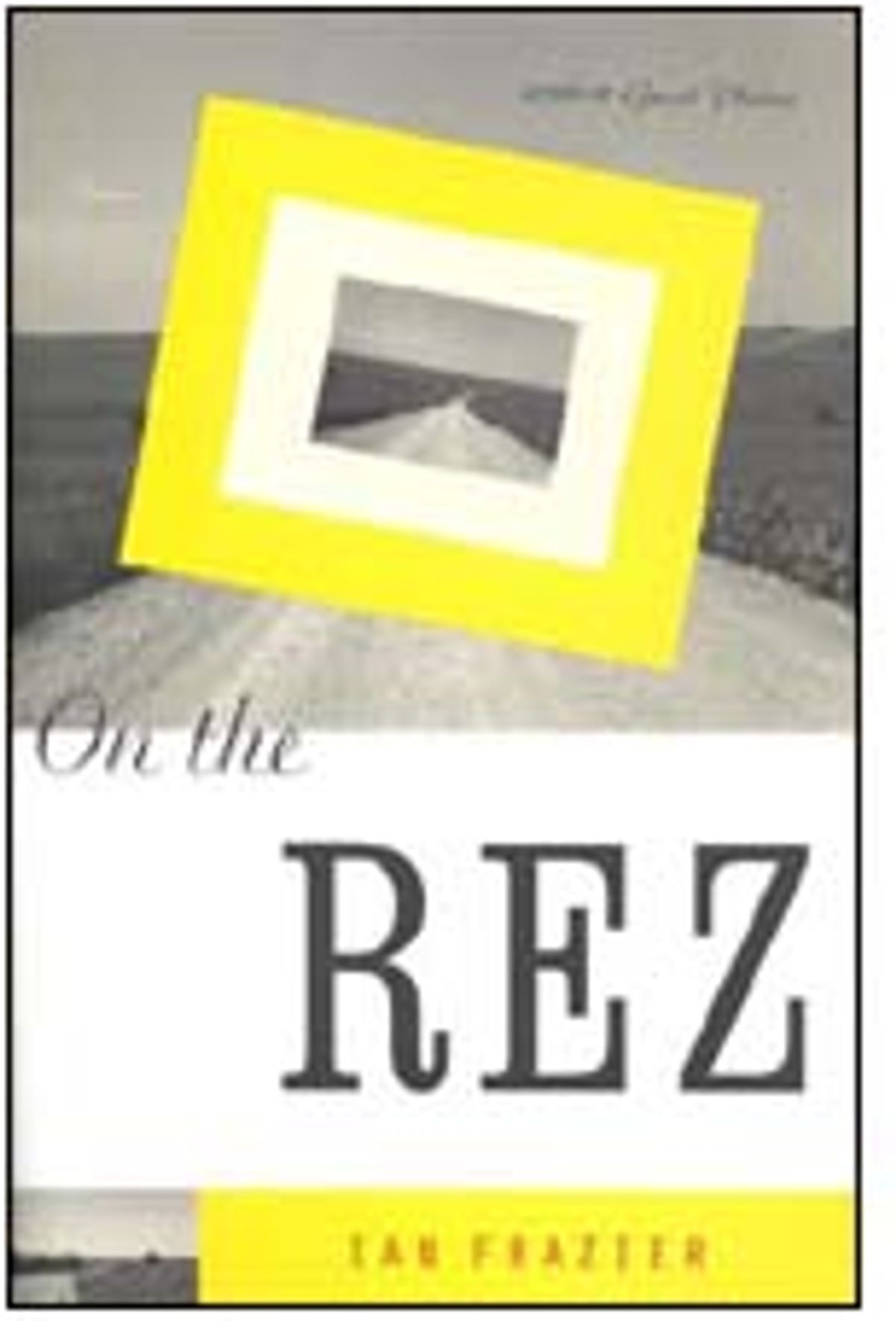
“On the Rez” by Ian Frazier

In an instant American classic, a great writer zeros in on the Oglala Sioux (as much as he can zero in on anything).

  • more
    • All Share Services

Everything that’s right about Ian Frazier’s nonfiction can be summed up by two sentences that occur late in his new book, “On the Rez”: “Reader, books are long, and I know that even the faithful reader tires. But I hope a few of you are still with me here.” When was the last time you encountered a contemporary writer who addressed you as “reader” without irony, who regarded you not as a presence to be taken for granted but as a relationship that needed tending?

It’s fitting that Frazier extends this consideration to his readers. His writing, in such books as “Great Plains” (1989) and the magnificent “Family” (1994), is about a willingness to engage with other people, to experience (and accept) them as they are rather than as you wish they would be. Decency is its common coin. I won’t say “common decency,” because Frazier’s type of decency is anything but. And yet he writes as if the respect he shows his subjects, as well as his readers, were the natural state of human affairs and anything else would be a deviation from the norm.

Frazier is old-fashioned in the best sense. (He even wrote about still working on a manual typewriter in an Atlantic Monthly piece a few years back.) He’s determined, through either stubbornness or just temperament, to let as few of the blockades of modern life get in his way as possible. Open his books and you find yourself in an America where people still talk to their neighbors (and this has been as true of his writing about Brooklyn as about the Great Plains), where community life is conducted in post offices and convenience stores and at high school sporting events. That attitude might make Frazier seem like a square if his writing didn’t reveal his loopiness (which comes into full flower in his humor pieces). Frazier’s vision of America is no cozy Norman Rockwell neverland; it’s more like David Lynch land, a place where the ordinary seems deeply strange and fascinating and, finally, anything but ordinary.

In “On the Rez,” Frazier zeros in on one of the subjects he touched on at length in his rambling tour “Great Plains”: American Indians. As much, at least, as he can zero in on anything — typically, this account of Frazier’s friendship with an Oglala Sioux named Le War Lance and of his visits to the Pine Ridge Reservation in South Dakota reveals him to be interested in just about everything. (Empires could rise and fall in the time it would take him to go through a flea market.)

That wide-ranging interest can sometimes make for a meandering read. Frazier is a list maker and a plaque reader. “On the Rez” opens with a genuinely surprising prologue that lays out the case for Indian influence on American culture, in the process pointing out the condescension in the well-meaning (and, Frazier contends, wrong) pieties about how Indian culture has been obliterated. It’s a brilliant piece of writing, but it may set up false expectations, since the essay form of stating an argument and then making a case for it isn’t the way Frazier writes.

He’s much more interested in just recording his comings and goings at Pine Ridge, in following the ups and downs of his often testy friendship with Le War Lance as they make trips to pick up beer or to repair one wreck of an auto after another or to visit some relative or other, and seeing what that approach will reveal. (One thing it reveals a lot about is Frazier’s decency. I doubt that there are five readers of “On the Rez” who would put up with War Lance’s drinking or freeloading the way Frazier does.) It’s a method that demands the reader’s patience but also rewards it, getting at the texture of life in a way that a sociological analysis or a straightforward inquiry into the place of the Indian in contemporary America never would.

Toward the end of the book, totting up the problems that bedevil the Indians on Pine Ridge — poverty, alcoholism, suicide — Frazier writes, “But beneath all that is something bigger and darker and harder to look at straight on. The only word for it, I’m afraid, is evil. News stories emphasizing the reservation’s ‘bleakness’ are actually using this as a circumlocution for that plain, terrible word.” And here — in his understanding of the limits of cause-and-effect explanations and his ability to make that statement without a trace of hysteria — is the strongest echo of the 19th-century literary sensibility that so often seems his model.

But it’s not evil that hangs over this book; it’s a sense of plain perseverance. Much of that feeling has to do with the three chapters near the end on SuAnne Big Crow, a Sioux who died a hero at the age of 17 after leading her high school basketball team to a state victory; the championship had much to do with softening the tensions not just between the Sioux and the white teams they often played but also between the bitterly divided political factions on the reservation. Characteristically, Frazier stumbles on SuAnne’s story when he happens into a youth center named for her, and he turns it into a small classic of empathetic reporting.

For Frazier, SuAnne’s story (too good to spoil by retelling it here) is bound up with the notion of heroes — another of the unfashionable or outmoded concepts he embraces without embarrassment. In his eyes, SuAnne exists simultaneously as legend and real person, within an Oglala tradition of figures like Crazy Horse, who was “just a guy you saw around from time to time” but also “the near-magic warrior.” For those of us not used to having legends spring from our midst, Frazier compares the phenomenon to having your childhood fantasy of your father as the strongest man in the world confirmed by seeing him win the Olympic gold medal in weight lifting — astonishing and inspiring in a way that makes us aware of our best possibilities.

SuAnne’s story is also deeply bound up with the notion of community that runs through “On the Rez.” She lived within the framework of her community but also at the limits of it, pushing it, showing it that it could contain more than anyone had imagined. By articulating a vision of life with her actions, by making people ask why they should settle for less, she elevated her community. And so for Frazier, finding SuAnne becomes almost a form of karmic payback: An affirmation that the humane curiosity he extends subjects is justified, that it has, at last, found a story worthy of it.

Charles Taylor is a columnist for the Newark Star-Ledger.

No Plan B for Native American women

Despite being at exceptionally high risk for sexual assault, many have little access to emergency contraception

  • more
    • All Share Services

No Plan B for Native American women

Many women in America’s most vulnerable communities are already forced to live out Rick Santorum’s contraception-less nightmare. Heather Michon explains:

After weeks of debate over personhood, Planned Parenthood funding, transvaginal ultrasounds, fetal pain, Fluke-fest, aspirin-between-the-knees, and the little matter of 130,000 economically disadvantaged Texas women losing access to basic health care starting today, discussions about the accessibility of Plan B seem so… December 2011. Ancient history.

But for one group of women, access to emergency contraception is an urgent and tragically unmet need: the hundreds of thousands of Native American women who live on reservation lands. Their struggle for a better standard of care is the subject of a recent roundtable discussion by the Native American Women’s Health Education Resource Center (NAWHERC).

The statistics are stark. More than 1 in 3 Native American women will be sexually assaulted their lifetimes, a rate much higher than the general population. In one study, a stunning 92 percent of young women reported they had been forced to have sex against their will on a date.

Read more on her Open Salon blog.

Shocker: Obama to give America back to Indians

A secret U.N. plot revealed: First, they'll take Manhattan

  • more
    • All Share Services

Shocker: Obama to give America back to IndiansPresidential Medal of Freedom recipient Joseph Medicine Crow shows a drum to President Barack Obama and First Lady Michelle Obama during a reception for recipients and their families in the Blue Room of the White House, August 12, 2009. (Official White House photo by Pete Souza) This official White House photograph is being made available only for publication by news organizations and/or for personal use printing by the subject(s) of the photograph. The photograph may not be manipulated in any way and may not be used in commercial or political materials, advertisements, emails, products, promotions that in any way suggests approval or endorsement of the President, the First Family, or the White House.(Credit: The White House)

Congratulations, 2010, for fitting in one more completely insane made-up right-wing scandal: Barack Obama is going to give Manhattan back to the Indians! Also the U.N. will help, because grrrr, the U.N.!

Earlier this month, Obama said the U.S. would support the U.N.’s “Declaration on the Rights of Indigenous People,” a non-legally binding promise to finally treat indigenous peoples with some small amount of decency after hundreds of years of the government murdering them and expelling them from their homes and forcibly relocating them to barren desert ghettos and now just letting them live in conditions of appalling, abject poverty. Bush refused to sign on to this, because, I dunno, it was from the U.N., and it might lead to frivolous lawsuits, or something? It’s a non-binding Declaration that basically says “we will be nice to indigenous people,” there’s no good reason not to support it.

But because hysterical right-wingers are hysterical right-wingers, they are seizing on this document as yet more proof that Obama wants to forcibly redistribute all the wealth, from productive hard-working Real Americans to swarthy welfare leeches. Take it away, World Net Daily!

President Obama is voicing support for a U.N. resolution that could accomplish something as radical as relinquishing some U.S. sovereignty and opening a path for the return of ancient tribal lands to American Indians, including even parts of Manhattan.

The issue is causing alarm among legal experts.

Oh, I bet it is. WND-founder Joseph Farah has a little column where he repeats this insane story, but then he quotes some egg-head professor who says that all the tribes want is some “open lands/spaces for repurchase,” which doesn’t really sound like “giving back” Manhattan to the Native Americans.

I say if you’re gonna do it, do it right and actually give New York back to the Delaware Indians! I’d rather be ruled by them than by Bloomberg and Albany.

(Also why don’t Scalia-style Constitutional originalists ever insist that America honor its various broken treaties with all the Indians whose lands we stole as we systematically removed and massacred them? I know that would entail giving them back the entirety of Oklahoma, among lots of other amusing things, but the supremacy of treaties is in the damn Constitution! Although I guess Article Six, with its federal supremacy clause and its no religious test talk, has always been the article that right-wingers are not particularly enthusiastic about.)

Correction: This article originally stated that WND founder Joseph Farah repeated the phrase “Carter era” in his incredibly silly column. That is incorrect. It was the incredibly silly “news story” on his incredibly silly website that repeated that phrase, even though the story has nothing at all to do with Jimmy Carter. I apologize for the error.

Continue Reading Close
Alex Pareene

Alex Pareene writes about politics for Salon and is the author of "The Rude Guide to Mitt." Email him at apareene@salon.com and follow him on Twitter @pareene

Custer’s “Last Flag” sells for $2.2 million

A private collector takes home the only banner not captured or lost during the Battle of Little Big Horn

  • more
    • All Share Services

The only U.S. flag not captured or lost during George Armstrong Custer’s Last Stand at the Battle of Little Bighorn in southeastern Montana sold at auction Friday for $2.2 million.

The buyer was identified by the auction house Sotheby’s in New York as an American private collector. Frayed, torn, and with possible bloodstains, the flag had been valued before its sale at up to $5 million.

Since 1895, the 7th U.S. Cavalry flag — known as a “guidon” for its swallow-tailed shape — had been the property of the Detroit Institute of Arts, which paid just $54 for it.

Custer and more than 200 troopers were massacred by Lakota Sioux and Northern Cheyenne warriors in the infamous 1876 battle. Of the five guidons carried by Custer’s battalion only one was immediately recovered, from beneath the body of a fallen trooper.

And while Custer’s reputation has risen and fallen over the years — once considered a hero, he’s regarded by some contemporary scholars as an inept leader and savage American Indian killer — the guidon has emerged as the stuff of legend.

“It’s more than just a museum object or textile. It’s a piece of Americana,” said John Doerner, Chief Historian at the Little Bighorn Battlefield National Monument in southeastern Montana.

The other flags were believed captured by the victorious Indians.

The recovered flag later became known as the Culbertson Guidon, after the member of the burial party who recovered it, Sgt. Ferdinand Culbertson. Made of silk, it measures 33 inches by 27 inches, and features 34 gold stars.

For most of the last century the flag was hidden from public view, kept in storage first at the museum and later, after a period on display in Montana, in a National Park Service facility in Harper’s Ferry, Md., according to Detroit Institute of Arts director Graham Beal.

Dating to an era when the museum took in a variety of natural history and historical items, the guidon was sold because it did not fit with the museum’s focus on art, Beal said.

“The irony is you get all these people phoning the museum upset we’re selling the flag, and no one knew we owned it,” he said.

A second 7th Cavalry guidon was recovered in September 1876, at the Battle of Slim Buttes near present-day Reva, S.D.

Now in possession of the Little Bighorn Battlefield National Monument, that flag was poorly cared for and is now in horrible condition — “almost dust,” according to the monument’s chief of interpretation, Ken Woody.

As for Culbertson’s Guidon — or Custer’s Last Flag, as Sotheby’s has billed it — Woody pointed out that without the Custer mystique, it would be just another piece of old cloth.

“Some people like memorabilia and Americana, and they all want to own a little piece of it,” Woody said.

Sealed in a custom-made plexiglass case by the Detroit museum since its return from the Park Service in 1982, the flag has several holes and the red of some its stripes has run into the white stripes. Its once-sharp swallow tail tips are now tattered and torn.

Culbertson’s Guidon also is missing a star and a section of striping about 9 inches wide and 6 inches high — apparently cut away as a souvenir before its acquisition by the museum. Yet on the auction block, even what’s missing is worth a story.

“I’m sure Culbertson let other men take small snippets for themselves,” Sotheby’s vice chairman David Redden said.

Continue Reading Close

Obama set to hold second Native American conference

The president will host leaders from the nation's 565 federally recognized tribes at the White House Dec. 16

  • more
    • All Share Services

President Barack Obama will play host to Native American leaders at a White House conference on Dec. 16.

The president has invited the leaders of each of the 565 federally recognized tribes to the event, the White House announced Monday. It would be Obama’s second conference with American Indians. Obama first met with tribal leaders last November.

The president says he wants tribal leaders to be able to interact with him and with top administration officials.

Last year’s event drew leaders from 386 tribal nations and was the first meeting of its kind in 15 years.

U.S. offers $680 million to Indian farmers

After months of negotiation, the government settles with Native American ranchers who say they were denied loans

  • more
    • All Share Services

The government is offering American Indian farmers who say they were denied farm loans a $680 million settlement.

The two sides agreed on the deal after more than 10 months of negotiations. The government and the Indian plaintiffs met in federal court Tuesday to present the settlement to U.S. District Judge Emmet Sullivan.

The agreement also includes $80 million in farm debt forgiveness for the Indian plaintiffs and a series of initiatives to try and alleviate racism against American Indians and other minorities in rural farm loan offices. Individuals who can prove discrimination could receive up to $250,000.

A hearing on preliminary approval of the deal is set for Oct. 29. Sullivan indicated he was pleased with the agreement, calling it historic and coming down off his bench to shake hands with lawyers from both sides.

Assistant Attorney General Tony West and Joseph Sellers, lead attorney for the plaintiffs, both said they were encouraged by the judge’s positive reaction.

“Based on the court’s comments, we’re optimistic,” West said after the hearing adjourned.

The lawsuit filed in 1999 contends Indian farmers and ranchers lost hundreds of millions of dollars over several decades because they were denied USDA loans that instead went to their white neighbors. The government settled a similar lawsuit filed by black farmers more than a decade ago.

Unlike a second round of the black farmers suit that is now pending in Congress, the American Indian money would not need legislative action to be awarded.

The Obama administration has said settling the American Indian case is a priority. Hispanics and women farmers also have pending cases.

“Today’s settlement can never undo wrongs that Native Americans may have experienced in past decades, but combined with the actions we at USDA are taking to address such wrongs, the settlement will provide some measure of relief to those who have been discriminated against,” Agriculture Secretary Tom Vilsack said in a statement.

Claryca Mandan of North Dakota’s Three Affiliated Tribes, a plaintiff in the case, stopped ranching after she and her husband were denied loans in the early 1980s. She said she was pleased with the settlement.

“This is a culmination of 30 years of struggle,” she said.

Continue Reading Close

Page 1 of 5 in Native Americans