South Park
Show me your indies
Think it's hard getting into Sundance? Try getting into Lapdance. A report from the Indiewood trenches.
By Daniel KrausTopics: South Park
Kevin DiNovis sits in a dark corner, hunched beneath a coat rack and wedged between two doors. From one door, the loud, brittle shudder of a 35 mm projector. From the other, the muffled moans of a makeshift movie theater. Every minute or two, someone exits the theater. And each time, DiNovis scurries up from his stool and buffers the inevitable slam by closing the door gently. “I know how it feels when you hear that sound,” he whispers.
DiNovis is working the back door of the 2000 Slamdance Film Festival, located — literally — across the street from the Sundance Film Festival’s famous Egyptian Theatre. DiNovis is volunteering his time to the festival that premiered his 1998 film “Surrender Dorothy” and presented him with the first of several awards that he would accumulate over an unprecedented 23-festival run.
While Sundance has busied itself with a TV channel, a clothing line and expensive, rustic-type furniture — while still maintaining its rep as the hipster Hollywood end-all — Slamdance has grown up in dog-years, becoming one of the biggest film festivals on earth in only six short years. Founded by four filmmakers rejected from Sundance, it was christened “Slamdance ’95: Anarchy in Utah — The First Annual Guerrilla Intl. Film Festival” before arriving at its current, much cooler truncation.
Sundance honcho Robert Redford threw down the original gauntlet himself by calling Slamdance “a festival that’s tried to attach itself to us in a parasitical way.” Now, with 2,050 submissions, Slamdance is statistically harder to get into than Sundance. Variety calls it “the unofficial Director’s Fortnight to Sundance” and Chris Gore’s “Ultimate Film Festival Survival Guide” assures us that “Slamdance has become THE festival to watch for the next big thing.”
“The Daytrippers,” “20 Dates” and other Slamdance films have received major distribution. “Ayn Rand: A Sense of Life” and “Armagosa” have nabbed Oscar nominations. And Matt Damon, Ben Affleck, Keri Russell and Billy Bob Thornton all Slamdanced on their way to stardom.
But in 1998 a strange thing happened. A scruffy little band of ruffians calling themselves Slumdance holed up in the cellar of a closed Park City cookie factory, tossing movies onto walls above filmmakers passed out from exhaustion and/or vice. By 1999, there were no less than nine Slamdance-wannabes with names like Tapdance, Laughdance and Independance, as well as the yet-to-be-confirmed Docudance, Netdance, Indiedance, HDdance, Shortdance, Streamingdance, Eurodance and Clonedance.
Skindance (formerly Sleazedance) was reported to run out of a 30-foot Winnebago fitted with tasseled headlights and privacy stalls offering such renegade fare as “Viagra, Viagra” and “Bitch Cassidy and the Bundance Kid.” Undance unspooled in a hidden room at the Underground Bar, where people were led in pairs to confront a short film about a monk thwarting ninjas with his prehensile penis.
Stinkdance is a Web site seeking the worst films ever made. “Dances on Wheels” occurred inside of a van before a gas leak threatened to blow the “theater” to smithereens. And Son-of-Samdance, despite getting international press, was a massive Web hoax, complete with juicy summaries of films that didn’t even exist (like “Some Enchanted Life: The Weird World of Robert Goulet”). Incidentally, by order of the Sundance-worshipping Park City City Council, none of these events can be called “festivals.” Only “assemblies.” Just so you know.
Then a February 1999 New York Times headline asked about Slamdance, “Is Success Seducing the Rebels?” Indeed, if Slamdance arose because of Sundance’s failure to identify with truly independent filmmakers, it stands to reason that the proclivity of “dance” suffixes reflects a similar identity crisis for the adolescent Slamdance.
“You can’t fault them for doing it, but Slamdance turned their backs” on the small-time filmmakers, says James Boyd, director of No Dance. No Dance is having a triumphant year three, utilizing attention given to the controversial rape/snuff film “15 Minute Tape,” giving out free back massages in the lobby and promoting itself as the first all-DVD film festival.
Boyd’s 1998 film “The New Gods” was rejected by Slamdance, perhaps due to a conflict of interest — Slamdance festival director Peter Baxter was one of Boyd’s producers. Park City’s increasingly incestuous interbreeding of talent continues to muddy boundaries. Actress Eddie Daniels starred in the 1998 Slamdance feature “Central Standard Time.” Today — sporting leopard-print hot-pants, pink tutu, feather boa and a stocking cap stretched atop a straw farmer’s hat — Daniels works for Slamdance. “I think all the filmmakers [who I've recently acted for] are kind of mad at me, blaming me that they didn’t get in,” Daniels says.
Although they’re outwardly congenial to one other, there is an obvious air of one-upsmanship among the upstarts. A Slamdance filmmaker stages a motorcycle jump on Main Street. Just up the block, actor Will Keenan appears to douse himself with gasoline, threatening to set himself aflame if onlookers don’t go see No Dance’s “Waiting.” Several people are disturbed enough to call 911.
Yet this cut-throat ballyhoo is crucial. Every third week of January, this tiny ski town is wallpapered with millions of multi-colored posters, each jockeying desperately for an angle — the poster for Slamdance’s “The Meeting” boasts, “From the Production Designer of the ‘The Blair Witch Project’!” Yep, the guy who tied up those twigs.
Festivals without this brand of mad zeal, like 1999′s Souldance — an awkward, self-conscious experience involving two people, a hotel room and a large-screen TV — may never return.
“There’s never enough festivals,” stresses Cabot Orton, co-founder of SlamDunk. “It is, lamentably, a public art form. Unlike writing or painting, it’s expensive, it’s collaborative, it takes a long time and a lot of work, and it’s really for the public more than it is for the individual filmmakers. There are very few people cut out to be filmmakers, but it’s an admirable thing to try.”
Three years ago, Orton and his partners staged SlamDunk as a publicity stunt to create a buzz around their unfinished feature film. But when they arrived in Park City, Sundance was bowing to legal pressure and kicking out Nick Broomfield’s contentious documentary “Kurt & Courtney.” Realizing that careers are made over breaks like this, Orton scrambled to screen the film at SlamDunk’s location — the Park City Elk’s Lodge. “Every cell phone in town was going off, people were running out of screenings to get there, we had 500 people in the street, and cops at the door running the whole thing,” Orton recalls.
SlamDunk alternates small, experimental works with brand-name productions. Orton raves about “Dogdance 2000″ (a film festival farce featuring the likes of “Pup Fiction” and “The Terrier Bitch Project”) as well as “Woman Wanted,” starring Keifer Sutherland, Michael Moriarty, Holly Hunter and directed by Sutherland under the pseudonym Alan Smithee. Sutherland allegedly removed his name when the film was reedited and re-scored.
“I could not believe they were considering showing it” at SlamDunk, says Orton. “I was very flattered, very honored and a little nervous. I’ve pleaded to have the cast come back and look at the film. Hey, if you’re out there reading this, Keifer Sutherland, stop being a childish fucking actor, watch this movie and be so proud of the work you did as a director. Scorsese and Fellini don’t edit and score their own works, and neither should you.”
SlamDunk offers a spread of Woody Harrelson-endorsed bottled oxygen, and screens its films in the basement of Harry O’s, a popular Park City night spot. To get to the screening area, you have to walk through the kitchen, where Mexican cooks stand with their arms crossed, vaguely disinterested, watching you like goldfish. When you sit down, your shadow blocks out some of the screen. Inevitably, at some point a viewer will collide with the aisle projector, knocking the film from the screen over onto the side wall, illuminating the menus and plastic flowers that betray the theater’s previous life as a dining room.
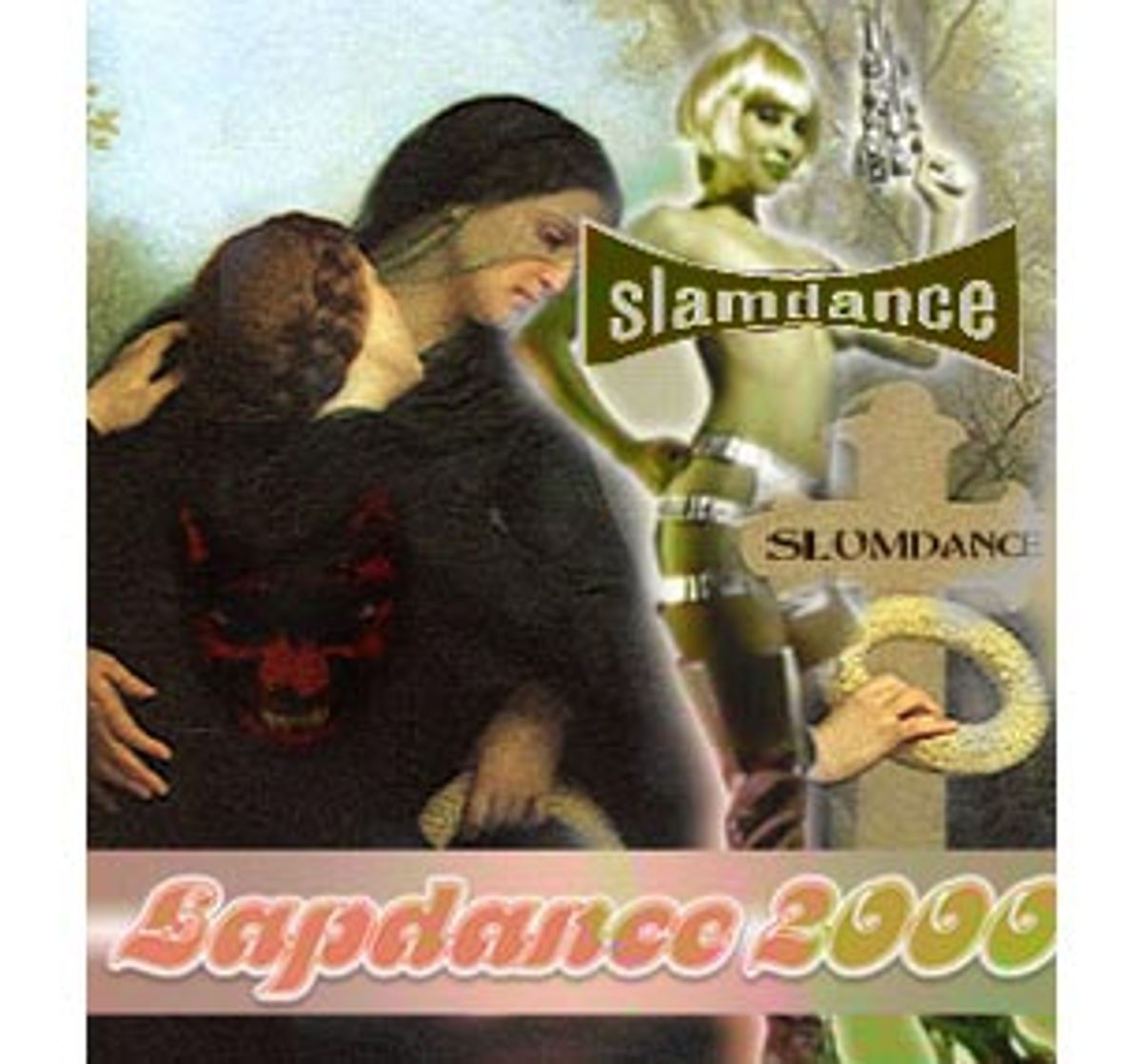
Also providing alternative media outlets at Harry O’s are Digidance, Jamdance, Webdance and Lapdance, the last of which was bandied about as the biggest and baddest party in Park City. This was due in part to the musical performance of DVDA, fronted by “South Park” brainiacs Trey Parker and Matt Stone. Parker and Stone — whose 1997 short “Spirit of Christmas” and 1998 film “Orgazmo” both premiered at Sundance — started off their set with a disrespectful little ditty called “Robert Redford Baby Fucker.” Muttered Parker to the howling crowd, “I believe it was this time last year that Robert Redford called us the lowest of the low.”
The grudge stems way, way back to 1994, when Parker and Stone’s first feature, “Cannibal: The Musical,” was forsaken by Sundance. The duo trekked up to Park City and screened the film anyway, and are therefore sort of spiritual forefathers of not only Slamdance, but the entire indie insurrection in Park City. “This year, 2000,” claims “South Park” and “Orgazmo” producer and Lapdance director Jason McHugh, “is as wild as I’ve ever seen it.”
Young, attractive hipsters exhaled plumes of steam into their cell phones as they waited in line for up to two hours to get in to Lapdance, ears freezing red because of their refusal to compromise their cleverly gelled hair with a winter hat. This is particularly amusing when you consider that it is nearly impossible to turn around in Park City without someone offering you a free stocking hat emblazoned with the logo of a film that has yet to be made, or, in many cases, even written.
So, although it is hard not to enjoy Lapdance’s anarchistic revelry, it is easy to see how Lapdance’s long lines also represent what is rotten in Park City. Park City is about being at a doorway and crossing over. It’s not about what you do once you’re allowed in, it’s about simply getting in — possessing that pass, holding that ticket, getting the Sundance seal of approval while everyone else presses their face against the icy glass.
Unfortunately, Park City caters mostly to Park City, not the rest of the movie-going universe. Hence the flood of self-referential, in-joke movies-about-movies — Sundance’s “A Sign From God” is about making a film; SlamDunk’s “Falling” is about a Sundance film; and Slamdance’s “Road to Park City” is “a film about a film about a film about a film” about getting your film into Sundance.
In the self-involved, egocentric scheme of Park City, it often feels as if everyone is making a movie about everyone else. An unsettling sign on my condo door read: “Entrance into this condo constitutes a tacit agreement to be videotaped and your likeness reproduced in any medium without any further consent by you. — Proprietor.”
“Road to Park City” dispels countless Sundance myths, including “Your film must be black-and-white and confusing enough that people won’t want to admit that they don’t get it” and “you have to be gay to get into Sundance.” Director Bret Stern cheekily announced during his Q&A, “We have a press release coming out. The whole crew is going to announce they’re gay.”
“R2PC” senses the subtle competition within the network of supposedly affable film festivals by issuing Pokimon-esque battle-cards that pit indie heroes against one another, like Atom “The Sweet Hereafter” Egoyan (Strength: strong visual style. Weakness: Canadian citizen) vs. Darren “Pi” Aronofsky (Strength: creativity galore. Weakness: obviously insane).
Troma films, the schlockmeisters behind such underground classics as “The Toxic Avenger,” are hosting a Tromadance party just down the street from Lapdance. Sweaty bodies are packed together like sausages. It’s so crowded, in fact, that the waxed, oiled and bikini-clad Miss Hawaiian Tropic contestants can barely nudge their way to the small stage. Outside the window, barely clothed dancers blow fire in the snow. Somewhere in the distance, a dog barks.
“Sundance sucks, and now Slamdance is going in the same direction,” says Troma president and ex-Slamdance sponsor Lloyd Kaufman. “They were in Cannes having this big party and they were keeping people out. It was horrible, it was disgusting, I was so depressed. We’re not going to sponsor them anymore, but hopefully they’ll [keep showing] some good movies.”
“We had a party at Cannes,” sighs Slamdance co-founder Dan Mirvish. “And unfortunately it was the hottest party that night and there were like 500 people trying to get in. But we did let [Troma] in as opposed to some executives at Miramax and Fine Line that didn’t get in at all. It was one of those crowded party things, what the hell are we supposed to do? People would’ve drowned on the beach if we would’ve let everyone in.”
For filmmakers shut out from the warm celebrity glow of Sundance, getting in to such galas represents the rare opportunity to play out their Hollywood fantasies. At Slamdance — whose unofficial mantra is still “By unemployed filmmakers, for unemployed filmmakers,” and whose screenings are, despite criticisms to the contrary, still stubbornly hot, crowded and uncomfortable — “Matt in Love” filmmaker Adam Kleid gushes about how he and Martin Scorsese were competing for the same New York location one day. “I took the day, he took the night, so it all worked out,” Kleid says, grinning from ear to ear.
“In case of emergency, your seat cushions can be used as flotation devices,” announces Mirvish to the capacity crowd sitting before him on folding metal chairs. He introduces the next film by pushing a button on his infant’s Fisher Price camera. “Lights! Camera! Cookie!” it squeals. “It’s like giving your kids candy cigarettes,” quips Slamdance projectionist Gabe Wardell. “It teaches them to spend lots of money on film at an early age.”
The false impression that Sundance gives is that this money will assuredly be compensated. “The nature of Sundance is that filmmakers’ expectations are, ‘Oh, I’m coming to get picked up.’” says Mirvish. “I think what Slamdance tries to do is emphasize to filmmakers that you might get picked up, and that’s great, but it’s also about getting your film to other festival directors and meeting other filmmakers and having a good time.”
What Mirvish means is that it is what you make of it. “I would kill to have my film at Sundance,” says No Dance’s Boyd. “It’s the best festival in the world. But the overcommercialization of it has created a watered-down product. For example, we’ve come a long way from ‘Reservoir Dogs’ to ‘Happy, Texas,’ where anybody off the street with $3 million to throw at actors is gonna get their film into Sundance.” Still, Boyd embraces No Dance as an inherent “Sundance tutorial” for filmmakers who might one day move on to the bigger, more economically encouraging festival.
It is true that Sundance’s impressive sales record has influenced filmmakers to create Sundance-formula pictures, thereby undermining the power of the medium. However, this is mostly the fault of the uninspired filmmaker. After all, Sundance also programs non-commercial, low-budget opuses, like the deliberately paced meditation of deaf black culture “Compensation,” or “Could Be Worse!” a documentary by gay filmmaker Zach Stratis about his family’s reluctance to accept his lifestyle; a documentary that includes several musical numbers performed by Stratis’ real-life sisters and aging, non-actor parents. No, really.
Executive producer Gill Holland — producer of 1998 Sundance triple-winner “Hurricane Streets” — writes in the Film Festival Reporter: “I am lucky enough to be involved with two [Sundance] productions (“Spring Forward” and “Snow Days”) … I also worked on “Home Sweet Hoboken” (making this my first official trip to Slamdance) and a short (“A Clockwork Maury”) in competition at No Dance. I do not even know what this last festival is, but the film is about Stanley Kubrick’s brother and it’s pretty cool.”
This “pretty cool” film, directed by Bob Leddy Jr., won the jury prize for best short at No Dance. Atom Films, one of the current leaders of online short film representation, has picked it up. “These people are aggressive marketers,” says Leddy. “They get out and shop your film to HBO, Canal +, BBC, to Japan, Australia, to airlines … They say their average short will make between $50,000-$60,000 in the first year. The days when a short meant nothing other than a calling card are gone.”
The overwhelming onslaught of net-based entertainment — or “dot-commies” as Slamdance puts it — seems a realistic (if financially unproven) end for many of Park City’s forgotten. “Sundance has gobbled up all of the physical space in Park City,” Slamdance co-founder Shane Kuhn says. “So we are moving to virtual space.”
Online distribution, unfortunately, is not yet equipped to handle feature-length films. Which makes it no use to Kevin DiNovis, whose “Surrender Dorothy” currently rests on a shelf — and not Blockbuster’s shelf, either.
“After my film won the Slamdance jury prize, I had lunch with a big agent in Beverly Hills,” DiNovis says, eyeing Slamdance’s back door for
defectors. “He said, ‘I didn’t see your movie, but I loved the reviews — I want to be in the Kevin DiNovis business.’
“And my heart just sank. I had been in the Kevin DiNovis business all my life, and I was dying to get out.”
Daniel Kraus is the director of the award-winning film "Jefftowne." More Daniel Kraus.
The pop culture legacy of Kim Jong Il
Few will miss the North Korean despot -- except perhaps writers on "30 Rock," "The Daily Show" and "Team America VIDEO
By Mary Elizabeth WilliamsTopics: 30 Rock, Kim Jong-il, South Park, The Daily Show
Kim Jong Il in "Team America" Kim Jong Il was one of the most chilling figures of the modern era, with a harrowing human rights record. But of the tyrannical madmen who have died this year, he was also the one who made the oddest pop culture splash. Moammar Gadhafi’s ability to rock a golden muumuu will never be paralleled. But from “30 Rock” to “The Daily Show,” the departed North Korean leader will be missed. Was it those rock star shades? His fondness for olive green? The way he really knew how to throw a tank-rolling, goose-stepping military parade? In a word, yes.
Sure, Saddam Hussein got to play a role in Trey Parker and Matt Stone’s 1999 opus “South Park: Bigger, Longer & Uncut.” But it was Mr. Jong Il who really stole the show in Parker and Stone’s subsequent puppet masterpiece “Team America: World Police.” Kim’s not just a homicidal maniac in a big house — he’s a guy who really, really loves to put on a big show. He’s also a man who can’t quite pronounce “inevitable,” who struggles with the isolation of success, and who, it turns out, is actually a bug from outer space. Now that’s a villain!
What makes the puppet Kim Jong Il such a classic comedic character is that he’s not all that far from the Western perception of the real guy. This, after all, was a man who loved the movies so much he wrote a book on “The Art of Cinema.” He loved them so much he owned thousands of DVDs – “Rambo” and Elizabeth Taylor were allegedly among his faves. He loved them so much that early in his career, he had South Korean filmmaker Shin Sang-ok and his South Korean film director Shin Sang-ok and his actress ex-wife Choi Eun-hee kidnapped to forge the North Korean film industry. The results included the somewhat less subtle than “Triumph of the Will”-rampaging monster masterpiece “Pulgasari.”
Jong Il not only forcibly created entertainment, he inspired it. He became part of a pivotal plotline on “30 Rock” last season, when Jack Donaghy’s wife, Avery Jessup (Elizabeth Banks), wound up abducted by the internationally fearsome “convenience store owner.” It was a crazy sitcom twist – based on the very real imprisonment (and subsequent release) of Current TV’s Euna Lee and Laura Ling in 2009.
Even as he retreated from the spotlight throughout his later years, Kim Jong Il became all the more dominant a force on the Internet. Is there a more elegantly straightforward, satisfyingly amusing Tumblr than Kim Jong-il Looking at Things? There is not. Have you ever seen photos of Stalin smiling merrily at great wheels of cheese? I rest my case.
He was a complicated man. A man who apparently had a penchant for water slides and could golf a 38-under-par round. Would you tell him he couldn’t take that mulligan? What can you say of a person who has been played by both Margaret Cho and Gilbert Gottfried? A man who’s provided more material for “The Daily Show” than anyone not named Jim Cramer? A guy like that doesn’t come along in too many lifetimes. Now that the leader is dead, his legacy on the evening news will no doubt be harrowing. But as Elizabeth Banks tweeted Monday, we are indeed at a pivotal moment in history” — one that leaves joke writers and Tumblr bloggers just a little “sad and ronery.”
Mary Elizabeth Williams is a staff writer for Salon and the author of "Gimme Shelter: My Three Years Searching for the American Dream." Follow her on Twitter: @embeedub. More Mary Elizabeth Williams.
How the “South Park” guys became an American institution
Trey Parker and Matt Stone's potty-mouthed genius has made them into our country's greatest living humorists
By Matt Zoller SeitzTopics: South Park, Television
Uh, you guyyyyyssss....It's Cartman, Trey Parker and Matt Stone of "South Park." As I watched Trey Parker and Matt Stone, the creators of Comedy Central’s “South Park,” collect armloads of Tony awards for their satirical musical “The Book of Mormon” Sunday night, a disquieting and thrilling realization popped into my head: These potty-mouthed clowns might very well be America’s greatest and most consistently inventive humorists.
Of course they have competition. There’s “The Daily Show,” for sure, though I’d argue that Jon Stewart’s version is as much a news program as a comedy series. But for audacity, visual flair, musical chops, verbal invention and gut-busting silliness, not to mention consistency of vision over time, I think the “South Park” boys trump all comers — including the creators of “The Simpsons,” a landmark show that started to flag halfway into its endless run, and Seth MacFarlane of “Family Guy,” whose show has its moments but has never quite risen to the heights of conceptually driven insanity that Parker and Stone reach so often. At their best, I’d put Parker and Stone up there with “Monty Python’s Flying Circus,” “SCTV,” Ernie Kovacs, the Marx Brothers, George Carlin and W.C. Fields, all of whom skated along the edge of the surreal and willfully outrageous, doing pirouettes and blowing raspberries at anyone who tried, like yours truly, to call them great and significant.
Their success is all the more remarkable when you consider what true outsiders they were, and to some extent still are. Back in 1992 they were just a couple of students at the University of Colorado who’d produced a goofy little short film titled “The Spirit of Christmas.” Within five years — thanks to help from Fox executive Brian Graden, who gave them $2,000 to turn the short into a “video Christmas card” that he could send to friends and birthed the very first viral video sensation — they’d landed a Comedy Central show, “South Park.”
Their rise was so sudden that there was no reason to think they’d last. Most overnight successes freeze up in the spotlight or reveal themselves as one-trick wonders. Not Parker and Stone. They’re safely ensconced in mainstream culture — almost everything they do is connected to Viacom, the gigantic parent company of “South Park” network Comedy Central — yet they still seem mysteriously and delightfully outside of it. What other American humorists have been so successful within the mainstream over such a long period while routinely landing on news pages (most recently for Comedy Central’s censoring of their jokes about Mohammed) and maintaining an almost punk rock edge?
Sure, some episodes have been sharper and more coherent than others; like a lot of the aforementioned iconic clowns, Parker and Stone practice a type of humor that is by nature hit-and-miss. But over the past few days, I’ve rummaged through prior seasons of “South Park” looking for duds and have found surprisingly few. The stuff that seemed astonishingly vital at the time still does, and the stuff that felt subpar — such as the Season 1 episode with the Ethiopian – has proved better than I remembered, sometimes much better. Even a weak episode is likely to contain a scene or subplot so terrifically unhinged that it makes you dizzy. A “C” effort from these guys is better than a latter-day “A+” effort from “Family Guy” or “The Simpsons.”
And an A+ — such as Season 10′s “Hell on Earth 2006,” wherein Satan decides to rent out the W Hotel in downtown South Park and throw himself a Sweet 16 party — is one for the ages. The Satan stuff (a continuation of the great hell sequences in their 1999 animated feature “Bigger, Longer and Uncut”) is a barbed skewering of skeezy reality show participants’ narcissism, and the audience’s rubbernecking smugness; that by itself might have been enough to sustain a half-hour episode. But Parker and Stone aren’t content to do just enough. They always want to give us more than we expected, to go further, to overwhelm with sheer imaginative excess. So they add a subplot with the boys summoning the spirit of murdered rapper Biggie Smalls by repeating his name into a mirror à la “Candyman,” and yet another subplot that finds mass murderers Ted Bundy, Jeffrey Dahmer and John Wayne Gacy being dispatched from the underworld to pick up a giant cake shaped like a Ferrari and deliver it to Satan’s bash. The “Three Murderers” become the supernatural version of the Three Stooges, squabbling among themselves, getting into wacky high jinks, and beating, stabbing and disemboweling themselves and various innocent bystanders. These bits are breathtaking for all sorts of reasons, one of which is that they explore the connection between comedy and cruelty incisively, but without becoming dry or self-regarding.
Hell on Earth 2006
Tags: SOUTH
PARKmore…
Another of Parker and Stone’s admirable qualities is their resistance to political pigeonholing. At some point, representatives of every American party or movement have tried to claim them as standard-bearers, only to get a thumb in the eye soon after. Are the “South Park” guys liberal? Conservative? Republican? Democrat? Libertarian? Pro-choice? Pro-life? Pro-capitalism? Pro-socialism? I suspect they’re mainly anti-complacency, and anti-bullshit.
I’ll never forget watching their 2004 political satire/puppet epic “Team America: World Police” with two different theatrical audiences — one in lower Manhattan, the other in suburban Dallas — and hearing both crowds chortle as Parker and Stone beat up on people or ideals they thought worthless, then squirm when the humorists started butchering their sacred cows.
Parker and Stone fire on targets and settle scores. But their work almost always has a structural integrity that makes it feel more substantial than a rant-of-the-week. For instance, the epic, three-part, 2007 “South Park” episode “Imaginationland” is one of the definitive statements on American pop culture in the age of terrorism and endless foreign war. But it’s not just a finger-wagging editorial about how to behave or not behave, or how to think about the relationship between the American imagination and the media that feeds it. It’s self-contained and self-supporting, a stand-alone piece that has internal logic as rigorous as that of any big budget fantasy film that takes itself seriously.
Imaginationland
Tags: SOUTH
PARKmore…
Parker and Stone have done some of their sharpest and craziest work in the last couple of seasons — for the record, that’s seasons 14 and 15, at which point most TV series are either long-canceled or coasting on the memory of past triumphs. This season’s send-up of the royal wedding — a 12-tiered wedding cake of riffing — was one of the single greatest episodes the show has produced. The goof on the ceremony itself (substituting the “Canadian royal family” for the Brits, with Parker-as-cable-newscaster ending every other observation with a variation of the phrase, “as is tradition”) belongs on a short list of great self-contained surreal set pieces, alongside the “Hail, Freedonia” number from the Marx Brothers’ “Duck Soup” and the duel with the Black Knight in “Monty Python and the Holy Grail.” (You can watch it below at the 1:30 mark.) “People in attendance now gently tossing Captain Crunch as the prince passes by, as is tradition … [The] Canadian prince now dipping his arms into the pudding, as is tradition … The princess will, of course, scrape the pudding off the prince’s arms, symbolizing their union … This is a glorious day for our country, and indeed the world.”
Last week’s half-season finale, “You’re Getting Old” — in which Stan’s 10th birthday afflicts him with cynicism, and prompts arguments between his parents about how one’s taste in pop culture almost inevitably hardens over time — might have made a great series closer if Parker and Stone had decided to hang it up now. But why would they when they’re producing work like this, which makes an unpretentious but true statement on generational tension, aging and nostalgia without turning self-important?
Parker and Stone have managed to seem as though they’re still a couple of wiseacres sitting in the back row of the classroom, goofing off and making trouble, when in fact they’ve spent the past decade-and-a-half winning Tonys and Emmy and Oscar nominations, and diligently assembling a body of work that should be the envy of any animator, stand-up comic or editorial cartoonist. It’s been a remarkable run. And as long as the show stays interesting — and it has; much more so than any of its long-running animated competitors — there’s no reason it shouldn’t continue.
Since I’ve managed to go a whole column without running a clip from “Bigger, Longer and Uncut,” let’s close with one, shall we? All hail Satan. He can dream, too.
“South Park” eviscerates Tyler Perry and his fans
The Comedy Central cartoon takes on Madea and her self-loathing audience members
By Drew GrantTopics: Rachel Maddow, South Park, Television, Tyler Perry
Tyler Perry drops by "South Park." Tyler Perry is something of a divisive figure. We’ve already seen Spike Lee decimate Perry in the pair’s ongoing feud, and it’s a well-documented fact that audiences of Tyler’s extremely popular Madea series don’t give a crap what Spike Lee thinks of the “coonery buffoonery.”
Last night, “South Park” gave Perry a long-awaited noogie when he showed up to accept at the school’s comedy awards show. (Called “The Kathy Griffin Awards” – how I wish those really existed.)
Perry continues to pop up throughout the episode, and Token Black (the only African-American “South Park” kid) continues to laugh before stopping himself in self-loathing. Even Obama isn’t exempt from the “South Park” stereotype of every black person loving Perry. “I know it’s embarrassing, but I simply can’t help myself,” says the president.
Drew Grant is a staff writer for Salon. Follow her on Twitter at @videodrew. More Drew Grant.
“The Book of Mormon” leads Tony Award nominations
"South Park" creators lead the field for Broadway's biggest prize
By Mark Kennedy, Associated PressTopics: South Park, Theater, Tony Awards
In this theater publicity image released by Boneau/Bryan-Brown, Andrew Rannells, center, performs with an ensemble cast in "The Book of Mormon" at the Eugene O'Neill Theatre in New York. (AP Photo/Boneau/Bryan-Brown, Joan Marcus)(Credit: AP) When the Broadway season began last year, a big brash musical about Spider-Man was supposed to muscle its way to multiple Tony Award nominations. Instead, a pair of goofy Mormons may be the ones to beat.
“The Book of Mormon” nabbed a leading 14 Tony Award nominations Tuesday morning, earning the profane musical nods for best musical, best book of a musical, best original score, two leading actor spots and two featured actor nominations.
The musical, about two Mormon missionaries who find more than they bargained for in Africa, was written by Trey Parker and Matt Stone, the creators of “South Park,” and Robert Lopez, co-creator of the Tony Award-winning musical “Avenue Q.” The trio teamed up with Casey Nicholaw, who co-directed with Parker and choreographed.
It has received 12 Drama Desk Award nominations, six Outer Critics Circle Award nominations and a Fred & Adele Astaire Award nomination, which recognizes excellence in dance. The musical is also grossing more than $1 million a week and is selling out — the place “Spider-Man: Turn Off the Dark” was supposed to be before its implosion.
“The Scottsboro Boys,” a searing tale of 1930s injustice framed as a minstrel show, received 12 nominations, including best musical, best book of a musical, best original score as well as a leading actor and two featured actor nods.
Among others who earned nominations were Al Pacino, who played Shylock in “The Merchant of Venice,” Vanessa Redgrave in “Driving Miss Daisy” and Sutton Foster for “Anything Goes.”
“There’s absolutely nothing cookie-cutter about this season,” said Charlotte St. Martin, executive director of the Broadway League, which jointly produces the Tony awards with the American Theatre Wing. “The theme is that there is no theme.”
Of the 42 new productions this season, there were 14 musicals — 12 new ones and two revivals — and 25 plays, a whopping 16 of them brand new. The last time there were 16 new plays produced in a single season was 1986-87.
It is also shaping up to be a lucrative time for Broadway, with total box-office grosses already at more than $987,057,484, or 3.6 percent more than the same time last year. Attendance this season is at over 11.4 million, up 3 percent from this time last year.
The awards will be handed out June 12 at a new location: the Beacon Theatre on the Upper West Side of Manhattan after producers lost their long-term space at Radio City Music Hall. It will be broadcast live by CBS.
Five instances of Osama bin Laden hiding out in pop culture
How the terrorist invaded our TV and film, from "Family Guy" to Morgan Spurlock
By Drew GrantTopics: Family Guy, Osama Bin Laden, South Park, Television
Osama woos a camel on "South Park." In the past decade, Osama bin Laden invaded our sense of safety, but also our pop culture. Here’s a look at the top five most memorable appearances by the slain al-Qaeda terrorist in TV and film, from the irreverent to the bizarre.
1. “Family Guy”: While American audiences found dread in bin Laden’s cryptic video messages, Seth MacFarlane found gag reel opportunity. The show’s famous FCC-baiting episode “PTV” depicted the terrorist in Afghanistan cracking up during a taping of his own terrifying video message. Botching the pronunciation of “Ramadan,” the cartoon bin Laden breaks character to say, “Did I just say Radaman? What is that? Yeah, maybe Dennis Radaman is going to punish you with his crazy hair.” Bin Laden made several appearances on “Family Guy” throughout the years, though many never made it to the screen.
2. “South Park”: The first post-9/11 episode from the Comedy Central show was titled “Osama Bin Laden has Farty Pants” and showed the four boys meeting their Afghani counterparts and getting captured by the head terrorist. In a typical “South Park-ian” twist, the episode was surprisingly pro-America, with Stan saying, “America may have some problems, but it’s our home, our team. If you don’t want to root for your team, then you should get the hell out of the stadium.”
3. “Where in the World is Osama Bin Laden?”: Morgan Spurlock’s satiric Middle East travel documentary didn’t quite capture the zeitgeist like “Super Size Me.” The 2008 film found Spurlock hunting down the terrorist while his wife was pregnant with their child — a reflection of just how futile the search for bin Laden seemed by then. But the film did poorly with critics, earning only a 38 percent approval rating over at Rotten Tomatoes.
4. “Tere Bin Laden”: Better known in the states as “that Bollywood comedy about Bin Laden,” the 2010 satire featured a reporter who lies about having an interview with Bin Laden, shades of Jack Kelley at USA Today.
5. “Postal”: This videogame-to-film adaptation was never going to be known as the best of its kind, and that’s a low bar to jump. However, the 2007 film based on a first-person-shooter game hit new lows when it depicted an Americanized Osama Bin Laden holding hands and skipping around with George W. Bush.
Drew Grant is a staff writer for Salon. Follow her on Twitter at @videodrew. More Drew Grant.
Page 1 of 11 in South Park
Recommendations
-
Protesting NATO war crimes in Chicago
Emma Kaplan -
Inside The Matrix: My Night In Sheriff Joe Arpaio’s Jail
Amy McMullen -
The Mouth Shall Rise Again
Ashley Holt