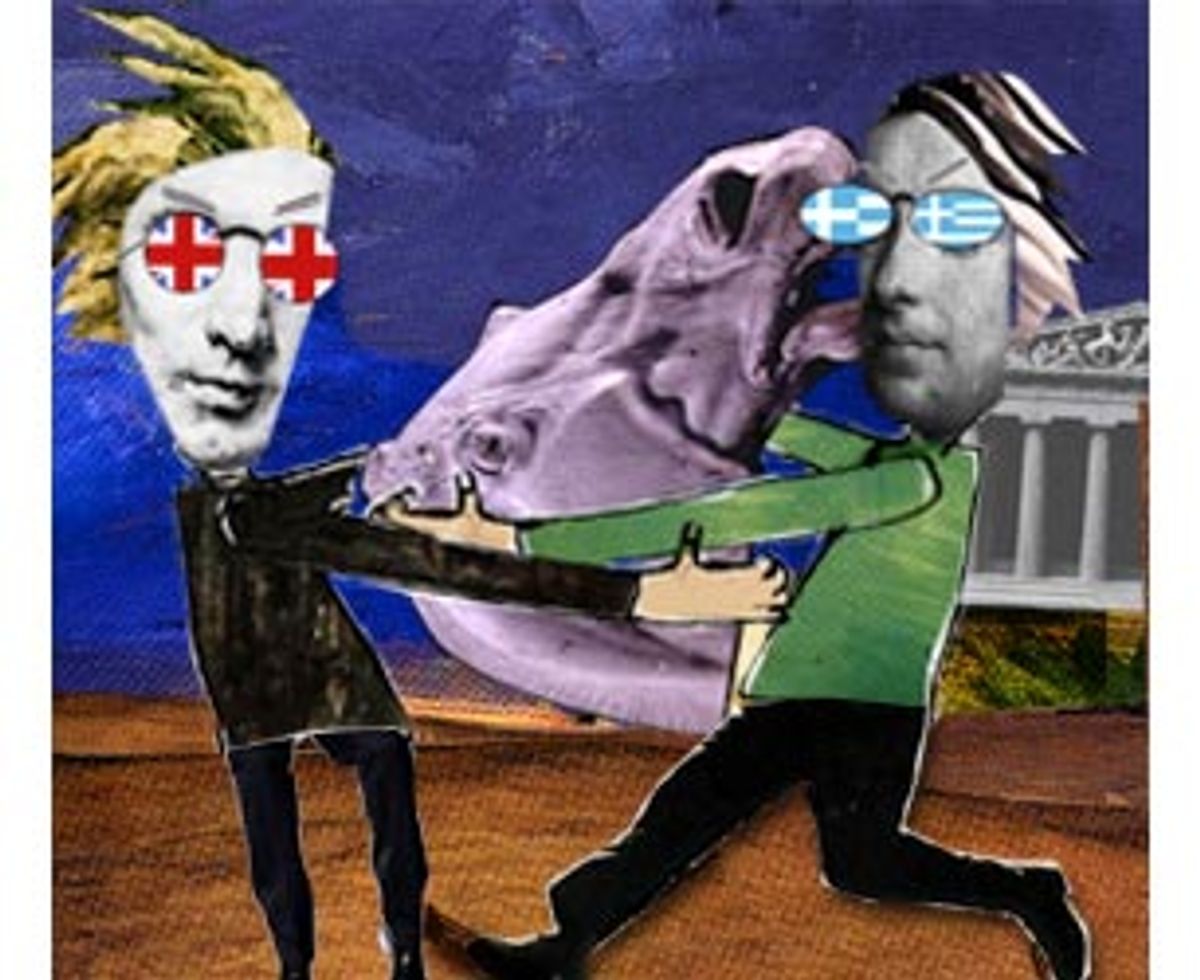
The British Museum has lost its charm for many of the tourists who throng
its galleries. The government of Greece has lately been kicking up such a
stink over the museum's handling of the marbles that Lord Elgin took from Athens' Parthenon 200 years ago that its 6 million annual visitors
are beginning to distrust the evidence of their eyes. How much of what they
had always assumed was perfectly preserved treasure has been tarted up? How plausible is the museum's long-trumpeted claim to be a caring steward? How many of its 6.5 million exhibits should be there at all?
The story begins with a deal that Elgin struck in 1801. The Scottish Earl
of Elgin, a passionate amateur collector of antiquities, had proposed himself for the
post of British ambassador to Turkey's Ottoman Empire because of his
health. He had syphilis, a disease which was to leave him as distressingly
noseless as many of the chipped statues he collected, and the doctors
recommended a warm climate.
Europe was in the grip of the Romantic revival, and he was obsessively keen
to record and, if possible, obtain as many of the ancient Greek treasures
now in the uncaring care of Turkey. His purpose, he wrote, was to improve the
modern art of Great Britain by permitting its artists to see firsthand
the greatest examples of sculpture ever made.
Ruling a wide swath of the ancient world, the potentates of Constantinople
were pleased to accept bribes, gifts, money and munitions from the warring
countries of England and France. In return, they gave permission to record,
then sketch, then dismantle, and finally, transport the monuments and
sculptures by earlier inhabitants of the empire they now ruled. They
regarded the newfound passion of the European aristocracy and artists for
ancient Greek artifacts as faintly ludicrous. But if the English and the
French wanted to compete in carting those long-neglected relics halfway
round the world, let them.
So it was that Elgin (called "Eggy" by his vivacious young bride) was able
to wheedle and buy permission to collect any chunks of the Parthenon
crowning Athens' Acropolis that had crashed to the ground, and, he airily
assumed, any more that might possibly fall down in the future.
Built between 447 and 432 B.C., the Parthenon was a vast building masterminded
by the Athenian statesman Pericles. Over the years, the Acropolis had
many times been a battleground. In 1687 a Turkish powder magazine in the
temple exploded after a direct hit by besieging Venetians, destroying a
large part of it. The rubble was used as building material and rifled by
souvenir hunters. All that was left intact of the three-dimensional art
that had filled the building was part of the frieze and metopes (sculpted
pictures) and some pediment sculptures.
Elgin set about dismantling 274 feet of the original 524-foot frieze, 15 of
the metopes and 17 figures from the pediments. They ultimately filled over
100 large packing cases. That some of the best examples of Phidias'
art broke into fragments while being lowered to the ground was unfortunate,
but that did not stop Elgin from squirreling up the bits.
The treasures' subsequent adventures included sinking in shipwrecks,
heavy-handed salvaging, being possessed by and rescued from Napoleon's
fleet, and then lying, dispersed and neglected -- for many years awaiting
transportation to London.
Elgin himself suffered imprisonment in France, the infidelity and divorce
of his countess, worsening health and near-bankruptcy caused by the
enormous cost of dismantling, transporting and storing 120 tons of marbles,
which were finally piled up in the back garden of a house at the corner of
Piccadilly and Park Lane.
Most distressing for Elgin was finding that his reputation had become that of a despoiler
of an ancient civilization. His detractors were led by the mad, bad Lord
Byron, whose hand probably carved on the Acropolis the lines, "Quod Non
Fecerunt Gothi, Fecerunt Scoti" -- "What the Goths spared, the Scots have
destroyed." In the bestselling narrative poem, "Childe Harold," Byron wrote:
The last, the worst, dull spoiler, who was he?
Blush, Caledonia! such thy son could be!
... Cold as the crags upon his native coast,
His mind as barren and his heart as hard,
Is he whose head conceiv'd, whose hand prepar'd
Aught to displace Athena's poor remains ...
Dull is the eye that will not weep to see
Thy walls defac'd, thy mouldering shrines removed,
By British hands ..."
But Napoleon met his Waterloo, and the loot that he had collected
for the Louvre was sent back: The four horses from St. Mark's to Venice,
Rubens' "Descent from the Cross" to Antwerp, the Medici Venus to Florence. And so, at last, victorious England was able to consider buying the
Parthenon Marbles from Lord Elgin.
Elgin claimed that he personally had spent 62,440 pounds on bribes, workmen,
transportation and storage -- roughly $10 million at today's prices -- but the best offer a
government committee could come up with was 35,000 pounds. Reluctantly, he took it, and returned to Scotland to father eight children with a new countess,
adding to the four already born to the first Lady Elgin.
The British government handed the marbles over to the British Museum for
safekeeping and preservation, but they soon fell victim to the misguided
Romantic notion that all Greek art should be pristine white. In fact, the
Parthenon Marbles were probably brightly painted when new and were
certainly dark brown when removed by Elgin (although how much of that was
grime and pollution is debatable). Nor did the Victorians like their
sculptures incomplete: If noses, arms and genitalia had been chipped off,
new ones were often stuck on.
Over the next century, the golden patina of the Elgin Marbles was scrubbed
whiter and whiter until the final desecration, by order of Sir Joseph
(later Baron) Duveen. The picture dealer had made millions of dollars
selling often dubious and touched-up old masters to the new rich of the
United States, and was now busily buying honors for himself. In 1928 he
offered to build a new gallery for the British Museum to house the Elgin Marbles -- on condition that they were made more attractive to the public (and reflected
more glory on himself).
On his orders, paid masons attacked the marbles with metal tools and Carborundum, leaving them
whiter than white but -- according to the modern Greeks -- irreparably
harmed. Dr. R.D. Barnett, then the museum's keeper of Western Asiatic antiquities,
wrote a suppressed memo detailing his shock at seeing a laborer "day after
day using hammer and chisel and wire brushes."
So damaged were the Elgin Marbles that they were placed behind barriers -- still
there today -- so that the public could not get close enough to see the
ravages. And serious scholars have always resented the way Duveen arranged
them around the sides of his gallery, when they were meant to be seen
as a continuous narrative as they were approached and circled.
In Elgin's day, the marbles were exhaustively studied by working artists,
who had the benefit of naked models in poses echoing those of the statues.
Today they are high on tourist lists and are, indeed, the very best value
in London, as entry to the museum is free.
To get to the Duveen Gallery, turn left at the entrance and go through the
stunning Egyptian collection. You won't see "Elgin" or
"Marbles" written anywhere -- the collection is neutrally described as "Sculptures of the Parthenon."
Once inside, there is no sense of anticlimax. These really are what
critics have praised for 200 years as simply the most magnificent
sculptures in the world. Despite their incompleteness, despite their
unnatural color, despite the poor arrangement, the sculptures come alive at
a glance. You swear you can see the rippling of muscles and the sway of
materials. Grace and beauty are meaningful terms here. The centerpiece of a
family sacrifice is restrained and moving. The long parade of horses and
riders is magnificent.
Oddly, for a noncommercial institution, the British Museum allows
champagne and gourmet food parties in the gallery in return for high
rental fees. The marbles have become a prized setting for corporate hospitality
parties. These parties have got the Museum into more hot water, as guests are even
permitted to be photographed in Ancient Greek fancy dress with the Elgin Marbles
as a decorative background.
Sir Kenneth Alexander, a former trustee of the National Museum of Scotland,
describes this as a "crass misuse of one of the world's greatest
antiquities." Andrew Dismore, a Greek-speaking member of Parliament, says: "I
am frankly dismayed at the attitude of the museum. What are we going to
have next? Themed orgies in the Roman galleries?"
A museum publicist shrugs: "I am amazed that there should be any reaction
to the museum holding dinners and receptions there. Everybody does it
now."
At a symposium arranged by the museum to placate Greek activists in December, an official confessed for the first time that, "The way
Duveen went about cleaning the sculptures was a scandal, and the way the
museum tried and failed to cover it up was a scandal."
"The British Museum is not infallible; it is not the pope," admitted Dr.
Ian Jenkins, deputy keeper of Greek and Roman antiquities. "Its history has
been a series of good intentions marred by the occasional cock-up: The
cleaning was such a cock-up."
But almost identical techniques, he said, including wire brushing and
scraping with metal chisels, had been used in Athens in the 1950s on the
Hephaesteum Temple. "And while people moralize about bribes paid by Lord
Elgin 200 years ago, and protest about cleaning that happened 60 years ago,
South Metope 1 and North Metope 32, two of the finest sculptures that ever
there were, still rot on the Parthenon as I speak."
Ah, but if you let us have them back, we would conserve all the marbles
in a new 30-billion drachma ($109 million) Acropolis Museum, retorts the Greek
government. And it would be very nice if they -- along with the other bits
in Paris, Copenhagen, Palermo, the Vatican, Heidelberg, Munich, W|rzburg,
Strasbourg and Vienna -- were returned by 2004, when Athens hosts the
Olympic Games.
President Clinton wants Britain to hand them back, according to Elisavet
Papazoe, the Greek government minister who showed the U.S. president and
daughter Chelsea around the Parthenon last year.
Papazoe said Clinton promised to bring up the issue with Prime Minister Tony Blair. But Blair is known to be antagonistic to the demand, unlike former leaders of his Labor Party, Neil Kinnock and Michael Foot, who had both pledged a future Labor government to return the sculptures. The best Blair can come up with is a select committee to look into the matter -- a familiar Parliamentary palliative.
If he did return them and that set a precedent, how many of the world's museum collections would then have to be also returned?
Mark O'Neill, director of Glasgow Museums, who has returned the Ghost Dance Shirt originally taken from the corpse of a Sioux warrior at the Battle of Wounded Knee, believes it could be as much as 10 percent for museums with major ethnographic collections: "It's all about values and ethics. A shirt that was ripped off the body of a dead Sioux had no business in our collection."
The looting of treasures has been going on at least since Biblical times. It is recorded in Chapter 52 of the Book of Jeremiah that "the Chaldaeans broke up the bronze pillars from the Temple of the Lord, the wheeled stands and the bronze sea that were in the Temple of Yahweh, and took all the bronze away to Babylon."
More recently, in World War II, Germany plundered 427 museums in the Soviet Union, taking the pick of them to Berlin. The National Gallery of Art in Washington coveted 202 paintings salvaged from the wreckage of Germany and "liberated" some of them. The decision was supported by Francis Henry Taylor, director of the Metropolitan Museum, who opined, "The American people have earned the right in this war to such compensation if they choose to take it."
American archive officers on the spot demurred. In the Wiesbaden Manifesto, they stated that "the transportation of these works to America establishes a precedent which is neither morally tenable nor trustworthy." President Truman agreed, and all the art taken to the United States for "safeguarding" was subsequently returned.
In another case of disputed museum holdings, the Trojan treasures now in the Pushkin Museum in Moscow once belonged to the Museum f|r Vor- und Fr|hgeschichte in Berlin. They were thought to have been destroyed until it was disclosed in 1991 that they had been taken to the Pushkin Museum in Moscow. Germany wants them back, but its claim is disputed by Turkey, which asserts that German archaeologist Heinrich Schliemann excavated and smuggled them illegally from Turkey in the 19th century. When they were put on show at the Pushkin in April 1996, the Turkish ambassador to Moscow refused to attend the opening.
Similarly, various competing historical claims put the British Museum collection particularly at risk. Among them:
- The head of Rameses the Great (Egyptian, 1270 B.C.) and the Rosetta Stone (Egyptian, 196 B.C.). Taken in 1799 by a sharp-eyed French lieutenant who prevented its use as a building stone for a Napoleonic fort in the desert, the Rosetta Stone went to George III by Treaty of Alexandria in 1801 and provided the key to hieroglyphics. Egypt has asked for both of them back.
- Assyrian winged bull gateway, from Khorsabad, Iraq, c.710 B.C. In the 19th century, French and English teams competed to excavate thousands of tons of carved stone from Assyrian palace sites. Like Elgin, Henry Rawlinson bought these huge stone figures in 1850 under license from the Ottoman Empire -- a transaction now disputed.
- Easter Island statue. Cult image, made between 11th and 17th centuries. Collected by British survey ship HMS Topaze in 1868 and presented to Queen Victoria.
- Statue of A'a. French Polynesia, 18th century. Acquired from Christian converts by missionaries in the 1820s, bought from the London Missionary Society in 1911.
- Mexican Rock Crystal Skull. Either a unique survival of pre-Spanish conquest Mexican Aztec art or a 19th century fake. Bought from Tiffany's in New York in 1897.
- The Benin bronzes. Seized by a British punitive expedition in Nigeria in 1897 in revenge for an ambush in which nine British officers died. Auctioned in London by the Admiralty to cover the costs of the expedition. Twenty-five were returned in 1951, but when Member of Parliament Bernie Grant called for the repatriation of them all, the trustees commented, "we would regard it as a betrayal of trust to establish a precedent for the piecemeal dismemberment of the collections, which recognize no arbitrary boundaries of time or place."
Some Zuni Indian claims are equally contentious. In 1990, the U.S. Congress required museums to respond to requests from Native Americans for the return of "sacred objects and communally owned cultural patrimony." As a result, private collectors and art dealers, as well as museums, have sent many wooden gods back to New Mexico.
But the Pitt Rivers Museum in Oxford, England, refused to return a wooden god in its collection. They replied that it was not a real one -- it was made by Frank Hamilton Cushing, an anthropologist. The Zunis retorted that the god was certainly authentic because it was made by Cushing with "Zuni knowledge."
The piece is still in Oxford, but for how long is anybody's guess. In the new world of international political correctness, pressures are building for a global treasure hunt.
One expert who appreciates the new mood is Ricardo Elia, professor of archaeology at Boston University and the editor of the Journal of Field Archaeology. "The only way to collect ethically, and without contributing to the looting problem," he says, "is to refrain from acquiring anything unless it can be proved to have been legally removed and exported from the country of origin."
Curators and collectors, look to your mantelpieces, empty your glass cases and prepare for the great swap of the 21st century. Maybe you'll get something from your country back in return.
Shares