Laura Rozen

Payoffs, fear and bloody conflict

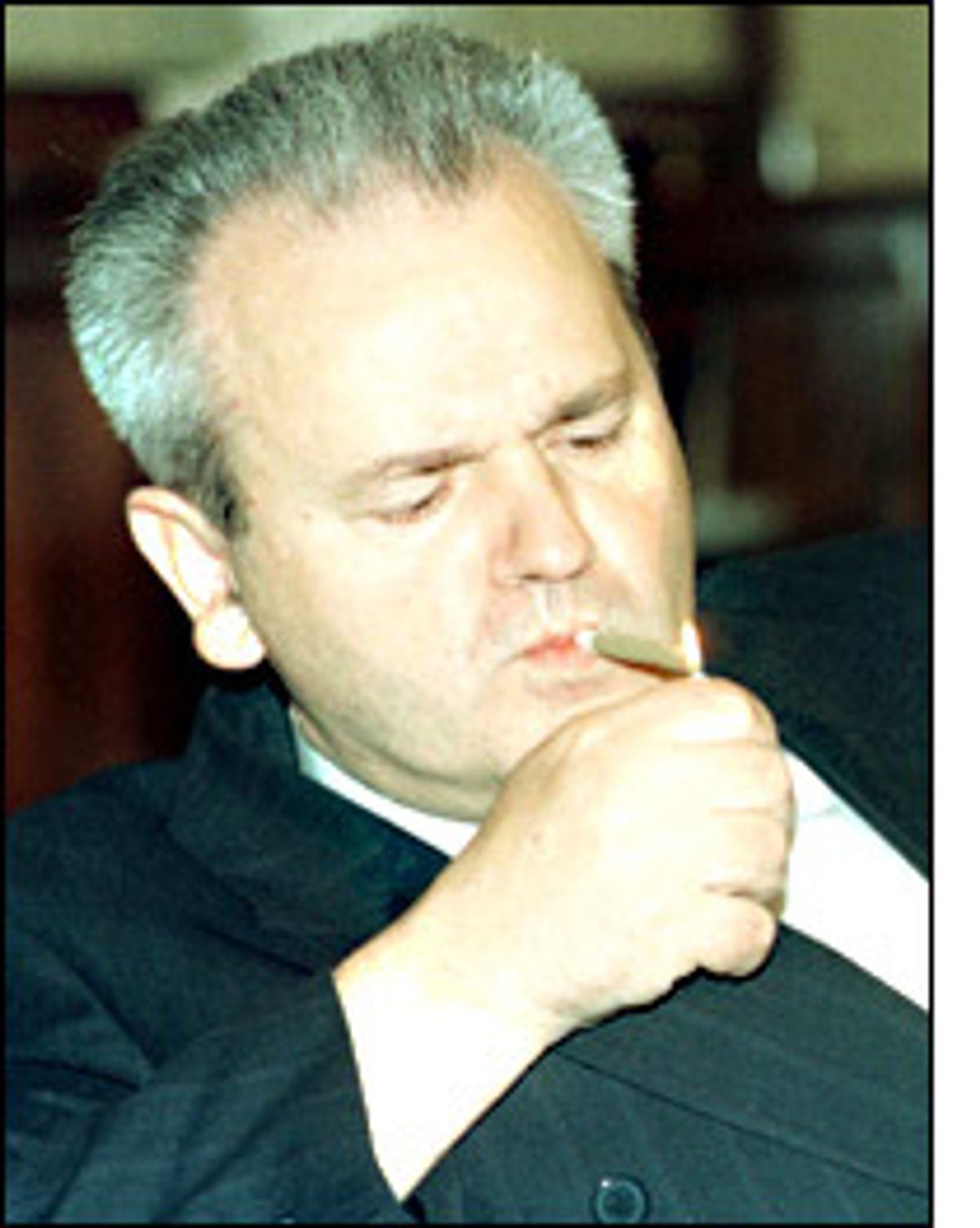
With his usual bag of dirty tricks, Slobodan Milosevic looks to be preparing Serbia to reelect him.

  • more
    • All Share Services

Payoffs, fear and bloody conflict

Ethnic clashes in northern Kosovo. Fear of war in Montenegro. Money mysteriously moving from foreign bank accounts back into the Serbian regime’s coffers. It must be that Slobodan Milosevic is preparing for elections.

It is the opposition’s worst nightmare: Having demanded early elections all year, now Milosevic looks set to call them, but under the worst possible conditions.

Milosevic normally prepares for elections by distracting and worrying the population with violence — in Kosovo, in Montenegro — which scares enough of the old people to vote for the strongman. Then he gets ahold of some of the millions of dollars the regime stole from Yugoslav banks years ago and stashed in foreign bank accounts, and brings it back in time to pay off pensioners, the police, army and anyone else on the state payroll.

This year Milosevic has another potential target group of new voters for his Socialist Party: some of the 700,000 Serbian refugees who have been displaced by his failed war bids in Croatia, Bosnia and Kosovo, and who are living miserably in Serbia.

Suddenly, some 50 of these poor refugees a day are being granted Yugoslav citizenship, according to opposition politician Goran Svilanovic. What’s the implicit catch? That they vote for the man who gave it to them.

Milosevic has recently managed to get hold of enough hard currency to stave off hyper-inflation for the next six months, so that he can pay off pensioners, police and the army and hold elections within that time. According to leading dissident economist Mladjan Dinkic, some $300 million mysteriously moved from China to Belgrade in December. The regime first tried to explain the money as a gift of the Chinese government, then coyly suggested it was a loan.

“It could not be a gift, that’s for sure,” says Dinkic, who heads the G17 group of independent economists in Belgrade. “Because China does not give financial gifts, it’s not that rich. My opinion is this is money of Serbia’s political establishment that was transferred abroad, first to Cyprus, and other countries, and then to China, and it was being repatriated here in December.”

The value of the Belgrade-Chinese relationship — which has blossomed in the wake of NATO’s accidental bombing of China’s Belgrade embassy last spring — became clear this week, as Milosevic ordered his Socialist Party branch offices to begin preparing their “voter rolls” for elections, possibly as early as later this month.

Under the Yugoslav constitution, Milosevic must call Serbian local and Yugoslav federal elections by November. Serbian parliamentary elections — perhaps most critical for unseating Milosevic’s ruling coalition — are due to be held in 2001, but the opposition has been demanding that they be held this year as well.

The pillars of Milosevic’s election strategy are making payoffs and creating a fear of war among his population. Not only does he have the Chinese government loan at his disposal, but he is also benefiting indirectly from the United Nations oil-for-food program for Iraq — which allows Saddam Hussein to sell about $1 billion worth of oil a year and use the cash to buy humanitarian supplies of food and medicine. Recently, a key Yugoslav military procurement agency was granted permission to sell $100 million worth of wheat to Iraq. In fact, the Yugoslav company is the very same one that the U.S. meant to hit when it accidentally hit the Chinese embassy.

Analysts have wondered how, after his loss of Croatia, Bosnia and Kosovo, Milosevic could manage to find some place with which to cause another conflict and distract his population of 10 million impoverished, war-weary and sanctions-burdened people from blaming him for their misery. He has found two ways.

His special forces have infiltrated northern Kosovo, in particular the northern Kosovo city of Mitrovica, and he has put many Serbs in that ethnically divided city on Belgrade’s payroll. Thus he has found agents for continuing to stir up ethnic violence even under a Kosovo controlled by 50,000 NATO-led peacekeeping troops.

Last week at least 10 people were killed and dozens injured in the worst clashes in Kosovo since the war ended in June. Milosevic stokes the flames by having his generals promise that the Yugoslav army will return to Kosovo this summer if NATO continues to permit this “genocide” against the Kosovo Serbs — a promise they are unlikely to be able to fulfill, but this is election season.

Milosevic is playing an even subtler game with the pro-Western, independence-minded smaller Yugoslav republic of Montenegro — but the subtlety could end in more violence.

Western governments are encouraging Montenegrin President Milo Djukanovic to slow down his move toward independence, out of fear it will provoke Milosevic to clamp down with an army coup against Montenegro. But Milosevic is actually pushing Montenegro out. The border between Montenegro and Serbia has been entirely shut by Serbian police since last week. Milosevic is also reported to be arming his supporters in Montenegro. He knows that NATO will find it extremely difficult to intervene in a civil war in Montenegro, but it would be under tremendous pressure to intervene to protect Montenegro should Serbia attack it.

The assassination of Yugoslav Defense Minister Pavle Bulatovic at a Belgrade restaurant Monday added to growing speculation that Milosevic is trying to provoke a civil conflict in Montenegro in order to rally support behind him at home. Bulatovic, a pro-Serbian Montenegrin, comes from northern Montenegro, where many of the people tend to support Belgrade over the independence aspirations of Djukanovic.

Recently, there were reports that the Milosevic government was covertly arming these pro-Serbian factions in Montenegro and Bulatovic, as defense minister, would have been a natural vehicle for these activities. Bulatovic was also reported to have been the organizing force behind demonstrations by pro-Belgrade tribes in northern Montenegro.

Analysts believe that the killing of Bulatovic could be the spark for pro-Serbian Montenegrins to seek revenge against pro-independence Montenegrins — and there are fears of a possible revenge assassination attempt against Djukanovic, and against the pro-Montenegrin former head of the Yugoslav army, Gen. Momcilo Perisic, who has become a staunch critic of the Milosevic regime.

What’s an opposition desperate to get rid of Milosevic to do?

Having recently overcome their differences, Serbia’s political opposition parties have decided they will come to a decision together on whether to boycott or participate in elections.

Zarko Korac, a liberal Belgrade psychology professor and a leader of the opposition Social Democratic party, says the opposition must fight and win even under Milosevic’s rigged rules. Essentially, the opposition must win unfair local elections, because that is all they are likely to get.

Economist Dinkic agrees. If the opposition manages to win some towns, and Milosevic tries to cheat and declare his ruling coalition the winner, Dinkic believes outrage will drive people onto the streets, and the massive anti-government demonstrations his opponents have been trying to mobilize all year will happen.

And many think that scenario is actually possible. Frustration with Milosevic has reached such a massive level, many opponents believe, that this attempt to preserve the illusion of legitimacy through elections may be one of his last. A poll released by the independent Serbian magazine NIN this week shows that roughly two-thirds of Serbs think Milosevic’s Socialist Party of Serbia has failed to fulfill its promises, and had conducted a disastrous foreign policy. About the same number couldn’t name a single achievement of the party over the past 10 years.

Bush’s diplomacy allergy

As war in the Middle East rages, even some conservatives are calling for the U.S. to start talking to its enemies, not just its friends.

  • more
    • All Share Services

Bush's diplomacy allergy

As Secretary of State Condoleezza Rice touched down briefly in Beirut, Lebanon, Monday for meetings with the besieged Lebanese government en route to talks in Jerusalem and Rome over how to end the war between Hezbollah and Israel, she faced not just a complex conflict that has confounded policymakers for decades, but a debate at home over whether the U.S. should be talking more. Specifically, should the U.S. be talking with those central actors in the drama it has previously deemed unworthy of dialogue — Hezbollah, Syria, Hamas and Iran?

Before she arrived in Beirut, Rice had downplayed the diplomatic estrangement between the U.S. and Damascus. “The problem isn’t that people haven’t talked to the Syrians,” Rice told the Associated Press. “I think this is simply just a kind of false hobby horse that somehow it’s because we don’t talk to the Syrians.

“It’s not as if we don’t have diplomatic relations,” she insisted. “We do.”

But other reports said that rather than hold direct talks between Washington and Damascus, the Bush administration was leaning on Saudi Arabia to negotiate with Syria, with the aim of trying to drive a wedge between Damascus and Tehran, both supporters of Hezbollah. Rice also met with Lebanese Parliament speaker Nabih Berri, widely understood to be an unofficial liaison with Hezbollah. In both cases, the Bush team preferred proxies to direct conversation.

Increasingly, some former U.S. policymakers and diplomats, including self-described conservatives, are losing patience with the Bush administration’s allergy to talking, and are challenging its underlying assumption. The rationale for not talking to rogue regimes and extremist groups is that it rewards or legitimates them, demonstrates appeasement, and therefore sets back U.S. security interests.

“In diplomacy, you do not negotiate peace with your friends,” says former Undersecretary of State for Near Eastern Affairs Edward Djerejian, who served as ambassador to Syria and Lebanon during the George H.W. Bush administration. “You negotiate peace with your enemies and your adversaries. That is one of the highest tasks of diplomacy.

“In the Arab-Israeli equation, people often say we have to put pressure on the parties to make peace,” Djerejian continued. “There’s some truth to that. At the same time, you have to deal with all relevant parties in order to obtain the political buy-in and chart out the common ground to make necessary compromises to come to an agreement. For that, you need dialogue and muscular diplomacy.”

“Real conservatives have never minded talking,” insists Arthur Hughes, a former ambassador to Yemen under the elder George Bush and former chargé d’affairs of the U.S. embassy in Tel Aviv. “It needs to be set up properly, to make sure there is no misunderstanding. But remember when [Reagan's former Secretary of State] George Shultz — no liberal –convinced Reagan that the PLO in Tunis were fit discussion partners?”

In fact, it was during the Reagan administration that the schism between neoconservatives and realists on the subject of diplomacy first became apparent. As Rick Perlstein, author of a book about Barry Goldwater and a forthcoming one on Richard Nixon (and a political liberal), points out, some on the right were calling Reagan unprincipled for negotiating arms control agreements with the Soviet Union and not providing more backing for the Polish Solidarity movement. “It’s a founding narrative of the modern right,” claims Perlstein. “It is built into the right-wing characterological DNA.” With the ascendancy of the neoconservatives in the Bush administration, the non-talkers seemed to have won the battle on the right.

David Frum, the former speechwriter for George W. Bush, says it’s not just his fellow conservatives who’ve voiced concerns about engaging with extremists. “Warning against the dangers of legitimating terrorist groups is not an exclusively conservative concern,” Frum told me. “It’s a concern everyone had to deal with. This problem goes back to the debate over how you deal with the rise of the Nazi Party. It’s an eternal problem, and not a distinctly conservative problem, nor one confined to the question of terrorist groups.”

Yet it’s modern conservatives, both in and out of power, who openly disparage talking to the wrong people. “‘We have accepted the lawyer-diplomatic fantasy that talking while North Korea builds bombs and missiles and talking while the Iranians build bombs and missiles is progress,” Newt Gingrich told the Washington Post recently. “Is the next stage for Condi [Rice] to go dancing with Kim Jong Il? I am utterly puzzled.”

“We would love to practice diplomacy with people who are worth talking to,” said a current Bush administration official who asked not to be identified. “But you’ve heard it before: Don’t reward terrorists by giving them any legitimacy or negotiating with them. Maybe if they came over to the right side of civilization, then there would be something to discuss. There’s a way to go about these things. Their way is not the way of normal people.”

This more hard-line approach has been apparent since George W. Bushs first term, when his administration refused to deal directly with Yasser Arafat. The posture was almost a mirror image of former Israeli Prime Minister Ariel Sharon’s hard-line stance toward Arafat, and his government’s subsequent decision that with no acceptable Palestinian negotiating partner, it would carry out unilateral withdrawal from Gaza. Now the Bush administration avoids dealing directly with the Hamas-led Palestinian government, though it supported the recent elections that brought Hamas to power.

Neoconservatives like Patrick Clawson of the Washington Institute for Near East Policy see their approach as pragmatic, not ideological. “The problem with talking to rogue states is that we don’t get anywhere with them,” Clawson told me. “In particular, Syria’s Bashar al-Assad repeatedly lied to us. We go, get a promise, and then nothing happens. On [former Secretary of State] Colin Powell’s first trip to the Middle East, Assad directly lied to Powell about whether Iraqi oil products were flowing through Syria.” With “three big rogue states,” concludes Clawson, meaning Iran, Syria and North Korean, “it just doesn’t work.”

But talking can be OK, as long as it’s done with a baleful countenance, and the party across the table is suitably intimidated. “As for Syria, the question is, we want this crisis to end with a change in Lebanon, with Hezbollah under a different station than now,” says Joshua Muravchik, of the American Enterprise Institute, a neoconservative Washington think tank. “And I have always been categorically against appeasement or concessions to miscreants. But I don’t think talking to someone is per se appeasement or concession. If our attitude toward Syria is what I think it ought to be, more threatening than supplicating, then I am perfectly happy to talk with them.”

“I don’t think it’s a matter of principle not to talk to these people,” Muravchik adds. “And there’s not a principle that you have to talk to everyone. There are some times you might want to delegitimize someone, you might want to give them a cold shoulder. I think I completely support what we have done vis à vis Hamas, saying that if they want to talk to us, that there’s a certain price of admission.”

There are already signs, however, that as on the ground in Iraq, such ideological purity is bumping up against messy reality. In June, the Bush administration moderated its stance toward Iran. Where once it had forsworn any direct diplomacy, the administration indicated it was open to joining in some European-led talks with Iran, provided the regime suspend its nuclear enrichment program. Predictably, just as they had done with Reagan two decades before, conservative foreign policy activists led by former Reagan-era Pentagon official Richard Perle began to accuse the Bush team of going soft.

Continue Reading Close

How the mighty have fallen

For human-rights workers, the mere presence of Milosevic in the dock is a triumph that was unimaginable when Serbian forces were slaughtering thousands.

  • more
    • All Share Services

Slobodan Milosevic blustered through a third and final day of opening remarks at his historic war crimes trial Monday, blasting NATO’s 1999 bombing of Yugoslavia as the real war crime and saying he had always worked for peace. The former Yugoslav president, who is charged with 66 counts of war crimes, crimes against humanity and genocide, has used his first extended opportunity to speak at his trial to deny any knowledge of or responsibility for atrocities, to show videos suggesting Western powers concocted evidence of massacres as an excuse to bomb Yugoslavia, and to aggressively brandish photos of the charred remains of innocent bystanders killed by NATO bombs.

But even as Milosevic berates the war crimes tribunal, the dozens of people who have struggled for years to bring a measure of justice and peace to the victims of the Balkans wars feel a profound satisfaction — tinged with disbelief — that they have lived to finally see the former Serb strongman sitting in the dock. And they hope that the trial, although painful, will allow Milosevic’s fellow Serbs to come to terms with what was done in their name.

When the U.N. Security Council mandated the creation of the International Criminal Tribunal for the Former Yugoslavia (ICTY) in 1993, it required a huge leap of faith to believe that a mere legal institution — operating out of a bland former insurance-company building in this seaside Dutch city — would ever be able to exert any power over the perpetrators of the worst atrocities Europe had seen since the Holocaust. Justice itself seemed a remote and abstract possibility in a world where one saw nightly news reports of emaciated men held in concentration camps; people shelled and sniped at while standing in bread and water lines in the former Olympic city of Sarajevo; smugly confident Bosnian Serb troops bullying U.N. humanitarian convoys and holding U.N. peacekeepers chained to poles; Red Cross buses full of inconsolable women and girls from a previously unknown town called Srebrenica saying that Bosnian Serb troops had rounded up all of their male relatives. Those anguished reports were the first news of one of the great atrocities of the 20th century: the slaughter by Bosnian Serb forces of some 8,000 unarmed Bosnian Muslim men and boys in a three-day orgy of killing in July 1995.

But those who were appalled by the horrors unfolding in the Balkans never gave up. They dedicated years of their lives to reconstructing what had happened in the former Yugoslavia and bringing justice to the guilty — interviewing survivors of atrocities and family members of those who didn’t, lobbying governments to detain and extradite war crimes suspects.

One such person is Stefanie Frease. Currently a program director at the Coalition for International Justice, a Washington nonprofit, Frease formerly worked at the tribunal in The Hague as a researcher in the office of the prosecutor, investigating the killings at Srebrenica, among other atrocities.

Long before the world heard of Slobodan Milosevic, Frease had an experience that gave her a chilling premonition of the ethnic tensions that simmered below the surface in Communist-era Yugoslavia. It was back in 1980, just months after Marshall Tito, the country’s longtime communist ruler, died. Frease was an American high school exchange student living in the western seaside town of Split, in Croatia — at the time one of Yugoslavia’s six republics.

“Someone made a remark, using some derogatory word for one of Yugoslavia’s ethnic minorities I can’t remember now,” Frease recalls. “And it just made me think, if there’s ever a war here, I have to come to help.”

Twelve years later, Frease — the child of an American Fulbright scholar located in Yugoslavia — became a humanitarian aid worker for the International Rescue Committee in Croatia. After working in the field for the IRC, Frease headed to The Hague to work as a researcher gathering testimony, interviewing witnesses, and documenting exactly what happened in the weeks and months before, during and after 8,000 people were massacred at Srebrenica. She also researched other crimes. That evidence is part of Milosevic’s 29-count Bosnia indictment, which accuses him, among other crimes, of responsibility for genocide.

Tribunal prosecutors say Milosevic paid, equipped and was ultimately responsible for the actions of the troops that overran Srebrenica, besieged Sarajevo and Gorazde, and operated concentration camps where torture, rape and murder were rampant at Omarska and Trnopolje. But Milosevic denies he knew anything about any atrocities committed by Serb troops. He claimed he “heard of Srebrenica” for the first time from Carl Bildt, a Swedish peace envoy. And on Thursday, Milosevic said he asked Bosnian Serb leaders about reports of concentration camps in northwest Bosnia but that they “deceived” him, insisting that they were merely prisoner of war camps where non-Serbs were kept for a short while before being exchanged.

The question of collective guilt — whether Milosevic and a few other accused leaders are being blamed for the sins, or non-sins, of an entire nation — is central to the trial. Prosecutors have been at pains to argue that Milosevic is on trial, not Serbia as a whole. For his part, Milosevic has sought to portray both himself and the vast majority of his fellow Serbs as honorable and innocent. “I want to say something that everybody in Serbia knows,” Milosevic told the chamber in his opening remarks on Thursday. “In the Serb tradition, and the tradition of the Serb military, a prisoner of war and an unarmed person is held sacred. Whoever violated this sacred principle has to be held accountable. However, this was not done by the military and the police. I am not trying to say that this wasn’t committed by some individuals and some groups. But this was not done by the army and police, who defended their own country with honor and chivalry. Such dirty crimes cannot be ascribed to an army, a police, a people, a nation, a country, their government,” Milosevic insisted.

In his 10 hours of opening remarks, Milosevic has tried to dip into wells of resentment many Serbs feel not just at the NATO bombing, but for incidents going back to World War II. In his testimony, as during his 10-year reign over Serbia, Milosevic has repeatedly compared NATO’s bombing of Yugoslavia to the Nazi invasion of Yugoslavia during World War II, in which 2 million Yugoslavs were killed, most at the hands of other Yugoslavs. A detailed accounting by Human Rights Watch, meanwhile, estimates that stray NATO bombs accidentally killed some 500 Serbs and ethnic Albanian civilians during its 1999 air war.

How well are Milosevic’s remarks playing in Serbia? Bogdan Ivanisevic, a Serbian Balkans researcher for Human Rights Watch, is watching the trial from Belgrade, the capital of the country Milosevic ruled for more than a decade, and which saw massive protests a year and a half ago demanding he step down. Ivanisevic says it’s hard to gauge what ordinary people in Serbia make of Milosevic’s statements at his trial. But he says that at some level, Serbs know about some of the crimes committed during the wars, and that Milosevic is not being truthful in his account.

“Milosevic has been saying [at his trial] that NATO deliberately tried to kill as many Serb civilians as possible,” Ivanisevic — who risked his safety to count the bodies of those killed by NATO bombs — cites as an example. “Nobody could believe that crap. People [in Serbia] know that if that were true, thousands of people would be dead, instead of just a few hundred.

“Any person with any intelligence and decency is not really going to put full faith in Milosevic’s words,” Ivanisevic says. “But now of course, when Milosevic shows those photos [of people killed by NATO bombs], some people are going to be angry. People here don’t like NATO.

“But the way Milosevic goes on for hours and hours, this is counterproductive,” Ivanisevic continued. “A few words, a few photos would suffice. Now it continues, it goes on and on, and first of all, it’s boring. Second of all, a person here can ask himself, ‘is this guy normal, showing all these corpses?’”

Ivanisevic says there’s a third element that weakens Milosevic’s attempt to make Serbs feel like they are on trial with him for war crimes: Despite Milosevic’s years of propaganda and control of the media, Serbs know that some of what he says is not true. In particular, Ivanisevic says, they know that Serbian forces and police deliberately evicted Kosovo Albanians from the province in 1999 — although Milosevic insisted at the trial that they fled NATO bombs. (This is also the position held by the American leftist Noam Chomsky.)

“They know Albanians didn’t just leave because of NATO bombs,” Ivanisevic says. “My [relative] who hates NATO, who is a Serbian nationalist, will only watch the parts of the trial where Milosevic speaks. But when I asked him about the forced deportation of Albanians, does he think that’s a crime, he says, ‘Well, they were not killed, just deported.’ But when I ask him about the deportation of Serbs from Croatia, he thinks it’s a crime, and that’s a whole different context. But the significant thing is that my relative didn’t deny the Albanians were deported. He knows.”

Ivanisevic says the analysts and journalists commenting on the Milosevic trial for Serbian television are surprisingly balanced — a stark contrast from the days when Milosevic held the country’s media in an iron grip, permitting almost no coverage of the Serbian opposition or the wartime suffering of non-Serbs.

For her part, Frease hopes that the trial, by allowing Serbs to come face to face with what actually happened, will have a cathartic effect. “I think a lot about the impact this trial will have on Serbia and on Serbs in the Republika Srpska. I really have a deep hope that the truth is going to be revealed, and that it is going to have a positive impact,” Frease told Salon. “That it is going to be able to penetrate people’s thinking in a way that the nationalism, and being so wrapped up in the war, didn’t allow them to do before. And that people won’t need to feel as if this is an indictment against their ethnicity.”

The lack of such a truth-establishing mechanism after World War II — which saw some of the fiercest fighting in the former Yugoslavia — actually contributed to the myths, resentments and nationalism that fueled the savagery of the past decades’ wars in Bosnia, Croatia and Kosovo, Frease believes.

“I have always wondered what impact this kind of tribunal would have had on Serbs if it had existed 50 years ago,” Frease said. “Because it gets at the truth. And when there isn’t any sort of justice process in place, it’s just impossible to get over things. You need an acknowledgment; there needs to be a recognition of the facts, of what happened. It doesn’t work to bury the past, to just say, ‘Oh well, that’s the past.’ It doesn’t go away.”

Sonja Biserko, the president of the Serbian chapter of the Helsinki Committee for Human Rights, says while there is still an audience for Milosevic’s denials that some forces under his command committed atrocities, this trial could be a turning point.

“This trial is an opportunity for people to disassociate from the Milosevic policy,” Biserko — who has faced serious threats from extremists in her own country — said by telephone from Belgrade Friday. “I am afraid they still somehow identify with it. Most of the media is defending him, because he took the opportunity to accuse NATO in front of the whole world. But the wider reaction here is not pro-Milosevic. Most people here feel uneasy about this trial, which is normal. Anyone decent enough feels uneasy, for what happened.”

International justice activists say the Yugoslavia tribunal, the first of its kind, has been an experiment that will help them in the future, as well as in war crimes tribunals currently underway in Sierra Leone and East Timor.

The tribunal’s biggest problem, according to several observers, was its insufficient initial attention to outreach programs — efforts to explain, in the local languages and in the local context, what the tribunal is about. Such programs are installed in capitals throughout the former Yugoslavia. But Frease says they should have started outreach programs earlier. In the case of Serbia, such programs could have defused considerable hostility: People in Belgrade have tended to look at the tribunal as a totally anti-Serb institution, when in fact the tribunal has also indicted and arrested several non-Serbs accused of committing crimes against Serbs. (Almost all of them have already been handed over by Zagreb, capital of Croatia, and Sarajevo, capital of Bosnia-Herzegovina.)

Echoing that criticism is Nina Bang-Jensen, the executive director of the Coalition for International Justice. “I think the tribunal initially did not devote enough attention to explaining themselves to people in the region. It took them years to translate the court documents into the local languages. The outreach programs were very slow in coming. It’s most improved now.”

Indeed, the Milosevic trial is a logistical wonder, with the prosecutors and judges speaking in English, Milosevic testifying in Serbian, and the first prosecutorial witness today testifying in Albanian. The trial is simultaneously translated into Albanian, French, and the triad of almost identical languages that emerged with the breakup of Yugoslavia known as “Bosnian-Croatian-Serbian (BCS).” Some 1,200 people work for the tribunal — judges, lawyers, translators, researchers, investigators, registrars, secretaries and pathologists. Although Milosevic is the biggest name the tribunal has tried to date, it has indicted over 80 people — Bosnian Muslims, Croatians and Serbs — some 49 of whom are in its custody, and another 31 of whom remain at large.

Prosecutors and international justice activists hope that Milosevic will not be the last powerful figure to be brought to justice. They are encouraged by growing signs from Belgrade that it may at last hand over the Bosnian Serb general accused of orchestrating the Srebrenica massacre, Ratko Mladic. And on Friday, chief prosecutor Carla Del Ponte skipped Milosevic’s testimony to go to the Bosnian Serb capital, Banja Luka, to press yet again for the arrest and extradition of former Bosnian Serb president Radovan Karadzic. Both Karadzic and Mladic are indicted for genocide at Srebrenica, and for crimes against humanity.

Some of the more utopian of those who backed the idea of the tribunal back in 1993 believed that its very existence would serve as a deterrent to further atrocities. Those hopes have been dashed. But Milosevic’s presence in the dock these past two weeks has offered a lesson for leaders the world over who believe that power itself guarantees that they can act with impunity.

Continue Reading Close

See no evil

As prosecutors present graphic evidence of Balkans atrocities, accused war criminal Slobodan Milosevic yawns and looks away and calls his trial "illegal."

  • more
    • All Share Services

In his first opportunity to speak to the courtroom since his historic trial opened here on Tuesday, Serbian former strongman Slobodan Milosevic chose to ignore the harrowing evidence of Balkans atrocities that prosecutors have presented in graphic detail over the past two days. Instead, Milosevic asserted that the United Nations war crimes trial is illegitimate, and that his arrest and extradition by Belgrade authorities seven months ago was illegal. His show of defiance was reminiscent of the bluster and refusal to acknowledge reality that marked Milosevic’s negotiations with Western peace envoys during the 10-year Balkans war.

“I challenge the very legality of this tribunal,” Milosevic said, speaking from his bulletproof glass-enclosed trial chamber, flanked by two policemen. “This tribunal does not have the competence to try me. My extradition violated the constitution of Serbia and Yugoslavia.”

“You have failed to take this into account,” Milosevic told the presiding judge, Richard May, referring to his extradition here by Belgrade authorities on June 28 of last year. “You are duty bound to call hearings into my unlawful arrest. I was brought here on the basis of a crime being committed.”

Milosevic also accused the court of being biased against him.

“Your prosecutors have already proclaimed my sentence and judgment,” Milosevic said. “Your prosecution has orchestrated a parallel trial of me through the media — a parallel lynch process.”

After listening to his protests for a few minutes, Judge May interrupted Milosevic to say the court had already considered his arguments, made in several pretrial hearings, and dismissed them.

“Your views about the tribunal are completely irrelevant,” May, a British jurist, said, adding that the court had responded in writing to Milosevic’s earlier demands that the court review the legality of his arrest and extradition, but Milosevic has refused “to bother” to read any of the court documents, including even the indictments against him.

Milosevic’s comments came after prosecuting attorneys had finished their own lengthy presentation, displaying before the court a gruesome gallery of images and descriptions from the wars in Bosnia, Croatia and Kosovo. The court heard and saw evidence of forced expulsions by Yugoslav soldiers and Serbian police; mass killings of men, women and children; rape of Muslim and Albanian women; and the destruction of mosques, homes and livestock — all aimed at “cleansing” parts of the Balkans of the non-Serbian. Prosecutors also charged today that war-crimes investigators in Kosovo had discovered a systematic effort by Serbian forces to cover up massacres by digging up many of the bodies of those they killed, removing them in refrigerator trucks, and reburying them in mass graves in Serbia. In the months since Milosevic was removed from power in October 2000, the new authorities in Belgrade have discovered the bodies of hundreds of murdered Kosovars in mass graves on Yugoslav army bases near Belgrade’s airport and in a refrigerator truck dumped in the Danube River in eastern Serbia.

Prosecuting attorney Dirk Ryneveld described what happened after Yugoslav soldiers and Serb police surrounded one extended family’s compound in the Kosovo village of Meja, near the southwestern Serbian city of Djakovica, in April 1999.

“Women and children were sheltering in the basement,” Ryneveld told the court, displaying an aerial photograph of the village and pointing out the building under which the women and children hid. “Armed men came and ordered them upstairs. One gunman shot the group of 17 women and 10 children. But one child, a 10-year-old boy, survived. He could see that his sister was alive too, under his mother’s body, and he could hear her calling to him. But because the boy was shot, he was unable to lift his mother’s body to save his sister. Serb soldiers set fire to that house.

“Imagine this boy’s agony,” Ryneveld said, “knowing that his sister was being burnt alive. That gruesome night, that boy saw his mother, all his sisters, his two aunts, his cousins, and their friends murdered.”

As Ryneveld spoke of the killings at Meja, Milosevic looked on, without the slightest trace of emotion or concern. Indeed, at points during the prosecution’s testimony today, he could be seen yawning into the back of his hand. During the prosecution’s showing of a video made by a doctor who had survived a massacre of 127 Kosovars in the village of Izbica, Milosevic seemed to be looking down, as if he were refusing to see the grim pictures of dead elderly men, women and children, some with their walking sticks and canes next to their bodies, splayed out in a field.

Ryneveld also described how eight bodies, out of of 340 people reported missing from the village of Meja, were later discovered in a mass grave near Belgrade.

“So piece by piece, the jigsaw puzzle is becoming clearer,” Ryneveld continued. “Kosovar civilians were murdered and buried. Then an organized attempt was made to move the bodies and put them elsewhere.”

Ryneveld showed the courtroom a photo of a white refrigerated truck that was found by a Serbian policeman, sunk in the Danube River in eastern Serbia, filled with 80 bodies of Kosovar Albanians. In the photo, one can see the shoes of corpses hanging out the back of the truck doors.

“This evidence points to an attempted coverup, to hide the bodies ‘where they won’t be found,’” declared Ryneveld. “The architects of this coverup failed miserably.”

Ryneveld also described the alleged massacre of 47 members of the Berisha family of the Kosovar village of Suva Reka on March 26, 1999. “Their ages ranged from 12 months old to 81 years old. One of those killed was a 24-year-old woman who was eight months pregnant.”

Prosecutors also asserted today that Serbian forces under Milosevic’s command engaged in a much more systematic practice of rape than had previously been reported in Kosovo. The reason this has not been widely reported, Ryneveld suggested, is due to the tremendous stigma the rape victims felt in their communities. “Some women and girls have not told their families,” Ryneveld said, describing how the court would protect the identities of some rape victims who testify. “It takes great courage for them to come forward”

In one case, Ryneveld said, “Witnesses described how soldiers executed a group of 17 Kosovar men, and then selected some 50 women and girls, who were raped in front of the rest of the group.”

In another case described by the prosecution, eight women and girls who had been kept in a shed by Yugoslav army soldiers were found dead at the bottom of the village well.

Ryneveld said the rapes, like the widespread destruction of mosques and other monuments to Albanian culture that took place during the war, were a form of systematic ethnic and religious persecution against Albanians practiced by Yugoslav forces.

But if prosecutors hoped Milosevic’s defiant posture would be shaken by the grisly evidence of his forces’ crimes, they were disappointed. Milosevic did not acknowledge a single point made by the prosecution over the past two days, and instead continued to insist that the trial itself was illegal.

Instead of defending himself against the 66 charges of war crimes that U.N. prosecutors have leveled against him, Milosevic, who has refused to appoint a defense lawyer and insisted upon defending himself, has signaled that he plans to attempt to try NATO and the West in his trial.

Zdendko Tomanovic, a Serbian legal advisor to Milosevic, told journalists after the proceedings today that the accused war criminal would open his defense tomorrow by playing a videotape “showing what really happened in Yugoslavia for the past 10 years.” Milosevic and his supporters contend that he is being persecuted by the international community because he attempted to defend Yugoslavia from Western aggression and attempts to break up and overrun the country.

While Serbs overthrew Milosevic in October 2000 after he refused to accept his loss in presidential elections, many in his homeland agree with his claim that the West and the war crimes tribunal are biased against the Serbs, and that the NATO bombing of Serbia in 1999 was a war crime in itself. Many of Milosevic’s statements to date seem intended to win sympathy from Serbs back home, rather than to advance his legal defense.

Milosevic also has drawn defenders to his trial here from the West, including a group associated with former U.S. Attorney General Ramsey Clark, who is a longtime critic of U.S. foreign policy; Jacques Verges, the French former lawyer for the accused Nazi war criminal Klaus Barbie; and Canadian attorney Christopher Black. The motley group has held a series of press conferences in this sleepy Dutch city, claiming some of the video footage the prosecution has shown, such as pictures of emaciated Bosnian Muslim men allegedly held by Bosnian Serb troops at Trnopolje concentration camp in 1992, are fakes.

But human rights groups attending the trial claim Milosevic’s refusal to acknowledge the charges laid against him could backfire.

“Milosevic’s tirades will grow tiresome in the face of the evidence,” said Richard Dicker, director of international justice programs for Human Rights Watch, a New York-based organization. Dicker is in The Hague observing the trial. “If all Milosevic can do is say, ‘I am here illegally and I am a victim of NATO,’ if he can’t do any better than that in the face of this horrific evidence of human carnage, then I think that will boomerang on him. Because at the end of the day, people are going to be asking, ‘Why doesn’t this guy have anything to say about the evidence being presented against him?’”

Dicker also says there is no substance to Milosevic’s allegation that the U.N. war crimes court is illegitimate. “This court was established by the United Nations Security Council in 1993. It is clearly part of the Security Council’s authority to maintain international peace and security — and establish this kind of court. Under international law, the authorities of Yugoslavia, as a member state of the United Nations, had an overriding obligation to cooperate with this court.”

“I think part of the picture Milosevic is trying to paint — that here he is in the courtroom, all by himself, with this team of four prosecutors all focusing on him, and, my gosh, he’s the poor David to this Goliath — nothing could be further from reality,” Dicker added. “He’s in there by himself because he made the decision he did not want legal counsel. He chose to represent himself because he realized that he might convey a more sympathetic image to public opinion in Belgrade.”

Political analysts in Belgrade have long observed that Milosevic is a brilliant tactician, but a disastrous strategist. In this case too, as in previous wars, Milosevic seems intent on winning some early public relations battles, but doing little to contribute to his long-term defense. Like the Balkans wars he’s accused of inciting, Milosevic seems determined to take on the international institutions he decries as illegitimate, only to ultimately concede no contest.

Continue Reading Close

Milosevic’s moment of judgment

The former Yugoslav president stands accused of crimes against humanity as the most important international trial since Nuremberg begins.

  • more
    • All Share Services

Milosevic's moment of judgment

Shifting in his chair and occasionally taking notes, Slobodan Milosevic, the first head of state to be charged with war crimes committed while in office, listened impassively today as his historic trial got underway. Prosecutors from the U.N. international war crimes tribunal described the former Yugoslav president as the shrewd and calculating mastermind of a decade of brutal genocide, forced deportations and campaigns of “almost medieval savagery,” all designed to create a Greater Serbia out of the former Yugoslavia and consolidate his own power.

“We should just pause to recall the daily scenes of grief and suffering that came to define armed conflict in the former Yugoslavia,” Carla Del Ponte, the chief prosecutor of the U.N. International Criminal Tribunal for the Former Yugoslavia (ICTY), told the trial chamber. “The events themselves were notorious, and a new term, ‘ethnic cleansing,’ came into common use in our language. Some of the incidents revealed almost medieval savagery and a calculated cruelty that went far beyond the bounds of legitimate warfare.

“The Chamber will now begin the trial of this man for the wrongs he is said to have done — to the people of his own country and to his neighbors,” Del Ponte said. “How simple that statement is to make today, and yet how remarkable it is that I am able to speak them here. Today, as never before, we see international justice in action.”

Del Ponte told the court that the 66 counts of war crimes against Milosevic, ranging from crimes against humanity to genocide to violations of the Geneva conventions, are not “local affairs,” and their prosecution belongs in a world court.

“Crimes of [this] magnitude affect all of us throughout the world,” Del Ponte said, as Milosevic, in a navy suit with his white hair cut short and brushed back from his face, looked on. “These crimes touch every one of us, wherever we live, because they offend against our deepest principles of human rights and human dignity. This Tribunal, and this trial in particular, give the most powerful demonstration that no one is above the law or beyond the reach of international justice.”

Del Ponte, a Swiss, and her fellow prosecutor, British lawyer Geoffrey Nice, allege that Milosevic deliberately fanned the flames of ethnic nationalism and fear that contributed to Yugoslavia’s violent breakup. Further, they claimed today, Milosevic was both aware of and refused to halt the savage behavior of troops, police and paramilitaries under his de facto and official control who committed genocide, crimes against humanity, the willful destruction of property and ethnic cleansing.

As prosecutors laid out the scope of their case against Milosevic today, they emphasized that the trial will be an opportunity for survivors of atrocities to tell their stories, and give voice to the tens of thousands who didn’t survive to testify.

Some 200,000 people were killed in wars that began in Croatia in 1991, continued in Bosnia from 1992 to 1995 and erupted in Kosovo in 1999. Many hundreds of thousands were forced to flee as refugees. Houses were burned, women were raped, ethnic minorities were forced to flee their homes and many thousands of civilians were massacred.

“In 1992, in Visegrad, Bosnia, a young woman, heavily pregnant, found the town taken over by Yugoslav soldiers,” Nice told the courtroom today. “Because of what was happening, she and many other people took to the woods at night, indeed she gave birth to her daughter in the woods at night. And it would appear from evidence we do have, that she gave that daughter a name. But we can’t tell you what the name is. In due course, that woman, her baby and many others including some 45 members of her extended family were taken to a house that had been prepared for them, with petrol on its carpets. They were burnt alive. And the baby’s screams were heard for some two hours before it too succumbed.

“And so,” Nice continued, “that is one crime to represent the thousands killed in the Bosnian conflict.”

In her speech to the chamber, Del Ponte emphasized that the victims should be the focus of the trial. “Your Honors, while I bring the indictments as Prosecutor in the international public interest, I do not mean to ignore the victims of the crimes committed during the conflicts,” del Ponte said. “Many victims cannot come before you because they did not survive. Nor is it possible, in the proof of crimes on such a scale as those in the indictments, for any prosecutor to bring all the surviving witnesses to give evidence in court.”

Del Ponte also made a crucial legal distinction between Milosevic the individual, and Serbia, the nation and its people. “The accused in this case is charged as an individual,” she said. “No state or organization is on trial here today: The indictments do not accuse an entire people of being collectively guilty of the crimes, even the crime of genocide … Collective guilt forms no part of the prosecution case, it is not the law of the Tribunal, and I make it clear that I reject the very notion.”

Her remarks seemed intended to forestall Milosevic’s likely argument that the trial is really against Serbia, as well as being directed at those Serbs who, although they overthrew Milosevic in a peaceful revolution in October 2000, believe that the Hague Tribunal is biased against Serbs, and that Serbia as a nation is being symbolically tried for war crimes.

“What I most appreciate were Mrs. Del Ponte’s comments that the focus of the trial is definitely on the victims,” said Mary Greer, a Hague-based observer of the trial for the Coalition for International Justice, a Washington-based nongovernmental organization. “I also very much appreciated her distinction between individual criminal responsibility and collective guilt. And it shows that this trial is really all about the evidence. The evidence may include historical and political perspectives. But it really does boil down to what the actual evidence against Mr. Milosevic is, not about his country or his political party.”

The prosecution’s position that Serbs are not collectively guilty for Milosevic’s alleged crimes will also be important in securing Belgrade’s future cooperation with the Tribunal. In recent weeks, Del Ponte has ratcheted up the pressure on Belgrade’s new leaders to extradite other Serb war crimes suspects, who could be crucial links in the chain of command connecting Milosevic to crimes committed in Bosnia and Croatia. Two indicted men in particular, the former Bosnian Serb President Radovan Karadzic, at large in eastern Bosnia, and the Bosnian Serb Gen. Ratko Mladic, who is believed to be living under Yugoslav army protection in Belgrade, are key figures without whom it may be difficult for prosecutors to establish Milosevic’s command responsibility for war crimes perpetrated in Bosnia from 1992-95.

Rumors are rife here that Belgrade could extradite key war-crimes suspects here in the next few weeks. Belgrade authorities extradited Milosevic himself here last June, under pressure of a U.S. threat to boycott an upcoming donors conference for Yugoslavia if they did not do so.

The trial, in a four-story blond brick courthouse in this sleepy, windswept seaside Dutch city, is the most important war crimes trial since the Nuremberg trials in Germany after World War II. It could involve as many as 300 witnesses and is expected to last two years. Del Ponte acknowledged that the trial “will certainly test the criminal justice process itself.”

Beyond logistics, Milosevic’s trial raises momentous questions about the relationship between law and politics and law and power. A permanent international criminal court could hold heads of state or their subordinates responsible for war crimes years later, with the definition of “war crimes” a highly political judgment. For this reason, the United States, fearing its own officials could be prosecuted, has opposed the creation of such a court.

As was the case at the Nuremberg trials, some accuse this trial of being political. A group associated with former U.S. Attorney General Ramsey Clark, an outspoken supporter of Milosevic and critic of U.S. foreign policy who has accused NATO of war crimes in the Balkans, passed out leaflets reading “Free Slobodan Milosevic! Jail George Bush!” to journalists at the trial today.

“This is an illegal court,” said Bill Cecil, who was passing out the fliers on behalf of Clark’s group, the International Action Center. (The IAC is affiliated with the Workers World Party, which took the side of the Chinese regime against the Tiananmen movement.) “It’s a private court that’s funded by the U.S., the U.K., the belligerent parties, also by [financier George] Soros and private corporations like CNN. The judges are in complete collaboration with the prosecutors and with the arresting forces.”

From the outset, Milosevic has also rejected the Tribunal’s legitimacy. As a sign of that rejection, the 60-year-old Serb, a graduate of Belgrade University law school, has refused to appoint lawyers to defend him and chosen to represent himself. In previous statements, Milosevic has vowed to call as witnesses world leaders and diplomats such as former U.S. President Bill Clinton and diplomat Richard Holbrooke, who at one time, Milosevic alleges, treated him as a peacemaker. Meantime, the ICTY has appointed a team of amici curiae, or friends of the court, to try to make sure the trial is fair to the former Serbian and Yugoslav president.

Milosevic was originally supposed to face two trials: one for the five counts he is charged with in Kosovo, and another for the 61 counts he is charged with in Bosnia and Croatia. But earlier this month, Tribunal judges agreed with Del Ponte’s request that the trials be combined into one, in part so that many of the witnesses she wants to call to testify only have to appear one time.

Because he served as president of the Federal Republic of Yugoslavia, of which Kosovo is a part, Milosevic’s command responsibility over troops and police that are alleged to have commited atrocities in Kosovo is considered easier for the prosecution to prove than for those crimes that occurred in Bosnia and Croatia.

While prosecutors had the floor today, laying out their case for more than four hours in a presentation that included video clips and recorded phone conversations between Milosevic and Karadzic, Milosevic will address the court at length on Wednesday.

Then the victims will take the stand.

“The victims demand truth,” del Ponte said. “This is the contribution of justice, and we wish to make it dispassionately.”

“If humanity wishes to be worthy of that name,” del Ponte concluded, recalling the words of the Nobel prize-winning Yugoslav writer Ivo Andric spoken at Sarajevo’s Jewish cemetery, on a grassy hilltop above which Bosnian Serb snipers shot at Sarajevo civilians during the war, “it must erect a barrier which is sound and sure, and truly punish all the murderers of men and peoples.”

Continue Reading Close

Is a U.S. bioweapons scientist behind last fall’s anthrax attacks?

A growing number of scientific experts have come to this conclusion. But the FBI seems strangely reluctant to zero in on the most likely suspects.

  • more
    • All Share Services

Is a U.S. bioweapons scientist behind last fall's anthrax attacks?

When Arthur O. Anderson, chief of clinical pathology at the U.S. Army Medical Research Institute for Infectious Diseases (USAMRIID), saw the anthrax sent to Sen. Tom Daschle, D-S.D., last October, he was amazed.

“There was nothing there except spores,” he told Salon. “Normally, if you take a crude preparation of anthrax spores, you see parts of degenerated bacteria. But this stuff was highly refined.”

Another former Army lab scientist characterized the sample as “very, very good.”

“Only a very small group of people could have made this,” said David Franz, a former U.N. weapons inspector in Iraq and biodefense scientist at USAMRIID, who now works for the Southern Research Institute, a defense contractor. “If you look at the sample from the standpoint of biology, it tells me this person [who made the anthrax] was very good at what they do. And this wasn’t the first batch they’ve made. They’ve done this for years. The concentration was a trillion spores [on anthrax] per gram. That’s incredibly concentrated.”

Anderson and Franz aren’t drawing conclusions about where the anthrax came from — perhaps in part because the subject is deeply sensitive at the U.S. Army’s own biodefense lab, which could find itself at the center of the investigation. But conversations with dozens of scientists and experienced biodefense hands reveal a growing belief that last fall’s anthrax letter culprit is most likely an experienced bioweapons scientist. And while Franz and others note that there are Iraqi and Russian scientists with the skills to pull off the complex anthrax-mail attack, many experts now believe the culprit worked at a U.S. bioweapons facility.

Only a few dozen individuals in the U.S. possess the expertise to produce the sophisticated anthrax specimen sent to Daschle, Vermont Sen. Patrick Leahy and at least three media outlets last fall. There may be as many as 200 Russian scientists capable of such work, and perhaps 10 Iraqis. But certain clues have convinced many — though not all — bioweapons experts who’ve followed the FBI investigation closely that the anthrax in the letters most likely came from a U.S. lab. That’s chiefly because Ames strain anthrax, the type used in the letters, has been distributed by USAMRIID to about 20 U.S labs since 1981. Of those, only four facilities are believed to have the ability to produce the highly lethal, dry powder form of the Ames strain anthrax the lethal letters contained.

But despite signs that this should narrow the list of anthrax suspects to a few dozen people, the FBI appears to be casting a wider net in its investigation, which seems to have made fairly limited progress since the first victim, American Media Inc. photo editor Bob Stevens, died of anthrax inhalation four months ago.

Just two weeks ago, for instance, the FBI blanketed New Jersey, where at least four of the anthrax letters were mailed from, with fliers asking anyone who might have any knowledge of the culprit to contact the Bureau. This week, a University of Illinois law professor said that his university was one of dozens that recently received FBI subpoenas demanding that they turn over all documents relating to anthrax. And last week, the American Society for Microbiology in Washington announced that, at the request of the FBI, it had e-mailed its 40,000 members asking for possible clues.

A spokesman for the group said that while they happily complied, they found the FBI request a bit perplexing. “As we understand, it’s not just microbiology needed to create [the anthrax that was in the letters],” said the microbiology society’s spokesman, who asked not to be named. “You need the microbiology skills to grow it, but to process it, you need a totally different set of skills,” such as advanced chemical engineering training, he said.

The wide net cast by the FBI also baffles many scientists and other weapons nonproliferation experts familiar with the anthrax investigation, who think federal authorities could make more progress identifying the anthrax attacker by focusing on a much narrower group.

“If you want to see the intersection of the two talents — the microbiologic ability to obtain and safely grow lots of anthrax, and the industrial ability to turn it into a dry powder — then that would suggest to me that the person did indeed have some experience with the biological warfare program,” says C.J. Peters, who, as a doctor specializing in hemorrhagic fevers such as Ebola, worked at USAMRIID from 1977 to 1990, and later at the Centers for Disease Control and Prevention. He now heads a new center for biodefense at the University of Texas at Galveston.

“Frankly, I find it puzzling,” says Elisa D. Harris, who served as director of nonproliferation issues at the National Security Council from 1993 until 2001, and is currently a resident scholar at the University of Maryland. “Given what’s been reported about the nature and quality of the anthrax material in the Daschle and Leahy letters, that the material itself almost certainly originated in the U.S. biological weapons program, they ought to be able to narrow the investigation to a fairly limited number of facilities. That number is certainly less than 20. So I find it puzzling that the FBI has approached all 40,000 members of the American Society of Microbiologists. I don’t understand why they seem to be casting the net so widely.”

The FBI says it is pursuing all avenues.

“We are continuing to investigate the source of the anthrax, and who might be responsible for sending it,” an FBI spokesman told Salon. “That investigation is very thorough and very exhaustive and we have not ruled anything out. We have pursued thousands of leads.”

Perhaps responding to a growing chorus of criticism, on Thursday unnamed FBI sources were quoted telling the Wall Street Journal that they are in fact zeroing in on U.S. weapons labs in their anthrax investigation. But the article also revealed a startling fact: The FBI has not yet subpoenaed employee records of the labs where Ames strain anthrax is worked with.

Barbara Hatch Rosenberg, a biological arms control expert at the State University of New York at Purchase and chair of a bioweapons working group at the independent Federation of American Scientists, believes the FBI has intentionally dragged its heels on the weapons-lab angle, most likely for political reasons.

“For more than three months now the FBI has known that the perpetrator of the anthrax attacks is American,” Rosenberg wrote to Salon on Tuesday. “This conclusion must have been based on the perpetrator’s evident connection to the U.S. biodefense program.”

Rosenberg has become convinced that the FBI knows who sent out the anthrax letters, but isn’t arresting him, because he has been involved in secret biological weapons research that the U.S. does not want revealed.

“This guy knows too much, and knows things the U.S. isn’t very anxious to publicize,” Rosenberg said in an interview. “Therefore, they don’t want to get too close.”

Other experts aren’t ready to make that leap. Some suggest that the FBI may just be moving slowly and carefully to gather incriminating evidence that can stand up in court. Some blame simple incompetence.

“Barbara says the FBI’s been told to look for things, and they haven’t,” says Milton Leitenberg, a biological arms control expert at the University of Maryland. “I don’t know. I think they [the FBI] are doing a half-assed job of it myself. But maybe other people would have done as bad a job, who knows.”

But Jonathan A. King, a professor of microbiology at the Massachusetts Institute of Technology, says he, too, is suspicious of the government’s handling of the investigation.

“The first place one would have looked for the anthrax perpetrator is at the U.S. facilities where people have grants from the government to do biological defense research,” King said in an interview. “But for months, there was no statement from any federal authorities naming these laboratories as under suspicion. It’s extraordinary.”

Although Rosenberg goes further than most experts in criticizing the FBI’s anthrax investigation, her analysis of the case has become must reading for scientists and congressional staffers concerned about biodefense issues. (An FBI spokesman contacted by phone Thursday says the agency, too, is reading her work, but won’t comment on it.) A microbiologist by training, Rosenberg worked as a cancer researcher at Memorial Sloan-Kettering Cancer Center, and as a professor of biochemistry at Cornell Medical College. A decade ago, she founded the Federation of American Scientists’ biological and chemical weapons program, which she now heads.

In her analysis of the details known about the anthrax attacks to date, she has built a persuasive and disturbing case that the anthrax culprit is a deep insider to the U.S. government’s biological weapons program.

Her conclusion is based on a collection of facts that point to a smaller and smaller number of individuals who could have met all the criteria for producing, handling and sending out the anthrax letters. The perpetrator seemed to have advanced expertise and experience in biological weapons like anthrax, for instance, and access to the technology to produce and refine it. He or she (but most think it’s a he) probably would have had to have access to the anthrax vaccine, which is not widely available, in order not to succumb to the disease himself — which means records of anthrax vaccinations, which require a yearly booster shot, would be available to further help identify the person.

In addition, the perpetrator used a highly sophisticated, lethal powder form of the Ames strain of anthrax. Although the strain itself came into the possession of USAMRIID in 1981, and was distributed from there for research purposes to about 20 labs, only about four facilities in the U.S. are believed to have the capability for “weaponizing” dry anthrax — which basically means refining or cultivating a pure sample whose spores are so tiny and uniform they can easily be inhaled into the lungs.

Even the FBI seems to acknowledge the anthrax suspect has technical expertise in biology. In the letter sent to the 40,000 members of the American Society for Microbiology, Van Harp, assistant director of the FBI’s Washington field office, told recipients: “It is very likely that one or more of you know this individual. A review of the information to date in this matter leads investigators to believe that a single person is most likely responsible for these mailings. This person is experienced working in a laboratory. Based on his or her selection of the Ames strain of Bacillus anthracis, one would expect that this individual has or had legitimate access to select biological agents at some time.

“This person has the technical knowledge and/or expertise to produce a highly refined and deadly product,” the letter continued. “This person has exhibited a clear, rational thought process and appears to be very organized in the production and mailing of these letters. The perpetrator might be described as ‘stand-offish’ and likely prefers to work in isolation as opposed to a group/team setting. It is possible this person used off-hours in a laboratory or may have even established an improvised or concealed facility comprised of sufficient equipment to produce the anthrax.”

Rosenberg says the perpetrator has dangled plenty of clues in front of investigators. One of those clues, she says, is a letter sent to the military police at the Quantico, Va., Marine base (and forwarded to the FBI) in late September — well before the public was aware that anthrax was being sent in the mail — that tried to frame a former U.S. biowarfare researcher as a bioterrorist. That anonymous letter stated that the writer had worked with the man, Dr. Ayaad Assaad, and had details about him that only an insider would know (although some details in the letter turned out to be incorrect.) The FBI has cleared Assaad of any possible connection to the case, but Assaad himself has criticized the agency for not zeroing in on his accuser as a likely culprit, since that person seemed to have foreknowledge about the anthrax attacks.

“The perpetrator has left multiple, blatant clues, seemingly on purpose,” Rosenberg writes. “Second letters, addressed similarly to the anthrax letters and containing [talc] powder … The postal addresses and dates of these letters map out an itinerary of the perpetrator(s) … which single out the perpetrator from the other likely suspects.”

Rosenberg also says three senior U.S. biodefense officials have given the same name of a likely suspect to the FBI. She would not reveal that person’s name, but said he is a former USAMRIID scientist, who she understands is working for a defense or CIA contractor in the Washington metropolitan area. Rosenberg says that the FBI has questioned the individual, along with many other former biodefense scientists.

Interestingly, William C. Patrick III, the founder of the U.S. military’s biological weapons program, and the man who taught the folks at the Army’s Dugway Proving Grounds in Utah how to make dry anthrax (using a harmless anthrax substitute, though), is no longer willing to talk to the press. Contacted by Salon Thursday, Patrick said that he has been misquoted in the media, and doesn’t wish to comment on the investigation anymore. Rosenberg believes that the anthrax perpetrator may know Patrick, because the attack resembles a classified study that Patrick wrote for a CIA contractor a couple of years ago, which tried to predict how an anthrax attack through the mail would work.

Based on all the evidence, Rosenberg sums up her conclusions this way: The perpetrator, she believes, is “angry at some biodefense agency or component, and he is driven to demonstrate, in a spectacular way, his capabilities and the government’s inability to respond. He is cocksure that he can get away with it. Does he know something that he believes to be sufficiently damaging to the United States to make him untouchable by the FBI?”

But C.J. Peters, the former USAMRIID and CDC doctor, says the FBI’s dragnet to date is just standard operating procedure, and he doubts that it’s been a ploy to hide secret weapons research.

“The FBI throws the net as wide as they possibly can,” Peters said. “They put hundreds of people on this case and turn the crank and look for little clues and putting A and B together. I could imagine that maybe, just maybe, there might be someone in the Defense Department who says, I don’t want this to be traced back to Dugway [the Army proving grounds in Utah]. I could imagine a person thinking that. But I couldn’t imagine that the FBI would care if it were traced back to Dugway. The FBI guy’s thinking, ‘Hey, man, I got them. I am going to be famous now. We are going to be heroes, we found it.’ I don’t believe it’s a grand government-wide conspiracy.”

That said, Peters does have concerns about the FBI’s ability to use the scientific information the physical anthrax provides.

“I’m not sure the FBI understands how to use the biological information,” Peters added. “They think they are going to solve this the way they solve all other crimes. But it also seems possible to me they may be overlooking some helpful hints from the biology of the anthrax itself. I wonder if they are making full use of everything that’s known about the biology.”

And while few other scientists admit to sharing Rosenberg’s dark conclusions about why the FBI has been slow to solve the anthrax case, some believe that casting the net widely served multiple political purposes for the Bush administration.

“From the moment one saw that it was highly concentrated Ames strain anthrax, the first lead candidate should have been a U.S. laboratory with a military contract,” says MIT’s Jonathan King. “Instead, we heard no such public admission. Immediately they were talking about Iraq and al-Qaida, when the largest such facilities are in the U.S. That leads me to think two things: the U.S. government is covering up the fact that the most likely source of the anthrax was not al-Qaida, was not foreign terrorists, but was a home-grown individual. And secondly, it was turned into part of the anti-terrorist propaganda.”

Indeed, while in the early days of the anthrax letter scare, U.S. political leaders said they were actively looking to see if there was a connection between the anthrax and Iraq and al-Qaida, those views are now in the minority. On Dec. 17, White House spokesman Ari Fleischer said that it is “increasingly looking like it was a domestic source.” On Jan. 13, Homeland Defense Director Thomas Ridge told media, “the primary direction of the investigation is turned inward.” Two weeks ago, at a New Jersey press conference, an FBI official said the investigation was focusing on a U.S. government scientist.

It would be easier to dismiss Rosenberg’s fears of a high-level U.S. coverup as cloak-and-dagger paranoia if it weren’t for the fact that U.S. bioweapons programs are so secretive and mysterious. There is growing evidence that the programs, which are governed by international law and are supposed to be under congressional oversight, are more widespread and ambitious than officials have admitted.

Many experts are still angry that the U.S. walked out of the Biological Weapons Convention conference this past July in Geneva, after the Bush administration rejected language that would have subjected signatory nations, including the U.S., to inspections to make sure they’re not engaging in any prohibited offensive bioweapons development.

“They [U.S. government officials] don’t want the treaty to be tighter, and they don’t want people coming here and investigating our facilities and stockpiles,” says Meryl Nass, an MIT-trained physician who has long advocated for stricter arms control. “So it turns out that the U.S. did have this dry weaponized anthrax after all, and that was a big secret. But no one has really discussed the implications of this. They completely avoided the issue. But the rest of the biodefense establishment around the world knew exactly what it meant. They knew the U.S. had basically transgressed the weapons convention.”

And even if the FBI isn’t intentionally trying to protect bioweapons secrets from being revealed, some experts worry that the proliferation of bioweapons programs — some of them still secret — could be hampering the FBI’s anthrax investigation.

“I think a number of us were surprised by some of the revelations” of secret bioweapons programs, says Elisa D. Harris, the former Clinton administration NSC official. Harris thinks it’s possible the FBI itself is not aware of all of the biodefense work being contracted out by the U.S. government, because it is such a highly secretive and compartmentalized program.

Harris says she was shocked to read in the New York Times last September about biodefense research programs that she herself had not known about, although she had served for eight years in the White House as the point person for weapons of mass destruction nonproliferation issues.

On Sept. 4, 2001 — just a week before the Sept. 11 attacks, the Times reported that from 1997-2000, the CIA conducted a program called Clear Vision, to build a model of a Soviet germ bomblet. The program was carried out at the West Jefferson, Ohio, labs of Battelle Memorial Institute, a defense and CIA contractor. In addition, the Times story reported, the Defense Intelligence Agency, the Pentagon’s intelligence arm, hired Battelle last year to create a type of genetically enhanced version of anthrax, a “superbug,” to see if the anthrax vaccine currently in use by the Pentagon was effective against it. A second Pentagon program, called Bacchus, involved building a germ factory in the Nevada desert from scratch, but reportedly did not use real germs, but simulants that mimic their dispersal.

“I was only aware of one of those three programs,” Harris says. “I was never told by the Defense Department about the other two. I was also not aware that since the early 1990s, the U.S. Army has apparently been producing small quantities of dry, very potent Ames strain anthrax.”

An FBI spokesman said he knew of no effort by other government agencies to hamper the bureau’s investigation. But whatever is stalling the investigation — the forensic complexity of the case, bureaucratic resistance to FBI scrutiny, or a darker scenario of the sort Rosenberg describes — Harris and others say it’s now clear the U.S. biodefense program lacks proper oversight. And some experts even think it could take a congressional investigation to get to the bottom of what has stalled the anthrax investigation — especially to answer questions about why the FBI didn’t beat a quicker path to U.S. bioweapons labs.

“If it turns out that the anthrax that killed 5 people and injured a dozen and resulted in tens of thousands of people having to take antibiotics, if that anthrax came from the U.S. biodefense program, that just underscores the importance of the Congress looking into this program and getting a really comprehensive picture about what has been taking place.

“There has been no real serious oversight of the U.S. biological defense program for a very long time,” Harris added. “And I think this is a good moment, given the impact of the anthrax attacks, for Congress to take responsibility.”

This story has been corrected since it was first published.

Continue Reading Close

Page 1 of 14 in Laura Rozen