Books
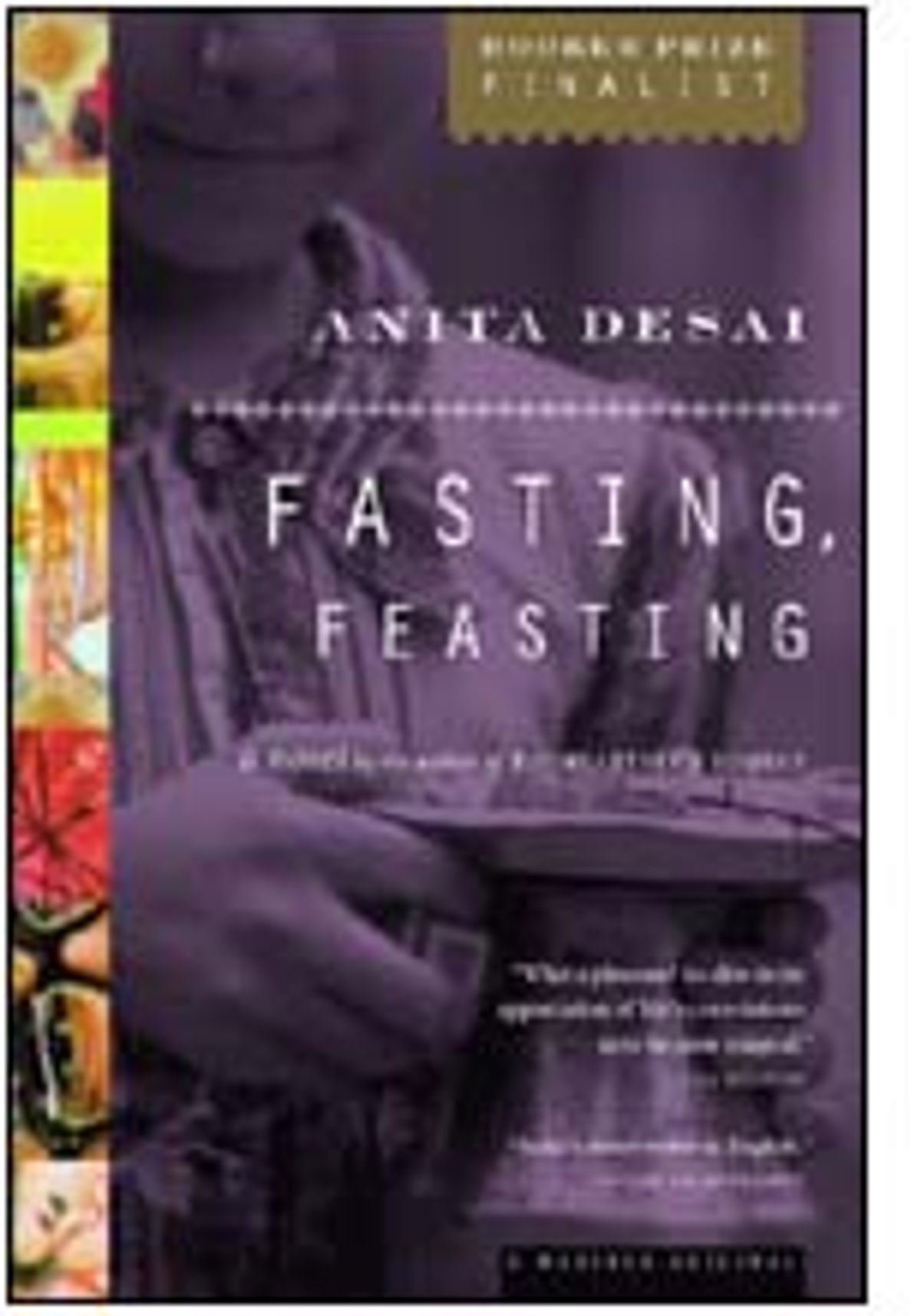
“Fasting, Feasting” by Anita Desai
Unhappy Indian families are unhappy in their own way, too, the author demonstrates in this Booker Prize finalist.
Anita Desai is a wonderfully subtle writer who achieves her powerful and poignant effects by stealth rather than by direct action. Her latest novel, “Fasting, Feasting,” a finalist for last year’s Booker Prize, tells the apparently spare story of one Indian family and the varying fates of its two daughters and single son; it is only on the novel’s final, quiet page that Desai’s intricate structure becomes clear and the complexity of her emotional insight makes itself felt.
She opens her story with a busy domestic scene, as the parents — who have such a fused authority that they are often referred to simply as MamaPapa — fussily ask whether daughter Uma has given orders to the cook and prepared a package for son Arun, who is studying in America. In the novel’s present tense, Uma is a gray-haired spinster living under MamaPapa’s demanding rule. In flashbacks scattered through the novel’s first part, we gradually see how Uma arrived at this imprisoned state.
|
Uma is an eager, thwarted character of genuine pathos: Clumsy, nearsighted, slow, she is treated with neglectful impatience by her parents and with some condescension by her smart and pretty younger sister, Aruna. Her greatest happinesses occur in moments of near oblivion, as when she succumbs to a fit in an ashram to which her pious Aunt Mira-Masi has taken her (the fit is interpreted as possession by the Lord), or when she nearly drowns in the Ganges during a religious ritual but is saved, much to her dismay, by scolding relatives.
Uma resembles the good, frustrated woman in a Victorian novel, which is unsurprising given this family’s traditional structure. When Arun is born, the family’s resources are poured into his physical and intellectual nourishment. For the girls, the sole future is marriage. The arranged marriages produce their own painful comedy when Uma proves difficult to pair off: “Mama worked hard at trying to dispose of Uma, sent her photograph around to everyone who advertised … but it was always returned with the comment ‘We are looking for someone taller/fairer/more educated, for Sanju/Pinku/Dimpu.’” Twice the family is duped into handing over a dowry as part of an unsuccessful engagement — a shame that clings to Uma forever after, though she is blameless in both situations. Inevitably, Aruna’s marriage is a glamorous triumph, taking her off to a new metropolitan life in Bombay.
Although perpetually cheated of opportunities — a benign doctor’s attempt to give Uma a simple job is swiftly quashed by MamaPapa — Uma is not jealous of her siblings, exactly. When Arun receives his longed-for acceptance from an American university, Uma notices her brother’s blank joylessness: “All the years of scholarly toil had worn down any distinguishing features Arun’s face might once have had.” With a deft touch, Desai shows us that MamaPapa’s ambitions for Arun are as stifling as their lack of ambition for Uma, and that Uma’s brief spiritual ecstasies have given her moments of self-expression that Arun has yet to enjoy.
Two-thirds of the way through “Fasting, Feasting,” the narrative abruptly shifts to present-tense Boston, where gloomy Arun is spending his own captive summer lodging with an American family, the Pattons. Though Desai knows Boston (she lives in Cambridge), her footing here does not seem as firm. The Pattons speak an oddly anachronistic American (“India — gee!”) and exist largely to flesh out the metaphors of surfeit and want that are at the heart of Desai’s careful creation. Thus, the Pattons represent excess: The father barbecues great slabs of meat, the mother overfills vast shopping carts and the miserable daughter binges on endless candy bars. Arun is comically appalled by these physical and emotional hungers; if the contrast with India seems overschematized, his wistful, belated appreciation of home comforts is real and vivid.
“Fasting, Feasting” is a novel not of plot but of comparison. In beautifully detailed prose Desai draws the foods and textures of an Indian small town and of an American suburb. In both, she suggests, family life is a complex mixture of generosity and meanness, license and restriction: The novel’s subtle revelation is in the unlikely similarities. In one dark moment, Arun recognizes in the Pattons’ bulimic daughter a version of his own unhappy sister Uma, and the shock provokes a reflection on these two frustrated women: “But what is plenty? What is not? Can one tell the difference?” Desai’s novel is a moving, eloquent exploration of that question.
Sylvia Brownrigg is the author of a novel, "The Metaphysical Touch," and of a short-story collection, "Ten Women Who Shook the World," that will be published later this year.She is a frequent contributor to Salon Books. More Sylvia Brownrigg.
“People Who Eat Darkness”: The disappearing blonde
A true crime story set in Tokyo illuminates the complicated truths behind media cliches
Joji Obara and Lucie Blackman (Credit: Estate of Lucie Jane Blackman) Lucie Blackman, 21, went out for the afternoon in 2000, phoning her roommate and best friend Louise to arrange a meeting later that night. Lucie never showed up, and within a few days she’d become one of those vanished blondes whose fates fuel headlines and hours of speculative media coverage. She was British, a former flight attendant, and she and Louise were living in Tokyo. They were also bar hostesses, a profession with a very specific meaning in Japan, difficult to explain to foreigners and not entirely clear to the Japanese themselves. Lucie both did and didn’t match the classic Missing Blonde profile, and for a while the mystery of what happened to her threatened to lapse into permanent obscurity.
Continue Reading Close
Laura Miller is a senior writer for Salon. She is the author of "The Magician's Book: A Skeptic's Adventures in Narnia" and has a Web site, magiciansbook.com. More Laura Miller.
Corporate criminals gone wild
The maker of the documentary film "Inside Job" has a new book excoriating Wall Street -- and President Obama
A detail from the cover of "Predator Nation" “Inside Job,” Charles Ferguson’s Oscar-winning documentary film on how government, Wall Street and academia colluded to deliver us the worst financial crisis since the Great Depression, made a powerful case that something was very very rotten at the heart of the American political/economic nexus. His follow-up book, “Predator Nation: Corporate Criminals, Political Corruption, and the Hijacking of America,” can be considered the legal brief that dots every “i” and crosses every “t” in his argument. A tightly argued, profusely footnoted and deeply enraged castigation of everyone involved, “Predator Nation” isn’t just a factually unchallengeable account of how Wall Street blew up the global economy. It’s a denunciation, a call for justice and a warning: After getting away with the crime of the century, Wall Street still isn’t satisfied.
Continue Reading Close
Andrew Leonard is a staff writer at Salon. On Twitter, @koxinga21. More Andrew Leonard.
Can you identify?
Science shows that the only way around some readers' prejudices is to trick them
(Credit: Shutterstock/Salon) The news of recent research documenting how readers identify with the main characters in stories has mostly been taken as confirmation of the value of literary role models. Lisa Libby, an assistant professor at Ohio State University and co-author of a study published in the Journal of Personality and Social Psychology, explained that subjects who read a short story in which the protagonist overcomes obstacles in order to vote were more likely to vote themselves several days later.
The suggestibility of readers isn’t news. Johann Wolfgang von Goethe’s novel of a sensitive young man destroyed by unrequited love, “The Sorrows of Young Werther,” inspired a rash of suicides by would-be Werthers in the late 1700s. Jack Kerouac has launched a thousand road trips. Still, this is part of science’s job: Running empirical tests on common knowledge — if for no other reason than because common knowledge (and common sense) is often wrong.
Continue Reading Close
Laura Miller is a senior writer for Salon. She is the author of "The Magician's Book: A Skeptic's Adventures in Narnia" and has a Web site, magiciansbook.com. More Laura Miller.
“The Aleppo Codex”: The bizarre history of a precious book
A reporter traces the shadowy fate of the definitive version of the Hebrew Bible
Matti Friedman An ancient and priceless book, a murky history of evasions and coverups, an underground of sinister and possibly violent dealers, a former spy who drops tantalizing hints and a wily 84-year-old millionaire who says stuff like, “The problem with this story is that it could damage your health”: Are these the ingredients for a cheesy, improbable historical thriller? Yet “The Aleppo Codex,” Matti Friedman’s account of his attempts to learn the history of one of the world’s most precious books, sports all of these assets, and it’s nonfiction. If reporting this story damaged Friedman’s health, it probably happened when he realized what he’d stumbled into and his reporter’s heart started beating in doubletime.
Continue Reading Close
Laura Miller is a senior writer for Salon. She is the author of "The Magician's Book: A Skeptic's Adventures in Narnia" and has a Web site, magiciansbook.com. More Laura Miller.
Augusten Burroughs: Conquer trauma by letting it go
Salon exclusive: The best-selling memoirist says past horrors haunt us because we think about them too much. Stop
Augusten Burroughs Many people continue to feel influenced and even controlled by the things that happened to them a long time ago. Sometimes, people harbor dark, traumatic memories from childhood. Or fragments of memories — incomplete scenes, uncomfortable feelings, perhaps even a sense of certainty that something specific and terrible happened to them, but little more than this.
Others experienced something traumatic in adulthood that continues to affect them day to day many years later. Maybe an assault has left a person afraid to leave their home or enter a particular neighborhood.
Continue Reading CloseAugusten Burroughs' many books include "Runnning With Scissors," "Dry," "Sellevision," "Magical Thinking" and "Possible Side Effects." His latest book is "This Is How." More Augusten Burroughs.
Page 1 of 984 in Books
