Margaret Spillane

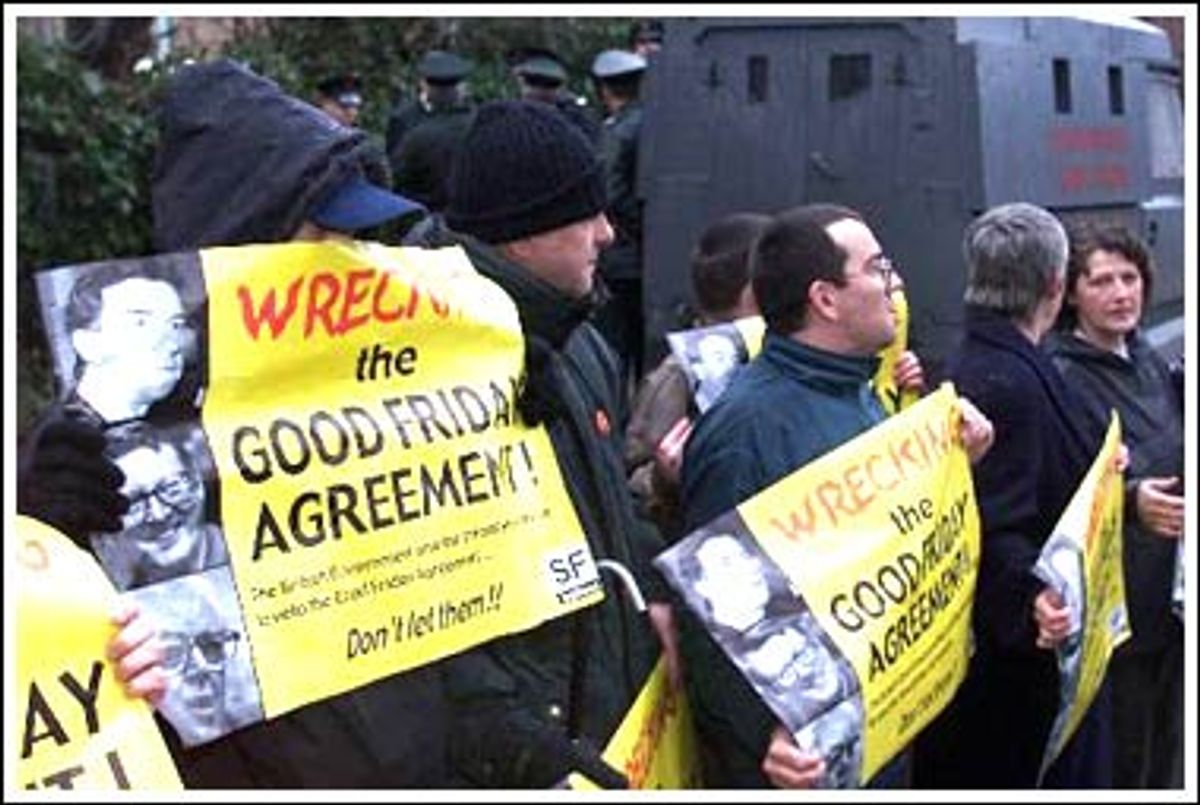
“Good Friday is dead”

Britain is to blame for greatest crisis in Northern Ireland since the cease-fire began.

  • more
    • All Share Services

“Keep your nerve,” Gerry Adams, the president of Sinn Fein, used to remind his allies in Northern Ireland’s Republican political circles during particularly edgy moments leading up to the Good Friday peace accords signed in 1998.

But Wednesday afternoon, Adam’s own patience sounded profoundly frayed. Britain had suspended Northern Ireland’s promising new power-sharing government and the Irish Republican Army withdrew from disarmament talks. British and Irish prime ministers held crisis meetings at Number 10 Downing Street, to try and restore the suspended government.

The talks reportedly bore little fruit. “The institutions have been torn down and the Good Friday Agreement has been torn up,” Adams said outside in exasperation. By Friday, leaders from all sides were booking flights to Washington for White House meetings next week.

The current crisis is the most profound since the IRA’s current cease-fire began in 1995. Adams and his IRA-allied Sinn Fein are at loggerheads with suspended First Minister David Trimble. Trimble’s Ulster Unionist Party provoked the current crisis by threatening to withdraw from the government altogether if the IRA did not satisfy Trimble’s personal deadline for a disarmament timetable.

Britain’s suspension of the power-sharing government also infuriated Dublin, where the new Northern Irish institutions have been written into the Republic of Ireland’s constitution after a popular referendum.

Irish Prime Minister Bertie Ahern believes Britain’s Northern Ireland Secretary Peter Mandelson’s suspension of the Belfast government — supposedly designed to buy time — has no basis in law, and puts whole process in jeopardy: “Each day they are suspended is a day in which further damage is being done to the well-being of the agreement,” Ahern said Tuesday.

The immediate source of today’s crisis was a revival of what is known in Northern Ireland parlance as “the “Unionist Veto” — the long tradition Ulster’s Protestant majority rejecting any accommodation with the Roman Catholic minority, now nearly half the population of the province. Mandelson’s predecessor Mo Mowlam periodically angered Unionists by declining their veto demands, and Mandelson was named in part to assuage that fury.

In this case, Mandelson decided to accommodate the Unionist veto in the form of Trimble’s insistence that his Ulster Unionists would only remain in the new government if the IRA began handing in its arms by February. It was a demand completely outside the terms of the Good Friday accord, which set a May date for all of Northern Ireland’s Catholic Republican and Protestant loyalist paramilitaries to cooperate with an international disarmament commission.

Trimble’s demand turned last week into an occasion for Belfast brinksmanship. The IRA’s leadership repeatedly asserted its commitment to the Good Friday process, but not to Trimble’s threats.

With Trimble threatening to bring down the government altogether, the IRA — while vowing it would pose “no threat” to its cease-fire — went down to the wire of Mendelson’s self-imposed deadline last Friday before giving the disarmament commission reassurance that it would put its arsenal “beyond use” in keeping with the treaty. Ahern now maintains that Mandelson pulled the plug even though he knew the IRA proposal was on offer — a charge London denies.

Mandelson, later admitting that the IRA’s proposal was “a big advance,” nonetheless drew a line in the sand and suspended the new government, returning rule of Ulster to London. On Tuesday, the IRA shut off contact with the arms commission and withdrew its offer from the table.

While Mandelson’s move pacified the Unionists, it defied the logic of the past five years. When Northern Ireland’s peace process has worked, it has been because a succession of intermediaries, ranging from Irish-American business leaders to Irish and British officials to Senator George Mitchell, insisted upon keeping the key parties at the table.

Officials continue to speak publicly about restoring the suspended Northern Ireland government as quickly as possible. But some of the most informed observers believe the Good Friday process as it has existed is finished. “Essentially, arms decommissioning is dead,” said one intimate participant in the peace process.

As political leaders descended on Downing Street, two small events occurring well away from the cameras in Northern Ireland served as evocative reminders of the stakes in this crisis. At St. Patrick’s Cathedral in the town of Armagh on Monday, several hundred people assembled for a memorial service commemorating those “disappeared,” killed by one paramilitary faction or other and never recovered, during the 25 years of the Troubles.

Archbishop Sean Brady addressed an assembly of people from both communities, urging those who knew the locations of these brutal burials to provide that information. “A grave gives us a focus for grief,” he said, and the opportunity to satisfy this critical human need to reckon with the physical facts of death would provide the means for both communities to “create together the kind of future we really want.”

If that service was a reminder of the worst of the recent past, a ribbon-cutting in Monkstown underscored the stakes for the immediate future. There, the Canadian telecommunications conglomerate Nortel announced a new # 29 million investment package and 500 new jobs, creating Nortel’s largest systems facility in Europe. But company president John Roth issued a pointed warning: Political stability “will be an important consideration” in any future investment.

Returning local government to Belfast after 30 years of rule from London was supposed to empower the most compromise-minded elements among Republicans and Unionists. It would force them to find common ground in the day-to-day business of running schools, sewers and streets. Mandelson’s suspension of the process does precisely the opposite — it has given credence to the hard-liners and most polarizing voices on all sides.

Just how polarizing can be read in the fine print of the IRA’s withdrawal from the arms-decommissioning process. Not only did the IRA pull its current offer from the table; it accused the British government and Ulster Unionists of seeking “a military victory” rather than a negotiated peace, and withdrew “all propositions” made to the international arms-handover commission since November — ominously moving discussions back to square one.

The irony is that until last week, the IRA’s military leadership had long accepted the wisdom of putting its arsenal on ice. It supported Adams’s commitment to promote the goal of unifying Ireland through elective office both in the Republic and the North. What returned the IRA to center stage last week was not a hard-line Republican faction but Trimble’s intransigence and Mandelson’s inability to see beyond it.

Is it possible, as Tony Blair pledged today, to “pick up and move on” from such a disastrous impasse? Perhaps — but it will likely be a far different and more limited peace process from that underway just last week.

Niall O’Dowd, publisher of the Irish Voice newspaper in New York and one of a handful of Irish-American community leaders who jump-started the peace process in 1993, believes that both disarmament and a locally-controlled Ulster government are now dead in the water. O’Dowd, whose weekly newspaper maintains close relationships with players on all sides in Northern Ireland, believes “the best hope — and what Sinn Fein will be looking at — is to negotiate areas of the peace process where there can be no Unionist veto.”

He paraphrases the sentiment among senior Republicans: “Good Friday is dead. Long live the peace process.” That means pushing forward police reform, workplace equality and other issues, but abandoning the Good Friday legislative framework. Sinn Fein, he says, “no longer trusts that process, and believes that Trimble is unsafe at any speed” as a coalition partner.

One unresolved question is a role for Washington. So far, the White House played it low-key, backing the Blair government’s suspension, urging the IRA to make more aggressive disarmament moves. A senior National Security Council official told Salon that so far, the NSC is playing no active intermediary role in the crisis, although next week Trimble, Mandelson and McGuinness are each expected to meet with NSC Chief Sandy Berger.

This deference to London is in sharp contrast to the Clinton administration’s early commitment to a Northern Ireland rapprochement, with NSC officials brokering negotiations and a U.S. visa for Gerry Adams in defiance of the notoriously Anglophilic State Department bureaucracy. Later, Clinton encouraged the appointment of George Mitchell as peace negotiator.

In Belfast, Clinton is still regarded as an honest and independent peace broker, and in Washington, Northern Ireland is recognized as one of the administration’s few foreign policy success stories. From both directions, pressure may swiftly emerge for a mideast-style peace summit, an opportunity to revive the dialogue shut off by Mandelson’s botch of the arms confrontation.

In the meantime, Northern Ireland stands in a state of watchful waiting — its elected government suspended after just two months, the IRA and loyalist paramilitary cease-fires holding but vulnerable to unforeseeable events.

The peace process has always been about far more than disarmament or even elections. But without the cross-border and cross-community institutions the Good Friday agreement created, the gains of the last five years will take far longer to secure.

The witch hunt against Archbishop Weakland

Yes, the eminent cleric had a love affair with a younger man -- but who was the real victim?

  • more
    • All Share Services

Anyone tuning in to ABC’s “Good Morning America” Friday began the day with a sickening tale: What host Charles Gibson called “serious new allegations of sexual misconduct in the Catholic church.” Unlike the Boston Globe’s months of investigative reporting involving Cardinal Bernard Law, the misconduct reported by the network’s correspondent Brian Ross did not involve pedophilia. Instead, Ross reported that one of the country’s most respected and reform-minded Catholic leaders, Archbishop Rembert Weakland of Milwaukee, stood accused of attacking a male graduate student nearly a quarter-century ago, and paying $450,000 in hush money in 1998.

ABC reported that Paul Marcoux, now 54 years old, charged that around 1980, “he was sexually assaulted by the archbishop when he went to him seeking advice on entering the priesthood.” Marcoux himself was even more explicit: “He was sitting next to me and then started to try to kiss me and continued to force himself on me and pulled down my trousers, attempted to fondle me. Think of it in terms of date rape.” The story was incendiary. Within hours, Archbishop Weakland — the leading voice within the American Catholic hierarchy for democratization, acceptance of gays and other social-justice reforms — had accelerated his planned retirement. It seemed the logical next chapter in a season of church scandal.

But who was really the victim this time? A close look at the Weakland case suggests a story far different from ABC’s simple “date rape” report — and an accuser with far less credibility than suggested on “Good Morning America” and in subsequent national media reports. Indeed, the real story behind Weakland’s resignation suggests that the hard work of documenting the church’s coverup of clerical pedophilia risks being derailed by personal vendettas and gay-bashing.

The story really begins with what ABC’s viewers — and later readers of the New York Times, which put Paul Marcoux’s charges on the front page — were never told. They did not hear, for instance, that questions have arisen about accuser Marcoux’s credibility. One small but telling example: Marcoux recently told Milwaukee reporters that he did “undergraduate work” at Boston College, the prestigious Jesuit institution. But a call to the B.C. registrar’s office reveals that Marcoux’s “undergraduate work” consisted of a single summer class taken in 1975.

Reporters for the Milwaukee Journal Sentinel found similar problems with Marcoux’s credibility. “Marcoux sometimes exaggerates,” the paper reported in Friday’s editions. It quoted an e-mail message from him describing his “friendship” with a California academic who has written about victims of abuse. But the professor said Marcoux “was never anything more than a vague acquaintance.” So unreliable was Marcoux — reneging on agreements to document his charges — that the Journal Sentinel, which had been working on the story for weeks, had killed the story until Marcoux appeared on ABC.

ABC’s viewers did not learn, either, that whatever happened between Weakland and Marcoux, the two enjoyed a lengthy and intimate relationship. A long and agonized 1980 letter by Weakland to Marcoux describes a planned vacation on Nantucket, a trip to Boston, and conflict over Marcoux’s involvement with another man named Don. In the letter — excerpted by the New York Times but most revealing and moving if read in full on the Journal Sentinel or Times Web sites — Weakland describes his decision to turn away from Marcoux and back to celibacy as “the greatest renunciations” in his life as a priest. In the letter, the archbishop cautions Marcoux against pursuing a plan to combine psychodrama therapy and religious counseling. The distress evident in Weakland’s efforts to be fair and tolerant toward Marcoux’s ideas — even giving the younger man his entire personal savings of $14,000 — reflects his apprehension about finding himself bankrolling a pop-therapy scheme dressed in clerical robes.

ABC viewers also never learned that Marcoux spent decades in perpetual financial crisis: He was an inveterate houseguest of the sort that makes Kato Kaelin look like a standard-bearer for the Protestant work ethic. Archbishop Weakland’s anguished letter in 1980 worries explicitly and deeply about Marcoux’s repeated demands for money and his inability to manage his own finances: “Your anger was evident that I couldn’t play the great patron … In all truth I do not see how you could possibly earn the kind of money you foresee, enough to live in the style you are accustomed to … I am baffled by your handling of money.”

This is no one-time lovers’ quarrel. The Journal Sentinel reported that 22 years later the same problems were evident: Marcoux had stayed with a succession of friends for years, and his own sister told the paper that in four years’ time he had burned through the entire out-of-court settlement from Weakland. What emerges is not the tale of a victim but the story of a sponge.

Weakland, who had already submitted to a planned mandatory retirement, decided to step aside and apologize — not for his relationship with Marcoux, but for eventually settling his personal affairs at the expense of the archdiocese. Weakland says he will not breach the settlement’s confidentiality agreement. So whatever happened in private between Weakland and Marcoux, the public outcome is clear. The country and the Catholic Church have lost a consistently dignified and passionate activist for women’s equality within the church and for economic equality in the nation. What Marcoux may have gained is a matter of speculation. But the public reality is that Archbishop Weakland was blackmailed, and ultimately punished, for being gay.

What’s clear is that the meticulous reporting of sexual abuse by the Boston Globe — swinging a wrecking ball through a wall of silence behind which the cries of the innocent were smothered lest they interfere with business as usual — is in danger of giving way to sweeping persecution of gay priests. The Marcoux affair, and the slipshod reporting of his accusations by ABC, suggest it’s open season.

Continue Reading Close

What made peace possible in Ireland?

A vision of prosperity and inclusion, for North and South, moved both sides beyond violence.

  • more
    • All Share Services

It was the end of a workday at the chief port on Ireland’s southern coast. People were moving nimbly through the light rain, going about their business, hardly sparing a glance for the military spectacle they had to step around on the sidewalk: Eight Irish soldiers with their semiautomatics at the ready.

This was closing time at the Cobh bank, a routine handover of the office cash-box common to businesses the world over. But on this particular occasion, the familiar Securicor transport van had arrived amid a phalanx of Land Rovers from which those soldiers piled out. After the van picked up its cargo, the whole parade moved a half-block down the street and repeated its performance at Cobh’s small post-office on the town’s waterfront, before zooming out of town under police escort.

At the opposite corner of the island and across the border in Northern Ireland, TV crews from all over the globe were this day unloading their own heavy artillery, preparing to broadcast the momentous event initiated at midnight Thursday: Ulster’s first power-sharing government, marking the presumed end of the 30-year conflict known as the Troubles. Seated side by side at Belfast’s Stormont Castle Thursday were representatives of Sinn Fein, the electoral ally of the Irish Republican Army, and Protestant Unionists to whom Sinn Fein and the nationalist aspirations of Northern Ireland’s Catholics have generally been anathema.

Cobh, in the Irish Republic, is as geographically remote from British-controlled Belfast as any city on the island. But the high-firepower escort for Cobh’s cash boxes was a guarantor for those dramatic events in the North. Rumors were rife that a small faction of dissident Republicans hoped to wreck the talks with some daring act of violence on either side of the border. That cash box-protection-squad was called out to preempt any action which might cause tempers in Belfast to explode and inspire any player to walk away from the table.

In the annals of Irish diplomacy, guarding Cobh’s cash box will be a minor footnote. Yet the fact that Ulster’s new government took office Thursday was largely attributable to an accumulation of such unheralded gestures on both sides of the border.

It is part of what Inez McCormack in Belfast calls “the unheard part of the peace process.” McCormack, president of Unison, the province’s union of health care workers, was one of a handful of Irish and Irish-American labor, business and political leaders who helped broker the first cautious approaches between Northern Ireland’s bitterly contending factions in 1993. At the time, any settlement of the Troubles seemed almost unimaginably remote: Sinn Fein’s Gerry Adams was banned from British airwaves and denied a U.S. visa; the Ulster Unionist Party, the largest Protestant party, would not sit in the same room with Sinn Fein, let alone contemplate participation in a joint government.

Now, she watched the run-up to Thursday’s government handover with what she describes as “a sense of disbelief — and I don’t mean that in a bad way.” This salubrious astonishment even from so deeply engaged a political player is understandable. While those soldiers went on quiet alert in the Irish Republic in the South, open anxiety had mounted in Belfast last Saturday as Ulster Unionists debated for hours whether to take the final leap.

Unionist leader David Trimble finally won a narrow majority for the new government — in which he holds the office of first minister alongside Deputy First Minister Seamus Mallon of the Catholic-nationalist Social Democratic and Labor Party — by promising to resign if the IRA does not make disarmament progress by February. Trimble was praised in some quarters for his bravery — putting his career on the line for the new government. Yet he also created a timetable and a demand far outside the agreement negotiated for months by former U.S. Sen. George Mitchell.

“If that vote were not conditional, there probably would be euphoria,” says McCormack. “But even so, the sense of a moment of transformation is still there. While the media has focused on that February deadline, it is just as important that there are no demonstrations in the streets saying shut down the new government. Things will never be the same again.”

The struggles of Northern Ireland, a British province of just 1.5 million, may seem old news compared with, say, world trade talks and mass protest in Seattle. But in a curious way, the contradictions of the entire island of Ireland — the roaring Celtic Tiger economy in the South adjoining a high-unemployment North economically dependent upon Britain; a Protestant-majority British province whose Catholic minority identifies itself with the Republic across the border — are a microcosm of some of the most pressing issues of inequality and conflict in the global-economy era.

The story of Northern Ireland’s peace deal, the so-called “Good Friday Accords” negotiated by Mitchell, has been portrayed in the United States as the dance of rival Protestant and Catholic leaders — particularly, in recent months, the uneasy rapprochement between the UUP’s Trimble and Sinn Fein’s Gerry Adams. But that portrayal neglects what McCormack calls the “unheard” peace process, the education and organizing that convinced masses on both sides of the divide that peace was in their interest.

By the early ’90s, politics in Northern Ireland was defined entirely by sectarian conflict, and government defined entirely as an obsession with security. Northern Ireland’s contending parties were responsible to no one but their own back-benchers and paramilitary allies, breeding a kind of self-reinforcing militance.

Now, instead of bringing to power only each side’s “permanent government,” some truly resourceful people are seizing the opportunity represented by the Good Friday process to open Northern imaginations to the real meaning of inclusivity. Rather than cutting up the pie along lines demarcated Catholic/Protestant, Nationalist/Unionist, they’re proposing that the door be flung open to all the constituencies whose voices have never been heard in the halls of Ulster government: the poor, the immigrant, the sexual minority, the physically handicapped.

So while the TV cameras head for Trimble and Adams, at the deepest level the peace process is not about them. Its complex procedures are engineered, says McCormack, to “create cooperation between government and the people who govern,” which after 27 years of rule from London represents a radical departure.

To get some idea of how radically things change starting now, consider that the new cabinet’s education minister is Sinn Fein’s Martin McGuinness, who distinguished himself as the IRA’s brigade commander in Derry in the 1970s. Under the careful checks, balances and equality benchmarks of the Good Friday agreement, he is now legally bound to deliver schooling across community lines, “advised and assisted” by a committee headed by two Unionist deputies who until recently would have happily run McGuinness out of the province.

What has really happened is that the era of heroic Republicanism and mythic Unionism is over. It has been replaced by the mundane responsibilities of building sewers and dividing up budgets, which under the Good Friday accords cannot happen without at least token consultation across community lines. For the first time, sectarian leaders will, in the word of one Irish political veteran, sometimes “have to say no their own people, and yes to others.”

The Ulster peace accord is also far more profoundly an all-Ireland process than overseas reporters usually understand. “The impact on the South is really quite substantial,” reflects Dick Spring, the Irish Republic’s former foreign minister at the time negotiations began — negotiations that turned into an infinitely complex diplomatic calculus involving not only the direct combatants in Ulster but the governments in Dublin, London and Washington (where the Clinton administration played a notable role in facilitating early talks).

Though no longer foreign minister, Dick Spring still represents County Kerry in the Dail, the Irish Republic parliament. A first-time visitor to his constituency in Kerry, which along with County Cork forms the southwest corner of Ireland, might well imagine these peninsulas of wild mountains, dramatic coastlines and rolling farmlands to be as psychically removed from the traumas of Belfast as they are physically remote.

The small towns all look freshly-painted and prosperous; local businesses are the small boats lifted by the tide of transnational commerce which Ireland’s highly-educated population has attracted and held. The new Irish economy is so robust that for the first time in 800 years British laborers are booking passage to Irish construction sites rather than the other way around. Unemployment is so low that a few days ago the Irish government announced that 3,000 guest workers will be imported from Europe to meet the needs of farmers, unimaginable in Ireland’s long agrarian history.

Yet Spring’s constituency lives in a landscape which earlier in this century ran red with the blood of martyrs in the war of independence from Britain, as well in the brief, horrifying civil war that followed. Monuments on the sites where heroes fell dot the roadsides, pictures of IRA founder Michael Collins are still occasionally visible through the window of a home and a former IRA gunrunner was elected just last year to the County Kerry Commission on the Sinn Fein slate.

Despite the historic resonance of Republican politics in Cork and Kerry, these districts, like the rest of the Irish Republic, voted last year to remove from the nation’s constitution its historic claim of sovereignty over the territory of the North, long the basis of fear and contention by Ulster’s British-identified Protestants. That change, as dramatic as the new ministerial council in Belfast, occurred simultaneously on Thursday.

What enabled such a shift, says Spring, is twofold. “There is fatigue among those who were actually waging the war. As recently as last Friday I was talking to a room of Republicans who said they supported the Good Friday accords because they are middle-aged guys who want to get on with their lives.

“And then there are younger people who bring a total change of mindset: A generation of people who are more inclined to see their Irish identity in cultural terms. For them, the claim to national territory is not so compelling. They have a far better understanding of the presence of 1 million Protestants on this island, a history which was not previously taught us in school.” Indeed, Thursday did not just bring about the removal of Ireland’s old constitutional claim. In its place is new language casting Irish identity not only in terms of the island’s two traditions but the worldwide Irish diaspora.

And the settlement that finally resulted from five years of negotiation is a thorough transnational innovation — in Spring’s words, “a new working model for governance” with a north-south Ministerial Council and institutions for regulating health, the environment, human rights and commerce for the whole island. With the resolution of ethnic conflict across national lines a burning issue everywhere from the Balkans to Indonesia, Ireland’s experiment is being closely watched.

Spring is sanguine about threats to this new arrangement. On each side, there are peacebreakers as well as peacemakers. Among Republicans, the “Real IRA,” responsible for last year’s horrific bombing in the Northern market town of Omagh, regards Good Friday as a sellout of United Ireland. Fewer than 100 in number, their leaders well-known, they are intensely monitored by police on both sides of the border.

Far more numerous and unpredictable are dissident Unionists in the North: Reverend Ian Paisley’s Democratic Unionist Party which agreed to participate in Stormont only with the express promise of disrupting its proceedings and that substantial segment of Trimble’s UUP which voted against Stormont.

Even more dangerous, says Spring, is David Trimble’s resignation pledge to his recalcitrant back-benchers. “Trimble has put himself in a very precarious position that does not fill one with confidence,” Spring says.

In fact, IRA “decommissioning” as a precondition for Sinn Fein’s participation has never had much meaning as peacemaking. Though the IRA has pledged voluntary cooperation with an international disarmament commission, everyone agrees that the IRA could speedily rearm if it wished, and some of the most potent bombs have been made of that basic commodity of an agrarian economy, fertilizer.

Instead of a prerequisite of peace, decommissioning is a political demand by Unionists — intended, depending on which faction is talking, either to humiliate Republicans, to wreck the Good Friday Agreement by delaying its implementation so long it falls of its own weight, or worst of all, to provoke a resumption of IRA violence. So far, the IRA has stuck to the “decommissioning” which counts most: An end to sectarian combat, even in the face of continued low-level loyalist violence against Catholics.

Disarmament is far from the only issue with the potential to derail Ulster’s promising new government. “Don’t underestimate the resistance among some Unionists” to the cross-border institutions, Spring warns. Even though financial services and agribusinesses are already functioning in both the North and South, and Northern business leaders would like a ride on the back of the Celtic Tiger, hardline Unionists take a dim view of Irish Republic investment in the North. In late November, for instance, Unionists sounded the alarm at reports that British banking giant Natwest might sell out to an Irish holding company. The chairman of Natwest, however, did not even reply.

Just as symbolically volatile is policing — reform of the notorious Royal Ulster Constabulary. Former Hong Kong governor Chris Patten, commissioned by the British government to report on RUC reforms, carefully delayed the scheduled release of his final recommendations until early December, after the Stormont government’s inauguration. But a few days before the UUP vote, Queen Elizabeth awarded the RUC the George Cross for its service in the Troubles — a salve to Unionist sensibilities in advance of a controversial overhaul and renaming of a 98 percent Protestant police force deeply tied into Unionist patronage networks.

Neither the George Cross nor any concessions in the Patten agreement mean the RUC controversies are over. Just this week the force was barred from training at the FBI Academy in Quantico because of its documented involvement in human rights abuses. The American Bar Association urged that the force be removed from the investigation into the murder of human-rights lawyer Rosemary Nelson in which RUC officers may be complicit.

To Belfast’s Inez McCormack, the key for the new government to survive these high-risk confrontations is for ministers to take their mandate to create social equity seriously, rebuilding Northern Ireland from the ground up. “The question is, can we have economic growth with social inclusion?” she asks. “Development along with regeneration? This society has already had a transformation, coming from people who have experienced the most appalling inequality. Now it is time for that sense of generous transformation to be respected by the politicians. That is the only way this will work.”

Cross-border governance, constitutional recognition of cultural diversity and social equity as an imperative of growth — these innovations of Northern Ireland’s peace process, not just short-term “peace,” will make the inauguration of the Stormont government a historic marker. Northern Ireland’s creation in the Anglo-Irish Treaty of 1922 prefigured still-vexatious ethnic partitions in the Middle East and other old imperial possessions. Now a peace process which has apparently ended the three decades of the Troubles may prove just as dramatic an international catalyst.

Continue Reading Close

A death foretold

Despite Rosemary Nelson's murder, the Northern Irish peace process will survive.

  • more
    • All Share Services

Less than a year ago Rosemary Nelson of Lurgan, Northern Ireland, told me she worried that her three children might see her murdered, just the way the children of a fellow human rights lawyer, Pat Finucane, had seen their father gunned down at the dinner table back in 1989. The worry would not go away. Just a few weeks ago, when Nelson was leading demands for an inquiry into alleged collusion between British security forces and loyalist paramilitaries in the Finucane assassination, she asked Prime Minister Tony Blair’s office for protection. She was denied it, causing her to lie awake nights contemplating scenarios of her own violent death.

On Monday, Nelson was murdered. After a weekend fishing trip with her husband, she was heading for work when a bomb strapped to the underside of her car tore her legs off and ripped through her abdomen. Her 8-year-old daughter, Sarah, was on lunch break in her school yard, less than 50 yards away. Nelson’s sister, a teacher at the same school, spoke with Rosemary as firefighters cut through the twisted metal that pinioned the victim. Nelson lived two hours longer.

According to Dolores Kelly, deputy mayor of nearby Craigavon, Nelson “took the issues nobody else wanted to touch,” representing clients in both Catholic and Protestant communities. Last month Nelson went to Blair’s office at 10 Downing Street to discuss the persistence of harassment by Northern Ireland’s Royal Ulster Constabulary, intimidation intended to discourage her from providing people with republican politics their right to legal counsel. She described how members of the RUC had repeatedly issued death threats against her because her large, cross-community clientele included Colin Duffy, a man who’d been acquitted of murdering two RUC members; the family of Robert Hamill, a Catholic walking home from a dance who was kicked to death by a loyalist mob while four RUC officers watched from their Land Rover; and a group of 200 nationalists trapped in their neighborhood by a contingent of hard-line loyalist Orange Order members who’d set up camp there, whom police would not remove in spite of legal directives forbidding the encampment.

A tiny group of professional killers called the Red Hand Defenders have claimed responsibility for Nelson’s death. But Northern Ireland’s police chief, Ronnie Flanagan, admitted Tuesday that the faction lacked the technical resources to pull off this car-bombing alone, suggesting collaboration with other more expert assassins. The killers’ twofold goal was to silence one of the most visible crusaders against police intimidation in the six counties and to undermine the year-old Northern Ireland peace process by provoking a cycle of violent reaction.

Nelson’s assassination comes at what was already a delicate moment for a peace process that began with the signing of the Good Friday accord last year: The new Northern Ireland Assembly’s first minister, David Trimble, has made clear that he will require a commitment that the Irish Republican Army is ready to begin decommissioning of weapons before he will permit the two Sinn Fein delegates to take their seats. On Wednesday, President Clinton will meet with Irish officials and leaders from the North and South, to try to push the peace process forward. The horror at Nelson’s murder will either stabilize the process — or set it back dramatically.

Yet in spite of Monday’s horrifying event — and of the nearly three dozen murders in Northern Ireland over the past year — it is still possible to declare that the bomb and the gun are no longer decisive in Northern Irish politics. Last spring voters on both sides of the Irish border voted overwhelmingly in support of the Good Friday accord, an extraordinary document that established new cross-border legislative and judicial bodies jointly representing the Republic of Ireland and Britain as well as calling for reform in key areas of contention — including policing.

It was particularly ironic that Rosemary Nelson was murdered while many of the leaders in both communities — including Trimble, Deputy First Minister Seamus Mallon and Irish Congress of Trade Unions leader Inez McCormack — who have kept the peace process on track had just the weekend before crossed the Atlantic for a conference held jointly at Seton Hall University in New Jersey and across the Hudson at Columbia University. Called “The Equality Agenda: Northern Ireland in 2000,” the conference put on display the components of the Good Friday accord: a focus on human rights — as manifested through economic, cultural and legal rights — in every aspect and at every stage of building this new society.

What makes the Good Friday accord so radical is its refusal to accept the old bilateral model of the body politic — Catholic Nationalist vs. Protestant Loyalist. From the time of the first cease-fire declaration back in the fall of 1994, a startlingly broad array of community activists has seized the opportunity demilitarization has brought to articulate a radical new notion of equality that seeks the bannerless people on the furthest fringes of their communities and thrusts them into a forum with people who’d already presumed their own right to be heard. The new model for Northern Irish inclusion counts gender, ethnicity, physical capacity, race, sexual orientation and socioeconomic class — not just religion.

Much of the impulse for inclusion has come from women, who were sick of the war-room secrecy that characterized Northern politics for so long. Civil rights activist Bernadette McAliskey once said that she didn’t devote her life to the cause of freedom only to turn decision-making over “to a small group of men playing high-class intellectual poker with Ireland’s future and refusing to consult or inform the masses.” The refusal by leading Irish women to pursue business-as-usual politics led to an agenda that includes the issues of Chinese, South Asians, Travelers (Ireland’s nomadic people) and other ethnic communities as well as disabled people and the lesbian and gay communities. Perhaps the most startling feature of this new inclusivity is its declaration that there will be no “hierarchy of victims,” a worldview that gets the Irish beyond the old Catholic vs. Protestant polarities. There will be no yardstick for establishing who has suffered more than whom. As London sociologist Mary Hickman reminded last weekend’s conferees, the Good Friday agreement was not simply about people having the good manners to respect differences, but about their “having the freedom to express differences.”

The implications of this bold new venture reach beyond Northern Ireland. Nancy Soderberg, who as a National Security Council official steered the Clinton administration’s Northern Ireland policy during the hardest years of negotiation, told the conference that the lessons the White House has learned in Northern Ireland are informing its approach to the futures of Ethiopia, Cambodia, Haiti and Kosovo. As U.N. High Commissioner for Human Rights (and former Irish President) Mary Robinson has pointed out, “The legacy of the Cold War which suggested there was contradiction between civil and political rights on the one hand, and economic, social and cultural on the other, is slowly dissipating.” The United Nations is now urging governments to conduct “human rights assessments,” Robinson said, along the lines of environmental impact assessments.

But while the stamina of Northern Ireland’s grass-roots peace architects remains inspiring, the dangers to civil liberties that Rosemary Nelson struggled to expose continue apace: So-called “emergency legislation” that allows police to sweep through neighborhoods picking up people and detaining them for up to a week with no charges being proffered and no right to legal counsel; progressive erosion of the right to silence; resistance to the idea that a peacetime police service needs a vetting mechanism to eliminate people with records of abuse. Even those in the law enforcement establishment who are willing to institute reform measures are loath to establish a truth commission to deal with the facts of the RUC’s part in supporting and perpetrating torture and murder. “The police say, ‘Let’s look forward; don’t look back.’” says Human Rights Watch attorney Julia Hall.

Continue Reading Close

Northern Ireland: Who will police the police?

The one issue that the Northern Ireland peace accord has not addressed is the Royal Ulster Constabulary and its repressive ways.

  • more
    • All Share Services

While I was in Belfast during the summer of 1995 — right in the middle of the Northern Ireland cease-fire that miraculously lifted bomb-sniffing dogs and armored soldiers from everyday life there — the Northern Ireland Office bankrolled a series of festive billboards. Splashed across the signs were the closing words of native son Van Morrison’s “Coney Island”: “Wouldn’t it be great if it could be like this all the time?”

On TV spots, Morrison’s “Days Like This” played over images of two little boys — one Protestant, one Catholic — frolicking together near the magnificent North Antrim coast. “Everything falls into place with the flick of a switch,/Yes my mama told me there’d be days like this.”

Belfasters, in war or peace one of the most extroverted and friendly urban populations anywhere, appeared to be enjoying their city with gusto, gleefully driving through that summer’s spectacularly Mediterranean weather on downtown streets that only months earlier had been a labyrinth of barricades and police checkpoints. Jokes abounded about how the Royal Ulster Constabulary, interrogation artists who had distinguished themselves as compressors of skulls and testicles, were now self-consciously shuffling around like beat cops, pointing out faulty taillights and writing parking tickets.

This charming picture of lethal enforcers suddenly beating their Heckler and Koch machine guns into ploughshares was, however, far away from reality. While tourists were busy discovering the delights of the newly relaxed-looking six counties and journalists ceasing to call Belfast’s Europa Hotel the Beirut Hilton, the RUC was still making arrests the old-fashioned way. As civil rights lawyer Rosemary Nelson was told when she filed a criminal complaint against an officer for injuries inflicted on a client while in custody, “We’ve been doing whatever the fuck we want for 30 years, and 30 years from now we’ll be doing the same.” Another Nelson client, Michael Carragher (whose brother Fergal had been shot dead at a checkpoint), was beaten so severely while detained in one of the RUC’s infamous “holding units” that the doctor who examined him told the interrogators that Carragher needed immediate hospitalization. The doctor’s plea was ignored.

Nelson has filed thousands of criminal complaints against the RUC on behalf of such clients, and every one has been thrown out (though civil courts pay out huge damages daily for the same claims). She has received death threats from the RUC, and lies in bed at night wondering if her three children will witness what the children of her fellow human-rights lawyer Pat Finucane did: their parent murdered in a spray of death-squad bullets as the family sat down to dinner. After all, an RUC officer had predicted Finucane’s death a few weeks before it happened.

It is for such reasons that Friday’s cross-border referendum on the historic Northern Ireland peace accord is an occasion for vigilance as well as for hope. The agreement provides for a democratically elected Northern Ireland assembly; a North-South council of ministers empowered to create cross-border policies in such areas as education, environment, social welfare and economic development; possible early release for prisoners affiliated with Sinn Fein and those loyalist parties that sat at the negotiating table; the relinquishing by the Republic of Ireland of its constitutional claims to Ulster; demilitarization on all sides, from the British army to the loyalist and republican paramilitaries, within two years; and restructuring of the police.

However, these unprecedented fruits of cooperation could fall apart from within, Nelson told me recently, because “there’s very, very little focus on human rights, and I don’t think a political settlement can exclude human rights abuses.”

While the Belfast Agreement mandates police reform over two years, there is no reining in of the broad repressive powers granted the RUC. As Nelson points out, “When someone is picked up by the RUC and taken to a detention center, the right to a fair trial dies right there.” A person can be detained up to seven days with no charges preferred and can be deprived of legal advice for 48 hours. Interrogations often continue day and night, with legal counsel barred from the proceedings. And under the
Criminal Evidence Order, a client’s right to silence can be used in court to corroborate any evidence the police present.

In the weeks leading up to the accord, evidence of the full range of RUC abuses began to emerge. In a report to the United Nations High Commissioner for Refugees, the U.N. rapporteur to Northern Ireland, Dr. Param Cumaraswami, described how the civil and political rights of RUC detainees were systematically suspended. In particular, the U.N. report cited the degree to which lawyers for nationalist political prisoners are targeted by the RUC for harrassment, surveillance and death threats.

Coming on the heels of the U.N. report is a book called “The Committee,” by Irish investigative reporter Sean McPhilemy. The book, published in the United States by Roberts Rinehart, is an expansion of a 1991 British television documentary and it reveals how high-ranking RUC and British Army officers, along with Ulster Unionist businesspeople, clergy and politicians, worked together to select nationalist targets for assassination by loyalist hit men.

Whether and how far the RUC should be reformed is one of the most contentious issues in the referendum campaign. Nationalists, who for years have been plastering the North with signs reading “RUC: 93 Percent Protestant, 100 Percent Loyalist,” see no solution short of disbanding the RUC and building an entirely new police force. Unionists largely believe the RUC to be an effective bulwark against
terrorism. Many “no” votes in Friday’s referendum are expected to come from Unionists who fear that the RUC is going to lose not only its recognizability but even its name. Ronnie Flanagan, chief constable of the Royal Ulster Constabulary, recently enthused to London’s Daily Telegraph that “it makes us proud” to have “a title conferred by royal charter. There are
few policing organizations in the world that enjoy that privilege.”

Flanagan is also bucking any suggestion that former paramilitaries might be allowed to join a newly configured police force. This is as
unrealistic as it is shortsighted: Apart from the violence emanating from “The Troubles,” the streets of Northern Irish cities have been and continue to be astonishingly safe — and the credit for this goes not to the RUC but to the paramilitaries who constitute the grass-roots law enforcement in their respective communities.

British Prime Minister Tony Blair recently made a move that may help precisely because it provides an equal-opportunity irritant: He named Chris Patten, Britain’s final governor in Hong Kong, as head of an independent body looking to reform Northern Irish law enforcement. Patten is a former Conservative Party MP, so it’s hard to imagine a large nationalist constituency cheering his appointment. But Unionists could find as much to
be worried about: Patten is a Catholic, who as a junior minister to
Northern Ireland once supported the predominantly Catholic Derry City Council’s shortening of its name from Londonderry. And there are other factors that make him an interesting choice: While Patten had the thankless job of lowering the British flag on Hong Kong, he did so only after instituting wide-ranging democratic reforms there that infuriated Foreign Office mandarins who’d been accustomed to running the island like
a fiefdom.

But the huge task of transforming the notoriously sectarian RUC into a representative, accountable policing body with widespread community support will require more than the unusual talents of a maverick Tory Catholic. There will need to be a vigorous international presence, even though many Unionists still
object to any such idea as “outside interference.” They might want to look to South Africa, whose relatively rapid evolution to postapartheid policing required not only considerable outside financial support for training purposes but also
community-policing expertise from the U.S., Japan and elsewhere. Nor was the Mandela government too proud to call upon outside civil liberties scholars to help rewrite South Africa’s criminal laws.

The good news about Northern Ireland is that the 30-year-old war appears to be over. While there will likely be further deaths and acts of destruction caused by the marginalized rejectionist fringes on each side, the Northern Irish people, Protestant and Catholic, are overwhelmingly opposed to a resumption of war.
Recently, when the Protestant demagogue Rev. Ian Paisley tried to address the international press corps about the evils of the settlement, young and middle-aged loyalists drowned out his hellfire rhetoric with shouts of “Dinosaur!” and “You sent one generation of loyalists to prison, you won’t be sending another!”

The sense on the streets of Northern Ireland
is not only that a settlement is a good thing, but that citizens at the grass roots are confident they can sustain it. That feeling will remain only if the day-to-day justice issues are dealt with intelligently and swiftly. If it remains business as usual at Royal Ulster Constabulary headquarters, and Rosemary Nelson’s clients continue to emerge battered and bloody from police interrogation, then the euphoria and the hopes will quickly evaporate.

Continue Reading Close