Sex Work

Pros and amateurs

One way or another, men still expect to pay for sex -- and women pay for it, too, by keeping their financial goals low.

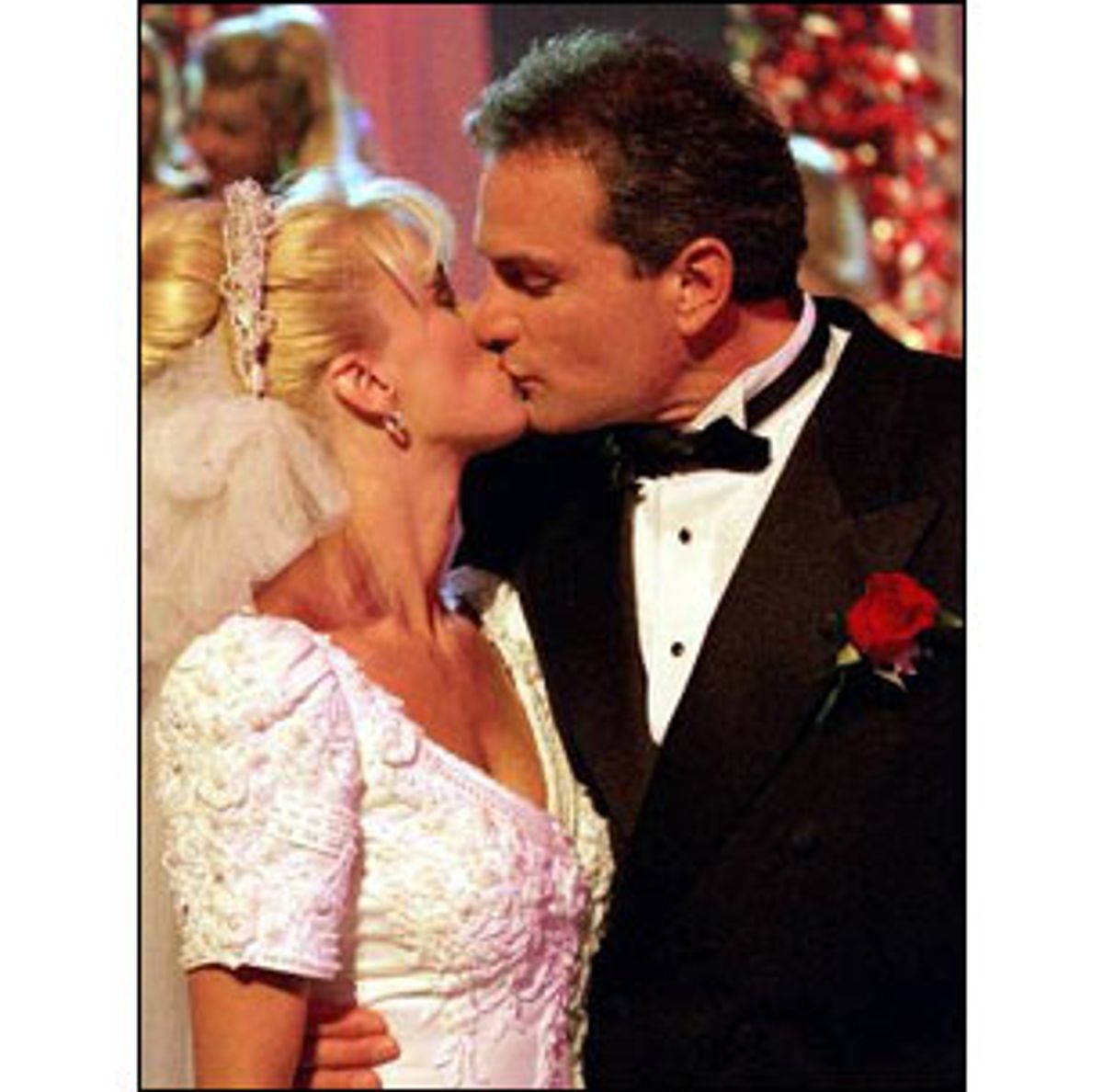
When I first heard about “Who Wants to Marry a Multi-Millionaire?” I remembered an incident from my childhood. It might have been the first time I became aware that sex was sometimes exchanged for money. My parents were gossiping, mainly over my head, and a scrap drifted down in my father’s voice: “Why buy a cow, when milk is so cheap?” I asked what that meant, and my parents laughed. “Your father is talking about what happens when men and women live together without being married,” my mom explained, in a lower voice. I didn’t quite understand, but I felt the offense to my gender, and seethed with anger at my father for a few minutes.

After “Who Wants to Marry a Multi-Millionaire?” I was also offended for my gender. But after years of life experience, I was equally offended by its members. I knew the evil patriarchy hadn’t forced the female contestants to enter this humiliating contest, or forced millions of women to watch. (The show actually got higher ratings among women than men.) If women were willing to sell themselves on national television, and other women were entertained by it, we hadn’t come very far from the gender primitivism of my childhood, when both my parents took it for granted that sex was a good that men would, or should, pay for, and one that women could either “give away” or, well, not exactly sell, but obtain full value for bestowing.

After 40 years of feminism, many women still expect men to show their intentions, and devotion, by paying for dates and presents, and still evaluate them as future providers for a family. Men still complain of “wasting money” taking women out to dinner who don’t want to have sex with them. They still mutter, “When push comes to shove, we pay all the time, whether it’s prostitution or dating.” Girls still grow up thinking of work as an option, while boys know it as a necessity.

Conventional wisdom would have it that women have to think hard about their future spouses’ earnings because of the earnings gap. In 1998 the median income for all females in the labor force was 73 percent of male income ($25,862 to $35,345). For college graduates 25 and older, the gap is wider, with women earning only 71 percent of what men make ($35,408 to $49,982).

But what if, rather than being hapless victims of the earnings gap, women allow it to continue, in part in order to choose their bed partners based on their incomes? What if (most) women enjoy earning less than men, because we have eroticized being on the short end of the stick? What if women, like men, effectively pay for sex — with lower earnings?

My theory is that men have by and large eroticized freedom, while women have eroticized its absence. It’s not that lower female earnings lead women to evaluate men based on their earning power — it’s that women want to maintain male financial dominance, so they make sure they earn less then men. And it’s not that men are willing to support women (and their children) because they are committed to them — it’s because men believe they are buying the freedom to leave that they will (for a while at least) foot the bills. This applies to prostitution, where men pay for the freedom of closing the door on the selves they show, and to family life, where all too many men are able to walk away from supporting their children.

We rarely examine the values implied by the kinds of remarks we let slip constantly — “She married badly,” “He’s a meal ticket,” “She’s too high-maintenance.” Very few women would react well if a man asked their price, but many will casually boast of their boyfriend’s expensive presents or recent promotion, or imply that a lover’s income offsets other less stellar qualities. Not many men are proud of going to prostitutes, but even those who have never bought sex are apt to mutter that one way or another, men still pay for it.

Some people will howl in outrage at these ideas. Some will say it’s harmful to the feminist cause to air these issues. I raise them here with the hope that discussion leads to more open lives, and better ones, with choices being made with open eyes. Some women may consciously choose a less responsible, less stressful or less remunerative job — and that’s fine, as long as it is a choice, not the result of sexism or its internalized equivalents. But just as we have learned to look at cultural factors when equal opportunity doesn’t result in equal results racially, so we should inquire why so few women opt for the top of their professions, and why so many of the best and brightest women sideline themselves in their 20s, long before the tradeoff between childbearing and work becomes acute.

Instead of endlessly rehashing the staple women’s-magazine issues, we should be exploring why women set their work and money goals relatively low, why women still represent only 13 percent of corporate officers of Fortune 500 companies, why so few of the dot-coms are founded by women, why of a recent list of 167 newly minted Goldman Sachs partners not even 15 percent are female. I do not think institutionalized sexism is a major part of the answer.

The tricky part of the sex-for-money trade is that there’s a slippery slope. On one end is a man sending flowers to a woman after a first date, and on the other is the prostitute and her client. In a typical dating scenario, it isn’t sex for money, exactly, but it may be sex because of money — sex because a man’s behavior gives signals that he has money and is willing to spend it. It’s sexy, we women often think, when a man insists on taking us out to dinner or sends flowers, when he gives jewelry, when he promises a big diamond if things work out. But we also feel it’s sexy when he earns more, when he has more heft and impact in the world. “More” is always relative, and since we can’t be sure of having a relationship with a tycoon — indeed, most women can be sure they won’t — women increase their chances of having a relationship with a man who is more successful by being fairly unsuccessful themselves.

You choose one of those fields that are respectable and interesting and offer an absurdly low ratio of income to effort, like public-school teaching or social work; or you have a series of dead-end and nonlucrative jobs rather than a career; or you do embark on a career, say in law or banking or advertising, but you take it less seriously, and ensure that you will never make partner or the equivalent. You make it clear that your career will not come first in your life. You can even make it clear that you are going to need to be taken care of. And surprisingly enough, men respond protectively.

I say “surprisingly” because hardly any woman wants to marry a man who says he will have to be supported. And in our cash-conscious society, we have few qualms about lacking a safety net for poor children, the ill or the disabled. Yet many a man who is not rich and doesn’t expect to be rich will take on the financial responsibility for a young, able-bodied, well-educated woman who is not yet, and may not ever be, the mother of his children. Of course, there are limits. Men say, “She’s too high-maintenance” about a woman they feel will bankrupt them. Women who overtly demand financial tribute are a turnoff to most men. But men almost never say (as women do), “What a great person — but we can’t get married because she’s a nursery school teacher and hasn’t got a dime.” Women who need to be supported, with humble expectations for themselves, are a turn-on.

In middle- to upper-class life, it’s almost a rule: The lower paid the occupation, the more obvious it is that the woman in it expects to attract a man to support her. Publishing? Auction houses? Private-school teaching? Classic post-deb, waiting-to-be-wed jobs. (Office receptionist, restaurant host, public-school teaching used to be the lower- to middle-class equivalents, except that now almost all married women in these economic groups have to work.) It’s not that women need to get married because they hold these jobs — in many cases, they hold these jobs because they want to get married. They’re signals: “Rescue me” is the message.

Look at the equally controversial black-white earnings gap. While substantial numbers of blacks have moved into the middle class, the statistics also reflect the “underclass” who have not. In many inner-city neighborhoods, children emulate gangster culture and profess scorn for those who succeed in school. They’re behaving in a self-defeating manner, dooming themselves to poverty, but it’s understandable. They not only have few role models of conventional success, but they have little chance of achieving it. So a new culture of low expectations grows, with its own aesthetic, set up in opposition to the mainstream or elite.

Aren’t there analogies to the case of women? We fail to see them because our eyes have not been nearly as opened to the effects of patriarchy as they have been to the effects of racism. When adult women spend substantial amounts of leisure time shopping for clothes they neither need nor can afford, or undergoing time-consuming “beauty” treatments, both men and women tend to read that as appropriate behavior. In both cases, women and African-American inner-city dwellers, there are what biologists call “feedback effects”: The defeatist attitude leads to certain perceptions by the power structure of the group in question, and these perceptions are internalized, increasing the defeatist attitude. Multiply that by 5,000 years of patriarchal society, and you have some deeply ingrained behaviors. So deep, they tend to be called natural, by both sexes.

Nietzsche called this process of scorning what you can’t have ressentiment. It’s a status order internalized in the form of rules, like “Don’t do your homework — that’s not cool,” or “Majoring in computer engineering will scare attractive men away,” or the perennial “If you work out too much, you’ll bulk up.” Women’s eroticization of traditional power relationships makes evaluating a boyfriend for his earning power seem acceptable, rather than mercenary, to most men and women. And it’s one small step from assessing a man’s spending power to assessing your own salability. How far is that from selling yourself on national television?

Ann Marlowe is the author of "How to Stop Time: Heroin from A to Z" and "The Book of Trouble," published last month.

The politicization of the Secret Service scandal

What was once one of the right's favorite government agencies becomes a symbol of waste and moral degradation

President Obama, surrounded by members of the Secret Service, upon his arrival in San Diego, Sept. 26, 2011. (Credit: AP/Pablo Martinez Monsivais)

It’s hard to work up much outrage about the Secret Service prostitution scandal, in which 11 members of the president’s elite protective service and various military personnel were found to have picked up escorts in Colombia, where they were doing advance work for the president’s visit. I guess it is probably not a good idea for the people in charge of protecting the president to leave themselves vulnerable to sexual blackmail, but on the other hand we do not live in a John Le Carré novel or “24″ episode, and I don’t think the threat of a honey-trap assassination conspiracy plot is very credible. If members of the Secret Service want to get drunk and hire escorts after work, that is their business. (As Melissa Gira Grant says, the only actual scandal here — and the reason this became an international incident — is that all these guys tried to bilk one of the women out of the money she was owed.)

But the predictable Washington mixture of prurient interest and moral posturing has turned this incident into grist for the scandals-and-investigations mill. And now we have the attempts at somehow making this a winning partisan issue for Republicans. Chuck Grassley, the senator from Iowa who triumphed over adversity and became the ranking Republican on the Senate Judiciary Committee despite being functionally illiterate, would like to know whether any White House staff also slept with escorts that evening. No one has made the claim, but Grassley’s asking just in case. (For a live peek at a future paranoid right-wing myth in its embryonic stage, read the comments on that Washington Times story: “I can just hear those paper shredders going a mile a minute in the white house, and the document forgers are being called in, you know the same ones that did the birth certificate.”) Grassley was on Fox last night to make sure viewers repeatedly heard baseless speculation as to the involvement of White House staff.

Rep. Pete King, Long Island Republican and stalwart publicity monger, has sent Secret Service Director Mark Sullivan a list of 50 questions about the scandal in order to make it appear that he is very seriously investigating this very serious incident.

For those outside Congress, for whom insinuating escort patronage by unnamed White House staff seems a bit of a reach, the game is to attempt to use the scandal to prove some point the fecklessness of Obama as a leader and his shameful failure to make everyone in Washington stop being so awful and wasteful all the time.

NRO’s Mark Steyn, after praising the fiscal discipline of the agent who attempted to bilk his escort (ugh), suggests that the moral of the story is that we pay too much for presidential security, and that all those agents and fancy bullet-proof Suburbans are wastes of taxpayer funds and evidence of broke post-Imperial America’s profligacy. Sarah Palin, who had every right to be personally aggrieved for once, after it was reported that the agent at the center of the scandal wrote gross sexist things about her on Facebook, was among the first to declare that the problem was with the “culture” Obama has created at the White House. (Karl Rove, smarter than most of these people, suggested that politicizing a Secret Service scandal was dumb and counterproductive. Secret Service Director Mark Sullivan, coincidentally, was elevated to his position under George W. Bush.)

The makeup of the Secret Service, obviously, has very little connection to the political party of the person occupying the White House. Like most American law enforcement agencies, it’s primarily white and overwhelmingly male, and, historically, the culture of the agency has had more than a whiff of machismo. These are not exactly the sort of public sector employees right-wingers get off on demonizing.

In fact, the right has had for years a sort of Clint Eastwood-inspired fantasy of the Secret Service agent as folk hero. Decent, hard-working men putting their lives on the line to protect a bunch of elitist ingrates. That ingratiating phony Bill Clinton and his frigid, hectoring monster of a wife weren’t deserving of such stolid, unflinching loyalty and service.

The fullest expression of this fantasy is in this classic chain email that made its way to every inbox in the nation during the second president Bush’s first term. According to this email, attributed to the unnamed author’s former neighbor, the president’s security detail was constantly disrespected by those awful Clintons and their terrible staff. Hillary Clinton was “arrogant and orally abusive.” “She forbade her daughter, Chelsea, from exchanging pleasantries with” agents. “Al Gore resented Bill Clinton and thought he was to centrist. He despised all republicans.” Agents prayed for Bush to win the election, and their reward was the joy they all felt in the presence of President Bush and his amazing, wonderful wife.

This nonsense has its roots in fake anti-Hillary attacks, attributed to imaginary Secret Service members, that Republican operatives spread to sympathetic media voices starting more or less the day Bill took office. Former Secret Service agents do plenty of gossiping and bitching, most frequently to Ronald Kessler, but their complaints don’t tend to track quite so directly to right-wing fantasy narratives.

But a popular trope is of the upstanding agents blanching at being asked to look the other way as libidinous Democratic presidents — Kennedy, Johnson, and Clinton — womanized. (Clinton was said to have threatened to fire agents who stymied his attempts to have trysts with Monica Lewinsky, though the agent who made the claim admitted to having invented it.) The pat moralism of the conservative Secret Service fantasy makes the agency’s lurid misadventure a bit funnier. It also explains why various people have to somehow convince themselves that the Obama administration somehow degraded the agency, through a lack of “management skills” or the widespread embrace of sexual deviance that is the logical end result of repealing the military’s ban on out gays and lesbians.

Continue Reading Close
Alex Pareene

Alex Pareene writes about politics for Salon and is the author of "The Rude Guide to Mitt." Email him at apareene@salon.com and follow him on Twitter @pareene

My favorite john: My very own “Pretty Woman”

Hector was a handsome Argentine. I was the male escort he hired. What happened next surprised us both

(Credit: ArrowStudio, LLC via Shutterstock)

When people learn that I’m a gay male escort, they invariably ask me how much my life is like the movie “Pretty Woman.”

“It’s more like ‘Daddy Day Care,’” I usually quip. And while that’s meant to be a joke, there’s also some truth to it. I spend a good amount of my work time offering support and advice to men in their 30s and 40s who are just coming out of the closet. Surprised? I was too, at first. But then I thought, where else are these guys going to catch up on two decades of sexual and social experience? Until someone comes out with “Gay for Dummies,” the next best thing is a trained professional.

A few years ago, for example, a charming man from Vancouver hired me every night for a week while he was in Las Vegas for a conference. By the time he went home we’d checked off every item on his wish list, and he was finally comfortable lying naked with another man. It was strangely gratifying to help a guy learn the ropes.

But nothing prepared me for Hector: Thirty-nine years old, handsome, stocky, with a full black beard. Born and raised in Argentina, he lived in Chicago and owned a seat on the stock exchange. He was successful but lonely, and so intensely left-brained that he had carefully engineered a self-improvement plan: He took a sabbatical from work to get himself together. Among other things, he needed to admit he was gay and better understand how that fit into his life. That’s where I came in.

When I first spotted him I thought, “Damn, this guy needs new pictures.” He was much better looking than he’d led me to believe, and more socially adept as well. We clicked instantly. And I don’t know where he learned how, but he kissed like the devil himself.

We had a suite at the Bellagio and spent the weekend like a couple of princes. We went to the spa on Sunday, and then stayed in our bathrobes and ordered appetizers from room service while we watched the Oscars, like two teenagers pretending to be Hollywood royalty.

We also made practical plans, mapping out the next few months on a calendar, scheduling what we’d do and where we’d go. He came back to Las Vegas twice, and we traveled together to Washington (for the cherry blossoms), Provincetown, Montreal, Miami, Hawaii and – wait for it – Paris for the French Open. This was the best gig ever.

Now, I can be what my friends kindly refer to as “an acquired taste.” I have a classic Irish temper, I talk too much, and I tend to be too clever by half. I can also be moody, needing to go off by myself for no discernible reason. So while I wasn’t concerned I’d get bored with Hector, I was a little worried he might get tired of me. But we only had one serious confrontation.

I tried a little too hard to share my love of nude beaches, for which Hawaii is especially famous. He tolerated the one we found on Maui; it was beautiful, and it wasn’t crowded. But the one on the Big Island was another story. It required a treacherous climb to get to, and was filled with too much tie-dye and the kind of bodies no one wants to see naked. Long story short: We didn’t stay very long.

We were spending a few days in Hilo, which is not a town most people recommend. The best hotels haven’t been renovated since the ’70s and there are very few sandy beaches within city limits. As we were driving back, Hector grew quiet, and I tried to fill the air with idle chatter.

“Can we not talk until we get back to the hotel, please?” he asked.

Eventually we stopped for coffee.

“I’m really angry right now,” he started, “so I have to ask you this and hope I get an honest answer.” A beat. “Was that beach the whole reason we came to Hilo?”

I’m not usually very good with confrontation, and my knee-jerk response is to raise my voice. But Hector was calm and his tone was more inquisitive than accusatory, so I tried to follow his lead. “If you knew me any better,” I answered, “I’d be really pissed off that you asked me that question. I don’t manipulate people, and I really don’t like being accused of it.”

“And if I knew you better,” he said, “I probably wouldn’t have to ask. But I do.”

I understood where Hector was coming from, especially given the number of disappointments we’d already met with in Hilo. I explained to him that I didn’t even know about the nude beach until we’d planned to come here. I wanted to come to Hilo for the botanical gardens and the waterfalls we’d seen that morning.

“OK,” he said. “Makes sense. But we’re done with nude beaches.”

It was the only time he ever pulled rank, and within a day the story was a joke between us, the mere mention of Hippie Hollow eliciting mutual groans.

The “Hippie Hollow Incident” was the most mature disagreement I have ever had – including fights with my parents, everyone I’ve ever worked for, and all of my boyfriends. The guy I lived with for four years? We’d have had two weeks of drama and a ruined vacation at the very least. Instead, Hector and I grew closer because of it.  Was this because this was ultimately a business deal and we weren’t arguing as much as negotiating? Or was it because we were especially adept at communicating with each other? Who can say?

Whatever the reasons, the rest of our time together only became more enchanted: sunset dinners on the beach in Kona, orchestra seats for “Follies” at the Kennedy Center, watching Federer’s narrow victory over Monfils from a box at the French Open. It was the kind of magic that would make even a chick-flick aficionado roll her eyes and say, “Yeah, right.” And yet there we were.

Until we weren’t.

The last time I saw Hector was in the Newark airport after we came back from Paris. We’d planned to meet up again in San Francisco for one last week before he returned to work. Instead, he canceled a few days before our meeting. His leave had gone terribly over budget, he said, and he wanted to spend time alone before heading back to work. We’d do a long weekend in the fall, after he’d readjusted to work. Sounded good to me.

I tried to arrange a rendezvous over Thanksgiving and then again over Christmas, but both times he demurred. I was on the East Coast for New Year’s and I asked him if I should stop in Chicago on my way home. He never gave me a straight answer until I pushed the issue. He said it wasn’t a good time.

So our story is unfinished. We send each other text messages several times a week, and I consider him one of my best friends. And yet, I still can’t help wondering what things would be like if we’d met under different circumstances.

Once, while walking along the Seine (you can’t make this stuff up), he told me how sad he was that our time together was drawing to a close. Half-joking, I suggested he take me away from my life of crime and make an honest man of me. He said he wished he could, and I believed him. I still believe him. But I also know that we live in a real world where people click and then discover all kinds of complications. We just happened to know the complications in advance, and then went on the honeymoon, only then to discover how much we liked each other. For now, I continue to mentor guys in the ways of love with other men. Hector has returned to work with confidence, and he has no trouble meeting guys. I encourage him to date. If I know the way Hector’s mind works he won’t even think about embarking on any kind of serious relationship – with me or anyone – until he’s had more practice. In the process he might meet the one guy who’s perfect for him, and good for him if he does.

I know nothing serious could grow between us until I retire from the skin trade. I certainly couldn’t date a hooker – I’m way too insecure for that – and I wouldn’t expect anybody else to. But I’m not planning to escort for the rest of my life. I expect I’ll leave Vegas eventually too; there’s way too much world out there for me to stay in the desert. I don’t expect anything as widescreen as a limo or flowers or being “saved” by anyone (with or without a lot of money); I gave up on that fantasy a long time ago. What’s different for me now is that I’m able to imagine somebody else – maybe Hector, maybe not – in the picture with me on whatever comes next. And that means seeing things through a whole new lens.

Continue Reading Close

Rusty McMann is the professional name of a working call bear.

Ontario legalizes brothels

In an effort to protect prostitutes, the Canadian province's top court strikes down some restrictions on sex work

Sex workers listen to a presentation at the 16th International AIDS conference in Toronto (Credit: Reuters/JP Moczulski)
This article originally appeared on GlobalPost.

Ontario’s top court has legalized brothels in the Canadian province, a ruling that is meant to protect the safety of sex workers.

Global PostThe landmark decision taken Monday, decided that the dangerous work of prostitution could be made more safe if it occurred under one roof with security staff, reported the Globe and Mail.

The Appeals Court of Ontario said that some of the country’s anti-prostitution laws were unconstitutional as they restricted the prostitute’s ability to protect themselves — a ruling already made by a lower court in 2010 but appealed by the provincial and federal governments.

The court also said that it would re-model the law against pimps, which prohibits living off the work of others by adding “in circumstances of exploitation,” reported PostMedia News.

This is thought to allow violent or manipulative pimps to be arrested, while permitting prostitutes to be able to hire drivers and security staff for their safety.

Prostitution is legal in Canada with many caveats.

According to the Associated Press, while sex work might be legal, soliciting sex and operating a brothel are both criminal acts.

While the latter provision was struck down, the court upheld the ban on soliciting sex in public.

According to the National Post, the new laws will likely prompt similar challenges in other provinces around the country.

The case was brought forward by an appeal by the provincial and federal governments, which opposed the earlier lower court ruling.

The case took nine months of deliberation and a week of oral arguments with more than 25,000 pages of evidence, according to the National Post.

Witnesses at the hearings included current and former prostitutes, police, activists, politicians and journalists.

Both sides said they will take their case to the Supreme Court of Canada if they lost.

The new laws, which will be binding in Ontario, will come into effect next year.

Continue Reading Close

“Are you on the cover of a magazine?”

During a trip to the bookstore, my mom wandered into the gay section -- and saw my face

(Credit: Unzipped.net)
This article is the second in a new series of oral histories by former and current sex workers, in which they describe the moment they told their family what they do.

I’ve lived in San Francisco for 18 years, and I’ve always been around porn. For a long time, I worked behind the scenes, at a couple of companies’ websites and stuff like that, but I had never wanted to do porn because I wasn’t secure with the way I looked or I had a boyfriend who was against it. Around 2009, those weren’t problems anymore. I got approached to do some nude photo shoots, and one of them ended up being picked up by Men Magazine, which at that time was kind of a big thing. At the same time, a friend of mine was directing a video that he wanted me to be in. At first I just wanted to be an extra, and then he was like, “Why not just have sex in it?” And so I did. Then another director found out about me, and then another, and then I was scheduled in four videos in pretty much the same time.

I liked doing porn. Though I never wanted to be in a situation where I was doing it to pay my rent, I wanted to do it to enrich my life, so I could do things I wanted to do or so I could go on a vacation I wanted to go on. I was making good money, and all that kind of stuff. I filmed my first films in the beginning of 2009, and things started to come out in August 2009. I got tons of press and everything, but I didn’t tell my mom — not because I was skittish about it. My mother was a free love hippie-type person, and she’s always been very sex positive. But it was not something I needed to tell her. My parents divorced when I was really young, but I don’t talk to my dad. I came out to him when I was 17 or 18, but he is very anti-gay, so I haven’t spoken with him in 17 years.

Then in February of 2010 I got a phone call from my mom. My mom never calls me. Never. It’s like pulling teeth to get her to talk on the phone, but she called me and she was like, “Are you on the cover of a magazine?”  I had been voted Man of the Year in Unzipped Magazine that month, so I said, “Yeah … how do you know that?” And so she told me this story: It was a Saturday night, and she had had a date with a guy and he had stood her up. She wanted to entertain herself so she went to the adult bookstore to buy a dildo, and she decided to browse the gay magazines because she said that’s where the hottest guys always were. And there I was on the cover of the magazine.

Later on she called me again. She had read the article that went with my photos in the magazine, and she said it was really beautiful. She cried a little bit and I was like, “Oh, that’s really nice.” I think at one point she wishes she could have done porn, which is a strange thing to hear from your mom. Now we talk a lot more and there’s always the feeling that I don’t need to be hiding anything from her. If you’re open to your mom with the fact that you do porn there’s not really any other secret you can have.

Porn is much more out there these days. So many celebrities have sex videos, and everybody has naked pictures on their phones, and there are so many amateur porn tube sites. But I know a lot of people who come from conservative religious backgrounds whose parents have completely disowned them or distanced themselves from them, and it’s unfortunate. It’s hard to come out as a gay person, but it’s even more difficult to also come out as a person who has sex for a living. It can be hard for some family members to take. But that’s their loss, unfortunately.

My partner also does porn and his porn coming-out started when his aunt, who had a lot of gay friends, found his blog online. Then she told his mother. And she was shocked at first. But now she’s completely accepted it and makes jokes about it, like, “If I do porn, my porn name is going to be Luscious Lynn.” My mother is actually coming to visit in a week for a few days, and she’ll be meeting my partner for the first time, which is great.

I’ve never seen doing porn as a negative thing — ever. Just because it’s sex doesn’t mean it’s not moral. I’m not swindling people. There are plenty of white-collar jobs with bigger ethics and morality issues. I know the rest of society doesn’t see it that way, and it’s always a little frustrating to be an intelligent, educated, articulate person doing porn and have people thinking that you’re a high school dropout.

My mom’s just happy that I’m successful and not on drugs and happy. Anything else is a bonus.

As told to Thomas Rogers. 

Samuel Colt is a gay porn performer living in San Francisco. 

Continue Reading Close

A match made on Craigslist adult services

James was the first man to pay me for sex. He wanted to bring out the good in me, even though he needed the bad

This article is the first in a series of essays by current and former sex workers about their favorite johns.

The Big Book of Alcoholics Anonymous describes the fellowship as “people who normally would not mix.” That’s a good way of describing James and me. I was 27 years old, a grad student, bored and curious — just like my ad said. James was in his mid-30s, a little too old and far too normal. He was not the kind of guy who’d approach me in another situation, at least that’s what I thought when I saw him. Then again, James and I would never meet in any situation other than this.

I was a Craigslist call girl. James was my first. I had gotten the idea from a friend. “There are ads,” she said, “placed by men, looking for” — she raised an eyebrow — “company.”

That night I got online. It was just as she’d described: SWM seeks non pro, GFE, a little fun. FS. DATY. BBBJ. A lady that speaks GREEK, possibly, a road of possibilities, a chance encounter, no strings attached. For 200 roses, 300 reasons, a generous donation, a happy ending. You can start any day that you like.

On the now-shuttered adult services section of Craigslist — to the left and below where you’d rent an apartment or sell a couch — you could find ads, written in their own coded language, from men and women and everything in between, all of them after one thing: the simple exchange of money for sex.

It was just what I needed. Working full-time as a research assistant at a hospital, I struggled to make ends meet. I was single for the first time in adulthood. Besides my ex, who’d been my high school sweetheart, I’d only slept with a handful of people. I shocked us both by calling off the engagement. I was not ready to start a family. I didn’t want to grow up. In the weeks and months after our breakup, I slept with anyone who’d have me — most of my male classmates and some of the women — until I’d alienated many of the people who had once been my friends. I was guilt-ridden. I was alone.

It was a Tuesday night after class, and I’d had three or four drinks at the bar. It was one of those nights where no matter how much I drank, I couldn’t get drunk. No one would talk to me either; I went home alone, pitiful and unsafe in my own skin. But not 20 minutes later, I found myself in a yellow cab traveling south down the West Side Highway, on my way to meet a man who called himself James.

How I got to James is something of a blur. I remember answering James’ ad, getting directions, getting dressed, hailing a cab. I had his phone number and address written on a scrap of paper I held in my hand. I remember the cab stopping at an intersection, our green light, and two bright white lights — headlights — coming straight at me.

When the other car made impact, we spun. The taxi was facing the opposite direction when it finally stopped. I can still remember the quiet, the pause.

The paramedics said, don’t move. But I wasn’t hurt. I scanned my body as if it were someone else’s, but I felt nothing. Really, I told them, I’m not hurt. Not one bump or scratch. The driver lay slumped over the steering wheel.

“Do you have anyone to call?” the paramedic asked. I shook my head. “No family? No friends?”

I looked down at the scrap of paper still in my hand. I called James.

When James arrived, I saw that he was not bad-looking. Irish American, deep blue eyes. He was not my type, exactly — he had a beer gut and was wearing a Red Sox sweat shirt and a matching baseball hat — but he was a normal guy. As James helped me fill out the police report, I couldn’t stop laughing. I felt giddy. I had just survived a near fatal accident without so much as a scratch. This was so surreal.

“She’ll feel it,” one paramedic said to the other, “when the vodka wears off.”

Back at James’ place, I made myself comfortable. His home was nice in a Crate and Barrel sort of way. I sat down on his microsuede sectional and slipped off my heels. From the kitchen, he offered me wine. I asked him what he did for a living.

“I own a sports bar on the Upper East Side.”  “You’re not having one?” I asked, as he reappeared with one glass.

“I don’t drink.”

“You own a bar and you don’t drink?”

“It’s complicated,” he said.

Whatever, I thought. Enough with the small talk. I drained the glass and returned it to its coaster. As soon as he sat next to me, I straddled his lap. This is fun, I told myself. This is no big deal.

Sex for money is not the same as casual sex. When you’re getting paid by someone, you become his employee. I didn’t understand this at the time. I set up two dates with another man and met James later that week. I sold the Girlfriend Experience, or GFE for short. GFE meant the encounter would feel like a “real” date. I’d show affection for the guy and act as if I were attracted to him. After a drink or two, we’d end up at my place or his. There’d be kissing, petting, cuddling, oral sex, sex.

Normal being what I wanted, normal was what I sold. I began attaching a picture to my email. The picture was taken by my mother a few Christmases back. I’m sitting at my computer, wearing a sweater, a knitted scarf wrapped around my neck. It looked like an author’s photo.

In the beginning, I scheduled dates for evenings when I didn’t have class. I made the arrangements days ahead of time, emailing back and forth multiple times before we’d actually meet. At the time, I might have told you I was screening my clients. The truth is that the emails were foreplay. It was part of the thrill. I liked meeting new people. I liked seeing new places. I liked being in apartments nicer than mine. I liked seeing the insides of fancy hotels. I liked getting dressed up. I liked making lots of money, fast. Most of all, I liked having sex. I was aroused by the fantasy of getting paid to do all this. Becoming someone else’s fantasy really turned me on.

In my eyes, I was a non-pro — not a professional, not a prostitute. I was different, I thought. I was educated. I was not drug addicted. I was no victim of trafficking. I didn’t have a pimp. I was doing it by choice. I didn’t know what I was doing, and I didn’t want to know. This wasn’t my career. I wasn’t a whore.

“You know,” James said one night when we were done, “you don’t have to do all that you do.” He meant, I understood, my giving a blow job without a condom. “Most girls don’t,” he said, and then hesitated. “Or they’ll charge more.”

I’d never given a blow job with a condom but, having been to the dentist, I knew that latex tasted gross. I said as much to James.  ”Besides,” I went on, “it’s safe, right? I don’t let you come in my mouth and if you did, I’d just spit it out.”

James looked at me like I was nuts, like he felt sorry for me or like maybe he wanted to help. But he knew he had tried to help enough.

James told me all the time that what I was doing was wrong. He’d say, You’re a good girl, Melissa, and, Shit, Melissa, you gotta stop. A part of him meant it: the part of him that put potpourri in a little jar next to the sink in the bathroom. The part that had hung the plaque in the hall decorated with geese that read, “Bless this house.” Part of him felt guilty, ashamed: the part of him that would always offer me the ride home that I’d always refuse.

Then there was the other part of James, the part that contacted me like clockwork nearly every night an hour before he got off work, cryptic texts that would inevitably lead to my coming over, if I didn’t already have “plans.” This part of him was excited by the very things that brought him shame. I understood it well. It was the part of James I knew best, maybe the only part of him I ever really met. We can’t do this again, he’d say every time just as soon as we’d finished. He’d say, We gotta stop. And, You gotta stop, this isn’t right. He’d make me promise I wasn’t doing it with anybody else and so I would, even though we both knew it was a lie.

The fact that there was a “good” part of me — a part of myself that I was proud of, a self-esteem still salvageable — just as there was still a good part in him is what made me appealing to James, which made it all the worse. He was destroying that part of me, he understood, just as he destroyed that part in himself.

Refresh, refresh, refresh. After less than a month I’d started trawling for dates during the daytime at my desk at the hospital. The hospital where I worked had spyware; I didn’t care. After just one month of selling sex online, I had already accumulated a literal pile of money —  tax free, in cash — that I kept it in a desk drawer at home. I’d take it out some nights and I’d count it just for fun.

I started squeezing more than one date in a night. I was meeting men before and after class. If the offer was sweet enough, I’d skip class altogether. I spent all my free time sitting at my computer, posting ads, responding to ads, emailing back and forth. I became less interested in getting to know them ahead of time and more interested in making it happen, as quickly as possible, so I could get on to the next. Every encounter, I got a little charge. Night after night in the same dress, the same ad, the same scenario — two and a half months into it, it was becoming harder and harder to bill myself as “non-pro.” I was crossing boundaries I hadn’t even known existed.

I once met a guy who said you can buy anything on Craigslist. He was talking about collectible antique furniture, but I thought it was so funny I wrote it down. You know, ironic. He said it as we took the back stairs up to the 14th floor of the granite building where he worked on Fifth Avenue, where in his corner office I gave him a blow job for 200 bucks, the city lit up behind him like a Broadway set. When he finished, he opened the top drawer of his desk and brought out an antiseptic towelette, as if he did this all the time, as if I were contagious. I didn’t write that part down, but I remember.

Every man I had sex with for money, all the strangers that I met — when it comes to memory, you have no choice what you remember and what you forget. I could tell you the good parts: the nice guys I met, like James, and the fancy restaurants. I could describe the interiors of every luxurious hotel. I could tell you all about the time I was flown to Paris with a man I’d met just the week before. We stayed at the Four Seasons and ate $800 meals. I could tell you the price of the meal, but I can’t tell you I enjoyed it. Hell is getting everything you want — everything you think you need and more than what you even asked for — and not enjoying any of it. Getting everything you think will make you happy and still feeling nothing at all.

The longer I sold sex, the less I was the person I wanted to be. After three months of prostitution, I felt raggedy, used up. I was anxious and afraid. Condoms broke. People stiffed me. The only way to deal with these things, I thought, was to pretend they didn’t happen. Trading sex for money, I changed.

James changed too. He began asking me to do things that I wouldn’t — anal sex, sex without a condom — wanting to take bigger and bigger risks. Alternately, he would email me on Thanksgiving, wishing me a happy holiday. He would ask me out on dates. He was a good person — we both were — but we did not know how to be good to each other. We were using each other to get high. I wanted real relationships. For me, prostitution had made that impossible. As much as I wanted to trust James, I could not. The first night we met, when the police asked, he said his name was Chris. But how could I trust anyone? I couldn’t trust myself.

No one forced me to have sex for money, and no one could have compelled me to stop. But when the pain became great enough, I became willing. Today, I don’t believe in accidents. I believe things happen for a reason. I haven’t seen James since I stopped selling sex, months before I stopped drinking and long before I became a teacher. But that is another story entirely.

Continue Reading Close

Melissa Petro writes for The Huffington Post, Daily Beast, Rumpus.net and XO Jane..

Page 1 of 39 in Sex Work