Readers and Reading
Childproofing
The New Yorker cartoonist picks five books you'd better hide from the kids.
These are five books that you might not want to leave lying around your house if you have small kids. They are guaranteed nightmare-makers, anxiety-creators and undesirable-question-raisers. When my son was about 7, I accidentally let it slip that, yes, it was possible for a person to be born with a third leg, that I had seen photographs of such a person. When he asked “Where?” I immediately changed the subject in a way that I’m sure will fester in his unconscious for years to come.
Very Special People: The Struggles, Loves, and Triumphs of Human Oddities by Frederick Drimmer (Amjon Publishers, 1973)
Text plus plenty of photographs of freaks — three-leggers; bearded ladies; 1,000-pound men; people with parasitic twins, i.e., with a little body, or just part of a little body, growing out of their torsos; the grotesquely fat or skeletal; distressingly bendable people; etc.
Sleeping Beauty: Memorial Photography in America by Stanley B. Burns, M.D. (Twelvetrees Press, 1990)
A collection of postmortem photographs from 1840 through 1930. Dead men, women and children. Plenty of children. Some have their eyes open. Some are in their beds. Some are just propped up in chairs. Some are only minutes dead. One is 9 days old.
Evidence by Luc Sante (Farrar, Straus and Giroux, 1992)
Evidentiary photographs taken by the police from 1914 through 1918. Creepy black-and-white pix of people murdered in tenement hallways, in their beds, at the kitchen table and so forth, plus Sante’s notes on each photo.
Special Cases: Natural Anomalies and Historical Monsters by Rosamond Purcell (Chronicle Books, 1997)
Sample chapter title: “Too Much, Not Enough, and in the Wrong Place.” The cover is a nightmare image in itself — a photograph of the skeleton of an impossibly hydrocephalic child whose skull, to quote the author, “has opened up like a flower.”
Elmer Batters: The Caruska Sittings (Taschen, 1996)
Photos by a well-known foot-fetish photographer. Caruska is the goggle-eyed, overweight, eerily smiling German frau who posed, often topless (though that’s completely beside the point), for all of these foot- and spike-heel-shoe-oriented photographs. A bunch of them are set in cheesy ’70s offices or living rooms. If “somebody” found this book, there’d be just too much splainin’ to do.
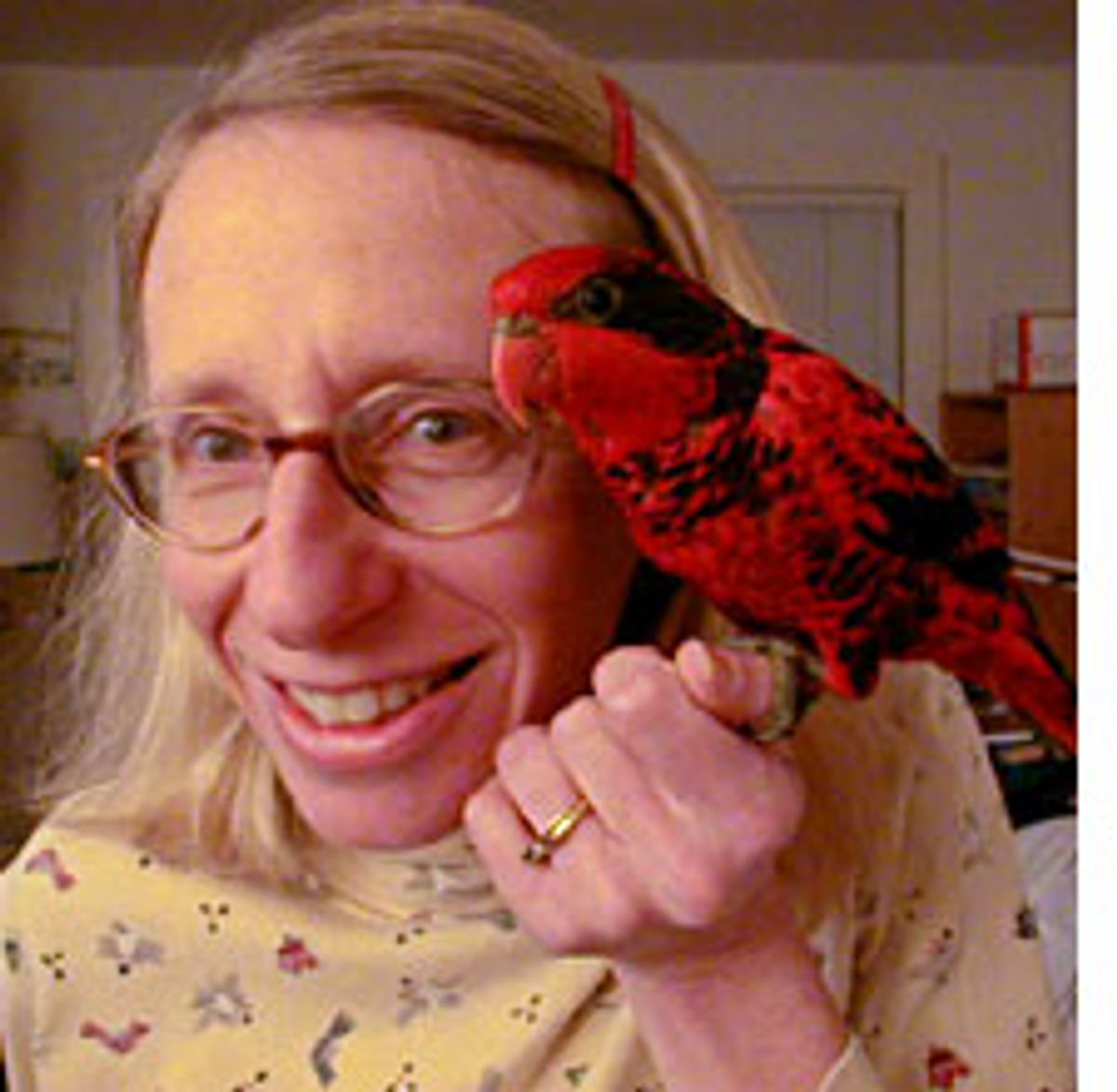
Roz Chast is a cartoonist for the New Yorker and other magazines. Workman will publish her newest book, "The Mink Was Already Dead! And Other Rationalizations" (a collaboration with Henry Beard, Andy Borowitz and John Boswell) in March. More Roz Chast.
Reading, revolutionized
A poet/book artist and a programmer team up to create a book that unites the traditional and the electronic
(Credit: via Between Page and Screen)
“Between Page and Screen,” a groundbreaking collaboration between poet and book artist Amaranth Borsuk and programmer Brad Bouse, is truly a first: a book that only can be read when simultaneously using a codex book and a computer’s webcam. When placed in front of a webcam, the black shapes printed on the pages, sans words, trigger animated text on the screen, revealing a correspondence between characters P and S.
Stories don’t need morals or messages
A "stupid" test shows that the Puritan ethic lives on. Why do we insist on learning lessons from the books we read?
(Credit: iStockphoto/Yayayoyo via Shutterstock) What is the purpose of reading stories, especially made-up stories? That’s the question lurking behind a recent posting to the New York Times’ education blog, SchoolBook. Ann Stone and Jeff Nichols, the parents of twins, wrote about taking their kids’ third-grade English Language Arts test with some friends as a party game on New Year’s Eve. The group read an inane little story about tiger cubs learning to tear bark off logs, but, to their surprise, couldn’t agree on a single answer to the multiple choice question that followed: “What is this story mostly about?”
Continue Reading Close
Laura Miller is a senior writer for Salon. She is the author of "The Magician's Book: A Skeptic's Adventures in Narnia" and has a Web site, magiciansbook.com. More Laura Miller.
Reader responses: Books you want banned
On Wednesday, we asked which books you think kids should never have to read in school. Here's what you said
Earlier this week, Laura Miller and other Salon writers weighed in on books they’d like to see banned from school reading lists — from “Lord of the Flies” (“Is it pure sadism [that makes teachers assign that book]?” asked Andrew O’Hehir) to “Ivanhoe,” which went a fair way toward dulling Life editor Sarah Hepola’s enthusiasm for high school English.
Continue Reading CloseEmma Mustich is a Salon contributor. Follow her on Twitter: @emustich. More Emma Mustich.
What did you really read this summer?
As August ends, Arthur Phillips, Laura Hillenbrand, Lev Grossman and others reveal their reading records to Salon
For readers, summer often starts with grand ambition. This will be the year we really tackle Roberto Bolaño or David Foster Wallace; it will be the summer of nothing but lemonade and Alice Munro. Or perhaps we’ll educate ourselves by delving deep into accounts of the financial crisis or the war on terror. Then the days turn lazy and even the most sincere intentions wilt in the heat.
With September looming, we thought it would be a good time to check in with some of our favorite authors — and some of the writers you’re likely to be reading this fall — to see what they really read this summer. Click through the following slide show to see what they had to say.
Emma Mustich is a Salon contributor. Follow her on Twitter: @emustich. More Emma Mustich.
Can a computer ever give good book recommendations?
The latest and most ambitious attempt to turn literary taste into an algorithm
Recommending books is an art, replete with mysteries and moments of inexplicable grace. When I wrote about the topic last year, John Warner — sometime “Biblioracle” at the website the Morning News — reminisced happily about the time he “went out on a limb and recommended ‘Gravity’s Rainbow,’ and the person said it ‘changed my life.’”
The occasional triumph (and perhaps only a fellow recommender will appreciate just how sweet such instances can be) are inevitably balanced out by mortifying failures. Though it was over a decade ago, I’ll never forget the time a friend chewed me out for suggesting she read Louise Erdrich’s “The Beet Queen.” It seemed the perfect choice after I’d ruminated on all the other novels she said she’d liked, but she complained that Erdrich’s women characters were all “victims” who refused to do anything to improve their lot.
Continue Reading Close
Laura Miller is a senior writer for Salon. She is the author of "The Magician's Book: A Skeptic's Adventures in Narnia" and has a Web site, magiciansbook.com. More Laura Miller.
Page 1 of 25 in Readers and Reading


