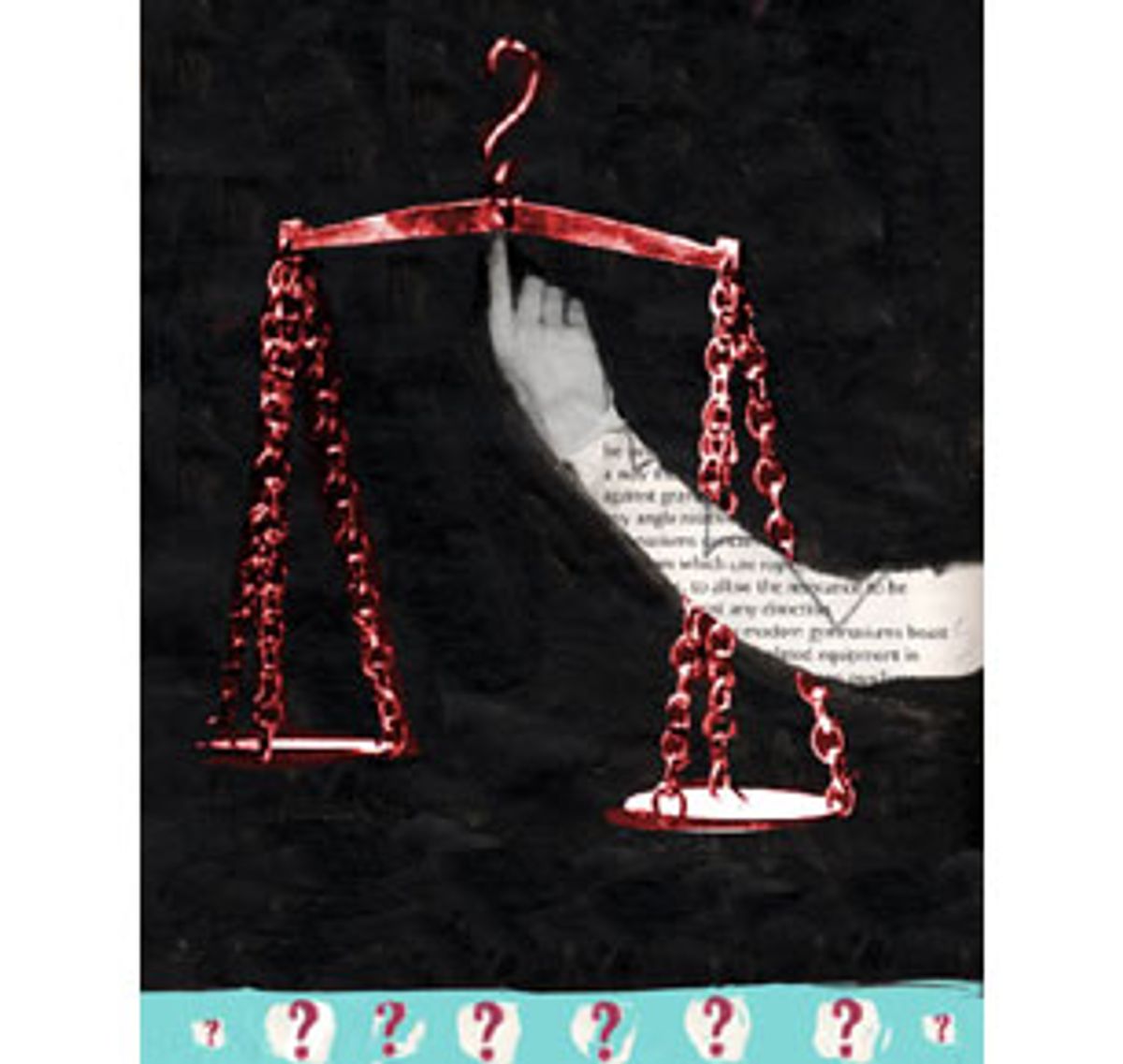
Merely finishing college or graduate school is enough of an accomplishment for most students. Now a very few can also claim their studies helped to save someone's life. In recent years, students in a handful of law school and journalism programs have dug into potential miscarriages of justice, not only freeing innocent people from death row, but also altering the climate of public opinion. If it weren't for the hard work of a small group of academics and their students, the governor of Illinois might not have declared his recent moratorium on executions in the state. That suspension has catalyzed proposals for a halt to executions in other states and at the federal level, as America begins to rethink its nearly quarter-century-old resurrection of the death penalty and the human price of tough-on-crime politics.
The Illinois moratorium, imposed by Republican Gov. George Ryan at the end of January, largely resulted from the extraordinary exoneration of 13 men sentenced to die after Illinois reinstituted the death penalty in 1977. (It had been invalidated in 1972 as a result of a United States Supreme Court decision in a Georgia death case.) During the same period, 12 men were executed. All 13 overturned convictions resulted from campaigning by people outside the criminal justice system, with seven cases involving academic and student investigators.
Illinois has offered some of the most dramatic examples of students and academics increasingly questioning the reliability of the criminal justice system. There are legal clinics at many law schools that occasionally take up cases of wrongful convictions, but few focus as intently on freeing the innocent -- often with special attention to people sentenced to death -- as the Center on Wrongful Convictions at Northwestern University Law School in Chicago and the Innocence Project at the Benjamin N. Cardozo Law School of Yeshiva University in New York. No other journalism school has had a program like the class at Medill School of Journalism at Northwestern, where budding reporters can investigate death row prisoners' claims to innocence.
Those outside the justice system have accounted for the vast majority of the 85 death row inmates exonerated nationally since 1974, with students increasingly involved in those actions, according to Rob Warden, executive director of the Center on Wrongful Convictions. It's a telling indictment of American justice. "To have a hand in saving somebody's life for something they're innocent of is overwhelming," said Scott Stewart, a Northwestern University journalism student who helped prove the innocence of a man who escaped execution by two days. "But it's sad and scary that it's come down to dedicated law clinics and law and journalism students to do some of these investigations. It shows there's a breakdown in the system at some level."
President Clinton recently rejected a federal moratorium, despite prodding by death penalty opponents Sens. Russell Feingold, D-Wis., and Patrick Leahy, D-Vt. Clinton has long viewed support of the death penalty as a key part of his "new Democrat" strategy to be tough on crime. He refused to stop the execution of a mentally impaired convict during his presidential campaign and also signed the 1996 Anti-Terrorism and Effective Death Penalty Act, which greatly limited the rights of prisoners challenging their death sentences.
But Clinton may have been trying to keep in tune with shifting public sentiments when he invited Rubin "Hurricane" Carter to a White House viewing of "The Hurricane," the movie about the former boxer's fight for freedom. In 1967 Carter and John Artis were convicted of killing three people in a New Jersey bar. After Carter won an appeal, prosecutors claimed in his second trial that he acted out of racial revenge and convicted him again. But in 1985, a federal judge ruled that there was no proof of their theory and that prosecutors had withheld evidence disproving the testimony of a star witness.
Although polls often show that two-thirds or more of Americans support the death penalty, the Death Penalty Information Center reports that many surveys show sharp declines in support since the mid-1990s. When given a choice of sentences, the Center reports, a national majority favor life sentence without parole over the death penalty in murder cases. Also, some polls demonstrate that more than half of Americans agree with academic studies demonstrating that the death penalty is not a deterrent and that there is class and racial bias in its application. There's also a growing sensitivity in popular culture about the usually ignored fate of death row inmates, from movies like "The Hurricane" and "The Green Mile" to the recently published book, "Actual Innocence," which chronicles the work of lawyers at the Cardozo Law School to use DNA evidence to free unjustly condemned prisoners.
Gripping stories of men imprisoned for many years and barely escaping execution for crimes they didn't commit raise doubt even among death penalty advocates. "Telling a story is worth a hundred studies," said Lawrence Marshall, a professor at the Northwestern University School of Law in Chicago and legal director of its Center on Wrongful Convictions. "What has driven public opinion is the amazing drama of some of these stories -- and the way they show the system did not work and that people were saved by complete fortuities."
Marshall has worked on some high-profile cases that led to freeing death row prisoners, often with Northwestern University journalism professor David Protess. In 1998, Protess, along with students from his class and a private investigator, uncovered evidence that freed Anthony Porter, who was condemned to death for a double murder. Marshall, who had much experience in evaluating death row cases, had concluded that Porter's only hope was showing that he was not mentally fit to be executed. "We looked and said, 'It seems there's a strong case [against Porter].'" Marshall said. "We were ready to dismiss the case out of hand."
Protess had decided not to take the case because Porter was scheduled to die before the professor's fall class started. But two days before he was supposed to be killed, Porter's attorneys won a stay of execution to consider their claim that Porter was not mentally fit to be executed. At that point, Protess and his pupils plunged into a frenzied investigation. Student Tom McCann, now 22 years old and an intern at the Chicago Tribune, had barely thought about the death penalty before he began investigating Porter's case. But he was intrigued with exposing prosecutorial mistakes.
McCann pored over the testimony several times and mapped out the murder scene, showing where each witness or participant would have stood. "That uncovered loads of mistakes," he recalled. "Witnesses saying they're in one place, then jumping to another location without explaining how they got there. Witnesses said Porter was shooting with his left hand, but Porter was right-handed. After a lifetime of watching 'Perry Mason' and 'Matlock,' [refuting the evidence] was easy."
The case involved the murder of a young man and woman in Southside Chicago. Police appear to have quickly fingered Porter, who was known as a loud neighborhood tough, and found two witnesses who claimed Porter shot the pair. But when Protess and five students found the evidence lacking, Tom McCann checked trial testimony against the mapped-out murder scene and found much of the testimony implausible. McCann and his classmate Shawn Armbrust got another key witness, William Taylor, to recant his testimony, explaining that police had threatened, harassed and intimidated him into implicating Porter. The students then tracked down the real killer and elicited a confession from him.
"Once you get that involved in a case, you make it your life's work," McCann said. "You know you could have an innocent life at stake, and if you don't [save it], nobody will." McCann first became convinced Porter was innocent when Taylor recanted his testimony. McCann says the experience not only persuaded him that the death penalty was wrong because it might irrevocably condemn innocent lives, but it also inspired him to pursue a journalism career. He hopes to work on stories as meaningful as the work he did as a college senior.
Armbrust is even more emphatic in her moral opposition to the death penalty following her classroom experience. "The death penalty is racist, biased against people who can't afford good lawyers and it runs the risk of executing innocent people," she asserted. Now she works as a case coordinator at the Center on Wrongful Convictions and plans a career in law, hoping to iron the justice system's wrinkles. "I don't think a 21-year-old should be doing the job of the justice system," she said. "But given that the system doesn't do the work it should, I think it's a necessity."
The latest potential miscarriage of justice in Illinois to be exposed by 21-year-olds involves Edgar Hope. Hope awaited execution for 18 years on two separate charges of murdering law enforcement officers -- one at a McDonald's, the other on a Chicago Transit Authority (CTA) bus. For nearly two decades, defense attorney Richard Kling has operated a clinic at Chicago-Kent College of Law that provides students with firsthand experience in criminal cases. Last year Kling was assigned Hope's case after the Illinois Supreme Court overturned his conviction because of judicial and prosecutorial misconduct.
Kling requested all the files of previous attorneys in the case and put a team of students to work sifting through roughly 20 boxes of material. At the bottom of one box, they found an internal McDonald's corporate security report indicating that there were witnesses who had never been interviewed. Also, corporate security had been in daily contact with Chicago police Lt. Jon Burge, who was eventually removed from the force for torturing police suspects. Kling and his students tracked down all witnesses, including ones who wondered why nobody had ever contacted them before. Several people said that Hope had never been in the store and another identified the second gunman as someone other than Hope. Now Kling hopes that if he can establish Hope's innocence in the McDonald's case, he may be able to save his life in the bus killing charge.
Kate Moriarty, Kling's student, planned to be a defense attorney; her classmate working on the Hope case, Scott Stewart, had always wanted to be a prosecutor. Stewart, now less of a staunch death penalty advocate but still a prosecutor at heart, found himself making arguments [against the death penalty] as a result of investigating the case. Meanwhile, Moriarty says she is "even more motivated to be a criminal defense attorney and not take anything at face value. I came in very jaded [about the legal system]. This case has made me even more jaded."
Although a few other schools have -- or are now considering -- programs like those at Chicago-Kent and Northwestern, they are likely to remain rare. Kling thinks they should be mandatory for criminal lawyers, the way residencies and internships are for doctors, but he realizes the obstacles. "[These cases] are so overwhelmingly time consuming," Kling said. "We have spent thousands of hours on Hope, and there's a negligible amount of money we can bill for. [But] I'm comfortable: We can look ourselves in the mirror and be proud." Protess said he was under such pressure from the journalism school's former dean, Michael Janeway, that he nearly left Northwestern. "He was completely unsupportive," Protess said. "He thought students were placed in physical risk and ideology was driving this." But whether the five or so cases investigated each year result in conclusions that the prisoners are guilty or innocent, "miscarriage of justice cases are a good way to get young journalists to learn the techniques of investigative reporting and teach them how to be better reporters," Protess said.
When Anthony Porter was cleared, public officials quickly claimed the overturn as proof of the justice system's efficacy. "[But Protess' students] were so obviously external to the system, something we can't count on," Marshall said. "People can't say, 'See, the system always works, because there are some gung-ho journalism students who will save the day.' For every person exonerated, I'm confident there's at least one other innocent one we're putting to death."
"It scares the hell out of me," Kling said. "Proud as I am of my students, whether people are taken off death row shouldn't depend on students. We're the last link of the chain, getting in after everything is done. That's crazy."
Shares