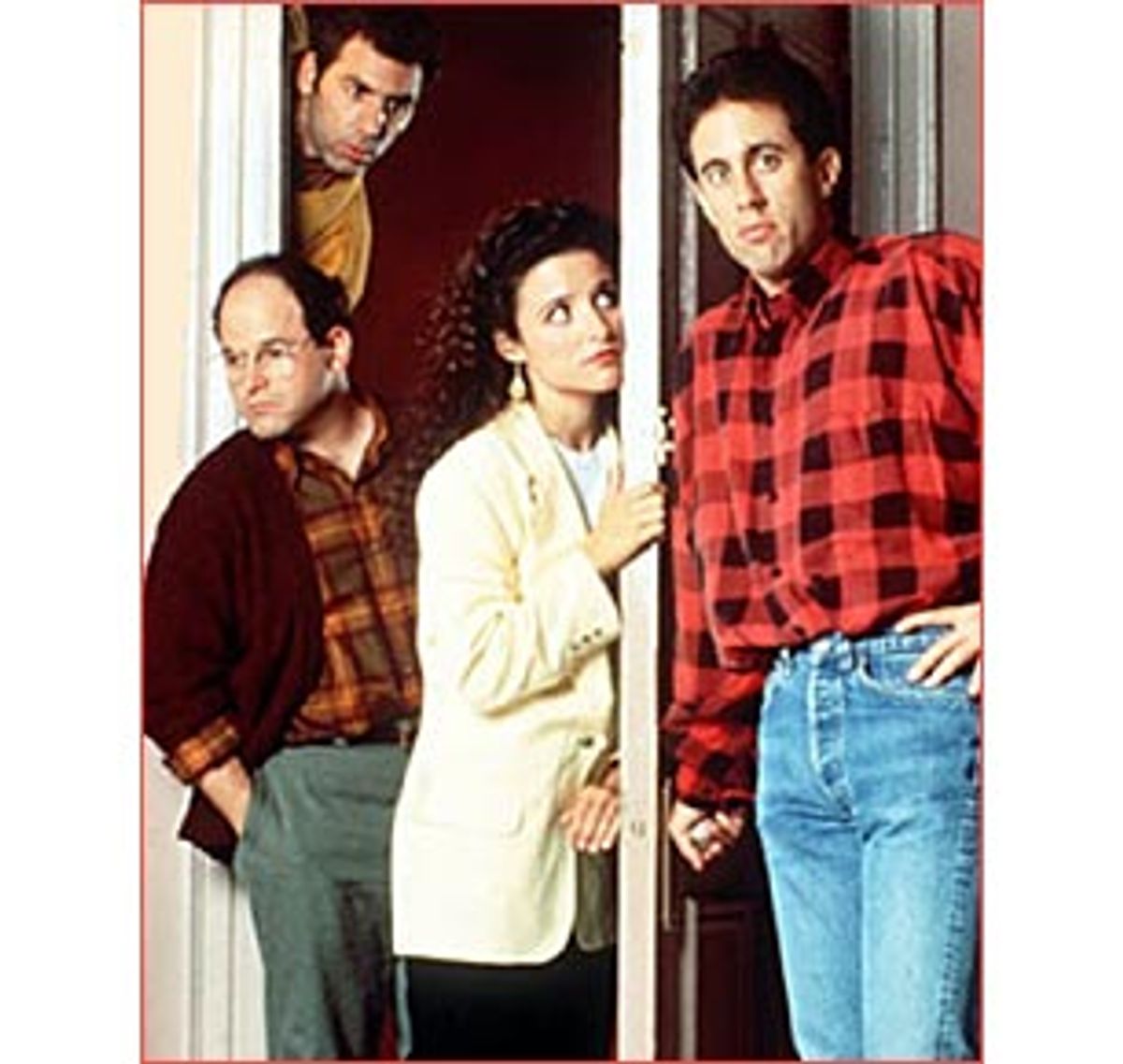
Seinfeld

The Tao of “Seinfeld”

A sitcom that forbade hugging and learning becomes a tool for teaching Aristotle. Not that there's anything wrong with that.

The average American grows up watching four hours of television a day. For thirtysomethings whose parents did not “kill their television sets,” “Happy Days” did more than Freud to shape their understanding of family. So is it elitist to say that Freud merits academic attention and “Happy Days” does not? Yes, according to a handful of adjunct philosophy professors weaned on TV, now all grown up and infiltrating the hallowed halls of academia. They are hip, budding professors, not stodgies in wingtips and monocles, as depicted in Merchant Ivory movies. Now they are infusing philosophy lectures with lessons from “Seinfeld;” the irony is that “Seinfeld” writers were guided by two principles: no hugging and no learning.

William Irwin, 29, is a Cuban cigar aficionado, puffy-shirt owner and assistant professor of philosophy at King’s College in Pennsylvania who edited “Seinfeld and Philosophy: A Book About Everything and Nothing,” published in October 1999. This collection of essays from philosophy professors kills two postmodern problems with one stone: It bridges that irksome gap between sitcoms and existentialist Søren Kierkegaard and masticates 2,000 years of bearded philosophers into contemporary dudes who spout digestible sound bites for today’s student. Irwin believes that as Socrates sought to stir the masses, “Seinfeld” can elucidate people because it strips characters to their narcissistic selves. For example, the “Good Samaritan” finale (when the group is charged with failing to help a carjacking victim) shows humanity at its darkest.

Syracuse University professor Robert Thompson founded the Center of the Study of Popular Television after musing, “Why do smart people watch dumb television shows?” “Liberal arts’ last great hope is to use TV,” says Thompson, who is also president of the Popular Culture Association. “For so many years the traditional methods of teaching the humanities have been losing ground. Television gives students something they can identify with, it’s a reference point to access subjects like Kant, Sartre and Heidegger.”

But this doesn’t mean “An Introduction to Seinfeld” will enter philosophy class descriptions next fall. “Seinfeld” studies is a nascent fad, not a burgeoning discipline. The book was spawned after Irwin noticed that he and his philosophy cronies were all referencing the show in their classrooms. It’s composed of essays such as “Wittengenstein and Seinfeld on the commonplace” and “Elaine Benes: Feminist icon or just one of the boys?” It reads like a grown man driving a Miata with the top down, chugging a Mountain Dew and singing along with Alanis Morissette in a shrieking falsetto. The book is funny, unpredictable and well, creepy. The contributors are addicts who tape and chronologically arrange the 169 episodes and converse in “Seinfeld” lexicon like ” No soup for you!” or “I’m the master of my domain!”

The text draws parallels between the four main characters and their philosophical counterparts: When George decides that all the decisions he’s made in his life have been wrong, so he should do the opposite of his instincts, one writer likens it to the Aristotelian paradigm “of the many.” George embodies all the deficiencies of many people rolled into one, the author says, and thus provides an example of the forks in the road one should not take.

At times the analogies get downright futile and an author shoots himself in the foot. In “Kramer and Kierkegaard: Stages on Life’s Way,” Irwin writes: “Think, for example, of Kramer’s boycott of Kenny Rogers Roasters. His motivation is not principled but practical: the glare from the store’s neon sign is disturbing him as he tries to sleep. When Jerry switches apartments with him, Kramer yields to Newman’s temptation and begins to feast on the tasty bird.” His point is that it first appears as if Kramer is flirting with ethics, and Kierkegaard proposed various stages of existence, but the example is lame.

After reading that even the title of the show holds etymological affinity to German existentialist philosopher Martin Heidegger’s “Being and Time,” one wonders if “Seinfeld and Philosophy” is merely an elaborate gimmick, an attempt to cash in on a sitcom with mass appeal and crass (book) sales potential. What better way to propel one’s career than creating a buzz and turning hours wasted in leisure into a dissertation? Like Kenny Kramer (supposedly the real man whom the television character was modeled on), quips on the book jacket, “I just thought the show was funny. Who knew there was so much more involved?” Ironically, Kenny Kramer has been accused of trying to ride the show’s coattails all the way to the bank.

Irwin intends the book for a general audience, rather than serious philosophy scholars. “The book is ‘Seinfeld and Philosophy,’ not ‘The Philosphy of Seinfeld,’” the professor has insisted. “I’m not claiming that there’s some abstruse philosophy behind the show, just that the two can be linked in some way. I would never recommend ‘Seinfeld’ over classic philosophy texts. It is just a good pedagogical tool to get students interested in philosophy. I don’t take this stuff too seriously. I hope no one takes these essays too seriously.” It’s in moments like this that Irwin dances like a boxer. He takes enough of a jab to make a marquee name for himself and stir up musty academe dust, but instead of following up with a convincing upper-cut, Irwin sputters, “But I was only kidding!”

It’s one way to dodge an opponent. For someone who doesn’t take anything seriously, Irwin is as earnest as a missionary. He and the other contributors followed each episode as if it were a Rosetta Stone, seeking dogma in every plot development, facial tick or failed joke, including scenes left on the cutting-room floor. Irwin cries wolf when he advises against earnest interpretations of the “Seinfeld and Philosophy” pieces and criticizes people who would mock the endeavor. “For 2,000 years emerging forms of scholarship have been lambasted,” Irwin proclaims. “One hundred years ago, people would have scoffed at scholarly examinations of Charles Dickens since his work was considered pop culture at the time. History will render whether or not [studying "Seinfeld"] is worthy.” And “Star Trek” was once just a corny sci-fi show. But just because fans translate “The Illiad” into Klingon lexicon doesn’t mean the show had inherent depth.

Irwin’s next project is a book about “The Simpsons” and philosophy; University of Virginia literature professor Paul A. Cantor won an award from the American Political Sciences Association for his essay, “The Simpsons: Atomistic Politics and the Nuclear Family.” “Seinfeld and Philosophy” joins thousands of other pop television texts now crowding bookstore shelves: “An Analytical Guide to ‘Battlestar Galactica’” and “PopLit, PopCult and The X-Files” as well as “A Critical Exploration: ‘Planet of the Apes’ as American Myth.”

“A lot of TV studies are trash,” Thompson admits. “A show like ‘Gilligan’s Island’ is not a cultural bellwether,” said Gary Edgerton, chairman of the department of communication and theater arts at Old Dominion University in Virginia and editor of the 30-year-old academic “Journal of Popular Film and Television.” “But ‘Seinfeld’ has had a lot to say about urban culture in the ’90s. Thompson concurs with Edgerton that “Seinfeld” is indicative of contemporary culture. “If you look carefully, the show speaks volumes about what our culture is all about. ‘Seinfeld’ tells us more about ourselves in the ’90s than the New York Times.”

Edgerton and Thompson rally against the cultural elitism that thwarts television studies. “Television is an 800-pound gorilla that shapes and changes us every year,” Edgerton said, noting that TV has only been around for 50 years and it took print media many years before it warranted attention from scholars. According to Thompson, “TV studies is a great equalizer.” And to think that television used to be an escape from homework.

James Nestor is a freelance writer and MA candiate.

The five most egregious quotes from Gwyneth Paltrow’s dinner party article

The actress invites her famous friends to dinner to tell the New Yorker how special she is

"Let them eat soy cakes!"

Gwyneth Paltrow, stop it. I am begging you. You are making me look bad in front of all of my friends. Here I go, trying to defend your bourgeois reputation with a (fairly) nice review of your cookbook, calling many of the dishes unpretentious and easy to make.

You must have hated that. I almost can see you, queen-like, reading Salon (as you do every day) in the print form we give to celebrities, reading that article with your lovely eyes widening before crumpling it into a ball and throwing it across the steam room where you are currently enjoying a reflexology massage.

“Get me the New Yorker!” I hear you screaming at your personal assistant/GOOP editor (?)/Chris Martin, “I will teach them who is the most grandiloquent food celebrity of modern culture!”

And congratulations, Gwyneth. You did it. Lizzie Widdicombe’s article “Gwyneth’s World: Gwyneth Paltrow, Movie Star and Domestic Goddess“so turgidly describes your latest dinner party with Jay-Z, Michael Stipe, the Seinfelds, Christy Turlington and a bunch of other famous people that I wanted to crumple up my edition of the magazine and throw it across a steam room. But I can’t. Because I don’t have a steam room, and also I don’t have a copy of the New Yorker. Some of us aren’t made of crisp, lemon-scented money, Gwyneth!

Anyway, if I had to pick the five most offensive parts of this article (which is difficult because it is short, and also if I say “all of it” then I’m stuck with four blank spaces), it would have to start with the duck sentence.

1. (Seriously, with no context whatsoever):

Michael Stipe added, “Once, a duck she was cooking caught fire, and she threw it in the pool.”

2. Mary Elizabeth Williams’ piece about the hot new trend of stick-thin actresses getting idealized as some giant food processing machine is definitely embodied here: 

“She eats like a truck driver,” (Mario Batali) said of Paltrow. He recalled being in Valencia, Spain, and “watching her eat an entire pan of paella as big as a manhole cover.”

3. Christy Turlington knows what will happen if she speaks ill against the Paltrow/Martin family:

“They do everything themselves, including the killing of the lobster,” she said. “It’s not the boiling-in-the-pot-and-screaming lobster thing. It’s a different, faster approach. I could never do it.”

“You smack it against a tree or something?” Batali asked.

“You stick a knife through the head,” said Turlington, who seemed suddenly troubled.

4. Why would anyone give quotes like this to the press?

Wendi Murdoch, sitting nearby, had said that she is a reader of Paltrow’s blog: “Only one thing comes to mind — healthy and organic.” She listed her favorite recipes: “Pumpkin soup, grilled market vegetables. It’s good. I get my chef to cook it.”

“But you’re directing the chef,” Kelly Behun, a friend of Murdoch’s, interjected.

5. And, of course, no party at Gwyneth Paltrow’s is complete without the slavish groveling:

Jessica Seinfeld made a toast … she turned to the assembled guests. “And you are all so lucky to be part of Gwyneth’s world. Because this is the real deal. And she’s invited all of you good people in here. I would never do that.”

Emphasis hers, naturally.

Continue Reading Close

Drew Grant is a staff writer for Salon. Follow her on Twitter at @videodrew.

Shades of “Seinfeld”: Maine bottle scam alleged

A la "The Bottle Deposit," three are accused of illegally cashing in on out-of-state recyclables

SHAW AIR FORCE BASE, S.C. -- Dana Green, Shaw's recycle center attendant, dumps a load of plastic bottles into a recycle bin Nov. 27. Shaw recycles aluminum cans, plastic and glass bottles, office paper, newspaper, magazines, cardboard, printer cartridges, shoes and metals. (U.S. Air Force photo/Staff Sgt. John Gordinier)(Credit: Staff Sgt. John Gordinier)

A memorable “Seinfeld” episode features Kramer and Newman taking thousands of cans and bottles to Michigan so they can get a nickel more per container than they would in New York, but beverage distributors say there’s nothing funny when it happens for real.

In Maine, which has a more expansive bottle-redemption law than neighboring states, three people have been accused of illegally cashing in more than 100,000 out-of-state bottles and cans for deposits, the first time criminal charges have been filed in the state over bottle-refund fraud, a prosecutor said.

A couple that runs a Maine redemption center and a Massachusetts man were indicted this week for allegedly redeeming beverage containers in Maine that were bought in other states.

Thomas and Megan Woodard, who run Green Bee Redemption in Kittery, face the more serious charge of allegedly passing off more than 100,000 out-of-state containers — with a value of more than $10,000 — as if they had been purchased in Maine.

That’s just the tip of the iceberg.

An estimated 90 million cans and bottles are fraudulently cashed in each year in Maine, costing beverage distributors $8 million to $10 million, said Newell Augur, executive director of the Maine Beverage Association.

People from other states — especially New Hampshire, which has no “bottle law” — routinely redeem loads of cans and bottles in Maine, Augur said. Redemption centers pay customers 5-cent refunds on most beverage containers and 15 cents for wine and liquor bottles. The centers, in turn, get that money back from distributors, plus a 3 1/2- or 4-cent handling fee per container.

In the 1996 “Seinfeld” episode, Kramer and Newman hatch a plan to drive a truckload of cans and bottles to Michigan, because the redemption fee there was 10 cents, double New York’s nickel deposit.

Kramer laments it can’t be done. “You overload your inventory and you blow your margins on gasoline,” he says at one point. But Newman offers up free space in a mail truck he has to drive to Michigan before Mother’s Day — “the mother of all mail days,” he calls it — and the pair head off. (They end up aborting the trip while chasing down Jerry’s stolen Saab.)

“That was a very funny episode,” Augur recalls. “But this is not a laughing matter.”

Officials estimate that up to 1 billion beverage containers are sold in Maine each year. Containers sold in other states, however, carry the Maine deposit stamp because it’s not cost-effective to change labeling for each state.

The redemption rate — and the instances of fraud — have gone up with the poor economy, Augur said.

In all, 10 states have redemption laws, but Maine is susceptible to fraud because it has expanded its 1978 bottle-deposit law through the years beyond soda, beer and other carbonated beverages. It now accepts juice, water, sports drinks, liquor and other containers.

Neighboring New Hampshire doesn’t have any redemption law. In Massachusetts, redemptions are limited to beer, carbonated soft drinks and mineral waters.

Distributors say redemption fraud is most prevalent along Maine’s border with New Hampshire.

In 2003, the owner of redemption centers in the border towns of South Berwick and Kittery paid a $10,000 fine following a state crackdown on redemption fraud, but Assistant Attorney General Leanne Robbin said this week’s indictments were the first criminal charges she’s aware of in a redemption case in Maine.

The Woodards did not return a call to their home seeking comment.

They are accused of knowingly accepting containers at their redemption center that were purchased in another state, and therefore not eligible for a refund in Maine, and then selling them to distributors for the combined handling and redemption fees.

Peter Prybot, a 62-year-old lobsterman and writer from Gloucester, Mass., denied the allegations in the indictment, which charges him with redeeming more than $1,000 of empty containers in Maine that weren’t eligible to be redeemed.

Prybot said he accumulated cans and bottles during road trips to Maine and later cashed them, but said they all came from Maine.

Augur said legislation has been introduced that could help alleviate the problem by allowing distributors to sue individuals they believe are illegally redeeming large numbers of containers in Maine.

 For Newman and Kramer, their beautiful scheme was doomed from the start:

Continue Reading Close

“Harry’s Law”: Has David E. Kelley finally run out of steam?

The disastrous "Harry's Law" combines bad farce with serious social issues -- and wastes the talents of Kathy Bates

Kathy Bates in "Harry's Law"

It’s funny that writer-producer David E. Kelley keeps making shows about cynical careerists who rediscover their ideals, because on his shows you often see the same trajectory happening in reverse. Any given episode of any given Kelley series is a 12-car pileup on the Anything Goes freeway, mixing politically correct posturing, harangues disguised as legal summations, wacky ethnic characters, kinky sex and tabloid luridness. The creator of “The Practice,” “Ally McBeal,” “Boston Public” and “Boston Legal” is smart and prolific and capable of surprise, and he’s unafraid to court controversy, but does he stand for anything except industry success? I’m sure he’d insist otherwise, and would point to all the legal concepts his law series have introduced to American television, and all the hot-button issues they’ve dealt with. But to me, Kelley’s shows embody the sneering stereotype of network TV in the ’60s and 70s, when most of it was stupefyingly bad and boring and safe: There’s a flurry of activity each week, but nothing really happens, and the characters are inconsistent, often nonsensical, doing and saying whatever they have to do or say in order to hold our attention and fill up the space between commercials.

That pretty much describes Kelley’s latest, “Harry’s Law” (Mondays, 10 p.m./9  Central). It’s about Harriet “Harry” Korn (Kathy Bates), a burned-out Cincinnati patent attorney who gets fired for smoking pot in her office, then gets hit by a young man named Malcolm (Aml Ameen) after he jumps off a roof, and then is released from the hospital only to be hit by a car driven by a hot shot young attorney named Adam Branch (Nathan Cordry), then joins forces with both of them and some other characters and takes over a shoe store in a rundown neighborhood and turns it into a law firm that seems to handle every kind of civil and criminal case. But because this is a Kelley series, Harry and her staff continue to sell shoes. There’s a high-heeled shoe in the series’ logo. I know — cute, right?

The moment in tonight’s episode where one of Harry’s staff shows up with a sandwich board that promises a legal defense and women’s shoes is cute, too, as is the line about how the shoes are on consignment. Kelley’s shows are always very, very cute, often greeting-card cute, until they suddenly turn grotesque or sleazy or gratuitously stupid (remember what happened to George Vogelman on “The Practice”?) or toss in some antiquated ethnic stereotype (like the no-tickee, no-shirtee Chinese laundromat guy who accosts the heroine at the start of tonight’s episode of “Harry’s Law” and sets a subplot about China’s one-child reproductive policy in motion) or  suddenly start lecturing you about gun control or workplace harassment or immigration or abortion or something, as if a mediocre episode of “Seinfeld” had suddenly decided to rally by turning into “Twelve Angry Men.”

I think it would be best for everyone involved — especially the audience — if “Harry’s Law” were quickly canceled. It’s not as bad as some recent Kelley series (“The Brotherhood of Poland, New Hampshire,” to name one). But  judging from the pilot and tonight’s first regular episode, it’s got all the David E. Kelley tics and tricks that make me want to drink lye, but none of the energy and confidence that often make Kelley’s series watchable anyway. My favorite Kelley show was his “Practice” spinoff, “Boston Legal,” because for long stretches it seemed to slough off the bonds of reality altogether and become a strange comic soft-shoe between William Shatner and James Spader, two of the most authentically bizarre actors ever paired as co-leads in a long-running TV program; but even if “Harry’s Law” decided to go in a “Boston Legal” direction, I doubt the show could pull it off, because it’s so half-assed. It looks awful, too, with its utterly undistinguished cinematography and blocking and “Hey, look, we’re on the same generic urban backlot every NBC show uses!” settings, and the blown-out windows looming behind people’s shoulders as if they’re on a reality TV series. I don’t think the show is smart enough to be doing any of this stuff for a reason; more likely either Kelley or NBC is a cheap bastard. At times it feels as though Harry is a coded stand-in for Kelley himself, a legendary figure who’s bored with his job and has run out of ideas and inspiration, but who needs to stay in the game because he doesn’t know what else to do.

But the more pressing problem with the show is that Bates, so often a hilarious and surprising actress, can’t seem to find to find a way into this character. Supposedly the title role was intended for a man until Bates read the pilot script and took a liking to it. If you picture Harry’s predicaments and dialogue on the page, then imagine Shatner or Spader in “Boston Legal” mode doing and saying the same things as Bates, you can almost envision a watchable series. The problem isn’t the gender swap, it’s that Bates’ energy is wrong. She seems to be playing Harry as a real person rather than a David E. Kelley kook. Watch how she interacts with one of her clients, the 87-year old African-American grandmother (Irma P. Hall) who’s being tried for sticking up a convenience store because she would have starved otherwise. Harry’s embittered bluster dissolves almost immediately, and she begins responding to the woman’s plight on a human level, and the score signals Harry’s thaw by tinkling in our ear. Bates, who does over-the-top very well (“Misery,” “Primary Colors”), can’t help reaching out to the client, and responding naturally, as most functioning people would. That’s fine, but it doesn’t match up with the woman we saw earlier in the episode who responded to the staff’s sighting of a rat in the shoe store/law office by pulling a pistol and blowing the rodent away.

The rat scene and the scenes between Harry and the stickup granny encapsulate the show’s problems. Apparently this isn’t just the kind of series where the lead character packs heat and uses the gun to casually blow away vermin in her workspace; it’s the kind of series where the rest of the staff reacts to random, stupid, incredibly dangerous gunfire in their office by sort of shrugging and then carrying on with their business. That’s all fine — it would even be funny if the timing were sharper and the tone more vigorous — but when “Harry’s Law” suddenly becomes a finger-wagger about the neglect of elderly people of color and the cruelties of the post-capitalist economy, and Kelley hasn’t bothered to smooth the shift between those wildly different modes, and if the star is overdoing the earnestness and fellow-feeling and neglecting to make the main character hard and unpredictable and nutty, there’s really no way that the series can ever work.

Interestingly, Irma P. Hall, who played the matriarch in “Soul Food” and the righteous widow in the Coen brothers’ remake of “The Ladykillers,” comes closer to selling this unwieldy work-in-progress than any of the regular cast members. She’s an old movie-style actress, always sharp as a tack, always playing the character and seemingly not giving a damn what you think of her. I am tempted to argue that if you put an actress like Hall in a series like this one, you might have something. But I don’t want to give Kelley any encouragement.

Continue Reading Close

“Seinfeld” saves “Curb Your Enthusiasm”

The season finale of Larry David's uneven HBO comedy proves how funny it can be with a little help from friends

Larry David and Jerry Seinfeld

Why can’t the cast of “Seinfeld” appear on “Curb Your Enthusiasm” every season?

Last night’s seventh season finale offered a particularly tantalizing taste of just how funny the “Seinfeld” cast and its creators still are after all these years. The finale and its fictional reunion show not only found several fun and clever ways to bring these familiar characters into a current landscape — George invents the iToilet but his fortune is ripped off by Bernie Madoff, Elaine ignores Jerry to read her BlackBerry — but it also featured some truly memorable scenes between Larry David and Jerry Seinfeld.

The behind-the-scenes bits from the reunion plot have proven entertaining all season, particularly when they didn’t involve some tiff with Larry David that we’ve seen a million times before. Larry’s spat with Julia Louis-Dreyfus over water stains on her antiques fell into repetitive territory, of course. (And how many times can Suzie call Larry an asshole and throw him out of her house?)

Having said that, the running lines “Do you respect wood?” and Jerry’s bit about the absurdity of the segue “Having said that …” both captured that distinctly Seinfeldian flair we all know and miss so desperately. The scene where Larry and Jerry marvel over Jason Alexander’s pretentious vanity book “Acting Without Acting” demonstrated the more nuanced and (somewhat paradoxically) more punch line-driven tone that comes from Jerry’s comic stylings and Jason’s, well, acting without acting, getting thrown into the mix.


In fact, the reunion-focused episodes of “Curb” this season have demonstrated just how funny this show could be if its writers relied more on relatable observations of modern behavior (constant texting by young kids, the vanity of actors) and less on gripes about tipping, personal favors and perceived insults (angry waiters, angry maitre d’s, angry coffee guys) that lead to the shouting matches. Even the predictable setup of Jason borrowing Larry’s pen last week paid off in spades when Jerry heard about Jason’s indiscretions with the pen, shook his head and told Larry, “You don’t lend Jason anything, anything that can be … inserted.”

On last week’s episode, when several characters reacted to Larry’s scatological reference to a kid’s rash with stunned silence, culminating in a doctor leaving the room with Larry and quietly instructing his nurse to call the cops, we got a glimpse of how a little restraint allows the show’s humor to shine through. Larry was being a jerk, as usual, but the reactions were subtle and the situation was at least somewhat familiar. (I particularly loved the scene where we glimpse Larry texting to his young fan, “NO I DON’T WATCH WIZARDS OF WAVERLY PLACE, I’M AN ADULT!!!!!!!!!!!!!!”)

But even after last week’s surprisingly strong episode, the finale didn’t disappoint, from Larry’s jealousy over the smug camaraderie between Cheryl and Jason to his larger-than-life imitation of George. The best scene, though, had to be this classic diner exchange between Jerry and George, after George’s estranged wife Amanda is gone for good.

George: Well, I’ll never meet anyone else again.

Jerry: Probably not.

George: Meeting is hard.

Jerry: Meeting is hard. Why can’t you meet?

George: Can’t meet! Why is that?

Jerry: This is what single people are thinking about the minute they wake up in the morning. And yet we’re surrounded by people, they’re right next to us, on the bus, on the street! But we can’t meet them.

George: Why won’t they meet us?

Jerry: Because strangers have a bad reputation.

George: A few bad strangers have ruined it for the rest of us!

Jerry: It’s unfortunate.

We’ll never meet two jackasses we love this much again, will we? Surely there’s some government-mandated way to force them to keep producing episodes, for the good of the nation!

But bringing the best sitcom of all time back from the dead is hard. Why is that? Why won’t they come back for us? Because reunions and revivals and comedic resuscitations have a bad reputation. A few crappy reunion specials have ruined it for the rest of us!

Having said that, this revisited, pseudo-”Seinfeld” reunion was about as fun and as satisfying as any “Seinfeld” reunion could be, and for that, Larry and Jerry and the rest have our deepest thanks. 

Continue Reading Close

Heather Havrilesky is Salon's TV critic and author of the rabbit blog. Her memoir, "Disaster Preparedness," published in 2010.

“Bee Movie”

Heard the buzz? Jerry Seinfeld's back ... as an animated bee. But this low-flying movie has no sting.

Over the past month or so it’s been impossible to pick up a major, or even a minor, entertainment publication and not see a story describing the animated feature “Bee Movie” as the return of Jerry Seinfeld — even though he’s returning to us only as a cartoon bee named Barry. Although Seinfeld has been doing stand-up comedy regularly since the end of his hugely popular eponymous TV show, the fact that he hasn’t been coming into living rooms regularly has made him seem somewhat invisible. That may be why his involvement with “Bee Movie” — which he co-wrote with Spike Feresten, Barry Marder and Andy Robin, and also co-produced — has been treated by the press, if not necessarily by fans, as a sort of second coming.

Seinfeld’s sensibility, so oblique it’s concrete, does surface now and then in “Bee Movie”: The picture is peppered with jokes that are there, and yet not fully there, like the holes in French bread. There are a few great gags, including one in which Barry, having dodged certain death via a rolled-up shopping circular, explains how every bee learns to fear modest and glossy periodicals alike: “I lost a cousin to a copy of Italian Vogue,” he tells the human friend Vanessa (voiced by Renée Zellweger) he’s got a crush on.

But “Bee Movie” is just another ambitious, lavish animated adventure, pretty enough to look at, but ultimately foundering on the weakness of its script. Barry B. Benson is a bee like any other, having gone to school for three days (one each for grammar school, high school and college) in preparation for a lifetime of work, work and more work at the honey-producing corporation known as Honex. Each bee at Honex gets a job to do, which he happily does for life. Barry’s best pal, Adam Flayman (Matthew Broderick), is OK with that arrangement, but Barry wants more out of his little bee life. His parents, Janet and Martin (their voices belong to Kathy Bates and Barry Levinson, respectively), don’t see what the problem is. “Would it kill you to make a little honey?” they implore. But Barry is too curious about the world outside the hive: He wants adventure, and when Vanessa, a kindhearted florist, first scoops him out of harm’s way, he understandably falls for her. As he spends more time in the human world, he realizes, with horror, that people actually steal honey from bees. He tries to redress that wrong by suing the human race, with consequences he never could have predicted.

From an environmentally conscious point of view, the core idea here is sound enough, particularly if you’ve paid any attention to the recent news stories about how the decreasing bee population threatens to alter the delicate balance of our environment. But that doesn’t make the jokes in “Bee Movie” any funnier, or the characters any more appealing. Nor does it make the animation more impressive or more charming. “Bee Movie” has a soft but vibrant color palette, and the design of the characters is pleasing enough: Barry has an inquisitive expression, and flits around in a black-and-yellow striped sweater with coordinating Chuck Taylors at the end of his spindly little legs. Vanessa, with her alert, almond-shaped eyes, doesn’t have the creepy hyperhuman quality of the characters in the “Shrek” movies: She looks blessedly cartoonlike (and I’d be remiss if I didn’t also point out that, in her fitted striped cardigans and pedal-pusher jeans, she also has a pretty nice rack).

But “Bee Movie” just lacks spirit and energy. Part of the problem may be that, as far as I’m concerned, any animated movie released this year (and possibly in years to come) suffers in comparison with Brad Bird’s “Ratatouille,” a beautifully animated picture whose details and design serve a story and characters that are solid to begin with. “Bee Movie” is clever enough, but only in fits and starts. Too many of the movie’s gags are just filler: The pollen jocks, those lucky, supermasculine fighter-pilot types who are chosen to leave the hive and pollinate the world of plants, are praised as “nectar collectors.” When Barry and Adam graduate from college, Barry, looking at the assembled mass of bee-students, remarks, “Wow! Quite a bit of pomp — under the circumstances.” Even the Italian Vogue gag is recycled later in the movie, and it’s funny only the first time. Only Chris Rock, as a bloodthirsty mosquito, gives the picture any recognizable jolt of life. The rest of “Bee Movie” neither floats like a butterfly nor stings like a — well, you know. That buzz around it is nothing more than hype.

Continue Reading Close

Stephanie Zacharek is a senior writer for Salon Arts & Entertainment.

Page 1 of 9 in Seinfeld

www.salon.com/topic/seinfeld/