I wake up panicked. J. is snoring, soft and even as always. It takes a minute to remember where I am: visiting my boyfriend, in a hotel room, in Cameroon.
My eyes adjust to the darkness and I realize that the halo around the thick blue curtains is not the sun, but tall lights reflecting off the pool. It must be 3 or 4 in the morning and a million thoughts are running through my head. J. has been here for two months and I for only four days, but already the past three years feels like a good movie that has ended too soon.
I tiptoe into the bathroom and sit on top of the toilet seat. My sallow reflection under the fluorescent lighting reminds me how disappointed I am, in everything. I watch my own face crinkle into a sob. To calm myself down, I start mentally scripting my travel article on Cameroon. So far I know little about Cameroon, except that it is a French-speaking country in West Africa, and that Yaounde, its capital city, which we're in, is a dusty, urban mess.
"Despite the heavy French colonization, Yaounde is a far cry from Paris." I laugh at this attempt to compare the land of lovers to a city so in need of romance. How ironic that this is where J. and I should come apart.
It's true what they say: Africa requires a heavy dose of disbelief. Perhaps this was why I couldn't quite fathom what was happening. The day after I arrived in Yaounde, J. left for work at 7 a.m. and I sat on the hotel balcony and watched the rain -- rain like I'd never seen before. From the top of Mont Febe, the sprawling city was completely hidden by a dense gray cloud. Everything was instantly and thoroughly drenched. Five minutes later, the sky started to lighten and the city bled through as if it were emerging from a dream. I had thought it was the dry season, my first of many misconceptions about Cameroon.
After the rain, I watched five African men convene in the shade near the pool. All the guidebooks warn female travelers: "Wear baggy clothing," and "Do not go out alone." This seemed and still seems a ridiculous remnant of the "black men are rapists" myth. Still, there is something about Africa that seems to legitimize otherwise irrational fear. With malaria, yellow fever, polio and typhoid in the air, how can you be sure that there aren't also outdated forms of terrorism still lurking?
So, much as I hated myself for it, I was nervous to go down to the pool and expose my skin. Instead I put on baggy pants and a long-sleeve shirt and attempted a jog down the hotel's hill. The few beeps and cheers from jeeps full of men set me on guard, but I didn't feel unsafe until a stream of boys emerged from a school and headed in my direction. One of the boys spotted me, crossed to my side of the street and as I approached him, unzipped his pants. Before I found the motivation to look away, he pulled out his penis. Regrettably, I didn't do anything cool like shake my head at his member's inadequacy. Instead, I headed back to the hotel fast, stopping only when I heard a beep that I thought might be J. returning home. I turned and saw one of the boys following me. I ran.
Safely secluded in our too-blue hotel room, I wondered if I had overreacted. Nothing like this had ever happened to me, and if I was really in danger, wouldn't I have taken a more aggressive approach? I decided not to tell J. for fear that the episode was minor and he would feel guilty or worse, regret having invited me to visit. After work, we drove into town, parked the car and walked through bustling streets. In Yaounde, everyone's selling something: food, discarded electrical appliances, clothes, stamps, Xeroxes, license plates. It is an amazingly energetic city where people wake at dawn and everyone is either walking with large loads on their heads or jogging around the circular streets. The exercise club hits the roads at 5 a.m. One of J.'s co-workers admitted that sometimes he gets up at 4 a.m. and just waits for the day to begin.
As we walked, I ignored stares, thinking that this is how African-Americans must have felt, and still feel, as the minority in America. My discomfort was a lesson, the small price of my privileged whiteness. "I like your woman," one man shouted at J. A moment later, a hand reached out and pinched my ass. I gripped J.'s hand, whispered what had happened and we headed back to the car, where I confessed the day's earlier incident. "I'm so sorry," J. kept repeating, but it wasn't his fault, or my fault. And how do you blame a country?
After this, I spent most days in the hotel room. Like a Charlotte Brontk character, I read, wrote and answered the hotel staff's inquiries about my well-being.
Ga va, Madame?
Ga va, merci.
J., on the other hand, was suddenly extremely important to the world, or at least this is how he acted when he left for the office at 7 a.m. or reported the frustrations of being boss. He had to fire three locals, negotiate other people's raises and vacation pay, lead weekly meetings. Even the parking lot attendant at the Mont Febe Hotel routinely begged him for a job.
When he got home from work at 4 he would take me out: to markets, drives through the bush, circles around the city, restaurants and local bars. Although these outings exposed me to some unusual sights -- baboon skulls for sale, traditional masks with grossly exaggerated features, bush taxis jammed with people, cocoa drying by the side of the road, small boys carrying huge jugs of palm wine, dilapidated porches -- these were still only images. After a week in Africa, my only story was the one about how I bravely fought a bee out of the hotel room and then locked myself out on the balcony. I felt pathetic. Plus, most nights I wouldn't have much to talk about and would get irritated by J.'s long-winded stories about the office. Many nights we would fight, make up, go to sleep and start again. After four days, it felt like the beginning of the end.
A few days before the end of my visit, right before Thanksgiving, J. finally took a few days off from work and we embarked on a trip to the "extreme north," a region of Cameroon vastly different in terrain and culture than Yaounde. The morning we left, I was giddy watching the sun rise over the shadowed city, birds flying like M's in the sky. The clouds were so low you could touch them, and hiding way below were the mud huts of the valley's villages. I felt ecstatically far from home.
When we stepped off the plane, we were met by Victor, our friendly guide who drove us to the nearby city of Maroua. Finally, for the first time since I had arrived in the country, the dusty roads were not J.'s home, but a foreign land we were going to explore together. The roadside terrain was dry and barren, dead soil with patches of wilting greens. And the haze wasn't just fog but a seasonal aura caused by the Sahara's blowing sand. The locals were mostly Muslim farmers -- yet another degree further from ourselves.
By sunset of our first day we were in Waza National Game Park bumping around on the back of a pickup with Muslim animal-tracers pointing out lurking giraffes, flying eagles, peacocks and birds in blue that looked more artificial than our Yaounde hotel room. As the sun went down, small heat fires began to burn the bush. We drove straight through a neat line of these mini fires which had parted like the Red Sea along the driving path. I could feel the burning heat against my face as the flames leapt around us.
A few minutes later we hit a bump and J., who had been sitting in front of me, fell against me. I hugged his soft waist and felt a new love for the body I held. That night I told him. How do you know, he asked? I just do. Me too, he said. It was Thanksgiving and we dined by moonlight on delicious, roasted pheasant -- perhaps the one we saw waddle into Waza's waters. After dinner, we walked under the star-filled sky and imagined living without anyone else around.
It was ideal. J. didn't have to work. He didn't have to shave. I didn't have to be alone or wait for him to get home. We were both at the mercy of Victor, who spoke little English and introduced us to natural sweetness like sugar cane and guava growing by the side of the road. Up north, our strangeness was more a wonder than a burden, and J. and I were equally out of place.
Two days into our journey, after hours of being bounced around on unpaved roads, we reached Rumsiki, a small village on the border of Nigeria which is famous for its crater-like mountains. The massive, rocky peaks shadowed by the slowly reddening sky confirmed the village's reputation as one of the 10 most beautiful places in the world. The next morning we visited the crab sorcerer, an old man with a yellowing beard who seemed to be in a trance as he moved around his mud hut. We asked him a question and he sat on a rock, meditatively massaging and blessing his special crab. Finally, he let the crab do its "work" in his clay pot, then opened the lid, examined the crab's tracks and laughed loudly.
"You will be together for a long time, until he" -- he pointed to J. -- "is like me!" The old sorcerer lifted his cane.
At the end of the four days, J. and I were closer again. In fact, I felt more in love than I had in a long time. Perhaps it just takes time to get back in sync, I reassured myself. But then, as if to remind us that nothing in Africa can be counted on to go as planned, our flight back to Yaounde was delayed -- for two days. The rescheduled flight remained uncertain and no airline reps were available for confirmation. The airport had no phones, no food. We spent the night on a cold, hard floor. By the time the flight left for Yaounde, I had missed my flight back to the States.
Maybe I'll stay longer, I thought. But as soon as we returned to Yaounde, J. hurried off to work and I was once again confined to the icy isolation of the blue room. I scheduled a flight for the following day and J. drove me to the airport.
"I like it here," J. said as we drove through Yaounde's gritty streets followed by curious stares and harsh glares from poor Africans walking miles to get home. For the first time in our relationship, at least the first that I could remember, J. and I were having completely opposite reactions to an experience. We had traveled all over the world together, albeit only to beautiful places; we had shared everything for three straight years. Why now, why here was it all unraveling?
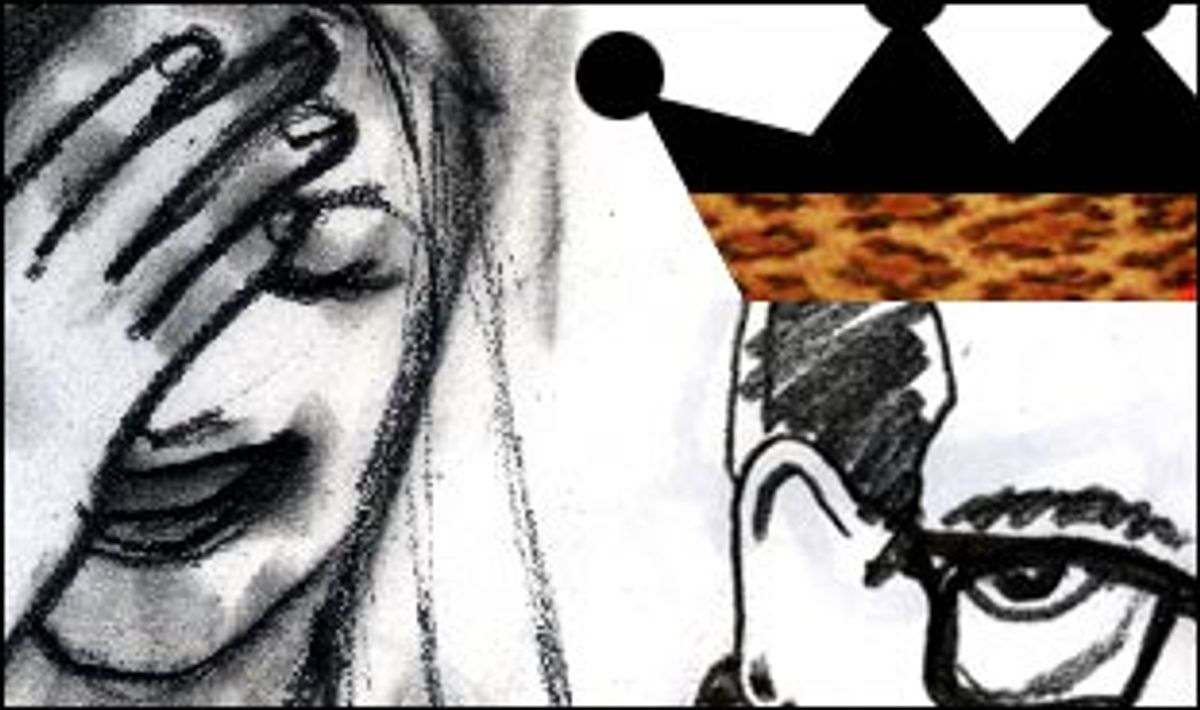
I reached for another clichi about Africa: Africa was another woman, a mysterious seducer who was exerting a pull over J. that I was incapable of preventing or imitating, making him feel excited, in control, powerful -- all the things he missed in his life in New York, his life with me. Being white, being the boss, he was not judged by the standards he was so used to failing. I thought about how much he hated the crowds, the subway, kissing up to a superior. In Africa he was a king. I looked at his face and briefly pictured him as the old sorcerer, raising his stick, which looked more like a scepter than a cane.
Weeks later, J. e-mailed me to say he loved me and wanted to be with me but wasn't yet ready to leave a place he found so much more enjoyable than home.
"When will you be ready to leave?" I asked.
"A month, two months. I don't know," he said.
That night I had a dream in which I broke up with J. and then ran off, up ladders, down slides, until it dawned on me that I had made a mistake. I tried to return to the place where I thought he was, but found him instead in a store, trying on a snakeskin coat with four African men. He looked happy and at home.
Shares