I have two children. I will not be having any more. Not that I wouldn't like to, but my partner, a party pooper if ever there was one, has made it clear that if I have another child, I will be a single parent.
If I were my mother, I would just get pregnant anyway and then pretend it was an accident. But I am not my mother. For one thing, I am a bit less manipulative than she was. For another, I am a lesbian and it's very difficult to explain an accidental pregnancy in a lesbian relationship.
I could try the "Oh, darling, I'm so sorry. You see, I just happened to be in the sperm bank and the lights went out and I tripped and stumbled and somehow, I'm not even sure how, I got pregnant" line, but I'm pretty sure it wouldn't fly. And so, now that my baby is no longer a baby, I am beginning to realize that I will never have another child.
This is sad in all the usual ways. I miss that baby smell and those little baby diapers and all that, but there's something else I miss too. I miss the reproductive sex.
I know, I know. Finding reproductive sex sexy is sick, perverse even. Reproductive sex is, by definition, the opposite of hot. There is something innately unattractive about the line "Honey, the stick is purple. We gotta do it, quick!!!" And yet, here I am, pining for reproductive sex.
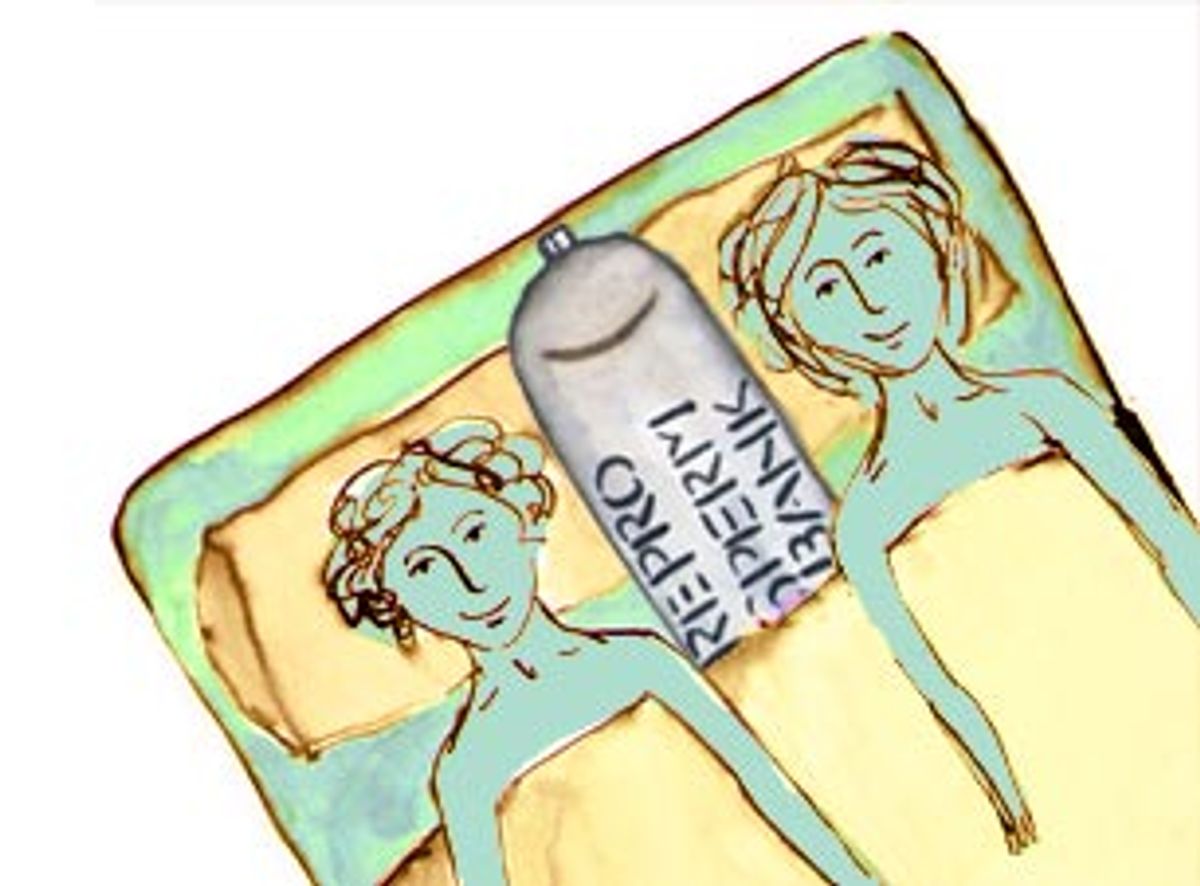
Perhaps it is because there is something terribly naughty and titillating about two women in bed with a vial of disembodied sperm. In fact, the image of two women having reproductive sex is so naughty that it is nearly unmentionable. In popular culture, whether it's the children's book "Heather Has Two Mommies" or the sitcom "Friends," lesbians do not have reproductive sex. Among the many lesbian couples I know, none of them had reproductive sex. They either did it the old-fashioned way (with a man) or took themselves to a doctor's office.
Perhaps it is because we as a society and we as lesbian mothers cannot conceive of creating a baby without a man present. The "man" takes the form either of a literal father or of a medical doctor, male or female, exercising control over the messiness of women's reproductive organs.
In the safety of a doctor's office, women in sanitary white gowns are allowed to reproduce with the aid of the doctor/father and the nearly surgical insertion of sperm. My partner and I tried the medical route once, sort of. With my legs in stirrups and a tube inserted into my o's, our feminist midwife handed my partner the syringe and told her to "Squirt away, stud muffin."
Then she suggested that I have an orgasm, since she believes orgasm aids in conception. But all this medicalization of reproduction was not a turn-on for me, and besides, I never could perform under pressure. After that, we decided to reproduce in the privacy of our own home. After all, this isn't brain surgery. It's reproductive sex. Even our parents managed to do it.
It wasn't exactly easy to make our babies at home. There were a lot of logistical problems. We had to transport the sperm home from the sperm bank. It was always terribly embarrassing to sit on the subway with a large metal tank with the words "REPRO SPERM BANK" painted on the side. Getting the sperm from the subway to the apartment was even more difficult. In my stoop-sitting, nosy neighborhood, more than one person asked me what I was carrying.
Once inside the apartment, my partner would become "Mr. Science." She would put on her nerdy glasses and carefully defrost the sperm to the exact temperature required. There was something frighteningly fatherlike about her. She was so in control and rational and practical all at the same time.
I remember the night we got pregnant with our first child. We had just sat through a rather long and not terribly good rendition of "The Magic Flute." Four hours of opera had put me in a pessimistic mood. I didn't want to be inseminated and I was sure it wouldn't work anyway. I began to cry. I insisted that we throw the sperm out and try again the next month.
My partner calmly explained that we had bought the damned sperm and we were going to use it whether I wanted to or not. I was angry and turned on all at the same time. I was angry because I didn't want Mr. Science, Mr. Rationality and Mr. Control to tell me what to do. But I was turned on because I knew that once she removed her glasses and brought the sperm over to the bed, Mr. Science would disappear. Her role as the "father" would become ironic, distanced by her body (female) and her desire (lesbian). And I, always a sucker for a woman who knows what she wants, was enthralled by the idea that we would have reproductive sex whether I felt up to it or not.
Now that is hot. Sex and desire and reproduction all too big and too important to be ignored or put off. Sex and desire and reproduction between two women, no doctor, no father.
I, for one, will always find lesbian reproductive sex sexy. And I will always feel a certain nostalgia and desire for the days of little purple sticks and large metal tanks and doing it whether we wanted to or not.
Shares