The New York Times

The digital reader

In which I borrow an e-book and give up print for two weeks.

A few years ago, when Salon relocated to a new office, the moving company gave everyone handouts indicating where on our furniture and office equipment we should place those color-coded stickers that tell the movers where to put each item in the new space. The handout featured little drawings of your basic office stuff — desk, chair, filing cabinet — and typewriter.

That last drawing made me laugh. We didn’t have a single typewriter, of course, and neither did the last company I’d worked for, which wasn’t a particularly high-tech outfit. But there was also something unsettling about it. When was the last time I had even seen a typewriter, let alone used one? And yet the typewriter was once an indispensable, even iconic tool in the writer’s life. Somewhere in my peregrinations I’d managed to discard my old manual machine, then the electric one, without quite noticing their passing. Somehow the typewriter had become virtually extinct, passenger-pigeon style, while most us weren’t looking.

Changes in the ubiquitous technologies of our everyday life seem to work that way — that is, sneakily. The revolutions that experts predict, on the other hand, usually don’t pan out. Visualizations from the 1950s of life in the year 2000 tend to include meals-in-a-pill, robot maids and individual hovercars instead of automobiles. Those gizmos haven’t materialized yet, but Post-its, fax machines and the Internet — unimagined by the creators of George Jetson — have.

So when I heard that consultant Hugh Look, speaking in London on March 22 at a seminar called “The Book Trade in 2010″ as part of the second annual Internet Librarian International conference, had predicted that “reading material in book form” will soon be replaced by e-books, I was skeptical. After all, I’m still waiting for my own personal hovercraft.

If printed books will be replaced in the next 10 years, then what, exactly, will replace them? I’m open to the idea that the p-book can be supplanted, but the alternative, the e-book, remains pretty theoretical in the minds of most avid readers. Ask people to imagine a future in which print books have been usurped, without at the same time providing them with a clear image of the new, improved substitute, and you’re asking them to visualize a beloved and enriching pleasure supplanted by — nothing. No wonder it scares them.

So I called up NuvoMedia (a partner of Salon’s) and asked them to lend me one of their Rocket eBooks for a couple of weeks. I’d endeavor to do as much of my daily reading as possible on the device, and I’d take it (almost) everywhere I take the printed books and other publications I read. If the demise of the p-book is going to leave a hole in my life, I want to know if the e-book can fill it.

- – - – - – - – - – - – - – - – — – — – — – — – — -

The arrival of my e-book device (which, for the sake of brevity, I’ll just call the e-book, at the risk of its being confused with the digital files that are also called e-books) is an occasion of some excitement at Salon’s New York office, which is more than you can say for the arrival of bushels of p-books from publishers every day.

Now’s the time to explain that my relationship to books isn’t quite like that of the average reader. As an editor of and reviewer for Salon Books, I get sent at least a dozen books — many of them “galley proofs,” uncorrected advance copies of forthcoming titles — every day. To most book lovers this probably sounds like heaven, but there’s nothing like editing a book section to make you realize how much crap gets published. And 300 pages of dreck takes up just as much shelf space — always at a premium in our office — as 300 pages of genius; of course, the supply of dreck is far more copious. Once unwanted books are in our office, we’ve got to find a way to get them out again (those suckers are heavy), and even the keepers occupy a lot of room.

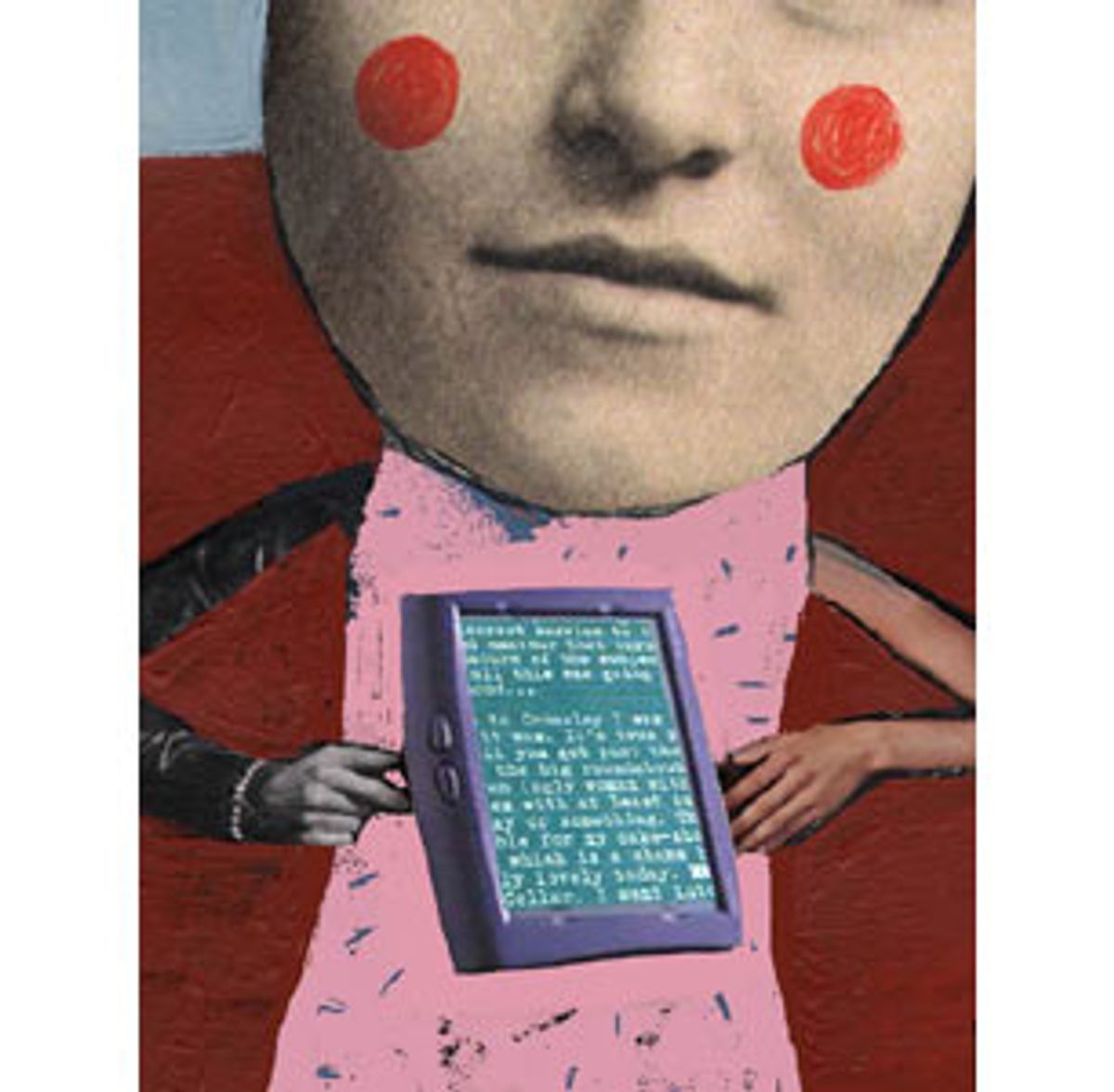
So if only for this reason, I’m disposed to like e-books. The paperback-sized reading device in my hand, the Rocket eBook Pro, holds up to 40 book-length texts, according to the e-manual that comes pre-installed in it. It weighs about the same as the average hardcover, but its left side is thicker and heavier than its right: It swells out into a curved ridge where the spine of a p-book would be. This asymmetry turns out to be one of the most pleasing aspects of the object’s design and something that several people comment on when I hand it to them. The e-book nestles naturally in my left hand while I’m reading it, and the ridge makes it easy to carry around without worrying about accidentally dropping it. “Some market research went into this,” one acquaintance said as he weighed the device appreciatively.

However, before I can actually use the e-book to read anything more that the pre-installed content (a dictionary, a user’s manual and “Alice in Wonderland”), I’ve got to connect its cradle to my iMac and get the software that enables me to download texts from the Web to work properly. There are the usual delays; it’s hard to buy any computer hardware these days without realizing at the moment of consummation that you don’t have the right cable or driver, a disappointment that’s a lot like being on the verge of sex and discovering you’ve got no birth control. The hassles are nothing egregious to someone who’s not daunted by the technology to begin with, but I suspect that more inexperienced users might be stymied by them.

A day or two later, we’re up and running. People who have tried the SoftBook Reader, a larger device produced by SoftBook Press (which, along with NuvoMedia, was purchased by Gemstar International Group Limited in January), tell me that you can plug that device directly into a phone line at night and download the next day’s Wall Street Journal while you sleep. With the Rocket eBook, I’ve got to download documents to my iMac first, then transfer them to the e-book. The advantage of this procedure is that my computer can hold much more content than the device itself, and I can download dozens of files to RocketLibrarian, the software that manages those files on my hard drive, moving them into and out of the e-book as needed.

Still, SoftBook’s deal with the Journal intrigues me. Print newspapers get on my nerves. Every morning when I buy my copy of the New York Times, I have to extract and discard the sports section and often the automobile supplement. On Sundays, I automatically toss out a huge wad of the paper, mostly classifieds. When I’m done reading the sections I am interested in, there’s another pile of newsprint to either jam guiltily in the wastebasket or lug over to the nearest recyclables depository. Besides, the large pages of broadsheets are difficult to read, especially on the subway, and the ink always seems to wind up smeared on my face.

I buy an e-book subscription to the Times, and even though it doesn’t download while I sleep, it’s still pretty handy. Soon I’m reading the day’s top stories with a single, unbesmirched hand. If I’m on a crowded train and have to stand, I still have one hand free to hold on with as I read effortlessly through the articles — no awkward folding, no tucking sections under my arms, no wresting the paper into a convenient position. I feel the unreasonable smugness of someone who has beaten the system. It’s like shopping wholesale.

Here’s what I see: The screen is fairly small, 4 1/2 inches by 3 inches and the default font resembles the classic Macintosh Geneva: sans serif with streamlined letter forms. The resolution is good but not anywhere close to that of print, and there’s no color (not that I miss it) beyond the greenish glow that the screen gives off, which is identical to that of a Palm Pilot. The brightness of the backlighting, along with the font style and size and the page orientation, can be adjusted.

The document I’m reading appears as one long, continuous stream of text. I use Page Forward/Back buttons built into the case to scroll down through it — they’re easy to push with the thumb of the hand that’s holding the device. Along the right side of the screen there’s a long, thermometer-style navigation bar that shows me how far along I am in the text. Menus enable me to switch to another document or book, to add underlines or annotations, to zip to specific pages, etc. I can activate them with a stylus attached to the e-book, but most of the time I just use my finger. Some documents, like the e-book edition of the New York Times, have hyperlinks so that you can touch one in a list of headlines and get the entire story.

But here’s the inevitable rub: The version of the Times I’ve bought for my e-book contains only a small percentage of the stories that run in the edition I can buy at my corner newsstand. I get the top stories, mostly international, and way too much of the business coverage. But I don’t get any of the arts coverage, including the book reviews, although I can pay extra to get the full books coverage plus some additional content from the Times’ Web site. The stuff most e-book owners need to read may be the business coverage, but for me it’s the cultural journalism. Plus, the one part of the paper I read purely for pleasure, the Metro section — home to gnomic reports of strange crimes, tales of domestic tragedy and offbeat stories about exotic species of trees inexplicably discovered in Brooklyn — is MIA as far as my e-book is concerned.

Likewise, most of the periodicals available in Rocket eBook format are the things that litter the coffee tables of early adopters: Bloomberg.com, the Industry Standard and — hey — there’s Salon.com, but only a best-of collection that’s sterling (if I do say so myself) but dated. My first request for Salon’s “current weekly book review” gets me a piece that’s a month old, and the second time I try I get an error message. Eventually I figure out how to transfer current Salon stories to the e-book by calling up each story, clicking on the “print this page” option, then saving the resulting page as an HTML file to my hard drive and then using RocketLibrarian to convert it to e-book format. This isn’t hard, but it’s tedious.

Still, the ability to download Salon stories to my e-book turns out, surprisingly, to be one of the device’s most appealing and useful features. As the amount of Salon’s content has mushroomed, I’ve found myself reading less and less of it, because I already spend too much time at my computer. For me, it’s not the actual screen that makes reading from a screen undesirable — it’s the fact that the screen is part of the machine I work on more than eight hours a day, restricted to a limited range of postures. Once I’m done working, I don’t want to linger at my keyboard to do my recreational reading; sometimes I print stories out, but that seems like a waste of paper. With the e-book, I’m able to read my colleagues’ work while stretched out on my sofa, curled up in my armchair, even as I chug along on the Stair Master at the gym.

But what about books themselves, the medium that the e-book is supposed to revolutionize? First I need to get some, so I troll Rocket-Library.com, the Rocket eBook community Web site, in search of books I can download for free. The titles there include public-domain favorites like “Jane Eyre,” “Frankenstein” and the stories of Chekhov, along with more obscure titles reflecting the idiosyncratic tastes of the community’s members. (Some big Andrew Lang fans in that crowd; and for some reason, if you read Portuguese this is the place for you.) I also find books that appear to have been written by e-book owners who have uploaded their magnum opuses to the site. I download a selection of titles that I hope will give me a sense of how various literary works hold up on the (other) small screen.

I’ve bought Stephen King’s new “Riding the Bullet” and an e-book version of Arthur Golden’s bestseller “Memoirs of a Geisha,” which I wind up finding unengaging. If, by the time I get to page 40 or so in a novel, I discover that I really don’t care whether I ever finish it, I usually don’t — and it peeves me that I shelled out $14 for this one. “Riding the Bullet,” I discover, is short and not King at his creepy, page-turning best.

I start rummaging through the other stuff I downloaded and settle on a collection of G.K. Chesterton essays called “A Miscellany of Men.” One of the essays describes how, as a young man, Chesterton once explored a half-built house, writing messages on the wall to its future inhabitant, and then, in middle age, went back to the place and asked if the man he had envisioned was at home. It’s a peculiarly confessional piece, and reading it provides me with my first sublime e-book experience. I read it in bed, with all the lights off, the pale rectangle of the screen floating in the darkness over my duvet while Chesterton describes approaching the house at evening, seeing the light shining from the windows and hearing a girl playing the piano and singing inside. The way the darkness isolates the e-book screen mimics the way lighted windows glow in the night, and Chesterton’s wistful pursuit of a decades-old whim seems so obliquely revealing that the moment feels intimate in the way the best reading should. I wonder if the personal essay, with its first-person voice, might be the form best suited to the e-book.

I also read in public — on the subway, on buses, in cafes, in bars, in the park and in the gym. I don’t read in the bathtub because I’m afraid I’ll drop the e-book in the water, and I don’t read on the beach because it’s March. In general, the darker the surroundings, the easier it is to read. My gym has very bright overhead lights, and the glare off the screen makes reading there somewhat uncomfortable. The fact that I don’t have to hold the pages of the book open as I peddle the stationary bike, on the other hand, is a big advantage.

Some experts are skeptical about the future of reading devices like the Rocket eBook, and it’s not hard to see why. They don’t seem to be taking the world by storm. I’ve never seen anyone else reading one — in fact, this was the first e-book device I’d ever seen, period. Personal Digital Assistants such as the Palm Pilot are often presented as the chief competitor to e-books. Companies like AvantGo make content (including Salon content) available in formats readable on Palm Pilots — that’s how a lot of people read “Riding the Bullet.” I don’t use a PDA myself, but I can see why someone who’s already forked out between $200 and $300 for a Palm doesn’t want to pay the same amount to get a slightly larger and less flexible device just for reading.

But the text display on the Palm can’t compare to the Rocket eBook’s for readability, and the addition of certain features might make the latter more appealing on balance. One of them certainly isn’t sound, a feature NuvoMedia touts on its Web site. The Rocket e-book has speakers, but who cares? What would make this gadget far more handy is a wider selection of content. I may be reluctant to buy book-length works in e-book form, but I’d gladly get all my magazine subscriptions (the New Yorker, Entertainment Weekly, Harper’s, the New York Review of Books) in digital form — no more piles of back issues gathering dust in my living room! And I’d want the full New York Times or I wouldn’t want it at all. Other readers will probably lean toward something entirely different — it’s an idiosyncratic market — so the offerings have to be both wide and deep.

Instead of tricking the e-book out in multimedia gewgaws, NuvoMedia should make its information-handling features more powerful. I can get an e-book file containing all the top stories from the New York Times for a particular day, but there’s no easy way to set just one of those stories aside. In other words, the technology doesn’t support clippings, one of the nice things about print newspapers that ought to be easy to replicate digitally. Endowing e-books with some kind of calendar and address-book capabilities — not to mention games — would make them even more appealing. The right price is also key. The miscellaneous people I consulted on this one seemed to agree upon $200; the top-of-the-line model I was using costs $269 from barnesandnoble.com.

Will I keep this e-book or not? I still haven’t decided. Over the past two weeks it has alternately exasperated and enchanted me, and in the end it may be the way that it makes Salon’s content so much more easily accessible to me that decides the matter. That’s pretty ironic when you consider that Salon is meant to be read on the screen to begin with, and that the only paper I’ll be saving will be from our laser printer. Even I couldn’t have predicted that.

Laura Miller

Laura Miller is a senior writer for Salon. She is the author of "The Magician's Book: A Skeptic's Adventures in Narnia" and has a Web site, magiciansbook.com.

We don’t need truth vigilantes

But we do need good political reporting, and the media's rote repetition of Santorum's JFK lies fell short

Rick Santorum and John F. Kennedy (Credit: AP/Wikipedia)

New York Times public editor Arthur Brisbane got a lot of grief last month for a blog post in which he asked readers whether the Times ought to be “a truth vigilante.” I didn’t join the pile-on, because truth be told, I kind of understood what he was getting at. Sure, “truth vigilante” is a shrill, easily mocked term: It doesn’t take “vigilantism” to get at the truth, only good reporting. But there can be questions for editors and reporters about how far is too far – what’s good reporting, and what’s hectoring? What’s debunking, and what’s partisan water-carrying? (Also, I don’t like the practice of mocking people for asking questions, even when we think the answer should be obvious. Better that Brisbane ask than to ignore the issue entirely.) I can understand why some cases aren’t clear.

But now I have a case that’s very clear for Mr. Brisbane: the Times’ story on Rick Santorum’s lies (yes, I call them lies) about John F. Kennedy’s 1960 religion speech, headlined “Santorum Makes Case for Religion in Public Square.” Since it’s the New York Times and all, I don’t expect the paper to call it a “lie.” But the story contains not one word suggesting that Santorum might be, I don’t know, misrepresenting, misremembering, distorting or otherwise being completely wrong about what JFK actually said.

I’m getting a lot of credit on Twitter and Facebook today for my piece, but this is one of those rare times when I’d rather not be recognized, because – don’t tell my editors – what I did was easy. It took me exactly 10 seconds to Google JFK’s speech and another few minutes to read it. Then I cut and pasted Santorum’s comments next to JFK’s and voila, kids, I had a story. The Washington Post’s Jonathan Capehart credited me with a “deep-dive,” and I appreciate the praise, but really, I barely got my feet wet. (The Post’s own news story wasn’t any better than the Times’; Capehart was the first person on staff to note Santorum’s distortion more than 24 hours after it aired on ABC’s “This Week.”)

I assumed I’d be late to the Santorum story because I was sick yesterday and didn’t even watch him live, I just heard about his remarks online. But I’m writing a book about the Democratic Party and Irish Catholics, and as you’d expect, there’s a little bit about Kennedy in there, and so I thought I’d take a moment to explain what Kennedy said – and how rabid anti-Catholicism, as late as 1960, made it necessary.

I made a comment last week in passing that I’d like to elaborate on here: I’ve spent a lot of time, in the book as well as on Salon, pointing out the anti-Catholic Nativism that hobbled my people and that accounts for some of our pugilism, shall we say, in the public square. But Santorum makes me realize I haven’t said enough about why some people were and still are suspicious of Catholics. His disrespectful comments about mainline Protestant churches somehow being agents of Satan is just one example of the contempt for other faiths that has gotten us in trouble over the years. I came of age after Vatican II; my parents were devout Catholic ecumenicists, attending seders at our local Jewish temple and telling the neighbors, no, we’re not supposed to blame Jews for killing Jesus anymore, and Protestants love Jesus, too. Santorum is an example of the mind-set that liberal Catholics and lapsed Catholics have been fighting in my lifetime, and he’s really a disgrace.

I don’t expect the New York Times to call him a disgrace in its news pages, but I do expect the paper to do a minimum of fact-checking, to see whether our first and only Catholic president actually said what Santorum attributes to him. There was a reserved, respectful, Timesian way to do it, and the paper missed an opportunity to reassure its readers that the paper is all about the truth, and that it’s not cowed into printing untruths by the GOP culture warriors who’ve spent decades now insisting the Times has a raging liberal bias.

I don’t mean to single out Michael Barbaro, either, who does good work, or the team of writers the Times lists as providing additional reporting at the end of the piece. Or Kit Seelye, who wrote the earlier Caucus post, on a tighter deadline, about Santorum’s remarks without fact-checking the JFK claim. I’ve always loved the singular way the paper almost always attributes mistakes, in its Corrections column, to “editing errors.” This was an editing error. Someone at some point should have said, “Hey, I know you’re on deadline – but what did JFK actually say?” It’s not vigilantism. It’s journalism.

You’re welcome, Mr. Brisbane.

Continue Reading Close
Joan Walsh

Joan Walsh is Salon's editor at large.

Anthony Shadid, the best of his generation

The NYT reporter, acclaimed for his unparalleled coverage of the Middle East, died in Syria on Thursday

Anthony Shadid, winner of the 2010 Pulitzer Prize for International Reporting with The Washington Post (Credit: AP)
This article originally appeared on GlobalPost.

WARSAW, Poland — I woke up this morning to the news that Anthony Shadid has died — apparently of an asthma attack — while on assignment in Syria. Whether you knew his byline or not, the loss is incalculable.

Global Post

I can speak in absolutes about the quality of his work. No one reported the Middle East with greater clarity and nuance than Shadid. No one brought the humanity of the people of the region, people who live in a perpetual state of stress even when they are living in the comparative comfort of Beirut and Tel Aviv, to the wider world with a surer touch than Anthony.

He could have coasted on his one great advantage — fluency in Arabic — to beat other reporters to the story. He did not. He used it as a foundation to serve readers — and help colleagues. When I left Iraq after the overthrow of Saddam, a sizeable part of my heart was left behind with new friends who were struggling to make the country a better place. Amid the constant shifts in the chaotic post-war era, Anthony’s dispatches were the ones I relied on to give me the complete picture of what was happening around the country.

American reporters are trained to be objective. It is an ideal to aspire to, more than an achievable goal. We are human beings and those of us who cover conflicts have our emotions challenged every day. The desire to bear witness and to make readers and listeners feel what we feel is overwhelming. Sometimes this gets in the way of objectivity. Anthony, who saw more terrible things than most, managed to stay closer to that ideal than any one. That’s what makes his reporting the best and why in years to come, it will truly be seen as the first draft of history.

We published books on Iraq at the same time and shared a panel at the Brattle Theatre in Cambridge, Mass. on Iraq. I had long since decided that objectivity was getting in the way of my reporting. It was important to let my readers know that I was angry and that my friend had died because of the criminally poor planning of the bigwigs in Washington. That emotion suffused my book. Anthony’s book was scrupulously written, you could never guess what he felt about the war.

My memory is that during the course of the conversation I pressed him about keeping his feelings about the war out of the book. He came back at me with full vigor, eloquently defending the importance of objectivity. He was a big-hearted, supremely talented man — and disciplined about the work. The panel was recorded by C-Span and you can watch Anthony and get some sense of who he was and what we have lost here.

Continue Reading Close

What David Brooks gets right about the left

Relying on a mic check to make strategy is a big mistake

David Brooks, philosophe

As he often does, in his column Friday New York Times columnist David Brooks offered what looks like a “nonpartisan” analysis.  Social movements, he warned, are suffering because everyone thinks they should make up their own belief system. Unless you’re Nietzsche, Brooks advises, this is a guarantee of failure. Every man is not a political genius.

It’s not a hard task to figure out whom Brooks is really criticizing: Occupy Wall Street. But it’s not alone. The democratization of ideology is vastly more tempting to the self-inventing liberal left than to the authoritarian right. Nobody does emotionally consistent talking points like the conservative right. Nobody does “whatever floats your boat” like the liberal left. The belief that every man is a philosopher makes progressives vastly more vulnerable to the destructive dynamic Brooks describes. It is an irony Brooks would appreciate that the left acts more like the right believes (and vice versa).

Brooks’ criticism is dead on. Letting every person with a “mic check” suggest a fundamental strategy for the movement is a recipe for disaster. Not only have existing intellectual traditions been the product of superior minds, they have stood the test of time. Anyway, how to act collectively when everyone is pursuing his own quixotic dream?

Of course, anyone who follows the debate knows the left must beware of Brooks bearing gifts. The Times’ conservative columnist is always making sensible sounding suggestions to the left, which, upon closer examination, turn out to be ticking bombs. In this case, the right has a perfectly good foundation in the libertarian tradition, Brooks reports. So it doesn’t need to reinvent its first principles .

For his friends on the left, however,  Brooks advises a simple reversion to their philosopher, Karl Marx. Now there’s a thought.  When the centrist Democrats of the filibuster-bound Senate passed a healthcare plan modeled on the Republican scheme from Massachusetts, the Republicans branded their leaders as socialists, or worse, as taking their beliefs from Paris, if not Nairobi. Imagine if they started actually quoting Karl Marx.

Fortunately, should the left be capable of giving up its endlessly proliferating individual belief systems, two schools of thought other than the return to the specter of communism would be available to them.  There is a robust utilitarian tradition, represented most recently in the work of Princeton philosopher Peter Singer, that asks people to rise to the demands of altruism. As a matter of ordinary morality, you’d pause on a walk to pull a drowning child out of a pond, Singer begins. Why would you not give up a trivial expensive treat to rescue someone starving in Africa?

Or, closer to home, living in a shelter somewhere in New York, or in Washington’s McPherson Square. The well-worked-out analysis of Singer’s argument for beneficence is a vastly better foundation for a long-term social movement than any of the slogans on OWS placards. “Tax the rich” is catchy, but dissolves when confronted with Brooks’ comrades’ libertarian first principle: “It’s my money.” Singer offers the opportunity to argue about why keeping every last penny of it when others are in real need is, well, immoral.

Another great 20th century philosopher, the late John Rawls, made a very well-worked-out argument for why it’s not “your money” at all. It’s only your money, as citizens of many less well-favored societies than the United States know, if other people are willing to refrain from killing you to get it. Otherwise, life is, famously, “solitary, POOR, nasty, brutish and short.” Rawls set forth elaborate conditions for when societies agree to let the rich keep the money without having to live behind walls topped with ground glass.

Most important, Rawls posits, inequality must also benefit the people on the bottom, e.g., by expanding the size of the pie. This was the case for much of American history, and the society was the better for it. But now that finance has replaced manufacturing as the engine of the economy, not so much. The endless claims of money movers like Mitt Romney that they are “creating jobs” reflects the deep power of Rawls’ construct. If they’re not, what is he doing with all that money? Rich people’s claims to be complying with Rawls’ condition can only go on so long in face of the robust evidence to the contrary.

Brooks is right about one thing: Ideas matter. The resurrected right has relied on the power of libertarian ideas for decades. During the same period, the left has relied on mic checks and bumper stickers (“the audacity of hope”). When we see them start to use the rich store of liberal thinking available to them, David Brooks, watch out.

Continue Reading Close

Linda Hirshman is the author of “Victory: The Triumphant Gay Revolution,” forthcoming in June 2012. Follow her on Twitter @LindaHirshman1

The “education crisis” myth

Ignore the media spin. Wages and working conditions -- not skills -- are the real reasons jobs get outsourced

A production line in Suzhou Etron Electronics Co. Ltd's factory in Suzhou, China on June 8, 2010 (Credit: Reuters)

Has the term “education” become a code word? And if so, a code word for what?

These are the major unasked — but resoundingly answered — questions to emerge from two much-discussed articles about the future of American manufacturing. One is a cover story in the Atlantic Monthly about why jobs are being shipped overseas. It concludes that “to solve all the problems that keep people from acquiring skills would require tackling the toughest issues our country faces” — the first of those being “a broken educational system.” The second and even more talked about article comes from the New York Times. It looked at why Apple Computer has moved its production facilities overseas, concluding in sensationalistic fashion that “it isn’t just that workers are cheaper abroad” but that America “has stopped training enough people in the mid-level skills that factories need.”

These pieces were clearly written with a very specific objective in mind: to draw media attention to the supposed “education crisis” in America — a favorite topic of these publications’ elite readers, who have a vested interest in blaming the recession on the poor rather than on the economic policies that enrich the already rich. No doubt, both the Times and the Atlantic achieved their goal, with various NPR shows, cable gabfests and elite magazines spending the last week frothing over the articles’ central thesis.

The tragedy in all of this is that in both the articles and in most of the discussions that followed, few bothered to question the fundamental assumptions about education in America — and fewer still bothered to ask if “education” in the modern parlance has now become a synonym for “acquiescence.”

To see how this linguistic shift is occurring, reread the Times article with a critical eye. Specifically, notice that after the reporters structure their piece around Apple executives’ (unchallenged) claim that “the U.S. has stopped producing people with the skills we need,” there’s not a single shred of proof — empirical or otherwise — offered in support of that assertion. On the contrary, after a sweeping declaration at the top of the piece that wage and human rights differences between Chinese and American workers have little to do with offshoring, the article inadvertently goes on to prove those differentials — not skill levels and education — are the driving force behind the domestic job losses in America.

In one section of the piece, for example, the Times notes that Apple’s big Chinese factory, Foxconn, attracts American investment because “over a quarter of (the) work force lives in company barracks and many workers earn less than $17 a day” — and “many work six days a week, often spending up to 12 hours a day at the plant.” In another section of the piece, the Times notes that the cost of “building a $1,500 computer in (California) was $22 a machine … In Singapore, it was $6 … In Taiwan, $4.85.” While the Times unquestioningly forwards Apple’s impossible-to-believe explanation for these figures (“wages weren’t the major reason for the disparities”), the statistics are yet more proof that wage differences, not education, are the real offshoring motive.

The Times also quotes an Apple executive saying the company must outsource because “the entire supply chain is in China now” — and though the article doesn’t bother to mention it, that is true precisely because other factories in that supply chain have moved to China for the cheap wages and lax human rights/labor regulations. The Times later talks to Eric Saragoza, an American worker laid off by Apple, who says that Apple told him to keep his job he didn’t need to acquire more skills, but instead “to do 12-hour days, and come in on Saturdays.” And in another part of the piece, the Times quotes a former Apple executive who insists Apple was forced to move to China because there’s no “U.S. plant (that) can find 3,000 people overnight and convince them to live in dorms” — an admission, again, that Apple’s move to offshore isn’t about skills, but about a desire to employ a “flexible” (read: exploitable) workforce.*

In light of all this, the absurdity of the Times’ “education crisis” conclusion is obvious. Somehow, Dickensian realities are meticulously recounted, but Apple is permitted to plead helplessness without so much as a contradictory fact being mentioned — as if the company isn’t making calculated choices that are generating record profits off sweatshop conditions. China’s super-low wages and nonexistent labor, environmental and human rights protections are shown over and over again to be the driving force behind American corporate offshoring, and yet the conclusion is nonetheless that the problem for America is our education system. And somehow, that conclusion is made without the Times, the Atlantic Monthly or any part of the media echoing their stories measuring it against actual data from the American education system.

And what, pray tell, does that data say? It says that far from a drought of skilled high-tech workers forcing supposedly helpless victims like Apple to move to China, America is actually producing more of such workers than Apple and other high-tech companies are willing to employ. As I noted in a previous newspaper column (looking at yet another New York Times piece making the same education argument):

No doubt, you’ve heard (the) fairy tale from prominent politicians and business leaders who incessantly insist that our economic troubles do not emanate from neoliberals’ corporate-coddling trade, tax and deregulatory policies, but instead from an education system that is supposedly no longer graduating enough science, technology, engineering and math (STEM) experts. Indeed, this was the message of this week’s New York Times story about corporate leaders saying America isn’t producing “enough workers with the cutting-edge skills coveted by tech firms.”

As usual, it sounds vaguely logical. Except, the lore relies on the assumptions that American schools aren’t generating enough STEM supply to meet employer demand…
To know (that) supposition is preposterous is to consider a recent study by Rutgers and Georgetown University that found colleges “in the United States actually graduate many more STEM students than are hired each year.”

These facts were most recently corroborated in mind-boggling detail by the Senate testimony of Rochester Institute of Technology’s Ron Hira. But, of course, they are nowhere to be found in the Times. That’s not altogether shocking (even if it is offensive) — the Times is a newspaper whose ombudsman recently challenged the very idea that the paper’s journalists should actually fact-check statements made by its sources. It is also a newspaper that has helped construct a larger political and media consensus around what I’ve called both “The Great Education Myth” and the “Neoliberal Bait-and-Switch.”

These sleights of hand simply stipulate as unchallenged, unquestioned fact that all of our economic problems can be solved with better STEM education and more STEM graduates. The idea is that this educational improvement would fix the alleged problem of high-tech companies like Apple not being able to find enough STEM workers. This myth endures even though the data indisputably proves that there is no such dearth of STEM worker supply — indeed, we are already producing more STEM graduates than the domestic economy can employ, meaning the only worker shortage that exists in America is a shortage of workers willing to toil at slave wages with no labor or human rights. But, alas, those facts don’t matter because the Great Education Myth isn’t about economic reality — it is an instrument of propaganda designed to distract attention from the tax and trade policies that allow companies like Apple to make so much money off the current system of exploitation.

So that gets us back to the key question of whether the term “education” is effectively being redefined? In all of the elite media’s stories about offshoring and the STEM “education crisis,” does the term “education” no longer mean “learning a set of skills”? Does it in practice now mean American workers learning not new technological crafts, but learning to quietly accept the wage, labor and human rights standards of China — the standards we thankfully improved after our own crushing Industrial Age a century ago? In short, does “education” now mean “teaching American workers to be subservient”?

The answer, almost certainly, is yes, because that’s the only way that the media and political establishment’s entire “education crisis” meme makes any logical sense.

The fact is, while our cash-starved schools would obviously benefit from more resources, and while better schools clearly couldn’t hurt our society, there’s no empirical, data-based reason to believe that improving our schools would reverse the trend of America losing high-tech jobs to slave-labor nations like China. Without a change in tax and tariff-free trade policies that economically incentivize companies like Apple to keep moving production to cheap labor havens overseas, the only “education” that will bring those jobs back is the kind that indoctrinates high-tech American workers to compete with Chinese workers by accepting the horrific labor conditions those Chinese workers experience. Based on the New York Times’ own reporting on Apple, that means an education system in America that teaches our workers to simply accept being paid $17 a day, to work six days a week in 12-hour shifts and to live in crowded dormitories so that they can be stampeded into the factory at any hour of the day. It means, in short, an education system that tells Eric Saragoza to shut up and accept the employer’s draconian demands.

Not surprisingly, the curriculum for this new education system is already being championed by the very political and media realms that originally constructed the Great Education Myth. In Congress, a group of senators is proposing to eliminate overtime protections for vast swaths of the America’s high-tech workforce in the name of competing with China. In state legislatures, lawmakers are looking to weaken child labor statutes, also in the name of competition. And on the New York Times Op-Ed page, Thomas Friedman implies that Americans are lazy and declares that “average is over” and that “everyone needs to find their extra” — elite-speak for the notion that Americans, who already log some of the longest workdays in the world and who are already among the planet’s most productive laborers, must work even harder than they already do.

In beginning to construct this kind of pedagogy, our mandarins are not coincidentally promoting a key part of the educational ideology of their Chinese counterparts. No, not the part of that ideology that is focused on training high-tech workers — the part that prioritizes obedience. Indeed, as my friend Michael Levy recounts in his terrific book “Kosher Chinese,” that educational method teaches Chinese workers never to question their station, demand basic rights or ask for better conditions.

That same ethos is now being proudly promoted here at home. Should we accept it — and the redefinition of “education” that comes with it — we may end up bringing a few jobs back, but we will have reversed the very labor, wage and environmental progress that once defined our basic concept of human rights — and America itself.

*It’s important to note that the Times did eventually publish this follow-up piece to its original article about Apple and offshoring. The follow-up piece looks more closely at how Apple mistreats its workers in China, and that kind of scrutiny is certainly necessary and laudable. However, the fact that the Times made the decision to separate the later piece on labor rights from the earlier article on Apple’s employment decisions implies that the two issues — worker exploitation and offshoring — are separate, when in fact they are inextricably intertwined. That kind of distinction is a real problem. Indeed, pretending that these two issues are wholly different topics (as Apple and other high-tech executives so often do) perpetuates the deceptive notion that exploitation is just a “liberal” feel-goody concern while business practices are more serious, dispassionate, non-ideological decisions. But only when these issues are looked at in aggregate will we be able to start having an honest debate about how globalization really works.

Continue Reading Close
David Sirota

David Sirota is a best-selling author of the new book "Back to Our Future: How the 1980s Explain the World We Live In Now." He hosts the morning show on AM760 in Colorado. E-mail him at ds@davidsirota.com, follow him on Twitter @davidsirota or visit his website at www.davidsirota.com.

Newspapers, “truth vigilantes” no more

The NYT's fact-checking question was absurd, but the real problem is that the press has lost its credibility

(Credit: Library of Congress/U.S. Farm Security Administration)

Time was when newspaper journalists prided themselves on being working stiffs: skeptical, cynical and worldly-wise. “If your mother says she loves you, check it out.” I’ve always preferred the unofficial motto of my native New Jersey: “Oh yeah, who says?”

Fact-check politicians? Here’s how H.L. Mencken saw things in 1924: “If any genuinely honest and altruistic politician had come to the surface in my time I’d have heard of him, for I have always frequented newspaper offices, and in a newspaper office the news of such a marvel would cause a dreadful tumult.”

Mencken could recall no such excitement. “The unanimous opinion of all the journalists that I know, excluding a few Liberals who are obviously somewhat balmy,” he added “… is that since the days of the national Thors and Wotans, no politician who was not out for himself, and himself alone, has ever drawn the breath of life in the United States.”

Alas, such attitudes went out of fashion with snap-brim fedoras, smoke-filled rooms and bottles of rye in desk drawers. Today’s national political reporters have attended fancy colleges, regard their professional affiliations as valuable status symbols, hence give every sign of identifying more with Washington courtiers and political professionals than the great unwashed.

To the extent they may share Mencken’s exuberant disdain for hoodwinker and hoodwinked alike, ambitious reporters are well-advised to keep it to themselves. As a career strategy, thoughtful circumspection is advised. The uphill path to a sinecure on “Meet the Press” must be trodden carefully.

Many readers, for example, can probably identify a name-brand journalist such as Judith Miller, who fell into disrepute for parroting Bush administration propaganda about Saddam Hussein’s WMD. But can you name anybody whose skeptical reporting made them famous? No, you cannot.

Columnists have more leeway, but even there it’s safer (and easier) to stick to anodyne topics such as dorky clothes, bad hair, which candidate resembles what character in “Pride and Prejudice,” and who mistreats his dog. To me, it’s significant that an honorable exception like Paul Krugman — my nominee for progressive MVP — is not a product of newsroom culture.

So now comes New York Times “public editor” Arthur Brisbane with maybe the most disingenuous question of the year: Should Times reporters be “truth vigilantes”? When politicians lie, should reporters call them out?

And if so, how?

Brisbane’s two columns on the subject drew widespread astonishment and hilarity from readers and journalists alike — partly because journalists love talking about ourselves as much as the average Hollywood starlet. They also drew a sharp rebuke from Times editor Jill Abramson, who insisted that the “kind of rigorous fact-checking and truth-testing you describe is a fundamental part of our job as journalists.”

Abramson gave instances of the newspaper supplying proper context for politicians’ statements such as Mitt Romney’s preposterous charge that President Obama wants “to replace our merit-based society with an entitlement society.” (Wink, wink. Nudge, nudge. Know what he means?) She said that the Times reported that “the largest entitlement programs — Social Security, Medicare, Medicaid — were all enacted before Mr. Obama entered grade school.”

Of course, that’s not what Romney’s really saying. Look, as somebody who spent more than a decade waging a quixotic war of words against the New York Times over its role in the Whitewater hoax, the subsequent “War on Gore,” and its shameful (and acknowledged) role in “catapulting the propaganda” that led the U.S. to invade Iraq, I have two observations.

First, the Times has rebounded since those dark days of 2003. Far less unmediated government propaganda and make-believe scandal characterizes its news columns. Abramson’s 2011 appointment as executive editor gives further reason for optimism.

Second, the answer to Brisbane’s real question — exactly how reporters are supposed to go about calling Mitt Romney a liar — has no good answer. Because the more forcefully it’s done, the more the GOP candidate’s apt to like it.

Take Romney’s oft-repeated charge that Obama goes around apologizing for America. The Washington Post’s Glenn Kessler did this one to a fare-thee-well, showing conclusively that the allegation is completely false — an absurd mix of misrepresented circumstances, doctored quotes, etc. And it took him 1,800 words.

And who read them? Certainly nobody who’d already swallowed the lie on Fox News, Rush Limbaugh or any of a hundred right-wing websites. So the Washington Post says it’s a lie. Well, they would, wouldn’t they? The Times agrees? Even better.

Romney’s not talking to reporters, but over and through them, seeking not nuanced news stories, but five-second video clips and TV ads. Reporters who ask confrontational questions can be ignored, or worse, made characters in the story. Well-paid operatives can make their editors’ lives miserable.

The uncomfortable truth is that no newspaper today has the power and moral authority the New York Times so thoughtlessly squandered, and it ain’t coming back. Obama will have to defend himself.

Continue Reading Close

Arkansas Times columnist Gene Lyons is a National Magazine Award winner and co-author of "The Hunting of the President" (St. Martin's Press, 2000). You can e-mail Lyons at eugenelyons2@yahoo.com.

Page 1 of 70 in The New York Times

www.salon.com/topic/the_new_york_times/