Books
“Red Smith on Baseball” by Red Smith
Nobody captured the game at midcentury like the man whose pen was as mighty as Joltin' Joe's bat.
In the middle of the century, Red Smith
was to sportswriters what Joe
DiMaggio was to center fielders. As
New York Times columnist Ira Berkow
writes in the foreword to “Red Smith on
Baseball,” Newsweek put the columnist
for the New York Herald Tribune (and,
later, the Times) on its cover in 1959
with the headline “Star of the Press
Box,” and he was often referred to as
the Shakespeare of that smoky structure.
Berkow also tells us (and there’s no
reason not to believe Berkow, himself a
typist of the first order) that baseball
was Smith’s favorite sport: hence this
collection of columns, subtitled “The
Game’s Greatest Writer on the Game’s
Greatest Years” — both arguable points.
|
It’s tempting to just fill this review
with quotations from Smith’s writing by
way of illustrating what the Pulitzer
Prize folks called his “erudition,
literary quality, vitality and freshness
of viewpoint” when they laid the overdue
laurels on him in 1976. I found myself
marking particularly lively passages
with a pencil. From 1941, the date of
the first column, through the early
’50s, my copy is a mess of No. 2 lead.
After that, the pages are considerably
cleaner: In those years Smith lost some
of his edge and settled in as just a
very good sportswriter, if one who
reminisced a bit too much about the old
days and relied a little too heavily on
sarcasm.
|
Also Today If you fold it, they will come Minor league baseball is bittersweet. The players are praying for a ticket out, and it’s even worse when the team is looking to move, too By Steve Burgess |
“Now it is done,” reads the famous lead
of his Oct. 4, 1951, column on Bobby
Thomson’s “Shot Heard Round the World,”
the home run that won a three-game
playoff and capped the greatest comeback
in baseball history, when the New York
Giants, who’d been hopelessly out of it
in mid-August, rallied to overtake their
arch-rivals, the Brooklyn Dodgers. “Now
the story ends. And there is no way to
tell it. The art of fiction is dead.
Reality has strangled invention. Only
the utterly impossible, the
inexpressibly fantastic, can ever be
plausible again.”
A week later, the Giants had lost the
World Series to the New York Yankees,
who were taking their third of what
would be five straight world
championships. (Smith wrote that rooting
for them was like pulling for U.S.
Steel.) “Magic and sorcery and
incantation and spells had taken the
Giants to the championship of the
National League and put them into the
World Series … But you don’t beat the
Yankees with a witch’s broomstick. Not
the Yankees, when there’s hard money to
be won.”
Ah, what the hell. I have a couple of
beefs, but first:
Smith on Dodger Cookie Lavagetto’s
game-winning pinch double in the 1947
World Series: “After 136 pitches, Floyd
Bevens, of the Yankees, had the only
no-hit ball game ever played in a World
Series. But he threw 137 and lost, 3 to
2.”
On Stan Musial: “He is the best left
fielder the Cardinals have, the best
center fielder they have, the best first
baseman they have. He is, in short, the
best ball club in St. Louis and one of
the best in the world.”
On DiMaggio: “Sometimes a fellow gets a
little tired of writing about DiMaggio;
a fellow thinks, ‘there must be some
other ball player in the world worth
mentioning.’ But there isn’t really, not
worth mentioning in the same breath with
Joe DiMaggio.”
Remembering Jackie Robinson on his death
in 1973, Smith wrote that the picture
that stuck in his mind was a game-saving
diving catch Robinson made on the last
day of that fateful ’51 season: “The
unconquerable doing the impossible.”
He liked to go into an ironic formal
tone when writing about the scruffy
tobacco-chewers who populated the game,
so a Phillies second baseman is “Mr.
Babe Alexander, of Philadelphia,” and
Yogi Berra and Casey Stengel are usually
Lawrence Peter Berra and Charles Dillon
Stengel. Uniforms are “flannel rompers,”
the game is “rounders,” players are
“wage slaves” or “employees” or, if
they’re well paid, “capitalists.”
But it wasn’t just the wordplay that
made Smith special. He was a keen
observer, too. As early as the 1940s,
for example, he was predicting that if
the players could ever organize
themselves into an effective union, they
would take over the game from the
shortsighted, ineffectual owners — a
development that came to pass three
decades later.
So here’s the beefs: This book will
probably be read only by baseball fans
(which is a shame, because anyone
interested in good newspaper writing
will find plenty to snack on), so the
lack of explanatory notes isn’t a huge
oversight. Still, they would have helped
explain some of Smith’s offhand
references to baseball events and people
that a casual fan in, say, 1948, would
have recognized at once, but that are
head-scratchers today.
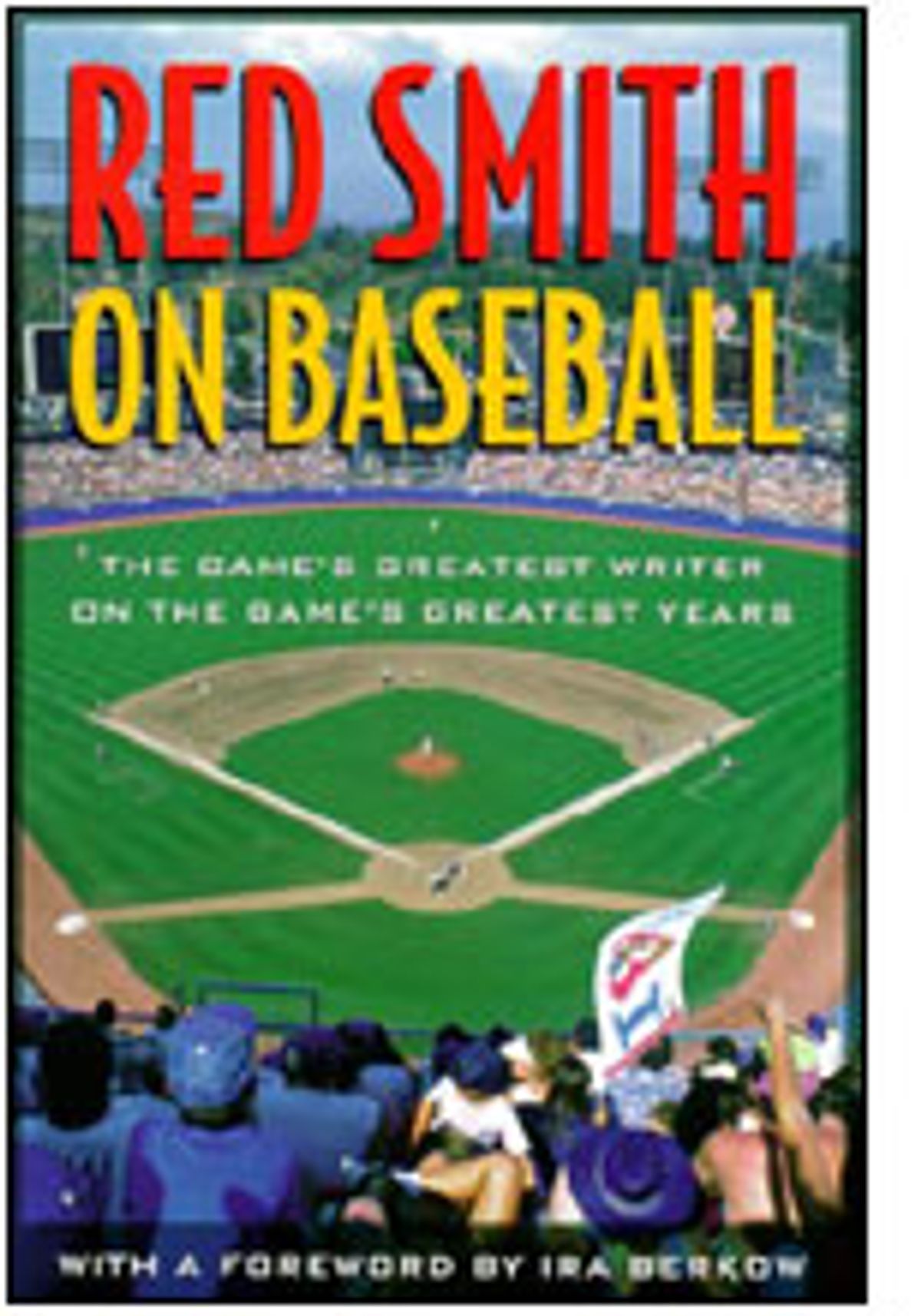
Much worse, the book’s cover is, to
paraphrase Smith paraphrasing Babe Ruth,
an adjectival bonehead play, an
indelicacy mistake. It’s a lovely
picture, taken from the upper deck, of a
ballgame being played on a sunny
afternoon — at Dodger Stadium in Los
Angeles. Here’s Smith in 1957: “The
departure of the Giants and Dodgers from
New York is an unrelieved calamity, a
grievous loss to the city and to
baseball, a shattering blow to the
prestige of the National League, an
indictment of the men operating the
clubs and the men governing the city.”
It was, he wrote, “the boldest step
backward since the league was born in
1876.”
They couldn’t have found a nice color
picture of Ebbets Field or Yankee
Stadium in the ’50s? Whoever chose that
photo was having, as Red Smith might
say, a bad day with the old medulla
oblongata.
DO NOT USE. use king kaufman byline and bio. More Gary Kaufman.
“People Who Eat Darkness”: The disappearing blonde
A true crime story set in Tokyo illuminates the complicated truths behind media cliches
Joji Obara and Lucie Blackman (Credit: Estate of Lucie Jane Blackman) Lucie Blackman, 21, went out for the afternoon in 2000, phoning her roommate and best friend Louise to arrange a meeting later that night. Lucie never showed up, and within a few days she’d become one of those vanished blondes whose fates fuel headlines and hours of speculative media coverage. She was British, a former flight attendant, and she and Louise were living in Tokyo. They were also bar hostesses, a profession with a very specific meaning in Japan, difficult to explain to foreigners and not entirely clear to the Japanese themselves. Lucie both did and didn’t match the classic Missing Blonde profile, and for a while the mystery of what happened to her threatened to lapse into permanent obscurity.
Continue Reading Close
Laura Miller is a senior writer for Salon. She is the author of "The Magician's Book: A Skeptic's Adventures in Narnia" and has a Web site, magiciansbook.com. More Laura Miller.
Corporate criminals gone wild
The maker of the documentary film "Inside Job" has a new book excoriating Wall Street -- and President Obama
A detail from the cover of "Predator Nation" “Inside Job,” Charles Ferguson’s Oscar-winning documentary film on how government, Wall Street and academia colluded to deliver us the worst financial crisis since the Great Depression, made a powerful case that something was very very rotten at the heart of the American political/economic nexus. His follow-up book, “Predator Nation: Corporate Criminals, Political Corruption, and the Hijacking of America,” can be considered the legal brief that dots every “i” and crosses every “t” in his argument. A tightly argued, profusely footnoted and deeply enraged castigation of everyone involved, “Predator Nation” isn’t just a factually unchallengeable account of how Wall Street blew up the global economy. It’s a denunciation, a call for justice and a warning: After getting away with the crime of the century, Wall Street still isn’t satisfied.
Continue Reading Close
Andrew Leonard is a staff writer at Salon. On Twitter, @koxinga21. More Andrew Leonard.
Can you identify?
Science shows that the only way around some readers' prejudices is to trick them
(Credit: Shutterstock/Salon) The news of recent research documenting how readers identify with the main characters in stories has mostly been taken as confirmation of the value of literary role models. Lisa Libby, an assistant professor at Ohio State University and co-author of a study published in the Journal of Personality and Social Psychology, explained that subjects who read a short story in which the protagonist overcomes obstacles in order to vote were more likely to vote themselves several days later.
The suggestibility of readers isn’t news. Johann Wolfgang von Goethe’s novel of a sensitive young man destroyed by unrequited love, “The Sorrows of Young Werther,” inspired a rash of suicides by would-be Werthers in the late 1700s. Jack Kerouac has launched a thousand road trips. Still, this is part of science’s job: Running empirical tests on common knowledge — if for no other reason than because common knowledge (and common sense) is often wrong.
Continue Reading Close
Laura Miller is a senior writer for Salon. She is the author of "The Magician's Book: A Skeptic's Adventures in Narnia" and has a Web site, magiciansbook.com. More Laura Miller.
“The Aleppo Codex”: The bizarre history of a precious book
A reporter traces the shadowy fate of the definitive version of the Hebrew Bible
Matti Friedman An ancient and priceless book, a murky history of evasions and coverups, an underground of sinister and possibly violent dealers, a former spy who drops tantalizing hints and a wily 84-year-old millionaire who says stuff like, “The problem with this story is that it could damage your health”: Are these the ingredients for a cheesy, improbable historical thriller? Yet “The Aleppo Codex,” Matti Friedman’s account of his attempts to learn the history of one of the world’s most precious books, sports all of these assets, and it’s nonfiction. If reporting this story damaged Friedman’s health, it probably happened when he realized what he’d stumbled into and his reporter’s heart started beating in doubletime.
Continue Reading Close
Laura Miller is a senior writer for Salon. She is the author of "The Magician's Book: A Skeptic's Adventures in Narnia" and has a Web site, magiciansbook.com. More Laura Miller.
Augusten Burroughs: Conquer trauma by letting it go
Salon exclusive: The best-selling memoirist says past horrors haunt us because we think about them too much. Stop
Augusten Burroughs Many people continue to feel influenced and even controlled by the things that happened to them a long time ago. Sometimes, people harbor dark, traumatic memories from childhood. Or fragments of memories — incomplete scenes, uncomfortable feelings, perhaps even a sense of certainty that something specific and terrible happened to them, but little more than this.
Others experienced something traumatic in adulthood that continues to affect them day to day many years later. Maybe an assault has left a person afraid to leave their home or enter a particular neighborhood.
Continue Reading CloseAugusten Burroughs' many books include "Runnning With Scissors," "Dry," "Sellevision," "Magical Thinking" and "Possible Side Effects." His latest book is "This Is How." More Augusten Burroughs.
Page 1 of 984 in Books
