Books
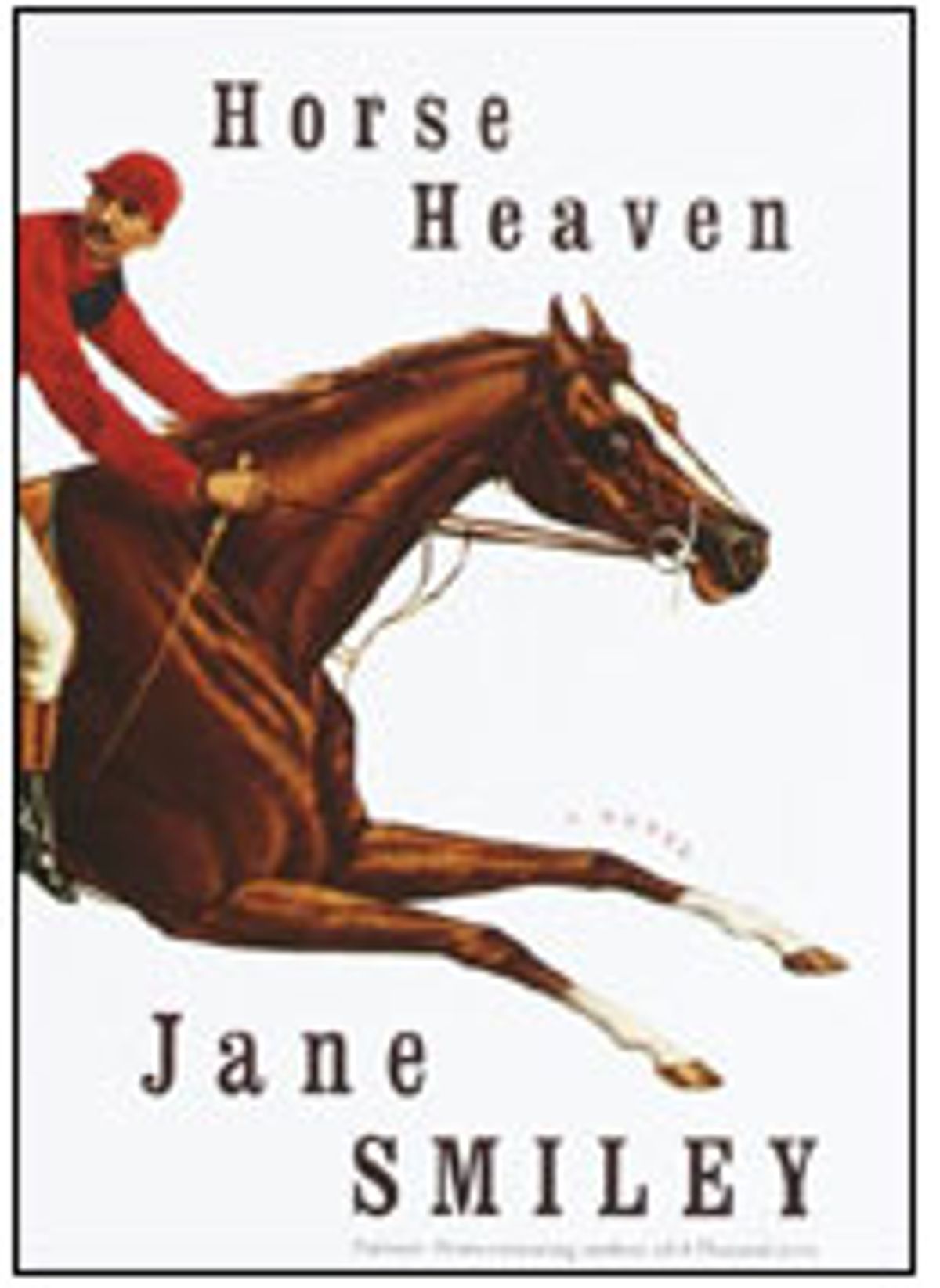
“Horse Heaven” by Jane Smiley
A great big novel, jampacked with characters, that brings poetry to the dust and the lust of the racetrack.
Horses are whores, works of art, incubators, bargaining chips, slaves, money pits, athletes, status symbols, workers, toys, pets, beauty queens, food, machines. Jane Smiley, whose considerable range has thus far stretched from Shakespearean tragedy to campus satire, has produced a remarkable literary achievement: a resolutely unsentimental horse novel. With “Horse Heaven,” she makes us care about horses the way E.B. White made us care about pigs in “Charlotte’s Web,” and makes us understand them the way Walter Tevis made us understand chess in “The Queen’s Gambit.” And as with everything Smiley writes, she rides this uneven turf with the calm of a jockey who knows she won’t be thrown.
One of her characters sums it up: “A day at the races is thousands of stories.” Smiley sets the novel at and around the track, jumping from New York to Florida to Maryland to Chicago to New Orleans to Southern California to Texas to France. Along the way, she stages numerous races, from casual contests to the Belmont Stakes, and dips in and out of the lives of her human characters, which sometimes intersect, and the lives of her horses, too, most prominently Froney’s Sis (a self-esteem-challenged orphan), Residual (thoughtful), Epic Steam (a pain in the ass) and a promising bay colt later named Limitless.
There are so many characters that you’re bound to end up identifying with somebody. Will it be Farley Jones, the middle-aged Zen trainer and enlightened man? Or Elizabeth Zada, the “animal communicator” who has enviable (and profitable) powers of intuition? Or Rosalind Maybrick, the unhappy wife of a difficult owner? Or Eileen, Rosalind’s peevish Jack Russell terrier, who occasionally gets an internal narrative of her own from about a foot off the ground? (Everything smells, literally and figuratively.) Or Krista Magnelli, the struggling breeder and beleaguered young mother? Or Roberto Acevedo, the young rider from a dynasty of jockeys, whose thrill in his first real race we get to experience directly? Or — my own pick — will you put your sympathetic dollar on Justa Bob, the biggest sweetheart of them all and a genuine romantic hero? He’s a horse, too.
At every turn, there’s plenty of that “old, old story,” as Groucho Marx says in “A Day at the Races” — “Boy meets girl. Romeo and Juliet. Minneapolis and St. Paul.” We witness the love of a trainer for his boss’s wife, of a billionaire for the tantrically adept psychic, of a trainer for a broken-down stallion, of a corrupt owner for money, fame and (sporadically) Jesus. There’s also a full complement of track villainy; among the lowest of the lowlifes is scurrilous vet Curtis Doheny, who without blinking will do anything to a horse to keep it bringing in the cash.
Throughout, Smiley’s pellucid style brings poetry to the dust and greed of the track while establishing firm analogies between the mania of the racing world and the runaway reveries of her human protagonists. Her plot turns can be startlingly efficient, and tragic or wonderful events can take place over the course of a single sentence: “Here was where Rosalind fell in love.” All of the scenes involving Sam, a hardworking and kind veterinarian, are riveting, reminiscent of the supple, homely tone of “A Thousand Acres.” And Smiley’s pacing is impeccable. The Breeders’ Cup sequence especially — a montage involving most of the principal characters — demonstrates her gift for sustained buildup, for the juxtaposition of small and large events.
Even in her seemingly offhand descriptions, Smiley achieves a similar effect with carefully distilled metaphor: Epic Steam “was big and shining and all but black and, well, mysterious. He looked like a Cadillac with a Mafia don inside.” While horses are easy screens for the projection of human fantasies, Smiley spares us the cutesy anthropomorphizing that would obscure their essential natures. And though the novel isn’t a rollicking satire like “Moo,” there’s a considerable amount of sly humor here. Eileen, the terrier, gets a lot of good lines, but so do many others. A typical dig: The wife of a wealthy horse agent “went to a lot of parties. Although she was a princess, she never minded talking to anyone with scads and scads of discretionary income.”
The novel does have surprising gaps. For one thing, there are swaths of the horse-racing world that Smiley only glances at. I wanted to see more of the grooms (mainly immigrants whom we glimpse but don’t meet), jockeys (after his debut race young Roberto disappears for almost the entire length of the novel), stableboys and -girls. (We look in on a likable girl who has lost her father, but what do horses do for her in particular?) A few characters are too broadly typed, especially an Italian-Irish horse masseur named Luciano, whose rhapsodies about the healing power of gnocchi and wine become increasingly silly. More unsettling is the character of Tiffany Morse, a black ex-Wal-Mart checker who glides from obscurity and boredom to the dazzle of high-end racing without a hitch. Why don’t we get her inner monologue? Finally, Smiley’s attempt to root the novel in a specific political climate — the Clinton impeachment circus — seems an unnecessary distraction.
These are cavils, though. Horses’ truths are our truths; as Deirdre says, “They have great hearts. But it’s their downfall, that they don’t feel the cost until they’ve paid it.” Jane Smiley allows us to feel the cost as it’s being paid, and that’s what makes this novel a reader’s heaven.
Emily Gordon is the assistant book editor at Newsday. More Emily Gordon.
“People Who Eat Darkness”: The disappearing blonde
A true crime story set in Tokyo illuminates the complicated truths behind media cliches
Joji Obara and Lucie Blackman (Credit: Estate of Lucie Jane Blackman) Lucie Blackman, 21, went out for the afternoon in 2000, phoning her roommate and best friend Louise to arrange a meeting later that night. Lucie never showed up, and within a few days she’d become one of those vanished blondes whose fates fuel headlines and hours of speculative media coverage. She was British, a former flight attendant, and she and Louise were living in Tokyo. They were also bar hostesses, a profession with a very specific meaning in Japan, difficult to explain to foreigners and not entirely clear to the Japanese themselves. Lucie both did and didn’t match the classic Missing Blonde profile, and for a while the mystery of what happened to her threatened to lapse into permanent obscurity.
Continue Reading Close
Laura Miller is a senior writer for Salon. She is the author of "The Magician's Book: A Skeptic's Adventures in Narnia" and has a Web site, magiciansbook.com. More Laura Miller.
Corporate criminals gone wild
The maker of the documentary film "Inside Job" has a new book excoriating Wall Street -- and President Obama
A detail from the cover of "Predator Nation" “Inside Job,” Charles Ferguson’s Oscar-winning documentary film on how government, Wall Street and academia colluded to deliver us the worst financial crisis since the Great Depression, made a powerful case that something was very very rotten at the heart of the American political/economic nexus. His follow-up book, “Predator Nation: Corporate Criminals, Political Corruption, and the Hijacking of America,” can be considered the legal brief that dots every “i” and crosses every “t” in his argument. A tightly argued, profusely footnoted and deeply enraged castigation of everyone involved, “Predator Nation” isn’t just a factually unchallengeable account of how Wall Street blew up the global economy. It’s a denunciation, a call for justice and a warning: After getting away with the crime of the century, Wall Street still isn’t satisfied.
Continue Reading Close
Andrew Leonard is a staff writer at Salon. On Twitter, @koxinga21. More Andrew Leonard.
Can you identify?
Science shows that the only way around some readers' prejudices is to trick them
(Credit: Shutterstock/Salon) The news of recent research documenting how readers identify with the main characters in stories has mostly been taken as confirmation of the value of literary role models. Lisa Libby, an assistant professor at Ohio State University and co-author of a study published in the Journal of Personality and Social Psychology, explained that subjects who read a short story in which the protagonist overcomes obstacles in order to vote were more likely to vote themselves several days later.
The suggestibility of readers isn’t news. Johann Wolfgang von Goethe’s novel of a sensitive young man destroyed by unrequited love, “The Sorrows of Young Werther,” inspired a rash of suicides by would-be Werthers in the late 1700s. Jack Kerouac has launched a thousand road trips. Still, this is part of science’s job: Running empirical tests on common knowledge — if for no other reason than because common knowledge (and common sense) is often wrong.
Continue Reading Close
Laura Miller is a senior writer for Salon. She is the author of "The Magician's Book: A Skeptic's Adventures in Narnia" and has a Web site, magiciansbook.com. More Laura Miller.
“The Aleppo Codex”: The bizarre history of a precious book
A reporter traces the shadowy fate of the definitive version of the Hebrew Bible
Matti Friedman An ancient and priceless book, a murky history of evasions and coverups, an underground of sinister and possibly violent dealers, a former spy who drops tantalizing hints and a wily 84-year-old millionaire who says stuff like, “The problem with this story is that it could damage your health”: Are these the ingredients for a cheesy, improbable historical thriller? Yet “The Aleppo Codex,” Matti Friedman’s account of his attempts to learn the history of one of the world’s most precious books, sports all of these assets, and it’s nonfiction. If reporting this story damaged Friedman’s health, it probably happened when he realized what he’d stumbled into and his reporter’s heart started beating in doubletime.
Continue Reading Close
Laura Miller is a senior writer for Salon. She is the author of "The Magician's Book: A Skeptic's Adventures in Narnia" and has a Web site, magiciansbook.com. More Laura Miller.
Augusten Burroughs: Conquer trauma by letting it go
Salon exclusive: The best-selling memoirist says past horrors haunt us because we think about them too much. Stop
Augusten Burroughs Many people continue to feel influenced and even controlled by the things that happened to them a long time ago. Sometimes, people harbor dark, traumatic memories from childhood. Or fragments of memories — incomplete scenes, uncomfortable feelings, perhaps even a sense of certainty that something specific and terrible happened to them, but little more than this.
Others experienced something traumatic in adulthood that continues to affect them day to day many years later. Maybe an assault has left a person afraid to leave their home or enter a particular neighborhood.
Continue Reading CloseAugusten Burroughs' many books include "Runnning With Scissors," "Dry," "Sellevision," "Magical Thinking" and "Possible Side Effects." His latest book is "This Is How." More Augusten Burroughs.
Page 1 of 984 in Books