I'm driving between Nazareth and Bethlehem, seeking enlightenment about an age-old Easter tradition. Quaint houses dot the landscape; one displays a flag honoring Marvin the Martian. As I take a sharp curve, a box of blue marshmallow rabbits slides closer to the driver's seat. I select one and bite its head off.
The rabbits have more to do with this pilgrimage than you might think. For this Nazareth and Bethlehem aren't in anyone's Holy Land; they're in Pennsylvania's rolling Lehigh Valley. And the Mecca I'm traveling to is decidedly secular. It's Bethlehem's Just Born factory, breeding ground for the most ubiquitous of all Easter candies: sugar-encrusted marshmallow Peeps and their cousins, marshmallow Bunnies.
For five years running, Peeps and Bunnies have been America's favorite nonchocolate Easter treats. But numbers don't tell half the story. These innocent-looking creatures -- the chick-shaped Peeps in particular -- have become icons of American pop culture. People don't just eat Peeps. They take pictures of them. They make crafts with them. They write songs about them. They put them on wreaths. They put them on pizza. They create parody porn Web sites for them. And some curious souls devote countless hours to Peep research, testing the effects of everything from heat to liquid nitrogen on the hardy little fertility symbols.
What is it about Peeps that inspires such passion? Is it their expressions, as winsome as a kitten offering you its paw? Maybe. But hollow chocolate rabbits are cute, too, and nobody writes loving odes to them. Is it their long-standing association with Easter? Perhaps; the Just Born company has been putting Peeps in Easter baskets since 1953. But Cadbury eggs have the holiday-icon thing going on too, and nobody builds little dioramas for them to live in.
Maybe it's the pure sugar rush that ensues five seconds after you pop a Peep in your mouth. Some folks find it blissful; others shudder in disgust at the mere thought. Arguably, though, those marshmallow Circus Peanuts provide the same result. And, safe to say, nobody devotes parody porn sites to them.
The Just Born factory seems the ideal place to start a Peeps-related investigation. It sits off a wide industrial street in Bethlehem, a sprawling town of 70,000 often pronounced "Bethl'm" by the locals. The company moved here in 1932, nine years after Russian immigrant Sam Born founded it in New York. Around 1953, Just Born acquired another candy manufacturer, Rodda. This was fortuitous. Rodda's products included an early version of Peeps: little marshmallow birds squeezed out of tubes and hand-decorated in a laborious process. Just Born began streamlining the process, and the Peeps phenomenon was on its way.
Today, Just Born's headquarters are shiny and modern, the result of a recent remodeling. Inside, I'm met by community relations manager Rose Craig, who says it's a "hoot" that Peeps have captured such a large -- and weird -- segment of the American imagination. She introduces John Kerr, group product manager for Peeps and other seasonal products. He's friendly and professional, with the air of someone who frequently deals with the Peep faithful. He offers a factory tour.
Before I can enter the factory, though, I have to remove all jewelry and other loose items that might conceivably fly off into a vat of burbling marshmallow. Even the cap on my felt-tip pen is forbidden. I'm given steel pens with the Just Born logo, along with a lab coat and hairnet. We head to an elevator; its handrail is filled with Mike & Ike jellybeans, another Just Born product. "It's a fun atmosphere," Kerr says with understatement.
Soon we step into the large, bright factory, and that's when the sensory overload kicks in. The air is humid and sharp with cinnamon, courtesy of the company's Hot Tamales candy product. Huge metal ovens -- in which jellybeans bake for 17 hours -- tower in front of us. All around, machines are producing such a clatter that most of the workers are wearing earplugs.
To the left are the star attractions: two Peeps-related assembly lines. One makes nothing but the classic chick-shaped Peeps. Although they're only sold during the Easter season, they're produced throughout the entire year; a Peep's shelf life is 24 months. The second assembly line creates the company's other marshmallow products: Bunnies, creamy Easter eggs, Halloween ghosts and cats, Christmas trees and snowmen and Valentine's Day hearts. Workers in hairnets and lab coats bustle around each line.
The first things that catch my eye are the huge containers pouring colored sugar onto each line's conveyor belt. Right now the first line is making yellow Peeps, while the second line is creating lavender Bunnies. Yellow is the most popular color for Peeps and Bunnies, but in the wilds of your local drugstore you'll also find lavender, pink, blue and white variations. The albino Peeps are the rarest, though Kerr says they still account for 4 percent of sales. "Chefs like them," he says. I imagine a pair of pristine white Peeps perched atop someone's wedding cake.
A closer look at the Peeps assembly line reveals a fascinating process. The liquefied marshmallow mix, produced on-site with sugar, corn syrup, gelatin and potassium sorbate, is aerated in a vat and pumped into a machine. About once a second, it undulates in an S-like motion and squeezes out six groups of five Peeps. They're perfectly formed from beak to tail -- except for the fact that each Peep in a group of five is joined to its neighbor. Siamese quintuplets, if you will.
The 30 Peeps -- at this point just quivering, chick-shaped masses of white marshmallow -- land on the sugar-coated conveyer belt and roll upward to a covered area. Inside, a tiny, perpetual tornado picks up the colored sugar from the belt and sprays it around. When the Peeps emerge, they're totally covered. A bit further up the line, a photo-sensor machine triggers the mechanism that adds eyes made of little drops of carnauba wax.
Even with their new eyes, though, the Peeps can't see what's happening to them. This is because they're traveling backward up the line. "Rose jokes that we do that so they don't get nervous and try to make a break for it," Kerr says.
Indeed, it's for the best that the Peeps don't know what's next. The conveyor belt drops each of the six sets of Peeps onto a separate smaller belt that leads to the packaging area. Winding down from the ceiling are transparent pneumatic tubes filled with boxes. Each tube regularly spits out boxes at the belt level, catching a group of five Peeps as it drops from one segment to the next. The timing is exquisite: shwoomp, shwoomp, shwoomp. I could watch it for days.
Kerr breaks the spell by grabbing a box and offering a just-born Peep, which is delectably warm and smooth. "You'll never get them quite as fresh as this," he says. He's right.
Next, the boxes of Peeps travel down to a cellophane-sealing area, where they're automatically packaged and dropped into cartons. The entire production time of each Peep, from the marshmallow-squirting machine to the sealer, takes less than seven minutes. Up to 2 million Peeps can be made per day. This is fortunate, because the company anticipates this spring's sales of its Easter products -- the Peeps, the Bunnies and the new marshmallow eggs -- will top 600 million.
The second production line, which runs parallel to the Peeps line, requires a bit more human labor. Because it makes different shapes at different times of the year, the process can't be quite as mechanized. As sugarcoated Bunnies wind their way to the packaging area, employees scoop up groups of four and nimbly fit them in boxes, which then roll down to the sealing machine. The workers laugh and elbow one another as they gather Bunnies. I'm awed by their speed and dexterity. If I were involved, there'd be definite rabbit carnage.
A bit later, we leave the factory and are joined in a nearby conference room by Greg Barratt, the company's V.P. for marketing and sales. The room is festooned with Just Born products and Peep crafts. A child's Easter bonnet sports four Peeps, and more nestle in a small tree branch. This is a company that recognizes that people do more with their products than eat them.
So what accounts for Peeps' appeal as more than a confection? Kerr thinks for a second and cites their adaptability: "You can make a wreath with them or decorate cakes or make a centerpiece."
"They've developed a real personality over time," adds Barratt. "They're colorful, obviously. They're fun. They're squishy."
Never underestimate the power of personality -- or squishiness -- to capture the American imagination. Take to the Internet, and you'll find the alt.food.peeps newsgroup, where Peep fans rhapsodize about finding them when "Peep season" begins shortly after Valentine's Day. They debate the merits of eating fresh Peeps vs. letting them age by poking holes in the packaging. (When Just Born did a customer survey last year, it found that 20 percent of consumers prefer their Peeps stale. Five percent like them frozen.)
And then there are the Web sites. "You must know there are many, many unauthorized sites, which is part of what prompted us to do our own two years ago," says Barratt. "People have spent all kinds of time on them. They take pictures and do all kind of creative things."
Indeed. With all due respect to the folks in Bethlehem, the Internet has become the true home of the Peeps phenomenon. In addition to Just Born's official site -- a cheerful affair featuring crafts, recipes and many, many dancing Peeps -- you'll find dozens of fan-created pages. Many are simple tributes, but some get weirder: There's the aforementioned porn parody page ("The hottest chicks on the Web!") and, predictably, a Peep Dance. One of the oddest pages features Peeps-related lyrics corresponding to several Monkees songs; for example, "I'll Be Back Upon My Feet" becomes "I'll Be Back to Throw Some Peeps." And you thought you had too much time on your hands.
One of the Internet's more established Peeps pages belongs to Philadelphia Web designer Tracy Bannett. Every spring she and her girlfriend, Mia Levesque, post a new gallery of Peep-related photos.
Bannett says she loves the Peeps' aesthetic and believes they have the power to bring out latent inventiveness in adults. "When people get older they have so much anxiety when it comes to doing something creative," she explains. "So sometimes at parties I'll just have Peeps and glitter and markers and pipe cleaners. And I swear, Peeps bring out the creativity in people. All their inhibitions fall by the wayside."
As a vegetarian, Bannett doesn't eat the gelatin-containing creatures. Yet she had an epiphany a few years back when she accidentally barreled over an empty Peeps box with her bike. "Implanted in my brain were the words 'marshmallow Peeps,'" she recalls. "That's all I said for a week: 'Peep peep!'"
As Bannett's Peeps obsession grew, Levesque gave her the ultimate birthday present: a Peep neon sculpture commissioned from a local artist. Bannett proudly displays it in her window every Peep season.
She answers quickly when queried about Peeps' appeal. "They have this combination of cuteness and kitsch and almost repulsion about how bad for you they are. But they're so cute! And innocent-looking, with the little eyes."
The natural innocence of Peeps and Bunnies also attracts Brooklyn, N.Y., artist Spencer Holloway, who says his work deals with "discrimination against the Peep." Some of his first Peep-related pieces showed Bunnies attached to boards with words above them like "jerk" or "asshole."
"It's a pun on taking something that looks so cute and innocent and trying to give it a personality that's not so innocent," he says. "So a person would ask, 'Why did this person just call that Peep an asshole?' Never judge a book by its cover."
Holloway's latest pieces morph the faces of celebrities like Britney Spears onto Bunnies. And he has a Bunny-related vision for the future.
"I'd like to cover an entire room," he says. "Like my bedroom, from wall to floor, covering every piece of furniture. Or maybe even a kitchen. Just to see a million yellow Bunnies."
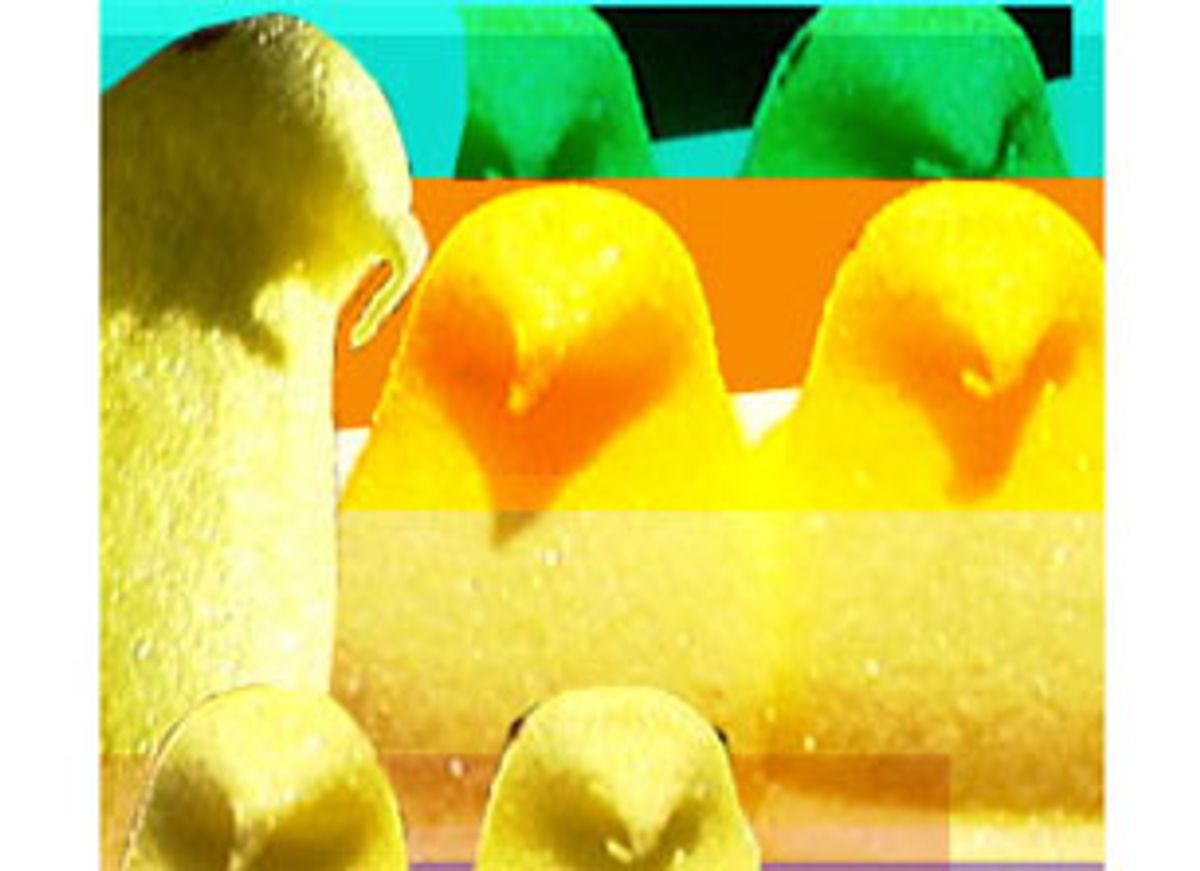
Washington, D.C, artist David Ottogalli also deals with Peeps en masse. His Web site displays several Warholian pieces featuring rows upon rows of Peeps and Bunnies. The effect is surreal and slightly unsettling.
"I'm just fascinated with all kinds of colored food," he says. "And it's funny -- when I do pictures where I do rows of either the Bunnies or the Peeps, if you actually look at them, you'll realize each one is different. They're mass-produced, but the eyes might be crooked on this one or different on the next. It's almost as if they each have their own personalities." He pauses and laughs. "Maybe I'm reading too much into it."
Ottogalli occasionally spray paints the Peeps and Bunnies for added effect. "The paint doesn't melt the marshmallow or anything," he says. "It just makes them glow."
He's not the first to note Peeps' curious resiliency against the elements. One very visible subculture of Peep fandom is fascinated by their ability to withstand factors that would turn lesser candy into mere blobs. While amateur Peepologists simply throw Peeps into microwaves, one team of actual scientists -- Gary Falcon and James Zimring from Atlanta's Emory University -- has conducted extensive clinical studies in regard to Peep hardiness. With hilariously dry scientific detachment, their site documents the effects of everything from smoking to liquid nitrogen on the brave little Marshmallous microfoulus.
As Peepology is a young science, research is ongoing. The team tells me that it'll soon have new results online: "We have some results from our investigation of aging and space travel on Peep health to publish, as well as a new theory to test about behavioral responses of Peeps to enclosed spaces and bright lights."
Of course, you could always just test the effects of Peeps on your stomach. One group of gastric adventurers in Sacramento, Calif., holds an annual Peep-off, in which contestants consume as many Peeps as possible in 30 minutes, washing them down with bourbon and Schlitz. The 1999 winner, Dennis Gross, ingested 81.
"And then he went home and ate a pizza," marvels organizer Dave Smith, who got the idea from a Peep-off held years ago on the East Coast. Smith says he's not a fan of Peeps' taste but nonetheless finds them "deeply amusing."
"Probably 15 or 20 people participated last year," he says. "And about twice that many people were hanging out and barbecuing, going, 'You people are sick.'"
Understandably, the company's reaction to all this Peep-related tomfoolery is mixed. "There are things people do that we certainly wouldn't encourage," says Kerr, "but we really can't police it."
"It's all done tongue-in-cheek," adds Barratt, "as long as you read it in that fashion."
And to be sure, the company's relationship with the public encourages a few leaps of logic. A 1999 survey asked U.S. fans which celebrity most embodied the spirit of a Peep; the winner was Rosie O'Donnell. And in preparation for Peeps' inaugural season in the U.K. this year, a second poll revealed that the Brit celebrity most like a Peep was Benny Hill. (One can only imagine the uses Hill could have come up with for Peeps on his show.)
Peeps were also introduced in Canada a few years back, but Barratt grew up there when the country was Peep-free. "When I came to this company, Peeps were just a brand name to me," he says. "I now understand this phenomenon. It's truly amazing."
Too soon, my time with Kerr and Barratt is up; I thank them and bid the factory goodbye. A few hours later, Bethlehem has disappeared from my rearview mirror. My box of blue Bunnies is almost empty, colored sugar sliding around in the corners. Half of me wants to bounce off the car ceiling; the other half just feels queasy. But I can't help myself; the last Bunny disappears.
And somewhere in Philadelphia, Tracy Bannett's neon sculpture is glowing softly from a window, letting all passersby know that Peep season is well underway.
Shares