

In the 1920s a Russian inventor named Leon Theremin unveiled the first
purely electronic instrument. You played the theremin by waving your
hands in the vicinity of two metal rods, controlling pitch and volume,
that were attached to a nondescript wooden cabinet. Between the strange arm
motions and the instrument’s invisible machinations, the theremin’s overall
effect in
performance was theatrical and mysterious.
But like the 200-ton telharmonium, the world’s first mechanical music
synthesizer (invented by Thaddeus Cahill around 1900), the theremin was
difficult to play. It soon disappeared behind the curtain, relegated to
cheap performances in B-grade alien-invasion movies. In 1955, four years after the theremin’s eerily weepy sound was employed in
“The Day the Earth Stood Still,” RCA introduced the first modern
synthesizer. The machine made sounds by
manipulating electrical waves to denote timbre, pitch and volume. Like
early computers, it filled a room and was tended by men in lab coats.
A few years later Robert Moog, a graduate student in physics at Cornell
University, published a magazine article explaining how to build a
theremin, offering do-it-yourself kits for $49.95. Orders poured in, and
Moog sold 1,000 that year. “We had $13,000 in the bank,” he
recalled recently, “a humongous cache of wealth for a graduate student
back then!” The windfall enabled a career that helped bring electronic
music out of the realm of novelty acts and university labs. A decade
after the first RCA machine, Moog introduced the first widely adopted
electronic instrument — the synthesizer that bears his name.
When Moog (rhymes with “vogue”) unveiled the Moog music synthesizer in
1965, his engineering skills combined with a bit of business luck to
radically change the way music was made. Synthesizers went from being
computers to instruments that could be found in any music store. The
flowering of rock music may have come via Leo Fender, Les Paul and the
Gibson
Guitar Co., but the innovative music of the early 21st century owes far
more to Moog and his imitators and successors.
– – – – – – – – – – – – – – – – – – – –
–
Growing up in the ’40s in Flushing, Queens, Moog suffered the usual
cruelties boys
inflict on the smarter, more introverted members of their tribe: “I was
the class brain,” he recalled in one of several e-mail interviews. “I
knew I was smarter than they were, so they felt compelled to beat me up
periodically to keep me in my place.” He spent a lot of time with his
father, who liked to dabble in electronics, and started his own
electronics projects. He built his first theremin with the help of a
hobby-magazine article at age 14. “I was hooked,” he recalled. Five
years later, Moog published his own do-it-yourself theremin article.
Moog’s mother, meanwhile, gave him piano lessons and made him practice
hours every day in the hope that he’d become a concert pianist,
“klopping” him if he “didn’t practice right.” He found refuge in New
York’s prestigious Bronx High School of Science, where he “actually
had some friends who were as nerdy as I was.” Later, at Queens College,
Moog finally developed what he called “a medical-minimum amount of
social grace,” and even started dating.
After getting some exposure to the liberal arts at Columbia
University’s Engineering School, Moog began graduate education in the
engineering physics department of Cornell University. He took eight
years to get his Ph.D., largely because of his part-time hobby: building
theremins and other electronic instruments. The degree came in 1965, a
year after Moog launched his synthesizer business.
Moog built his synthesizer in 1964 after a composer told him about the
need for user-friendly electronic instruments utilizing new
solid-state technology. The Moog was modular: You used patch cords to
select your waveform (the sound’s timbre) and frequency (pitch), and
plugged in the interface — a keyboard, instead of the binary
code on paper that had defined the first RCAs. Moog’s engineering
wizardry did the rest.
Significantly, Moog’s was the first synthesizer to use
attack-decay-sustain-release (ADSR) envelopes, set with four different
knobs, which control the qualities of a sound’s onset, intensity and
fade. Like many of his designs, Moog’s envelope generators became a
basic component of later synthesizers. The sound was monophonic — one
note at a time — but that was enough, since studio recording techniques
could create whole orchestras from single notes by the late 1960s.
RCA synthesizers, intended for an elite market of labs financed by
universities and record companies, had cost $100,000 and up. In 1967 the new
Moog sold for $11,000. It wasn’t the only synthesizer around; many
experts also commend Donald Buchla’s modular synthesizer, built around
the same time. But the Moog became prized for its utility and elegance,
making Moog the name that brought synthesized music to the masses.
“I remember seeing it as a teenager and thinking, ‘I gotta get my hands
on it,'” says Jeffrey Hass, director of the University of Indiana’s
Center for Electronic and Computer Music. “I wasn’t alone. It had a
tremendous impact on many people and brought electronic music to many
composers, both popular and academic.”
The synthesizer also boasted the voltage-controlled lowpass filter that
came to be known as the Moog filter, capable of making a variety of
full horn, string and vocal timbres. The filter was patented in 1968,
much to the envy of the competition, who “ate their hearts out,” Moog
says. They “all came up with voltage-controlled lowpass filters, but
most of them sounded like shit, if I do say so myself.”
The Moog’s biggest break came in 1969, when musician Walter (now Wendy)
Carlos had a huge, Grammy-winning hit with “Switched-on Bach,”
popularizing electronic music with Moog-made renditions of Johann
Sebastian Bach. Canadian pianist and Bach interpreter Glenn Gould
said that Carlos’ Fourth Brandenburg Concerto was “the finest
performance of any of the Brandenburgs — live, canned or intuited —
that I’ve ever heard.”
The Beatles introduced a new Moog in the majestic “Because,” on “Abbey
Road,” the last album they recorded. The instrument was somehow perfectly
suited to the layered, atmospheric vocals and John Lennon’s ethereal
lyrics. In 1971, Carlos brought the Moog to cinema, scoring Stanley
Kubrick’s “A Clockwork Orange” with electronic Beethoven whose gleeful
perversity helped lend the movie its malevolent sheen.
Still, these were products of studio recording. It took musicians with a
talent for excess — such as keyboardist Keith Emerson — to tote the
enormous Moog setup, a towering box of electronics, onto the stage
for live shows. Ever mindful of utility, Moog next introduced the portable,
performance-minded Minimoog. Rock-oriented musicians like Jan Hammer showed
that the synthesizer could be used as an expressive lead instrument.
Jazzers like Josef Zawinul used the instrument to “add new colors to the
traditional sound world of jazz,” says Doug Keislar, editor of the Computer
Music Journal.
“It was really the advent of the Minimoog that saw synthesizers take
off,” Keislar says. “The Minimoog showed that there was a significant
market for portable, cheaper synthesizers.” Or as Moog put it, in
typically dry fashion, “By 1974 or so, having a Minimoog would make it a
lot easier to get a job playing the local Ramada Inn.”
The Minimoog became the gold standard. “He hit it so right, everyone
realized that was the way to do it. So everyone did it more or less the
same,” says Joel Chadabe, author of “Electric Sound: The Past and
Promise of Electronic Music,” who has known Moog since 1965. “Underlying all
this
was a basic quality. The sound of his instruments was really good.”
A century after Thomas Edison reproduced the first recorded sound, the
synthesizer began to spread into musical genres from the avant-garde to
jazz. In 1977, the instrument took a central role in emerging forms of
electronic music, with Donna Summer’s hit dance single, “I Feel Love,”
created almost entirely on Moog synthesizers, and German band
Kraftwerk’s “Trans Europe Express,” an album of purely technological
music.
“The spirit of the times was very exciting,” says Chadabe, who also
serves as president of the Electronic Music Foundation. “You could start
a basement business and really have an impact. Later on the real
businessmen came in with their accountants and financial planning and a
lot of capital, and the business matured.”
Moog admits he didn’t have much of a head for the business end; his main
goal has always been creating useful technology. “My transition from
scientist to entrepreneur?” he asked in an e-mail. “Some would say that I
still haven’t made that transition,” he joked. “I suddenly found myself
in a growing business and I didn’t know how to run it,” Moog wrote of
his early days. “I didn’t know anything at all about business back then.
I didn’t know what a balance sheet was. I didn’t know what cash flow
was. So the business survived as long as it grew, but as soon as a
contraction occurred, I ran out of money.”
In quick fashion, Moog’s family business was bought out. The
Micromoog was the last synthesizer created by Moog to bear his name.
After musical instrument manufacturer Norlin took over his company,
including synthesizer design, Moog spent the rest of his days at the
company designing guitar effects, guitar amplifiers “and similar small
electronic stuff.” He left Moog Music in 1977, blaming corporate politics
for his
departure.
When the Polymoog went into production in 1976, Moog says,
“reliability-wise it was a disaster.” It had been created by Norlin’s
new head of synthesizer design, David Luce. And why did Luce design
synthesizers for Norlin while the man they were named for “was assigned
to the technological provinces”? Just like his school days in Queens,
Moog says, it came down to social skills: “Luce liked to go out and drink
and socialize with the Norlin brass, and I didn’t, or maybe couldn’t.”
The first digital synthesizer, the Synclavier, had come along in 1975.
Digital sound synthesis, invented in the 1950s, became an affordable and
popular technology in the 1980s. Soon digital sampling, computers and
MIDI (musical instrument digital interface) standardization swept
through electronic music, transforming the landscape. While the 1960s
and 1970s were the heyday of analog synthesis, a sound many musicians
still prefer, computer-synthesized sound now had the technological edge.
Moog largely eschewed the digital music revolution, though he had played a
part in it. In 1978 he moved to North Carolina to launch Big Briar
Productions and began making effects modules and control devices for
electronic instruments. One of the first projects was an attempt to create
a keyboard instrument that could be played as expressively as a violin. At
the International Computer Music Conference in 1982, he introduced the
multiple-touch-sensitive keyboard, developed with John Eaton of Indiana
University. In addition to responding to the downward motion of a key, the
keyboard also sensed the horizontal position of the finger playing it,
opening up new dynamic possibilities.
Later, at the behest of artists, he made a flat touch-plate
interface. “Artist feedback drove all my development work,” he
recalls, listing examples dating from the beginning of his career:
“The first synthesizers I made were in response to what [composer] Herb
Deutsch wanted. The now-famous Moog filter was suggested by several
musicians. The so-called ADSR envelope, which is now a basic element
in all contemporary synthesizers and programmable keyboard isntruments,
was originally specified in 1965 by Vladimir Ussachevsky, then head of
the Columbia Princeton Electronic Music Center. The point is that I
don’t design stuff for myself. I’m a toolmaker. I design things that
other people want to use.”
While Moog’s Big Briar inventions have not had the sensational impact of
the first Moog synths, they are creative, futuristic visions of
alternative methods for playing electronic instruments. “Unfortunately,
the trend is toward user interfaces that are simpler, not more complex.
Most people don’t care enough about the increased possibilities for
expression to sacrifice years of their lives mastering an instrument,”
says Keislar. “They want to press a button and hear music come out. As a
result, such systems are probably destined to remain experimental, even
if elegant.”
Big Briar also makes effects modules such as the “moogerfooger,” which
mimics analog synthesizer timbres, one of which (Big Briar
Moogerfooger Model MF101 Lowpass Filter) is based on the Moog filter.
In 1997 Moog came out with a theremin (the Ethervox) based on the
electronic instrument from the 1920s but featuring both a MIDI interface
and a sound module that can re-create a theremin performance from MIDI
data.
Reflecting on the waves of synthesizers and musical innovation that
followed in the Moog’s wake, the inventor says the instrument “has
introduced a vast array of new timbres and textures to the available
palette of musical sound” and fostered what he calls “sound design.”
Much of contemporary music, Moog points out, “has as much to do with
sculpting complex, slowly evolving sounds as it does with ‘playing’
fixed-timbre musical sounds.” Moog’s quotation marks underscore the
plasticity of the concept.
While some have credited Moog with helping to foment a
“democratization of music,” he will hear none of it. That societal shift
came about thanks to “cheesy Casio and Yamaha keyboards that sold for
$100 to $500” and were “small and portable and battery-powered, so you
could take them to a party or to the beach,” he says. “I see these
devices as being on a branch of music technology that is completely
separate from the analog synthesizers of the 1970s.”
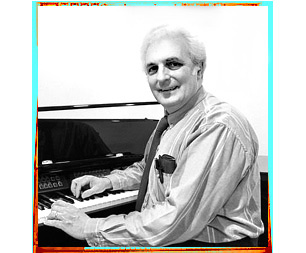
His newest project is an “interactive piano” that manages to be both
newfangled and old-fashioned. Designed with David Van Koevering, who
helped to market the first Moogs, it is housed in the fine finished wood
of a concert piano, but instead of strings under the lid, there is only
a speaker. A touch screen the size of a laptop’s takes the place of
sheet music. The piano has 128 sounds, including a digitally sampled
Steinway grand, and 256 tracks for recording. It will transcribe any
composition onto the screen as fast as you can play it. Connect to the
Web and download MIDI files to play along with in a kind of instrumental
karaoke. Hook up a CD burner and make copies of your symphony, or print
it on sheet music for that authentic touch. Its educational software is
far more forgiving than was Moog’s mother.
Institutions as varied as the University of Miami and the New York
Islanders use the $8,000 (and up) piano. But unlike Moog’s synthesizers,
the instrument is aimed more at musical tradition than musical
innovation. “Before the radio and the phonograph, people made their own
music, for themselves and for each other,” Moog says. “People regularly
got together to sing, play [music] and dance with each other.
Now, most of the music is recorded, and a lot of that is listened to by
solitary people, isolated from their surroundings by headphones.” Moog
hopes that in the near future, “people will get tired of being in their
own little boxes, and they’ll come to understand that they would be a
lot happier if there were more social music making in their lives.”
These days, Moog is accorded the respect and admiration of a great
American inventor. In the fall of 1994, when the excellent documentary
“Theremin: An Electronic Odyssey” had its debut at the New York Film
Festival, Moog was greeted by warm applause when he was recognized in
the audience by the film’s director, Steven Martin, during a
post-screening Q&A. If most musically inclined people have some
familiarity with the Moog, that’s because Moog became a de facto
leader when it came to introducing electronic music technology into the
public consciousness.
Moog also helped forever alter the creative process of music making.
It’s easy to forget that music was once an elite art, the province of
those who could liberate the scrawl of notes on a page through
specialized and sometimes highly technical mechanical expertise. Today,
Danny Elfman, who composed the scores for the “Batman”
movies, “The Simpsons” and countless other productions, has an advantage
Beethoven and Mozart probably never dreamed possible: creating full
orchestration with technology instead of sheet music.
For Moog, it all goes back to his initial, sustaining fascination with
the theremin: “Leon Theremin’s original designs are elegant, ingenious
and effective. As electronics goes, the theremin is very simple. But
there are so many subtleties hidden in the details of the design. It’s
like a great sonnet, or a painting, or a speech, that is perfectly done
on more than one level.” The statement equally applies to Moog’s own
marvel of engineering.
