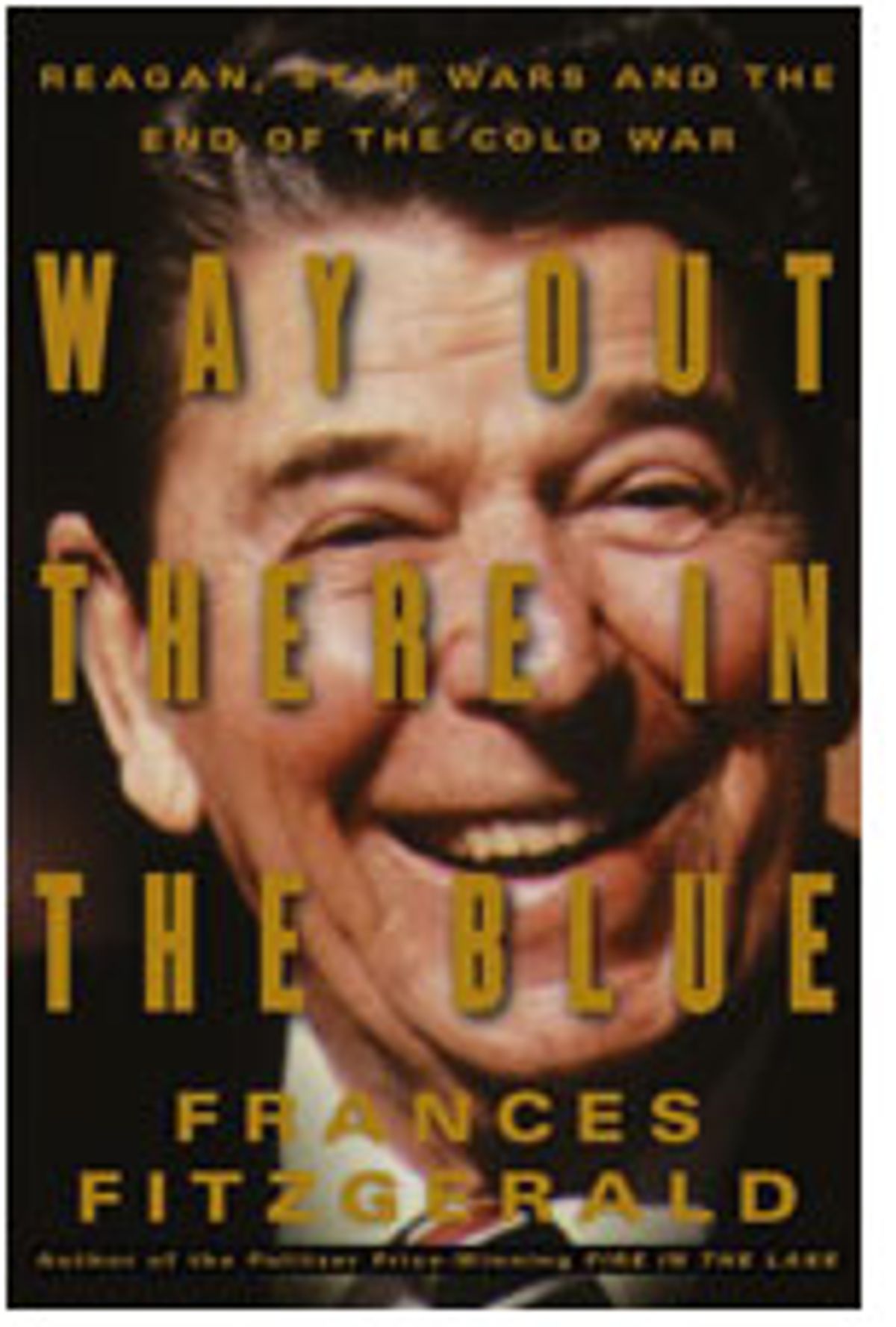
Ronald Reagan
“Way Out There in the Blue” by Frances FitzGerald
The definitive account of Star Wars, the military fantasy that's soaked taxpayers for $60 billion -- and counting.
Once upon a time, according to science-fiction legend, a group of writers in Manhattan had an imaginative jam session about designing a new religion according to sci-fi principles; the result was Scientology. Something similar also occurred when, according to conservative sci-fi author Larry Niven, “The scheme that drove the Soviet Union bankrupt was first drafted at my house in Tarzana, [Calif.] by about 50 good people invited and led by Jerry Pournelle.”
Also assembled were authors Robert A. Heinlein and Poul Anderson, retired Gen. Daniel O. Graham, astronaut Buzz Aldrin and aerospace industry luminaries in the Citizens’ Advisory Council on National Space Policy, a group that apparently wrote parts of President Reagan’s 1983 Star Wars speech. “We were gathered to build a space program, with costs and schedules, to submit to Ronald Reagan via his science advisor. We generated the Space Defense Initiative (or ‘Star Wars’ if you didn’t like it.)”
Star Wars is still alive and still costing taxpayers billions of dollars a year: $60 billion has already been spent, and $6 billion more is earmarked for the Strategic Defense Initiative and its various sequels. In fact, after 20 years and a steady hemorrhaging of dollars — mostly to the aerospace companies represented at the original Tarzana huddle — SDI technology has advanced to the point where, if a fish is very large, brightly dyed and nailed to the bottom of a barrel, sharpshooters may occasionally hit it — assuming there are no other fish around to distract them.
As Frances FitzGerald reports in “Way Out There in the Blue,” the only unequivocally successful test of the technology, back in 1984, was achieved by turning the target on its side so it appeared bigger and heating it up so that it was brighter to make it easier for the intercepting missile to hit. Sadly, real missiles come in swarms, surrounded by decoys and debris, and are somewhat more coy about showing their best side to would-be anti-missile defenses. FitzGerald also reports that GAO scrutiny revealed that other tests involved targets containing charges with explosives that would be detonated if the interceptors got anywhere near them.
FitzGerald’s starkly and voluminously documented book shows just how the American right’s pervasive faith in SDI shaped foreign policy in the strangest ways. If it weren’t that her account already weighs in at over 500 pages, I’d wish that she had editorialized a little more (and had mentioned the science-fiction angle). But she shows admirable restraint, leaving readers to conclude from the testimony of her voluble Washington sources that the country, for most of the 1980s, was run by people who were obsessive, gullible, mendacious and not a little paranoid.
Star Wars was very effective in one respect. The hard-liners in the Reagan administration used it to derail almost every opportunity for strategic disarmament that the Soviets offered. They continually insisted that any reduction in nuclear weapons was only possible if they were allowed to breach the existing Anti-Ballistic Missile Treaty by developing Star Wars systems.
Faced with the total failure of Star Wars to work in practice, its proponents now maintain that as a bluff it brought down the evil empire by forcing the Soviets to counterspend. As FitzGerald laconically puts it, “The evidence for this proposition is wanting … Soviet spending on strategic weapons was a very small fraction of the overall Soviet military budget,” she explains.
In fact, the very missile gap that Star Wars was supposed to combat was as imaginary as the “space lasers,” “brilliant pebbles,” “brilliant mirrors” and other cool stuff that its supporters kept talking about. While CIA chief Robert M. Gates sang of massively increased Soviet defense spending, FitzGerald points out that the lower-level agency analysts who actually looked at the data concluded that Moscow’s weapons procurement programs were flat, while its spending on strategic missile systems had actually dropped by 40 percent from 1976 to 1983. Their reports were suppressed in favor of more threatening estimates.
The undoubted winners are the defense contractors. According to Boeing’s Web page, Star Wars II, the National Missile Defense, may “after its first three years of development, integration and testing … be deployed and operational within five more years.” Apart from the petty detail that the program would require abrogating the ABM treaty, and that similarly optimistic completion periods have been cited now for two decades, why not?
Ironically, perhaps the one success of the Reagan era spending on Star Wars and the military was the way it defied all the economic principles of the Reagan Revolution. John Maynard Keynes once suggested that governments could spend their way out of a recession by putting money in bottles, burying them in pits and paying people to dig them up. There is no pit so bottomless as space, and the spending on Star Wars may have creatively helped expand the economy as the government paid contractors a fortune to blast a load of bullshit into orbit.
Ian Williams' book "Rum: A Social and Sociable History of the Real Spirit of 1776" is due in late August 2005 from Nation Books. His last book was "Deserter: Bush's War on Military Families, Veterans and His Own Past." More Ian Williams.
Auction claims to be selling vial of Reagan blood
The blood sample was taken after Reagan was shot in a 1981 assassination attempt
LONDON (AP) — A Channel Islands online auction house has angered Ronald Reagan’s foundation by claiming to offer a vial that once contained his blood.
The PFCAuctions house says the vial contains some of Reagan’s dried blood residue. The auctioneers say it was used by the laboratory that tested Reagan’s blood when he was hospitalized after a 1981 assassination attempt in Washington.
Officials at the Ronald Reagan Foundation in California have told BBC News that the sale is despicable.
Auction house spokeswoman Kylie Whitehead told The Associated Press that the blood is being sold by a man whose late mother took it from the laboratory with permission weeks after the tests were made.
Bidding for the vial had passed the 7,000-pound ($11,000) mark Tuesday.
Reagan required emergency surgery after he was shot by John Hinckley Jr. outside the Washington Hilton Hotel.
Liberals are not uniquely “unreasonable”
A widely discussed critique of the left's attitude toward Obama forgets some important history
By now, you’re probably familiar with Jonathan Chait’s provocatively titled New York magazine story: “When Did Liberals Become So Unreasonable?” Chait’s answer is that they’ve pretty much always been unreasonable – that the same “unceasingly despairing” attitude the left has taken toward Barack Obama’s presidency emerges whenever a Democrat claims the White House.
Of course, Chait is overstating the current depths of liberal despair, given that the outspoken frustration of some left-of-center commentators hasn’t exactly trickled down to the liberal masses, and that overall support and enthusiasm for Obama has fallen more significantly among non-liberal Democrats than among liberals. Joan Walsh did a nice job earlier this week of pointing this out, and of addressing many of the specific points Chait made about Obama’s record.
Continue Reading Close
Steve Kornacki writes about politics for Salon. Reach him by email at SKornacki@salon.com and follow him on Twitter @SteveKornacki More Steve Kornacki.
The Iran-contra scandal, 25 years later
In 1990s, U.S. prosecutors assessed "criminal liabilty" of Reagan, George H.W. Bush
President Ronald Reagan shortly after the Iran-contra scandal engulfed his administration in November 1986. (Credit: AP/Dennis Cook) It has been 25 years since President Ronald Reagan stepped up to the microphone in the White House press room and made the announcement that launched one of the greatest scandals in modern American politics.
Reagan announced that his administration had sent “small amounts of defense weapons and spare parts to Iran” not to trade arms for hostages, but to improve relations and support moderate mullahs. There was “one aspect” of the operation that, the President said, he had been “unaware of.” His attorney general, Edwin Meese, then stepped forward to describe how “private benefactors” had transferred profits from those sales to counterrevolutionary forces, the contras, fighting to overthrow the Sandinista government in Nicaragua. No U.S. officials were involved, according to Meese, in this “diversion” of funds that linked two seemingly separate covert operations.
Continue Reading ClosePeter Kornbluh is a senior analyst at the National Security Archive in Washington D.C. and co-author of The Iran Contra Scandal: A Declassified History. More Peter Kornbluh.
Peggy Noonan, Reagan's storyteller, says Obama tells too many stories
Crafter of the Reagan Myth doesn't care for the president copying St. Ronald
Peggy Noonan(Credit: wsj.com) Peggy Noonan has diagnosed what is wrong with Barack Obama: He is too concerned with “telling stories,” and not concerned enough with “leading.” And Noonan should know, because she was a professional writer of stories for Ronald Reagan, the American president whose entire legacy is built around the fact that he was really super good at telling stories.
Noonan has been out in the “real” part of the country talking to people and she sees “a kind of new patriotism among our professional class” and it inspires her, but back East, where the bad politicians live, people are too obsessed with “The Narrative,” which she knows because she read Ron Suskind’s book:
Continue Reading Close
Alex Pareene writes about politics for Salon and is the author of "The Rude Guide to Mitt." Email him at apareene@salon.com and follow him on Twitter @pareene More Alex Pareene.
Obama gets to play Ronald Reagan
He praised him on the campaign trail. Now he's channeling his ability to compromise. Why won't the GOP go along?
President Barack Obama and former president Ronald Reagan Earlier this week President Obama invoked Abraham Lincoln’s Emancipation Proclamation to point to the value of compromise in American politics. Now Democrats and Republicans are fighting over what Ronald Reagan might have done with the debt crisis. It’s nothing new in American politics: In this country with a relatively short history politicians like to look backward at what their predecessors might have done. It’s also rather useless – especially when both sides leave out key parts of the historical picture.
Continue Reading CloseJoan Walsh is Salon's editor at large. More Joan Walsh.
Page 1 of 34 in Ronald Reagan