My religious conversion to the muscle-magazine mind-set occurred in the middle of an Albertsons supermarket 10 months ago.
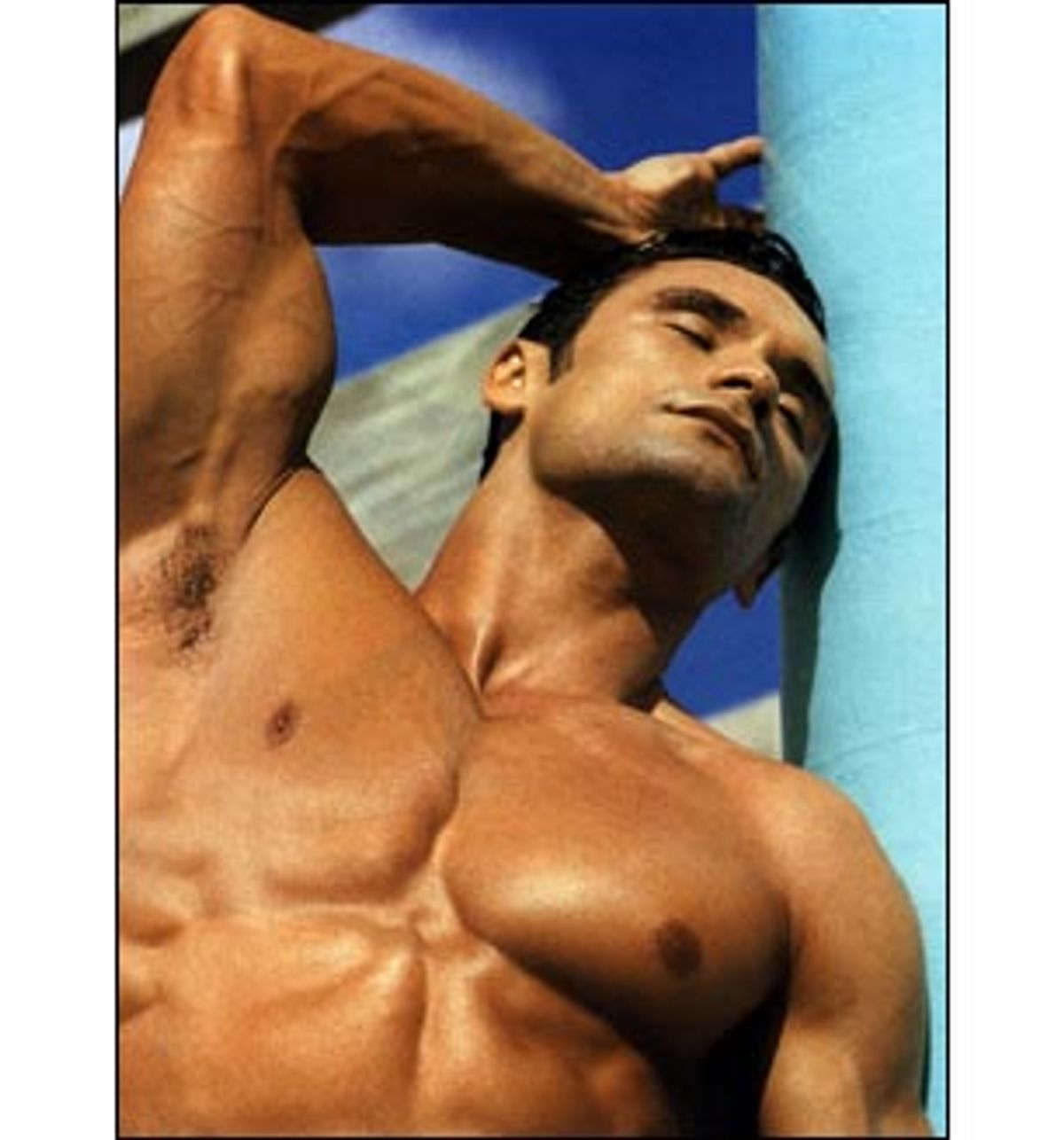
I had usually ignored men’s magazines, but as I perused the magazine shelves, this one had an irresistible allure. Its cover featured a healthy, bright-faced youth, wearing nothing but a Speedo — and a nicely bulging Speedo at that. He was shown emerging from a pool with a look on his face of absolute joy. Water dripped down his glorious, muscular body. He seemed to me the most gorgeous specimen of masculinity I had ever seen. Sort of like a young Tom Cruise, but sexier and with a less prominent nose. I quickly looked to see if the magazine’s contents lived up to its cover. Indeed, they did. Page after page of male heat sizzled inside. Posing, sweating, getting physical. Men! Men! Men! I could feel my temperature rise.
Had I found the magazine Burn! Real Fitness for Real Men at a gay bookstore I wouldn’t have been surprised, but at the local grocery market? That bastion of homogenous, middle-class, suburban heterosexual culture? What would Dr. Laura say? Though Burn! was disguised as just another fitness magazine, I blushed as I handed it to the clerk at the checkout stand. I knew it was much more than a fitness magazine.
It was pornographic, and it turned me on.
Available at most any newsstand, muscle magazines are homoerotic pornography for the masses. Their appeal seems to cross sexual orientations. Straight, gay and bisexual men have been known to enjoy them. In their pages, they eroticize both the flesh and the culture of men. To read them is to be sexually seduced into a fraternity to which all men are invited. They unite their readers in a kind of sexually charged adulation of masculinity. To the cult of testosterone in America, they have an almost biblical authority. They give direction, in the most literal ways, on how to be the ideal man: “Do this exercise, take this supplement, play this sport and you will be just like the men in these pages.”
When Richard Perez-Feria founded Gym and Burn! magazines in 1998 he believed there was a void in the so-called men’s fitness market for publications dealing with the lifestyle of men who enjoy working out. His instinct proved correct. They became huge hits. This month, approximately 300,000 copies of each title were distributed to newsstands nationwide. While the Audit Bureau of Circulations has not released paid circulation numbers for the magazines, Perez-Feria says they have averaged a 35 percent sell-through on newsstands. And Muscle & Fitness boasts a paid circulation of almost 500,000.
Having sold the magazines to a publisher a few months ago, Perez-Feria will soon launch a similar one called Tough, fully expecting it to be a hit as well. He says he wasn’t surprised by the success. Instead, “I was surprised at the intensity and the quickness … and near fanaticism which I got.”
He received thousands of positive e-mails, letters and phone calls from readers. “There was such passion behind it. The readers were so excited about the magazine. The intensity … and devotion to the magazine was incredible.”
Several of these letters appeared in the magazines. The writers represented a wide spectrum of masculinity, from married men in the suburbs to college frat boys to guys who are openly gay. Someone wrote in to admit that the models were so hot that both he and his wife were turned on by them.
While at first I thought this to be a new trend — fitness magazines doubling as homoerotic porn — I soon discovered it’s an old practice that’s undergoing an intense revival.
The first muscle magazine was published in Germany in 1893, followed five years later by two similar English language publications titled Physical Culture and Physical Development. Over the past 100 years, muscle magazines have taken many forms, but a historical overview of the genre shows that, at least until the 1960s, they served mostly as alibis for men to be able to look at pictures of other men, either nude or semi-nude, with little risk of scandal.
In his book “Hard to Imagine: Gay Male Eroticism in Photography and Film From Their Beginnings to Stonewall,” Thomas Waugh demonstrates that the poses of the models, the gay ghetto codes used in the captions and advertisements, and the letters readers sent to the editors all point to a deliberate but secretive homoeroticism in muscle magazines throughout the first half of the 20th century.
He even claims that, “In terms of impact as well as artistry, the current of physique eroticism that flourished in the postwar decades is one of the great achievements of gay culture.”
Is it true, then, that the typical muscle magazine on the market, read by men from all walks of life, including the most macho, hulking, heterosexual of figures, has its roots in gay culture? This may come as a surprise now, but the public started to catch on to it in the 1950s.
This new awareness was exemplified by the House of Representatives’ gathering committee on current pornographic materials, which, in 1952, railed against “Nudist magazines and those which pandered to homosexuals by depicting ‘the male body beautiful.’”
In 1958, a model writing in Iron Man magazine said he was disgusted by the realization that he and other bodybuilders were being ogled by men “with perverted sex interests.” Something had to be done about this, and it was. An intentional split occurred in the muscle magazine trade between those serving a straight readership and those of a gay readership (or closeted gay readership).
Magazines arose strictly for “real” bodybuilders, a category that still exists. In these, publishers bypass the homoerotic beefcake imagery, and feature articles on training, diet and competitions instead. The photography is dull and lifeless. The men, invariably pictured gripping some huge weight, always look very pained and not at all sexy. (Or rarely even human, for that matter. The physical ideal seems to be that of the Incredible Hulk without the green skin.) It’s easy to spot these magazines, as their covers usually feature some muscular version of Pamela Anderson Lee — further enticement, presumably, to a heterosexual male reader.
There are no women on the cover of Burn!, or anywhere inside. Nor will you find them in Gym, its sister publication. Other exclusively male magazines are Exercise for Men Only, and Men’s Workout. It seems that readers of these magazines aren’t interested in the female form. What are they interested in, then? For whom are these magazines intended?
This is an issue someone raised in a letter to Burn! last year. He wrote, “I’m not sure who your audience is, despite the tag line (‘Real Fitness for Real Men’). I would hate to see such a wonderful magazine get blacklisted by anally retentive, unaccepting individuals. It could happen to Tinky Winky, it could happen to Burn!”
Richard Perez-Feria estimates that when he was editing Gym and Burn!, which was when they were most erotically charged, the readership was evenly divided between gay and straight men, though the boundaries between gay and straight seem to be blurred in this case.
“It’s a very open secret among the magazines that are in the market that you’re basically creating a magazine for, we call it a ‘closet case reader,’” he explained. “A guy in St. Louis or Alabama who doesn’t get a chance to look at men openly, or enough men as he wants to look at. And so you wrap it around the fitness context. You put a hot guy, oiled down with a dumbbell, on the cover like Men’s Workout does, and they do all the phone sex ads in the back, and you have a magazine. It’s a healthy magazine that will have 100,000 or so readers that just can’t get that stuff anywhere else, so they’ll buy it. And so Suzy the girlfriend or wife or mother thinks it’s a fitness magazine, when in fact — wink, wink — they know it’s something else.”
There was a lot of winking going on in the Gym cover story about Baywatch hunk Michael Bergin. The August 1999 issue featured an interview with him and made playful references to his sexual preference. Was he straight? Was he bi? He claimed the former, but one had to wonder about the latter. Suggestive photos of a semi-nude Bergin surely aroused even the most jaded pornographic fan. The pepperoni on the nipple shot was my favorite.
In a few of the photos, Bergin seems to resemble the late John F. Kennedy Jr., which is interesting because Bergin claims to have proposed marriage to Carolyn Bessette twice before she married Kennedy.
Oh, if only Kennedy had graced the pages of these magazines! Especially as he appeared in his 20s, he would have been a marvelous model for either Burn! or Gym. To my mind, the young men of these pages, with their bodies so elegantly muscled, resemble the long, lean figures of Lysippus, the great pre-Hellenistic sculptor. They are living works of art. Neither bulky nor skinny, they are perfectly balanced, shown in a rare, privileged moment, right at the cusp of full adult masculinity. Posed always before male photographers, wearing the tightest of underwear and no shirt, they know men watch and worship them and seem to delight in being the focus of their gaze.
The photography is intended to be erotic to men, yet the accompanying text often points out that the model is straight, by making reference to his girlfriend or wife. A typical example is the profile of competitive diver Troy Dumais, a gorgeous 19-year-old Olympic hopeful. “The first time I had sex, I was 17,” he says. “It was with my girlfriend, Nicole. Man, it was so wonderful and so special in the sense that I know that I want to spend the rest of my life with her.”
Photographs show Dumais modeling four different pairs of shorts, all bursting with the most promising bulge, as he gives off a lusty stare. The message seems to be that although a guy is romantically committed to being with a woman, he can still share a little “erotic play” with men. It’s not sex, but it’s seduction, flirtation and just a mutual enjoyment in being male.
This is illustrated by the copy for “College Muscle Jocks,” a video that’s advertised in several muscle magazines. “It’s back to college as eight stunning, buffed-out centerfolds invite you to a skin-filled fraternity weekend of hazing, rowdiness and wild fun!” shouts the headline.
“After the secret initiation of the freshmen it’s a nonstop party with workouts at the gym, towel-snapping in the showers, stripper parties at the bar and pillow fights in the dorm. Then catch each frat stud alone in a private fantasy showing off his naked muscular body just for you. Once you see these great looking college boys, you’ll join the fraternity.”
Other video titles include “Wide Nude World of Sports,” “Naked Football League” and “Buff Bachelor Party,” where “seven hunky friends celebrate the groom’s last weekend of freedom with wild naked games and horseplay.”
If the advertising in a magazine is an indication of its readership, as surely it must be, then the fantasy of male community, of team sports and group male bonding is obviously a very popular one. For gay men, this has long been known. Tom of Finland, one of the gay icons of the 20th century, illustrated it quite frankly. His images show an obsession with the erotic charge of male culture.
But does the average reader of these magazines realize the attraction? Of course I have no way of getting into his head, and believe me, the last thing I’m going to do is approach some strapping baseball-cap-wearing dude who’s flipping through one of these things at the newsstand and ask him if the pictures make him horny, and why.
But I believe some of the readers are indeed clueless about the underlying eroticism of the publications. For instance, Perez-Feria says that his father read Gym and didn’t feel it was pornographic at all. “He thought it was a bunch of guys with great bodies. He had no clue for him that it was pornographic. So, it’s all how you respond to what you’re looking at.” I have noticed a variety of responses among heterosexual men.
Some have expressed discomfort about the semi-nudity of the models. In one issue, five young dudes (Mike, Mike, Jeff, Adam and Steve) complained about it, claiming in a jointly written letter that most guys don’t want to see others in such a state. They didn’t say they were canceling their subscriptions, though.
Some readers are shocked when the eroticism of muscle magazines is pointed out to them. Rob Schuh, a columnist for Testosterone, recounts that, “Conrad, a friend of mine, was over eating pizza and he started flipping through all of my bodybuilding magazines. Conrad is gay and thought that All Natural Muscular Development was geared for a gay audience. I put this question out there and received about 10 corroborating e-mails. I also gave Conrad all of my bodybuilding magazines to take home. He lives in an all-gay household. He said that all of the mags went into the garbage except for All Natural Muscular Development. His roommates stated that all the male models were in ‘homoerotic’ poses. They also said that the few photos of females were thrown in merely as ‘cover’ and that the real reason the mag was always next to the toilet with the pages stuck together had nothing to do with the women, if you catch my drift. OUCH!”
In another issue of Testosterone a reader comments, “I got a few laughs when I read the discussion sometime back about whether Muscular Development is a ‘gay mag.’ But take a look at Page 110 of the May 2000 issue — this guy is obviously gay: 1) His ass is hanging out of the back of his ‘hot pants.’ 2) He’s only squatting 135 pounds. 3) Why does he have a boner, and why is Muscular Development showing it to us?”
A spokesman for Testosterone told me, “Look, the point is, these mags simply aren’t published for bodybuilders and serious athletes. I mean, do we waste our time criticizing Modern Sewing or Ladies Home Journal? Nope, they aren’t made for us, so why bother. Same with some of the other ‘fitness’ mags out there. Just don’t buy them ‘em if they ain’t your cup o’ tea.”
But they are my cup of tea. I find them much more exciting than conventional gay pornography, most of which is nothing but mindless humping and sucking. Very one-dimensional. The best muscle magazines depict men in a fraternal fashion, as “buddies,” as guys you want to hang out with to watch sports on TV after a sweaty workout. But the holding back of actual sex makes for a steeping, spicy brew.
As a teen, I never fit in with male athletic culture. Like many sissy-boys in high school, I feigned illness to avoid going to the gym and the dreaded locker room. I wish I had discovered these magazines when I was a young man grappling with my attraction to and fear of men. I think Gym would have helped me work out my sexual thoughts and feelings, as others might have done on the sporting field or in the locker room.
Bruce Benderson wrote of such a person in his 1970 sex novel, “Meet Me at the Baths.” His 15-year-old character, Paul, has sexual fantasies of the kind of men he had seen in muscle magazines: “Sometimes it would be a short, stocky blonde; at other times a mammoth brunette. He would speak harshly to me, telling me to get down on my knees and pay homage to the glory of his muscular body.”
“The depth of reaction that people have to bodybuilders is very significant,” says David Plummer, who writes about male sexuality from the University of New England, Australia. “People seem to be either gripped with desire or they are revolted. The point is that it is rare to see anybody who is simply disinterested.”
Plummer speculates that narcissism is an important factor in determining why some men are “gripped with desire” when reading muscle magazines. “Narcissim tells us a lot. It is a deeply homoerotic phenomenon. It implies that, deep down, men really do know how to appreciate men.” In this case it seems that narcissism is a love not only for oneself but for one’s ideal self as pictured in the pages of the magazines.
Paul eventually meets up with one of these guys in real life, a “straight” jock who forces oral sex on him after gym class. Although this was rape, Paul mysteriously described the experience later as a kind of epiphany, as “the image of his powerful body in the shower, and the halo of water which bounced off his white shoulders as I knelt before him, was impossible to erase from my mind.” After long immersion in the “monthly bibles” of masculinity, it was as if the young man had encountered a god.
Perhaps, then, the greatest allure muscle magazines have to men — one that crosses boundaries of sexual identity, that goes beyond the titillation of pornography or the usefulness of fitness information — is that they glorify masculinity. They make men feel good about being men. And the pages say to them, “You, too, can be a god.”
It used to be that strip clubs were merely blamed for society’s ills. Now they’re actually being charged for it.
In recent years, measures have been introduced in Georgia, Pennsylvania, Texas, Illinois and, most recently, California to apply special taxes to strip clubs — specifically to fund sexual assault services. Now, even if you aren’t inclined to view erotic entertainment as the source of all evil, this might seem an appropriate aim — who wants to argue against additional support for rape survivors? It would seem even more so when you consider politicians’ and activists’ repeated claims of solid scientific evidence showing a link between strip clubs — specifically those that sell alcohol — and sexual violence.
That is, until you look at the alleged proof.
The key study advocates point to is one commissioned by the Texas Legislature in 2009. But that very report states, “no study has authoritatively linked alcohol, sexually oriented business, and the perpetration of sexual violence.” What’s more, when I talked to Bruce Kellison, director of the Bureau of Business Research at the University of Texas at Austin, and one of the authors of the report, about the alleged link between strip clubs and sexual assault, he said, “That’s not really what our study was trying to do.”
What it was trying to do was review the research on whether clubs have a “negative secondary effect” (in other words, harmful side effects). “Most of the [research] has found that there is a moderate amount of increased criminal activity outside of clubs,” he said. That’s a point contested by some: Daniel Linz, a communications and law professor at the University of California, Santa Barbara, says studies used to support restrictive zoning or special taxes on strip clubs are methodologically flawed — they fail to use appropriate controls and rely on inconsistent and unreliable data sources. Take, for example, that zoning laws often relegate strip clubs to shadier parts of town, where, of course, there is greater crime. Without an appropriate control, that crime can’t be attributed to the club itself.
According to a study Linz conducted, “Those studies that are scientifically credible demonstrate either no negative secondary effects associated with adult businesses or a reversal of the presumed negative effect.” He tells me, “We’ve done crime map after crime map after crime map of many cities and there just aren’t clusters of crime around [strip clubs]. Most crime in most cities tends to occur around high schools.” Tax the teens!
That’s just to speak of crime in general. The important thing here, given the aim of these tax initiatives, is sex crime. The Texas report looked at the incidence of sexual violence in particular inside the clubs and found that there wasn’t “additional sexual assault violence going on in the clubs,” says Kellison, or even around the clubs.
Again, as with many things in this arena, that’s contested by some. Richard McCleary, a criminology professor at the University of California, Irvine, whom Linz says he’s had a “10-year scientific battle with,” argues that there is a sexual violence impact, but not the kind that these initiatives imply. He cites a 1998 survey of “a small sample” of adult entertainers that found a high rate of reported sexual victimization inside or nearby the club. This contradicts the findings of the Texas report, however. It’s also important to note that the proposed special taxes don’t go directly toward victimized dancers; the intended target is much broader than that.
McCleary also backs up his assertion saying that street prostitutes “are attracted to the neighborhood because of the clientele and that tends to be an extremely violent trade.” Even if we’re to presume that street prostitutes are driven to strip club neighborhoods in droves, and that they in general experience a high level of violence in their work, it isn’t a direct consequence of the venue itself. As Judith Hanna, an anthropologist and author of “Naked Truth: Strip Clubs, Democracy and a Christian Right,” told me, decriminalizing prostitution would be a much more effective way to address the violence that street prostitutes face.
Hanna is particularly sympathetic to the cause. She’s worked as a volunteer for over a decade with a program for victims of sexual assault, and yet she says, “I never, nor have others in the program, known of a sexual crime victim related to a strip club.” She’s quick to point out that “there is a plethora of evidence that clergy have committed sexual crimes against women, boys and girls.” Where’s their sexual violence tax?
Kellison cuts to the chase: “The reason that many advocates say the strip club industry is being tied directly to the effort to raise funds for rape crisis centers is not because there is increased sexual assault behavior going on inside the clubs or outside the clubs or as a result of a guy going to a strip club,” he says. “That is a very difficult argument to make. What the advocates will say is that it’s an industry that is primarily run with the use of women for, generally speaking, male purposes, male benefit. And that’s why advocates have seen it reasonable to ask the industry to support a tax that would fund services that are primarily geared toward women.”
Well, they rarely actually come out and say it so plainly without the cover of alleged evidence, but that is the fundamental moral judgment behind these initiatives.
Now, there is a strong link between alcohol consumption and sexual violence, but, as Linz says, “any location that is serving drinks, whether it’s a strip club or a regular bar is going to have this societal effect.” He adds, “Compared to other businesses that serve alcohol in the community, these places are no better and no worse.” In other words, it’s the booze, not the boobs.
McCleary, on the other hand, argues that there’s evidence that those who have consumed both alcohol and adult entertainment are more violent than those who have consumed only one or the other. But this is based on laboratory research, which McCleary admits is a far cry from the real world. He also says “it’s very difficult to establish a causal link.”
Critics say these measures have advanced because of courts holding them to a low standard of proof. While some circuits require “reliable social science evidence” to establish negative secondary effects, says Linz, others essentially say, “The city can pick and choose among findings and come to whatever conclusion they want.” Some argue that secondary effects — which were originally used to justify zoning restrictions but have since been applied to even regulations on the content of dances and the degree of nudity — have trumped First Amendments rights. David L. Hudson Jr., a research attorney at the First Amendment Center, calls exotic dancing “a First Amendment stepchild” and writes in a report on the topic, “Many free-speech advocates claim that the secondary-effects doctrine has allowed municipal officials an easy path to censorship.”
Speaking of censorship, Hanna sees crusading religious moralism at work. “A segment of the politically active Christian right are not only opposed to these clubs but they are working like the Tea Party works,” she says. “They have alliances, they have big money and they’re fighting it. Sometimes it’s indirect, they’re electing their people to legislative bodies — you only need one person to start making big noise.”
These measures are a crystal clear reflection of extreme conservative views of sexuality and gender. As Hanna tells me, “The Christian right believes that if you see a nude woman you’re gonna go out and rape the first woman you see.” She also points to the stereotype of “men as a volcano of testosterone ready to be ignited.” From that vantage point, the leap from strip clubs to rape makes intuitive sense — but it doesn’t make it fact.
There’s also just plain financial desperation behind these initiatives. Several sponsors have admitted that the tax is a response to devastating budget cuts to sexual assault resources. Sin taxes — those applied to alcohol, cigarettes and gambling — are not new and have only increased as cities face severe budget cuts. What’s unique about the strip club taxes is not only that boozy adult entertainment venues are being singled out — as opposed to the broader category of liquor — but also that the taxes are being directed toward a cause that is empirically unrelated.
When it comes to adult entertainment, though, critical thinking often falls by the wayside. Strip clubs are an easy target for religious moralizing and political pandering — and one few are willing to defend.
Continue Reading
Close
Joe, a licensed massage therapist, knows what it’s like having a famous client who expects something extra. He had an Academy Award-winning actor begin gyrating on his massage table before raising his hips in the air to show off his erection. “He was hoping that I would play with him in some shape or form,” he says.
Needless to say, Joe isn’t surprised by allegations by two masseurs that John Travolta got handsy during massages. (Travolta’s attorney has denied all the allegations, and called them “ridiculous.”) “It happens all the time,” he says, and not just with celebrity clients. He frequently encounters men who try to fondle him, usually while he’s working on their glutes or lower back and their hand happens to be level with his crotch. “They think they’re so original, but they’re all so much the same,” Joe says, his voice rising. “They all use the same tactics, the same body movements, the same gyrations and grinding my table, the [heavy] breathing.”
Usually it’s men, but he’s had a couple of women do it, too: One grabbed his crotch and then pulled his sweat pants down before he could stop her. Then there’s the woman who had an orgasm just from him massaging her thighs. “All of a sudden her knees locked and her legs became straight and I thought, ‘Oh no, maybe I hurt her, maybe she has boundary issues.’” Afterward, though, she made it clear what had happened — and that it was the best massage she’d ever had.
Even massage therapists who haven’t personally experienced sexual harassment or abuse on the job are fed up with the need to constantly reaffirm the fact that they are licensed medical professionals. Shows like Lifetime’s “The Client List,” which stars Jennifer Love Hewitt as a single mom trying to make ends meet by providing happy endings, certainly don’t help to diminish the nudge-wink side of massage, nor does the ubiquity of euphemistically driven ads for massage parlors. And, for the record, many object to the use of the terms “masseuse” and “masseur” because they leave too much room for misinterpretation.
Even still, some question the legitimacy, or at least earnestness, of the allegations against Travolta and suggest that it’s the massage therapist’s responsibility to avoid sketchy situations. Barbara Joel, a massage therapist and former president of the New York State Society of Medical Massage Therapists, tells me, “I disagree how he is being portrayed as the brute and the therapists as the innocent victims … I doubt that the therapists were unaware as to what they were walking into.” Joel says experienced massage therapists understand that “many male politicians, celebrities and men of power feel a sense of self-righteousness and that they are above the law.”
To others, that sounds too much like blaming the victim. Turning down clients — particularly high-powered clients that could make your career — is challenging. Joe was voted the best masseur in New York several years in a row, but when the economy tanked his business did too, and he moved to Kentucky for the affordable rent. Now he finds it hard to reject new clients during the initial screening process because he sorely needs the gigs. “It’s difficult when you’re a therapist trying to make money in this economy,” he says. Usually, he simply tries to dodge the wandering hands. “I move my legs away from the table and after a while they’ll mellow out,” he says. “If it starts to get really bad, I’ll grab their hand and press it firmly down onto the table and say, ‘C’mon now, I’m a licensed massage therapist, this is not about sex.’”
Like Joe, Cameron Richards, a massage therapist in New York, describes encountering inappropriateness from both genders. He recently had a male client ask to be undraped during the massage. “This was all red flags,” says Richards, who’s only been in the business for four years. “To make a long story short, he wanted me to fondle him.” Once, he had a female client try to urgently book a session within the hour and then she attempted to get him to massage her breasts. “She told me when she went on a cruise they massaged everything, which I knew was a lie,” he says. Richards also knows a massage therapist in Florida who is thinking about quitting the industry because “she is getting lots of phone calls from men looking for happy endings.”
In over a decade of massage therapy, the worst Eva Pendleton has ever encountered is a client grabbing her butt. “I just quickly stepped out of the way,” she says. But Pendleton had plenty of clients get “a little frisky or flirty” when she worked in a health spa. Now she specializes in geriatrics and end-of-life care, but still she’s encountered a hospice client who asked flirtatious questions like, “Who massages you?” He was also “really into having his abdomen rubbed, hinting about wanting me to work lower.” (That’s an example of the hospice saying, “You die as you lived.”)
Massage therapists often become accustomed to the hint of an erection under the sheet. “It’s tricky because the male body sometimes sends a signal just as part of the relaxation response,” says Pendleton, “not because they’re having a sexual reaction, so I learned to ignore erections and I usually gave the client the benefit of the doubt,” she says. “It’s rarely as obvious as perhaps some of Mr. Travolta’s massage therapists experienced.”
On the whole, the female massage therapists I spoke with reported less frequent in-person sexual harassment, maybe because they are more motivated to screen aggressively. Whenever she gets a call from a potential client, Denise mentions that she offers both massage and martial arts classes — which is not easily confused as a sexy euphemism. Most people who are looking for sex hang up after that, but the ones who stay on the line usually send up red flags by asking for “adult” or “full body” massage, or asking what she looks like or what she wears during the treatment. Recently, she had a man call to ask if he could “confess his bad behavior.” She suggested that he seek “psychological or spiritual counseling” and he hung up.
Elise Constantine has been working as a licensed massage therapist for 14 years and only once had a client cross the line: He kept asking to be naked during a Thai massage, which is usually done on a clothed body. “I was infuriated,” she says, “but did not engage in any further discussion beyond saying, ‘There is the exit. No payment is expected. Do not contact me again.’” Since then she’s developed strict policies to avoid inappropriate clients and dangerous situations. She only books new male clients when one of her colleagues will be in her office suite and never does outcalls for men unless they come with a direct, reliable referral. Constantine also makes a point of dressing “modestly” and not posting photos of herself on her professional website.
The erotic plagues the industry for some of the same reasons that massage is a good cover for sex work: the intimacy of nakedness and the sensuality of healing touch. We have a hard enough time separating nudity from sex, let alone naked touch. So it’s no surprise that there’s a genre of porn that eroticizes the tension between the legitimacy of massage therapy and the naughtiness of a paid-for hand-job. “Some people don’t get touched very often, they don’t have a love life, and to them it’s like, ‘Oh my god, this feels so good,’” says Joe. “It’s synonymous with sex or foreplay to them.” Of course, there’s a crucial difference between the occasional boner on the massage table and trespassing on another person’s body. One represents a natural physiological response, the other a raging dick.
Continue Reading
Close
I can now say that I’ve used a turn-of-the-century vibrator — on my hand, but still.
The silver, hand-cranked contraption is usually kept behind glass at Good Vibrations’ Antique Vibrator Museum in San Francisco — but staff sexologist Carol Queen made a rare exception. “This is very special,” she whispered, unlocking the case and carefully pulling out Dr. Johansen’s Auto Vibrator, a relic from 1904. The “auto” part is not so much: It was a two-person job, with her having to crank the device’s handle to get it thrumming. Pressing my finger tips to its inch-wide circular platform of pleasure, I was pleasantly surprised by its power.
As I was by the two other vintage vibrators that I got to try out — the White Cross Electric Vibrator from 1917, which has a pronged aperture that makes it seem like the ancestor of Jimmyjane’s Form 2, and the Beautysafe Vibrator from the 1940s, which is reminiscent in look, feel and sound to a car waxer.
The U.S. release this week of “Hysteria,” a Maggie Gyllenhaal flick about a Victorian-era doctor who invents an electric massager and uses it to bring about “paroxysms” of relief in female patients with “hysteria,” seemed like a good excuse to get a private tour of the museum, which provided vibes that appear in the film, to learn about the history that’s left out of the movie’s fictionalized story line — and, of course, to try out antique pleasure devices while on the clock.
While the movie is set in the 19th century, doctors’ “manual manipulation” as a treatment for female hysteria goes back as far as the second century. “That took too long,” said Queen. “So doctors started training midwives to do it.” In Rachel P. Maines’ “The Technology of Orgasm: ‘Hysteria,’ the Vibrator, and Women’s Sexual Satisfaction,” she quotes a 1653 medical book that advises:
When these symptoms indicate, we think it necessary to ask a midwife to assist, so that she can massage the genitalia with one finger inside, using oil of lilies, musk root, crocus, or [something] similar. And in this way the afflicted woman can be aroused to the paroxysm.
Of course, this paroxysm was orgasm, but it was rarely acknowledged as such. Instead, it was said to be the exorcism of hysteria, a vague, catch-all diagnosis for female ailments thought to arise from a displaced uterus or, charmingly, a “wandering womb.” “Some of these women probably had PTSD, some of them were overworked, some of them had extreme stress in their lives, some of them almost certainly had sexual issues going on,” Queen explains. As Maines points out, “many of its classic symptoms are those of chronic arousal: Anxiety, sleeplessness, irritability, nervousness, erotic fantasy, sensations of heaviness in the abdomen, lower pelvic edema, and vaginal lubrication.” Married women were often given the prescription of sex with their husbands.
Eventually, doctors turned to technology to speed up the laborious treatment. “It started with hydraulic devices, water jets, but that really only worked well at spas,” said Queen. In 1869, an American physician patented the Manipulator, a padded table with a steam-powered vibrating mound that rested between the legs. A decade later, British physician Joseph Mortimer Granville – who’s at the center of “Hysteria,” albeit heavily fictionalized — patented a battery-operated vibrator for treatment of muscle pain. Interestingly, he was vehemently against the device being used for hysteria. He wrote, “I have avoided, and shall continue to avoid the treatment of women by percussion, simply because I do not wish to be hoodwinked, and help to mislead others, by the vagaries of the hysterical state.”
Ads selling vibrators as home appliances began to appear in women’s magazines, often showing “women in attractive nightclothes, using it on their chest,” Queen said. “You see facial massage shown from time to time.” These spots referred to them as “aids that every woman appreciates” and promised “all the pleasures of youth … will throb within you.” But when vibrators started showing up in stag films in the 1920s, the ads started to disappear, Queen says.
“Within the next 10 years or so, the doctors close up shop,” she said, perhaps in part because it became impossible to deny the sexual nature of these therapies. “In 1952, hysteria is taken out of medical books,” Queen explained. “The medical associations voted to say, ‘Nothing to see here, there’s really not a disease – no, no, no, we haven’t been treating this with clitoral and vulva massage.’”
Vibrators were still sold direct to consumers, but manufacturers made no mention of hysteria and instead “talked about body massage and vague promises of health, vigor and beauty.” The ’60s did away with the subtlety and euphemisms: Maines explains in her book, “When the vibrator reemerged during the 1960s, it was no longer a medical instrument; it had been democratized to consumers to such an extent that by the ’70s it was openly marketed as a sex aid.”
Asked whether doctors or patients saw the treatment as sexual, Queen said, “One of the schools of thought is, ‘How could they not?’ They’re touching the genitals, she starts to sweat and flail around and vocalize and her breathing changes and she gets a flush.” But others argue that “the definition of sex and sexual functioning for a woman was so associated with intercourse,” it was so male-centric, that this treatment, which was most often external, wasn’t seen as sexual. As Maines puts it, “Since no penetration was involved, believers in the hypothesis that only penetration was sexually gratifying to women could argue that nothing sexual could be occurring when their patients experienced the hysterical paroxysm during treatment.”
Paradoxically, Queen explains that hysteria was overtly linked to sex “in that they said women without husbands who were spinsters or widows or whose husbands had become incapacitated were more likely to suffer from it,” she said. “So there was a subtext of, ‘What this lady needs is a good fuck and, sadly, she can’t have one — but this is the next best thing.’” Maines attributes the demand for the treatment to two sources: “The proscription on female masturbation as unchaste and possibly unhealthful, and the failure of androcentrically defined sexuality to produce orgasm regularly in most women.”
We haven’t exactly escaped the expectation that women should be able to climax from penetration alone, but we’re slowly improving on that front — and the mainstreaming of vibrators has played a big part. That point was only driven home as I left the museum, which is located in the back of a Good Vibrations store, and walked past scores of sleek and sexy toys in every color of the rainbow, all unabashedly advertised as what they are: Tools for sexual pleasure.
Continue Reading
Close
When I met Maggie Gyllenhaal about six weeks ago, she was enormously and gloriously pregnant, stretching out on a sofa with her shoes off and feet up in a Manhattan office building. (Since that time, Gyllenhaal and husband Peter Sarsgaard have welcomed their second daughter, Gloria Ray, to the world.) We were there to talk about “Hysteria,” the charming, lightweight feminist farce from director Tanya Wexler that explores a key event in the history of female sexuality: the invention of the vibrator by Mortimer Granville, a Victorian doctor who was seeking to cure the mysterious “female malady” that lends the movie its title.
While I wouldn’t assume there’s a vast amount of historical and social accuracy to “Hysteria,” it’s a lot of fun, and could definitely provide a viable moviegoing alternative for adult women eager to move on from “Iron Man” and “Captain America.” Gyllenhaal’s character, the crusading feminist and social worker Charlotte Dalrymple, who becomes the comic and romantic foil to Hugh Dancy’s stuffy, stammering Granville, might be described as a supporting character who takes over the movie. Charlotte effectively becomes the modern viewer’s window into the world of “Hysteria,” insisting as a matter of course that women indeed enjoy sexual pleasure (but are often plagued with partners who don’t know how to deliver it) and espousing then-outrageous views about women’s right to vote, go to college, work outside the home and so on.
Although still best known for her roles in independent films like the 2002 spanking-liberation manifesto “Secretary,” Spike Jonze’s “Adaptation” and the underappreciated “Sherrybaby” (not to mention her early role opposite real-life brother Jake Gyllenhaal in “Donnie Darko”), Gyllenhaal has also appeared in several major Hollywood productions, including “The Dark Knight,” “Crazy Heart” and the forthcoming “Won’t Back Down,” in which she stars with Viola Davis as parents trying to rescue a failing public school. Her prodigious on-screen charm is matched by a reputation as one of the most genuine and easygoing people in the movie business, and although I’d never met her before, this was one of the most relaxed interviews I’ve ever conducted.
We began our conversation, in fact, by talking about the Park Slope Food Coop, the legendary Brooklyn collective grocery store where we are both members. Unlike some celebrity members I could name, Gyllenhaal and Sarsgaard perform their assigned Coop work shifts personally. (She works in the basement, wearing a kerchief and packing nuts, teas, spices and cheeses, although like any other new mom she now has a one-year work exemption.) Is the Coop’s produce both better and cheaper than the pretty but nosebleed-expensive stuff for sale at Manhattan’s outdoor markets, we asked each other rhetorically? It is. Then we moved on to “Hysteria.”
So it seems like this must have been a fun character to play. You get to be the totally uninhibited character in a movie where everybody else has the 19th century hanging over them. You’re the liberated woman at a time when there almost weren’t any.
Right. Sometimes, a movie is set up where you’re meant to be winning, you know what I mean? I’ve certainly played a lot of characters who were really flawed and did horrible things, and where the challenge is to ask the audience if they can be compassionate enough to still have empathy for you. That’s really important to me, and I think that’s a really interesting thing to do with film — play a character who’s really flawed and ask the audience to practice being compassionate. Or who does things that are really outrageous that the audience might have judgments about, and make them question where their judgments come from.
This is completely different. This is like, you walk in and the movie doesn’t work if Charlotte isn’t winning. But the one thing I really did think — I mean, the script was so great, and so much of the tone of the movie was in place. I didn’t think it needed to be shifted almost at all. But one thing that I think comes from me is that I didn’t care at all about her being historically accurate. About her not having the 19th century over her, like you said. I think the movie is served better if she seems wild even now, if she seems so full of life that she could come from any time. Or any planet!
Because what she’s talking about in the movie — the actual politics — is very simple. The movie doesn’t have room for a complicated discussion of socialism. She says, “Socialism is a lot of people working together.” Well, you know, I mean — there’s a lot more to say about it! (Laughter.) Or, you know, women should have the right to vote, women should be able to go to college. We’re good with that here! So because her politics are so simple, and because the things that were so outrageous that she was saying do not sound outrageous now, she needs to be more outrageous in her spirit. So, yeah, it was fun to be able to just go, “You guys are constricted and constrained by all these things, and I just don’t feel them!”
I have to say the question of historical accuracy, or lack thereof, really never bothered me. It’s not that kind of movie.
Yeah. I think you’re on the wrong track if that’s what you’re worried about!
But one thing the writers really got right — or maybe this is your theatrical background and English-lit education at work — is that Charlotte feels like the heroine of a George Bernard Shaw play that Shaw never got around to writing.
Right! Right! She fits into a history of great wild women, you know? Even, like, ’40s women, screwball women, who you love even though they’re pissing you off. So, yeah, I agree with that. I liked that about it. I thought it would be fun!
You know, I probably can’t push this analysis of your career too far, but you do have a pattern of playing transgressive women, women who are defying social norms. Do you see it that way?
Well, I guess I think — and this might not be true either — but if you think about who might be interesting to watch, is it interesting to watch someone who’s absolutely following the norm and the pattern you’re used to watching? Sometimes people write those characters and they’re much more secondary characters meant to give you some exposition or whatever. Usually, the interesting character in a movie is either making a big change or transgressing somehow — making you think about how you live. So, yes, that is what appeals to me, but I also think it appeals to many people.
But no, I think maybe you’re right. When I think about Chekhov’s “Three Sisters,” for example — did you happen to see the production that we did last year?
No. I really, really wanted to. I love that play.
Well, so, of the three sisters, the transgressive one is Masha, and that’s who I played. But of course Olga is such an interesting character, and she’s not really transgressing at all. And in the movie I did after this, which is called “Won’t Back Down,” I’m also fighting against everything. It’s coming out in September, I think. I’m so pregnant! I’m all like, “It’s coming out sometime! I’ll talk to people about it!” Then there’s my character in “Crazy Heart” — she’s transgressive too, in a way. In her heart.
And of course everybody’s going to bring up “Secretary,” which, although it’s quite a different movie from “Hysteria,” is also about liberating female sexuality.
Well, yeah. That’s why people think about me that way. It’s always about what your first big movie is, that anybody knows about. And that movie is about transgression. I mean, that movie is overtly about what it means to transgress, and how it feels, and how you can live as a transgressor. But maybe it’s true: I am interested in people who are thinking — although the girl in “Crazy Heart” definitely isn’t thinking, or she wouldn’t do a lot of the things she does! I don’t know, you probably can’t tie them all together.
No, I wasn’t arguing that they all fit into that template. I’m always curious about the effect of having appeared in a really big movie. Do people see you on the street now and recognize you just because of “The Dark Knight”?
Some people do, yeah. It’s funny, because I’ve moved back and forth a lot. Even last year, I made “Hysteria” and then I made “Won’t Back Down,” which is a studio movie. There’s such a different feeling in terms of schedule, in terms of time, in terms of subject matter. I used to find it much easier to work on little movies: the pace and the way of working was just better for me. But I think I’m starting to change. I think I work the same way now on a smaller movie as I did on “Won’t Back Down.” It depends on the style of the movie. It’s harder when you’re in and out, like on “Dark Knight” or “World Trade Center.” I find that difficult. You’re not going to work and working for two months, going into the tunnel and just getting in your body who you are.
How has moving into your 30s changed your career? Don’t get me wrong, you’re still young! I was actually thinking it might have opened up some different possibilities.
Yeah, I actually feel like getting older has opened up a spectrum of roles to me. When I was younger, a lot of the roles that were coming to me were like, especially from a more Hollywood standpoint, the wacky girl. (Laughter.) Now I feel really drawn to playing grown-up women. I’m 34, and maybe it’s the way people age now or whatever, but I still feel like some roles I play are not grown-up women and some roles are. In “Won’t Back Down” she’s a child. In “Hysteria” she’s a woman, and in “Crazy Heart” she’s kind of half and half. You know, I have one foot in and one foot out. But thank God I’m done with, like, the wacky 25-year-old girl! That never worked that well for me. Plus, it’s so interesting to see a crop of really talented new actresses who are in a different generation.
Tell me who you especially like.
I love Rooney Mara. I was absolutely blown away by her performance in “Girl With the Dragon Tattoo.” Absolutely blown away. And to be honest, when you’re an actress, you go in and say, “All right — show me what you can do!” And every turn of that performance was excellent, and not just excellent in the way that some young actors are, where they’re just working on instinct and they have no craft. That was a crafted, excellent, beautiful performance. So to root for someone younger, that’s new for me. (Laughter.) You know, I’m sort of not in that young group anymore! I’m in another group now, but I like seeing talented young women come along. It’s exciting! What are they like? What I loved about Rooney Mara in that movie was that she wasn’t asking for anyone to love her. That’s hard to do!
“Hysteria” opens this week in New York and Los Angeles, with wider national release to follow.
Continue Reading
Close
Most parents loathe talking to their kids about the birds and the bees, let alone pubic hair grooming, faked orgasms and “water sports” — but most parents are not legendary “sexpert” Susie Bright.
Better than talking about these things, she penned an advice column in 2009 with her daughter, Aretha, then 19, for the ladyblog Jezebel. Their answers to questions about everything from porn to Paxil were unflinching but playful, and at times controversial. Now the pair have collected those columns into a new e-book, “Mother/Daughter Sex Advice.” Together, they read as an irreverent version of “Our Bodies, Ourselves” for the Internet age. The mother-daughter team also reflect on what the experience of writing the column was like, and it turns out it wasn’t as weird as many would think: For the most part, it was just a continuation of conversations they had been having throughout Aretha’s life.
I spoke with them both by phone about sex-positive parenting, where they draw the “TMI” line with each other, and their tips for making “the sex talk” less awkward.
Aretha, this might be an annoying question, because I’m sure you’ve gotten it for most of your life, but: What’s it like having a “sexpert” for a mom?
Aretha: I’ve been getting this question since second grade. Kids brought it up in the line at the cafeteria. I remember being way more defensive about it then, because just saying the word “sex,” it was like a four-letter word.
But now? It’s the same answer I always give, which is that it was pretty cool. I was the envy of all of my friends throughout puberty and high school. It’s interesting because now that I’m college-aged, I can see differences in how kids were brought up and, you know, I can see how my upbringing has affected me.
Did you have friends in high school who desperately wanted to come over and ask your mom for advice?
Aretha: I started community college when I was 13, so I had college friends who were in their 20s and late teens, and they felt really comfortable talking to my mom. Sometimes I got really jealous because they’d want to have alone time with her to talk about their relationship problems. With my high school friends, they felt too shy and inhibited. It was more that they’d come to me with a crisis and then I’d bring it to my mom.
Were you ever uncomfortable talking to your mom about sex when you were younger?
Aretha: No. Never. From age zero to now, I don’t think it’s ever been uncomfortable.
Susie: There’s an important distinction between “Do you feel comfortable talking about your personal sex life with your parents?” and “Do you feel comfortable talking about other people’s sex lives and sex in general, sex in the news and ‘what if’ sex, where you say, ‘I have a friend …’” All of that we’re very comfortable with. I think anybody would be shy when you feel like you need a little distance between you and your parents.
Sometimes I talk to kids and they tell me, “I have the opposite problem. My parents confide to me as if I was their little friend.” For me, that isn’t a healthy, sex-positive parental frame any more than being uptight and refusing to let a single word be said about it. Somehow, it’s the opposite but the same thing. A good parent says, “You can talk to me about anything and it can be in general terms. If you’ve got a physical problem and you’re uncomfortable talking, can I help get you to a clinic or a doctor that you would feel comfortable talking to?” Don’t get all hurt that they don’t want to tell you, just help them find someone that they can talk to instead of getting all sulky about it and saying, “You have to tell me everything or else I won’t help you!”
Aretha: I think we’ve always been sensitive about talking about each other’s sex lives. Except for when it comes to things that happened earlier in her life. I remember being really curious about how my mom lost her virginity. I could hear that story a million times.
Susie: There’s so many different levels of what it’s like to have conversations about sex, and because so many families don’t discuss it at all, they think that once you open the door it’s somehow like there’s no privacy, there’s no boundaries, there’s no self-respecting way to talk about anything. But I knew that wasn’t the case, even from my own growing up. My mom told me about getting her period, which I thought was fascinating, because she told me about the nuns stuffing a rag down her pants and they wouldn’t tell her what was happening. Her moral was, “I’m telling you this because you’ll never have to go through that, because I’m going to tell you the scientific reason for menstruating.”
My dad was the same. He would say, “I was so shy, I never kissed anyone until I kissed your mom, and I was in college,” but there were other things he wouldn’t have expressed to me — and of course not. It just starts to feel creepy, and I guess not everyone’s creep line is in the same place.
It’s just knowing that you can hold your privacy and yet you can share things that are part of a valuable conversation. Part of what I liked so much about writing the Jezebel column, and writing this book, was that I could hear Aretha’s reactions to things and it made me realize how strongly she felt about certain topics. I wasn’t going to just say to her, “So, Aretha, what do you feel about oral sex personally?” No way, I would have been too embarrassed and she would have been like, “Are you out of your mind?” When I heard her sticking up for other girls getting satisfied in bed and not just lying there and crying afterward …
Aretha: Why would I want them to do that? That makes no sense!
Susie: Well, you say that, but I know plenty of women who would say, “What do you expect, you shouldn’t be so romantic or you should try harder.” There are some really negative, shaming answers. The fact that you were such a good advocate, it just made me so happy inside. It wasn’t like I had dragged you over to a desk every day and said, “Now, Aretha, how do you spell ‘orgasm’?”
Susie, what sort of parental anxieties did you have about sex?
Susie: Well, I still have them in the sense — this is more dating and relationships — when she meets someone new, I wonder if I’ll like her boyfriend. If I don’t think they did something right or they hurt her feelings, there’s part of me that wants to run over and slap them — even though I’m supposed to just listen and be cool because they’re probably going to make up in 10 minutes and then I’ll look ridiculous.
Aretha: From my side, I see my mom worrying, like, “I want Aretha to feel like she can ask for what she wants with anyone, because not everyone’s had the same upbringing she’s had, so they might not know that everything’s supposed to be egalitarian.”
Susie: Yeah, but you haven’t had any really terrible sweethearts. You’ve had pretty open-minded people in your life so far.
Aretha: Well, there might be ones that maybe you don’t know about …
Susie: OK, now it all comes out! [Laughs] When you first asked that question, Tracy, I wondered what you meant, if it was, “Were you worried that Aretha would get pregnant too young?”
Well, here’s another question: What do you think most parents are afraid of when it comes to sex and their kids — is it the fear of them getting pregnant, of them having sex too soon?
Susie: I think the fear of having sex too soon is this big, tender topic that covers a lot of things. On the surface, they would say, “An early pregnancy or some sort of STD could be tragic and wipe my kid’s life out.” But if you scratch at that a little bit, lots of times it’s because the parent identifies with the kids and is having memories about regrets, about things they did or didn’t do when they were teenagers. So their child’s coming of age is like their chance of doing it over again.
As much as it’s true that I could just jump in there and completely micromanage every detail for Aretha, it is so important not to do that, to be a good listener and let them know that you hear them, to respond if they want your help but to mostly just be really solid and say, “I’m there for you.” You have to take every lesson you ever learned from a good therapist and bring it to bear and give them the space to figure it out on their own — not to be neglectful but not to be a busybody either. It’s such a hard line to walk, I’m not trying to make it sound easy.
Why is it so hard for most parents and kids to talk about sex with each other? We make such a big deal about the Sex Talk, as though it’s one talk that happens, ever, between parents and their kids. Why is that?
Aretha: Where to even start?
Susie: There’s so many fingers you want to point. For me, it had a lot to do with being raised in a religion that was very condemning of sexuality outside of procreation and women’s subjugation.
That sure covers a lot territory. So how can you make talking about sex with your kids, or with your parents, less awkward?
Susie: I got some of my first lessons of how to handle this when I worked in a vibrator store and someone would say, “How do I raise this with my husband?” or “How do I raise this with my wife?” I got really good at answering this: First of all, if talking is the part that freaks you out, buy a book and leave it in the bathroom or on the coffee table.
Aretha: I think you have to be careful with that, though! So many people complain, “My parents left a book under my bed about our changing bodies and they never said word one, they just expected me to find the book and come to them with questions later.” And guess what, they never came to them with any questions because they figured, “My parents are too shy to talk to me about it so I shouldn’t talk to them.” Not to, like, totally slam your suggestion, mom.
Susie: But they did something! People are always asking me, “Are there any particular books I should have in my house for sex education?” and I say, “You know what? If you have books at all, that’s great.” Books! Newspapers! Talk about what you’re reading on the Web! Sex will inevitably come up if you’re talking about it like you’d talk about anything else — in politics, in science, in arts. It’s not a ghettoized topic.
Here’s another thing: I call it “the cool aunt theory.” You realize that you, the parent, are too upset and uptight about sex to say anything, but your sister or friend or ex or someone you know very well has a sense of humor and has a good head on their shoulders and you go to them and ask, “Could you do this?” Or here’s another thing, when your kid raises an uncomfortable question, to just say, “You know, that is a really good question and I’m not sure I know the answer.” You’ve given yourself some time, but you’ve been friendly about it and then you can decide if you bring in somebody in the family or you get a book or find a documentary on PBS. The point is you don’t just freeze like a deer in the headlights and go, “Ahh!”
You can use that for a million things. People act like this is the only difficult topic — try talking about death in the family or money issues. There are so many things where people feel tense and if you can find some calming, loving ways to handle touchy questions in one area, you can pretty much apply it to everything.
Aretha: And definitely you can never start too early. Kids are talking about sex in one way or another starting in kindergarten.
Generationally, how were your youthful sexual experiences different?
Aretha: My mom was in high school in the ’70s — you know, a lot of free love everywhere. Seriously, when I was in high school and I liked two boys at the same time, my mom would suggest that we have an open relationship, like it was the most normal thing in the world! And she was like, “Why are you so possessive of each other? You’re so young, you don’t know who you are yet, so just experiment! They can’t even say they’re straight yet.” I just remember feeling like, “She does not understand. It is so different now.”
There’s also way, way more virgins and people who are waiting to have any sexual experiences. In some ways, I think kids know more, but they also know less, practically speaking.
Susie: I knew I was being kind of snotty when I was saying, “Why not have an open relationship?” but I just had to make my little feminist point.
Aretha: Well, you said it a lot.
Susie: I have a lot of feminist points to make, I guess. You know, all these people that are trying to live out the romance bible are going to grow up and realize that life is more complicated, and why not be exposed to reality? People either are having open relationships or they’re cheating, and here are these people in ninth grade acting like they’ve got to take their vows and it’s just so silly!
I not only came of age in the ’70s, I was also in a major urban high school and I was in a feminist consciousness-raising group, I was involved in an underground commie anarchist newspaper. So it’s like, yes, I was in an extremely different scene, but the tenderness, the inexperience, the shyness and all the drama that happened every day, that was the same.
Did you notice any themes in the questions that you got for the column?
Aretha: Um, that they have horrible boyfriends and that they should dump them?
Susie: The funniest line was people would always say, “Our sex life is awesome, but …” and then they would tell me this problem that would negate it being “awesome.” This is from my crabby old feminist dyke warrior lady position, but I was constantly saying, “Why would you give a fuck what he thinks?” Or I’d think, “What you need is a nice, big lesbian experience.” I would think that the lesbian cure, if you were in a lesbian milieu, you wouldn’t be so second-guessing yourself and your femaleness all the time, but I realized that’s a generation gap too. I get some questions from young lesbians and some of them are just as fragile as any straight girl. I realized it’s more my feminist point of view rather than gay or straight.
What was your favorite question that you got for the column?
Aretha: This wasn’t my favorite question, it was what happened afterward: Someone sent us a picture of her hand and an engagement ring on it and I was like, “Yes! It worked out!” I liked the throw-up column, the girl who throws up every time her boyfriend comes in her mouth. I liked the boyfriend who asked how he could ask his girlfriend to shave her pubic hair, politely.
Susie: Aretha’s answer to that is, “There is no polite way!”
Aretha: I stand by that.
Susie: My favorite was we answered a question from a girl who was given a Paxil prescription after a five-minute intake and it had a terrible impact on her libido. We wrote her a super-sympathetic, supportive thing that basically said, “Go see someone who will pay attention to you.” We thought it was a great answer, but it got a lot of pushback from people who are using and approve of the SSRI’s in their life. The Paxil cheerleaders were enraged!
But the girl who wrote the question really, really liked our answer and felt encouraged. It felt good, it makes you feel great when you’re a total stranger and you’re able to make a positive difference in someone’s life or their health. That’s what I like about my job in general, and it was even more poignant to do it with Aretha. It was like suddenly having a million daughters instead of just one.
Continue Reading
Close