Sitcoms

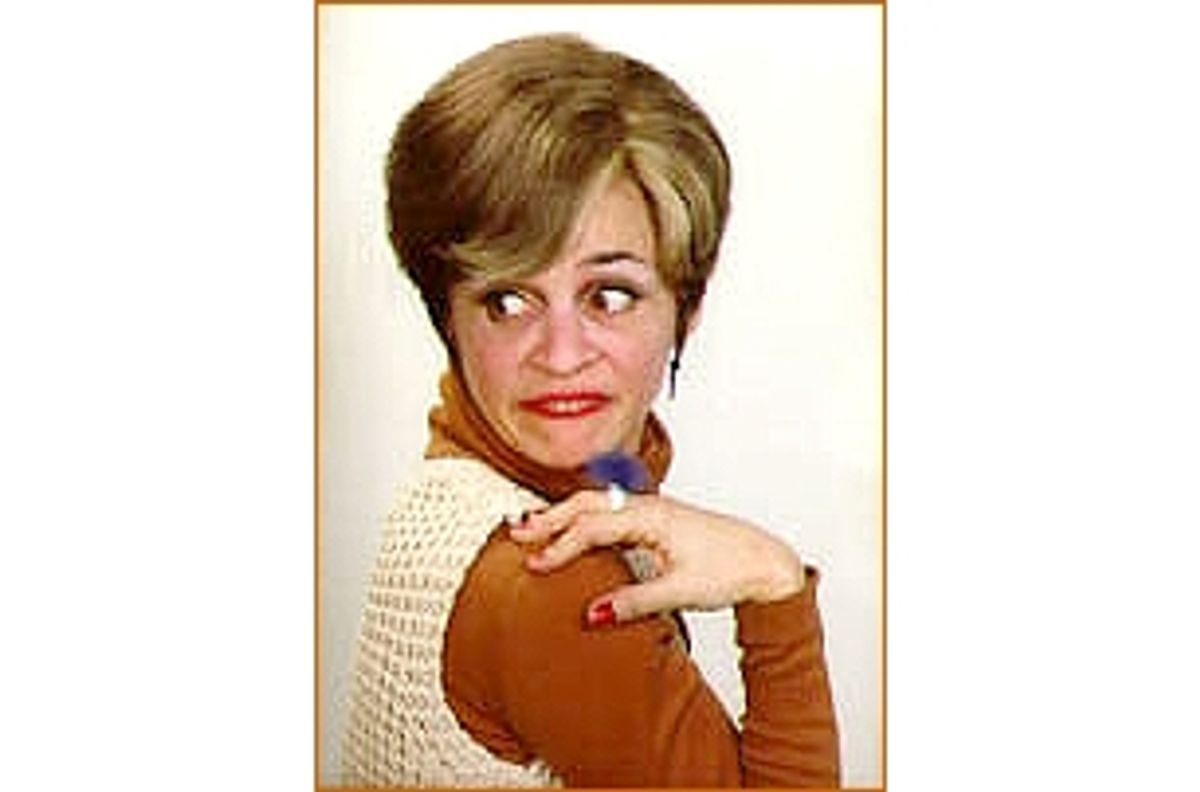
Amy Sedaris digs wigs and baking

The star of "Strangers With Candy" likes "small woodland creatures" and wants to play Angie Dickinson as "Police Woman."

  • more
    • All Share Services

Amy Sedaris digs wigs and baking

The TV roundup of your local paper might
list href="/ent/col/mill/1999/04/05/strangers/index.html">“Strangers With Candy”
as a sitcom, but to assume that this
implies the show bears any relation to
something like “Home Improvement” or
“The Nanny” would be a grave mistake.

When “Strangers” first aired two years
ago as a piss-take on those weepy “After
School Specials” of the ’70s, the show
tipped the scales with a warped wit
rarely encountered on the small screen.
Now, signed on for a third season on
Comedy Central, “Strangers” remains a
trusted outpost for those who find their
funny well beyond the standard sitcom
fare.

At center stage of the show is actress
Amy Sedaris, who plays the rumpled
chum-pot Jerri Blank. Blank is a former
teen runaway who, after a lifetime of
prostitution and drug abuse, has
returned to high school as a freshman at
age 46. With the possible exception of a
special trailer park edition of “Cops,”
“Strangers” is the only place one is
likely to encounter someone like Jerri
Blank.

The character represents an amalgam of
the fringe dwellers and human ruin that
have held the imagination of Sedaris
over the years. “The more serious they
are and the more tragic they are, the
more I’m drawn to them,” she admits.
“I’m usually the only person who’ll ever
talk to them and they tell me
everything.”

First, there was Bobbie. “I lived over
this woman in Chicago and she was just
trouble,” relates Sedaris. “I mean, she
had tattoos that she had tried to take
off herself. She also always thought she
was smelling formaldehyde. She’d call up
and say, ‘Hey, this is Bobbie downstairs
… Do I smell formaldehyde?’

“And she’d always drink too much and
fall down. I’d constantly see her with a
broken leg or a broken arm.” While
Bobbie proved an undeniably rich source
for any performer to draw from, Sedaris
also found inspiration from a late-’60s
drug prevention film. “We found this
documentary of this woman in the ’60s
who was a drug addict and a prostitute
and she’d go to high schools and talk to
students. The woman’s name is Flurrie.”
Sedaris adds, “She looks like Michael
Dukakis. She’s horrific looking.”

The final touch came when Sedaris
approached the wardrobe people at Comedy
Central during pre-production of the
series and told them, “I just want to
dress like someone who owns snakes.”
They responded with an assortment of
outfits that overpoweringly evoked
slutty ’70s sleaze. Jerri Blank was
born.

Sans the saddlebag thighs and prison
tattoos that help define her TV
character, Sedaris herself is pretty and
diminutive. She is also considerably
more laid-back, several RPMs slower than
her TV persona, which comes off as a
sort of manic, perverse Lucille Ball. Of
her recent appearance on Conan O’Brien
she groaned, “God, with all that
fidgeting and unfocused energy I had, I
looked like a damn monkey. So annoying.”

Some call it quality entertainment.

Sedaris’ Greenwich Village apartment is
tidy, nearly sizable by Manhattan
standards and distinguished by several
personal decorative touches. Choice cuts
of plastic meat are placed throughout
the living room. The TV is adorned with
a large plastic turkey. “I covered it
with foil for Thanksgiving and the
people who came over were extremely
disappointed when they found out it
wasn’t real.” There is also a stuffed
squirrel featured prominently on a
coffee table. “I really like squirrels.
My whole family does. We all like small
woodland creatures.”

Hard to say why it comes as a surprise
that Sedaris and her family hail from
North Carolina. But it is her home state
nonetheless. When asked what her life
might have been like if she had remained
there instead of defecting to the North,
Sedaris quickly responds, “If I had
stayed in North Carolina, I’d be wearing
ruffles or a uniform. You know,
waitressing and taking care of a stroke
victim … I probably would have been
dating him, too, by now.”

Not surprisingly, Sedaris grew up in an
open, permissive household where
creative expression was never
discouraged. “We all did our little
plays in our house,” she says. “For a
long time I had an imaginary classroom.
I’d come home from school, put on my
mom’s high heels and go right to the
back bedroom where I had a wall that was
one big chalkboard and I would teach my
imaginary students. This went on for
years and years. Then I realized I was
too old to do this, so then I just kind
of did it to myself in my head. I still
do that — like if I’m making an omelet
I pretend it’s a cooking show and I’m
teaching someone.”

Sedaris’ lifelong fascination with
costumes and wigs has also been lovingly
nurtured. “In the first grade I got my
first wig. It was a fall and I still
have it,” she says, gesturing to her
closet. “Since then I get two wigs for
Christmas usually. When I was a kid I’d
go shopping with my dad every Friday
night and I wore a different wig every
time I went,” she adds.

True to her craft, Sedaris would remain
in character the entire time she and her
father were at the grocery store. “It
was mostly neighbors that I would
imitate. I think most kids probably did
that stuff, I just stuck with it,”
Sedaris says with a shrug.

The subject of wigs has Sedaris bounding
off to another room. She returns with a
photo she had done with the help of a
makeup artist friend. It is a large
color print of Sedaris as Angie
Dickinson at the peak of her “Police
Woman” period. The likeness is
staggering. Sedaris is a convincing
blond, and with a gold turtleneck and
pistol poised, the transformation is
utter and complete.

It’s not merely an act of cosmetological
genius; Sedaris herself is totally
committed to her dream role. “I want to
play Angie Dickinson … I want to do
‘Police Woman,’” she says wistfully. “I
want to be so beautiful that I’m ugly.”

For Sedaris, the urge to transform
herself in front of a camera seems too
great to overcome. “If someone wanted me
to pose in a bikini for the cover of
Vanity Fair, I’d make sure I’d have some
scars or grow a hairline. To look in the
camera and act like you’re beautiful is
too hard for me.” She continues:
“Photographers always seem to appreciate
when you come in with ideas. I mean,
I’ll do what they want, but half the
time they don’t know what they want. So
I come and say, ‘OK, I got this
prosthetic leg, what can we do with
it?’”

Sedaris did in fact pose with a
prosthetic leg for Index magazine with
remarkable results. “That fake leg fit
me perfect,” she says. “It must have
been for a little boy.”

With her TV series in summer reruns,
Sedaris can return to her other
passions: stage work and baking. After a
two-year hiatus, she has agreed to write
and perform a play once again with her
brother, David, the author of popular
short story and essay collections such
as “Barrel Fever” and href="/march97/sneaks/sneak970305.html">“Naked,” and a frequently featured
commentator on the nationally syndicated
radio show href="/people/lunch/1999/07/16/glass/index.html">“This American Life.”

Exactly what their upcoming
collaboration will entail is a mystery.
“We have no idea what the play’s going
to be about, what sort of characters
it’ll feature. Nothing,” Sedaris says.
The only certainty at this point is that
it will be opening in six months.

Judging from their previous stage
collaborations, it does promise to be
engaging. Earlier Sedaris and Sedaris
works, such as “Stitches,” centered
around the story of a young woman who
had her face disfigured by a boat
propeller only to eventually star in her
own sitcom.

Then there was “One Woman Shoe,” where
welfare moms had to perform onstage in
order to qualify for their benefits.
Sedaris adds the following to her
risumi: “I’ve done my
little brother before as a donkey in a
play at Lincoln Center. I had overalls
and had a hat on. It involved animals in
the forest and had witches in it.”

One constant in each of these
productions has been the recurring
character best known as Piglet. Like
some knocked-up malcontent working the
Wendy’s drive-through, Piglet is the
embodiment of the foulmouthed hardened
teen everybody knows and loves. “She’s
in every play my brother and I do
together; we just change her name for
each play,” Sedaris explains. “You know,
you can’t do a character like that on TV
cause every word is fuckin’, fuckers,
fuckin’, fuck. Every word is a cuss
word. Audiences just go nuts over her.”

At most of the theater productions she
appears in, Sedaris also performs double
duty: acting on stage and selling
cupcakes in the lobby after the show.
She also specializes in cheese balls. “I
always sell out of whatever I bring.”

Why is she compelled to peddle baked
goods after a show? “I just love making
money. Cash, you know? It’s such a great
feeling.” Besides, Sedaris adds,
“baking is something to do at 3 in the
morning. If you’re bored, bake.”

But the growing popularity of “Strangers
With Candy” might just cut into Sedaris’
cupcake production. Several notables
have expressed interest in doing the
show. “ href="/people/feature/2000/01/26/janeane/index.html">Janeane Garofalo wants
to do the show again and Winona Ryder
has expressed an interest. I’ve heard
that href="/people/bc/2000/02/22/cher/index.html">Cher and href="/ent/music/feature/1999/04/27/waits/index.html">Tom Waits are big fans
of the show, too.”

Asked about performers she admires,
Sedaris says, “Clint Howard and that guy
from href="/ent/movies/1997/10/17boogie.html">‘Boogie Nights’ with the big
forehead that looks like an ax went
through it [John C. Reilly]. They both
kinda look like cave dwellers –
Cro-Magnons with big ol’ hearts.”

Despite its growing cachet among
celebrities, the double-barrel bizarre
nature of “Strangers With Candy” may
never play in the Midwest, but cult
status is OK with Sedaris. “It’s not a
show for everyone,” she says.

As for what to expect on “Strangers”
next season, it’s anyone’s guess. Except
for one thing. “I want to do a Ben
Franklin episode,” announces Sedaris.
“You know, bring him back from the past.
I turned on the TV and saw an episode of
‘Bewitched’ where they did that. Darren
was having some company over and there
was Ben Franklin standing in the living
room and messing with a lamp. I want Ben
Franklin on my show!”

Rex Doane is a writer in New York.

“Two and a Half Men’s” latest sexist dis

The co-creator of fart-joke staple "Two and a Half Men" is tired of all the punch lines about female anatomy on TV

  • more
    • All Share Services

Lee Aronsohn

Lee Aronsohn is sorry he said he was tired of your vaginas. As you were, ladies.

On Monday, the co-creator of “Two and a Half Men” issued a now-standard Twitter mea culpa, explaining that “it was a stupid joke. I’m sorry.” His offense? Kvetching on Sunday to the Hollywood Reporter, “Enough, ladies. I get it. You have periods … We are approaching peak vagina on television, the point of labia saturation.” Labia saturation: no longer just a weird side effect from antidepressants.

It has indeed been a banner year for vaginas on television, with one-liners about the holy of holies turning up all over the place — including on saucy, female-driven comedies like “Whitney” and “Two Broke Girls.” The truth is that few of these jokes are legitimately funny. They’re more often deployed to shock, and thereby make lame routines notable. Surely Aronsohn isn’t the only one feeling a little exhausted by the V-word.

But a guy who admits “we do far too many fart jokes on ‘Two and a Half Men’” is not one to go throwing stones at the glass house of body function humor. There’s an underlying, unmistakable anger to Aronsohn’s words, coming as they do from a man who last year snarled at the Toronto Screenwriting Conference, “What makes men damaged? Sorry, it’s women. I never got my heart broken by a man.”

Unfortunately for Aronsohn, a whole lot of uppity broads are totally on the rag this week, and as word of his Hollywood Reporter rant made the rounds, they just couldn’t help expressing their crankiness. On Monday, writer Jen Kirkman issued a menstrual “fatwah” on Aronsohn, deploying a series of period anecdotes and lamenting, “Just looked out my window and vaginas are storming the streets with sitcom ideas!” And actress Martha Plimpton admonished, “Um, Lee, women are 51 percent of the population & a coveted demographic for advertisers. What are you thinking?” She wisely added that his version of “peak vagina” amounts to a mere “25 percent of all writers, producers, creators, DPs, editors & directors in television.” She joked, “3 women on television is more than enough. I say we bring it down to 2. One can be black if she wants.”

Initially Aronsohn, no doubt feeling defensive and “damaged” by all the unladylike hostility, replied on Twitter, “Women, please look up ‘irony.” Well, I did – and there was a picture of one of the creators of “Two and a Half Men” giving advice on comedy. What does it mean?

Aronsohn has since deleted his snarky tweet and, after issuing the excuse that he was simply making a “stupid joke,” has been laying low.

It’s a depressing reality of contemporary network television that too many sitcoms rely on easy shock-value words and ostensibly naughty behavior instead of crafting believable characters and employing clever writing. That’s a crime that both male- and female-based comedies are guilty of.

But Aronsohn wasn’t issuing a plea for higher standards. Instead, he came off as a squeamish boy, irked at the notion that estrogen is seeping into the man cave of his prime time. He was arrogant and dismissive, and his implication that jokes about Ashton Kutcher’s penis are somehow inherently superior to those about Kat Dennings’ vagina is utter sexist nonsense. But thanks for the apology anyway, Aronsohn. And if it’s any consolation, we’re pretty sick of your hole too.

Continue Reading Close
Mary Elizabeth Williams

Mary Elizabeth Williams is a staff writer for Salon and the author of "Gimme Shelter: My Three Years Searching for the American Dream." Follow her on Twitter: @embeedub.

The great sitcom divide

Once you've grown used to adventurous shows like "30 Rock" and "Louie," the traditional sitcom feels like a relic VIDEO

  • more
    • All Share Services

The great sitcom divide 30 Rock, Two Broke Girls, Parks and Rec, How I Met Your Mother

On a recent episode of “2 Broke Girls,” the following writing somehow made it onto television:

(Waitress to dissatisfied customer)

Waitress: Would you like to see the menu again?

Customer: This is crap, I wanted Muenster.

Waitress: Well, I wanted to be running a Fortune 500 company instead of waiting on a toxic man-child like yourself. But we can’t always get what we want, so order something else, put it in your pie hole and get on with your damn life.

- – - – - – - – - -

I hadn’t realized my taste in comedy was so elitist until I watched some of the new multi-camera sitcoms and observed what I had assumed was an already long-dead form of comedy. When I say “new,” I’m referring to multi-camera shows that have persisted after the advent/rise of the single-camera sitcom. If, like me, you’ve spent recent years watching “30 Rock,” “Arrested Development,” “Louie” and “Curb Your Enthusiasm,” it’s a completely different experience to tune into talked-about shows like “Whitney,” “2 Broke Girls” and “Are You There, Chelsea?”

Broadly speaking, there are two ways to shoot a sitcom. There’s the traditional multi-camera style of “I Love Lucy,” “The Cosby Show” and “Seinfeld” — as seen currently on hits like “How I Met Your Mother” and “Two and a Half Men.” On the other hand, “30 Rock,” “Arrested Development” and “The Office” use a more cinematic single-camera shooting style. Multi-camera shows usually have a live audience or laugh track; single-camera shows dispense with the stage metaphor and have no laugh track. For you gamers, it’s somewhat analogous to the difference between a side-scrolling video game like Mario Brothers and a first-person shooter, like Halo.

A testament to my solipsism, I hadn’t seen any of the new multi-camera shows (all of which are more highly rated than those I regularly watch) until recently, when the matter was brought to a glaring point. The deeper we get into our Internet-powered, on-demand culture bubbles that let us watch only the things we care about, the more jarring it is to see things that have mainstream, popular appeal. For the past several years, I’ve been experiencing comedy in a completely cinematic form as opposed to the more vaudevillian stylings of its television roots. These single-camera shows — even in faux-documentary style, like “The Office” — are more polished, with music, editing, shooting styles, lenses and lighting that all aid in the creation of each show’s particular timing, realism and comedic atmosphere.

Comparatively, shows like “Are You There, Chelsea?” or “2 Broke Girls feel simultaneously contrived — the seams of construction are so obvious — but also more honest in their presentation. The actors remain actors and rarely disappear into their characters. They are in makeup and hair and costume, underneath a harsh light, standing on their mark, trying to deliver jokes on cue, pausing for laughter. There’s a certain grit and intensity in relating to the actors as well as the characters they perform.

If you’re accustomed to single-camera comedy, watching a multi-camera show is a startling change. Most films and shows eliminate all signs of performance, thereby boosting realism, by inserting multiple distancing layers (editing, music, specific camera lenses, etc.) between the viewer and the actor. Consider this scene from ”30 Rock”:

The hand-held camera, quick edits and natural lighting all aid in our acceptance of the performance and set as real, thereby helping the jokes hit their mark. If this same scene occurred on a multi-camera set, with typical TV lighting, a stationary camera and even slightly slower editing, we would suddenly be aware of Alec Baldwin instead of Jack Donaghy, and Tracy Morgan instead of Tracy Jordan.

In comparison, the actors on multi-camera shows barrel forward with fascinating vulnerability. Each actor has jokey jokes to pound out and laughs to wait for. An actor’s reliance on his partner’s performance in a scene is perhaps nowhere as clear as on a multi-cam show. All this without the helpful and flattering gauze of expensive cameras and location shooting. This might make the multiple-camera sitcom the perfect place for comic writers and actors to prove their ability, and simultaneously, since it is so exposing, the riskiest place for the untalented. You can’t hide in a multi-camera show, and unfortunately, most of these show are less than stellar. As the more sophisticated comedies have gone single-camera, we’ve been left without a ”Seinfeld,” “Cosby Show,” “Dick Van Dyke” or even “Laverne and Shirley” to showcase great comic ”stage” acting.

But though the writing on ”Arrested Development,” for example, is smarter and funnier, the simplicity of multi-camera shows is refreshing. The writing is often horrendously bad and the jokes consist mainly of characters insulting each other, but for all their sexual idiocy and reliance on racist caricatures, these shows have worth despite themselves.

When we watch these shows, we are part of an audience in a way that we aren’t in the more intimate viewing experiences that single-camera shows offer us. The theater-like form of the multi-camera show requires us to embrace artifice in an era where performance and deliberate creation are hidden.

As our society continues to create new ways to communicate while we remain in individual isolation, the multi-camera sitcom might be one of the last places many of us participate in a communal viewing experience (even if it’s a simulated one). Movies are increasingly viewed at home and hardly anyone can afford to go to live theater. As I struggled through “I Hate My Teenage Daughter,” I felt a tingle of that camaraderie that arises when we’re part of an audience.

The live studio audience, a set that is very obviously a set, or even a laugh track, as simple and stupid and taken for granted as it is, are subtle and powerful tools that shape our viewing experience. An agreement between the actors, the set and the audience is loud and clear: We’re putting on a show for your entertainment. For 21 minutes we experience, in the teeniest-tiniest way, the essence of comic theater. Let’s hope someone remembers what these shows can be and makes one that’s actually worth watching.

Continue Reading Close

Television's season of the vagina

The once-taboo word enters heavy sitcom rotation. If this is a victory for women, why don't the jokes seem funnier?

  • more
    • All Share Services

Television's season of the vaginaBeth Behrs and Kat Dennings in "2 Broke Girls"

Long ago, vaginas were barely acknowledged in prime time. Mary Richards and Laverne and Shirley never mentioned theirs. Even Carrie Bradshaw only gave hers a few passing nods. And while “Grey’s Anatomy” turned “vajayjay” into a euphemism a few seasons ago, this year, there’s very little pussy-footing around. Vagina! Cue laugh track!

It’s a big year for the vagina, which has been asserting its presence as the go-to punchline for months now. It’s been lightheartedly hailed as the “center of civilization” (sorry, Williamsburg) in one Summer’s Eve douche campaign and turned into your sassy, vaguely racist BFF in another. Last month, Olivia Wilde one-upped Jennifer Love Hewitt’s now legendary explanation of vajazzling by describing her favorite “vagina tattoo” on “Conan.”

But now that the fall television season in full swing, it’s all ladybiz, all the time. On an upcoming episode of “Whitney,” its eponymous star Whitney Cummings ponders, “When did vaginas get so boring?” And in the opening moments of “Two Broke Girls,” waitress Max references “the sound of my vagina drying up” — a gag Bill Carter recently described in the ever-decorous New York Times as a “deleterious effect.” And “your vagina” turns up in zingers in “Free Agents” and “Suburgatory.” Coming next week: jokes about your mom’s vagina.

A portion of the vag effect can surely be laid directly at the feet of Whitney Cummings, who created “Whitney” and co-created “Two Broke Girls.” As Cummings told the Times last week, “If one day passes without me writing any more vagina jokes, my career is blown.” Cummings rightly notes that “our tolerance for what is edgy is changing” — when people can get unbleeped jokes all day on “Funny Or Die” or “College Humor,” why would audiences laugh at more delicately phrased jokes any more? But networks still have standards, just as joke writers still have marks to hit. “Muffin,” for example, might work in the family hour, but it doesn’t pack enough aggressive wallop. The C-word packs too much. And because it’s an anatomical term, vagina gets a pass that a pornier sounding turn of phrase would not. Enter vagina, laughing.

But why is the vagina having a moment now? A recent Associated Press story on “The vagina’s growing public profile” says it’s part of a “trend of women saying, ‘Hey, we’re not embarrassed to talk about this.’” And in his Times piece, Carter speculates optimistically that “The liberation of language could be read by some as barometer of how far women have come as creators of television content.” Really? Does all this “Power to the V” and chatting about pubic tattoos on late-night talk shows represent emancipation, linguistic or otherwise?

After all, the never-to-be-outdone penis has managed to assert itself this year as well. Matt LeBlanc’s allegedly formidable member is the unseen supporting star of Showtime’s “Episodes,” while Ashton Kutcher’s similarly Brobdingnagian rod has already more than announced itself on the revamped “Two and a Half Men.”  We are still a long, long way from one-liners about the magnificent, near-frightening quality of any sitcom star’s wonder cooch. And “vagina” is yet to be used as a brassy, admiring synonym for moxie.

It doesn’t take long, when you’re thinking of a put-down or a punchline, to veer toward the genitals or their excretory and sexual functions. And why not? Douche commercials aside, our privates truly are the core of our humanity. They motivate and enthrall and sometimes disappoint and embarrass us, yet keep the species going. They’re beautiful and weird, and all it takes is one picture of Michele Bachmann eating a corn dog to prove that inside almost every adult is an 11-year-old boy.

For now, “vagina” is still the Voldemort of prime time, a word that has been unspoken for so long that it has a mystical, fearsome ability to shock.  So simple. So plain. So powerful. But though it can provoke titters, “vagina” by itself isn’t uproariously funny. And if your prime-time sitcom can’t provide real jokes for its punchlines, chances are it won’t be long before your slot disappears altogether.

Continue Reading Close
Mary Elizabeth Williams

Mary Elizabeth Williams is a staff writer for Salon and the author of "Gimme Shelter: My Three Years Searching for the American Dream." Follow her on Twitter: @embeedub.

The retro sexism of “Whitney”

A new sitcom trots out the battle of the sexes -- circa "Three's Company." Who's ready for more cellulite jokes?

  • more
    • All Share Services

The retro sexism of Comedian Whitney Cummings arrives at the 12th Annual Young Hollywood Awards in Los Angeles, Thursday, May 13, 2010. (AP Photo/Chris Pizzello) (Credit: Chris Pizzello)

Ladies, don’t you just hate it when you’re ovulating? And guys are, like, not? Am I riiiiiiight?

It hasn’t even premiered yet, but Whitney Cummings’ aggressively promoted new sitcom may just be the most unself-awarely retro-sexist show on television. And in a season that’s giving us Playboy bunnies, sexy stewardesses and Charlie’s Freaking Angels, that’s quite an accomplishment.

As you likely already know from the deluge of magazine ads, billboards and canned laughter-heavy promos, “Whitney” is about a woman who’s happily unmarried to her scruffy yet adorable boyfriend. But lest you think this is some subversive takedown of biological clocks and enforced monogamy, the jokes about how a woman’s “silent treatment” isn’t really a punishment — probably not. Previews for “Whitney” include — I am not kidding — references to Cosmopolitan magazine, cupcakes, being “whipped,” and whether or not men are like cavemen. There are also references to cellulite, looking fat, her period, and what women “really mean” when they talk. As Best Week Ever exasperatedly points out, the show’s campaign might as well read, “Blah blah blah shopping. Blah blah blah PMS. Blah blah blah weight issues.”

Yet it would appear that our conquest by the short skirt-wearing, cutesy gun necklace-sporting Cummings — who writes her self-titled show and also co-created the marginally more promising “Two Broke Girls” — is all but inevitable. A recent Sunday New York Times Magazine profile in which she describes herself as “the weird, quirky, funny girl” ominously warned that “There Is No Escaping Whitney Cummings.” 

“Whitney” may yet prove to be something other than the lame one-joke disaster NBC is currently showcasing it as. Who’d have thought “Cougar Town” would evolve into something funnier and more multidimensional than its dismal first few episodes? But despite the media blitz and near frantic promotion, is there really an audience for more clichés about how supposedly hilarious our gender differences are? The truly horrific “I Don’t Know How She Does It,” a 90-minute collection of “Men are like this, but women are like this!” jokes, sank like a rock in its opening weekend.

Yes, men and women are different. But humor comes from originality and specificity, the way that Alison Brie makes “Community’s” Annie  an uptight dork but a thoroughly rich character, or the way that Margaret Cho can wring wry wit out of real pain and anger. “Bridesmaids” was a movie about bridesmaids and managed to avoid sinking into the morass of tired “men are such beasts and girls are such girls” jokes. Sunday night’s female Emmy nominees and winners — smart, complicated, breathtakingly goofy women like Melissa McCarthy, Martha Plimpton, Jane Lynch and Tina Fey, among others — prove that you can be funny and a woman without constantly having to be funny about simply being a woman. And America may just not get into that giant Hot Tub Time Machine back to the Comedy Barn, where the Token Female is doing a routine about why the line is always longer in the ladies’ room.

Continue Reading Close
Mary Elizabeth Williams

Mary Elizabeth Williams is a staff writer for Salon and the author of "Gimme Shelter: My Three Years Searching for the American Dream." Follow her on Twitter: @embeedub.

The Corner: All culture is devious propaganda

Liberals have been destroying the American family 30 minutes at a time, according to Ben Shapiro

  • more
    • All Share Services

The Corner: All culture is devious propagandaWilliam F. Buckley, and Jesse Tyler Ferguson and Eric Stonestreet from "Modern Family"

How weird and sad life must be when viewed through the eyes of Ben Shapiro, pop-culture warrior-in-residence at the National Review. It is his job to pretend (or, good lord, actually believe) that everything that appears on your TV set — not just the news bits, but the cartoons and toothpaste commercials and laugh-tracked situation comedies — is part of a liberal plot to destroy the American family. Here is a fun pop culture listicle, “The Top Ten TV Dads,” done the National Review way: “It’s instructive because we can see the transformation of fatherhood on television reflecting the left-wing bias against traditional family roles.” Oh, can we?

Ward Cleaver is the best. Mike Brady is ok, but with a caveat: “We’re already moving into the era of alternative family structures….” It seems likely that Shapiro has never watched half these shows, but did perhaps thumb through a TV Guide or flip past Nick at Nite in the early ’90s:

Archie Bunker (All in the Family, 1971-1979)

Archie is a good dad but a horrible person. Here’s where television begins to change from the respectful view of fathers to the flower-power view of fathers as racist, bigoted, old men you can mooch off of for years on end.

Steven Keaton (Family Ties, 1982-1989)

Steven is in one way a reversal, in another way, a step forward for liberals. Where liberals were militantly anti-father with regard to conservative dads, they’re all of a sudden in favor of traditional father roles when dad uses his authority to promote hippy liberalism. Steven always gets the last word, even if we love Alex.

It’s culture commentary as grand conspiracy! “In 1985 the anti-cyborg LIZARD PEOPLE who control television allowed a positive portrayal of robots with ‘Small Wonder’ but by 1986 it was back to their typical electronics-bashing….”

Shapiro, formerly the world’s youngest hack columnist, is no longer the world’s youngest anything, and so I guess I can’t begruge him his new schtick, but I can’t imagine even the dullest wingnut feeling compelled enough by the thesis (all of your favorite trash TV is a plot against you!) to pick up an entire book on the subject.

The great Roy Edroso has been on the case of Shapiro’s miserable worldview for some time and is required reading on the subject. But can I just:

Al Bundy (Married … With Children, 1987-1997)

A horrible father, a vulgar personality, and a cynical jackass. The Left’s newfangled view of traditional fatherhood takes Archie Bunker a step further, now stating that middle-American conservative dads aren’t good dads or good people.

Al Bundy was a blue-collar tragic hero, you dolt!

The fun listicle ends with a shot at the dads from “Modern Family,” who are guilty of portraying gay parents, without showing the disastrous consequences of gay parenthood (generally: happy, well-adjusted children, from families where they always felt loved and appreciated, in my experience). Still: After complaining about the Left undermining fatherhood for years by presenting fathers as absent or abusive, the Left hands Ben Shapiro two perfect dads and he’s still unsatisfied.

I can’t imagine what he’ll think of the pilot I created, “Three Dudes and a Horse, All of Whom Are Married to One Another, Raise Children in West Hollywood.” (ABC just picked it up! Being on the Left is great!)

Continue Reading Close
Alex Pareene

Alex Pareene writes about politics for Salon and is the author of "The Rude Guide to Mitt." Email him at apareene@salon.com and follow him on Twitter @pareene

Page 1 of 4 in Sitcoms