Jamie Allen

Misty and meat pies

Reflections on a girl I once knew -- and the most famous food in Natchitoches, La.

  • more
    • All Share Services

Misty and meat pies

I remember myself at that time as gangly and dim. I was 18, just removed from my first year of college, during which time I played baseball, ate Buffalo wings, drank beer, whispered lies to young women and slept. School? Let me put it this way — I got a “U” (as in “unsatisfactory”) in Typing 101 and the rest of my grades added up to “academic probation,” which is the university’s way of saying, “Yep, this guy’s dim.”

So, on the flight to Monroe, La., where I would visit my dad for three weeks, I was filled with a sense of freedom. It was the chance to escape my life for a spell. What I had — a retreat from school, a comfortable suburban life and a girlfriend I didn’t like anymore — was creative-enough punishment. But Dad saw to it that I’d spend my time steam-cleaning Case machines at his tractor company for eight hours a day at minimum wage, a not-so-subtle hint that if I kept up my study practices, minimum wage is exactly what I’d be earning for the rest of my life.

In other words, the visit was a way to purge myself of my failures and realize my potential. Of course, being dim, I had only a vague understanding of all this.

Monroe (pop. 56,000) and its smaller “twin city,” West Monroe (pop. 14,000), are split by the Ouachita River, lying a couple of hundred miles northwest of New Orleans in a flatbed portion of the state. In design, Monroe is the prototypic small Southern town — a centralized downtown with a few “skyscrapers” hovering over early 20th century homes. Delta Airlines was founded there, agriculture is a big industry and the University of Louisiana at Monroe adds academic appeal.

There’s a paper mill a few miles outside town that in spring competes with the scent of magnolias. It was hot that May, and the fawning oaks and crawfish clay absorbed the sun and held it in like a brick oven. My first day of work, Dad woke me at 6 a.m. by pulling open my left eyelid and shining a flashlight into my brain. Clearly, I wasn’t in college anymore. I dressed in the official company attire, a green jumpsuit with my name stitched on it. I grabbed a quick breakfast, hopped in my temporary transportation — a red CJ5 Jeep modified with a Ford V-8 engine and fat tires, which made it much like the early rockets that blew up on NASA launchpads — and drove to work. Dad’s tractor company was located on an industrial road on the outskirts of town.

Before I knew it, I was standing on a cement platform in the tractor yard out back, the early-morning sun already stinging the back of my neck. Before me, stretching out like the skeleton of a stegosaurus, was a muddy backhoe. J.T., one of my dad’s workers, was standing next to me. He had a thick brown beard and no teeth, giving his mouth the appearance of, among other things, a pink cave surrounded by fire-blackened scrub brush. His dentally challenged state, coupled with a thick-as-molasses Southern accent, made him impossible to understand as he explained to me how to steam-clean a tractor. He walked off.

I stood there for a moment, holding the steam gun in my hand, eyeing the caked backhoe. Then I blasted the tractor for a good 10 seconds. A trickle of mud ran to a nearby drain. The tractor was still covered, and the mud — crawfish mud, which smells like rotten eggs when it gets wet — was like cement. I blasted again and felt the rifle start to heat in my hands; I was realizing why, in fact, it was called “steam” cleaning. Mud began to splatter in chunks and brown spray. It got hotter. Every once in a while, I stuck my head under a nearby water spigot to cool off.

At lunchtime, Dad came out to check on me.

“Jesus,” he said at the sight of me. “You’re covered in mud.”

I looked at myself. He was right.

“You know, you don’t have to stand so close when you’re cleaning them,” he said.

“Oh yeah?” I said.

“Wanna eat lunch?”

“Can I?” I felt like I was in prison.

“Yeah, we’ll let ya.”

Southern folks have a way of recognizing the potential for a good story while it’s still happening. I discovered this when I walked into the tractor company lunchroom. My name was Mud and you could hear the whoops and hollers all the way to downtown Monroe.

My dad, to his credit, took pity on me. After work and a cool shower, I came out to the kitchen of his old Southern cottage. His house always smelled like someone was roasting garlic somewhere, and the double-hung windows were open to let in the dusky air, tinged with Confederate jasmine. He sat me down at the dinner table; he had something he wanted me try. He always had food he wanted me to try — baba ghanouj or crawfish itouffie or chicken sauce picante, just the type of fare that fans of Buffalo wings tend to avoid.

This time it looked like a miniature half-football, steaming on a small plate. A bottle of Tabasco sat next to it.

“What is it?” I asked.

“Try it,” he said, handing me a freshly poured, icy beer.

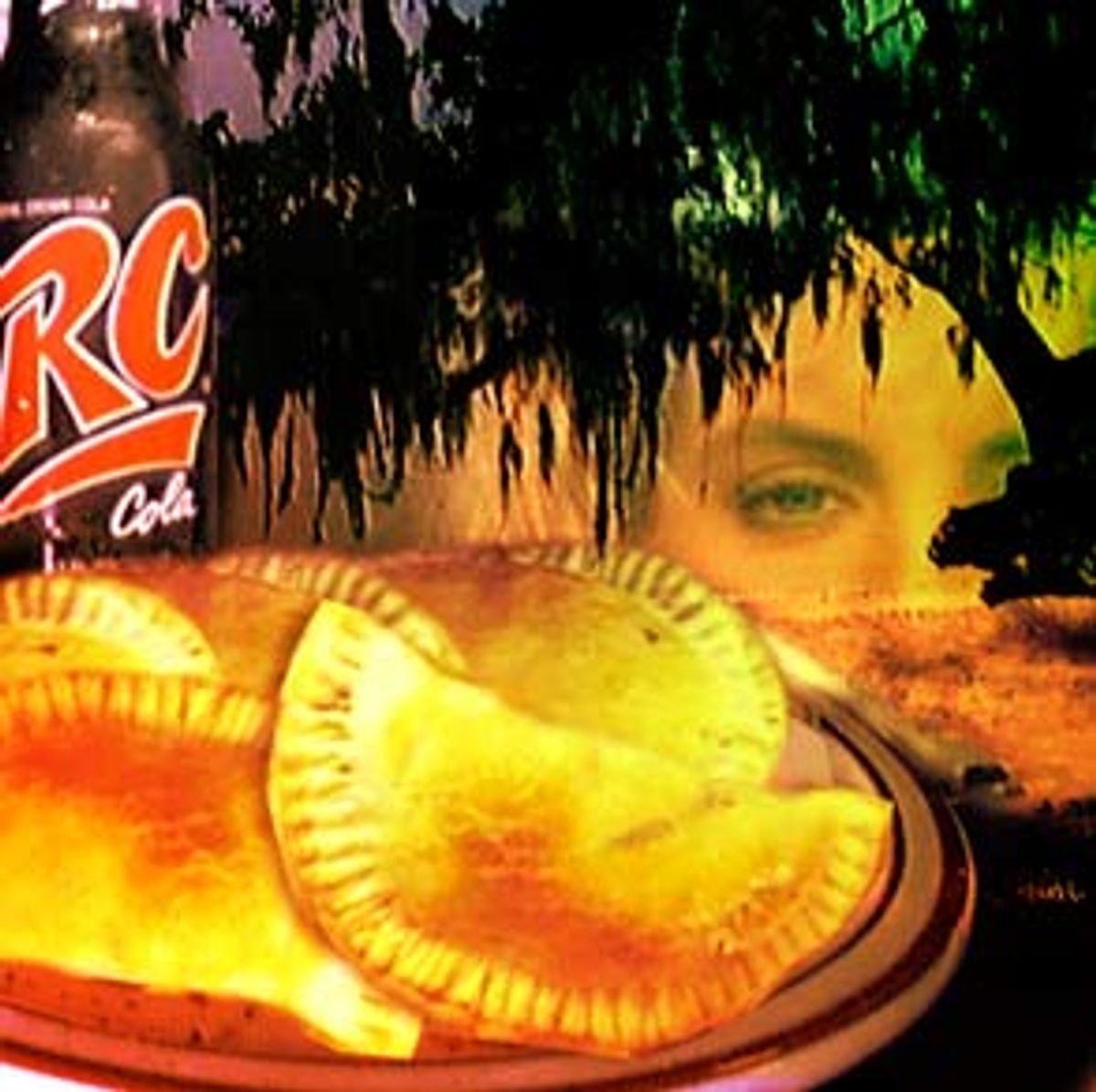
I did. It was some kind of crescent-shaped pastry filled with a spicy meat concoction and deep-fried. It tasted of green onions and garlic and seasoning that mingled like friends at a spring picnic. “It’s called a Natchitoches meat pie,” Dad said, pronouncing it NACK-a-tish. “They’re made in this small town a few hours from here.” I didn’t really care. It could have been filled with rat livers and I wouldn’t have cared. It tasted good, and I was hungry after working all day in the sun. I added Tabasco, scarfed it down, drank my beer, asked for more. That night, before bed, I had another pie. The next morning, after Dad woke me with a squirt gun, I had one for breakfast and packed two for lunch, along with a Coke. It seems Dad had a never-ending supply of the meat pies in his freezer.

My time in Monroe quickly fell into a rhythm. I’d rise early to avoid Dad’s practical jokes, pack my lunch, jump in the Rocket and head to work. I’d steam-clean until lunch, eat meat pies while struggling through a conversation with J.T., steam-clean until 5, rocket home, eat more pies, fall asleep early. I was getting better at the job, too, perfecting a way to spray the tractors without dirtying my entire person. (It’s all in the angle of the steam gun.)

Manual labor isn’t bad for the imaginative mind. There’s something mesmerizing about standing in the same place for hours, sweating, watching hot water run off steel and earth. It’s the fodder for daydreams, and — contrary to my dad’s efforts to persuade me to enjoy school — I was cultivating a fantasy about me as Blue-Collar Guy. I was reinventing myself into a life away from classes that make you type to classical music. Forget professional baseball, or whatever else it was that I thought I might get out of college. To me, steam-cleaning wasn’t a bad life. It was simple and relaxing.

Sometime near the end of that first week, Dad took me to his friends’ house. As with new foods, he was always introducing me to people — the Pilot, the Knife Guy, the Hunter. Now it was Neal and Doll’s turn, a middle-aged couple pulled straight from a Southern play. As I remember, Neal resembled Robert Conrad in the face. He was a scratch golfer who often practiced his golf swing in the middle of a conversation. He had Popeye forearms and a torso not unlike an upside-down pyramid. Doll, meantime, looked her name — porcelain skin, frumpy dress, sad eyes.

We said hello and made small talk as we all stood in the kitchen. Doll offered me sweet tea, and though she smiled, her eyes were still sad. As the conversation flowed, it occurred to me that I was being interviewed. They wanted to know what I was studying (“the usual”), what being a baseball player was like (“cool”).

A young girl walked in. She was maybe 13, Neal and Doll’s daughter. She smiled at me as if she knew a secret, then turned to her mom.

“When’s Misty gittin’ home?” she asked.

“She has class. She’ll be home shortly.” They were both smiling at me.

“Misty goes to the university,” Dad said, and I couldn’t help noticing the odd look on his face. Was this a setup of some kind?

“No kidding,” I said. I once had a cat named Misty.

“She sings in the church choir, too,” said Doll.

“Don’t scare the boy off,” said Neal.

“Mom, Dad, please,” said Misty, who had overheard her parents as she entered the house, then the kitchen. She smiled at me. I felt like a dirty young man. She was 19, a wisp of a girl, 5 feet tall and 90 pounds, with straight brown hair, bangs. My virgin detector went on high alert.

Naturally, I picked her up the next night for our first date. While she finished getting ready, I waited in the kitchen with her dad. Neal was flexing his forearms.

“You know how I got these forearms, Jamie?” he asked.

I shrugged.

“Scoopin’ ice cream,” he said. “I used to work at an ice-cream shop when I was in high school. That’s where I met Doll. And I’d scoop ice cream all night long.

“Look at that,” he said, flexing one arm.

“Wow,” I said, impressed. I was immediately sure that Neal was making a veiled reference to throttling the air from my lungs with those forearms should anything happen to his Misty. I didn’t want to disappoint him, at least not until I got Misty out of the house.

I don’t remember where I took her that night — dinner? ice cream? The important thing is that we ended up on my dad’s couch, watching movies, eating Natchitoches meat pies. (I was hooked, I tell you.) She asked me about baseball, and I happily regaled her with heroic stories about how I was a red-shirt left-handed pitcher who couldn’t find the plate. It got late. We traded soft kisses, and then traded bites of a pie.

Eventually, tired from the workday, I rested my head on her lap. While she brushed a hand through my hair the conversation entered that late-night zone where walls collapse and the truth slips out like details of a sleep talker’s dreams. I told her about my grades and my girlfriend back home. She told me she was a virgin, and I secretly patted myself on the back.

We made a unique couple. She’d take me places in her Hyundai; she hated the Rocket. She did well at the university; I was dim. I liked listening to Tom Petty; she liked to blare Amy Grant — when Amy Grant was pop-gospel — at top volume in her car, windows rolled up, singing along as if she were in church. I liked daydreaming; she liked asking me what I wanted to do with my life.

Each night we would end up on my dad’s couch, making out. I was hoping to teach the choirgirl to sing the praises of premarital sex. Things would get heated, skin rubbing and pushing, breath rising. I’d make a move to the promised land. She’d stop me in a voice as certain as a church hymn.

“Not yet.”

Rejected, I’d head to the freezer for a tasty meat pie. It was my first actualized experience of the connection between sex and food. I was merely heading to where the pie was plentiful. I was projecting my raging libido onto those pastries. I couldn’t get enough of them. I dreamed about them, wished for them while steam-cleaning, while driving the Rocket.

One morning, Dad came into the kitchen and said, “We’ve run out of meat pies.”

“Yeah.”

“That was my summer supply,” he said, a bit confounded. It was late May.

“Can’t we get some more?” I asked. I assumed we could pick some up at Publix or something.

He walked out. Apparently, there were ways to make the pies, but the best pies came from the place they were named after. Later, we formed a plan. I would take the next day off from steam-cleaning and drive to Natchitoches.

“Why don’t you call Misty and ask her to go?” Dad suggested. I did. She had a class, but she said she’d skip it.

I should have known not to take the Rocket, but who thinks at 18? Besides, I saw the potential for My Life as a Jeep Commercial: the open road in front of me, the sun overhead and a girl at my side.

The journey took Misty and me southwest to Natchitoches, along Interstate 20 to U.S. highway routes populated by roadkill and semis. But the scenery mattered not to me. I was just happy to be away from work. Plus, there was the vague hope that Misty, away from her dad’s gravitational pull, would lose touch with her virgin self and suggest a spontaneous rendezvous in the Rocket. And if that failed, there was the tangible idea that we’d soon be loaded down with delicious meat pies.

We listened to Amy Grant and Tom Petty. We talked. She got quiet. She had something she wanted to tell me, because she really liked me, she said.

“I had a brother,” she said. She told me he was younger than she, older than her sister. He was killed in a boating accident. Neal’s flexed forearms and Doll’s sad eyes suddenly made sense. I got lost and didn’t admit it for an hour. By the time we pulled into Natchitoches, we were sun- and wind-burned, thirsty, tired. We stopped at the 7-Eleven for drinks.

Natchitoches is home to Northwestern State University today, but it bills itself as the oldest permanent settlement in the land that made up the Louisiana Purchase. Located on the banks of Cane River Lake, it was founded as a trading post with the Spanish and Indians in 1714 by French Canadian Louis Juchereau de St. Denis.

Today, the town has a population of 17,000, with more than half taking classes at the university. I remember crooked streets through century-old neighborhoods and downtown.

We pulled up to Lasyone’s Meat Pie Kitchen on Second Street, one of many Natchitoches shops that sell pies at $2 a pop.

“Where ya been?” the gray-haired black woman said as we walked in.

“Huh?” I said.

“You’re pickin’ up the meat pies, right?” she asked.

“Yeah.”

“We been waitin’ for ya.”

“Here we are,” said Misty.

“We got turned around,” I offered.

“Help me with this,” the woman said to me. We picked up a large Styrofoam cooler stocked with pies and loaded it in the back of the Rocket. I tried to give her my dad’s credit card. She waved it off.

“Your dad already paid,” she said, walking back to the store.

If only the rest of the journey had gone so smoothly. We rolled east in the Rocket as thunderheads formed behind us, cruising on high winds to eventually cover us. I hadn’t brought the Rocket’s top. Who thinks at 18? The rain started falling somewhere in the middle of nowhere, when the open road offered no shelter. I handed Misty a dirty towel from the back seat.

The Rocket began to misbehave. Apparently the tires were not unlike the slicks found on dragsters, making the Rocket’s light frame and powerful engine a model for hydroplaning. I ignored the first couple of slides to the side of the road, ignored the 10-foot drop to a water- and mud-filled gully. In fact, I gassed the Rocket’s V-8, using the logic that speed was my only weapon for escaping the rain.

The Rocket started sliding again and didn’t stop. We left the road, bouncing out of control toward the ditch. I still have a picture in my mind of that moment, like a Polaroid, smeared at the edges and far away: Neal’s baby, her 90-pound frame in midair, hovering over the Rocket’s passenger seat, over the gully, like a doll, held only by the loose seat belt strap reaching over her skinny, pink thighs. I reached for her, grabbed her in an awkward place, lost her, saw the gully move closer, prayed with Misty, bounced more, lurched to a stop.

A semi roared past. Misty was still with us. So were the pies. Cars sprayed us. I heard my heart and thought it was the engine; I tried to drive but went nowhere. So much for reinvention: I was still an idiot. I started the Rocket and slowly pulled out. We were soaked. We didn’t say a word.

It was dark when we got back to Monroe. I pulled up to Misty’s house and she gave me a peck and got out. We didn’t talk for two days. When I called, she seemed distracted, and said I seemed distracted. Regardless, my time in Monroe was running out, so we made the effort to meet on the couch a few more times. But it never happened.

I have no doubt the relationship would have failed had I stuck around. But this was the first time I had left before getting through that initial phase of getting to know a person. The relationship was left in eternal limbo.

Before heading to the airport, Dad and I stopped by Neal and Doll’s house. I have no recollection of the goodbye scene with Misty — just the firm handshake from Neal and the awkward farewell with her mom as she surprised me with tears and a hug, then gave me an 8-by-10 high school photo of Misty that I had no idea what I was supposed to do with.

“Come back and see us soon,” she said.

“I will,” I said. “Definitely.”

Of course, I didn’t. Dad took me to my plane. My luggage included a small cooler of meat pies. I ate all of them within a week. Misty and I wrote to each other a couple of times. I went back to school. And I learned how to type.

“Smells Like Teen Spirit”

Was Nirvana's angry, culture-shifting 1991 anthem really a revolution? Maybe not. But it changed my life.

  • more
    • All Share Services

The first time I heard “Smells Like Teen Spirit,” I was sitting in the passenger seat of a pickup truck in Tampa, Fla. It was the fall of 1991 and I was a washed-up baseball player who had just graduated from college.

My next idea was to become a writer. I played in a band, wrote in my journal and went drinking with my buddies every night. This was on my parents’ bill. America was locked in a deepening recession and I was a slacker, in the days before slackerdom became a viable marketing demographic.

There was more missing in my life than a steady job. College had been a great disappointment. All we did was sit around and talk about other times. I listened to Bob Dylan and wished I had been alive in the early 1960s. The Gulf War had stirred things up briefly, but how can you aim your discontent at a video game? I had been bred to believe that I had been born at the wrong time, that nothing happened in my generation and that the last real cultural and artistic revolution was at least 20 years in the past. I was thinking about getting a job in sales.

The stereo system in my friend’s pickup was the ultimate. He was the drummer in his own band and he needed sound, loud sound, to surround him at all times.

“Listen to these guys,” he said, putting on the album “Nevermind” by Nirvana. “Teen Spirit” clinked its first guitar riff, then roared to life. It was easy not to listen to music then. The Milli Vanillis and Tiffanys seemed to have drained the life out of the record charts.

But halfway through “Teen Spirit,” I sat up in my seat. Clearly, the singer was pissed off, though I couldn’t understand a word he was saying. But he was also reaching into the melodic stratosphere and coming back with a simple tune that made you want to do something, even if you were a washed-up ballplayer who thought you just wanted to drink beer.

“Jesus,” I said to my friend. “Who are these guys?” I was probably more alarmed than impressed.

He handed me the CD case. The cover’s picture of a naked baby swimming underwater, reaching for a dollar bill hung on a hook, seemed to say, “Nothing is sacred.” I opened it, and on the inside, there they were: Nirvana. And the blond guy was shooting me the bird.

The story of “Smells Like Teen Spirit,” and the success that this five minutes and two seconds attained, is the story of rock ‘n’ roll: ugly and beautiful and triumphant and tragic.

Music fans know about its writer, Kurt Donald Cobain of Aberdeen, Wash., by now. The product of divorce and other family dysfunction, heroin addiction and his own apparent psychological problems, Cobain in hindsight seems predestined for suicide, which came at the age of 27, at his Seattle home, with material success all around him.

Long before that, Cobain was a familiar character to anyone who attended high school in the United States. He was the skinny burnout, the guy who would pick a fight with a redneck, then get his ass kicked. He was Jeff Spicoli from “Fast Times at Ridgemont High,” but with an intellect and a venomous bite.

Cobain was different from the stereotypical burners in one crucial way. For whatever reason — practice, God’s gift, random fate — he was able to churn his cauldron of discontent into delicious, consumable music.

In the spring of 1991, Cobain’s rock ‘n’ roll dream was about to come true. Since his teenage days, when he was bouncing through foster homes and other shelters not his own, he had wanted to be a rock star. And anybody who was anyone in the music industry knew about his Geffen-signed band, Nirvana, and how it was about to break out.

Nirvana’s first record, 1989′s “Bleach,” was produced for a little over $600 and became the scuffed jewel of the alternative world (this being when “alternative” was something slightly more than a meaningless marketing label). Songs like “Blew,” “School,” “About a Girl,” “Floyd the Barber,” “Negative Creep” and a roaring cover of “Love Buzz” had a decidedly raw sound, a guttural collage of grunts and screams that every once in a while found middle ground in gorgeous melodies powered by Cobain’s sugary, coarse vocals.

Cobain was 24 years old in the spring of ’91, and his songwriting had hit that plateau that merges confidence and wisdom. He had become consistent with structure, sardonically tailoring a song around verse-chorus-verse, packaging the whole thing in Beatles-esque singalong. Spurred by the carrot of rock success, delving into his depression and addictions, he was writing the best lyrics of his life.

On April 17 of that year, Nirvana played “Teen Spirit” live for the first time at the O.K. Hotel in Seattle. It received a positive response, though Cobain and bassist Krist Novoselic joked that it was a Pixies rip-off.

The title of the song had roots in heartbreak, according to the sterling, disturbing Charles Cross biography “Heavier Than Heaven.” Before Courtney Love, Cobain had dated Tobi Vail, who played in Bikini Kill. Apparently, he had it bad for her, though she was less interested and eventually dumped him. One night, while hanging out at Cobain’s apartment, Vail’s Bikini Kill bandmate, Kathleen Hanna, took a can of spray paint and scrawled on the wall, “Kurt smells like Teen Spirit.”

See, Vail wore Teen Spirit, the deodorant. According to Hanna, Vail had marked Cobain with her scent.

Part of Cobain’s genius was that he was able to use this material objectively. The phrase is not found in the song itself. But as the song’s wry title, it hints at something primal: To the casual observer, whatever “it” he’s referring to doesn’t sound or look like teen spirit, something found at a high school football game. It smells like it. The reference is sexual, but it’s also a nod to a product that’s marketed and sold to young people like songs on the radio. It smells like something fake. And the singer wants, above all, something real.

The song was recorded with producer Butch Vig during Nirvana’s Los Angeles sessions in May and June of 1991. Though Cobain deserves most of the credit, “Teen Spirit” would not have been the same song without Dave Grohl on drums and Novoselic energetically bouncing along on bass. Grohl — like Ringo Starr, the late addition to the band, but one you can’t imagine missing — hit the skins so hard they had to change them every couple of songs during those recording sessions. His pounding in “Teen Spirit,” as much as Cobain’s overwhelming guitar, shove the song down the listener’s throat. But it’s Cobain’s lyrics and delivery that elevate it.

“Teen Spirit” wasn’t even close to being the first alternative or punk song to make it to Top 40. And he didn’t really say anything new; everything has already been written, after all, and most of it was covered by Shakespeare.

But “Teen Spirit” is something like Dylan’s “Blowin’ in the Wind.” Old folksters will tell you that what Dylan said in that song wasn’t revolutionary to those in the know in 1963; he just managed to capture the right words and feelings floating around Greenwich Village and present it in a package the whole world could buy. “Teen Spirit,” too, was one of those rare moments when a song was pulled from the air of a scene — Seattle and its spreading ethos of youthful malaise and artistic meanderings — and became greater than the sum of its parts.

It’s a picture of modern youth, including those who have just entered adulthood but are unsure they actually want to stay there. It’s a group of friends sitting around on a couch in some apartment, overbored, not wanting to be bothered as they zone out to the Discovery Channel. They are completely detached from any political considerations; no politics engage them and no candidate moves them. And most of all, in this environment, it’s about the human need for something more — love, inspiration — and the realization that it might exist.

“Here we are now, entertain us,” a throwaway line used by Cobain, as the legend goes, when he entered a party, was the central force in the song’s chorus. Taking a first-person point of view, it reveals the song as an acerbic rant against those who follow the herd, those who buy records simply because they’re at the top of a chart or because MTV tells them to. Cobain, playing the role of the dupe, says he feels “stupid and contagious/ Here we are now, entertain us.” It’s a direct challenge to young consumers to find their own music, their own life.

Even the guitar solo is purposefully self-conscious and sarcastic: Cobain hated those hair-metal riffs so popular in the late ’80s, but the song needed something as a bridge, so he laid down a lazy, direct rip-off of the verse, and it ends up sounding like the voice of an adult in Charlie Brown’s world: “Wah-wah, wah-wah, wah-wah, wah-wah.”

At the moment Cobain should wrap up his point in poignant reflection, he does the entirely accurate thing. He sings, in a tired, cracked voice: “I find it’s hard, it’s hard to find/ Oh well, whatever, never mind.”

The line, perhaps more than any other pop lyric of the 1980s and ’90s, sums up the collective post-boomer generation and their apathetic reputations, without actually saying anything. It’s as if it’s the middle of a lazy day on that couch, and Cobain is trying to make a point about this strange world. But then he loses his train of thought, and since he doesn’t matter much anyway, and since there’s something halfway worth watching on TV, he’ll just let it go.

At the musical climax, with guitars and drums raging, Cobain’s apathy turns into a tirade, finally screaming what he truly believes: “A denial, a denial, a denial, a denial.” In Cobain’s furious voice, a denial is a crime, the worst kind.

With “Teen Spirit,” Cobain managed to put his finger on something that was lingering — at least subconsciously — in the minds of many who listened: a general, angry disenchantment with (take your pick) the music industry, ’80s greed that turned into ’90s recession, TV-news patriotism, Republican politics, baby boomers and their self-centered view of their lives and history, etc.

The album “Nevermind,” with “Teen Spirit” as the lead single, was released on Sept. 24, 1991. Although Nirvana clearly had a salable product, MTV, which had looked like a vehicle for music revolution just 10 years earlier, balked at playing the “Teen Spirit” video. According to Cross, some hard lobbying from 22-year-old MTV programmer Amy Finnerty landed the clip a place on “120 Minutes.”

The “Teen Spirit” video — masterminded by Cobain — takes the song’s lyrics a step further: Not only is the lead singer upset about something, he’s doing something about it. He’s turning a high-school pep rally of misfits into a mosh-pit riot. It’s a giant release, a microcosm of the nation’s malcontents finally demanding control of their own history.

And the essence of Nirvana is clearly portrayed. Grohl is a monster on the drums, hair and arms flying like a cartoon caricature. Novoselic was drunk and high during the filming, according to biographer Michael Azerrad, and his stringy dark hair disguises his baby-faced mug and turns him into a way-out rocker. Cobain, with his greasy blond locks and striped Freddy Krueger shirt, looks downright insane, bouncing like an ape at one point, then literally mugging the camera. It’s rock ‘n’ roll — a celebration, with a message.

The collective power of a catchy tune, meaningful lyrics and a kick-ass video is undeniable. But “Teen Spirit” was so infectious, and the other songs on the album so strong, that “Nevermind” (which was almost titled “Sheep”) became the thing it tried to mock — a hot commodity. It hit No. 35 on Billboard’s charts within four weeks, and would’ve risen more quickly than that, according to Cross, if the label hadn’t underestimated demand, causing a shortage of “Nevermind” CDs.

On Jan. 11, 1992, Nirvana’s major-label debut took the No. 1 Billboard spot from Michael Jackson. The culmination reeked with symbolism — a ’90s band unseats the king of 1980s pop. Five months earlier, the idea of an alternative band with hardcore leanings and a troubled lead singer topping the pops would have seemed laughable. But this was clearly the start of something new, something fresh, something young. It might not be considered a revolution in the purest sense of the word. Ultimately, no bills were passed; no capital buildings were burned; no battles were fought; no queens were miffed. But a pop-culture movement, led by Cobain’s “Teen Spirit,” altered the American landscape.

Eventually, in the media’s suddenly open eyes, everything youthful was hip again. Coffeehouses — the daytime hangouts for Seattle’s young people — became the basis for a burgeoning business empire. Flannel shirts and torn jeans found their way onto Manhattan fashion runways. Sitcoms revolved around the use of a goatee. Movies like “Wayne’s World” mocked slackers while taking their money. Commercials used the word “dude” far too often.

In short, alternative became commercial. It all started with “Teen Spirit,” a song that lamented that very idea. Then, the media started calling the song an anthem, and they called Cobain — who slept in his car the week “Teen Spirit” was released — the spokesperson for a generation.

There were many pop culture forces at work in the early 1990s. Douglas Coupland had already published the book “Generation X” (and, for better or worse, named a generation). Other bands, like Sonic Youth and Pearl Jam, were making indelible, generation-defining music. A deeper look reveals that Cobain was not a spokesperson for anything. He simply was a grand musician, a troubled talent.

Lost in all the hype was the message of the song. As Cobain himself once derisively predicted, people were marching to the stores to buy the record because the marketing machine told them to. The flock of sheep had not found a spokesperson; they simply found another bellwether.

I was just the type of fan that Cobain would’ve hated — the redneck who doesn’t know Bikini Kill from the Go-Gos, who had spent his teen life listening to Tom Petty and Bryan Adams before coming across Dylan’s greatest-hits album.

But Cobain’s music and lyrics confronted and changed me. They forced me to see a world I had previously avoided, mainly because my friends and I never walked that direction. Cobain was the first writer from my own age group to capture my attention.

When you want to write for a living, this is a seductive and powerful thing. You see that it’s possible to communicate ideas to a large audience, and you feel envy that someone else in your generation is getting the glory. Most of all, it empowers you to chase your own thoughts.

It helps that the artist in question is eccentric. Cobain served a necessary role for any wannabe. He was like Brad Pitt in “Fight Club”; he was the artist in your mind, the rebellious alter ego bubbling up inside everyone who lives a conformist cubicle existence.

I fell hard into the pop-culture swoon of the early ’90s. I moved to Atlanta, imagining it to be a Southern version of Seattle. I took on odd jobs (greens keeper, waiter, telemarketer) while scribbling my thoughts on life. Looking back on my journals, I can see that my stuff was poorly written, goateed posing, none of which I’ll share here, thanks. But I had invented a new person, one completely different from the one I had been before Kurt Cobain.

But pop culture fantasies never last, and, though it wasn’t apparent at the time, “Teen Spirit” and its revolution were finished the moment the song hit No. 1.

I went to see Nirvana for the first and only time in Atlanta in November of 1993. Their new album, “In Utero,” was out, and since it didn’t have another “Teen Spirit” on it, it was earning less radio play and fewer sales.

I didn’t really know about Cobain’s worsening heroin addiction, which in five months would lead him, directly or indirectly, to suicide. But I remember that he broke a string on his guitar and then pissed and moaned about how long it took the stagehands to get him a new one.

“What are they tuning,” he asked into the microphone, “a fucking harp?”

The audience laughed — surly Kurt was as surly as ever! Months later, when MTV aired Nirvana’s “Unplugged in New York” broadcast following Cobain’s suicide, I watched him say the same thing in the same situation. It was an act, after all, no more genuine than a singer inserting a city’s name into a song, just to get the crowd to cry out that it has been acknowledged.

Nirvana played “Teen Spirit” that night in Atlanta, and it pretty much sucked. Cobain sprinted and screeched his way through, and the mosh pit below moshed as they should, not unlike Pavlov’s dogs drooling at the sound of a bell. “Teen Spirit” had run the full course of rock. It was stale, two years after it had changed everything.

So was Cobain. Life was stale for him and he’d end it soon.

I was back home in Tampa again when he killed himself. I was working as a writer for local television news, where I had the honor of writing the 25-second voice-over on his death for the evening newscast. I stretched it to 35 seconds.

A few weeks later, I went with a group of people to this “alternative” bar in Tampa’s Ybor City district. The place was lit by black lights, with odd dance mixes and people with multiple piercings moving in interpretive styles. When I was in college, I used to go there to make fun of people; but on this night, we were there to have fun.

Then the D.J. put on “Smells Like Teen Spirit” and the dance floor was packed. I stood and watched. It was an odd thing: It looked like an energetic mourning, because the song was no longer an angry release, a spear in the ground. It was just a reminder that the guy who wrote it and sang it was dead.

People moshed with peculiar intensity. But it didn’t look like they were having fun. They just looked like they felt the need to do this as a sort of private salute — or maybe they did it just because everyone else was doing it.

After five minutes and two seconds, the music growled to an end. Some people filtered off the dance floor as another song came on. But others stayed to dance to the new song, whatever it was.

Continue Reading Close