Steve Burgess

Hell is back in business

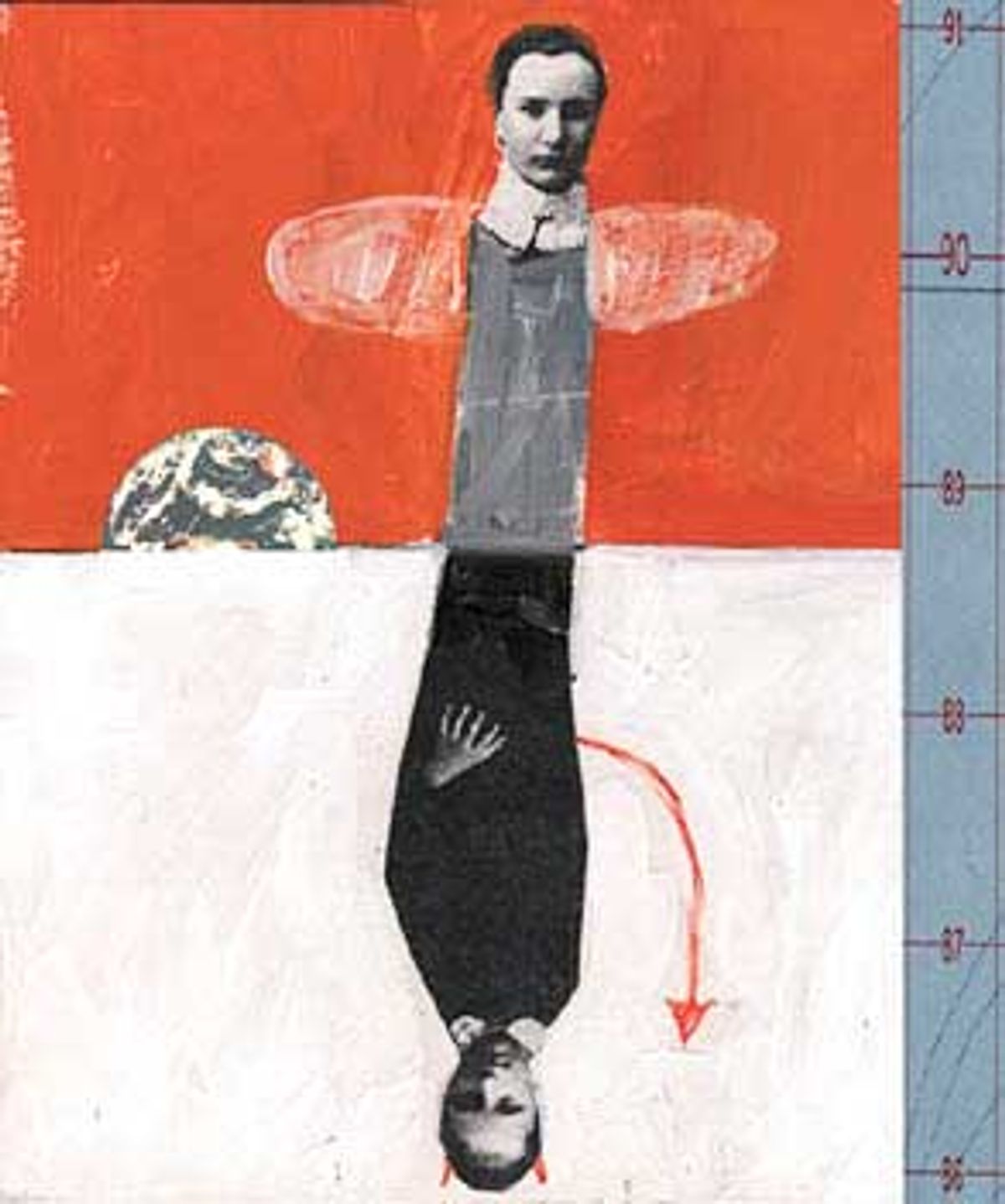
Trends come and go, so don't be surprised when you hear the latest: Hades is hot, angels are not.

  • more
    • All Share Services

Hell is back in business

There are gaps that form in our modern world — temporary imbalances that eventually right themselves, restoring equilibrium. Now may be one of those corrective times. The angel craze seems to have petered out and the moment could be right to address a neglected spiritual need: our deep-seated longing for hell.

We were born too late for all the comforting certainties — old-fashioned values, death from syphilis, searing fusillades of brimstone. Once there were no situational ethics, and forget about moral relativism. Cuss on a Sunday and, presto, you were a Grade A roaster on a subterranean spit, with the deli manager on permanent break.

But such cruelty could never survive in a soft-sell age. The gradual phasing-out of a retributive afterlife model gained official approval when even the venerable Church of England gave the devil a pink slip. The church’s revised theological interpretation, first unveiled several years ago, mothballed the pitchforks and doused the lake of fire. Hell, said the archbishops, is merely a state of nonbeing — a never-ending flight delay in a timeless Des Moines. (Odd when you consider that the official head of the Church of England is Queen Elizabeth II, who might at least preserve a little scorpion-stuffed corner of purgatory for pesky daughters-in-law.)

Toward the end, hell was reduced to an occasional appearance in “The Far Side” cartoons. When Gary Larson retired, receivership was inevitable.

The C. of E.’s new doctrine merely formalized a widespread belief that a merciful God could not be reconciled with torture. (Leave that to his followers.) But when the last truckload of charcoal briquettes departed from those underground caverns, what a vacuum was left behind. Believers uncomfortable with Dante’s Inferno were equally discomfited by the implied alternative — namely, blanket forgiveness for all earthly transgressions. Heaven yes, but hell no? Wrestling with the theological implications could get painful.

One example played out on CNN in February 1998 at the execution in Texas of Karla Faye Tucker. There in the Lone Star State, where authorities are not afraid to play Old Testament God on a regular basis, the pretty, born-again multiple murderer was dispatched by lethal injection despite waves of sympathetic media attention and even some conservative Christian support. Afterward, cameras surrounded Richard Thornton outside the death house. His wife, Deborah, had been one of Tucker’s victims, and now he described for the assembled media his vision of heaven. In Thornton’s view Karla Faye was headed up to meet Deborah and, he predicted, “it ain’t gonna be pretty.” Turning his face skyward, Thornton addressed his departed wife: “Here she comes, baby doll. She’s all yours.”

A husband’s profound grief is thoroughly understandable, but for those who choose to speculate on the world beyond, this was still a rather startling vision of paradise — a Texas heaven where murder victims lie in the tall grass, waiting for vengeance. Perhaps the baby Jesus is right there, passing out ammo. Once you remove hell from the eternal equation, heaven finds itself being adapted for uses clearly not foreseen in the original design specs.

Now there’s a move to set things right. Last month a coalition of conservative Christian denominations called the Evangelical Alliance released a report titled “The Nature of Hell,” produced by a five-member committee that included an Oxford theologian. Get out the industrial drums of starter fluid — according to the report, hell is back in business.

The concept of good and evil realms predates Christianity by many centuries. Zoroastrians believed in the existence of a Satan-like evil lord who opposed the forces of light. The Bible, in fact, is surprisingly quiet on the topic. Like the Greek Hades, which acquired negative connotations only gradually, the ancient Hebrews believed in an underworld called Sheol, not originally associated with punishment. But the Book of Daniel introduces the idea of eternal condemnation (or glory), and with the Bible’s closing scenes in the Book of Revelation, the blueprint that would inspire Dante and Milton appears: Satan’s lair, the bottomless pit, locusts with human faces and lion’s teeth, the lake of fire.

The Evangelical Alliance does not proclaim the literal truth of Lucifer’s Lagoon, but don’t start with the dancing and fornicating just yet — its report insists that undying worms, gnashing of teeth and, yes, eternal flames are legitimate symbols of the horrors awaiting those who reject Jesus. “Unimaginable torment” is what the alliance forecasts for sinners. The level of agony is dependent on the relative severity of an individual’s wickedness, which seems only fair. (Although from a marketing standpoint, the evangelicals are now burdened with a tremendous disadvantage. Given the clear choice between the tortures of the damned and simple nothingness, the Church of England must be doing land office business these days. And if it’s busy up here, imagine the lineups in hell.)

Metaphorical interpretations of the Inferno have long been the preferred way to reconcile warring concepts of a vengeful God with a God of divine love. “Hell is oneself,” said T.S. Eliot. “Hell is other people,” Jean-Paul Sartre demurred. No, said Percy Bysshe Shelley: “Hell is a city much like London.” Or perhaps Buffalo, N.Y. — (Miroslav) Satan plays hockey for the Sabres. Apparently hell really does freeze over, and the Zamboni comes out between periods.

And you may want to discount those cherubs — hell sells, too. The owners of Hell.com have announced plans to auction their domain name for millions of dollars. (See also the career of AC/DC.)

Curiosity about worlds beyond death must be nearly as old as the human urge to explore hidden places and dark caves (which in turn allowed many humans to discover what follows death). Recently that spiritual curiosity led a Vancouver, Canada, crowd numbering several hundred to drop 15 bucks for an audience with Friedbert Karger. Karger is a 56-year-old German physicist who, while pursuing thermonuclear research, also developed an interest in less tangible realms. After embracing the philosophy of 20th century prophet Abd-ru-shin (born Oskar Ernst Bernhardt in Bischofswerda, Saxony, in 1875), Karger began touring the world speaking on behalf of the Grail Foundation, an organization dedicated to spreading Abd-ru-shin’s teachings. It is the Saxon seer’s comprehensive theory of life after death that Karger is in Vancouver to explain.

As soon as Karger opens his mouth, any notion that he might be some smooth New Age charlatan is instantly dispelled. His accent is heavy, his speech plodding, his lack of charisma total. “I assumed you would prefer my poor English to my superb German,” Karger says dryly. With Karger’s oratorical skills, Jim Bakker and Jimmy Swaggart would have been forced to remain honest and monogamous.

Karger, fussing with little multicolored transparencies on an overhead projector, sketches out for his audience an ingenious afterlife that any scientist could love. Where you end up moments after your dinner companions reveal that they never got around to learning the Heimlich maneuver will depend on the otherworldly equivalent of Newton’s famous principles. Just as our physical plane is governed by laws, Karger explains, so the ethereal realm is ruled by the “spiritual law of gravity.”

Here’s how it works: Your spiritual weight is determined by the nature of your earthly preoccupations. “The higher your desires, the lighter your ethereal body becomes,” Karger explains. “Every soul is surrounded by souls of the same weight and nature. For some this is heaven, for some, hell.

“The malevolent are with the malevolent — murderers congregate to mutilate and torment each other, never dying, experiencing only the fury of their passions as both perpetrators and victims.”

Neat, huh? Moments later, however, the audience is somewhat taken aback at Karger’s choice of spiritual categories: “Gossips with gossips,” the bespectacled physicist continues, “smokers with smokers …”

There is nervous tittering. With Karger’s flat delivery, it is difficult to know whether he’s joking. Around the auditorium people are left to consider whether it might be worth taking up the habit again just to avoid spending eternity with ex-smokers. And still others contemplate the real implications of Karger’s vision — vast ethereal domains with no occupants and one jampacked spiritual plane full of masturbators.

Karger believes that the hell depicted in the Book of Revelation is not incompatible with what he describes. “Details like fire — that’s one thing that can happen,” he insists. “There can be many different pictures, not just the ones we get from Christianity.”

“There will be places of great joy, too,” Karger says, “for souls who dedicated themselves to the betterment of others.”

That would be heaven — land of clouds, harps and halos. And the next day, ditto. No wonder it was Mephisto’s lair that inspired the most memorable visions of Dante. Paradise is not nearly so compelling as speculation about the endless tortures Beelzebub might devise (clouds, harps and halos, for example).

It’s instructive that both Greek and biblical mythology started out with fairly benign, if gloomy, underworlds, then gradually moved toward more punitive depictions. Ancient storytellers, the keepers of oral traditions, must have sensed their audiences’ need for some kind of ultimate reckoning to redress the imbalances of fate. When hell did not exist, it had to be invented.

It has endured. Mainstream movies like “Ghost” and “What Dreams May Come” can’t get away from the idea of a pit for evildoers — just deserts are the essential flip side of every happy ending. Our collective craving for justice demands an ugly destination for the wicked who appear to prosper without consequences.

But eternal punishment makes for an odd fit with an enlightened credo. “Judge not that ye be not judged,” says Jesus in the Gospel of Matthew. Secularly, 19th century salon hostess Madame de Stael (allegedly) said, “To understand all is to forgive all.”

That compassionate acceptance of human error is probably the most evolved and difficult of spiritual philosophies. And it’s a very tough sell on the campaign trail, as any Texas governor can tell you. If you’re going to quote Scripture on the stump, better make it the one about the eye-and-tooth exchange. There’s always a market for retribution.

Which is why there will always be a hell, at least rhetorically. The physical existence of what the Israelites called Gehenna is beyond earthly proof. But whether or not you believe in it, before the week is out you’re likely to nominate a new candidate for membership.

Amen, and pass the brimstone.

Continue Reading Close

Why the U.S. must invade Canada — now

It didn't support the war, it's soft on pot and gays, its economy is rolling and U.S. troops are bored. Anyway, reasons to invade countries are no longer needed!

  • more
    • All Share Services

Topics: , , , , , ,

Why the U.S. must invade Canada -- now

There’s nothing like the deep, satisfying belch that follows a good meal. But hey America, what about dessert? Iran and Syria have both been offered up as succulent dishes to follow the Iraqi main course. May I suggest a simpler alternative, right next door? Invade Canada. Hell, we’re asking for it.

Canada — a ripe plum ready for the taking. And the plum was probably imported from Florida, which will make it all the easier. It’s not like it hasn’t been considered before — Michael Moore’s one stab at a fictional film (unless you count his documentaries) — was “Canadian Bacon,” in which President Alan Alda takes on Canada. The mere convenience of it is enough to justify it — a regiment in Detroit could blitz Toronto from 9 to 5 and still go home to watch the CNN highlights with the kids every night.

There are plenty of reasons to invade your passive-aggressive northern neighbor. (Or “neighbour,” as we spitefully choose to spell it. Doesn’t that just piss you off?) But never mind — thanks to the lessons learned in Iraq, reasons are no longer necessary. The Bush administration’s labored justifications for the Iraq invasion, served up as convincingly as a chocolate-smeared 6-year-old’s explanation of where the cookies went, proved to be utterly irrelevant. Most Americans, it turned out, were only too happy to kick some non-American ass and didn’t really require an explanation. As a prelude to the invasion of Canada, Bush could merely produce satellite photos proving conclusively that American troops are bored. Good enough for most.

So why bother? An excellent question. The United States owns most of Canada already and, unless you’re unusually fond of thick socks and earnest magazines, there’s not much worth plundering. But the invasion of Afghanistan proves that when sufficiently provoked America will invade and conquer the most God-forsaken acreage imaginable. You might live in an Oklahoma trailer park in tornado season but if you flip America the bird, the troops will come.

Lately, Canada has been flipping America the bird with suicidal abandon. For those who haven’t noticed (roughly everyone except Vegas bookies during hockey season), Canada has been acting rather snotty of late. After failing to support the invasion of Iraq, the Canadian government has been embarking on policies that threaten to turn our shared continent into a giant cesspool of sin.

Canadian Prime Minister Alex Trebek (trust me, it’s easier this way — at least you’ll be able to picture somebody) has also been profligate in his criticism of America, and President Bush in particular. On his way to the recent G8 summit, with Canada-U.S. relations already severely strained, the prime minister treated reporters to hearty criticisms of Bush’s economic and social policies. This after his director of communications had referred to Bush as “a moron” last fall and one of his party members was caught by a reporter’s microphone saying: “Damn Americans — I hate the bastards.” Bush’s planned visit to Canada, already postponed once in a fit of pique, has now been delayed again until after a new prime minister takes office. (Shania Twain, perhaps?)

Canceled visits are small beer of course, unless they presage a full-scale attack. Justifications are plentiful, if you want to be gentlemanly about it. Consider the moral issues.

Following a recent court decision, the Canadian province of Ontario has begun performing gay marriages. The Canadian government has indicated it will not fight the ruling, but will instead prepare legislation legalizing gay marriage nationally. The resulting influx of gay couples into Toronto is almost certain to spill over into Buffalo, N.Y. This could doom President Bush’s chances of carrying the state of New York in 2004. Or, even worse, that giant sucking sound of gay Americans pouring over the northern border could lead to economic catastrophe. Broadway will go dark.

Drug laws sound another alarm for American policymakers. Just last week, local authorities announced that they would open a legal “safe-injection” site for drug users in Vancouver, the first shooting gallery of its kind in North America. The U.S. response? “A lie,” said Bush drug czar John Walters. “Immoral.”

Recent moves to decriminalize pot in Canada may have disappointed Canadians who had been promised more drastic action (under pending Canadian legislation, possession of over 15 grams will still be criminal, less than that a misdemeanor), but they are still worrisome enough to have drawn dire warnings from Washington. During a Canadian speaking tour, Walters said Ottawa’s push toward decriminalizing marijuana could “complicate” border security. “Frankly, I’m worried about Canada beginning to look like Mexico as a major supplier of drugs into the United States,” he told one Canadian news program. Indeed, there are tremendous dangers here for the U.S. — a potential Cheech & Chong revival is only the beginning. But never mind the smuggling issue — that’s merely a smokescreen.

Bush’s real concern will be the state of the Canadian economy. It’s currently outpacing the U.S. quite nicely. Canada’s budget deficits are under control while America’s soar; the once-pathetic Canadian dollar is climbing steadily against the U.S. buck. Once Americans realize that even a dope-addled nation enveloped in a giggling fog can do a better job of running its economy than the Republicans are doing, it will be curtains for Bush. America’s next president will be Dr. Dre. An invasion must begin now.

Or how about a protective invasion for health reasons? A prophylactic invasion, a complete Canadian quarantine to prevent the spread of SARS and mad cow disease. Currently Canada is a festering cauldron of plague, our streets strewn with bloated dead. That’s pretty much an accepted fact. Summer tourist traffic is down in Vancouver, B.C., due to fear of SARS. That the only reported SARS deaths (about 30 so far, none recently) have been recorded in Toronto, Ontario — roughly as close to Vancouver as Los Angeles is to Panama City — is apparently not important to the American traveler. (Nor does it seem to matter that even in Toronto, SARS poses less risk to visitors than the flying spittle of Mayor Mel Lastman.) The fear of SARS is real, as real as was Saddam’s threat to the American way of life. Americans will cheer decisive action.

Mad cow disease could provide another pretext for invasion. So far, mad cow has been a singular Canadian experience — it has been found in a single cow. (Even that cow may only have been disgruntled.) Still, one dangerous cow is something - tough to sneak old Bessie past Hans Blix.

It’s not as if the fever for war would be entirely manufactured, either - certainly not for Canadians. Northerners express a litany of grievances against the U.S. — for example, the annoying tendency of Bushites to make pious pronouncements about the sanctity of free trade while slapping specious duties on Canadian lumber and grain.

Mostly though, Canadians are galled by the fact that we can get as angry as we want and nobody cares. Our refusal to participate in Iraq drew a few of the usual protests. A Chicago competition for school choirs refused to accept a Canadian group on account of our nation’s treachery. (Thank God you can always count on a few dedicated wingnuts.) But for the most part, no one noticed. Why would they? France was snubbing America too, and they have the bomb. Canada’s ancient helicopters are more dangerous to their pilots than to enemy combatants; Canada’s underpaid soldiers are mostly a threat to default on loans. Hold the “freedom bacon” — nobody missed our help anyway.

It is this sense of our irrelevance that drives Canada’s incessant whining about the States. We’re better than you, goes the Canadian refrain — nobler, more caring, more tolerant, given to smiles and hugs where Americans opt for assault weapons. And yet no one notices. What’s the point of being good if Mom’s not even watching? So we sit in a passive-aggressive funk and vote for leaders who exact our revenge by pissing in the Rose Garden and running away.

Damn it, we’re obnoxious little pests. Squash us like bugs, America! We’ll probably apologize afterwards.

Continue Reading Close

Georgy Do-Right

A top Canadian official calls Bush a "moron" -- and her countrymen cheer. Why do our northern neighbors think the president is a chimp?

  • more
    • All Share Services

Topics:

Georgy Do-Right

It takes a lot for Canada to make the papers, but this was a good one. Last week at a NATO conference Francoise Ducros, a top aide to Canadian Prime Minister Jean Chretien, was overheard calling President George W. Bush “a moron.” Out loud.

It was, to say the least, a bit of a diplomatic faux pas. In the Canadian Parliament, opposition politicians screamed for the head of Ducros, Chretien’s director of communications. Ducros paid the price for her indiscreet comment Tuesday when Chretien accepted her resignation. (She had offered to resign last week, but the prime minister initially refused to accept her resignation.) Before Ducros departed, a Canadian news organization ran a poll, asking the public what Ducros’ fate should be.

The winning suggestion: Give the woman a promotion.

No, these are not good days for the president’s international image. Bush may bask in warm approval ratings back home, but Canadians seem to view him with a mixture of fear and contempt, a German government official compared his foreign policy to Hitler’s, while European political cartoonists almost uniformly portray him as various species of monkey. And those are his allies.

Prime Minister Chretien, a man who often seems to speak both English and French as second languages, promptly offered a helpful clarification. “He’s not a moron at all,” Chretien said of Bush. “He’s my friend.”

That ought to show up in future Bush campaign literature. Pretty much lays the issue to rest (although Chretien left open the question of whether the president might be a chucklehead or possibly a putz).

Canadian antipathy to the States is neither new nor secret. A recent cover story in the National Review pilloried Canadians as “Wimps!” decrying our mewling, hypocritical complaints about U.S. behavior and facetiously suggesting that a good, sound bombing would do wonders for our attitude.

The Review story had a point. There is indeed a facile strain of Yankee-hating on the Canadian left, a relentless demonizing of the American ogre combined with an utter lack of gratitude for the military and economic benefits of having such a kick-ass next door neighbor. While 9/11 prompted an overwhelming grass-roots outpouring of Canadian solidarity with America, it also gradually uncovered an appallingly deep and intellectually lazy anti-Americanism among many educated Canadians. There was a widespread tendency to seek justifications for the terrorist attacks; a sort of “Yes, it was awful, but so is U.S. foreign policy” approach. The long habit of criticizing America proved so durable that many Canadians began to cast Osama bin Laden as a legitimate grievant.

That’s inexcusable. But in many other ways, northern anti-Americanism is not only understandable but inevitable. And for that, President George W. Bush must carry the can.

Try to walk a mile in fur-lined Canadian galoshes while you consider the following.

As the U.S. prepared to attack the Taliban, Bush called for allied support. Canada responded by sending troops to Afghanistan.

And how did the president say thank you? By imposing a massive tariff on Canadian softwood lumber, a tariff that threatened doom for the West Coast lumber industry and made a mockery of our vaunted North American Free Trade Agreement (not to mention the supposedly fundamental Republican commitment to free trade). The World Trade Organization criticized the U.S. tariff as pure politics. The Canadian government howled. No matter.

Meanwhile, four Canadian troops were killed in Afghanistan when an overzealous American pilot bombed them during a training exercise. The military investigation was secretive and grudging, while Michigan politicians began raising money to protect the U.S. pilots from a “witch hunt.”

And Canadians asked: Is this how America rewards its friends?

More irritants have been piling up of late. Recently Canada’s Foreign Affairs Office took the previously unthinkable step of issuing a travel advisory after the Americans threatened to single out Canadian citizens of Middle Eastern descent.

Lately, Canadian newspapers have been full of the tale of Michel Jalbert, a Quebec duck hunter who recently spent a month in a Maine jail. His crime: filling up at an American gas station in his hometown of Pohenegamook, which sits on the Canada/U.S. border. It’s a daily routine the villagers have engaged in for years (the gas station’s driveway is in Canada, but its pumps are in the United States). American authorities imprisoned him for crossing the border with a gun, not allowing him to contact his family for over a week.

The Jalbert story has been huge in Canada, ignored in the States. Which only adds to Canadian irritation — such affronts sting all the more since the Americans are no more aware of our outrage than a baboon who walks through a spider web. (Pat Buchanan recently caused a top-of-the-newscast Canadian furor when he referred to us as “Soviet Canuckistan.” Buchanan really ought to consider moving to Canada — up here, people pay attention to him.)

Recently, PBS ran a two-part biography of the great Benjamin Franklin. It detailed his subtle and brilliant diplomatic work in Paris during the American Revolutionary War, tirelessly ingratiating himself with the French to gain their support against Britain.

Not many Ben Franklins around these days. Then again, there is virtually no one in the Bush administration who feels the lack. Apparently, the new America does not need friends.

This American attitude was detailed with sobering clarity last September when the administration released its “National Security Strategy.” In it, the U.S. frankly proclaimed its intention to dominate the globe and, as the world’s only superpower, to play by its own rules. All justifiable, the manifesto claimed, because unlike the imperialist titans of the past, America always acts for the common good.

The honesty was almost refreshing. And the reality of the global situation is undeniable. What’s annoying is that America is not content to be the world’s über-bully. It also wants to be loved. It’s like Bogart and Peter Lorre in The Maltese Falcon. “When you’re slapped,” the U.S. sneers, “you’ll take it and like it.”

Few outside the U.S. accept the country’s automatic claim to the high moral ground. On the contrary, postwar history suggests that the U.S. tearily celebrates its own democracy while coldbloodedly subverting any other governments — including democratic governments — deemed to be hostile. Bush’s “You’re either with us or against us” rhetoric might have been all right when the villain was bin Laden. But now that this noble battle has been replaced by what is widely considered an irrelevant vendetta against Iraq, the attitude doesn’t wash internationally.

President Bush appears to have the instincts of a congressman. Congressional representatives do not generally care about foreign policy (unless it leads to local defense contracts). If some trade issue gives a congressman the opportunity to bash foreigners while championing local voters, he’ll snap it up like a whorehouse gift certificate. Likewise, the Bush administration often seems unconcerned with how American actions are perceived abroad.

Most of the media attention accorded Bush’s National Strategy focused on military matters. But grass-roots anti-Americanism often centers on an issue that American commentators rarely deign to notice — trade. The National Strategy revealed an interesting attitude toward free trade, a policy usually considered intrinsically American. Free trade, it announced, would be pursued as a sacred good. With one caveat: American workers must never suffer.

Hello? America will sign free trade agreements with you but if they ever start working in your favor, it’s tariff time? What sane nation would sign a deal like that?

A nation with no other choice. A nation like Canada.

The favorite Canadian quote on cross-border relations came from the late Pierre Trudeau. Living next door to the U.S., the former prime minister said, is like sleeping with an elephant; you feel every twitch and grunt.

He was perhaps too diplomatic to point out that Canada is actually more like a flea on an elephant’s ass — invisible unless we prove too annoying, and then easily crushed. That’s a fact Canadians are forced to accept. But it doesn’t lead to fond feelings.

Recently I was talking to some friends about that Ben Franklin documentary and happened to mention the inspiration French revolutionaries took from the Americans. My friends were skeptical — surely, they insisted, the American Revolution must have followed the French. The idea that those heroic peasants from “Les Misérables” lit their torches from an American flame seemed impossible to my Canadian peers. Today’s America is viewed as Republican — not bravely-manning-the-barricades republican, not teaching-the-world-the-ways-of-liberty republican. George W. Bush Republican.

And we know what Canadians call him.

Continue Reading Close

Please note: You’re in the Britney Generation

Is it our memory that's going or Pepsi's?

  • more
    • All Share Services

Topics: , ,

How about that. For once the football game was as interesting as the commercials. Which meant that for almost four solid hours on Sunday, millions of viewers could not safely dash to the bathroom. The drawdown at approximately 10:10 p.m. EST must have made city reservoirs swirl like toilet bowls.

You can’t ignore the ads anymore. They have their own Web site. Ever since director Ridley Scott’s 1984 Macintosh spot, the commercials have been a major part of the annual Super Bowl show — a telecast that draws approximately 800 million viewers worldwide. (One survey claims that 16 percent of viewers tune in only for the commercials, and 58 percent pay more attention to the ads than to the game.) Even as endless player interviews and game prognosticators droned on through the week, particular ads were generating their own pre-telecast hype. This year’s advertisers included surprise newcomers — the White House — and surprising dropouts, like EDS, whose “Herding Cats” and “Running With the Squirrels” ads were previous Super Bowl standouts.

Receiving the most pre-game publicity was Pepsi’s Britney Spears extravaganza — actually a series of commercials featuring Spears in mock Pepsi ads from decades gone by. There is Spears as a 1958 soda fountain patron in suitably grainy black-and-white, Spears as a white Supreme circa ’63, 1966 beach party Britney, 1970 hippie chick Britney and Britney as Robert Palmer in the 1989 “Simply Irresistible” video/Pepsi ad; the only “contemporary” one, a new millennium commercial. A commercial featuring snippets from all of the above was also aired during the game.

The period Pepsi jingles are real, but the ads themselves are modern reinterpretations of old TV commercials, and that may be the only interesting thing about them. Retro efforts like these always underline a certain truth: Eras are defined largely in hindsight. After all, who has the self-awareness (or clairvoyance) to understand exactly how a decade will be recalled?

Here, campy references to “American Bandstand” and “Beach Blanket Bingo” epitomize their times in a way that consumers of that day may not have appreciated. But the telling pop cultural touches are easily done in hindsight, and it has always been thus. Think of Ringo Starr’s retro revival of the Johnny Burnette song “You’re 16″: “You walked out of my dreams,” Ringo warbled in 1973, “and into my car.” Very ’50s. But the original version contained the more prosaic “out of my dreams and into my arms.” The composers did not have the benefit of first attending a matinee of “Grease.”

Periods are often remembered for extremes. Trends like punk rarely crack the media mainstream while still creating fresh outrage. Spears’ Pepsi epics are at least anchored in their times by authentic jingles, but must pump up the period references to properly cue the audience — the late ’60s version shows her in full Woodstock mode. But did late ’60s TV advertisers ever really play up the hippie ethos? It was also the Nixon era, and the Silent Majority were the ones with the bucks. (Coke’s ’70-71 “I’d Like to Teach the World to Sing” was more “Up With People” than hippie. And by that time we were post-Altamont anyway).

Most straightforward is the revival of 1989′s Robert Palmer commercial, based on the “Simply Irresistible” video with Spears cast as Palmer. In this case the original ad did capture the era rather well — besides, the pop cultural differences get subtler as time goes on. Unfortunately, 1989 is probably closer in style to 2002 than 1962 was to 1968.

It’s always telling that, when retro-to-modern transitions like this are attempted, the “modern” segment is usually generic and not representative of any era at all. The millennium Pepsi ad would not have looked particularly futuristic 15 years ago. In another 10 years, perhaps some defining characteristic will have been added, something to tell audiences: “This was the decade.”

However, the new ad may well have captured the current moment anyway, for one reason — Britney herself. What other figure on the current pop horizon has a better shot at becoming the emblem of the age? You don’t have to like it, of course. We can make our own history, but we don’t get to write it.

Continue Reading Close

Why does my Yankee loathing run so deep?

Is it possible to love New York yet pause a moment to curse the Bronx Bombers and all their works? You bet.

  • more
    • All Share Services

Topics:

Why does my Yankee loathing run so deep?

Today, everybody loves New York. Mayor Rudy, New York’s Finest, the firefighters — all part of the corny Big Apple bumper sticker plastered on our collective heart. As we watch the city get off the mat and start swinging again, people everywhere salute the plucky citizens of America’s mightiest metropolis. And then some of us turn toward Yankee Stadium and offer salutes of a different kind. To hell with solidarity — we still hate the Yankees.

Now, in the fall of 2001, is that OK? Is it cool to lie awake wishing painful strains on every pinstriped groin? At this dark moment when we stand shoulder to shoulder with all the residents of Gotham, can we pause a moment to curse the Bronx Bombers and all their works? Hell yes. I hate those Bronx bastards.

I know — sports don’t matter anymore. Sept. 11 put everything in perspective. Empty athletic contests mean nothing in the big scheme of yada yada. Why then do my teeth grind like tectonic plates as I watch Paul expletive O’Neill circle the bases like a prize spaniel prancing around a dog ring? Why does my Yankee loathing run so deep?

It’s the inevitability — the numbing predictability of Yankee success when the pumpkin wears frost. They say baseball is like life, and it’s true insofar as this: No matter what you do, what deals you make, what successes you enjoy, you cannot forestall the inexorable end. There are only two certainties in this life: death and the Yankees.

Taxes? You can cheat on your taxes. Taxes are random compared to the Yanks. In the 2001 playoffs they first faced an Oakland Athletics team that won 102 games and compiled the best record in the majors after the All-Star break. The Yanks lost the first two games of the best-of-five series on their own home turf. That left them in need of three straight victories, two of them in Oakland where the A’s had a 17-game winning streak going.

But the sun continued to rise and set as usual and the Earth failed to wing crazily off into space like a runaway truck tire. So a week later the victorious Yanks were heading into Seattle for the American League championship. The Mariners, you may know, tied the major league record for most wins in a season with 116. One hundred and sixteen victories, piled up steadily from April to September like sawdust from a Washington wood chipper.

And what are the victories of spring and summer? They are the youthful Hollywood dreams of a future chartered accountant. They are the salad days of a high school quarterback, destined someday to land steady work as the overnight security officer at a parsnip warehouse. They are a 10-course banquet of nachos and cream soda. They leave you as fat and gassy as the other half of a Mike Tyson fight. When the Yankees hit town, Seattle had as much chance as a crippled pigeon on a LaGuardia runway.

But why? Why do the Yankees wait like a terminal disease at the end of every tedious campaign? Money, of course; for all baseball’s trumpeting of midbudget successes like the A’s, the poor are no more likely to prosper in the major leagues than they are in the America’s Cup.

Nonetheless, winning is not just about cash. The Texas Rangers proved that with spectacular flair this year by vomiting a quarter-billion bucks onto shortstop Alex Rodriguez. Evidently Rangers’ management hoped their pitching staff, like Anna Nicole Smith, would perform better in front of a rich guy. Instead they finished with the worst earned run average in the major leagues and the Rangers missed the division title by 43 games. A-Rod played well, but to match expectations he would have needed the kind of season not seen since Moses went 10-for-10 against Pharaoh. The fact that ownership of the Texas Rangers now appears to be a springboard to the White House should have American taxpayers clutching reflexively at their wallets.

Money doesn’t help if you’re stupid. But Seattle spent wisely. So did Oakland. Baseball fans grown tired of the annual October pinstripe parade had every reason to believe that deliverance had come at last. And when baseball’s reliable rat fink Roger Clemens stumbled out of the playoff gate, losing Game 1 to Oakland and looking shaky in his second start, tyranny finally seemed on its last legs.

The Yanks didn’t need their ace. The Yanks, it seems, don’t need anything but that famous two-letter pileup stitched onto their hats. Logic becomes futile. Throw away the racing form. Yankee mystique trumps all.

The World Series begins this weekend. National League champion Arizona owns the deadliest one-two pitching combination in recent history with starters Curt Schilling and Randy Johnson. Yankee hurlers seem vulnerable. Finally, the stage may be set for new October heroes.

And maybe George Steinbrenner will be president. Sorry, Rudy, but I hate the goddamn Yankees.

Continue Reading Close

Janet Jackson

Her best singles represent the kind of quality craftsmanship that made us listen to the radio in the first place.

  • more
    • All Share Services

Janet Jackson

These are dark days for pop radio. Calculation rules. TV shows like “Making the Band” and “Popstars” celebrate the corporate Meccano set that is current pop culture; the deluge of boy bands and Britney leaves us grateful even for a bloated and self-indulgent remake of “Lady Marmalade” if it can at least remind us of an inspired original. Pop fans wait for the dawn to break — and in the meantime, thank the radio gods for Janet Jackson.

For 15 years, spanning the eras from Journey to Destiny’s Child, Janet Jackson has frequently provided the best reason to turn on the radio — although, admittedly, the case for opening a good book is usually a lot stronger. Top 40 has always been more or less a sausage factory. Between the occasional bursts of true genius that change the prevailing flavor of pop, journeyman producers and performers rush in to fill the gaps with sawdust imitations of the real joy. Much of pop history has consisted of marking time until the next big thing.

Janet Jackson is not, and never has been, the next big thing. Working with producers/songwriters Jimmy Jam and Terry Lewis, Jackson could be fairly described as yet another sausage merchant. But Janet’s gourmet links are so fine. Since her 1986 breakthrough album “Control,” whatever Janet Jackson song happened to be on the radio at any given time was usually the song you wanted to hear. At their best, her singles represent the kind of quality craftsmanship that made us listen to the radio in the first place — the kind of songs that make you swallow a stream of crap from O-Town and 112 because the next song might just be “Someone to Call My Lover.”

That hit from Jackson’s latest album, “All for You,” demonstrates much of what makes her records stand out from the radio dross. Opening with a guitar sample from America’s “Ventura Highway,” the producers demonstrate how such samples ought to be used — as filigree on an original work, rather than the basis for a Puff Daddy-style karaoke record.

As for the singer, she is dreaming aloud about the lover she seeks: “Maybe we’ll meet in a bar/He’ll drive a funky car/Maybe we’ll meet in a club … ” A bar? A club? Hardly a Cinderella scenario. And yet there is a quality in Jackson’s voice — the kind of sweet yearning Diana Ross brought to the Supremes — that culminates at the end of each verse as she sings a wistful “Maybe!” Somehow, Jackson makes a tale of club-hopping sound as innocent as “Someday My Prince Will Come.”

“Innocent” is not a word that has been attached to Janet Jackson’s music of late — ever since 1993′s “Janet” album, her lyrics have displayed startling sexual frankness. And yet while her songs have often been raunchier than Madonna’s, Jackson’s image retains a certain wholesome quality. Perhaps it’s because of the inherent sweetness of her voice, or perhaps it’s the power of first impressions. Aside from some early performances with her famous siblings, Janet’s first real introduction to the public came via roles on the sitcom “Good Times,” in the late ’70s, and then “Diff’rent Strokes,” in the early ’80s. That initial clean-cut image has subsequently allowed her to explore the subject of sexual pleasure as the natural province of a mature young woman.

Then too, the public may cut Janet some slack because, as she has admitted in interviews: “People see me as the ‘normal one.’” A relatively uncomplicated pop career is not what people have come to expect from the offspring of the most famous showbiz clan ever to come out of Gary, Ind.

Born May 16, 1966, Janet is the youngest of Joe and Katherine Jackson’s nine wunderkinds. The Jackson 5 were already stars when she was just a child, and Janet was spared the poverty of the family’s early years. After beginning her acting career, Jackson released her self-titled debut LP in 1982. She was only 16. The record drew little attention, and 1984′s “Dream Street” didn’t do much better. Meanwhile, brother Michael was dominating the charts in a way that few artists have ever accomplished.

Janet’s first real attempt to break away from the tight strictures of the Jackson clan was personal, not professional. At 18, she eloped with singer James Debarge for a quickie marriage that was just as quickly annulled, sending her back to the family home in Los Angeles. Her next breakaway would be more successful; it took her not to the altar, but to Minneapolis.

In 1985 A&M Records executive John McClain suggested that Janet work with Jimmy Jam and Terry Lewis, two aspiring producers who had until recently been members of the raucous funk outfit the Time. When Janet’s father, still her manager then, heard that the duo was based in Prince’s hometown, he bristled. According to writer David Ritz, father Joe warned the two men: “I don’t want my daughter sounding like Prince.”

And that, more or less, was the end of Joe Jackson’s professional hold over his daughter. Because sounding like Prince was something eager young Janet could definitely get behind. The resulting LP, “Control,” was a statement of independence packed with insolent hits like “What Have You Done for Me Lately” and “Nasty.” In the fall of ’86, “When I Think of You” not only gave Janet her first No. 1 single, it provided a blueprint for subsequent explosions of pop ecstasy like 1989′s “Escapade” and 1998′s “Together Again.” Sausages don’t get much tastier than those.

Reworking a successful formula need not lead to tedium. Motown was perhaps the greatest sausage factory of all, with songwriters like the Holland-Dozier-Holland team recycling every hit into one or more rhythmic clones. With her own team of Jam and Lewis, Janet Jackson would continue to hone her craft through the ’90s, experiencing increasing levels of success. But listen again to “When I Think of You,” and the essential elements of Janet Jackson’s style are already there, fully formed.

Many of Jackson’s records feature a postmodern “in-studio” theme, with Janet simultaneously performing the song and commenting on the playback. (“Didn’t quite hit the note,” she mutters in 1995′s “Runaway”; “That’s the end?” she squawks at the abrupt finish of “Miss You Much.”) A more important element is the reliable presence of actual melody. These tunes have hooks. Take away the melodic edge, the lilting style her team lends to these songs, and what would you have? A famous name and a state-of-the-art studio sound wrapped around an empty, aimless groove. You’d have Jennifer Lopez. J-Lo’s records deserve their very own adjective: per-funk-tory. Listen to a few of them back to back and see if you don’t start scanning the dial for a little dose of the Janet antidote.

Between 1986 and 1997, Jackson’s four albums of original material — “Control,” “Rhythm Nation 1814,” “Janet” and “The Velvet Rope” — all hit No. 1 on the Billboard album chart. The 1995 hits package “Design of a Decade,” featuring two new tracks, hit the Top 5. “All for You,” Jackson’s latest opus (by now credited only to “Janet”), proved to be her fastest seller yet, moving more than 605,000 copies in its first week last spring. The title track set a new standard at Radio & Records magazine by being added to every applicable radio station playlist in its first week, loping easily to No. 1 shortly thereafter. Jackson has also maintained a screen career with performances in John Singleton’s “Poetic Justice” and the Eddie Murphy vehicle “The Nutty Professor II.” Meanwhile her concert tours, beginning with her first in 1990, have been renowned for lavish production values and meticulous choreography. When you ponder the magnitude of her brother Michael’s ’80s and early ’90s success, it’s almost incredible to think that, as of now, Janet is the biggest star in the Jackson family. Few performers have ever had to emerge from such a formidable shadow — a shadow that includes the strong taint of family eccentricity.

When a Jackson pops up on the radio today it’s generally either Janet as a singer or Michael as a punch line. Years after his last chart appearance, Michael is still the butt of morning DJs’ jokes about plastic surgery, hyperbaric chambers, questionable pajama parties, etc. His solo career has charted a very different course from Janet’s (or almost anyone’s for that matter) — hers characteristically sure and steady, his wild and erratic. You can’t become the King of Pop without also making yourself a target for regicides, and the backlash against Michaelmania has threatened to make him a ghost of pop past. His carefully staged reemergence begins this fall with his 30th anniversary concerts at Madison Square Garden Sept. 7 and 10, featuring all-star guests and a handful of brothers. But never before has Michael faced the real possibility of eclipse by a sibling.

In interviews, Janet has confessed to a sense of family guilt about her relative success at a time when other Jacksons are consigned to oldies stations (and in LaToya’s case, back issues of Playboy). Likewise, reports have hinted at tension within the family — Janet will not be among those appearing at Michael’s big comeback show, a fact that she attributes to her undeniably busy touring schedule.

But regardless of whether Janet has put distance between herself and her tabloid-happy clan, she has at least tried diligently to stay out of the same supermarket publications. In that she has been largely successful, although at this level of success, it seems, no one escapes unscathed. It was only when she filed for divorce last year that Janet’s secret 1991 marriage to Rene Elizondo Jr. was revealed — a notably successful act of espionage for a woman so in the public spotlight (note to secretive celebs: Marry a key grip). Elizondo has since filed suit against his former wife for a portion of her royalties, allegedly owed to him for production work.

Aside from this marital unpleasantness, though, the only risqué thing about Jackson is her lyrics and her cheerful admission that they do reflect a healthy sexual appetite. (There is also the matter of her eye-popping promotional campaigns. In 1998, one sensual Jackson billboard was removed from a British motorway when drivers began plowing into hedgerows and each other as they gawked.)

There has rarely been a time when pop radio listeners could not legitimately complain about the dreck being dumped upon them in 3- and 4-minute piles. But the great ones stand out all the more in creatively fallow times. Janet Jackson may well be the beneficiary of contemporary pop’s Lilliputian landscape. Her singles are admittedly a hit-and-miss affair — she can sometimes descend too far into pop convention and turn out the same kind of mediocrity as her less-talented peers. More often, though, a Janet Jackson song on the radio is a deluxe buffet set up on a compost heap. Pass the sauerkraut.

Continue Reading Close

Page 1 of 7 in Steve Burgess