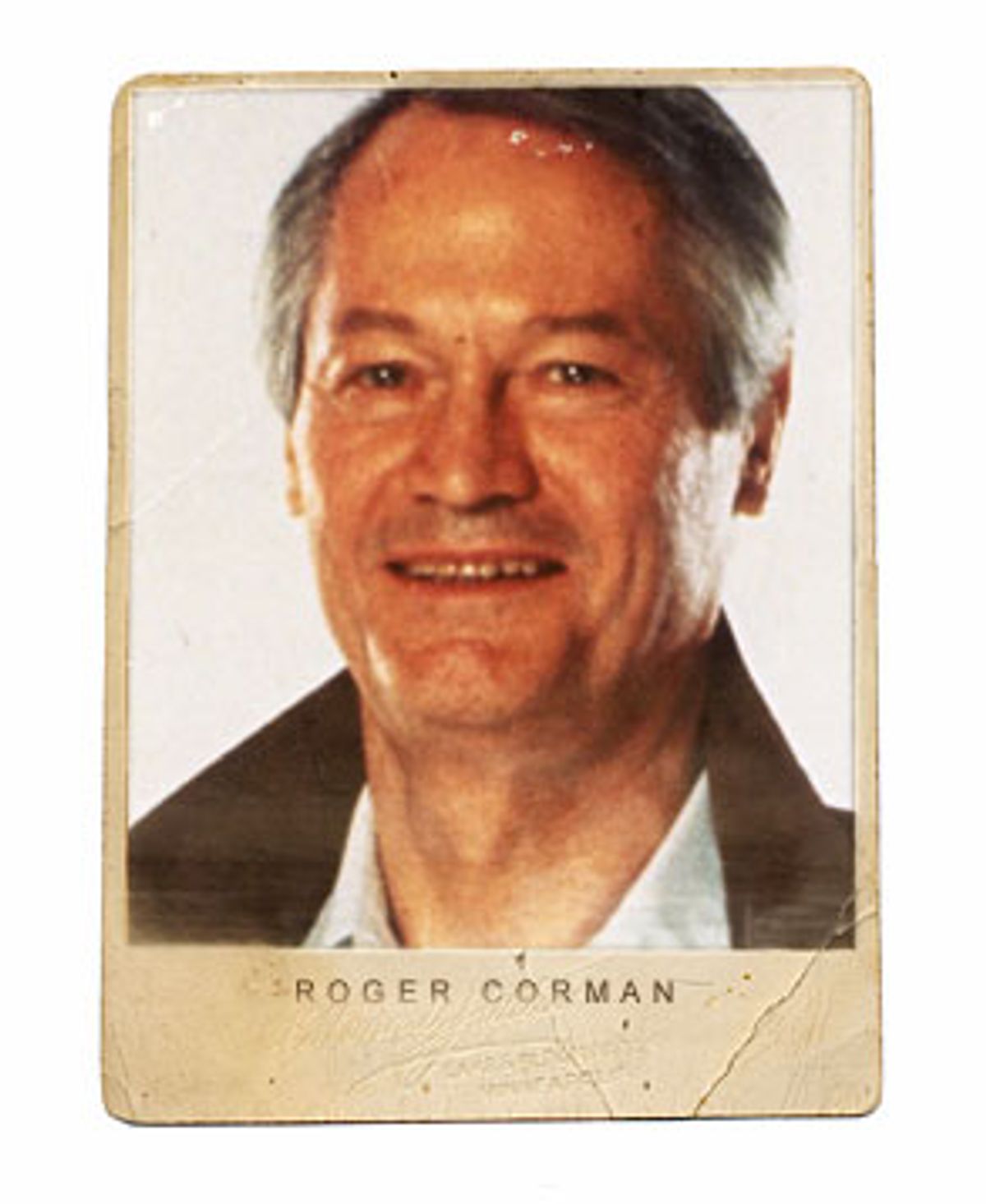
There's a scene in the 1960 film "Little Shop of Horrors" in which the bloodthirsty talking plant, Audrey Junior, takes about five seconds to hypnotize the hapless flower-shop assistant, Seymour Krelboin, who's a tad squeamish about supplying the plant's dinner again: "Krelboin! Turn around! Close your eyes. You are asleep. Open your eyes. Now you will do as I say." Roger Corman's method as a director and producer has often seemed about as delicate as Audrey Junior's -- logic and continuity tend to go by the board in Corman's drive to achieve maximum eventfulness. Still, he's always managed to entertain the masses, devoting a long career to answering their cry of "Feed me!"
Corman's been known for several decades as "the King of the B's," as in B-movies -- the cinematic world of papier-mbchi aliens, mad sorcerers, car chases, exploding heads and topless outdoor catfights. But zoom in on the ceremonies for the 1974 Academy Awards: Francis Ford Coppola won Oscars for best picture, director and adapted screenplay for "The Godfather Part II," Robert Towne won the best original screenplay award for "Chinatown," and Jack Nicholson, Talia Shire and Diane Ladd were among the acting nominees. What they had in common was that they'd all worked for Roger Corman as wet-eared novices in the '50s and '60s.
For good measure, the best foreign film Oscar that year went to Federico Fellini's "Amarcord," which Corman's company, New World Pictures, released in America; the film for which Ladd was nominated, "Alice Doesn't Live Here Anymore," was directed by Martin Scorsese, whose first major feature, "Boxcar Bertha," had been produced by Corman. What exquisite taste, what an eagle eye for talent! To top it off, Corman himself acted in Coppola's award-winning film, as one of the senatorial inquisitors in the big Mafia-hearing scene. So why wasn't Corman nominated for anything? Because in 1974, his company's premier productions were the likes of "Big Bad Mama," "TNT Jackson," "Caged Heat" and, of course, "Candy Stripe Nurses."
In the past half-century, Corman has produced, directed and/or distributed hundreds of movies, nearly all of them shot at breakneck speed on shoestring budgets, nearly all of them commercially successful, a rather large percentage of them -- how does one phrase it? -- beyond the bounds of conventional film criticism. Corman, like Mickey Rourke and Jerry Lewis, is esteemed in France, but you don't need to share the Gallic sense of whimsy to appreciate at least some aspect of his career in movies. "A Bucket of Blood" and "Little Shop of Horrors" paved the way for Sam Raimi's bravura no-budget horror comedies and for the gorily wry "Buffy the Vampire Slayer."
The remarkably stylish Edgar Allan Poe adaptations Corman directed in the early '60s have justly been a staple of off-hours TV programming for ages. He inaugurated two of the great exploitation genres of the '60s, outlaw-biker and psychedelic-drug movies, with "The Wild Angels" and "The Trip," respectively. And after he retired from directing in 1970, he started New World Pictures and invited a generation to indulge, repeatedly, in the cinema of student nurses, student teachers and women in prison. (I don't think he ever got around to a movie about student nurses in prison, but I'd be surprised if he hadn't thought about it seriously.)
Corman defined his field in his delightful 1990 autobiography, "How I Made a Hundred Movies in Hollywood and Never Lost a Dime":
"Exploitation" films were so named because you made a film about something wild with a great deal of action, a little sex, and possibly some sort of strange gimmick; they often came out of the day's headlines. It's interesting how, decades later, when the majors saw they could have enormous commercial success with big-budget exploitation films, they gave them loftier terms -- "genre" films or "high concept" films.
"Roger Corman: An Unauthorized Biography of the Godfather of Indie Filmmaking," a combative but insightful new book by Corman's former story editor Beverly Gray, elucidates the paradigm shift in Hollywood that occurred after the twin box-office triumphs of "Jaws" and "Star Wars." Before Spielberg and George Lucas, studios allotted big budgets to historical epics and character-driven dramas while tossing off exploitation films on the cheap, so Corman was at least competing in the same ballpark as the majors (albeit from left field). Since the mid-'70s, the studios' priorities have flipped and they've poured all their resources into aping, with far more polish, Corman's audience-pleasing strategies -- tongue-in-cheek, $100 million Arnold Schwarzenegger and Will Smith blow'em-ups that simply out-Corman Corman. A former Corman screenwriter pointed out to Gray that in Hollywood today, "There's nowhere you can go that isn't Corman."
Although Corman's box-office hits have usually been modest ones -- the lower your budget, the fewer tickets you need to sell to turn a profit -- his all-expenses-spared, all-profits-retained rules of moviemaking made him one of the most respected businessmen in an industry that commonly revolves around spectacular successes and monstrous failures. He's the model of the independent filmmaker who aims not for blockbusters, but for enough profits to keep making more movies. His distaste for squandering time and money is legendary. To the young Corman, a five-day shooting schedule was reasonable, anything over 10 days extravagant; he famously completed principal photography on "Little Shop of Horrors" in two days. In 1957 alone, he produced and directed eight movies. He may be the only director in history to turn down a major studio production because the budget was too high for him to get the job done right.
Corman was born in 1926 and raised in Beverly Hills, Calif., with his brother, Gene, who also became a film producer. He earned an engineering degree from Stanford, and an engineer's economy of means is his guiding aesthetic. Between 1954, when he produced his first movie, and 1970, when he retired from directing and founded New World Pictures, he directed about 50 films, overcoming the straitjackets of budget and genre with a sly sense of humor and a gut understanding of how to corral an audience's interest through camera movement and visually engaging screen composition. Even his shlockiest early movies are crafted with jaunty intelligence -- plenty of them are utter hokum (see "Teenage Caveman" or "The Viking Women and the Sea Serpent" ... on second thought, don't), but you're usually aware of Corman laughing along with you, not at you, from behind the camera.
For example, there's the splendidly goofy "Sorority Girl" (1957), starring Susan Cabot, one of Corman's ready-for-anything stock company, as an unaccountably bitchy and vicious coed who victimizes her sorority sisters (caught beating a pledge, she's indignant: "All I did was spank her a little"). Cabot also starred in "The Wasp Woman" (1960) as an aging cosmetics queen who ingests way too much rejuvenating wasp serum and turns into ... well, it probably should have been near the bottom of the makeup artist's risumi. And "It Conquered the World," made in 1956, is still a hoot. The ridiculous Venusian cucumber-crab creature at the center of the plot is about as menacing on-screen as "Sesame Street's" Mr. Snuffleupagus, so Corman concentrated on the characters' mounting trepidation rather than the alien's dubious shock value. Compare Bela Lugosi's wrestling match with the rubber octopus in Ed Wood's contemporaneous "Bride of the Monster": While Wood presumably thought the audience would be dumb enough to be thrilled by his inert monster, Corman knew not to try. "It Conquered the World" is a cheap entertainment made by an artist who knew exactly what he could get away with.
Though Corman's overtly comic trilogy of "A Bucket of Blood" (1959), "Little Shop of Horrors" and "Creature From the Haunted Sea" (1961) is responsible for much of his cult following, the poker-faced humor of the other quickies can be just as swell. Take "The Last Woman on Earth" (1960). Everyone in the world gets killed by a bomb that sucks all the oxygen out of the atmosphere. (Don't ask.) Everyone but three, that is: A married couple, Harold and Ev, and their friend Martin are fortuitously scuba diving off the coast of Puerto Rico when the holocaust hits. In a few minutes the oxygen's back. (I said don't ask.) The moment they can all breathe again, the first thing Harold does is stick a cigarette into his wife's mouth and light it. Naturally, a nasty love triangle soon develops, and eventually Harold and Martin squabble to the death. "I killed him," says Harold. Brief, blank pause. "Will we never learn?"
The screenplay of "Last Woman on Earth" was Robert Towne's first, and he also (pseudonymously) played Martin, which illustrates a long-standing principle of Corman's: Why bring two people on a location shoot when one ticket and one salary can cover your needs just as well? Actors played multiple parts, writers directed second-unit crews, production associates filled in as sound men. The positive side of this somewhat merciless brand of thrift is that it allowed -- forced, if you will -- Corman's crew members to learn all sides of filmmaking, and many of them moved up the ranks and out into the wider movie industry with experience that would have taken many years to rack up under any other producer. He's given career-making breaks to a throng of Hollywood heavyweights, not only Nicholson, Coppola, Towne and Scorsese, but also Bruce Dern, Peter Bogdanovich, Jonathan Demme, Ron Howard, John Sayles, Gale Anne Hurd and James Cameron, among others. "Sometimes I think about all the people who have worked with me and gone on to become famous filmmakers," Corman once said. "I wonder if it's because they learned a lot by working with me or they figured that if I could do it anyone could?"
In Christian Blackwood's 1977 documentary "Roger Corman: Hollywood's Wild Angel," actor Paul Bartel, who directed Corman's "Death Race 2000" and, later, "Eating Raoul," told Blackwood, "Roger believes, I think, in the producer as auteur. To a certain extent I think he doesn't really care that much who directs a lot of the films that he produces." As production executive, he retained approval of each film's basic concept (usually he came up with it), script, casting and final cut, so as long as a film's concept was salable to theaters, as long as it contained plenty of thrills, chases, humor and (starting in the '70s) breasts, he was happy to pay a novice director practically nothing to learn on the job, as he had done himself.
In "Hollywood's Wild Angel," Corman explained what he looks for in a project: "The picture must be visually oriented, and generally whatever is there will be exciting to me at that moment." Though he maintains a very low public profile, he's also declared that he likes to get a politically liberal point of view into his movies, though usually in a vague way: An outsider stands up for his beliefs and sticks it to The Man, who may be a Satan-worshipping prince, a buxom prison matron or a Venusian cucumber-crab creature. As a blanket statement, it's probably fair to say that there is no subtlety of ideas or structure or characterization to be found anywhere in his oeuvre. You seldom leave a Corman picture with questions, unless the question is "Didn't that same muscly guy die twice?" or "Why was her hair a different color in that one scene on the beach?"
Only once did he direct a movie about a political subject he was passionate about, "The Intruder," a 1962 drama about a Northern racist (played by the young, angry William Shatner) who shows up in a Southern town to incite violent resistance to school integration. Corman filmed on location in the Deep South, using locals as extras -- he didn't show them the complete script, which blasted contemporary ignorance, amorality and racism just when the civil rights movement was meeting bloody opposition. He barely finished shooting his small, stark, viriti-style film as the local cops, who correctly mistrusted his intentions, were ordering the crew out of town. When "The Intruder" failed commercially, he took it as a lesson: Aesthetic ambition without financial reward is just bad business. Of course, he didn't accept failure lying down; the film was retitled -- anything to lure ticket buyers -- "I Hate Your Guts!"
With the popular Poe films of the early '60s, which were created with slightly higher budgets and longer shooting schedules, critics and audiences finally took note of Corman as something other than a drive-in wunderkind. "House of Usher," "The Pit and the Pendulum," "The Tomb of Ligeia" and the others are claustrophobic, lavishly decorated, convincingly creepy Gothic horror stories. The masterpiece among them, arguably, is "The Masque of the Red Death" (1964), a surrealistic dirge of a movie that proves, with its abstract choreography and symbolically loaded imagery, that Corman was capable of a higher kind of art when he thought the crowd would buy it. (The cinematographer on "Red Death" was Nicholas Roeg, and the queasily saturated colors of the film presage Roeg's own great 1973 psychological-horror film, "Don't Look Now.")
If most of the Poe films lacked Corman's deadpan humor, he made up for it with "The Raven" (1963), a jolly diversion in which Boris Karloff, Vincent Price, Peter Lorre and Jack Nicholson chew the ominous scenery to a pulp, and "The Terror," which is absolutely inscrutable -- hardly surprising, since there was no story and it was shot by a tag team of directors including Coppola and Nicholson, none of whom, even Corman, had the foggiest idea what was supposed to be happening. Corman just wanted to get his money's worth out of the castle sets from "The Raven" before they were pulled down, so he commissioned the merest snippet of screenplay, retained Karloff for two more days of work at the end of the "Raven" shoot and let the cameras roll. Even Corman had to admit, with vast understatement, that "The Terror" is "somewhat confusing." If nothing else, it's a treat to watch the bemused Karloff and costar Nicholson fighting to keep straight faces.
Corman's pace slowed in the late '60s -- he directed "The St. Valentine's Day Massacre" and "Von Richthofen and Brown" for major studios and "The Wild Angels," "The Trip," "Bloody Mama" and the overwrought, absurdist hippie odyssey "Gas-s-s-s!" for his longtime independent backers, American International Pictures. But Corman thought many of these movies were hobbled by studio interference in the editing process, and he decided never again to be gainsaid by a releasing company. In 1970, at age 44, he got married (his wife, Julie, with whom he has four children, subsequently became a modestly successful producer herself) and started New World, which soon overtook American International as the most successful independent production company in Hollywood. Exit Corman the director, enter Corman the schlock mogul.
New World's voluminous '70s output is the giddy, gory, nipple-intensive, strenuously outrageous stuff that Quentin Tarantino grew up on. The most energetic of the women-in-prison films teamed director Jack Hill and star Pam Grier, of subsequent blaxploitation legend, but my favorite New World scene was conjured up by lesser talents for "The Big Bust Out" (1973): Naked Vonetta McGee is slung up in a dusty Filipino ruin and whipped savagely by a malicious dwarf, who is promptly murdered by a passing nun, who is herself then stoned by a silent mob of anonymous black-robed women, all in a couple of minutes. I wish I could explain my childlike wonder, but this aesthetic doesn't really have anything to do with reason. It's the cinema of the id, next to which Sergio Leone's spaghetti westerns take on a Merchant Ivory luster.
Still, it was at New World that Ron Howard directed "Grand Theft Auto" (all about car crashes), Jonathan Demme directed "Caged Heat" (women's prison again) and John Sayles wrote "Piranha" ("Jaws" redux) and "Battle Beyond the Stars" (a "Star Wars," or perhaps "Battlestar Galactica," rip-off). Corman's influence on them is evident in the exploitation hearts of Howard's "Backdraft" and "Apollo 13," Demme's "Silence of the Lambs" and even Sayles' "The Brother From Another Planet." And Paul Bartel's delirious "Death Race 2000" retains enough cult appeal that a major-studio remake starring Tom Cruise, "Death Race 3000," is reportedly in the works.
In 1973, New World began an anomalous sideline business distributing foreign films in America, at a time when "art films" were the province of relatively few theaters in big cities. But Corman successfully marketed "Cries and Whispers," "Amarcord," "Autumn Sonata," "Breaker Morant," "The Tin Drum," "Fitzcarraldo" and other weighty fare across the country. Ingmar Bergman was tickled to learn that "Cries and Whispers" was showing at drive-ins, telling Corman, "Nobody ever thought of that before. I've always wanted my pictures to get the widest possible audience." Since not a lot of distributors were vying for foreign films, Corman acquired them cheaply and made money, prompting others, like the fledgling Miramax, to start snapping them up as well. Competition drove the prices way up, and Corman relinquished the field. As so often in his career, when aesthetic value conflicted with the bottom line, the bottom line held firm.
The '80s and '90s saw Corman fade into the netherworld of video and cable-TV originals with New World's successor company, Concorde/New Horizons, which has churned out a lot of martial-arts, sword-and-sorcery and horror movies, generally shot in unlikely corners of the Third World. They make money, and that's the extent of their ambition. The Concorde movies are frequently dull copies of recent hits; moreover, there are also bad sequels of dull copies of recent hits -- seven installments of the sub-sub-Van Damme kickboxing epic "Bloodfist," anyone? "Chopping Mall" (1986), a passable flick about killer robots produced by Julie Corman, is at least full of fun references: A group of besieged teens hides out in Roger's Little Shop of Pets, and veteran Corman star Dick Miller turns up briefly as the same dopey character, Walter Paisley, who a quarter-century earlier murdered people and covered them with clay to cause a beatnik art sensation in "A Bucket of Blood." As if to formally declare himself all washed up as an artist, Corman made a surprise return to directing for the 1990 time-travel stinker "Frankenstein Unbound," a film sunk by his refusal to spend a little more money on effects; nobody much noticed its brief theatrical run.
There's been a pervasive seepage of the Corman aesthetic into pop culture lately, especially in the way directors like Tarantino, David Lynch, Wes Craven and many others infuse buckets of irony into hoary exploitation subjects. In the mid-'80s, the stage and screen musical adaptation of "Little Shop of Horrors" rekindled interest in Corman's career. Five years ago he reemerged as an elder statesman of film by way of a Showtime series, "Roger Corman Presents," introducing new movies that were often inferior remakes of his classics. Besides "The Godfather Part II," you've probably seen him on-screen in "Apollo 13," playing a congressman, or in "The Silence of the Lambs," as the FBI chief, or as a courtroom witness in another Demme movie, "Philadelphia."
But as a filmmaker, he's never quite revealed himself, never put his considerable talent in the service of a really ambitious project that would display that talent fully. He never wrote the scripts he directed or showed much respect for them, nor did he care to give actors any guidance whatsoever: If they got their lines right and the camera was in focus, the scene was printed. "Art was not something I consciously aspired to create," Corman wrote in his autobiography. "My job was to be a good craftsman." Beverly Gray's biography implicitly revolves around one question: What would Roger Corman have been capable of if he had cared more about art than commerce? But obviously we'll never know. And if you don't mind leaving all expectations behind, to observe his odd genius at work through the scrim of a silly exploitation picture is still one of the more enjoyable ways to spend an hour and a half, and maybe that's enough.
Shares